

Prepositions in on at rules confuse almost every learner of English at some point. The three words look interchangeable, yet native speakers never swap them by chance.
The good news is that one system explains most cases. Time and place both run from wide to narrow, and the preposition shrinks as the idea shrinks.
A preposition is a small word placed before a noun to show time, place or direction. Together, the preposition and its noun form a prepositional phrase like in the morning or at the door.
Quick Answer: The One Gradient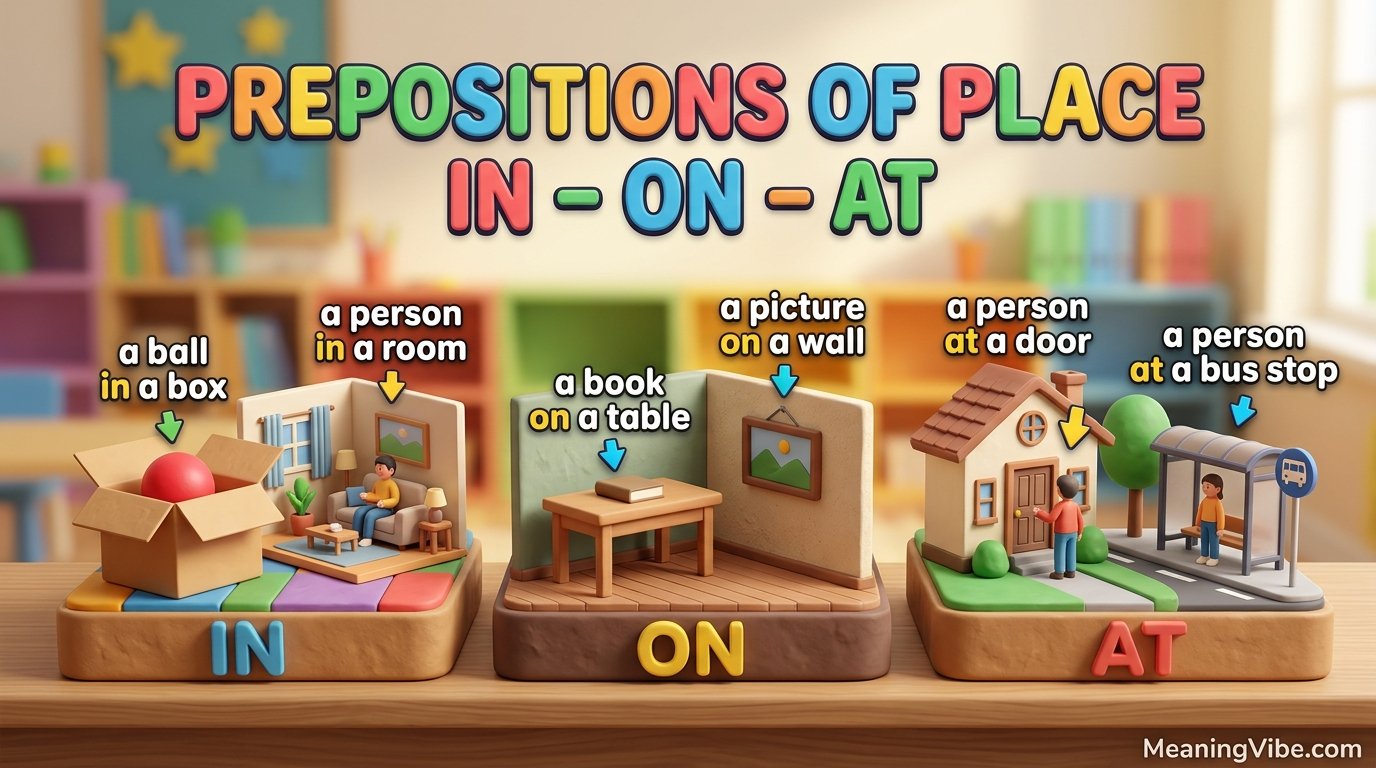
Ask one question before you choose: how big is the time or the place? A wide container takes in, a day or surface takes on, and a point takes at.
|
Job |
IN: the wide container |
ON: the day or surface |
AT: the point |
|---|---|---|---|
|
Time |
in June, in 2024, in the summer, in the morning |
on Monday, on July 4th, on my birthday, on Christmas Day |
at 7 pm, at noon, at midnight, at night |
|
Place |
in the room, in London, in France, in the car |
on the table, on the wall, on Main Street, on the second floor |
at the door, at home, at work, at the station |
|
Memory line |
If you can be inside it, use in |
If you can put it on a calendar or on a surface, use on |
If you can point at it on a clock or map, use at |
The gradient is a guide, not a law. English keeps a bank of fixed exceptions, and the honest way to learn them is to collect them openly, which the later sections do.
Keep three warning signs in mind from the start. Night breaks the pattern, some phrases take no preposition at all, and British and American English disagree on a few famous pairs.
Real sentences often stack all three in a single line, shrinking step by step. The shop opens at 9 am on Monday in June moves from a point, to a day, to a period without breaking the gradient once.
Read that sentence backwards and the ladder is just as clear. The widest frame comes last in the sentence but first in your decision: period, then day, then the exact point inside it.
Rule 1: In, On and At for Time
Time is the easier job to learn first, because the calendar gives you a clear ladder. Move from the clock to the day to the long period, and the choice makes itself.
AT for Clock Times and Precise Points
Use at when the time is a single point you could circle on a clock. Clock times, noon, midnight and mealtimes all behave as points, however long they feel.
The train leaves at 7 pm, lunch is at noon, and the film ends at midnight. Fixed point phrases join the same family: at the moment, at present, at lunchtime and at bedtime.
ON for Days and Dates
Use on when the time is one day or part of one named day. Days of the week, calendar dates and special days all count as single days on the calendar.
The meeting is on Monday, her birthday is on July 4th, and we rest on Christmas Day. A named day part works the same way: on Friday evening, on Monday morning.
IN for Periods and Parts of the Day
Use in when the time is a longer period that contains other moments inside it. Months, years, seasons, decades and centuries are containers, so they all take in.
She was born in June, the house was built in 2024, and flowers bloom in the summer. Parts of the day join the family too: in the morning, in the afternoon, in the evening.
One more in meaning matters for the future. In two hours means after two hours from now, so the bus comes in ten minutes means ten minutes from this moment.
When a Day Is Named, ON Wins
A named day pulls the whole phrase to on, even when a part of the day follows it. Morning alone takes in, but Monday morning takes on, because the day is the anchor.
Say in the morning for a general habit, and on Monday morning for one specific morning. The same logic gives on Friday afternoon and on the first day, never in Monday morning.
Rule 2: In, On and At for Place
Place runs on the same ladder as time, which is why one gradient covers both jobs. A room is a container, a table is a surface, and a door is a point.
IN for Enclosed Spaces and Areas
Use in when the place surrounds the person or thing. Rooms, boxes, cities, countries and regions are containers, and the bigger the area, the more certain the in becomes.
The keys are in the box, she lives in London, and the farm sits in the countryside. Smaller containers follow too: in the kitchen, in the water, in the garden, in a taxi.
ON for Surfaces, Lines and Floors
Use on when something touches a surface or follows a line. Tables, walls, pages, streets, coasts and borders are surfaces or lines, so contact with them takes on.
The book lies on the table, the picture hangs on the wall, and they live on Main Street. Floors of a building count as surfaces: the office is on the second floor.
AT for Points and Activity Places
Use at when the place is a point on your mental map, or a place named for its activity. A point needs no size at all, only a location you can indicate.
Meet me at the door, wait at the bus stop, and stand at the top of the stairs. Activity places form fixed phrases: at home, at work, at school, at the station, at a party.
Meaning Shifts: At the Station vs In the Station
Some buildings allow both forms, and the choice changes the meaning. At treats the building as a point for meeting or arriving, while in stresses being physically inside it.
We met at the airport can mean anywhere in the terminal area as a meeting point. We waited in the airport stresses the hours spent inside the building itself.
The same shift works for at school against in school. At school names the daily activity, while in school can stress the building, and in American English it also means enrolled and attending.
Choosing between small words is a habit across English grammar. The articles system works the same way, and the cluster guides on when to use a vs an and when to use the build that ladder separately.
Addresses: AT a Number, ON a Street, IN a City
Addresses climb the same ladder in miniature, which makes them the easiest place test of all. A house number is a point, a street is a line, and a city is a wide area.
She lives at 221 Baker Street gives the exact point on the line. Drop the number and the street itself takes on: she lives on Baker Street, inside the wider area of in London.
Memorise the ladder as one picture: at the address, on the street, in the city. It is the gradient wearing a place costume, and it settles most address questions instantly.
Rule 3: The Transport Rule, Reasoned
Transport confuses learners because the vehicles differ in size and shape. The rule is physical: picture how your body meets the vehicle, and the preposition follows the picture.
|
Vehicle type |
Preposition |
Examples |
Reason |
|---|---|---|---|
|
Large vehicles you can stand and walk in |
ON |
on the bus, on the train, on a plane, on a ship |
Treated as a platform you get on |
|
Small vehicles you sit inside |
IN |
in the car, in a taxi, in a truck cab |
Treated as a small enclosed container |
|
Vehicles you sit on top of |
ON |
on a bicycle, on a motorbike, on a horse |
Surface contact from above |
|
Method of travel in general |
BY plus noun, no article |
by car, by bus, by train, by plane |
The one exception is on foot |
Stand In It or Sit On It: ON
Buses, trains, planes and ships are platforms you step onto and walk inside. English treats that standing space like a surface, so every large public vehicle takes on.
You get on the bus, sleep on the train, and board on a plane in the travel sense. Bicycles, motorbikes and horses take on for a different reason: you sit on top of them.
Sit Inside It: IN
Cars and taxis are small containers you climb into and sit inside, with no room to stand. That enclosed feeling is exactly the container picture, so they take in.
She waited in the car, and the driver sat in a taxi outside. The verb matches the picture too: you get in a car, but you get on a bus.
BY Plus Transport, and the ON FOOT Exception
For the method of travel in general, English uses by plus the vehicle with no article. We travelled by car, by bus and by train, whatever the specific journey was.
Walking is the single famous exception to the by pattern. The fixed phrase is on foot, never by foot, and it follows the surface picture of feet meeting the ground.
Rule 4: When English Uses No Preposition at All
The fourth rule surprises learners most: sometimes the correct choice is no preposition. Time expressions beginning with last, next, this, every, each, some, any or all drop in, on and at completely.
|
Pattern |
Correct examples |
Typical error form |
|---|---|---|
|
last, next, this, every, each plus a time word |
last night, next week, this morning, every day |
on last night, in next week |
|
some, any, all plus a time word |
some day, any time, all day |
at some day, in all day |
|
yesterday, today, tomorrow, tonight |
I saw her yesterday, we leave tomorrow |
on yesterday, in tomorrow |
The logic is simple pointing. Words like last and this already fix the time exactly, so adding a preposition repeats a job that is already done.
Cambridge grammar states this zero rule as a rule, not a footnote, which is why it stands here as Rule 4. It is the single most skipped point in lessons on this topic.
The Exceptions Bank: Fixed Phrases to Learn Whole
Every system has fixed phrases that refuse to follow it, and in, on and at keep a famous set. Learn each item below as a whole phrase, with its reason attached.
Exceptions are not system failures. Most began as ordinary phrases used so often that the language froze them in place, and native speakers store them whole rather than building them from the gradient each time.
That is why the bank below gives each phrase its own reason where one exists, and honestly labels the rest as fixed. Guessing a reason for a frozen phrase only creates a new error.
1. At Night vs In the Night
The standard phrase is at night, for night in general as a time of day. Nurses work at night, and owls hunt at night, with no specific night in mind.
In the night exists with a narrower job: something happening during one particular night. The baby woke in the night means once, on that night, not as a general habit.
2. In Time vs On Time
These two phrases are both correct and mean different things, so swapping them changes your message. The contrast below is the one learners ask about most in this whole topic.
|
Phrase |
Meaning |
Example |
|---|---|---|
|
on time |
At the scheduled time, not late |
The lesson started on time at nine |
|
in time |
Early enough, before a deadline or event |
We reached the station in time to buy tickets |
A train can be on time and still leave you late if you arrive after it. You personally need to be in time, with minutes to spare before the moment passes.
3. At Christmas vs On Christmas Day
Use at Christmas for the whole holiday period, treated as one point in the year. Families gather at Christmas and travel at Easter, naming the season rather than a date.
Use on Christmas Day for the single day itself, December 25. A day is a calendar square, so the day rule wins and the phrase takes on.
4. In the End vs At the End
In the end means finally, after a long process or discussion. We argued for an hour and chose the cheaper car in the end, with the result as the focus.
At the end names the final point of something and usually needs an of phrase. Write at the end of the film, at the end of the street, at the end of the book.
5. On the Phone, On the Internet, On the Radio, On TV
Communication channels behave like services and surfaces, so they take on. You speak on the phone, read news on the internet, and hear songs on the radio and on TV.
Contrast the channel with the content container. Words printed inside a physical or text container take in: in the book, in the article, in the email, in the photo.
6. At Home, At Work, At School
These three phrases name a place by its activity, not by its walls, and they are fixed with at. She is at home, he is at work, and the children are at school.
The pattern extends to at university in British English and at college in American English. Learn the phrases whole, because in home and on work are never correct forms.
7. Arrive In vs Arrive At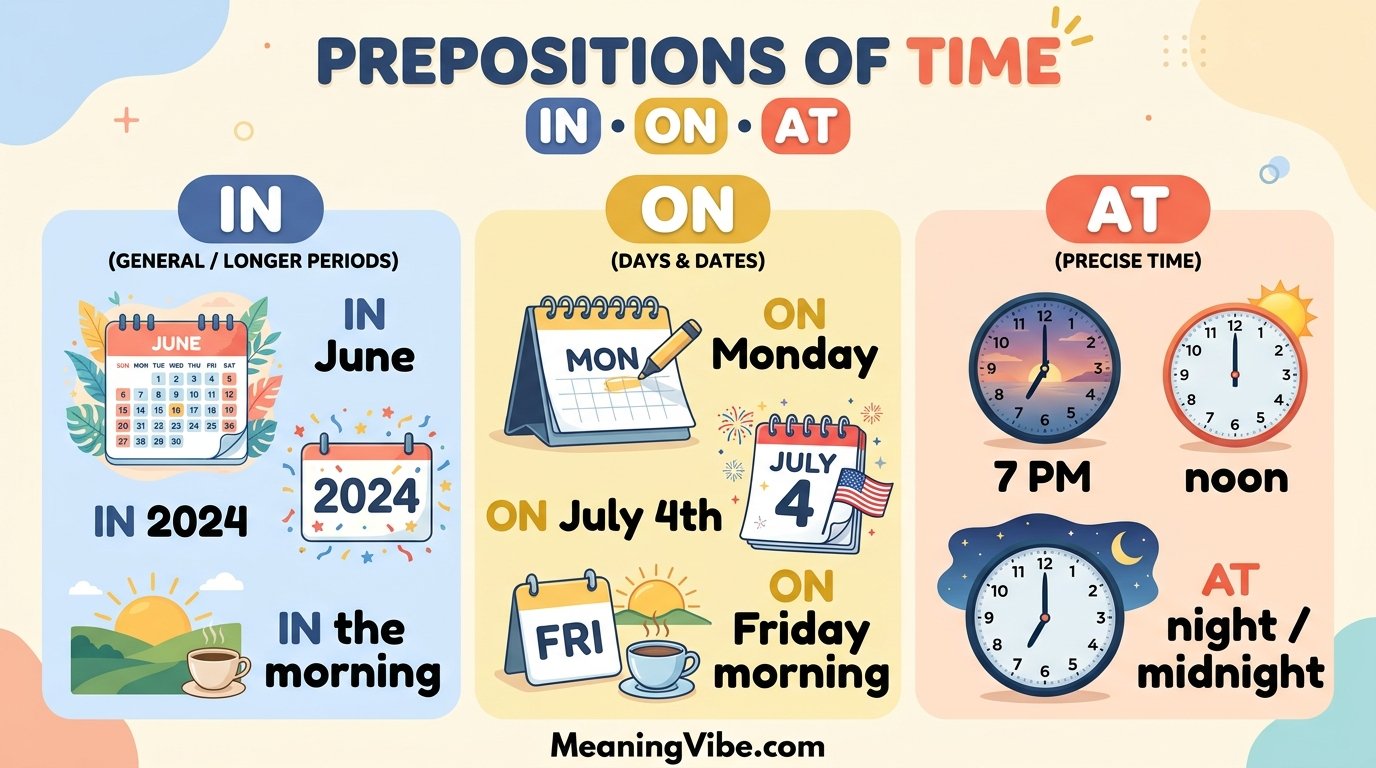
The destination size decides the preposition after arrive. Cities and countries are wide areas, so you arrive in London and arrive in France after a journey.
Buildings, stations and events are points, so you arrive at the airport and arrive at the party. One warning completes the rule: arrive to is a typical learner error, never correct with a place.
8. In Bed vs On the Bed
In bed means under the covers, resting or sleeping as an activity. He is ill in bed tells you about his state, not about furniture positions.
On the bed means on top of the covers, on the surface. The cat sleeps on the bed and the books sit on the bed, with plain surface contact.
9. In Two Hours Means After Two Hours
The future use of in catches learners who expect a duration meaning. The class ends in two hours means two hours from now, at a point two hours ahead.
Compare it with a plain duration, which takes for in fuller grammar. That boundary belongs to the planned sibling pages on since and for and during and while, not to this lesson.
US vs UK: Dialect Pairs That Are Both Correct
A few famous pairs split by dialect, and both forms are correct in their own variety. American forms lead in the table because this lesson serves a US audience first.
|
Pair |
American English (US) |
British English (UK) |
Note |
|---|---|---|---|
|
Weekend |
on the weekend, on weekends |
at the weekend, at weekends |
Neither form is an error in its own variety |
|
Hospital |
in the hospital |
in hospital (no article, for a patient) |
The UK form drops the article for patients |
|
Team |
on a team |
in a team |
Both are understood everywhere |
|
Street |
on the street |
in the street |
US on the streets alone can also mean homeless |
The teaching point is consistency, not correction. Pick the variety you are learning, use its forms throughout, and never mark the other variety wrong in an exam answer or an edit.
One floor note belongs here too. The preposition stays on in both varieties, but the US first floor is the UK ground floor, so on the first floor points to different levels.
The Decision Flow: Three Questions in Order
When a sentence stops you, run these three questions in order. Most real sentences are decided by the first question, and the exceptions bank settles the rest.
- Is it a point? A clock time, a moment, or a spot you can point at on a map takes at: at 7 pm, at noon, at the door, at the station.
- Is it a day or a surface? A calendar day, a date, or a surface you can touch takes on: on Monday, on July 4th, on the table, on the wall.
- Is it a container or a long period? A space that surrounds you, or a period that contains other moments, takes in: in the room, in June, in the morning.
Before you finish, run two checks. First, does the phrase begin with last, next, this or every, which means no preposition at all? Second, is it in the exceptions bank?
Twelve Typical Errors, Corrected
The table below collects typical learner errors, the mistakes teachers meet again and again in classwork. They are labelled as typical errors from teaching practice, never as measured statistics.
|
# |
Typical error |
Correct form |
Why |
|---|---|---|---|
|
1 |
in Monday |
on Monday |
Days take on |
|
2 |
at the morning |
in the morning |
Parts of the day take in |
|
3 |
in the bus for a journey |
on the bus |
Large vehicles you stand in take on |
|
4 |
on the car |
in the car |
Small vehicles you sit inside take in |
|
5 |
arrive to London |
arrive in London |
Arrive never takes to; cities take in |
|
6 |
on last night |
last night |
Last removes the preposition |
|
7 |
in next week |
next week |
Next removes the preposition |
|
8 |
by foot |
on foot |
Walking is the fixed exception |
|
9 |
in 7 pm |
at 7 pm |
Clock times are points and take at |
|
10 |
on June |
in June |
Months are long periods and take in |
|
11 |
at Christmas Day |
on Christmas Day |
A single named day takes on |
|
12 |
in the end of the film |
at the end of the film |
A final point takes at the end of |
Read the why column aloud as you correct each line. Naming the reason, container, surface or point, is what turns a corrected sentence into a rule you keep.
Practice: Three Exercise Sets With a Full Answer Key
Practice turns the gradient into a habit, so work through each set before opening the key. Say each finished sentence aloud, because the ear often catches what the eye misses.
The sets are graded on purpose. Set A isolates time, Set B isolates place and transport, and Set C mixes everything and asks you to correct real errors, the way sentences actually arrive.
Exercise Set A: Time
- The class starts ___ 9 am.
- Her birthday is ___ June.
- We met ___ Monday.
- He was born ___ 2010.
- The shop closes ___ midnight.
- We travel ___ the summer.
- The exam is ___ Friday morning.
- I will call you ___ two hours.
Exercise Set B: Place and Transport
- The keys are ___ the table.
- She lives ___ Chicago.
- Meet me ___ the door.
- The picture hangs ___ the wall.
- He is waiting ___ the car.
- They stood ___ the bus stop.
- The cat sleeps ___ the garden.
- Our office is ___ the second floor.
Exercise Set C: Mixed, With Two Corrections
- We arrived ___ Paris late.
- We arrived ___ the hotel at noon.
- She is talking ___ the phone now.
- The train left ___ time this morning.
- We reached home ___ time to eat together.
- We flew ___ the plane for six hours.
- Correct this sentence: I will see you in Monday.
- Correct this sentence: We met on last night.
Answer Key
|
Set |
Answers |
Reason in one line |
|---|---|---|
|
A |
1 at, 2 in, 3 on, 4 in, 5 at, 6 in, 7 on, 8 in |
Points take at, periods take in, days take on, and item 8 means after two hours |
|
B |
1 on, 2 in, 3 at, 4 on, 5 in, 6 at, 7 in, 8 on |
Surfaces take on, areas and small vehicles take in, points take at |
|
C |
1 in, 2 at, 3 on, 4 on, 5 in, 6 on |
Cities take in, buildings take at, channels take on, and the time pair splits by meaning |
|
C corrections |
7 on Monday. 8 last night, with no preposition |
Days take on, and last removes the preposition completely |
Score yourself by reason, not by answer alone. If you chose the right word for the wrong reason, reread that rule section before you move to the next lesson.
How These Rules Were Checked
Every rule in this lesson was checked against standard references for English grammar. The aim was agreement between authorities, not the habits of any single website or textbook.
The time rules and the at night contrast follow the British Council LearnEnglish lesson on prepositions of time, which teaches the same clock, day and period ladder for learners.
The zero preposition rule follows Cambridge Dictionary’s grammar note on time expressions without at, on, in, which lists the last, next, this and every pattern explicitly.
The American English framing follows the Purdue OWL guide to prepositions of time, place and introducing objects, a university writing resource written for multilingual writers.
Where the authorities describe both dialect forms, this lesson prints both and labels them. No rule here depends on a single source, and no statistic has been invented to support one.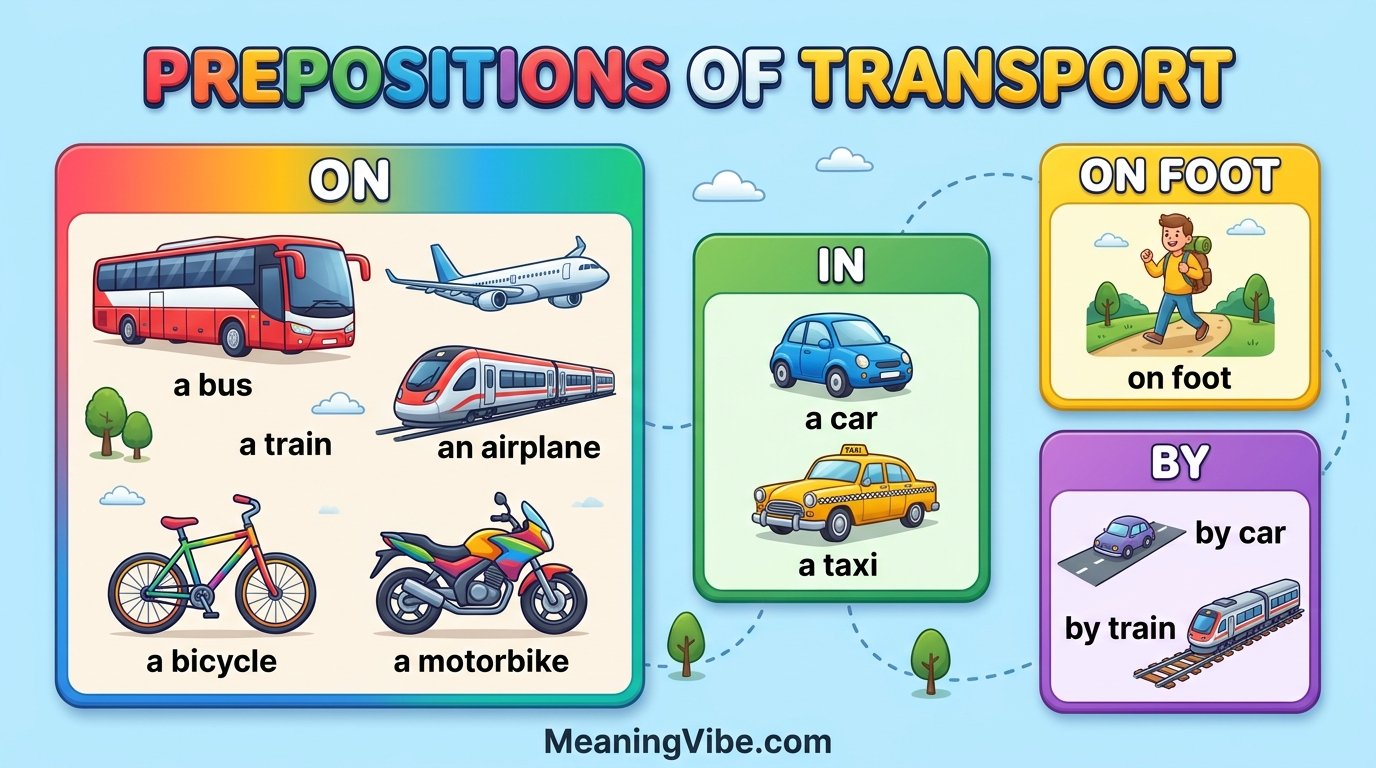
Frequently Asked Questions
Do we say in the morning or on the morning?
In the morning is correct for a general part of the day. On takes over when a specific morning is named by its day: on Monday morning, on Friday morning.
Is it at night or in the night?
At night is the standard fixed phrase for night in general. In the night exists with a narrower meaning, during one particular night, and is far less common in learner English.
Why is it in the morning but at night?
Morning, afternoon and evening behave as longer periods and take in. Night is treated as a point in the fixed phrase at night, so learn it as a whole phrase.
Do we say on the bus or in the bus?
On the bus for travel, because a bus is a vehicle you can stand and walk in. In the bus can describe physical inside position in rare contexts, but the travel phrase is on.
Why is it in the car but on the bus?
Cars and taxis are small vehicles you sit inside and cannot stand in, so they take in. Buses, trains, planes and ships are large enough to stand in, so they take on.
Is it at the weekend or on the weekend?
Both, by dialect. At the weekend is British English, and on the weekend is American English. Neither form is an error inside its own variety of English.
Do we say in time or on time?
They mean different things. On time means at the scheduled time, not late. In time means early enough, before a deadline or before something important happens.
What is the difference between in the end and at the end?
In the end means finally, after a long process. At the end means at the final point of something: at the end of the film, at the end of the street.
Is it at Christmas or on Christmas Day?
At Christmas for the holiday period in general. On Christmas Day for the single day, December 25, because days and dates always take on.
Do we say arrive in or arrive at?
Arrive in for cities and countries: arrive in London, arrive in France. Arrive at for buildings, stations and events: arrive at the airport, arrive at the party. Never arrive to.
Is it in a team or on a team?
It is a dialect strand. On a team is the usual American form, and in a team is common in British English. Both forms are understood everywhere English is spoken.
Is it in hospital or in the hospital?
Another dialect strand. In hospital, with no article, is British English for being a patient. In the hospital is the usual American form for a patient or a visitor.
Do we use a preposition before yesterday and tomorrow?
No. Yesterday, today and tomorrow take no in, on or at at all. Say I saw her yesterday, never on yesterday, however logical the extra word may feel.
Do we use in, on or at before last and next?
No. Time expressions beginning with last, next, this, every, each, some, any and all normally take no preposition: last night, next week, this morning, every day.
What does in two hours mean?
It means after two hours from now. The train leaves in two hours places the departure two hours ahead of the present moment, not during a two hour period.
Is it on the phone or in the phone?
On the phone. Phone, internet, radio and television as media and communication channels take on: on the phone, on the internet, on the radio, on TV.
Do we say in bed or on the bed?
In bed usually means under the covers, resting or sleeping. On the bed means on top of the covers, on the surface: the books are on the bed.
Is it at home or in home?
At home. Home in this phrase behaves as a point or activity place, and at home, at work and at school are fixed expressions to learn whole.
On Monday morning or in Monday morning?
On Monday morning. When a day name is added, the whole phrase takes on, even though morning alone takes in. The named day always anchors the phrase.
Do we say in July 4th or on July 4th?
On July 4th, because a date is a single day. Use in July alone for the month, because a month is a longer period that contains many days.
At 7 pm, on 7 pm or in 7 pm?
At 7 pm. Clock times are precise points on the clock face, and points always take at, at every level of English from beginner to advanced.
Is it in the summer or at summer?
In the summer, or in summer. Seasons are longer periods that contain weeks and months inside them, so they take in like months and years do.
Do we say on the train or in the train?
On the train for travel. The stand and walk rule applies to trains, planes, buses and ships alike, because passengers can stand and move inside them.
What about bicycles and motorbikes?
On. You sit on top of a bicycle, motorbike or horse, so they take on: on a bike, on a horse. The choice follows the surface idea of the gradient.
Is it by car or in car for travel method?
By car for the method of travel, with no article: travel by car, by bus, by train. The one famous exception to the by pattern is on foot.
Why is it on foot, not by foot?
On foot is a fixed exception. Transport methods use by plus a noun with no article, but walking keeps the older surface phrase on foot.
Do we say in the street or on the street?
A dialect strand. In the street is common in British English. On the street is common in American English, where it can also mean homeless in a separate idiom.
At the top or on the top?
At the top and at the bottom for positions and page positions: at the top of the page. On top of describes physical surface contact: the box on top of the shelf.
In the photo or on the photo?
In the photo for what the picture shows: three people in the photo. On can appear for something physically resting on the printed surface, which is rare.
At school or in school?
At school treats school as an activity place: the children are at school. In school can stress inside the building, and in American English it also means enrolled and attending.
Do we say in the evening on Friday?
Split the phrases. A day plus a part of the day takes on: on Friday evening. Evening alone takes in: in the evening. The named day anchors the whole phrase.
Is it at noon or in noon?
At noon. Noon, midday and midnight are precise points on the clock, and precise points always take at. There is no in noon in standard English.
On Christmas Eve or at Christmas Eve?
On Christmas Eve, because Eve here names a specific day. Compare at Christmas for the whole holiday period, which is treated as one point in the year.
In 2024 or on 2024?
In 2024. Years, decades and centuries are longer periods that contain months and days inside them: in 2024, in the 1990s, in the 21st century.
Do weekends take on in American English for repeated weekends?
Yes. On weekends is a common American pattern for repeated weekends. British English often uses at weekends. Label the dialect clearly and stay consistent in your own writing.
At present or in present?
At present, meaning now. It pairs with at the moment as a fixed point expression, and both belong with the clock point family of at.
Can we say in the night for last night events?
Yes, with care. In the night can describe something happening during one specific night: I woke up in the night. For the general time of day, at night is the form to learn first.
Is it on the first floor the same in the US and UK?
The preposition is on in both varieties. The floor naming differs, though: the US first floor is the UK ground floor. It is a dialect note, not a preposition change.
Do we say in the queue or on the queue?
In the queue in British English, in line in American English. On the list is a different phrase: a name written on a surface or list takes on.
At the airport or in the airport?
At the airport treats it as a point or meeting place. In the airport stresses inside the building itself. Both exist, and the point use is the default for meeting and arriving.
Why do we say on the internet but in the book?
Media channels take on: on the internet, on the website, on the radio. Content inside a physical or text container takes in: in the book, in the article, in the email.
How do I choose in, on or at quickly?
Ask one question: how big is it? A wide container or long period takes in, a day or surface takes on, and a point or clock time takes at. Then check the exceptions bank.
Conclusion
Prepositions in on at rules stop feeling random once the gradient is in place. Ask how big the time or place is, and the answer is in for containers and long periods, on for days and surfaces, at for points.
The system earns its keep when you add the finishing layers: the transport picture, the zero preposition rule, the dialect pairs, and the exceptions bank learned as whole phrases.
Keep practising with the exercise sets above until the reasons come automatically. The three sets and the gradient table also form a printable practice pack, so save or print this page and use it as your revision sheet.
Grammar grows in clusters on MeaningVibe, one system at a time. Natural next steps are the reported speech rules with their reported speech examples, the direct speech vs indirect speech comparison, and the conditional family: third conditional sentences, zero conditional sentences and mixed conditional sentences.