

Third conditional sentences rebuild a past that never happened: If I had left earlier, I would have caught the train. The speaker did not leave earlier, and did not catch the train, and the whole structure exists to hold those two facts at once.
The formula is one line, given in full below. The real work is the decisions around it: which modal belongs in the result, what a negative clause actually says about reality, and where the third conditional ends and the mixed conditional begins.
The centre of the page is a classified bank of 100 sentences in eleven sections, each sentence chosen to teach one decision. It completes the conditional set on MeaningVibe beside the live First Conditional Sentences and Second Conditional Sentences pages.
What a Third Conditional Sentence Is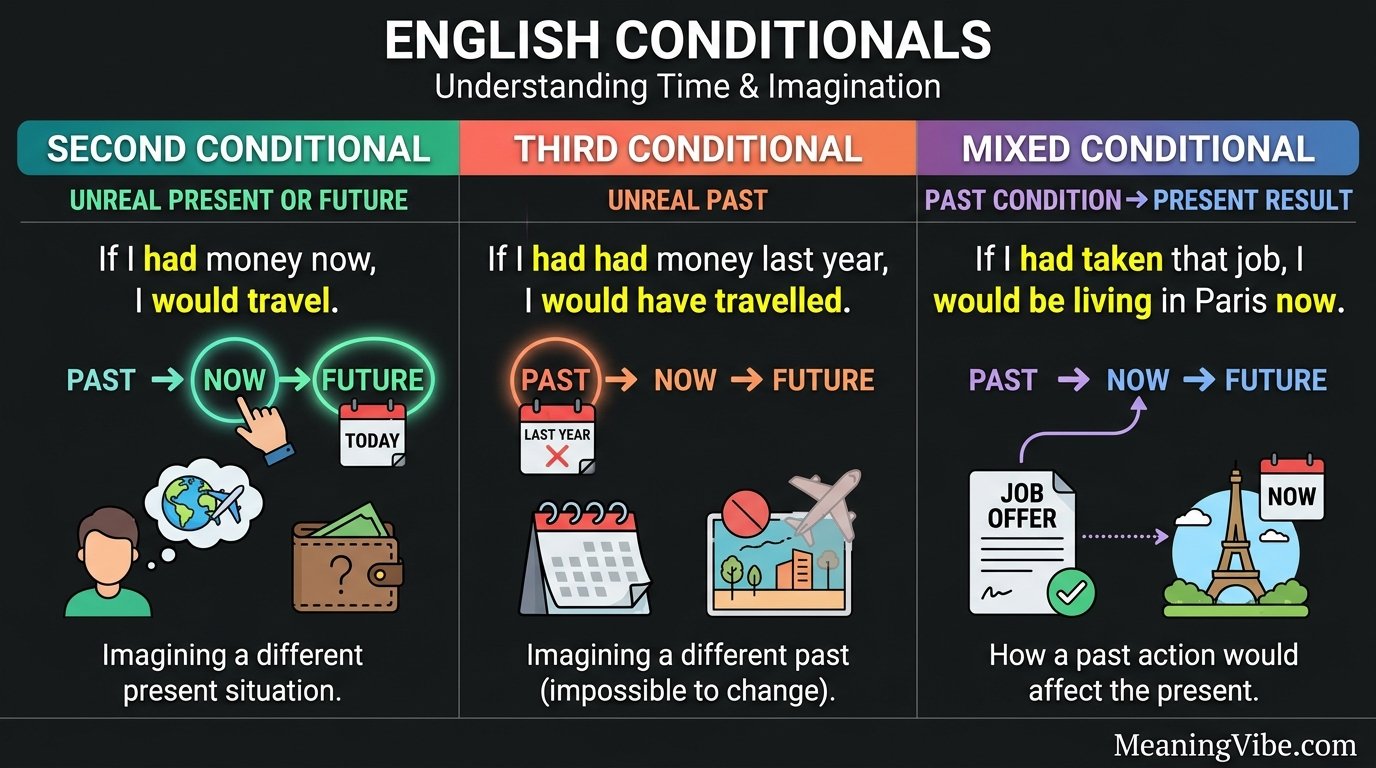
A third conditional sentence imagines a different past. The if clause names a past condition that did not happen, and the main clause names the past result that therefore did not happen either.
It is the grammar of regret, criticism, missed chances and alternative history. A speaker looks back at a finished situation, changes one piece of it in imagination, and states the result that would have followed.
Both halves are unreal, and both halves are past. That double condition is the definition, and every test on this page, the reality check, the modal scale and the now test, is a way of enforcing one half of it.
The Formula and the Two Clauses
|
Clause |
Form |
Example piece |
|---|---|---|
|
If clause (condition) |
if + subject + had + past participle |
If she had studied |
|
Main clause (result) |
subject + would have + past participle |
she would have passed |
The past perfect form, had plus the past participle, is the same for every subject. Learners who need the form itself should work through the Past Perfect Tense Rules page first, because the third conditional borrows that machinery whole.
The clauses can change places without changing the meaning: I would have helped if I had known. The comma follows the order: a comma after a leading if clause, and no comma when the main clause leads.
Teaching sites state the same skeleton. The Perfect English Grammar third conditional lesson and the Cambridge Dictionary grammar entry on conditionals and wishes both give if plus past perfect with would have plus participle, and both are worth reading beside the bank below.
The Reality Check: What Actually Happened
Run this test on any candidate sentence: state what actually happened. In a true third conditional, reality is the opposite of both clauses. If I had known, I would have helped means I did not know, and I did not help.
A negative clause flips only its own half. If she hadn’t studied, she wouldn’t have passed means she did study and she did pass, because the unreal version is the one where she did not. Reading negatives backwards is the skill this conditional most demands.
In stories, the past perfect orders two real past events, one earlier than the other. In the third conditional it does a different job: it marks unreality, not earliness. If I had known never means that I knew earlier.
100 Third Conditional Sentences
The bank prints 100 classified items in eleven sections, sorted by the decision each group teaches. The largest classified competitor bank, the EnglishFinders third conditional page, prints 50 sentences in five groups; this bank doubles it and sorts by job as well as by form.
Section A: Core Affirmative Sentences (14)
- If I had left earlier, I would have caught the train.
- If she had studied harder, she would have passed the exam.
- If we had booked the tickets earlier, we would have gotten better seats.
- If you had told me about the problem, I would have helped.
- If they had taken a map, they would have found the hotel easily.
- If he had driven more slowly, he would have avoided the accident.
- If I had saved more money, I would have bought the house.
- If the team had scored in the final minute, it would have won the match.
- If she had accepted the job, she would have moved to Chicago.
- If we had checked the weather, we would have packed warmer clothes.
- If the train had arrived on time, we would have reached the office by nine.
- If I had known your address, I would have sent the invitation.
- If they had invested in the company, they would have made a profit.
- If he had worn a coat, he would have stayed warm.
Section B: Negative If Clause (10)
- If I hadn’t forgotten my keys, I would have entered the house.
- If she hadn’t missed the bus, she would have arrived on time.
- If they hadn’t been late, they would have caught the train.
- If he hadn’t lost his passport, he would have boarded the flight.
- If we hadn’t taken the wrong road, we would have arrived by noon.
- If the shop hadn’t closed early, we would have bought the gift.
- If she hadn’t broken her leg, she would have played in the final.
- If I hadn’t spent all my money, I would have joined the trip.
- If the computer hadn’t crashed, we would have finished the report.
- If he hadn’t overslept, he would have attended the meeting.
Section C: Negative Main Clause (10)
- If I had left earlier, I wouldn’t have missed the flight.
- If she had taken the medicine, she wouldn’t have felt so ill.
- If we had locked the door, the thief wouldn’t have entered.
- If you had reminded me, I wouldn’t have forgotten the meeting.
- If they had watered the plants, the plants wouldn’t have died.
- If he had read the instructions, he wouldn’t have made that mistake.
- If I had brought an umbrella, I wouldn’t have gotten wet.
- If the driver had seen the sign, he wouldn’t have taken the wrong exit.
- If she had saved the file, she wouldn’t have lost the work.
- If we had eaten at home, we wouldn’t have spent so much money.
Section D: Both Clauses Negative (6)
- If I hadn’t met you at college, I wouldn’t have started this business.
- If they hadn’t trained every day, they wouldn’t have won the championship.
- If he hadn’t apologized, she wouldn’t have forgiven him.
- If we hadn’t reserved a table, we wouldn’t have gotten a seat.
- If the pilot hadn’t reacted quickly, the plane wouldn’t have landed safely.
- If she hadn’t practiced the piano daily, she wouldn’t have passed the audition.
Section E: Questions (8)
- Would you have helped if I had asked?
- What would you have done if you had won the lottery last year?
- Would she have passed if she had studied harder?
- If the flight had been cancelled, where would you have stayed?
- Would they have won if their best player had played?
- How would your life have been different if you had been born in another country?
- Would he have apologized if you had confronted him?
- If you had known the truth, would you have acted differently?
Section F: Could Have, Possibility and Ability (10)
- If we had booked earlier, we could have gotten cheaper tickets.
- If he had applied on time, he could have received the scholarship.
- If I had spoken French, I could have translated the letter.
- If they had left at dawn, they could have reached the coast by noon.
- If she had saved her wages, she could have afforded the course.
- If the weather had been better, we could have climbed the mountain.
- If you had asked politely, I could have lent you the car.
- If the library had been open, we could have finished the research.
- If he had trained properly, he could have run the marathon.
- If we had known about the sale, we could have bought the equipment at a discount.
Section G: Might Have, Uncertain Results (8)
- If he had trained more, he might have won the race.
- If she had taken the course, she might have found a better job.
- If I had invested in that stock, I might have lost everything.
- If they had driven through the storm, they might have had an accident.
- If we had chosen the other route, we might have arrived sooner.
- If he had accepted the offer, he might have regretted it.
- If the medicine had worked faster, she might have recovered sooner.
- If you had been there, you might have changed his mind.
Section H: Should Have, Expected Results (6)
- If you had followed the instructions, you should have finished by noon.
- If the package had been sent on Monday, it should have arrived by Friday.
- If she had studied the map, she should have found the street easily.
- If they had watered the garden, the flowers should have survived.
- If he had taken the earlier train, he should have been home by dinner.
- If we had left the motorway at exit five, we should have reached the village directly.
Section I: Regret and Criticism (12)
- If I had listened to my parents, I would have chosen a different school.
- If I had started saving in my twenties, I would have retired earlier.
- If I had learned to swim as a child, I would have felt safe on the boat.
- If I had spoken up in the meeting, my manager would have noticed my ideas.
- If I had visited my grandmother more often, I would have heard more of her stories.
- If I had checked the departure time, I wouldn’t have missed the train.
- If you had listened, you wouldn’t have made that mistake.
- If you had sent the file on Friday, we could have reviewed it before the meeting.
- If he had been more careful, he wouldn’t have broken the machine.
- If they had maintained the roof, the rain wouldn’t have damaged the ceiling.
- If you had woken me, I would have caught the early bus.
- If the company had tested the product properly, customers wouldn’t have complained.
Section J: Same Event Pairs (6 Pairs, 12 Sentences)
One event, told two ways. The pair forces the time decision that a rule can only describe.
Money, second vs third.
- If I had more money now, I would travel the world.
- If I had had more money last year, I would have traveled the world.
Study, second vs third.
- If she studied harder, she would pass the exam next month.
- If she had studied harder, she would have passed the exam last month.
A job, third vs mixed.
- If I had taken that job, I would have moved to Paris in 2019.
- If I had taken that job, I would be living in Paris now.
Medicine, third vs mixed.
- If I had studied medicine, I would have become a doctor by 2020.
- If I had studied medicine, I would be a doctor now.
A phone call, second vs third.
- If you called me tonight, I would come.
- If you had called me last night, I would have come.
Courage, third vs mixed.
- If I had been braver that day, I would have spoken up.
- If I were braver, I would have spoken up that day.
Section K: Advanced Forms (10)
The last ten sentences carry the advanced machinery: inversion without if, the double form had had, the passive, the continuous forms, and the but for pattern that names a condition with no if clause at all. The EngQuiz third conditional page drills the inversion pattern in quiz form.
- Had I known about the delay, I would have left later.
- Had she arrived five minutes earlier, she would have seen the whole show.
- Had they invested wisely, they would have doubled their money.
- If I had had more time, I would have helped you.
- If she had had the documents, she would have signed the contract.
- If the warning had been given, the accident would have been avoided.
- If the bridge had been repaired, it would have been opened in spring.
- If she had been listening, she would have heard the announcement.
- If I had known you were coming, I would have been waiting at the gate.
- But for your help, I would have failed the course.
The Modal Scale: Would Have, Could Have, Might Have, Should Have
The if clause never changes. The result clause is a dial, and the modal you choose sets how certain the imagined result is inside the imagined world.
|
Modal result |
Strength |
Use it when |
|---|---|---|
|
Would have + participle |
Certain inside the imagined world |
The result follows automatically from the condition |
|
Could have + participle |
Possible, or within someone’s ability |
The chance or the ability existed, nothing more |
|
Might have + participle |
Genuinely doubtful |
Even in the imagined world, it may not have happened |
|
Should have + participle |
Expected or advisable |
The result was the reasonable or correct outcome |
One fence to respect: should have also works alone as a reproach, You should have called, with no if clause anywhere. That pattern is a close relative of this conditional, not an instance of it.
Negatives and the Reality Flip
Negation can sit in the if clause, in the main clause, or in both, and Sections B, C and D of the bank separate the three positions on purpose. Each negative reverses the reality of its own clause and leaves the other clause untouched.
The double negative case, Section D, is where readers most often misread. If I hadn’t met you, I wouldn’t have started this business reports a real meeting and a real business: both unreal halves are negative, so both real halves are positive.
A practical habit: before answering questions about a third conditional, write the real past in one plain sentence. Ten seconds of reality checking prevents the most common comprehension error in this topic.
Questions, Contractions and Inversion
Questions invert would and the subject in the main clause: Would you have helped if I had asked? The if clause keeps statement order, and the pattern What would you have done if invites the listener to rebuild their own past.
Speech contracts this grammar hard, and the contraction ‘d is ambiguous by design. In If I’d known, I’d have helped, the first ‘d is had and the second is would. Expanding both on sight is the decoding skill listening tests examine.
|
Written form |
Spoken form |
Where it belongs |
|---|---|---|
|
If I had known |
If I‘d known |
If clause only |
|
I would have helped |
I‘d have helped |
Main clause only |
|
I would have helped (relaxed) |
I‘d’ve helped |
Speech only, never exams |
Inversion is the formal alternative: drop if, move had to the front. Had I known, I would have helped. Never combine the two systems in one clause; If had I known is a recognised error, and error spotting items use it.
Third vs Second, Third vs Mixed: The Border Decisions
Against the second conditional, the decision is time. The second imagines an unreal present or future with past simple plus would, as the Second Conditional Sentences page sets out; the third imagines an unreal past with past perfect plus would have. Section J prints the same events in both, because the contrast only becomes visible side by side.
The past simple half of that contrast is worth a refresher for many learners, and the Past Simple Tense Rules page covers the form that the second conditional borrows and the third conditional must not use.
Against the mixed conditional, use the now test. If the result clause carries a present marker, now, today, still, the sentence is mixed, whatever its if clause looks like: If I had taken that job, I would be living in Paris now. A pure third conditional keeps its result in the past: I would have moved to Paris in 2019.
The mixed conditional page is the next build in this cluster and is named here in text only until it exists. The border matters now because exam items live on it: telling third from mixed by the time of the result is a standard B2 discrimination task.
The Error Gallery: 6 Errors, 2 Competitor Defects, 3 False Alarms
|
# |
Item |
Verdict |
Correction or note |
|---|---|---|---|
|
1 |
If I would have known, I would have come |
Learner error (in writing and exams) |
If I had known; would have belongs in the result clause only. The form is heard in informal American speech, which is why learners meet it, but no exam accepts it |
|
2 |
I would of helped |
Learner error, always |
Would have; of is a spelling of the sound of ‘ve, never the grammar |
|
3 |
If I studied harder, I would have passed |
Learner error |
Past simple makes the condition present; the third conditional needs had studied |
|
4 |
If I had known, I would told you |
Learner error |
The main clause needs all three pieces: would have told |
|
5 |
If I had went home |
Learner error |
Participle, not past simple: had gone |
|
6 |
If I had have known |
Learner error |
One auxiliary only: had known. Protect had had, reject had have |
|
7 |
A major dictionary site files Pearl wouldn’t have made that comment if she knew her brother was listening among third conditional examples |
Competitor defect |
That sentence is mixed (past simple condition, would have result), not third |
|
8 |
A university course chapter prints If I had married earlier, I could have had 4 children by now as a third conditional model |
Competitor defect |
By now makes the result present; a border case, not a model |
|
9 |
If I had had more time |
False alarm, correct |
The first had is the auxiliary, the second is the participle of have |
|
10 |
Had I known, I would have helped |
False alarm, correct |
Inversion is the formal if free form, not a mistake |
|
11 |
If I’d known, I’d’ve come |
False alarm, correct in speech |
A real double contraction; keep it out of formal writing and exams |
The same backshift machinery that powers this page also drives reported regrets, and the Reported Speech Rules and Reported Speech Examples pages show had forms doing their narrative job, the useful contrast to the unreal job they do here.
Frequently Asked Questions
What is a third conditional sentence?
A sentence that imagines a different past: an if clause in the past perfect names a condition that did not happen, and a main clause with would have plus the past participle names the result that therefore did not happen either. If I had left earlier, I would have caught the train means I did not leave earlier and I did not catch it.
What is the third conditional formula?
If plus past perfect, comma, would have plus past participle. The if clause is had plus the past participle for every subject, with no change for I, she or they. The main clause is would have plus the past participle, and would can be swapped for could, might or should when the meaning changes.
Why does the if clause use the past perfect?
Because the past perfect is the form English uses to push a past event one step further back, and the third conditional uses that extra step to mark the event as unreal. The condition is not earlier than another past event in a story; it is a past that never occurred at all.
Does the past perfect in a third conditional mean the event happened earlier?
No, and this is the point most pages never separate. In narrative, the past perfect orders two real past events. In the third conditional it does a different job: it signals unreality. If I had known does not mean I knew earlier; it means I did not know.
What is the third conditional used for?
Four jobs dominate: regret about your own past (If I had saved, I would have bought it), criticism of someone else’s past action (If you had called, I would have come), missed opportunities, and neutral speculation about how history or a day might have gone differently.
Can you give a third conditional example with its reality check?
If she had studied harder, she would have passed the exam. Reality check: she did not study harder, and she did not pass. Every true third conditional survives this test: state what actually happened and it is the opposite of both clauses, unless a negative clause flips one side.
What is the difference between the second and third conditional?
Time and reality. The second conditional imagines an unreal present or future: If I had money now, I would travel. The third imagines an unreal past: If I had had money then, I would have traveled. The verb forms follow the time: past simple plus would for now, past perfect plus would have for then.
What is the difference between the third conditional and a mixed conditional?
A third conditional keeps both halves in the past: If I had taken that job, I would have moved to Paris (then). A mixed conditional lets a past condition produce a present result: If I had taken that job, I would be living in Paris now. The word now is the tell.
Can I use could have instead of would have?
Yes. Could have plus the past participle makes the result a possibility or an ability rather than a certainty: If we had booked earlier, we could have gotten cheaper tickets. The if clause does not change; only the strength of the imagined result changes.
What is the difference between would have, could have and might have?
Would have states the imagined result as certain inside the imagined world. Could have states it was possible or within someone’s ability. Might have states it was only a possibility, with real doubt attached: If he had trained more, he might have won, but nobody is sure.
When do we use should have in a third conditional?
Should have plus the past participle marks the expected or advisable result: If you had followed the instructions, you should have finished by noon. Handle with care, because should have also works alone as a reproach (You should have called), which is a related but separate pattern.
Is If I would have known correct?
In standard written English and in every exam, no: the if clause takes the past perfect, If I had known. Honest labelling matters, though. Several teaching sources note that would have in the if clause is heard in informal American speech. It is a speech strand, never a form to write in a test or a formal text.
Why is would of always wrong?
Because the word is have, contracted to ‘ve in would’ve, and ‘ve sounds like of in fast speech. The spelling follows the sound, but the grammar is have: would have, could have, might have, should have. Of is a preposition and can never do this job.
Is had had correct in a third conditional?
Yes, and deleting it is itself an error. When the main verb is have, its past participle is had, so the past perfect is had had: If I had had more time, I would have helped. The first had is the auxiliary, the second is the participle, and the sentence needs both.
How do I make a negative third conditional?
Put not after had in the if clause (hadn’t plus participle), after would in the main clause (wouldn’t have plus participle), or in both. Each negative flips the reality of its own clause only, which is why negatives are where learners most need the reality check.
What does If she hadn’t studied, she wouldn’t have passed actually mean?
The opposite of what the words seem to say at first glance: she did study, and she did pass. A negative if clause describes something that did happen, because the unreal version is the one where it did not. Reading the reality correctly matters more than forming the sentence.
How do I ask a question in the third conditional?
Invert would and the subject in the main clause: Would you have helped if I had asked? The if clause keeps statement order and the past perfect. A very common pattern asks about the listener’s alternative past: What would you have done if you had been there?
Can the two clauses change places?
Yes, with no change in meaning: I would have helped if I had known. The comma follows the order, not the grammar. When the if clause comes first, a comma separates the clauses; when the main clause comes first, no comma is used before if.
What is third conditional inversion?
A formal pattern that drops if and moves had to the front: Had I known, I would have helped. Had she arrived earlier, she would have seen it. It belongs to formal writing, speeches and exams at higher levels, and it means exactly the same as the if version.
Can I use if and inversion in the same clause?
No. If and inverted had do the same job, introducing the condition, so a clause takes one or the other, never both. If had I known is a recognised learner error, and it appears in exam error spotting items precisely because it looks plausible.
What does ‘d mean in If I’d known, I’d have helped?
Two different words wearing one contraction. The first ‘d is had, inside the if clause. The second ‘d is would, inside the main clause. Expanding both on sight is the decoding skill this conditional demands in listening and reading, because the whole tense system hides inside that one letter.
Is I’d’ve an acceptable form?
I’d’ve is a double contraction heard constantly in relaxed speech: If I’d known, I’d’ve come. It is real spoken English and useful for listening. In writing, use I’d have or I would have, because most style guides and all exams treat the double contraction as too informal for the page.
How is the third conditional connected to wish and if only?
They share the same unreal past machinery. Wish plus the past perfect and if only plus the past perfect express regret about the same territory: I wish I had studied; If only I had studied. The third conditional then adds the result clause that wish leaves unspoken.
Can I use unless in a third conditional?
Yes. Unless means if not, and it works in the if clause position: I would have missed the flight unless you had woken me, more naturally written as I would have missed the flight if you hadn’t woken me. Unless cannot replace if in every position, so the if not version is the safer default for learners.
What does but for mean in a conditional sentence?
But for is a formal way of naming the condition without an if clause: But for your help, I would have failed means if it had not been for your help. Without works the same way: Without the map, we would have got lost. Both are recognition essentials for reading formal English.
Is the third conditional only about the past?
Yes, completely. Both the condition and the result sit in a finished past that cannot be changed. The moment the result moves into the present, the sentence has become a mixed conditional, and the moment the condition moves into the present, it has become a second conditional.
Why is If I studied harder, I would have passed wrong as a third conditional?
Because the two halves disagree about time. Studied is a past simple, which belongs to the second conditional’s unreal present, while would have passed is a past result. Match them: If I had studied harder, I would have passed (past event), or If I studied harder, I would pass (present habit).
Is gotten or got correct in American third conditionals?
Gotten is the standard American past participle of get: If we had booked earlier, we could have gotten cheaper seats is normal American English. British English uses got in the same slot. Neither is an error; they are dialect participles, and mixing them inside one text is the only real fault.
Can a third conditional be passive or continuous?
Yes, at advanced level. Passive: If the warning had been given, the accident would have been avoided. Continuous: If she had been listening, she would have heard the announcement, and If I had known, I would have been waiting at the gate. The skeleton never changes: had in the if clause, would have in the result.
Is the third conditional B1 or B2?
Sources split, so the honest answer is a strand. British Council’s teen course files it under B1 to B2 grammar, and some test sites label it B1, while Cambridge oriented sources place confident use at B2 First. The workable summary: introduced at B1, expected to be produced accurately at B2.
What are the most common third conditional mistakes?
Six recur: would have inside the if clause; would of written for would have; past simple instead of past perfect in the if clause; have dropped from the main clause (I would told you); a wrong participle such as had went; and had have stacked together. Each has a different cause, so each needs its own correction.
Is If I had have known ever correct?
No. Had have stacks two auxiliaries where the structure needs had plus a participle: If I had known. The form is heard in some spoken varieties, which is why learners meet it, but it is nonstandard in writing and marked wrong in exams. The correct double form to protect is had had, not had have.
Does the third conditional use were like the second conditional does?
Not in its own if clause, which takes had been: If I had been there. Were belongs to the second conditional (If I were you) and to the present condition half of a rarer mixed pattern (If I were braver, I would have spoken up). Finding were plus would have in one sentence is a sign the sentence is mixed, not third.
How do I use the third conditional to criticise politely?
Keep the condition factual and the result helpful: If you had sent the file on Friday, we could have reviewed it before the meeting. The grammar carries the criticism, so the words can stay neutral. Adding might have instead of would have softens it further, because the result becomes a possibility rather than a certainty.
What is the difference between If I had known and I had known in reported speech?
They look alike and do different jobs. Inside a third conditional, had known is unreal: I did not know. Inside reported speech or narration, had known can be a real earlier past: She said she had known him for years. Context, and the presence of a would have result clause, tells them apart.
How many third conditional examples should a learner study?
Enough to meet every pattern, not just the affirmative template. A classified bank of around 100, covering negatives in each clause, questions, the three modal swaps, inversion, had had, and same event pairs against the second and mixed types, gives a learner the full map. Ten near identical affirmative sentences give only the illusion of coverage.
Can the third conditional appear without the word if?
Yes, three ways: inversion (Had I known), but for (But for the rain, we would have walked), and without (Without your call, I would have missed it). All three still carry a past perfect or its equivalent in meaning, and all three belong to formal or careful English.
Why do native speakers contract third conditionals so heavily?
Because the full forms are long and the pattern is frequent in speech: If I’d known, I’d’ve told you compresses seven words of grammar into four syllables. Learners do not need to produce the heaviest contractions, but they must be able to hear them, because the ‘d forms are where listening tests hide this grammar.
Is should have been able to a third conditional result?
It can be: If I had left earlier, I should have been able to catch the train stacks should have on the able to pattern. It is correct but heavy, and could have caught says the same thing more cleanly. Advanced learners should recognise the stack and prefer the lighter modal in their own writing.
What is a same event pair and why does it teach faster than rules?
One event told in two conditionals: If you had called me (yesterday, you didn’t), I would have come versus If you called me (generally, you don’t), I would come. Placing the pair side by side forces the time decision that the rule only describes, and learners who sort pairs correctly rarely misform the single sentences afterwards.
How is the third conditional tested in exams?
By gap fills on both clauses, sentence transformations from second to third and back, error spotting on the six classic mistakes, and mixed conditional discrimination items where now or then decides the type. Cambridge B2 First and IELTS oriented materials both treat the would have in the if clause error as a standard distractor.
What is the fastest way to check my own third conditional sentence?
Run the reality test. Say what actually happened in one plain sentence. If the real past is the opposite of both your clauses, allowing for negative flips, and your if clause carries had plus a participle while your result carries would have plus a participle, the sentence is a sound third conditional.
Conclusion
Third conditional sentences are one formula wrapped around three decisions: read the reality correctly, set the modal dial honestly, and keep the result in the past where it belongs. The 100 sentence bank above practises all three. Master the reality check and this structure stops being the hardest conditional and becomes the most expressive one, the grammar English keeps for the past it wishes it could rewrite.