
Prepositions by with rules confuse learners because by and with can sit in the same sentence slot and both look correct. They never do the same job: by names who did it, or the method that carried it, and with names what was used, held or brought along.
Ask two questions about the words after the gap, and the choice makes itself. Who did it, or what method or channel carried it? Or what was in the hand, in the cup, or beside the person?
The lesson builds one system: the hand test, the by jobs, the with jobs, the passive connection, the overlap zone where both forms live, and the error bank.
Quick Answer: The Hand Test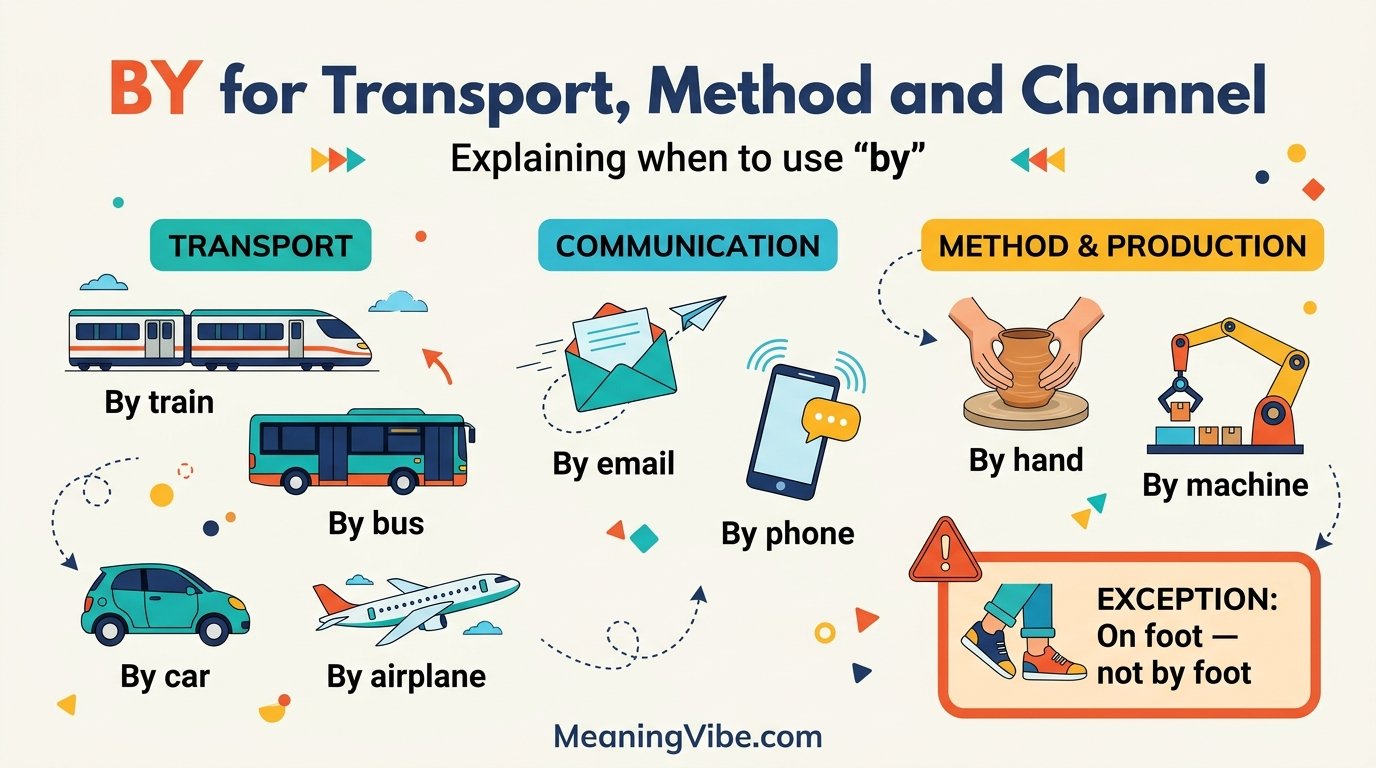
Look at the phrase and ask which picture it paints. A doer, method or channel takes by, and a tool, material or companion takes with, in almost every sentence you will ever build.
|
The test |
BY: the doer, method or channel |
WITH: the tool, material or companion |
|---|---|---|
|
Ask this |
Who did it, or how was it carried? |
What was in the hand, the cup, or beside the person? |
|
Typical partners |
written by Shakespeare, by train, by email, by hand, by Friday |
cut with a knife, filled with water, coffee with milk, with friends |
|
Memory line |
By points back to the doer |
With stays close to the hand |
One sentence can carry both words at once, each doing its own job. That pattern is the fastest proof that the two words are partners, not rivals.
|
Sentence |
BY job |
WITH job |
|---|---|---|
|
The cake was cut by the chef with a knife |
by the chef: the doer |
with a knife: the tool in the hand |
|
He was shot by the policeman with a rifle |
by the policeman: the doer |
with a rifle: the weapon used |
|
The door was opened by Mr Black with a key |
by Mr Black: the doer |
with a key: the tool in the hand |
Keep three warnings in mind from the start. Most passives drop by completely, a few famous pairs accept both words with different meanings, and money phrases split: by card, but in cash.
One shape rule runs under everything: after by, method and transport nouns drop their article. English says by train and by email, never by the train for a method, because the phrase names a way, not a thing.
Rule 1: BY for the Agent: Who or What Did It
In a passive sentence, by introduces the agent, the person or thing that performs the action. The passive puts the result first, and by adds the doer at the end when the doer matters.
The pattern is be plus past participle plus by: the play was written by Shakespeare, the bridge was built by the Romans, and the window was broken by the wind.
Agents Can Be People, Animals, Forces and Things
An agent is not always a person. Animals act: she was bitten by a dog. Natural forces act too: the village was destroyed by the flood, and the tree was blown down by the wind.
What matters is responsibility, not humanity. If the phrase answers who or what did it, the word in front of it is by.
Authorship: A Book By, a Song By
Creative work keeps the same pattern without a passive verb. A novel by Dickens, a painting by Picasso and a film directed by Spielberg all name the maker with by.
That is why with Shakespeare fails as an author phrase. With would make Shakespeare a companion standing beside the book, not the person who wrote it.
The Passive Connection: When BY Is Left Out
Here is the rule competitors bury: most passives drop the by phrase entirely. Writers add the agent only when the doer is important, surprising, or new information for the reader.
Cambridge states the same balance in its passive material: the doer can be left out, or placed in a by phrase when the sentence needs it.
Leave BY Out When the Doer Is Unknown, Obvious or Unimportant
The doer is often unknown: my wallet has been taken, and nobody knows by whom. Adding by someone would add words, not information.
The doer is often obvious: he was arrested says enough, because only the police arrest people. The doer is often unimportant: the road was built in 1990 cares about the road, not the crew.
Add BY When the Doer Is the Point
Add the agent when the doer is the news: the speech was written by the president herself surprises the reader, and Jurassic Park was directed by Steven Spielberg sells the film.
Exam questions test exactly this judgement. They ask who was it written by, and the answer needs the agent kept, not dropped.
News and science writing lean on the omission hardest. Headlines drop agents to save space, and reports drop them to keep the focus on results, which is why the passive sounds formal.
Rule 2: BY for Transport, Method and Channel
Transport: BY Plus the Vehicle, With No Article
For the method of travel in general, by takes the vehicle with no article: by car, by bus, by train, by plane, by boat, by air, by sea and by land.
Walking is the fixed exception, again: on foot, never by foot. The transport ladder in full, on the bus against in the car, belongs to the sister lesson on prepositions in on at rules.
The Article Changes the Job: By Bus vs On the Bus
By bus names the method, a general way of travelling. On the bus names one specific vehicle you are physically riding, so the article returns and the preposition changes.
The same shift gives by car for the method and in my car for the specific vehicle. Method phrases strip the article away; real vehicles keep it.
Channels: By Email, By Phone, By Post
Communication channels take by, because the channel is the method that carries the message. Send it by email, contact me by phone, and order it by post, by mail in American English.
Compare the channel with the conversation: speak on the phone names the live call, while by phone names the method of contact. The channel job is the one exams test.
Methods You Hold Loosely: By Hand and By Machine
Some methods name a process, not a held tool, and they take by. Made by hand means made manually, and made by machine means made in a factory process.
Hold the contrast ready for the overlap zone: written by hand is a method, while written with a pen is a tool in the hand. Both are correct, with different jobs.
Paying: By Card, but In Cash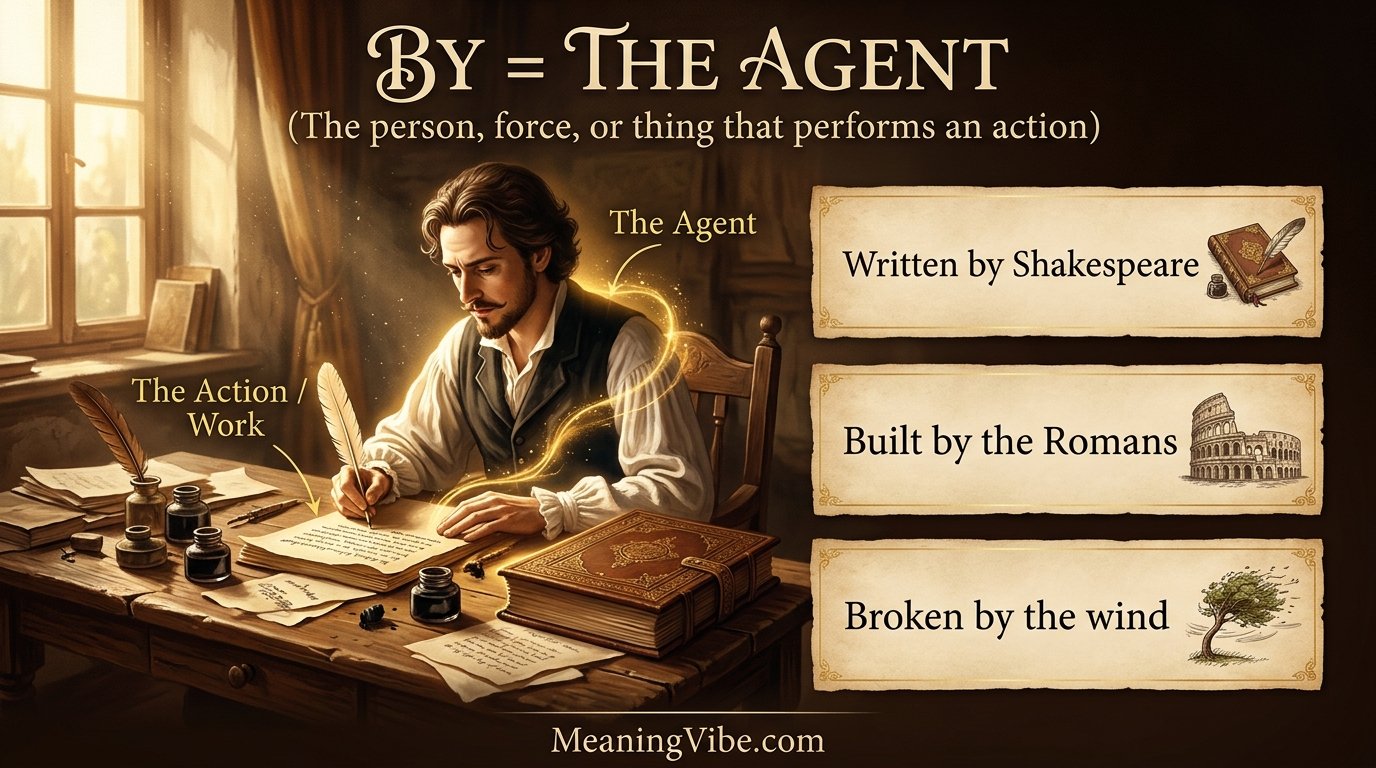
Money phrases split by method family. Cards take by: pay by card, by credit card, by cheque in British spelling and by check in American spelling.
Cash takes in: pay in cash, never by cash. You will also hear with a card when the physical card is the focus; careful writing and exams expect by card as the standard method phrase.
|
Method |
Correct phrase |
Strand note |
|---|---|---|
|
Card |
pay by card, by credit card |
with a card is heard for the physical card |
|
Cheque / check |
by cheque (UK), by check (US) |
Same rule, dialect spelling |
|
Cash |
pay in cash |
by cash is the error form |
BY Plus Verb-ing: The Method Clause
By can introduce a whole method clause with a verb-ing form. You learn by doing, improve by reading, and open the file by pressing this button.
The pattern answers how: how did he get in? By climbing through the window. How does she save money? By putting a little aside each month.
The error twin is learn with doing. With cannot carry a method clause; the method job belongs to by plus verb-ing every time.
Deadline BY and Measure BY
By Friday Means No Later Than Friday
Deadline by sets the last allowed moment, not a duration. Finish it by Friday means Friday is the limit; the work may be done on any day up to that point.
By points at past and future moments the same way: by now he should be home, and by then it was too late.
|
Word |
Its job |
Example |
|---|---|---|
|
by |
Deadline: at or before the moment |
Submit the form by Monday |
|
until |
Continuation: an activity runs up to the moment |
I will work until Monday |
The full contrast between the two words is a planned sibling lesson of its own. Here the boundary line is enough: a finished result takes by, an ongoing activity takes until.
Measure BY: Units, Amounts and Steps
By also measures: things are sold by the dozen, paid by the hour, and priced by the kilo. The unit after by is the measuring stick.
Differences take by too: prices rose by ten percent, and he missed the target by two inches. Repeated units build step phrases: day by day, step by step, one by one.
Fixed Phrases With BY to Learn Whole
A family of by phrases is frozen and learned whole, like vocabulary. By chance means by luck, by mistake means in error, and by accident means unintentionally.
Learn it by heart means memorise it completely. By myself means alone or without help, and she lives by herself works the same way with a reflexive.
By the way starts a new topic or an extra thought, and by far measures a large gap: she is by far the best singer in the group.
None of these follows the tool logic, and none should be rebuilt from it. Store them whole, and the decision flow later will route you around them.
Rule 3: WITH for the Instrument in the Hand
Use with when the phrase names the instrument, the thing a hand holds and uses to do the action. Cut it with a knife, write with a pen, and open it with a key.
The test is physical: if you can picture the thing in the agent’s hand during the action, with is the word. The agent still takes by when both appear.
The Core Tool Bank
Everyday tools follow the same picture: eat with a spoon, dig with a spade, hit it with a hammer, cut with scissors, draw with a pencil, and clean with a cloth.
The verb can change freely while the picture stays. What matters is the held tool, never the action being done with it.
Body Parts as Instruments: With Bare Hands
Body parts used as tools take with as well, a strand many lessons skip. He caught the ball with one hand, and she built the wall with her bare hands.
The hands are the instrument in those sentences, so with is correct even though no separate tool exists. Bare hands simply means hands with nothing in them.
Tool or Medium: With a Pen vs In Ink
Two questions can be asked about writing. With a pen names the tool in the hand, while in ink or in pencil names the medium the writing is made in.
Both forms are correct because they answer different questions. Choose with for the held tool, and in for the material the marks are made from.
Rule 4: WITH for Material, Contents and Ingredients
With also names what fills, covers or goes inside something. The glass was filled with water, the town was packed with commuters, and the hall was crowded with tourists.
The Participle Set: Filled With, Covered With, Packed With
A family of past participles pairs with with so regularly that the phrases are learned together: filled with, covered with, packed with, crowded with, decorated with.
The pattern describes a state, not an action in progress. Covered with snow reports how the field looks, with no doer in view.
A filled by strand exists when a real agent does the filling and is the point of the sentence. It is the rarer form; contents in a state take with.
Ingredients: Coffee With Milk
In food, with names the ingredient that accompanies the main item: coffee with milk, tea with sugar, soup with bread, and a salad with dressing.
By would break these phrases, because the milk is not the doer or the method. It is simply part of what is served, beside the coffee in the cup.
Made With: A Boundary Note Only
Made with fresh cream names an ingredient, and made with care names a manner, so with is right in both. The deeper split, made of against made from, is a future sibling lesson.
Do not let made pull you off the hand test. Ask what the phrase names: ingredient or manner takes with, maker takes by.
Rule 5: WITH for Accompaniment, Manner and Description
Accompaniment: Who or What Is Along
With names company: I went with my sister, she lives with friends, and come with me. People, animals and things can all accompany: a present with a card.
Two neighbours extend the same job: along with and together with add a person or thing to a group already named. The minister, along with her staff, arrived early keeps with at its centre.
By breaks accompaniment completely. By my sister would make her the doer of a passive action, which is why it is a headline error in the bank below.
Manner and Feeling: With Care, With a Smile
With plus a quality names manner, how something is done: made with care, spoken with difficulty, accepted with pleasure, and finished with ease.
Feelings and expressions ride the same pattern: she said it with a smile, and he waited with patience. No tool is held; with carries the manner instead.
Description: Features a Person or Thing Has
With names a feature in descriptions: the man with the beard, the girl with red hair, and a house with a garden. The phrase works like an adjective with a picture inside.
Rooms with a view and a coat with deep pockets follow the same job. If the phrase answers what does it have, with is the word.
An Advanced Strand: With Prices Rising
Written English owns an absolute construction with with: with prices rising, families cut back, and with the door open, the room cooled.
Treat this strand as recognition only. It belongs to advanced writing, and everyday by and with choices never need it.
The Overlap Zone: Both Correct, Different Meanings
Some pairs accept both words, and the choice changes the meaning instead of breaking a rule. This zone is where careful speakers earn their accuracy, so learn each pair as a meaning shift.
|
Pair |
What changed |
|---|---|
|
hit by a branch / hit with a branch |
By: the branch fell or moved on its own, an accident. With: a person held it and used it |
|
written by hand / written with a pen |
By hand: the method, not typed. With a pen: the tool in the hand |
|
made by a machine / made with a machine |
By: the machine as maker or process. With: the machine as a tool a person used (labelled strand) |
|
spoken by the mayor / spoken with a friend |
By: the mayor as speaker, the agent. With: the friend as the person in conversation |
|
covered by snow / covered with snow |
By: snow in view as the covering agent. With: the neutral description of the state |
The branch pair is the teaching heart of the zone. Swan’s tradition draws it exactly: hit by a branch suggests nobody held it, while hit with a branch puts a person behind it.
Read every overlap pair by asking the hand question again. Where a hand or a doer is in the picture, the meaning follows it, and the preposition simply reports the picture.
A smaller strand sits beside the table: surrounded by enemies names the agents around you, while surrounded with appears in loose writing for the same scene. Careful writers keep by for the surrounding doers.
The Decision Flow: Two Questions
When a sentence stops you, run two questions in order. Almost every real sentence in this topic is decided by the first one.
- Who did it, or what carried it? A doer, a method, a channel, a vehicle or a deadline takes by: by Shakespeare, by email, by train, by Friday.
- What was in the hand, the cup, or beside the person? A tool, a material, an ingredient, a companion, a manner or a feature takes with: with a knife, with milk, with friends.
Before you finish, run two checks. First, is the phrase a fixed one, like by heart or on foot, which is stored whole? Second, does the passive even need its agent, or should by be dropped?
If both answers seem possible, you are in the overlap zone. Decide what the sentence means first, and the word will follow the meaning.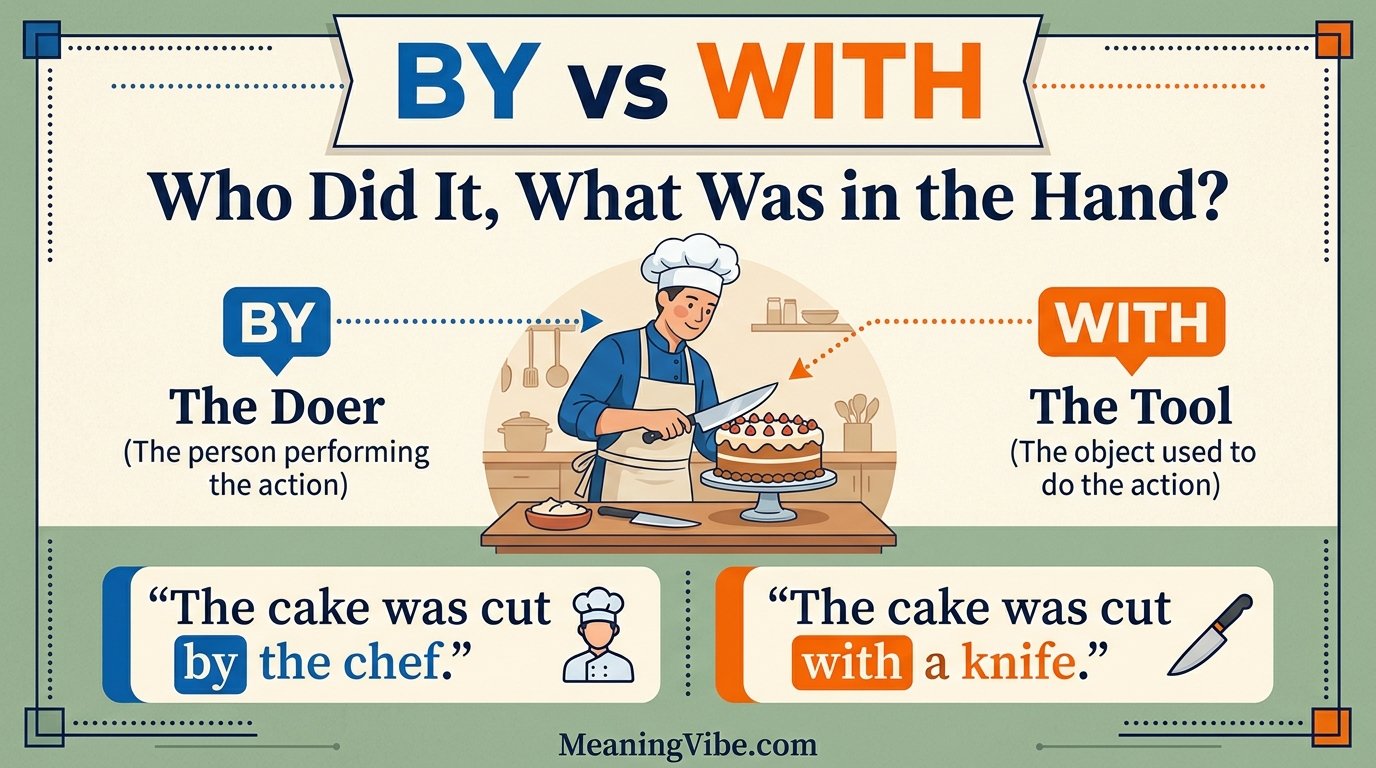
Twelve Typical Errors, Corrected
The table collects typical learner errors, the mistakes teachers and exam boards meet again and again. They are labelled typical errors from teaching practice, never as measured statistics.
|
# |
Typical error |
Correct form |
Why |
|---|---|---|---|
|
1 |
cut it by a knife |
cut it with a knife |
The knife is the instrument in the hand |
|
2 |
written with Shakespeare |
written by Shakespeare |
Shakespeare is the agent, the doer |
|
3 |
I went by my sister |
I went with my sister |
Accompaniment takes with |
|
4 |
learn with doing |
learn by doing |
Method clauses take by plus verb-ing |
|
5 |
by foot |
on foot |
Walking is the fixed exception |
|
6 |
travel with the bus (as a method) |
travel by bus |
The method takes by, with no article |
|
7 |
pay by cash |
pay in cash |
Cash takes in; cards take by |
|
8 |
the cake was cut with Ajit |
the cake was cut by Ajit |
Ajit is the doer; a knife would take with |
|
9 |
filled by water |
filled with water |
Contents after filled take with |
|
10 |
coffee by milk |
coffee with milk |
An ingredient accompanies; it is not a method |
|
11 |
finish until Friday (deadline result) |
finish by Friday |
A deadline takes by; until runs an activity |
|
12 |
opened by a key (no doer in the sentence) |
opened with a key |
A held tool takes with; by needs a doer |
Read the why column aloud as you correct each line. Naming the reason, doer or tool, is what turns a corrected sentence into a rule you keep.
Practice: Three Exercise Sets With a Full Answer Key
Practice turns the hand test into a habit, so finish each set before opening the key. Say each sentence aloud, because the ear catches wrong words early.
Set A isolates the basic choice, Set B works both words in one sentence and the passive, and Set C mixes strands with corrections.
Exercise Set A: The Basic Choice
- The letter was written ___ Shakespeare.
- She cut the paper ___ scissors.
- We travelled ___ train.
- He went to the party ___ his friends.
- Contact me ___ email.
- The room was filled ___ smoke.
- Finish the report ___ Friday.
- She opened the box ___ a key.
Exercise Set B: Both Words and the Passive
- The cake was cut ___ the chef ___ a knife.
- He was shot ___ the policeman ___ a rifle.
- The bridge was built ___ the Romans.
- She learns English ___ watching films.
- He caught the ball ___ one hand.
- Prices rose ___ ten percent.
- They sell eggs ___ the dozen.
- He did the homework ___ himself, with no help.
Exercise Set C: Mixed, With Three Corrections
- Coffee ___ milk, please.
- Will you pay ___ card or ___ cash?
- The field was covered ___ snow.
- He answered ___ difficulty.
- A house ___ a garden stood on the hill.
- Correct this sentence: I cut the cake by a knife.
- Correct this sentence: We learn with reading every day.
- Correct this sentence: She came here by foot.
Answer Key
|
Set |
Answers |
Reason in one line |
|---|---|---|
|
A |
1 by, 2 with, 3 by, 4 with, 5 by, 6 with, 7 by, 8 with |
Doers, methods and deadlines take by; tools, company and contents take with |
|
B |
1 by, with, 2 by, with, 3 by, 4 by, 5 with, 6 by, 7 by, 8 by |
Agent first, instrument second; method clauses and measures take by |
|
C |
1 with, 2 by, in, 3 with, 4 with, 5 with |
Ingredients and manner take with; card takes by and cash takes in |
|
C corrections |
6 with a knife. 7 by reading. 8 on foot |
A held tool takes with, a method clause takes by, walking is the fixed exception |
Score yourself by reason, not by answer alone. A right word chosen for a wrong reason means that rule section needs one more read.
How These Rules Were Checked
Every rule in this lesson was checked against standard references for English grammar. The aim was agreement between authorities, not the habits of any single website, course page or textbook.
The agent and instrument split follows the Cambridge Dictionary passive voice grammar page, which places the doer in a by phrase and names the instrument the agent used with with.
The omission balance follows the British Council LearnEnglish active and passive voice reference, which shows the agent named with by when it matters, and dropped the rest of the time.
The sense range for by, its deadline, measure, method and fixed phrase jobs, follows the Oxford Learner’s entry for by. The branch pair and the cover verb strands follow Michael Swan’s Practical English Usage.
Where authorities describe both forms, this lesson prints both and labels the strand. No statistic has been invented to support any rule.
Frequently Asked Questions
Cut with a knife or by a knife?
With a knife. The knife is the instrument in the hand. By names the doer: the cake was cut by the chef with a knife, one sentence, both jobs.
Written by Shakespeare or with Shakespeare?
By Shakespeare. Shakespeare is the agent, the person who did the writing. With would make him a companion or a tool, which is the classic agent error.
By Friday or until Friday?
By Friday for a deadline: finish it by Friday means no later than Friday. Until Friday means the activity continues up to Friday: I will work until Friday.
Pay by card or with card?
By card is the standard method phrase, with no article. With a card is heard when the physical card is the focus, labelled a strand, but exams and careful writing expect by card.
What does by myself mean?
Alone, without help or company. I did it by myself means nobody helped. It is a fixed phrase, and on my own means the same.
Coffee with milk or by milk?
With milk. Milk is an ingredient that goes with the coffee. By milk would wrongly make the milk the method or the doer.
Travel by train or with the train?
By train for the method of travel, with no article. With a specific vehicle, the form changes: on the 8.15 train, in my car.
Why is by foot wrong?
Because walking is the fixed exception: on foot. By plus transport takes vehicles; feet are not a vehicle in this phrase.
Cut by a knife: when could by be right with a thing?
When the thing acts by itself as the cause: cut by broken glass, hit by a falling stone. If a hand holds it, the thing is an instrument and takes with.
Hit by a branch or hit with a branch?
Both exist and mean different things. Hit by a branch suggests the branch fell or moved on its own, an accident. Hit with a branch means a person used it as a weapon.
Written by hand or written with a pen?
Both are correct, with different jobs. By hand names the method, not typed or printed. With a pen names the tool in the hand.
Made by a machine or made with a machine?
Both are heard as labelled strands. By a machine presents the machine as the maker or process. With a machine presents it as the tool a person used. Context decides; neither is a free swap.
Spoken by or spoken with?
Different jobs. Spoken by names the speaker as agent: a speech spoken by the mayor. Spoken with names the person in conversation: I have spoken with her.
By email or with email?
By email. Email here is a channel or method, and channels take by: send it by email, contact me by phone.
Learn by doing: why by?
Because by plus verb-ing names the method: you learn by doing, improve by reading. Learn with doing is the error form.
Is the agent always needed in the passive?
No. Most passives omit the by phrase because the agent is unknown, obvious or unimportant: my wallet has been taken. Add by only when the doer matters.
Filled with water or filled by water?
Filled with water for the contents. With follows participles like filled, packed and crowded. Filled by appears when a real agent fills it and is the point of the sentence, a rarer strand.
Covered with snow or covered by snow?
Both are strands with a slight shift. Covered with snow is the neutral description of the state. Covered by snow can stress snow as the covering agent. Reference grammars allow both with cover verbs.
With my sister or by my sister for going together?
With my sister. Accompaniment takes with: I went with my sister. By my sister would make her the doer of an action in a passive sense.
By chance, by mistake, by accident: why by?
They are fixed phrases learned whole. By chance means by luck, by mistake means in error, by accident means unintentionally. None follows the tool logic.
By the way: what does it do?
It introduces a new topic or an extra thought: by the way, did you call her? It is a discourse phrase, not a method phrase.
Day by day meaning?
Gradually, one day at a time: day by day, things improved. By repeats between units in measure phrases: step by step, one by one, word by word.
By far meaning?
By a large amount: she is by far the best singer. By measures the gap or amount of difference here.
With bare hands: why with for a body part?
Because the hands are the instrument used: he caught it with his bare hands. Body parts used as tools take with, a strand many pages skip.
Write with a pen or in pen?
Both exist. With a pen names the tool. In pen, in ink, in pencil name the medium the writing is made in. The questions differ: what tool, or what medium.
By cheque or by check?
Same rule, different spelling by dialect. By cheque is British spelling; by check is American spelling. The preposition is by in both.
Pay by card or pay in cash?
Both patterns exist for different methods. Card takes by: by card, by credit card. Cash takes in: in cash. By cash is the error form.
By machine or by hand for how something was made?
Both take by, because both name the method or process, not a held tool. Made by hand and made by machine are the standard pair.
The door was opened by Mr Black or with Mr Black?
By Mr Black. He is the agent who opened it. The full form can carry both: opened by Mr Black with a key.
Shot by a policeman or shot with a rifle?
Both, for different parts. The policeman is the agent (by), the rifle is the instrument (with): he was shot by the policeman with a rifle, the Cambridge example pattern.
By bus but on the bus: what changes?
The article changes the job. By bus names the method in general, no article. On the bus names a specific vehicle you are physically on.
Can with start a clause like with prices rising?
Yes, as an advanced absolute construction: with prices rising, families cut back. It is a written, advanced strand, taught here as recognition only.
Made with care: is care a tool?
No. With plus a quality names manner: made with care, spoken with difficulty, done with pleasure. Manner is its own with job.
The man with the beard: which with job is this?
Description. With names a feature someone or something has: a house with a garden, the girl with red hair.
By myself vs by himself: the reflexive use?
After verbs, by plus a reflexive means alone or without help: she lives by herself. It is the same fixed phrase family as by myself.
By the dozen, by the kilo: which by is this?
Measure by. Things are sold or counted by the unit: eggs by the dozen, fabric by the yard, paid by the hour.
Killed by a murderer, killed with a knife: who takes what?
The person takes by, the agent, and the weapon takes with, the instrument. The pair is the oldest teaching example of the whole contrast.
By a dog: can an animal be an agent?
Yes. Agents can be people, animals, forces or things that act: bitten by a dog, destroyed by the flood, blown down by the wind.
With a smile: instrument or manner?
Manner. She said it with a smile describes how, not a tool. With carries feelings and expressions as manner phrases.
By heart or with heart?
By heart is the fixed phrase for memorised: learn it by heart. With all my heart is a different idiom meaning sincerely, a neighbour phrase.
By sea, by air, by land: why by?
Because they name the means of travel in general, with no article, like by train. On a specific ship or flight, the form changes to on board or on the ship.
How do I choose by or with quickly?
Ask two questions. Who or what did it, or what method or channel carried it? By. What was in the hand, in the cup, or beside the person? With.
Conclusion
Prepositions by with rules stop feeling like a coin toss once the hand test is in place. Ask who did it, or what carried it, and the answer is by; ask what was in the hand, and the answer is with.
The system earns its keep when you add the finishing layers: the passive omission rule, the overlap zone read as meaning shifts, and the fixed phrases stored whole.
Keep practising with the exercise sets above until the reasons come automatically. The hand-test table, the overlap table and the three sets also form a printable practice pack, so save or print this page as your revision sheet.
Its sister lessons, prepositions in on at rules and prepositions for since rules, cover the size gradient and the duration system, and the articles a an the rules lesson completes the small words set on the same cluster.
Grammar grows in clusters on MeaningVibe, one system at a time. Natural next steps are the article pages on when to use a vs an and when to use the, the reported speech rules with their reported speech examples, the direct speech vs indirect speech comparison, and the conditional family: third conditional sentences, zero conditional sentences and mixed conditional sentences.