
When to use a vs an comes down to one test: listen to the next sound, not the next letter. Use a before a consonant sound and an before a vowel sound, which is why the correct pair is a university and an hour.
The spelling of the next word cannot settle the choice. University opens with a vowel letter and a consonant sound, while hour opens with a consonant letter and a vowel sound, and the sound wins both times.
The Short Answer: The Next Sound Decides
A goes before a consonant sound. A hotel, a happy man, a USB cable, and a NASA mission all open with consonant sounds, whatever their first letters happen to be.
An goes before a vowel sound. An hour, an honest man, an umbrella, and an MRI scan all open with vowel sounds, and the article matches the sound, never the spelling.
The word immediately after the article is the word that counts. An adjective standing between the article and the noun takes over the decision, so an old house and a very old house follow different openings.
Purdue OWL states the rule most precisely: the Purdue OWL page on articles, a versus an puts the choice on the phonetic quality of the first sound, not on the orthographic, or written, representation of the word.
Cambridge states the same rule for learners: the Cambridge Dictionary grammar entry on a, an and the teaches that a and an depend on the sound at the start of the next word, and that the next word can be an adjective.
The Wrong Teaching: Letters Lie, Sounds Tell the Truth
Most learners arrive holding the spelling version. The classroom shortcut says a before consonants and an before vowels, and it sounds complete until its own stock examples break it in both directions.
The shortcut fails on vowel letters first. University, European, eulogy, and one-way street all start with vowel letters, yet each opens with a consonant sound and takes a, not an.
The shortcut fails on consonant letters next. Hour, honest, heir, and honor all start with the letter h, yet the h is silent, each word opens with a vowel sound, and each takes an.
The Say-It-Aloud Test: The Operating Procedure in Four Steps
One procedure settles nearly every case. Say the phrase out loud at natural speed, listen to the first sound after the article slot, and let that sound choose the form.
Step 1: Read the next word as you would say it. Ignore its spelling completely, because the written first letter is the one piece of evidence this test throws out.
Step 2: Name the opening sound honestly. If the word starts the way apple, egg, or umbrella starts, the opening is a vowel sound, and the article is an.
Step 3: Watch for the two disguised consonant sounds. A yoo opening, as in university, and a w opening, as in one, are consonant sounds wearing vowel letters, and both take a.
Step 4: Check the word after the article, not the noun. If an adjective sits in between, the adjective’s opening sound decides, so test the adjective and let the noun wait.
Build English Academy teaches the same listening habit: the Build English Academy listening lesson builds its whole lesson on hearing the sound first, with flips like an apple becoming a green apple when an adjective moves in.
Trap Family One: Silent H, a Small Closed Set
Silent h is a finishable lesson, not an endless exception list. In standard US English the silent-h family is small and closed: hour, honest, honor, and heir, plus the words built from those four roots.
The family members all take an. An hour, an honest man, an honor, an heir, an hourly wage, an heirloom, an honest answer, and an honorary degree all open with vowel sounds.
The University of Hong Kong page lists the same core set: the University of Hong Kong silent h teaching page teaches honest, honor, hour, and heir as the silent-h stock, and notes that a history and a habit always keep a sounded h.
7ESL prints the fullest silent-h example stock: the 7ESL a vs an lesson lists an hourly rate, an honorarium, and an honorary degree among its verdicts, all consistent with the closed set of four roots.
Trap Family Two: Sounded H, the Default for Every Other H Word
Every other h word keeps its h, and takes a. A hotel, a house, a hospital, a history, a habit, a happy man, and a historic day all open with a sounded h.
Grammarly prints the contrast cleanly: the Grammarly consonants guide pairs an hour and an heiress against a hotel and a historic day, showing the sounded default and the silent exception side by side.
The Contested H Words: Historic, Hysterical, and Homage
Historic is the most argued verdict in the family. The US default is a historic and a historical, because standard US pronunciation sounds the h and stresses the second syllable lightly but audibly.
Merriam-Webster records why the an form exists. Its usage guide notes that before an unstressed or weakly stressed h, both forms appear in writing, because that h was long unstressed to the point of inaudibility.
Grammar Girl argues the other strand firmly. Quick and Dirty Tips comes down for a historic in standard pronunciation, treating the an form as a survival from a pronunciation most US speakers no longer use.
Our own cluster carries the partner distinction: our historic vs historical guide separates the two adjectives themselves, while this page settles only which article stands in front of each one.
Herb: One Word, Two Regions, Two Correct Answers
Herb is a regional split, not a disagreement. In US English the h is silent, the word is pronounced erb, and the verdict is an herb, in the garden, the kitchen, and the clinic.
WordsTrivia states the split with both labels attached: the WordsTrivia sound-first explainer prints the US and British verdicts side by side, and this page does the same, with the US verdict leading for US readers.
Trap Family Three: U and Eu Words With the Yoo Glide
Words like university open with a y sound, not a vowel. That opening is the sound at the start of yes and yellow, and it behaves as a consonant everywhere in English.
Purdue OWL names the mechanism. The initial y sound in union and unicorn is a glide with consonantal properties, which is why a union, a unicorn, and a university all take a.
The u words split by sound, not by letter. University, union, unit, unique, useful, user, utensil, and U-turn all open with yoo and take a, while the next family shows the u words that do not.
GrammarEnglish drills this family as its own rule: the GrammarEnglish indefinite article rules separates the yoo words from the true vowel words, and its golden rule matches this page: the first sound, not the first letter, decides.
Trap Family Four: True Vowel U Words
Some u words open with a genuine vowel sound. Umbrella, uncle, ugly, umpire, and utter all begin with the short uh sound, and each one takes an without any glide in front of it.
Trap Family Five: One Words and the W Sound
One opens with a w sound, not a vowel. The word is pronounced wun, so a one-way street, a one-time offer, and a once-in-a-lifetime chance all take a in standard US English.
Wikibooks records the historical stock of this family: the Wikibooks English in Use articles chapter lists a one and a European car among its verdicts, pairing the w sound and the yoo glide as the two disguised consonant openings.
The Adjective in Between: The Word After the Article Decides
The noun does not choose the article; the next word does. When an adjective moves between the article and the noun, the adjective’s opening sound takes over the decision completely.
The flip table shows the article changing while the noun stays fixed. Read each row across: the noun never moves, the adjective arrives, and the article flips or holds purely on the adjective’s first sound.
|
Noun alone |
With an adjective |
What flipped |
|---|---|---|
|
an hour |
a full hour |
Full opens with a consonant sound |
|
an apple |
a green apple |
Green opens with a consonant sound |
|
a house |
an old house |
Old opens with a vowel sound |
|
a teacher |
an excellent teacher |
Excellent opens with a vowel sound |
|
an umbrella |
a large umbrella |
Large opens with a consonant sound |
|
a university |
an excellent university |
Excellent overrides the yoo glide |
Trap Family Six: Initialisms and the Letter-Name Table
Initialisms are read letter by letter, so the letter name decides. An MRI scan is correct because M is pronounced em, a name that opens with a vowel sound, and the article follows the name.
Eight letter names open with vowel sounds. F, H, L, M, N, R, S, and X all begin with a vowel sound when named aloud, so any initialism starting with one of them takes an.
The letter table is the family’s whole system. Learn the two rows once and every initialism verdict becomes mechanical, from an FBI agent to a URL, with no guessing left.
|
Letter names opening with a vowel sound, take an |
Letter names opening with a consonant sound, take a |
|---|---|
|
F (eff): an FBI agent, an FAQ page when spelled out |
B (bee): a BBC report |
|
H (aitch): an HIV test, an HTML page |
C (see): a CIA memo |
|
L (el): an LED screen when spelled out |
D (dee): a DVD player |
|
M (em): an MRI scan, an MBA degree |
G (jee): a GPS unit |
|
N (en): an NHS hospital, an NBA game |
J (jay): a JPEG file |
|
R (ar): an R-rated film |
K (kay): a K-9 unit |
|
S (ess): an SOS call, an SQL query when spelled out |
P (pee): a PDF file |
|
X (ex): an X-ray, an Xbox console |
T (tee): a TV show |
|
The eight vowel-named letters sit in this column |
U (yoo): a USB cable, a URL |
|
Every other letter name sits opposite |
Y (why): a YMCA branch |
UTMB teaches the same verdicts to working writers: the UTMB nursing module on acronym verdicts walks through an FBI agent and a NASA astronaut in one module, separating the letter-name reading from the word reading cleanly.
Trap Family Seven: Acronyms Read as Words
Acronyms are read as words, so the word’s first sound decides. NASA is pronounced as one word opening with a consonant sound, so a NASA mission is the verdict, never an NASA.
Trap Family Eight: Numbers and Symbols by Reading
Digits carry no verdict until they are voiced. The figure 8 says nothing, but its reading, eight, opens with a vowel sound, so an 8-hour day and an 18-wheeler both take an.
Four number openings take an in US readings. Eight, eleven, eighteen, and eighty, plus their compounds like eighty-five, all open with vowel sounds, and every price, age, or quantity built on them follows.
The money examples make the rule concrete. An $11 ticket is read as an eleven-dollar ticket and takes an, while a $7 ticket is read as a seven-dollar ticket and takes a, though both are written with figures.
EnglishGrammarSite drills numbers inside its articles lesson: the EnglishGrammarSite articles lesson treats the voiced reading as the deciding evidence, the same position this family takes for every digit and symbol.
Trap Family Nine: Abbreviations With Two Readings
Some abbreviations genuinely split, and honesty beats a flat verdict. FAQ, SQL, and LED can each be read two ways in real US usage, so this page grades them by reading instead of forcing one answer.
FAQ splits between its letters and its nickname. Read as eff-ay-kyoo, it opens with a vowel sound and takes an, as in an FAQ page; read as fack, it opens with a consonant sound and takes a.
SQL splits between its letters and the word sequel. Database writers who say ess-kyoo-el write an SQL query, while shops that say sequel write a SQL database, and both camps are internally consistent.
LED usually travels spelled out. An LED screen is the majority form in US edited prose because most readers voice the letters, though the word reading led exists and would take a.
The grading rule for all three is the same. Name the reading first, print the majority US edited-prose form first, label the minority reading honestly, and never publish one flat verdict for a two-reading abbreviation.
Dialect and History: Strands That Never Change a Verdict
Merriam-Webster records a dialect strand honestly. Its usage guide notes that in some dialects, speech occasionally places a before vowel sounds, as in a apple or a hour, a spoken pattern that never becomes the edited verdict.
The same guide records a history strand. An once appeared before yoo words, as in an unique and such an one, a pattern that was real in older English and has grown less frequent ever since.
Etymology closes the family’s story. Merriam-Webster’s word history traces an to Old English an, meaning one, with a developing as the reduced form used before consonant sounds, and the first known use dated before the 12th century.
Special Frames: Plural-Looking Singulars and the Written A/An
Some singular nouns wear plural-looking endings. A species, a series, and a means of transport are each one thing grammatically, so each takes a, and the s ending is spelling, not plurality.
Forms and templates use the written a/an convention. Job applications, contracts, and worksheets print a/an where either form might land, inviting the writer to keep the one that matches the next word’s sound.
Dummies covers these frames for general readers: the Dummies guide to articles in English treats the everyday article frames in plain language, including the singular countable base that every a or an verdict quietly presupposes.
Where the Rest of the Article System Lives
This page owns one decision only. Whether the next word takes a or an is settled here; the wider question of which article a noun needs, if any, belongs to a different page by design.
The articles a an the rules page carries that wider system. It owns the known test, first mention, the zero article, and countability, and it is named here in full so readers know the system exists as its own topic.
One boundary fact is worth stating once. A and an appear only before singular countable nouns, a point Cambridge records, and everything beyond that single presupposition routes to the wider system’s page.
The neighbouring cluster carries the connected grammar: our reported speech rules guide and our reported speech examples bank handle reported speech, while our direct speech vs indirect speech comparison compares the two speech forms directly.
Sound-first thinking runs through the cluster: our quiet vs quite guide, our lose vs loose guide, and our complement vs compliment guide all separate spelling from sound, and our fewer vs less guide settles a determiner choice of a different kind.
The rules index gathers the whole set: our grammar category index lists the tense, conditional, and voice guides, including our zero conditional sentences guide, our first conditional sentences guide, and our active voice vs passive voice rules guide for readers building the full system.
The Classified Bank: 100 Verdicts Sorted by Family
Silent h verdicts, ten. Every entry opens with a vowel sound because the h is silent, and every entry descends from the four closed-set roots.
|
Verdict |
Opening sound |
|---|---|
|
an hour |
vowel, silent h |
|
an honest man |
vowel, silent h |
|
an honor |
vowel, silent h |
|
an heir |
vowel, silent h |
|
an heirloom |
vowel, silent h |
|
an hourly wage |
vowel, silent h |
|
an honestly earned wage |
vowel, silent h |
|
an honorable mention |
vowel, silent h |
|
an honorary degree |
vowel, silent h |
|
an heiress |
vowel, silent h |
|
Verdict |
Opening sound |
|---|---|
|
a hotel |
consonant, sounded h |
|
a house |
consonant, sounded h |
|
a hospital |
consonant, sounded h |
|
a history |
consonant, sounded h |
|
a historic day |
consonant, sounded h |
|
a historical novel |
consonant, sounded h |
|
a habit |
consonant, sounded h |
|
a happy man |
consonant, sounded h |
|
a hero |
consonant, sounded h |
|
a hypothesis |
consonant, sounded h |
Yoo glide verdicts, ten. Every entry opens with the yoo glide, a consonant sound spelled with u or eu.
|
Verdict |
Opening sound |
|---|---|
|
a university |
yoo glide |
|
a European |
yoo glide |
|
a eulogy |
yoo glide |
|
a unicorn |
yoo glide |
|
a union |
yoo glide |
|
a unit |
yoo glide |
|
a unique chance |
yoo glide |
|
a useful tool |
yoo glide |
|
a user account |
yoo glide |
|
a U-turn |
yoo glide |
|
Verdict |
Opening sound |
|---|---|
|
an umbrella |
vowel, uh |
|
an uncle |
vowel, uh |
|
an unusual day |
vowel, uh |
|
an utter failure |
vowel, uh |
|
an urgent call |
vowel, uh |
|
an unhappy child |
vowel, uh |
|
an ugly scene |
vowel, uh |
|
an umpire |
vowel, uh |
|
an unfair result |
vowel, uh |
|
an ultimate goal |
vowel, uh |
|
Verdict |
Opening sound |
|---|---|
|
a one-way street |
w sound |
|
a one-time offer |
w sound |
|
a once-in-a-lifetime chance |
w sound |
|
a one hundred dollar bill |
w sound |
|
a one-legged stool |
w sound |
|
a once-famous singer |
w sound |
|
a one-track mind |
w sound |
|
a one-year-old child |
w sound |
|
a one-bedroom flat |
w sound |
|
a once-only event |
w sound |
Initialism verdicts, twelve. Every entry follows its letter name, so the vowel-named letters take an and the consonant-named letters take a.
|
Verdict |
Opening sound |
|---|---|
|
an MRI scan |
em, vowel |
|
an FBI agent |
eff, vowel |
|
an MBA degree |
em, vowel |
|
an HIV test |
aitch, vowel |
|
an SOS call |
ess, vowel |
|
an X-ray |
ex, vowel |
|
an NHS hospital |
en, vowel |
|
an R-rated film |
ar, vowel |
|
a USB cable |
yoo, consonant |
|
a URL |
yoo, consonant |
|
a CIA memo |
see, consonant |
|
a YMCA branch |
why, consonant |
Acronym verdicts, eight. Every entry follows its word reading, because these forms are pronounced as words, not spelled out.
|
Verdict |
Opening sound |
|---|---|
|
a NASA mission |
consonant, word reading |
|
a NATO summit |
consonant, word reading |
|
a UNICEF report |
yoo, word reading |
|
an AIDS researcher |
vowel, word reading |
|
a UNESCO site |
yoo, word reading |
|
an OPEC decision |
vowel, word reading |
|
a LASIK procedure |
consonant, word reading |
|
a scuba tank |
consonant, word reading |
Number and symbol verdicts, ten. Every entry follows its spoken reading, since the digit itself carries no sound at all.
|
Verdict |
Opening sound |
|---|---|
|
an 8-hour day |
eight, vowel |
|
an 18-wheeler |
eighteen, vowel |
|
an 11-hour flight |
eleven, vowel |
|
an $11 ticket |
eleven dollars, vowel |
|
an 80 percent majority |
eighty, vowel |
|
an 11-year-old player |
eleven, vowel |
|
a $7 ticket |
seven dollars, consonant |
|
a 1-time offer |
one, w sound |
|
a 3-day week |
three, consonant |
|
a $1 coin |
one dollar, w sound |
Plain vowel and consonant verdicts, ten. These everyday words anchor the bank, the cases where letter and sound agree and the plain rule shows itself.
|
Verdict |
Opening sound |
|---|---|
|
an apple |
vowel |
|
an egg |
vowel |
|
an idea |
vowel |
|
an old house |
vowel |
|
an excellent teacher |
vowel |
|
a banana |
consonant |
|
a green apple |
consonant |
|
a full hour |
consonant |
|
a large umbrella |
consonant |
|
a very old house |
consonant |
Reading-dependent verdicts, ten graded entries. Each row names its reading first, because these are the verdicts that honestly change with the voice behind them.
|
Verdict |
Reading behind it |
|---|---|
|
an FAQ page |
spelled out, eff-ay-kyoo |
|
a FAQ page |
read as fack |
|
an SQL query |
spelled out, ess-kyoo-el |
|
a SQL database |
read as sequel |
|
an LED screen |
spelled out, majority US form |
|
a homage |
standard US, sounded h |
|
an homage |
minority strand, French influence |
|
a historic day |
US default, sounded h |
|
an historic day |
labelled strand, weakened h |
|
an herb garden |
US reading, silent h |
The Error Gallery: Wrong Form, Correction, Reason
|
Wrong form |
Correction |
Reason |
|---|---|---|
|
a hour |
an hour |
The h is silent, vowel opening |
|
an university |
a university |
Yoo glide, consonant opening |
|
a honest man |
an honest man |
Silent h in the closed set |
|
an one-way street |
a one-way street |
W sound opening |
|
a MRI |
an MRI |
Letter name em opens with a vowel |
|
an NASA |
a NASA |
Word reading opens with a consonant |
|
a eight-hour day |
an 8-hour day |
Reading eight opens with a vowel |
|
an hotel |
a hotel |
Sounded h, consonant opening |
|
a umbrella |
an umbrella |
True vowel uh opening |
|
an USB cable |
a USB cable |
Letter name yoo, consonant opening |
|
a heir |
an heir |
Silent h in the closed set |
|
an European |
a European |
Yoo glide opening |
A Final Proofreading Pass for Articles
The wider rules cluster rewards the same habit: our active to passive voice examples bank shows verdicts worked in bulk, our present simple tense rules guide and our future simple tense rules guide carry the tense rules, and the MeaningVibe home page indexes the full set.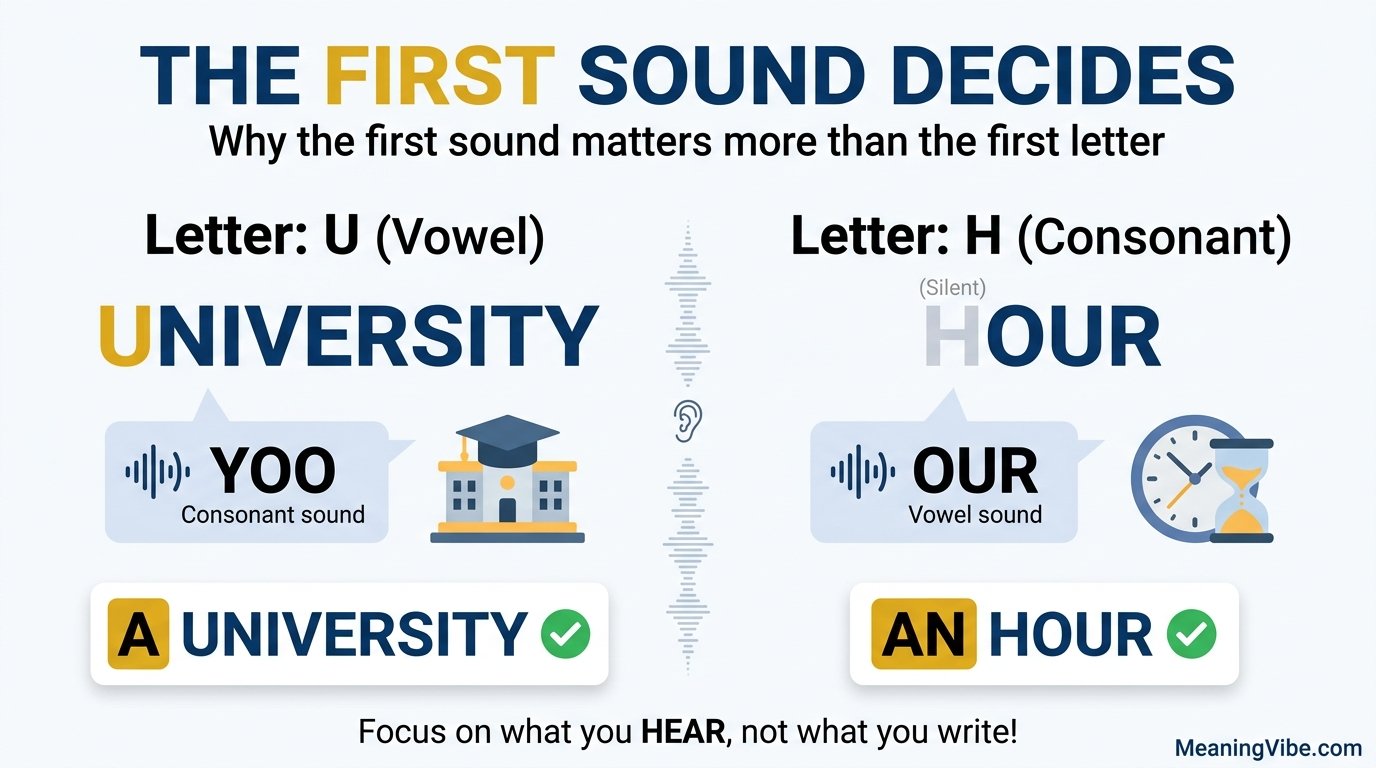
Frequently Asked Questions
1. Is it a hour or an hour?
An hour is correct. The h in hour is silent, so the word opens with a vowel sound, and an is the article that matches a vowel opening.
2. Is it a honest man or an honest man?
An honest man is correct. Honest belongs to the closed silent-h set with hour, honor, and heir, so the word opens with a vowel sound and takes an.
3. Is it a historic day or an historic day?
A historic day is the US default. Standard US pronunciation sounds the h, while an historic survives as a labelled strand from the era when that h was weakly stressed.
4. Is it a university or an university?
A university is correct. University opens with the yoo glide, a consonant sound, so it takes a even though its first letter is a vowel.
5. Is it an umbrella or a umbrella?
An umbrella is correct. Umbrella opens with a true vowel sound, the uh at its start, with no glide in front of it, so it takes an.
6. Is it a MRI or an MRI?
An MRI is correct. MRI is read letter by letter, and the letter name em opens with a vowel sound, so the initialism takes an.
7. Is it a European or an European?
A European is correct. European opens with the yoo glide, the same consonant sound that starts yes, so it takes a despite the vowel letter e.
8. Is it a one-way street or an one-way street?
A one-way street is correct. One opens with the w sound, a consonant sound, so every one compound, including one-way and one-time, takes a.
9. Is it an herb or a herb?
Both are correct, in different regions. US English silences the h and says an herb, while British English sounds the h and says a herb, each following the sound rule.
10. Is it a 8-hour day or an 8-hour day?
An 8-hour day is correct. The figure is read as eight, which opens with a vowel sound, and numbers always take the article of their spoken reading.
11. Is it a FAQ or an FAQ?
It depends on how you read it. Spelled out as eff-ay-kyoo it takes an, and read as fack it takes a, so name the reading before choosing.
12. Is it a FBI agent or an FBI agent?
An FBI agent is correct. The letter name eff opens with a vowel sound, and initialisms follow the first letter name, so FBI takes an while CIA takes a.
13. Is it a NASA mission or an NASA mission?
A NASA mission is correct. NASA is read as a word, that word opens with a consonant sound, and acronyms follow their word reading, so it takes a.
14. Is it a heir or an heir?
An heir is correct. Heir belongs to the closed silent-h set, its h is never pronounced in standard US English, and the word opens with a vowel sound.
15. Is it a hotel or an hotel?
A hotel is correct. The h in hotel is fully sounded, a consonant opening, and only the four closed-set roots, hour, honest, honor, and heir, silence their h.
16. Is it a honor or an honor?
An honor is correct. Honor is one of the four silent-h roots, so it opens with a vowel sound and takes an, as do honorable and honorary.
17. Is it a eulogy or an eulogy?
A eulogy is correct. Eulogy opens with the yoo glide, like European and euphemism, so the eu spelling takes a rather than an.
18. Is it a USB cable or an USB cable?
A USB cable is correct. The letter name for U is yoo, a consonant opening, so USB and URL both take a despite starting with a vowel letter.
19. Is it a LED screen or an LED screen?
An LED screen is the majority US form. Most readers spell LED out, and the letter name el opens with a vowel sound, though the rare word reading led would take a.
20. Why do we say an hour when hour starts with h?
Because the h in hour is silent. The word is pronounced our, opening with a vowel sound, and the article follows the pronunciation, never the written letter.
21. What is the rule for using a and an?
Choose by the first sound of the next word. A before a consonant sound and an before a vowel sound, judged on the word immediately after the article, adjective included.
22. Is the a/an rule based on the first letter or the first sound?
The first sound, never the first letter. Spelling misleads on hour, university, one, and every initialism, while the opening sound gives the right verdict in all of them.
23. Why is it a university but an umbrella?
Because their u sounds differ. University opens with the yoo glide, a consonant sound, while umbrella opens with a true vowel sound, so the same letter takes opposite articles.
24. Why is it an honest man but a happy man?
Because happy sounds its h and honest does not. Honest sits in the closed silent-h set and opens with a vowel sound, while happy opens with a consonant sound.
25. Does an adjective between the article and the noun change a to an?
Yes, the adjective takes over the decision. The word immediately after the article decides, so a teacher becomes an excellent teacher when the adjective opens with a vowel sound.
26. How do you choose a or an before numbers?
Read the number aloud and follow its first sound. Eight, eleven, eighteen, and eighty open with vowel sounds and take an, while one opens with a w sound and takes a.
27. Is it an 11-dollar ticket or a 11-dollar ticket?
An 11-dollar ticket is correct. Eleven opens with a vowel sound, so prices, ages, and quantities built on eleven take an, exactly as the spelled word would.
28. Is “an historic” grammatically wrong?
No, it is not a plain error. Merriam-Webster records both forms before a weakly stressed h, and this page grades an historic as a labelled strand under the US default a historic.
29. Why do British speakers say a herb while Americans say an herb?
Because the two regions pronounce herb differently. Americans drop the h and say erb, giving an herb, while British speakers sound the h, giving a herb, under one shared rule.
30. How do you choose a or an before acronyms that are pronounced as words?
Follow the word reading, not the spelling. Say the acronym as a word, hear its first sound, and choose accordingly, which gives a NASA mission and an AIDS researcher.
31. How do you choose a or an before initialisms that are pronounced letter by letter?
Follow the first letter name, not the letter. Names opening with vowel sounds, F, H, L, M, N, R, S, and X, take an, and all the rest take a.
32. What if an abbreviation can be read two different ways, like FAQ or SQL?
Grade it by reading and print both forms. FAQ, SQL, and LED each split by pronunciation, so name the reading, lead with the majority US form, and label the minority honestly.
33. Which words starting with u take a instead of an?
U words with the yoo glide take a. University, union, unit, unique, useful, user, utensil, and U-turn all open with that consonant glide, while true vowel u words take an.
34. Which words starting with eu take a instead of an?
Eu words pronounced yoo take a. European, eulogy, euphemism, and eucalyptus all open with the glide, so the eu spelling behaves exactly like the yoo u words.
35. Which words starting with h take an?
Only the closed set takes an. Hour, honest, honor, and heir, plus their families like hourly and heirloom, are the h words with silent h in standard US English.
36. Is it a historical or an historical?
A historical is the US default. The h is sounded in standard US pronunciation, and an historical is graded with an historic as a labelled strand, not the default verdict.
37. Is it a hysterical or an hysterical?
A hysterical is correct in standard US English. The h is sounded, and an hysterical is graded a minority form against that standard verdict.
38. Is it a homage or an homage?
A homage is the standard US verdict. The h is sounded, while an homage survives as a minority strand under French influence and is labelled as such.
39. Is it a ewe or an ewe?
A ewe is correct. Ewe is pronounced yoo, opening with the glide, so this small farm word joins the university family and takes a.
40. Is it a species or an species, and how do plural-looking singular nouns work?
A species is correct. Species is a singular countable noun despite its s ending, and it opens with a consonant sound, so grammar and pronunciation agree on a.
41. Where do the words a and an come from?
They descend from one word meaning one. Merriam-Webster traces an to Old English an, meaning one, with a as its reduced pre-consonant form, first used before the 12th century.
42. Why does my spellchecker not catch a/an mistakes?
Because a and an sound alike in fast speech. Checkers compare letters, not sounds, so they cannot hear that a hour is wrong, and no reputable source publishes an error rate for the mistake.
Conclusion
When to use a vs an is a listening decision, not a spelling decision. Voice the next word, name its opening sound, and the article chooses itself in nearly every sentence you will ever write.
The trap families are the whole game. The closed silent-h set, the yoo glide, the letter names, the word readings, and numbers by reading cover every case that the spelling rule gets wrong.
The graded cases stay graded on purpose. Historic, herb, FAQ, SQL, and LED carry labels instead of forced answers, and the wider grammar set indexed from the MeaningVibe home page carries the rest of the system.
Say it aloud, then write what you heard. That single habit, applied family by family through the bank on this page, is the complete method behind every verdict above.