
Prepositions for since rules confuse learners because for and since look interchangeable in the same sentence slot. They never are: since names where the time starts, and for measures how long it runs.
Ask one question about the words that follow the gap, and the choice makes itself. Can you point to the start on a calendar or clock, or can you measure the length like a distance?
Both words live mainly inside the present perfect system. That is why the tense choice matters here just as much as the preposition choice, and why the two are taught together.
The lesson builds one system: the test, the two banks, the tense pairing, the since clause, the boundary words, and the error bank.
Quick Answer: The One Question
Look at the time expression and ask what kind of thing it is. A starting point takes since, and a measured length takes for, in almost every sentence you will ever build.
|
The test |
SINCE: the starting point |
FOR: the measured length |
|---|---|---|
|
Ask this |
Can I point to it on a calendar or clock? |
Can I measure how long it lasts? |
|
Typical partners |
since Monday, since 2010, since 9 am, since June, since we met |
for two hours, for 15 years, for six months, for ages, for a while |
|
Memory line |
Since shows the start line |
For shows the full stretch |
The same stretch can be described from either end, or with both ends together. I have lived here since 2020, for six years gives the start line and the measure in one sentence.
Keep three warnings in mind. Ago runs the opposite way, present simple verbs break with since, and phrases like since last week against for the last week split on one small word.
Rule 1: SINCE Plus a Starting Point You Can Point To
Use since when the expression after it names the moment something began. The moment can be read off a clock, a calendar, or a remembered event, but it must be a point, not a length.
|
Point type |
Examples with since |
|---|---|
|
Clock times |
since 9 am, since noon, since midnight |
|
Days and dates |
since Monday, since July 4th, since my birthday |
|
Months and years |
since June, since 2010, since 1998 |
|
Past time words |
since yesterday, since last week, since then |
|
Events |
since breakfast, since the war, since the meeting |
|
Clauses |
since we met, since I arrived, since I was a child |
Clock Times, Days, Months and Years as Points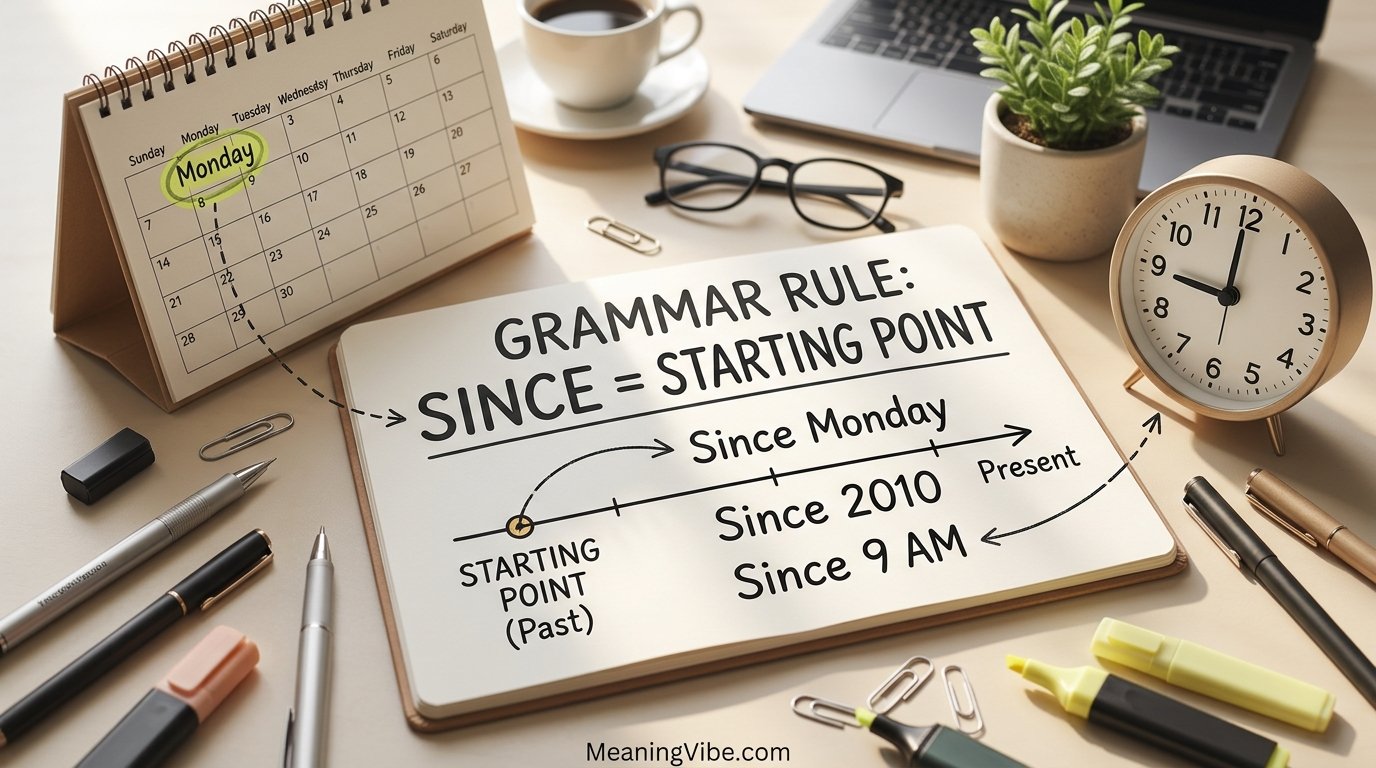
A year after since is a point, because it marks where the line starts, not how long the line is. I have lived here since 2010 points at the start of the stay.
The same logic covers months and days. Since June and since Monday name start lines on the calendar, which is why for June and for Monday fail the test in this use.
Events Are Points Too
An event names the moment it happened, so events behave exactly like calendar points. Since the war, since the accident and since breakfast all point at a single start moment.
If when did it happen has a one moment answer, since fits. If the answer needs a length, the expression belongs to for.
Since Then and Ever Since
Since then points back to a moment already named: he moved here in 2020 and has lived alone since then.
Ever since stresses the whole unbroken stretch. It follows a point, ever since that day, or stands alone: he has been careful ever since.
Since This Morning: The Careful Form
The careful standard form is since this morning, with this marking the exact start point. It has been raining since this morning is the form to learn for exams and writing.
You will also hear since morning in informal speech and in some varieties of English. Recognise the short form when you meet it, but write the full form yourself.
Rule 2: FOR Plus a Duration You Can Measure
Use for when the expression after it names a length of time you could measure. The length can be exact, like two hours, or vague, like ages, but it must be measurable.
|
Length type |
Examples with for |
|---|---|
|
Numbers plus units |
for two hours, for three days, for six months, for ten years |
|
Short lengths |
for a minute, for a moment, for a while |
|
Vague lengths |
for ages, for a long time, for years |
|
Recent stretches |
for the last three days, for the past week |
|
Whole spans |
for my whole life, for most of the week |
Numbers Plus Units: The Core Bank
The clearest for phrases pair a number with a unit: hours, days, weeks, months, years. She has worked here for two years measures the stay from start to now.
That is why since two years is the most common error in this whole topic. Two years is a length with no fixed start, and lengths always take for, in every tense.
A While, Ages and Other Vague Lengths
A length does not need a number to take for. For a while, for ages and for a long time are lengths too, because each one measures a stretch rather than pointing at its start.
The test still decides: you cannot point at ages on a calendar, so since ages fails and for ages stands.
For With Finished Periods: The Past Simple Use
For is not tied to the present perfect. When the period is finished and closed, for pairs with the past simple: we lived in Dallas for five years, and then moved away.
The up-to-now meaning comes from the pairing, not from for itself. Present perfect plus for reaches the present; past simple plus for stays finished.
When For Disappears: Omitting For, and All Takes No For
In informal English, for is often left out after verbs like be, live and wait. We have been here an hour and how long have you been waiting are both natural without it.
One pattern never takes for at all: all plus a time noun already carries the duration. They worked all night and she slept all day are correct; for all night is an over-application error.
Last vs The Last: One Small Word Changes the Job
The pair since last week and for the last week looks like a contradiction until the test is applied. Last week without the is a point; the last week with the is a measured period.
|
Phrase |
What it names |
Correct sentence |
|---|---|---|
|
since last week |
The point about seven days ago |
I have been here since last week |
|
for the last week |
The seven day period just completed |
I have been here for the last week |
|
for the last three days |
A continuous stretch up to now |
He has been ill for the last three days |
|
in the last three days |
Events framed inside the period (US strand) |
It has rained twice in the last three days |
The in the last three days form is a labelled American strand with a different job. It frames separate events inside the period, where for measures one continuous state across it.
A second American strand appears after negatives. I have not seen him in months is standard American English beside the neutral for months; Michael Swan notes the strand in Practical English Usage.
Print the strands side by side and labelled, never merged. Knowing which form belongs to which job, and which variety favours it, protects learners from unfair marking.
Rule 3: The Tense Pairing: Why the Present Perfect Carries Both
Since and for measure time up to a reference point, usually now. English marks that reach with perfect tenses, which is why the present simple and present continuous break beside them.
|
Form |
Shape |
With since |
With for |
|---|---|---|---|
|
Present perfect |
have or has plus past participle |
I have lived here since 2010 |
I have lived here for 15 years |
|
Present perfect continuous |
have or has plus been plus verb-ing |
It has been raining since this morning |
It has been raining for an hour |
|
Past perfect |
had plus past participle |
By 2020, he had worked there since 2010 |
She had been waiting for an hour when we arrived |
Present Perfect: States and Finished Results
Use the present perfect simple for states and for results that still hold. I have known him since 2019 and she has lived here for years describe states reaching the present moment.
The British Council groups for and since under exactly this use: things that started in the past and continue to now.
Present Perfect Continuous: Activities in Progress
Use the present perfect continuous for activities still in progress at the moment of speaking. Has been raining since this morning and have been waiting for an hour stress the activity itself.
The choice is about focus. Continuous forms watch the activity running; simple forms report the state or the result so far.
Stative Verbs Stay Simple
Verbs like know, be, believe, own and want describe states, not activities, and they never take the continuous. I have known her since we met is correct; I have been knowing her is not.
Cambridge lists this exact family in its present perfect typical errors: they have known each other since January, not they know, and not they are knowing. The state takes the simple perfect.
Past Perfect: A Past Reference Point
When the reference point sits in the past, the pairing shifts one step back. By 2020, he had worked there since 2010 measures the stretch up to 2020, not up to today.
The same test still chooses the preposition. Only the tense changes, to match the past reference point.
How Long Questions and Short Answers
How long is the question word this system answers. How long have you been here uses the present perfect, and the answer gives either end of the same stretch of time.
Answer with a length or with the starting point: for six years, or since 2020. Both answers are complete, because how long asks about the stretch, and each end describes it fully.
Since Clauses: Past Simple Inside, Present Perfect Outside
Since can introduce a whole clause naming the start, not just a noun. I have known her since we met packs the starting event into a clause of its own.
The Basic Pattern
The verb inside the since clause is past simple, because the starting event is finished. The main clause carries the present perfect: since I arrived, since we met, since I was a child.
Hold the split firmly: past simple inside, perfect outside. Swapping the two halves is a typical error.
Fronting the Since Clause
A since clause can move to the front of the sentence for emphasis. Since I left school, I have worked in three cities keeps the same tenses in the same halves.
Fronting changes the rhythm, never the rule. The tenses stay in their halves wherever the clause sits.
The Have-Seen Variant, Labelled
A small variant strand puts a present perfect inside the clause with verbs like see: it is years since I have seen him. Cambridge notes the pattern in its since entry.
Learn it as a labelled strand, not the standard. Exams expect the past simple form: since I saw him.
It Is Two Years Since: One Fact, Four Forms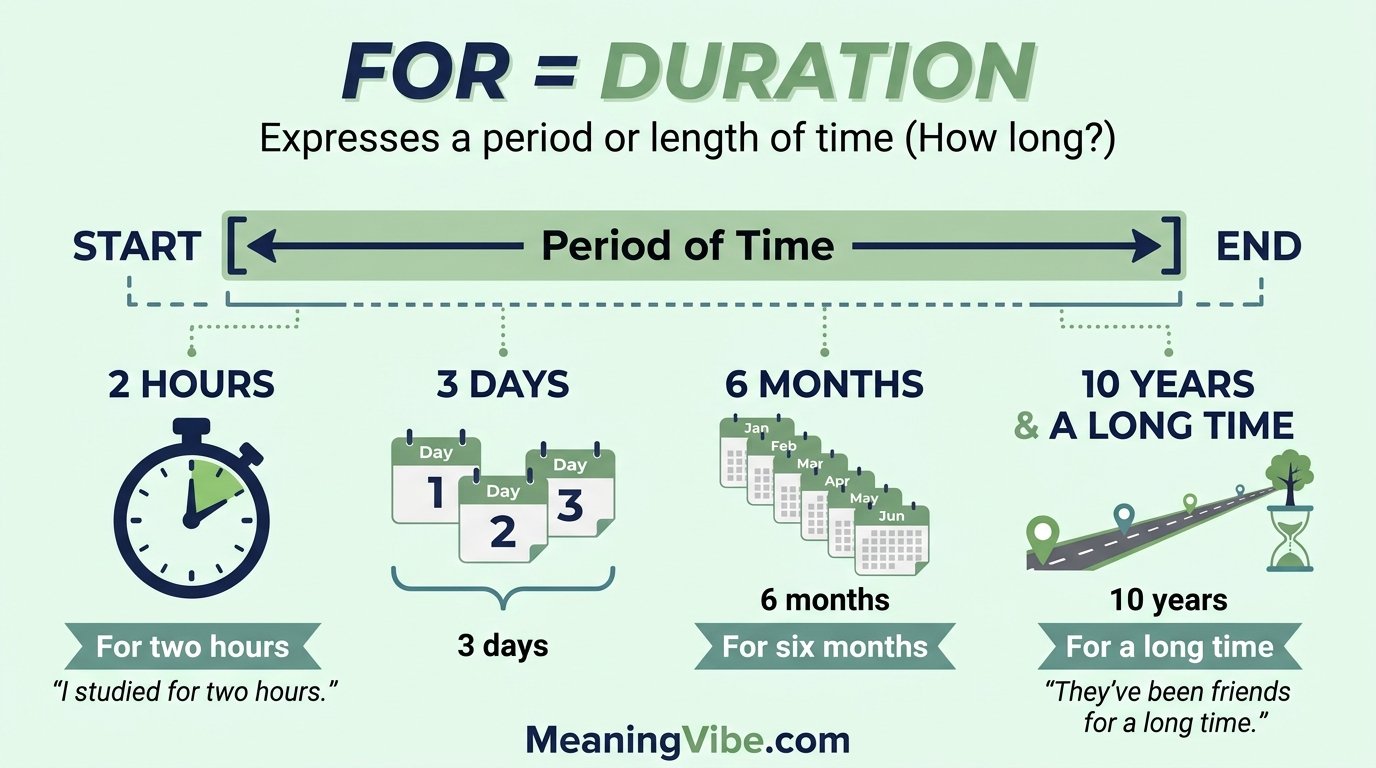
English owns a special construction for measuring the gap since a finished event. It is two years since we met counts the empty stretch between that meeting and this moment.
|
Form |
Sentence |
What it stresses |
|---|---|---|
|
It is plus time plus since |
It is two years since we met |
The gap measured from the event |
|
It has been plus time plus since |
It has been two years since we met |
The same gap, a common variant |
|
Ago form |
We last met two years ago |
The finished moment itself |
|
Negative for form |
We have not met for two years |
The empty stretch up to now |
All four sentences report one fact, and converting between them is a favourite exam exercise. The construction also powers the question form: how long is it since you last saw him?
A past version exists too: it was two years since I had ridden a bike. The main clause turns past, the clause takes the past perfect, and the gap logic stays identical.
The Boundary Trio: Ago, From and During
Three neighbours cause most of the remaining confusion. Each does a different job from since and for, and the table keeps them apart at a glance.
|
Word |
Its job |
Tense partner |
Example |
|---|---|---|---|
|
since |
Names the start, runs forward to now |
Present perfect or perfect continuous |
I have lived here since 2021 |
|
for |
Measures the length of a stretch |
Any tense |
I have lived here for five years |
|
ago |
Counts back to one finished moment |
Past simple only |
I moved here five years ago |
|
from |
Names a start in any direction |
Any tense |
The course runs from Monday to Friday |
|
during |
Names the event a thing happened inside |
Any tense |
He slept during the meeting |
Ago: Counting Backwards to a Finished Moment
The deepest difference in this topic is direction. Since starts at a past point and runs forward to now, while ago starts at now and counts backward to one finished moment.
That direction decides the tense. Ago names a finished moment, so it takes the past simple and never the present perfect: I saw him two days ago, never I have seen him two days ago.
Practise the conversion until it feels automatic. I moved here five years ago, I have lived here for five years, and I have lived here since 2021 are one fact told three ways.
|
Finished form with ago |
Up to now form with since |
Up to now form with for |
|---|---|---|
|
I moved here five years ago |
I have lived here since 2021 |
I have lived here for five years |
|
We met in 2019 |
We have known each other since 2019 |
We have known each other for seven years |
|
The rain started this morning |
It has been raining since this morning |
It has been raining for several hours |
From vs Since: A Start in Any Direction
From names a starting point too, but without the up to now link that since carries. From works in any direction: the shop opens from Monday, and the course runs from 2020 to 2025.
Choose since when the stretch reaches now inside a perfect tense. Choose from for future starts, ranges with to, and phrases like from now on.
During vs For: Event Noun or Measured Length
During and for split on what follows them. During takes an event noun, during the meeting or during the holidays, while for takes the measured length, for two hours.
So during two hours is a typical error, because two hours is a length, not an event. The separate contrast between during and a clause word belongs to the planned during vs while lesson.
The Other Jobs of For and Since, Briefly
Both words do other jobs outside the time system. Naming them once stops learners over-applying the rules; this section is a boundary marker, not a second lesson.
Purpose-For and Recipient-For
For lunch names a purpose, not a length of time, and this is for you names a recipient. Neither use measures duration, so neither follows the point or period test at all.
Time-for answers how long. If the sentence answers what something is for, or who it is for, a different for is at work.
Since Meaning Because
Since also introduces reasons: since you ask, since it is late, we should leave. That since is a conjunction meaning because, and it takes ordinary tenses, not the perfect pairing.
If since can be swapped for because without breaking the meaning, you are looking at the other job of the word.
The Decision Flow: One Question, Two Checks
When a sentence stops you, run the one question first, then the two checks. Almost every real sentence in this topic is decided before the checks are even needed.
- Point or period? Look at the words after the gap. A start you can point to on a calendar or clock takes since; a length you can measure takes for.
- Does the stretch reach now? If it reaches now or another reference point, choose a perfect tense. If the moment is finished, switch to ago with the past simple instead.
- Is a boundary word the real answer? An event noun wants during, a start in any direction wants from, and a reason clause wants since meaning because, outside the time system entirely.
Read your sentence backwards as a final check. Name what the phrase describes, start line or full stretch, and the preposition should match.
Twelve Typical Errors, Corrected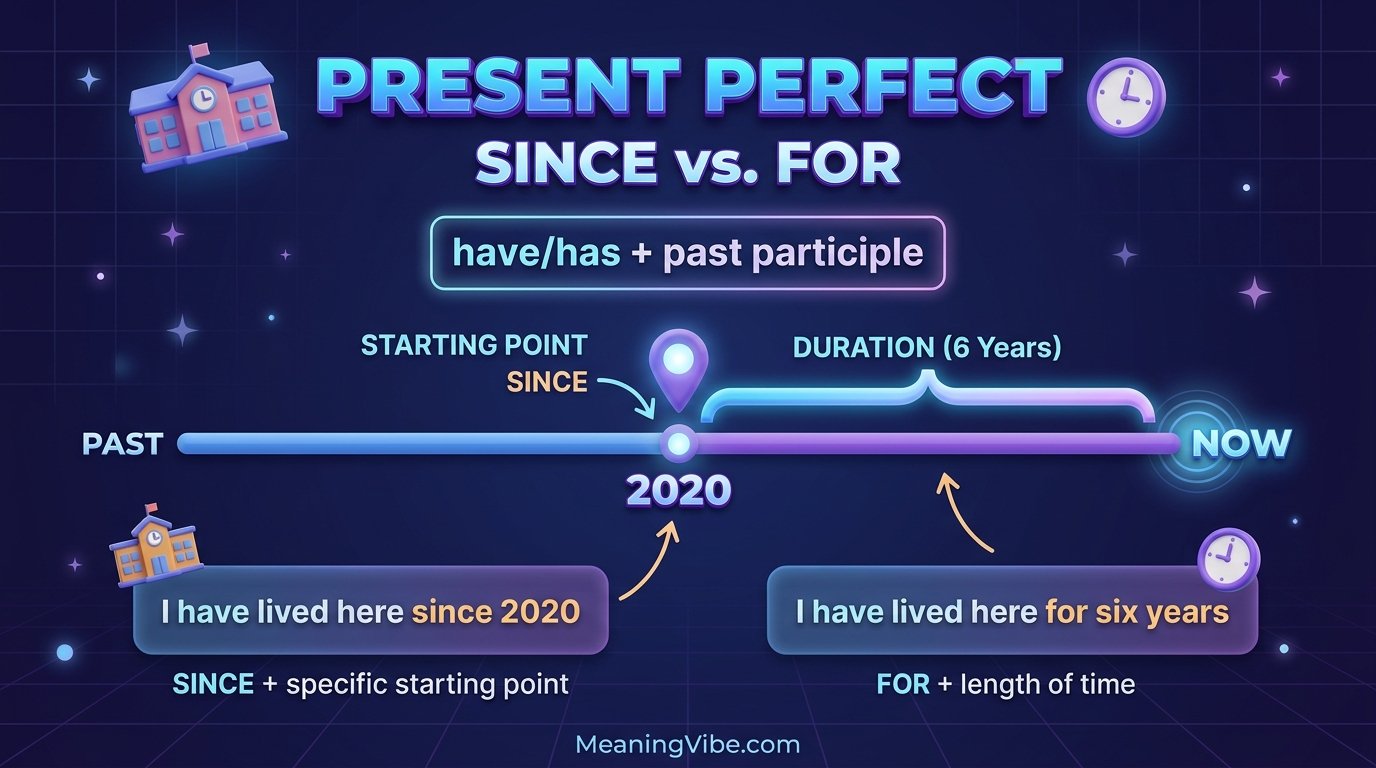
The table collects typical learner errors, the mistakes teachers and exam boards meet again and again. They are labelled typical errors from teaching practice, never as measured statistics.
|
# |
Typical error |
Correct form |
Why |
|---|---|---|---|
|
1 |
since two years |
for two years |
A measured length takes for |
|
2 |
for Monday (up to now) |
since Monday |
A calendar point takes since |
|
3 |
I live here since 2010 |
I have lived here since 2010 |
Time up to now needs a perfect tense |
|
4 |
I am working here since 2019 |
I have been working here since 2019 |
The present continuous cannot carry up to now |
|
5 |
since 3 hours |
for 3 hours |
Three hours is a length, not a point |
|
6 |
for 2019 (as a start) |
since 2019 |
A year naming the start takes since |
|
7 |
I have seen him two days ago |
I saw him two days ago |
Ago takes the past simple only |
|
8 |
during two hours |
for two hours |
During takes an event noun, never a length |
|
9 |
I have lived here from 2019 |
I have lived here since 2019 |
From lacks the up to now perfect link |
|
10 |
for all night |
all night |
All plus a time noun already carries the duration |
|
11 |
They know each other since January |
They have known each other since January |
A state up to now takes the present perfect |
|
12 |
Since how long have you been here? |
How long have you been here? |
Since how long is a learner strand, not the standard form |
Read the why column aloud as you correct each line. Naming the reason is what turns a corrected sentence into a rule you keep.
Practice: Three Exercise Sets With a Full Answer Key
Practice turns the test into a habit, so finish each set before opening the key. Say each sentence aloud, because the ear catches wrong words early.
Set A isolates the point or period choice, Set B works the tense pairing and clauses, and Set C mixes boundary words with corrections.
Exercise Set A: Point or Period
- I have known her ___ 2019.
- We have been waiting ___ forty minutes.
- It has been raining ___ this morning.
- He has worked here ___ six years.
- They have been married ___ 2015.
- She has been ill ___ a week.
- The shop has been open ___ 9 am.
- I have not seen him ___ ages.
Exercise Set B: Tenses and Since Clauses
- I ___ (live) here since 2020.
- She ___ (work) here since 2019.
- I have known him since we ___ (meet) at school.
- Since I ___ (leave) school, I have worked in three cities.
- How long ___ you ___ (be) here?
- By 2020, he ___ (work) there since 2010.
- It is three years since we last ___ (see) them.
- They ___ (know) each other since January.
Exercise Set C: Boundary Words and Corrections
- I last saw him three years ago. I have not seen him ___ three years.
- We moved here in 2021. We have lived here ___ 2021.
- The course runs ___ Monday to Friday.
- He slept ___ the meeting.
- He slept ___ two hours.
- Correct this sentence: I am here since Monday.
- Correct this sentence: She has been living here since five years.
- Correct this sentence: I have seen him two days ago.
Answer Key
|
Set |
Answers |
Reason in one line |
|---|---|---|
|
A |
1 since, 2 for, 3 since, 4 for, 5 since, 6 for, 7 since, 8 for |
Years, days and clock times are points; minutes, years counted, weeks and ages are lengths |
|
B |
1 have lived (have been living), 2 has worked (has been working), 3 met, 4 left, 5 have, been, 6 had worked (had been working), 7 saw, 8 have known |
Perfect outside, past simple inside the since clause, past perfect for a past reference point |
|
C |
1 for, 2 since, 3 from, 4 during, 5 for |
Ago converts to for, a start year takes since, a range takes from, an event takes during |
|
C corrections |
6 I have been here since Monday. 7 for five years. 8 I saw him two days ago |
Present simple breaks with since, since cannot take a length, ago needs the past simple |
Score yourself by reason, not by answer alone. A right word chosen for a wrong reason means that rule section needs one more read.
How These Rules Were Checked
Every rule in this lesson was checked against standard references for English grammar. The aim was agreement between authorities, not the habits of any single website, course page or textbook.
The tense error family follows Cambridge Dictionary’s present perfect typical errors page, which corrects since with periods and the present simple with since in exactly these terms.
The since clause pattern and the it is construction follow the Cambridge grammar page on since, which sets out the tense split and the labelled have-seen variant.
The tense pairing follows the British Council LearnEnglish present perfect reference, which places for, since and how long together under unfinished states that started in the past and continue.
The last versus the last distinction and the American in after negatives strand follow Michael Swan’s Practical English Usage, section 208. Oxford Learner’s short answer patterns support the how long section.
Where authorities describe both forms, this lesson prints both and labels the strand. No statistic has been invented to support any rule.
Frequently Asked Questions
Since 2010 or for 2010?
Since 2010. A year names a starting point you can point to on a calendar, and points take since: I have lived here since 2010. For 2010 would treat the year as a length.
Is it since two years or for two years?
For two years. Two years is a measured length, and lengths take for: she has worked here for two years. Since two years is the most common error in this whole topic.
How long have you been here: do I answer with for or since?
Either. Both describe the same stretch from different ends: a length (for six years) or the starting point (since 2020).
Can since be followed by a clause?
Yes. Since can introduce a whole clause naming the start: I have known her since we met. Inside the clause, past simple; in the main clause, present perfect.
What tense goes inside a since clause?
The past simple: since I arrived, since we met, since I was a child. The main clause takes the present perfect or present perfect continuous. That split is the rule, not a coincidence.
Since morning or since this morning?
Since this morning is the careful standard form. Since morning is widely heard in informal speech and in some varieties; learn this morning for exams and writing, and recognise the short form.
For the last three days or in the last three days?
Both exist, with different jobs. For the last three days measures a continuous stretch up to now. In the last three days, common in American English, frames separate events inside the period.
Why is I live here since 2010 wrong?
Because since measures time up to now, and English marks that with a perfect tense. Say I have lived here since 2010. Cambridge lists this exact error family.
Is I am working here since 2019 correct?
No. The present continuous cannot carry time up to now with since. Use the present perfect continuous instead: I have been working here since 2019.
Can I use since with the past simple?
Not for time up to now. The past simple appears inside the since clause itself, or with ago for finished moments: I left two years ago.
What is the difference between since and ago?
Direction. Since starts at a past point and runs forward to now, with a perfect tense. Ago counts backward from now to one finished moment, with the past simple: I moved here five years ago.
Can ago be used with the present perfect?
Never. I have seen him two days ago is wrong, because ago names a finished moment. Say I saw him two days ago, or change the marker: I have not seen him for two days.
From Monday or since Monday?
Since Monday if the period runs up to now: I have been busy since Monday. From Monday names a start without that link: the course runs from Monday to Friday.
During or for: which one takes a number?
For. During takes an event noun (during the meeting, during the holidays), never a measured length. For takes the length (for two hours). During two hours is a typical error.
What does ever since mean?
Ever since strengthens since and stresses the whole stretch from the point to now: ever since that day, ever since we met. It can also stand alone: he has been careful ever since.
Can since start a sentence?
Yes. A since phrase or clause can be fronted: Since 2010, I have lived here. Since I left school, I have worked in three cities. The tense pairing does not change when the phrase moves.
Is since how long correct?
Not in standard English. Since how long appears in some learner varieties, including Indian English, as a translation pattern. The standard question is How long have you, answered with for or since.
Can for be left out?
Often, in informal English, especially after be, live and wait: we have been here an hour. It is optional style, never an error, but keep for in formal writing.
Why is there no for in worked all night?
Because all plus a time noun already carries the duration, and for is not used before all: they worked all night, she slept all day. Adding for, for all night, over-applies the rule.
Since last week or for the last week?
Both, with different meanings. Since last week names the point about seven days ago. For the last week measures the seven day period just completed. Swan’s Practical English Usage draws exactly this line.
What does it is two years since we met mean?
It measures the gap from a past event to now. The same fact has four forms, including we last met two years ago and we have not met for two years.
Is it has been two years since also correct?
Yes. It has been two years since we met is a common variant of it is two years since we met. Both are standard; the it is form is the one reference books teach first.
Does since always need the present perfect?
For time up to now, it needs a perfect tense: present perfect for now, past perfect for a past reference point. The exception family is the it is X since construction, present simple by design.
Can since mean because in the same sentence system?
Yes, and it is a different job. Since you ask gives a reason, and that since takes ordinary tenses, not the perfect pairing.
For lunch: is that the time for?
No. For lunch is purpose-for, naming what something is for, not how long it lasts. Recipient-for, this is for you, is a third separate job.
Since June or in June?
Different jobs, both correct. Since June with a perfect tense looks back from June to now: I have been here since June. In June simply places an event inside the month: we met in June.
Has been raining since morning: is morning a point?
Yes, in effect. Morning marks the start of the day, so it behaves as a point. The careful form is since this morning; the short form is the informal strand.
Can I say since two years ago?
Yes, and it proves the rule. Two years ago names a point, the moment two years back, so since can take it. For two years is still simpler and more natural for the same fact.
For a long time or since a long time?
For a long time. A long time is a length with no fixed start, so it takes for. Since needs a point you can name: since 2019, since Monday, since we met.
How do I choose between present perfect and present perfect continuous with for and since?
Use the continuous for activities in progress (has been raining since this morning) and the simple perfect for states and results (have known since 2019). Stative verbs like know never take the continuous.
Can for be used with the past simple?
Yes, when the period is finished: we lived in Dallas for five years, and then moved away. For is not tied to one tense; the up to now meaning comes from pairing it with the present perfect.
Haven’t seen him in months or for months?
Both are standard. For months is the neutral form; in months after a negative is especially common in American English, as Swan notes. Print both, label the strand, and never mark either wrong.
Since the war: is an event a point?
Yes. An event names the moment it happened, so events behave as points: since the war, since the accident, since breakfast, since the meeting ended.
What is the difference between since then and ever since?
Since then needs the earlier point named or understood: he moved in 2020 and has lived alone since then. Ever since can stand alone at the end and adds emphasis to the whole stretch.
Can since be used for the future?
No. Since only looks back from a point to a reference moment, now or past. For future starts use from instead: the offer runs from Monday; I will be away from Friday.
Is since 3 hours or for 3 hours correct?
For 3 hours, also written for three hours. Three hours is a length you can measure, and measured lengths always take for, in every tense and at every level.
Why do exams ask since five years questions so often?
Because it is the highest frequency learner error in this system: a duration wearing a point word. Exam boards use it as a stock error spotting item. The fix is one word: for.
How long is it since you last saw him: what tense answers it?
The question uses the it is since construction with a past simple inside. Natural answers: three years, or I last saw him three years ago, or I have not seen him for three years.
Does for work with all tenses or only the present perfect?
All tenses. For measures duration anywhere: finished past periods, up to now with the perfect, and future stays like will stay for a week.
Since I have been here or since I was here?
The clause uses the past simple of the starting event: since I arrived, since I came here. A small have-seen variant exists, but the past simple is the taught standard.
What is the fastest test when I am stuck between for and since?
Ask one question about the words after the gap: can I point to it on a calendar or clock as a start (since), or can I measure its length (for)? That single test decides nearly every case.
For how long or how long: which question form is standard?
How long have you been here is the everyday standard. For how long exists as a more formal variant, and how long are you here for asks about a future stay. They differ in register, not correctness.
Conclusion
Prepositions for since rules stop feeling like two lists to memorise once the one question is in place. Point to the start and the answer is since; measure the length and the answer is for.
The system earns its keep when you add the finishing layers: the tense pairing, the since clause split, the it is construction, and the boundary words.
Keep practising with the exercise sets above until the reasons come automatically. The master table, the error table and the three sets also form a printable practice pack, so save or print this page as your revision sheet.
Its sister lesson, prepositions in on at rules, covers the size gradient for time and place, and the articles a an the rules lesson completes the small words set on the same cluster.
Grammar grows in clusters on MeaningVibe, one system at a time. Natural next steps are the article pages on when to use a vs an and when to use the, the reported speech rules with their reported speech examples, the direct speech vs indirect speech comparison, and the conditional family: third conditional sentences, zero conditional sentences and mixed conditional sentences.