

Mixed conditional sentences join an unreal condition in one time to an unreal result in another time. Each clause keeps the form of its own time, so the past perfect and would can sit side by side.
The method here is a timeline audit, not a formula list. You stamp each clause first, check any backdating, and only then build the verb forms.
The bank below prints 100 classified items, sorted by timeline distance, from last night to a whole life course, each distance in its own section.
This page sits on MeaningVibe beside the live First Conditional Sentences and Second Conditional Sentences pages. The third and zero conditional pages are named in text only until they publish.
What a Mixed Conditional Sentence Is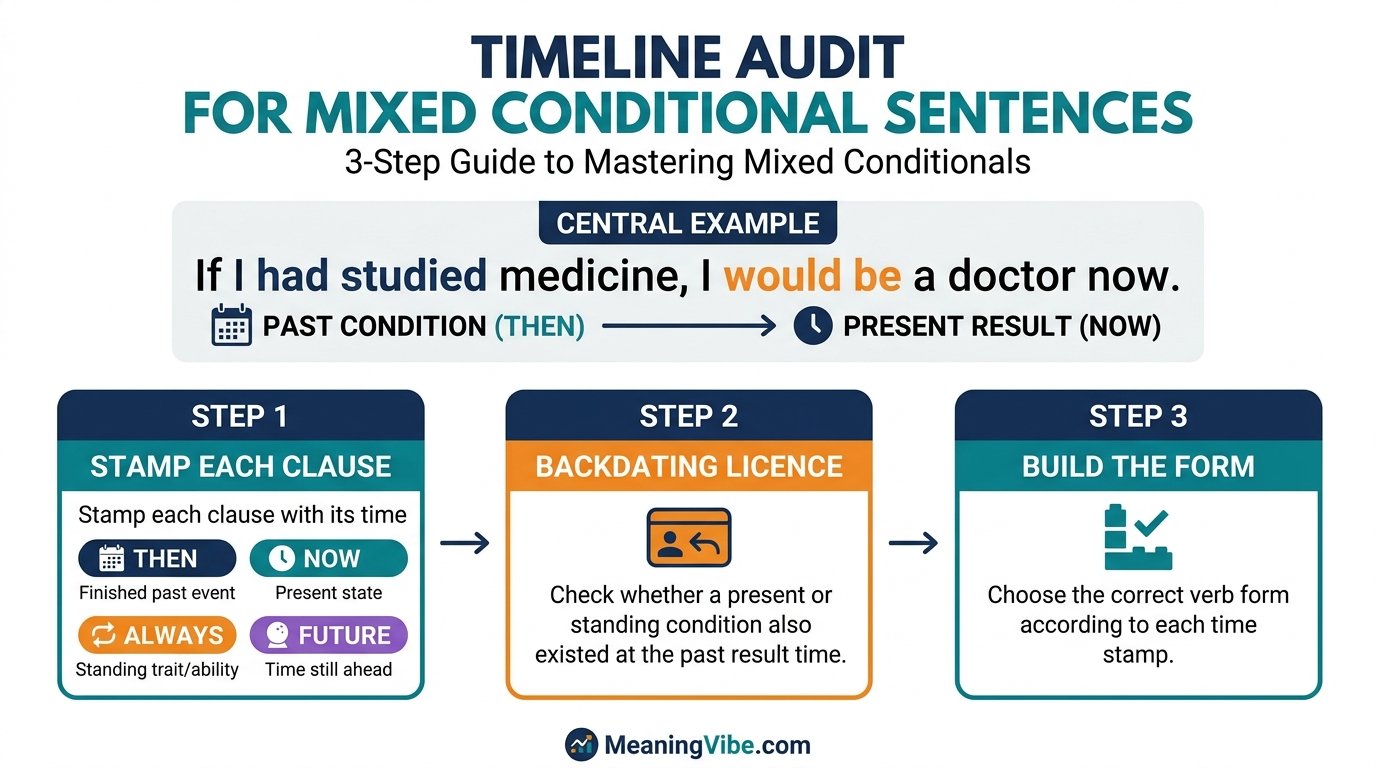
A mixed conditional sentence has two clauses pointing at different times, both unreal. The if clause gives a false condition; the main clause gives the imagined result in another time.
Nothing here is a new tense. A past condition borrows the past perfect from the third conditional; a present result borrows would plus base verb from the second.
The wider family is mapped in the Cambridge Dictionary grammar entry on conditionals and wishes. This page owns the corner where the times refuse to match, where regret and alternative life stories live.
A quick reality test proves any example. If I had studied medicine, I would be a doctor now means I did not study medicine then, and I am not a doctor now.
The Timeline Audit: Stamp, Backdate-Check, Build
The timeline audit is a three step protocol used on every sentence here. It turns a memorized formula into a meaning decision, made before any verb form.
Step 1: Stamp Each Clause
- THEN. Stamp a clause THEN for a finished past event, such as leaving late last night.
- NOW. Stamp a clause NOW for the present state of things, such as being tired today.
- ALWAYS. Stamp a clause ALWAYS for a standing trait, ability or truth, such as being careful or knowing Spanish.
- FUTURE. Stamp a clause FUTURE for a time still ahead, such as a flight tomorrow or a move next month.
Stamping is about meaning, not grammar. Learners usually know when each half lives, even when they cannot name the form it needs.
Step 2: Run the Backdating Licence Check
The backdating licence applies to one pattern only: an ALWAYS or NOW condition with a THEN result. Ask whether that condition also held at the past time.
If it also held then, the backdating is licensed. If it began only later, the backdating is unlicensed and the sentence must be rebuilt.
A present condition cannot literally change a past event. It can only explain a past result when it was already true then, which the licence check tests.
Step 3: Build the Form for Each Stamp
Once both stamps are fixed, the forms follow automatically. Each stamp owns one form in each clause job, with no mixing inside a single clause.
|
Stamp |
If clause form |
Result clause form |
Example piece |
|---|---|---|---|
|
THEN |
if + past perfect |
would have + past participle |
If I had left / I would have arrived |
|
NOW |
if + past simple, were for be |
would + base verb |
If I were ready / I would leave now |
|
ALWAYS |
if + past simple, were for be |
would + base verb, or would have for a past result |
If she were careful |
|
FUTURE |
Rare as a condition |
would + base verb, or would be + ing |
I would be flying tomorrow |
The Past Perfect Tense Rules supply every THEN form. The Past Simple Tense Rules supply the shape ALWAYS and NOW conditions borrow.
The Two Core Patterns and the Third Lane
Most courses teach two core patterns, taught first here. A third lane, past to future, then gets full named status instead of being buried inside Pattern 1.
|
Lane |
Condition stamp and form |
Result stamp and form |
Example |
|---|---|---|---|
|
Pattern 1 |
THEN, if + past perfect |
NOW, would + base verb |
If I had saved, I would own a house now |
|
Pattern 2 |
ALWAYS, if + past simple |
THEN, would have + past participle |
If I were careful, I would have checked |
|
Third lane |
THEN, if + past perfect |
FUTURE, would + base verb or be + ing |
If you had booked, you would be flying tomorrow |
Pattern 1: Past Condition, Present Result
Pattern 1 connects something that did not happen in the past to a present that is not real now. Its shape is if plus past perfect, then would plus base verb.
This is the regret and explanation pattern. Change one past decision and the present changes with it, as bank sections A, B and C show.
Pattern 2: Present Condition, Past Result
Pattern 2 connects a standing present condition to a past result that did not happen. Its shape is if plus past simple, then would have plus past participle.
This pattern is conceptually harder, because the cause looks present while the effect sits in the past. The backdating licence is the concept that makes it honest.
The Perfect English Grammar mixed conditionals treatment presents the same two patterns as its two types. The Settemila Lingue mixed conditionals page likewise starts from meaning before formula.
The Third Lane: Past Condition, Future Result
A past condition can also point forward. If you had booked earlier, you would be flying to Chicago tomorrow changes a past booking and imagines a future flight.
Some courses count this lane inside Pattern 1; others list it separately, a labelled strand here. The lane is real either way, so it gets bank section D.
Modals and Running Results
Would is the default result marker, but could marks ability or possibility and might marks weaker possibility. Swapping the modal changes certainty, never the stamps, as section J shows.
A result that is an activity in progress takes would be plus ing. I would be working in Lisbon now pictures a job happening; I would work there pictures an arrangement.
The Backdating Licence in Full
The licence deserves a full section, because Pattern 2 fails silently without it. A sentence can be perfectly formed yet logically false, when its condition did not exist at the result time.
|
Case |
Sentence |
Verdict |
Reason |
|---|---|---|---|
|
Standing trait |
If I were more careful, I would have checked the address yesterday |
Licensed |
Trait that also held yesterday |
|
Standing ability |
If I knew Spanish, I would have translated the letter yesterday |
Licensed |
Standing ability, not learned later |
|
Present only state |
If I knew his new number, I would have called last week |
Unlicensed |
Number learned this week, after the result time |
|
New ability |
If I could use the new software, I would have finished yesterday |
Unlicensed |
Training happened today; ability came too late |
|
Temporary state |
If I were free this afternoon, I would have helped this morning |
Unlicensed |
A state stamped only NOW cannot reach a THEN result |
The fix for unlicensed backdating is a restamp: move the condition into the past as a third conditional, or move the result into the present.
Treat the classic braver case as an audit exercise, never a plain model. If I had been braver, I would have spoken up is third conditional when bravery sits only at that past moment.
The same words earn a mixed reading only when bravery is a standing ALWAYS trait that also held then. The audit note must travel with the sentence.
Labels That Stay Separate: Four Strands
Four questions here have more than one honest answer, so this page labels them strands and never merges them into one asserted rule.
Strand 1: How Many Patterns?
The two pattern count covers the core system. The three lane count adds past to future, which several strong pages list inside Pattern 1.
Strand 2: Which CEFR Level?
Courses often introduce mixed conditionals at B2, while secure control sits at C1. The EngQuiz mixed conditional C1 quiz labels its practice C1, and both placements stay labelled here.
Strand 3: Was or Were?
Formal grammar prefers were for all persons with be, as in If I were taller. Was is common informally, taught here as a register strand, not a simple error.
Strand 4: A Fifth Type?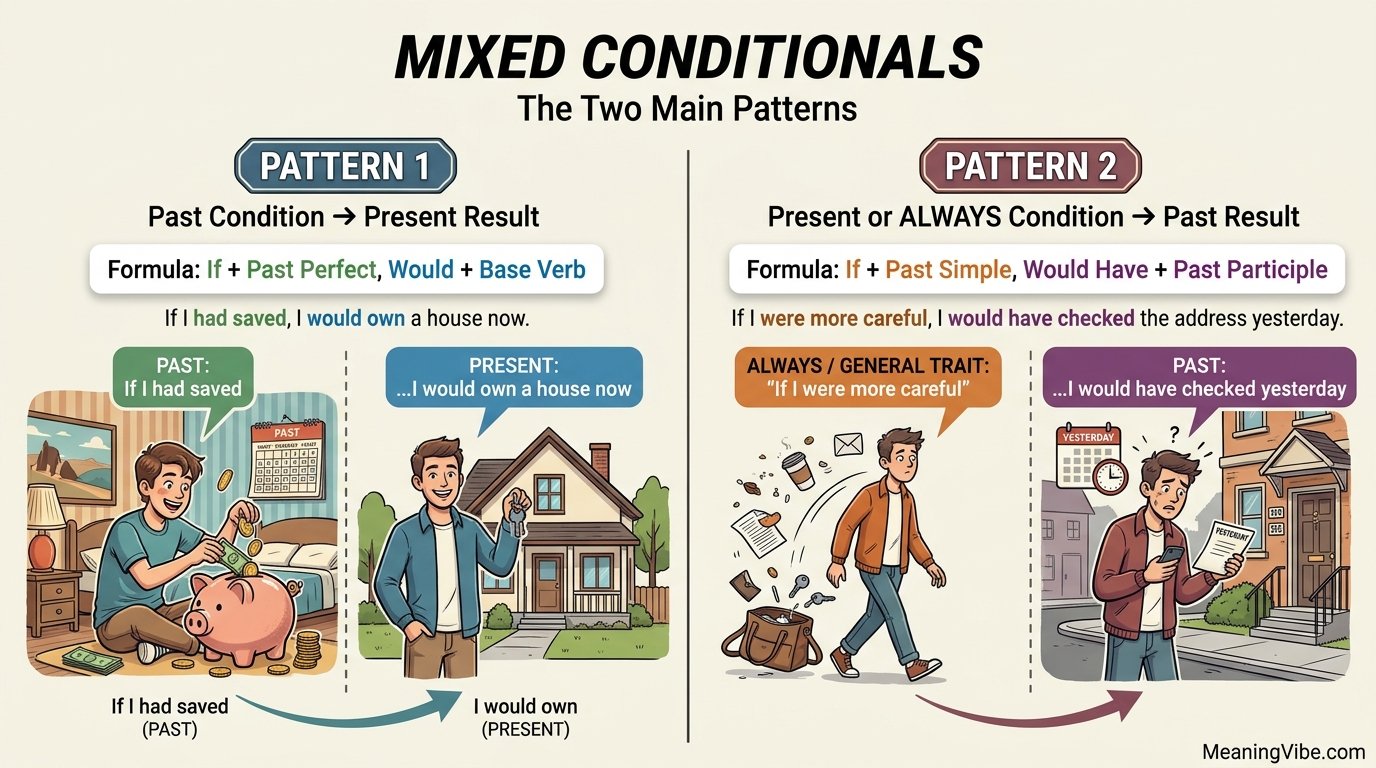
Some courses count mixed as a fifth type, after zero, first, second and third. Others treat mixed as a combination, not a type. The Present Simple Tense Rules page shows how those base forms are built.
100 Mixed Conditional Sentences by Timeline Distance
The bank prints 100 items in eleven sections, sorted by distance and duration, not pattern. Read the stamps first, run the licence check on ALWAYS to THEN items, then check the form.
Each section opens with a reality pair for its lead example, the real facts behind the unreal sentence and the fastest proof of its stamps.
Section A: Short Fuse, Hours or Days Ago to Now (14)
Reality pair, item 1: Fact THEN, I left late. Fact NOW, I am still traveling.
- If I had left the office at five, I would be home now. [THEN / NOW]
- If she had charged her phone last night, it would be working now. [THEN / NOW]
- If we had booked a taxi this morning, we would be at the station now. [THEN / NOW]
- If he had taken the earlier train, he would be here by now. [THEN / NOW]
- If I had checked the traffic an hour ago, I would not be stuck now. [THEN / NOW]
- If they had packed yesterday, they would be relaxing now. [THEN / NOW]
- If you had saved the file last night, it would be on the drive now. [THEN / NOW]
- If the team had finished the test yesterday, we would be free today. [THEN / NOW]
- If I had slept properly last night, I would feel alert now. [THEN / NOW]
- If she had replied this morning, we would know the plan now. [THEN / NOW]
- If we had watered the plants on Friday, they would look healthy now. [THEN / NOW]
- If he had worn a coat this morning, he would not be cold now. [THEN / NOW]
- If I had bought milk yesterday, we would have some for tea now. [THEN / NOW]
- If the shop had delivered on Saturday, we would be using the desk now. [THEN / NOW]
Section B: Long Fuse, Years Ago to Now (14)
Reality pair, item 1: Fact THEN, I chose another subject. Fact NOW, I work elsewhere.
- If I had studied medicine, I would be a doctor now. [THEN / NOW]
- If she had moved to Canada in 2015, she would live there now. [THEN / NOW]
- If we had bought that house years ago, we would own it outright now. [THEN / NOW]
- If he had learned to swim as a child, he would be confident in water now. [THEN / NOW]
- If they had started the business in 2010, they would employ fifty people now. [THEN / NOW]
- If I had kept my first guitar, I would still play it now. [THEN / NOW]
- If she had accepted the scholarship, she would be teaching at a university now. [THEN / NOW]
- If we had planted trees when we moved in, the garden would be shaded now. [THEN / NOW]
- If he had saved ten percent every year, he would be financially secure now. [THEN / NOW]
- If I had learned French at school, I would speak it fluently now. [THEN / NOW]
- If the city had built the rail line in the nineties, traffic would be lighter now. [THEN / NOW]
- If she had stayed in nursing, she would be a senior nurse now. [THEN / NOW]
- If we had adopted a dog last year, we would be walking it every morning now. [THEN / NOW]
- If he had finished his degree, he would be applying for senior roles now. [THEN / NOW]
Section C: Still Running, Past Cause to Would Be Plus Ing Now (10)
Reality pair, item 1: Fact THEN, I turned the job down. Fact NOW, I work inland.
- If I had taken the Lisbon job, I would be working by the sea now. [THEN / NOW]
- If she had joined the tour, she would be traveling through Peru now. [THEN / NOW]
- If we had opened the cafe, we would be serving lunch now. [THEN / NOW]
- If he had stayed on the course, he would be preparing for finals now. [THEN / NOW]
- If they had bought the farm, they would be harvesting apples now. [THEN / NOW]
- If I had kept the studio, I would be painting there now. [THEN / NOW]
- If she had signed the contract, she would be filming in Toronto now. [THEN / NOW]
- If we had moved in June, we would be settling into the new house now. [THEN / NOW]
- If he had joined the orchestra, he would be rehearsing with them now. [THEN / NOW]
- If I had chosen that flat, I would be living above a bakery now. [THEN / NOW]
Section D: Past Condition to Future Result, the Third Lane (12)
Reality pair, item 1: Fact THEN, you booked late. Fact FUTURE, your flight leaves later.
- If you had booked earlier, you would be flying to Chicago tomorrow. [THEN / FUTURE]
- If we had renewed the lease, we would be moving next month. [THEN / FUTURE]
- If she had passed the exam in June, she would start her placement in September. [THEN / FUTURE]
- If I had saved by March, I would be buying the car next week. [THEN / FUTURE]
- If they had hired in spring, the new team would be starting on Monday. [THEN / FUTURE]
- If he had applied last year, he would graduate next summer. [THEN / FUTURE]
- If we had ordered in August, the machines would arrive next week. [THEN / FUTURE]
- If you had registered yesterday, you would be attending the workshop tomorrow. [THEN / FUTURE]
- If she had taken the role, she would be relocating in January. [THEN / FUTURE]
- If I had planted bulbs in autumn, they would be flowering next spring. [THEN / FUTURE]
- If the council had approved the plan, building would start next year. [THEN / FUTURE]
- If he had booked the hall, we would be holding the reunion next Saturday. [THEN / FUTURE]
Section E: Standing Trait to One Past Outcome, Licensed (10)
Reality pair, item 1: Fact ALWAYS, I am not careful. Fact THEN, I did not check, and the trait held yesterday, so the licence holds.
- If I were more careful, I would have checked the address yesterday. [ALWAYS / THEN]
- If she were less shy, she would have spoken at the meeting last week. [ALWAYS / THEN]
- If he were better with money, he would have saved his bonus last year. [ALWAYS / THEN]
- If we were more organized, we would have filed the forms on time. [ALWAYS / THEN]
- If you were a morning person, you would have caught the early flight. [ALWAYS / THEN]
- If I were braver about heights, I would have climbed the tower yesterday. [ALWAYS / THEN]
- If she were more patient, she would have waited for the official reply. [ALWAYS / THEN]
- If he were less stubborn, he would have apologized last night. [ALWAYS / THEN]
- If they were more curious, they would have asked questions on the tour. [ALWAYS / THEN]
- If I were tidier, I would have found the keys this morning. [ALWAYS / THEN]
Section F: Standing Ability or Knowledge to One Past Outcome (8)
Reality pair, item 1: Fact ALWAYS, I do not know Spanish. Fact THEN, the letter stayed untranslated.
- If I knew Spanish, I would have translated the letter yesterday. [ALWAYS / THEN]
- If she could swim, she would have joined us in the lake last Sunday. [ALWAYS / THEN]
- If he knew the software, he would have fixed the file last week. [ALWAYS / THEN]
- If we understood the tax rules, we would have claimed correctly last year. [ALWAYS / THEN]
- If you could drive, you would have taken the van yesterday. [ALWAYS / THEN]
- If I knew first aid, I would have helped at the scene on Saturday. [ALWAYS / THEN]
- If she spoke Japanese, she would have answered the visitor this morning. [ALWAYS / THEN]
- If he could read music, he would have played the piece at the concert. [ALWAYS / THEN]
Section G: Negatives Across Distances (10)
Reality pair, item 1: Fact THEN, I missed the bus. Fact NOW, I am not at work.
- If I had not missed the bus, I would be at work now. [THEN / NOW]
- If she had not saved, she would not own her shop now. [THEN / NOW]
- If we had not moved, we would not be living near the sea now. [THEN / NOW]
- If he were not so forgetful, he would not have lost the tickets yesterday. [ALWAYS / THEN]
- If I did not procrastinate, I would have finished the report last week. [ALWAYS / THEN]
- If they had not trained, they would not be running the marathon tomorrow. [THEN / FUTURE]
- If you had not reminded me, I would be in the wrong room now. [THEN / NOW]
- If she were not allergic to nuts, she would have tried the cake at the party. [ALWAYS / THEN]
- If we had not booked early, we would not be staying near the center next week. [THEN / FUTURE]
- If he had not quit, he would be leading the team now. [THEN / NOW]
Section H: Questions Across Distances (6)
Reality pair, item 1: Fact THEN, you took a different job. Fact NOW, you live elsewhere.
- Would you be living here now if you had taken that job? [THEN / NOW]
- Would she have applied last year if she were more confident? [ALWAYS / THEN]
- Would we be traveling tomorrow if we had booked in time? [THEN / FUTURE]
- Would he be healthier now if he had stopped smoking years ago? [THEN / NOW]
- Would you have understood the lecture if you knew German? [ALWAYS / THEN]
- Would they still be working here now if the factory had not closed? [THEN / NOW]
Section I: Inversion and Implied Conditionals (6)
Reality pair, item 1: Fact THEN, I did not save regularly. Fact NOW, I do not own a flat.
- Had I saved regularly, I would own my flat now. [THEN / NOW]
- Were I more decisive, I would have signed the contract yesterday. [ALWAYS / THEN]
- But for your warning, I would be on the wrong train now. [THEN / NOW]
- Without her training, I would not have passed the test last month. [ALWAYS / THEN]
- Had she left earlier, she would be home by now. [THEN / NOW]
- Without that scholarship, he would not be studying in Boston now. [THEN / NOW]
Section J: Modal Scale, Could and Might (6)
Reality pair, item 1: Fact THEN, I did not apply. Fact NOW, I do not work there.
- If I had applied, I could be working in New York now. [THEN / NOW]
- If she had left earlier, she might be home by now. [THEN / NOW]
- If he were more qualified, he could have gotten the job last year. [ALWAYS / THEN]
- If we had invested, we might be wealthier now. [THEN / NOW]
- If you had studied law, you could be advising clients now. [THEN / NOW]
- If I knew the code, I might have opened the safe yesterday. [ALWAYS / THEN]
Section K: Audit Triples, One Fact Pair Three Ways (4 Items, 12 Lines)
Each triple tells one fact pair as third, second and mixed. Only the third member splits its stamps, which the audit is trained to spot.
- Triple 1a, Third: If I had taken the train, I would have arrived at noon yesterday. [THEN / THEN]
- Triple 1b, Second: If I took the fast train, I would arrive by noon every day. [ALWAYS / ALWAYS]
- Triple 1c, Mixed: If I had taken the train yesterday, I would be at the conference now. [THEN / NOW]
- Triple 2a, Third: If she had practiced, she would have played well at the recital. [THEN / THEN]
- Triple 2b, Second: If she practiced daily, she would play well. [ALWAYS / ALWAYS]
- Triple 2c, Mixed: If she had practiced as a child, she would play professionally now. [THEN / NOW]
- Triple 3a, Third: If we had saved, we would have bought the van last year. [THEN / THEN]
- Triple 3b, Second: If we saved regularly, we would have a fund for vans. [ALWAYS / ALWAYS]
- Triple 3c, Mixed: If we had saved, we would own a van now. [THEN / NOW]
- Triple 4a, Third: If he had studied coding, he would have passed the test in June. [THEN / THEN]
- Triple 4b, Second: If he studied coding, he would build apps. [ALWAYS / ALWAYS]
- Triple 4c, Mixed: If he had studied coding, he would be building apps now. [THEN / NOW]
Mixed Against Third and Mixed Against Second
The third conditional keeps both stamps in the past. A mixed sentence must split its stamps, so at least one clause leaves the past.
The second conditional keeps both halves in the present or general zone. The Second Conditional Sentences page covers that pure pattern.
One border rule settles most arguments. Matching stamps mean a pure type; different stamps, with any backdating licensed, mean a genuinely mixed sentence.
Reported speech trains a parallel habit, since reported clauses also keep their own time logic. The Reported Speech Rules and Reported Speech Examples pages build that clause by clause attention.
Negatives, Questions, Inversion and Implied Forms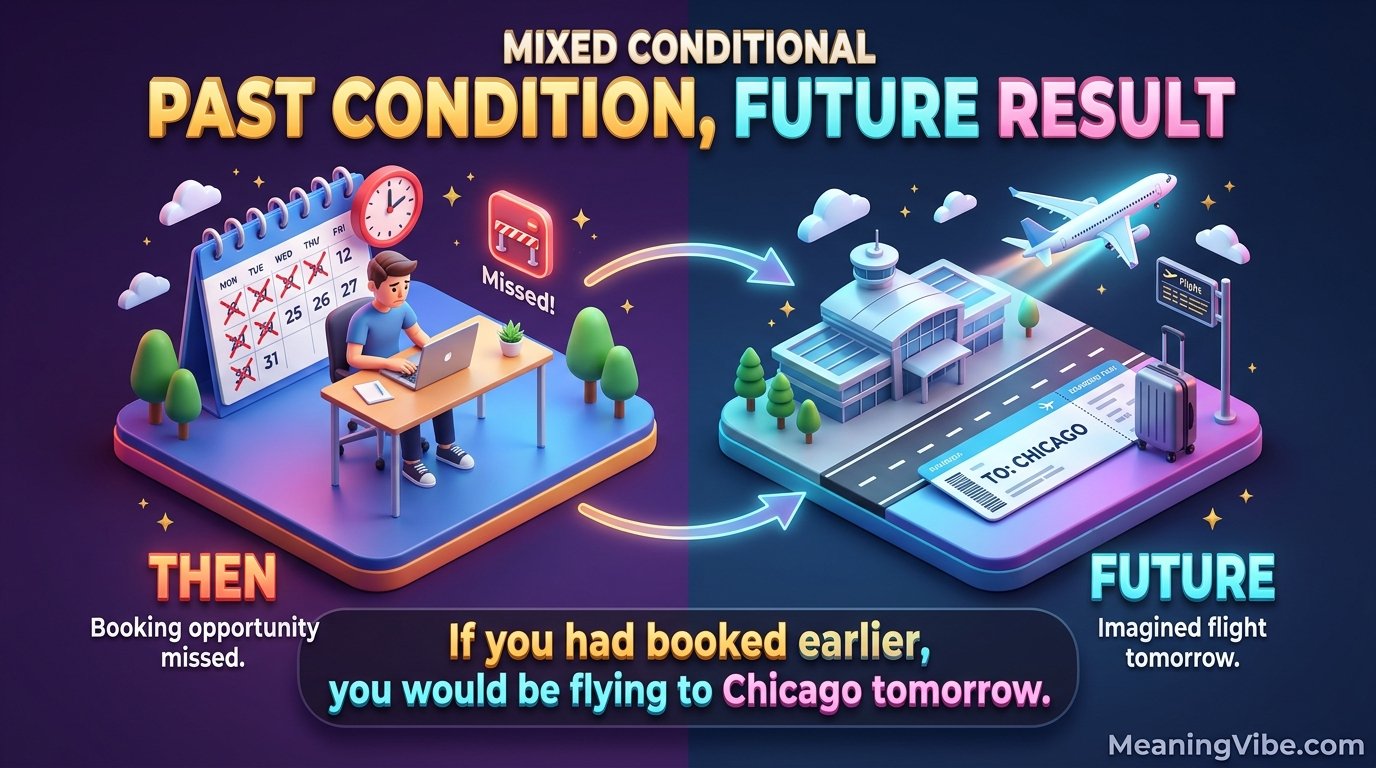
Negate the clause that carries the negative meaning only. Had not belongs to a past condition, were not or did not to a standing condition, and would not to the result.
Questions invert would and the subject in the result clause only. The if clause keeps its normal order, as in Would you be living here now if you had taken that job.
Inversion drops if and moves the auxiliary forward, as in Had I saved regularly. The form is formal, common in exams, and changes style only, never the stamps.
Implied forms hide the condition inside but for or without plus a noun phrase. Without your help expands to If you had not helped me, so the hidden clause still needs stamping.
Error Gallery: 11 Audited Items
The gallery opens with the three backdating failures, this page’s signature errors. Form errors, competitor defect classes and false alarms follow, each labelled.
|
# |
Type |
Faulty or disputed sentence |
Audit verdict and fix |
|---|---|---|---|
|
1 |
Backdating failure, present only state |
If I knew his new number, I would have called last week |
Unlicensed: number learned this week. Restamp the condition THEN or the result NOW |
|
2 |
Backdating failure, new ability |
If I could use the new software, I would have finished yesterday |
Unlicensed: training happened today, after the result time |
|
3 |
Backdating failure, temporary state |
If I were free this afternoon, I would have helped this morning |
Unlicensed: a state stamped only NOW cannot license a THEN result |
|
4 |
Would have in the if clause |
If I would have known, I would be ready now |
Wrong form. Use If I had known: past perfect in the condition |
|
5 |
Double would |
If I would save, I would have bought it |
Wrong form. Build the if clause by stamp: past simple or past perfect |
|
6 |
Trait and event confusion |
Treating one past moment of bravery as an ALWAYS trait |
Audit case only. A one time state is THEN: third, not mixed |
|
7 |
Present result misread |
If I had saved, I would have a house now, read as past |
False friend. Would have plus a noun can be present possession; a past result needs a past participle |
|
8 |
Competitor defect, class A |
A pure third sentence filed inside a mixed examples list |
Defect, quarantined. Both stamps past means third, never a mixed model |
|
9 |
Competitor defect, class B |
A past condition labelled as a present condition type |
Defect, quarantined. The label contradicts the example’s own stamps |
|
10 |
False alarm 1 |
Would be plus ing for a present result called an error |
Not an error. Correct form for a result still running then |
|
11 |
False alarm 2 |
Was in an informal Pattern 2 if clause called an error |
Register strand. Were is the formal choice; was is common informal usage |
Two quarantine rules protect the bank. No pure third sentence appears as a mixed model, and no competitor example enters without passing the same stamp audit.
Audit Your Own Sentence in Four Checks
Use these four checks, in order, on any sentence you write.
- Stamp both clauses. Write THEN, NOW, ALWAYS or FUTURE beside each clause, using meaning only, before checking any verb.
- Compare the stamps. Matching stamps mean a pure type; different stamps mean a mixed candidate.
- Run the licence check. For an ALWAYS or NOW condition with a THEN result, confirm it also held then.
- Build and reread. Choose each form by its stamp, then reread against the reality pair to confirm both halves are unreal.
Frequently Asked Questions
What is a mixed conditional sentence?
A mixed conditional is an unreal conditional whose if clause and result clause refer to different times. Each clause keeps its own time’s form.
What are the two core mixed conditional patterns?
Pattern 1 is a past condition with a present result. Pattern 2 is a present or general condition with a past result. A third lane, past to future, is treated separately.
What is the timeline audit?
The timeline audit is a three step check: stamp each clause, run the backdating licence check where it applies, then build the form for each stamp.
What does stamp mean in the timeline audit?
Stamp means label each clause’s time before choosing a verb form: THEN for past, NOW for present, ALWAYS for standing truths, FUTURE for times ahead.
What is the backdating licence?
The backdating licence is the Pattern 2 check. A present condition only licenses a past result if it also held at that past time.
Can a present condition change a past event?
No. A present condition cannot rewrite the past. It can only explain a past result if it was already true then, which the licence check tests.
What is an example of licensed backdating?
If I were more careful, I would have checked the address yesterday is licensed. Carefulness is a standing trait that also held yesterday.
What is an example of unlicensed backdating?
If I knew his new phone number, I would have called him last week is unlicensed if the number was learned this week. The knowledge did not exist then.
What is Pattern 1 in mixed conditionals?
Pattern 1 uses if plus past perfect, then would plus base verb. It connects a past condition to a present result.
What is Pattern 2 in mixed conditionals?
Pattern 2 uses if plus past simple, then would have plus past participle. It connects a present condition to a past result.
What is the past to future lane in mixed conditionals?
It is a past condition with a future result, as in If you had booked earlier, you would be flying tomorrow. Many competitors bury this lane inside Pattern 1.
How is a mixed conditional different from the third conditional?
In the third conditional both clauses are about the past. In a mixed conditional the clauses sit in different times.
How is a mixed conditional different from the second conditional?
In the second conditional both clauses are about the present or future. In a mixed conditional one clause looks back to the past.
What is an example of a mixed conditional?
If I had saved regularly, I would own my flat now. The saving is stamped THEN and the owning NOW, so the stamps split.
Why is If I had studied harder, I would have passed the exam not mixed?
Both clauses are about the past, so it is a pure third conditional. Filing it as mixed is a competitor defect, quarantined here.
Is If I had been braver, I would have spoken up mixed or third?
It depends on the audit. Bravery located only at that past moment makes it third; bravery as an ALWAYS trait that also held then makes a labelled mixed reading.
Which form follows if for a past condition?
A past unreal condition uses the past perfect, had plus past participle, as in If I had left earlier.
Which form is used for a present result?
A present unreal result uses would plus base verb, as in I would be at home now. A running activity uses would be plus ing.
When do you use would be plus ing in a mixed conditional?
Use would be plus ing when the result is an activity still running then, as in I would be working in Lisbon now.
When do you use would have in a mixed conditional?
Use would have plus past participle only for a result stamped past. For NOW or FUTURE results, use would plus base verb.
Can you use could and might in mixed conditionals?
Yes. Could signals ability or possibility; might signals less certainty. Both replace would without changing the stamps.
Is it was or were in Pattern 2?
Formal grammar prefers were for all persons with be, as in If I were taller. Was is common informally and stays a labelled register strand.
What CEFR level are mixed conditionals?
Introduction is often placed at B2, secure control at C1, and some quiz sites label mixed practice C1. Both placements stay labelled strands here.
Are mixed conditionals a fifth conditional type?
Some courses count mixed as a fifth type after zero, first, second and third. Others treat it as a combination, so the status stays a strand.
How do you make a negative mixed conditional?
Negate the clause that carries the negative meaning: had not in a past if clause, were not or did not in a present one, would not in the result.
How do you make a question mixed conditional?
Invert would and the subject in the result clause, as in Would you be living here now if you had taken that job. The if clause keeps normal order.
What is an inverted mixed conditional?
It drops if and inverts the auxiliary, as in Had I saved regularly, I would own my flat now. The form is formal, common in exams.
What do but for and without mean in conditionals?
But for and without introduce an implied condition. Without your help, I would still be stuck now implies If you had not helped me.
Do you need a comma in a mixed conditional?
Use a comma when the if clause comes first. When the result clause comes first, no comma is normally used.
Can a mixed conditional talk about the future?
Yes, in the past to future lane: a past condition with a future arrangement as result, as in If we had renewed the lease, we would be moving next month.
What time markers signal a mixed conditional?
Yesterday and back then point to THEN; now, today and still to NOW; tomorrow and next week to FUTURE. Always and generally point to ALWAYS.
What is the most common mixed conditional mistake?
The most common mistake is using would have for a present result. A present result needs would plus base verb.
Why is would have in the if clause wrong?
Standard English does not put would have in the if clause. Use past perfect for a past condition, past simple for a present one.
What is a double would error?
It is using would in both clauses, as in If I would have known, I would be ready. The if clause should use had known.
How can I check if my sentence is really mixed?
Stamp both clauses. Different stamps, with any backdating licensed, mean mixed. Both stamps past mean third, not mixed.
What is a reality pair?
A reality pair states the real facts behind a counterfactual, one for THEN and one for the result time. It proves the sentence is unreal.
Are mixed conditionals used in IELTS?
Yes. Used accurately, they show grammar range in IELTS writing and speaking, especially for regret and life choices. Accuracy beats frequency.
Can teachers use the timeline audit in class?
Yes. Students stamp clauses on a timeline, run the licence check for Pattern 2, then build the forms, turning a formula lesson into a meaning lesson.
What is the difference between a trait and an event in the if clause?
An event happened at a past point and is stamped THEN. A trait is a standing quality stamped ALWAYS. Confusing them causes most false mixed examples.
How many mixed conditional patterns should I learn first?
Learn the two core patterns first, then add the past to future lane. That order matches the strongest competitors and keeps the licence check manageable.
Where can I practice mixed conditionals?
Practice with a classified bank, short C1 pattern quizzes, and error correction sets that force you to stamp each clause first.
Should I memorize mixed conditional formulas only?
No. Formulas without time stamps produce the classic errors above. Learn the audit first; formulas then become a reliable shortcut.
Conclusion
Mixed conditional sentences reward the learner who checks time before form. Stamp each clause, license any backdating, and both patterns plus the future lane build themselves.
Keep the strands labelled and pure third sentences out of the mixed bank. Practice the audit until stamping feels automatic.