

Reported speech rules begin with one measurement: how far your report stands from the original words in time, place and person.
Report the words later, somewhere else, or as someone else, and the grammar steps back. Tense moves, time words move, place words move and pronouns move, because each one pointed at the original moment.
Direct speech quotes the exact words inside quotation marks. Reported speech, also called indirect speech, retells the content inside your own sentence, with your viewpoint replacing the speaker’s viewpoint.
The system runs on three tracks. Statements take a that-clause, questions take if, whether or a question word, and commands take a person plus the to-infinitive.
One Step Back: The Distance Idea
Backshift exists because time has passed. Cambridge Dictionary Grammar defines the changes as the ones we make because time has passed between the moment of speaking and the time of the report.
Every reported sentence has two clauses. The reporting clause names who spoke, as in William said, and the reported clause carries the content, reshaped to fit the reporter’s viewpoint.
The terminology comes from the Cambridge Dictionary Grammar page on reported speech. It is the one major source that names both clauses, and the split explains the punctuation rules that follow from it.
A plain pair shows the step. “I am tired,” she said, becomes she said she was tired, and the present simple steps back to the past simple because the report is later.
Distance is measured in three directions at once. Time distance moves the tense, place distance moves here and this, and person distance moves I, you and my.
Zero distance means zero change. Report the words at once, in the same place, about something still true, and the original forms can stay exactly as they were spoken.
That zero case is not an exception bolted onto the system. It is the system working in reverse, and it is why the no-backshift section below matters as much as the table itself.
The Master Backshift Table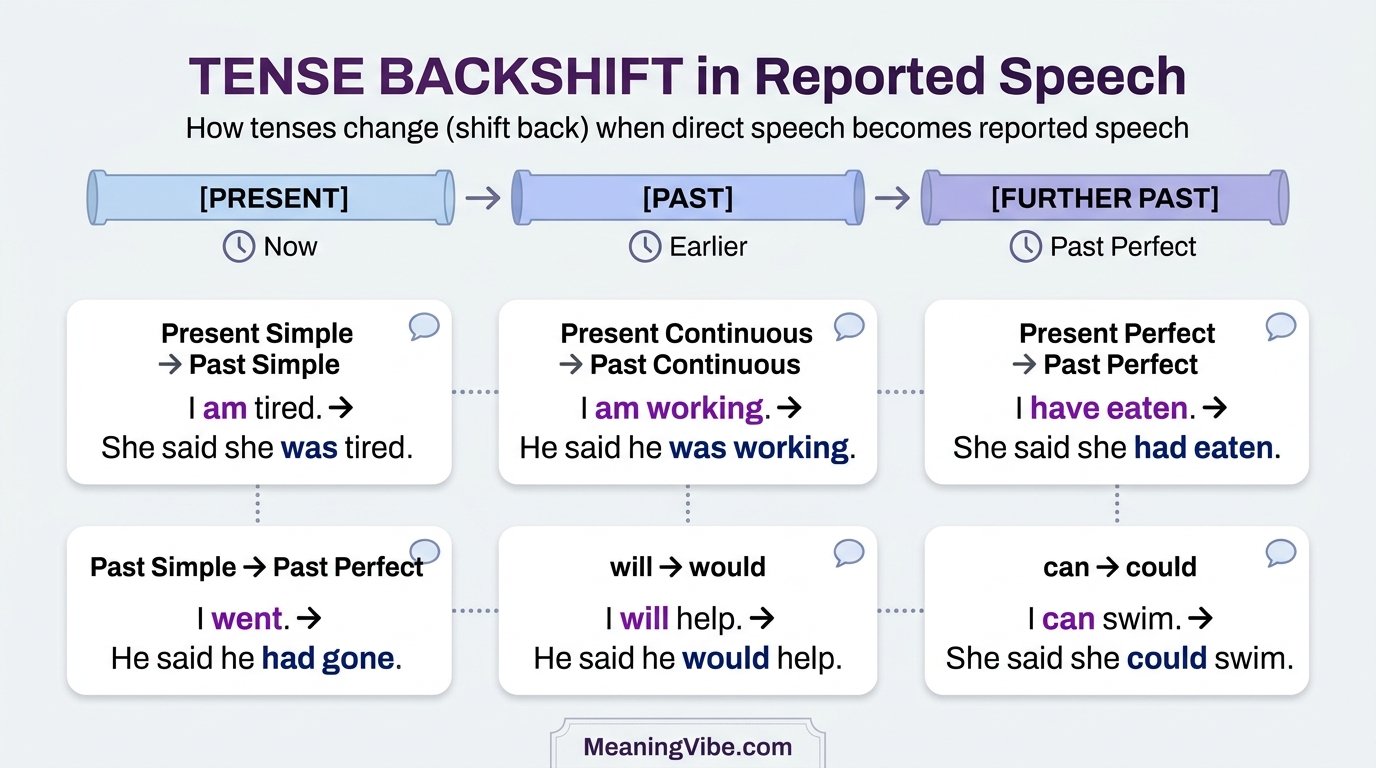
The table assumes a past reporting verb. After said or told, each tense in the reported clause steps one stage further back, and the rows below are the consensus core every major source prints.
|
Direct speech |
Reported speech |
Worked example |
|---|---|---|
|
present simple |
past simple |
“I like ice cream” becomes she liked ice cream |
|
present continuous |
past continuous |
“I am living in London” becomes she was living in London |
|
present perfect |
past perfect |
“I have not seen Julie” becomes she had not seen Julie |
|
present perfect continuous |
past perfect continuous |
“I have been waiting” becomes she had been waiting |
|
past simple |
past perfect, or past simple |
“I bought a car” becomes she had bought a car |
|
past continuous |
past perfect continuous |
“I was walking” becomes she had been walking |
|
past perfect |
past perfect, no change |
“I had taken lessons” stays she had taken lessons |
|
will |
would |
“I will see you later” becomes she would see me later |
|
can |
could |
“I can speak English” becomes she could speak English |
|
may |
might |
“It may rain” becomes it might rain |
|
shall |
would, or should |
“I shall come later” becomes she would come later |
|
must |
had to, or must |
“I must study” becomes she had to study |
The present rows land on the past rows. The starting forms are covered in our present simple tense rules and our present continuous tense rules, and their landing forms are covered in our past simple tense rules and our past continuous tense rules.
The perfect rows work the same way. Conversions from the forms in our present perfect tense rules land on the forms in our past perfect tense rules, and worked sentences for the starting forms sit in our present perfect tense examples.
One row is missing from most teaching tables. The present perfect continuous steps to the past perfect continuous, a row the majors largely omit, and both forms are set out in our present perfect continuous tense guide and our past perfect continuous tense guide.
The future rows follow the same single step. Will be becomes would be and will have becomes would have, and the starting forms sit in our future simple tense rules, our future continuous tense rules and our future perfect tense rules.
The deepest future form steps too. Will have been becomes would have been, the pattern whose starting form is covered in our future perfect continuous tense guide.
Two rows print two answers, and both stay in the table. Past simple and must each carry a strand, because the authorities print both forms and merging them into one would misstate the evidence.
The Modals That Never Move
Some modals are already at the back of the system. Would, could, might, should, ought to, used to, had better and needn’t never change in reported speech, because no further step exists for them.
The teaching tables mark the freeze directly. Perfect English Grammar asterisks would, could, should and might in its table as forms that do not change, and the Grammarist page prints the same instruction as a line.
Trying to shift them again is a named learner error. A sentence like he said he would would is not emphasis, it is a double backshift, and the cure is to leave the modal exactly where it stands.
Two Rows With Two Answers: Past Simple and Must
Past simple is the table’s honest disagreement. Strand A makes past perfect the default: British Council prints that past simple usually changes to past perfect, hedged with the word usually.
Strand B lets the past simple stay, and the Perfect English Grammar reported speech lesson prints both forms for the same sentence. Had bought or bought both appear, and Murphy’s grammar text says the past simple can usually stay the same in reported speech.
The condition is clarity, not laziness. The past simple may stay when the time sequence is already clear, or when the time is stated outright, as in she said she left in 2019.
Must carries four positions, not two. Most teaching tables give had to as the rule, and that is the safe learner default for obligation in a later report.
The second position prints both forms. Perfect English Grammar gives must or had to for the same sentence, and Grammarly keeps must unchanged in one of its own worked examples.
The third position refuses to move it at all. The United Nations Editorial Manual states that must has only one form, used in both direct and indirect speech, a professional style position rather than a school rule.
The fourth position splits must by meaning. Obligation becomes had to, while prohibition often stays must, so you must not becomes she said I must not in that strand.
Shall is a smaller strand of the same kind. Perfect English Grammar gives would, Grammarist gives should or would, and modern usage overwhelmingly reports first-person shall with would.
When NOT to Backshift: The Decision the Table Cannot Make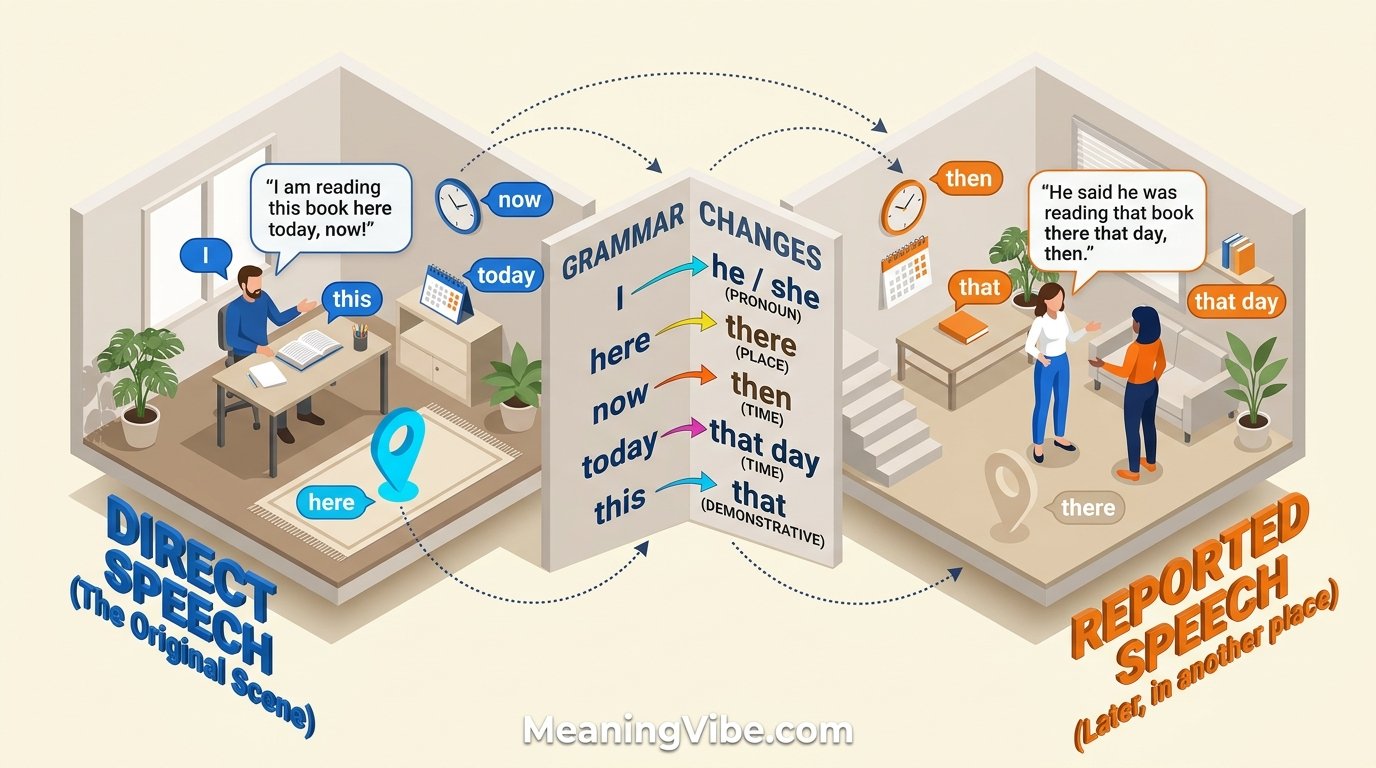
A present or future reporting verb stops the shift completely. She says that she likes ice cream keeps the present simple, and every authority agrees, because no time distance has opened.
Universal truths keep their tense as well. The teacher said that water boils at 100 degrees at standard pressure keeps boils in the present, because the fact does not age with the report.
Immediate reporting is the third release, and the Grammarist reported speech page lists it directly. When the original words are reported right away, the original moment is still active and the tense can stay.
The unreal past cannot move either. Verbs inside second and third conditionals already sit in a shifted form, so a reported conditional keeps its shape instead of stepping back a second time.
Exam English adds a rider, labeled as register, not grammar. IELTS teaching advises that backshift is always safe in an exam, so an unsure candidate should shift anyway, which is strategy rather than a rule of English.
Still True: Four Positions, Kept Apart
The still-true case is where the field genuinely disagrees. A statement that remains true at the moment of reporting may keep its tense, but the authorities scope that permission four different ways.
The wide position belongs to British Council LearnEnglish. Any statement that is still true or still relevant may keep its tense, and its examples even keep a present perfect: she said she has broken her arm.
The narrow position belongs to Perfect English Grammar. It limits the kept present to general facts, and adds that even then, speakers usually like to change the tense anyway.
The middle position treats both forms as correct. Keeping the present signals that the reporter presents the fact as current, while backshifting stays neutral, and the choice itself carries meaning.
Print the four positions and the decision becomes teachable. A learner who knows the scopes can defend either form, while a learner taught one flat rule marks correct English wrong.
Say vs Tell: The Person Test
Say takes the message, and tell takes the person. Say runs with a that-clause and no person directly after it, while tell always carries an indirect object before its clause.
The hearer joins say through a to-phrase. She said to us that she was leaving is correct, while she said us is not, because say cannot hold a bare person in that slot.
Cambridge prints the two classic errors as a pair. Not: he said me he was moving to New Zealand, and not: he told he was moving to New Zealand, because tell without its person is unfinished.
Both error pairs sit on the Cambridge Dictionary Grammar page on reported speech. The page is the strongest single source for this section, since it prints the wrong forms beside the corrections instead of only stating the rule.
Say, not tell, reports greetings and wishes in direct speech. Everyone said good luck is the pattern, and are you going now takes said rather than told when the exact words are quoted.
One-line versions of the rule agree. Tell is always followed by a person, say is not, and the learner version runs: put the listener after told, and the message after said.
Track One: Reported Statements
Statements are the home track of the table. A reporting verb plus an optional that plus the reshaped clause covers nearly every statement a learner will ever report.
That can be dropped in informal English. She said she was tired is complete without it, and Cambridge notes that the omission is normal in informal reporting, especially in speech.
Keep that where it protects the sentence. Formal writing, long clauses and verbs whose object could be misread all argue for keeping it, because clarity outranks brevity in a report.
Statements can also report the act, not the words. “I am sorry,” said Mark becomes Mark apologized, a Cambridge example where the reporting verb names the speech act itself.
A worked pair shows the full reshape. “We waited all afternoon for you to arrive,” Kacie said, becomes Kacie told me they had waited for me all afternoon in the Grammarly guide to direct and reported speech.
Track Two: Reported Questions
A reported question is a statement about a question. It takes statement word order, subject before verb, with no inversion, no do or did helper, and no question mark at the end.
Cambridge prints the punctuation error outright. Not: he asked me why I was so upset, with a question mark, because the sentence reports a question instead of asking one.
BBC Learning English answers the inversion question directly. Its Ask About English answer gives the full set: no auxiliary inversion, no question word order and no question mark in a reported question.
Everything else from statements still applies. Backshift, pronoun shifts and time-word shifts run inside reported questions exactly as they run inside reported statements.
Yes/No Questions: If and Whether
Yes/no questions report with ask plus if or whether. “Do you like chocolate?” becomes she asked me if I liked chocolate, with the do helper gone and the tense stepped back.
If is the more common of the two. Cambridge notes the frequency directly, and everyday reporting defaults to if in speech and in most writing.
Whether wins in three specific places. Choose whether before or not, after a preposition, and in formal writing where the two alternatives genuinely matter to the meaning.
Wh- Questions: The Question Word Leads
Wh- questions keep their question word as the connector. Where, when, why, who and how introduce the reported clause, and that never takes their place.
The mechanics run in two moves. For “Where do you live?” remove the do helper first, then backshift, giving she asked me where I lived.
Questions built on be un-invert instead. “Where is Julie?” becomes she asked me where Julie was, because the verb steps back behind its subject into statement order.
One detail almost no page carries. Negative questions are generally reported as affirmative ones, a point the analytic teaching tradition keeps and the standard tables drop.
Track Three: Reported Commands, Requests and Advice
Commands run on a different engine entirely. The pattern is reporting verb plus person plus to-infinitive, and the tense table plays no part in it at all.
The negative places not before to. “Do not be late,” he said, becomes he told me not to be late, and the not belongs to the infinitive phrase, never to a spot after the person.
The verb choice carries the force of the original. Order, command and instruct report authority, tell is the neutral default, ask and beg report politeness, advise reports advice and warn reports a warning.
Please is always deleted. Its politeness is not lost, because it moves into the choice of verb, where ask or request reports what please was doing in the original words.
That never introduces a command. The Grammarist page states the ban for imperatives directly, and the pattern holds across the field: statements take that, commands take the to-infinitive.
Requests Wearing Question Costumes
A request phrased as a question still reports as a request. “Could you close the window, please?” becomes she asked me to close the window in the Perfect English Grammar reported speech lesson, because the speaker wants an action, not an answer.
Permission is the one real exception. “May I leave?” becomes she asked if she could leave, because asking permission is a genuine yes or no question about what is allowed.
Report the act, not the surface form. The costume test settles the whole family: if the speaker wants something done, use the infinitive track, and if they want an answer, use the question track.
Offers and Suggestions
Offers mirror requests, with the speaker as the actor. “Shall I carry that?” becomes she offered to carry it, and the shall question form disappears into the verb offer.
Suggestions take the -ing pattern. He suggested taking a break is the model, or a that-clause such as he suggested that we take a break, with that and should both optional.
Suggest never takes a person plus a to-infinitive. That pattern belongs to advise, as in she advised me to wait, and swapping the two verbs is one of the commonest pattern errors learners make.
Reporting Verbs: The Four Patterns
Say, tell and ask are only the entrance. English reports speech through four verb patterns, and choosing the wrong pattern is an error even when every tense in the sentence is right.
|
Pattern |
Verbs that use it |
Example shape |
|---|---|---|
|
verb plus that-clause |
say, explain, claim, admit, argue, suggest |
she explained that she was late |
|
verb plus to-infinitive |
promise, offer, refuse, agree, decide |
he promised to call |
|
verb plus person plus to-infinitive |
advise, warn, remind, invite, order, tell, ask |
she advised me to rest |
|
verb plus -ing, or preposition plus -ing |
suggest, admit, deny, insist on, apologize for, accuse of |
he admitted taking it |
The that-clause family is the largest. Cambridge lists forty reporting verbs in its word table, and most of them can carry a that-clause.
The to-infinitive family reports commitments. Promise, offer, refuse and agree look forward to an action by the speaker, which is why no person stands between the verb and the infinitive.
The person-plus-infinitive family reports influence. Advise, warn, remind, invite and order all aim an action at someone else, so the person is part of the pattern, not an optional extra.
The -ing family reports admissions and proposals. Suggest, admit and deny take the -ing form, and apologize for, accuse of and insist on carry their preposition with them into the pattern.
Two traps guard the whole system. Explain takes to plus a person, never a bare person, and promise does not take a person plus infinitive, however parallel the pattern feels.
Pronouns: Follow the Viewpoint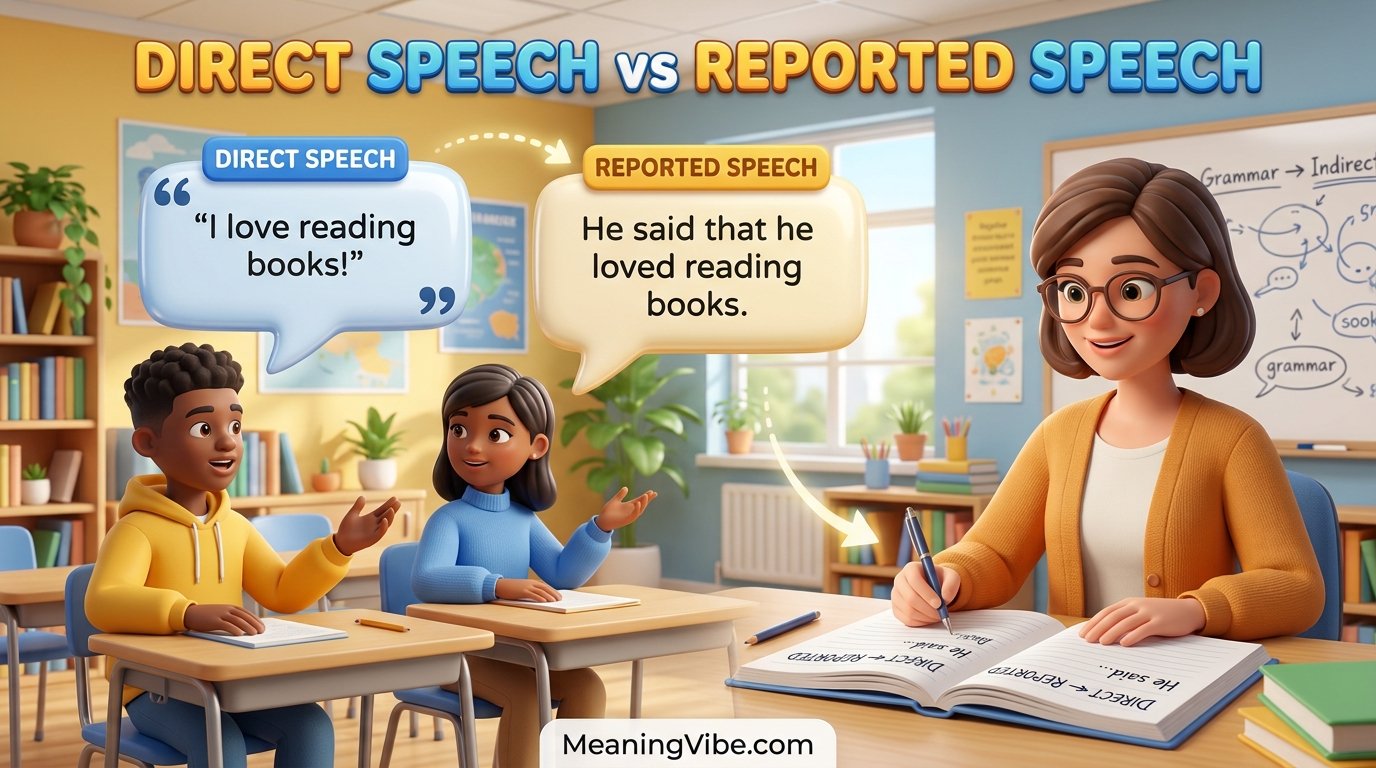
Pronouns change by viewpoint, not by table. The reporter re-aims every pronoun at the people in the reporting situation, which is why no fixed conversion list survives contact with real sentences.
|
Original word |
Usual report |
What decides it |
|---|---|---|
|
I |
he or she |
who the original speaker is |
|
we |
they |
whether the reporter joins the group |
|
my |
his or her |
who owns the thing named |
|
you |
the real referent |
who was actually being addressed |
The governing exception is simple. British Council states that pronouns do not change when the reporter is the original speaker: I told her that I was working on my thesis keeps every I.
Keeping the original pronouns by habit is a named mistake: the Grammarly guide to direct and reported speech lists it among its common errors. Retained pronouns blur who did what and quietly change the meaning.
Time and Place Words: Change Only What Stopped Being True
The governing condition is accuracy, not habit. British Council states it plainly: demonstratives and adverbs of time and place change if they are no longer accurate at the moment of reporting.
|
Direct speech |
Reported later, elsewhere |
Stays when |
|---|---|---|
|
now |
then |
the report is immediate |
|
today |
that day |
the report is the same day |
|
tonight |
that night |
the report is the same day |
|
yesterday |
the day before |
rarely, since the day has moved |
|
tomorrow |
the next day, the following day |
the report is the same day |
|
ago |
before |
the time gap is restated |
|
last week |
the week before |
the week is still current |
|
here |
there |
the place has changed |
|
this |
that |
the thing is no longer near |
|
these |
those |
the things are no longer near |
One scenario proves the whole section. In the Perfect English Grammar reported speech lesson, Julie says “I am leaving today” on Monday, and the report keeps today on Monday, says yesterday on Tuesday, names Monday on Wednesday, and says that day a month later.
The table is a default for a later, elsewhere report. Printed without its condition, it teaches learners to corrupt accurate same-day reports, which is the flattening the authorities warn against.
A minor strand closes the table. Some school traditions add come becoming go, a row the Western majors do not print.
The Advanced Corner: It Is Said That
Formal English can report without naming a speaker at all. People say he is rich becomes it is said that he is rich, the impersonal pattern of news and academic writing.
The personal pattern promotes the subject instead. He is said to be rich keeps the same meaning, and the infinitive carries the time: to be for the same time, to have written for an earlier one.
Believe, think, know and expect run both patterns. She is believed to have written it reports an earlier act, while it is believed that she wrote it keeps the clause whole.
The structure is passive reporting, and it belongs to the passive family. Its nearest relative on this site is our active voice vs passive voice rules, and it sits at an advanced level above the core tracks.
One error marks the corner. Dropping the dummy it, as in is said that the castle is haunted, breaks the impersonal pattern, which needs it in place before the participle.
Common Mistakes, Corrected
Most errors here break one named rule. Each correction below names the rule it restores, so the fix teaches the system instead of asking for memorization.
- Wrong: She asked me where was the station. Right: she asked me where the station was, because reported questions take statement word order with no inversion.
- Wrong: She asked where did I live. Right: she asked where I lived, because the do helper disappears and its tense moves onto the main verb.
- Wrong: He asked me why I was so upset? Right: end with a period, because the sentence reports a question instead of asking one.
- Wrong: He said me he was leaving. Right: he told me he was leaving, or he said to me, because say never holds a bare person.
- Wrong: He told he was leaving. Right: he told me he was leaving, because tell always carries its person before the clause.
- Wrong: She asked that I was ready. Right: she asked if I was ready, because that belongs to statements and never introduces a reported question.
- Wrong: He said he would would call. Right: he said he would call, because would is already backshifted and never moves a second time.
- Wrong: She suggested me to rest. Right: she suggested resting, or she advised me to rest, because suggest takes the -ing pattern and advise owns the person pattern.
Practice: Convert These Ten
Run each sentence through the distance test first. Name the track, check whether anything may stay, then convert, and compare your answer with the key beside each item.
- “I am leaving tomorrow,” she said, reported the next week. Answer: she said she was leaving the next day, with tense and time word both stepped back.
- “Have you ever been to Mexico?” Answer: she asked me if I had ever been to Mexico, a yes/no question with if and the present perfect stepped back.
- “Do not share the code.” Answer: she warned me not to share the code, a negative command with not placed before to.
- “I bought the tickets yesterday,” he said, reported today. Answer: he said he had bought the tickets the day before, and the past simple may also stay bought in the second strand.
- “Please help me.” Answer: he asked me to help him, a request where please disappears into the verb ask.
- “Water boils at 100 degrees,” the teacher said. Answer: the teacher said water boils at 100 degrees, a universal truth that keeps its present tense.
- “I shall call you tonight,” she said, reported days later. Answer: she said she would call me that night, with shall reported as would in the main strand.
- “Where does Peter live?” Answer: she asked him where Peter lived, with the do helper removed and statement order restored.
- “Shall I open the window?” Answer: he offered to open the window, an offer reported with offer plus the to-infinitive.
- “We must leave now,” they said, reported a week later. Answer: they said they had to leave then, with must reported as had to in the main strand and now stepped back to then.
Score yourself by rule, not by sentence. Misses cluster: word-order misses send you back to the questions track, pattern misses to the reporting verbs, and tense misses to the no-backshift decision.
Frequently Asked Questions
1. What is reported speech?
Reported speech retells what someone said without quoting the exact words. The reporting verb carries the report, the tense usually steps back, and pronouns and time words shift to the reporter’s viewpoint.
2. Is backshifting always required in indirect speech?
No, backshift is the default, not an absolute rule. It is not required when the reporting verb is present or future, when the statement is still true, or when the content is a universal truth.
3. Are quotation marks ever used in indirect speech?
No, quotation marks belong to direct speech only. A reported clause is the reporter’s own sentence, so wrapping it in quotes wrongly claims the words are exact.
4. Can you use both direct and indirect speech in one sentence?
Across a text, yes, but never inside one phrase. A quotation and a reported clause cannot share one verb, so keep each report in a single form and let the punctuation show which.
5. Is indirect speech more formal?
Indirect speech is the normal form in news and academic writing. Direct speech is kept for voice, evidence and emphasis, so the choice is about purpose rather than politeness.
6. Can indirect speech be used in storytelling?
Yes, stories move between the two forms constantly. Direct speech carries scenes and dialogue peaks, while reported speech compresses events and moves time forward.
7. What are the 5 rules for reported speech?
The classic checklist runs to five moves. Choose the reporting verb, change the pronouns, backshift the tense, change the time expressions, and remove the quotation marks.
8. What are the 20 examples of reported speech?
Worked pairs throughout this page cover every row of the table. They run from plain statements through questions, commands, offers, suggestions and the cases where nothing changes at all.
9. What is backshifting in reported speech?
Backshifting moves the reported verb one step further back in time. Present simple becomes past simple, past simple becomes past perfect, and will becomes would after a past reporting verb.
10. Do you always need to backshift?
No, three common situations release you from it. A present reporting verb, a statement that is still true, and a past simple with its time already stated can all stay unchanged.
11. How do I report commands and requests?
Use a reporting verb plus a person plus the to-infinitive. She asked me to close the window, she told me to sit down, and the negative places not before to.
12. Is the backshift always required?
It is the default after a past reporting verb, and optional beyond that. Still-true content, immediate reports and clear time sequences can stay, though exam English rewards backshifting anyway.
13. Is reported speech B1 or B2?
The basics sit at B1 and the full system at B2. Statements with say and tell come first, while modal strands, verb patterns and conditional time words belong to the higher level.
14. What is the difference between direct speech and reported speech?
Direct speech quotes the exact words, and reported speech retells them. Quotation marks, original tenses and time words belong to the quote, while the report reshapes all three to the reporter’s viewpoint.
15. When do I NOT backshift?
Skip the shift in six situations. A present or future reporting verb, a still-true statement, a universal truth, an immediate report, the unreal past, and any form that cannot move further back.
16. Does the tense change if the reporting verb is in the present?
No, and every authority agrees on this one. She says that she likes ice cream keeps the present simple, because no time distance has opened between the speaking and the reporting.
17. What happens to present simple in reported speech?
It becomes past simple after a past reporting verb. I like ice cream becomes she said that she liked ice cream, unless a no-backshift case protects the present tense.
18. Does past simple always become past perfect?
Usually, but the field prints two positions. The default rule shifts it to past perfect, while Perfect English Grammar and Murphy allow the past simple to stay when the sequence is already clear.
19. Does past perfect change in reported speech?
No, the past perfect is already the furthest step back. It stays exactly as spoken, and the same freeze protects would, could, might and should from moving again.
20. What does will become in reported speech?
Will becomes would, and its compound forms follow the same step. Will be becomes would be and will have becomes would have, while would itself never changes.
21. What does shall become in reported speech?
Shall prints two targets, so both are kept here. Perfect English Grammar gives would, while Grammarist and the United Nations style manual give should or would.
22. Does must become had to, or stay must?
Both forms are printed by the authorities, in four positions. Most teaching tables give had to, Perfect English Grammar prints must or had to, and the United Nations manual keeps must unchanged.
23. Which modal verbs never change in reported speech?
Would, could, might, should, ought to, used to, had better and needn’t never change. They are already backshifted or unshiftable forms, so the system has no further step for them.
24. What is the difference between say and tell?
Say takes the message, and tell takes the person. Say runs with a that-clause and no direct person, while tell always carries an indirect object before its clause.
25. Why is ‘He said me’ wrong?
‘He said me’ is wrong because say takes no personal object. Cambridge prints the error directly, and the fixes are said to me, or told me with the person placed after tell.
26. Can I leave out ‘that’ in reported speech?
Yes, that is often dropped in informal statements. Keep it in formal writing, in long sentences, and wherever dropping it could blur who did what in the report.
27. How do I report a yes/no question?
Use ask with if or whether, then statement word order. Do you like chocolate becomes she asked me if I liked chocolate, with no question mark at the end.
28. If or whether: which should I use?
Both are correct, and if is the more common choice. Whether is safer before or not, after a preposition, and in formal writing where the alternatives matter.
29. Why is there no question mark in a reported question?
Because a reported question is grammatically a statement. The sentence reports that a question was asked instead of asking one itself, so it ends with a period.
30. How do I report a command?
Use a reporting verb plus a person plus the to-infinitive. Sit down becomes she told me to sit down, please is deleted, and that never introduces a command.
31. How do I report a negative command?
Place not before to, inside the same pattern. Don’t be late becomes he told me not to be late, and the not never moves to a spot after the person.
32. How do I report a polite request with ‘please’?
Delete please and let the verb carry the politeness. Close the window, please becomes she asked me to close the window, because ask reports a request where tell would report an order.
33. ‘Could you help me?’ is a question: why is it reported with to?
‘Could you help me?’ is a question in form but a request in act. The speaker wants an action rather than an answer, so the report uses ask with a person and the to-infinitive.
34. How do I report ‘May I leave?’
Report permission with if, not with the to-infinitive. May I leave becomes she asked if she could leave, because asking permission is a genuine yes or no question.
35. How do I report an offer like ‘Shall I carry that?’
Use offer plus the to-infinitive for offers. Shall I carry that becomes she offered to carry it, because the speaker proposes their own action and the shall form disappears.
36. How do I report a suggestion?
Use suggest with an -ing form, or suggest with a that-clause. Never use suggest with a person and a to-infinitive, because advise owns that pattern and suggest never takes it.
37. How do pronouns change in reported speech?
Pronouns follow the reporter’s viewpoint, not a fixed table. I becomes he or she and my becomes his or her, but nothing changes when the reporter is the original speaker.
38. Do time words always change?
No, time words change only when they stop being accurate. A report made the same day keeps today, while a later report turns it into that day or names the day itself.
39. If something is still true, can I keep the present tense?
Yes, keeping the present is correct, and the authorities scope it differently. British Council allows any still-true statement to keep its tense, while Perfect English Grammar limits the habit to general facts.
40. What is a reporting clause and a reported clause?
The reporting clause names who spoke, and the reported clause carries what was said. In she said she was tired, the reporting clause is she said, and the reported clause holds the content in statement order.
41. What does ‘It is said that…’ mean, and when do I use it?
It reports a general belief when no single source is named. People say he is rich becomes it is said that he is rich, a formal pattern common in news and academic writing.
42. Is reported speech the same as indirect speech?
Yes, the two names describe one structure. British teaching leads with reported speech, American and Indian school usage often leads with indirect speech, and the rules are identical under both names.
Conclusion
Reported speech rules reduce to one habit: measure the distance between the original words and your report, then let every part of the sentence step back together.
Tense, pronouns and time words move as one system. When the report is later, from somewhere else, or about someone else, the grammar marks that distance on every word it can.
The exceptions protect meaning, not laziness. A present reporting verb, a still-true fact and an immediate report keep the original forms because no real distance has opened yet.
The wider tense cluster is indexed from the MeaningVibe home page. Each tense in the backshift table gets its own rules page there, with the forms and examples this system lands on.