

Articles a an the rules look like dozens of small rules, but every choice runs on three questions in a fixed order. Ask them in order and the article chooses itself.
The questions are the countability gate, the known test and the general or name test. The sound rule then settles a against an, last and only last.
An article is a determiner that sits before a noun and shows how the listener should take it. The Oxford Learner’s Dictionaries entry for article defines it in exactly those grammar terms.
The Three Questions: How Every Article Choice Is Made
Run the questions in order: each one can end the decision early, and the first can rule out a and an before meaning is considered.
|
Order |
Question |
If the answer is yes |
Example |
|---|---|---|---|
|
1 |
Is the noun singular and countable? |
A or an stays possible |
a dog, an apple |
|
2 |
Can the listener identify which one? |
Use the |
the dog we saw |
|
3 |
Is the meaning general, or a name or fixed phrase? |
Use no article |
Dogs are loyal; by bus |
If question 1 fails, a and an are impossible, whatever the meaning. If question 2 succeeds, the answer is the, and no later question can change it.
Only when the first two questions fail does the third decide between a or an and zero article. A first mention of one example takes a or an; a general meaning takes nothing.
First, the Countability Gate: What Your Noun Allows
Every noun falls into one of three types, and the type limits the articles before meaning is considered. Singular countable nouns take all three articles; plural and uncountable nouns never take a or an.
Purdue OWL’s count and noncount noun chart sets out which articles each noun type allows. Learn a noun’s type once and half of every decision is already made.
|
Noun type |
A / an |
The |
Zero article |
|---|---|---|---|
|
Singular countable (dog, book) |
Yes |
Yes, when known |
No, never bare |
|
Plural countable (dogs, books) |
No |
Yes, when specific |
Yes, when general |
|
Uncountable (water, advice) |
No |
Yes, when specific |
Yes, when general |
The sharpest consequence is simple: a singular countable noun can never stand bare in a sentence. I saw dog fails the gate; I saw a dog passes it.
In a passive sentence the subject is usually already known, so it takes the even when it looks new. Our guide to active voice vs passive voice rules shows how voice changes what the listener knows.
A and An: The Indefinite Article
First Mention and One of Many
Use a or an when the listener cannot yet identify the noun. The noun is new, or it is one example of many: a dog, a plan, an idea.
The article does not mark unimportance. It marks only that no identification has happened yet; identification is what the adds later.
Jobs and Identity
Jobs and roles take a or an: she is a doctor, he is an engineer. Cambridge Grammar lists jobs among the core uses of the indefinite article.
Plural jobs drop the article: they are teachers, because plural nouns never take a or an.
The Sound Rule: The Next Sound Decides
A or an is chosen by the first sound of the next word, never by its first letter. Say the word aloud: a vowel sound takes an, and a consonant sound takes a.
Letter and sound part company in four trap families, and exams test all four.
Trap 1: Silent H
When h is silent, the word begins with a vowel sound and takes an: an hour, an honest man, an heir, an honor.
Trap 2: Sounded H, and the Historic Strand
When h is sounded, the word takes a: a house, a hotel, a happy child.
An historic survives where the h is weak, mostly in older British usage. Treat it as a labelled strand of pronunciation, not the rule: follow the h you actually say.
Trap 3: Words Beginning with a Yoo Sound
Some vowel letters begin with the consonant sound yoo, and they take a: a university, a uniform, a European country, a URL.
The mirror trap is the word one, which begins with a w sound. A one-way street and a one-time offer take a, never an.
Trap 4: Abbreviations and Numbers
Abbreviations follow the way they are read. Read as letters, the first letter’s name decides: an MBA, an SOS, an MP3 player.
Read as a word, the first sound decides instead: a UFO, a NATO decision. Numbers follow their spoken form too, so an 80 pound note, read as eighty, takes an. Purdue OWL’s guide to using articles works through the acronym cases in full.
Some abbreviations are read two ways, like SQL. No single verdict exists; the article follows your own pronunciation.
The Adjective Decides
When an adjective stands between the article and the noun, the adjective’s sound decides: a broken egg, an unusual problem. Always test the word immediately after the article, not the noun.
What A and An Can Never Do
A and an never stand before plural nouns or uncountable nouns. A informations and an advice break the gate, however natural they feel in translation.
The repair is the partitive: a piece of information, a piece of advice, a bit of help. The countable piece carries the article.
The: The Definite Article
Mentioned Before: The First Mention Chain
The commonest use of the is the second mention. A noun enters a story with a or an, and every later mention takes the because the listener now knows it.
Retold stories run on this chain, which is why our reported speech rules page drills it. A dog appears, the dog stays, and the listener never loses the thread.
Unique Things and Shared Surroundings
Things that are one of a kind in our shared world take the: the sun, the moon, the earth, the environment. The listener can identify them without any earlier mention.
The same logic covers the immediate surroundings: pass me the salt, close the door. Speaker and listener share the scene, so the noun is already identified.
Institutions everyone shares join this set: the government, the police, the weather, the radio. Cambridge Grammar’s entry on a, an and the groups them with things known to everyone.
Made Specific by What Follows
Words after a noun can pin it down, and a pinned down noun takes the. The book on the table and the water in this bottle are specific.
This specification return is the hinge of the whole system. Any general noun becomes a the noun once extra words identify it: water, then the water we bought.
Imagined things obey the same test. In the second conditional sentences on this site, an invented house still takes the once the speaker has identified it.
Superlatives, Ordinals, Only and Same
Superlatives name one winner, so they take the: the best, the biggest, the fastest.
Ordinals, only and same work the same way: the first chapter, the only copy, the same mistake.
Groups of People and the Media
The plus an adjective can name a whole group: the rich, the poor, the young. The noun people is understood and not repeated.
Media mostly take the: the radio, the internet, the newspaper. Television is the exception: watch TV takes no article for the medium, while the TV names the set.
Geography: Where The Lives on the Map
Whole systems of water and land take the, while single named points do not. Rivers, oceans, seas, deserts and mountain ranges are systems; a peak or a lake is a point.
|
Takes the |
Takes no article |
|---|---|
|
the Nile, the Amazon |
Mount Everest, Everest |
|
the Pacific, the Atlantic |
Lake Superior |
|
the Sahara |
France, Japan, Brazil |
|
the Alps, the Himalayas |
Paris, London |
|
the United States, the Netherlands |
India, Canada |
Country names that are plural or built on a common noun take the: the United States, the United Kingdom, the Netherlands, the Philippines. Plain single names take nothing.
Ukraine follows the plain name rule in current standard usage; the older form with the is historical only.
Musical Instruments: A Labelled Strand
The traditional rule gives instruments the: she plays the piano, he plays the violin. Cambridge Grammar teaches this as the default form for instruments.
One strand must be printed honestly: in American English, play piano and play guitar without the are widely heard. Treat the form with the as the safe default, not an absolute.
The Zero Article: The System Nobody Teaches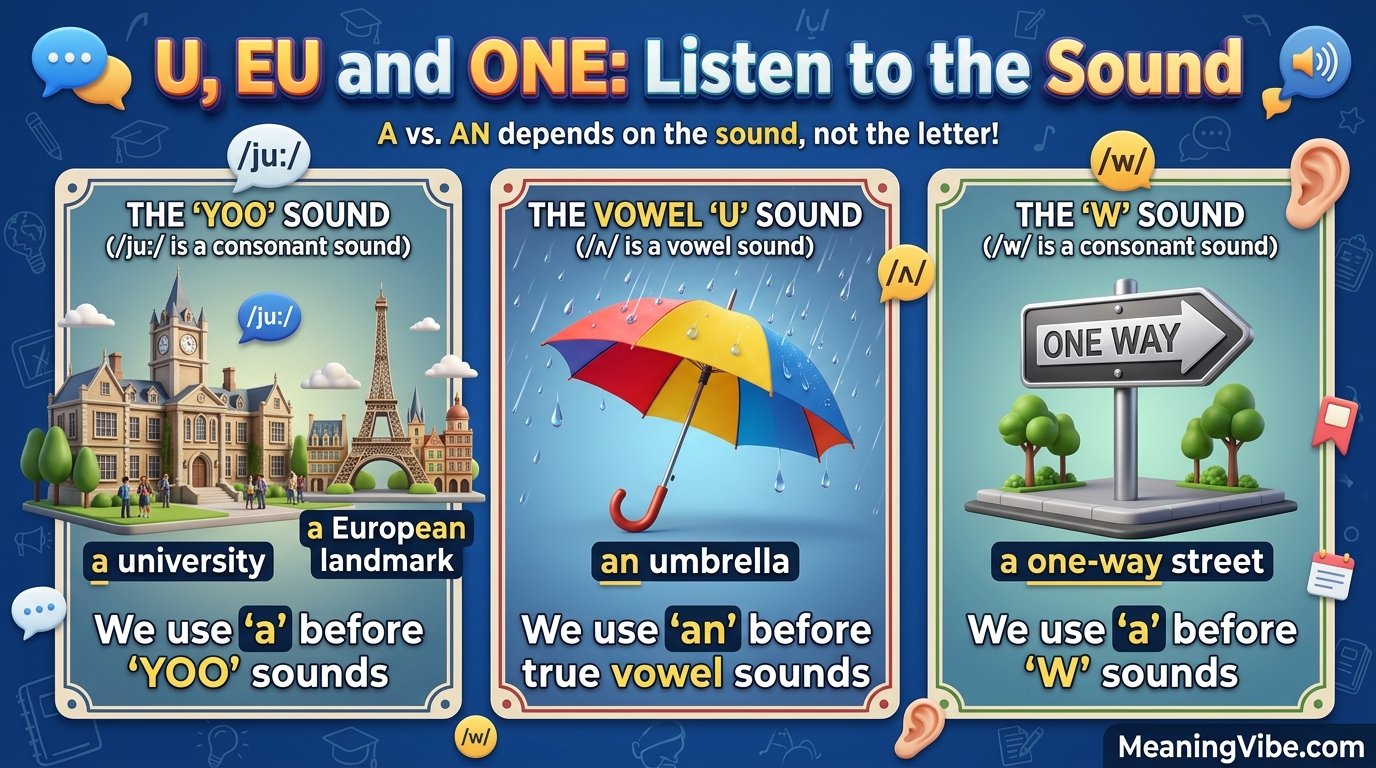
The zero article is a real choice, not a missing word. ESLBase’s articles guide gives it full standing as a system, and this section organises it into four blocks.
General Statements: Plural and Uncountable Nouns
When a plural or uncountable noun speaks about things in general, it takes no article. Dogs are loyal and water is essential make claims about the whole class.
These general truths are the daily bread of the zero conditional sentences and the present simple tense rules in this cluster. If you heat ice, it melts names ice in general.
Add specifying words and the returns at once: the dogs next door, the water in this bottle. General takes nothing, and specified takes the, every time.
Names: People, Places and Single Peaks
Most names take no article: people, cities, plain countries, single mountains and lakes. France, Paris, Mount Everest and Lake Superior all stand bare.
The exceptions are the system names from the geography table: ranges, rivers and plural countries.
Languages, Sports, Meals and Subjects
Languages take nothing: she speaks Spanish, he is learning French. The word language itself can take the: the Spanish language.
Sports and games take nothing: play football, play chess, play tennis.
Meals in general take nothing: breakfast is at eight, dinner is ready. A particular meal takes the instead: the dinner we cooked last night was cold.
School subjects follow languages: he studies mathematics, she teaches history.
Institutions by Purpose: The Purpose Test
When an institution is used for its purpose, it takes no article. A pupil goes to school, a prisoner is in prison, and a worshipper goes to church.
When the same place is visited as a building, it takes the. The parents went to the school to meet the teacher, and tourists visit the prison as a building.
|
Purpose use, no article |
Building use, with the |
|---|---|
|
go to school (be a pupil) |
go to the school (visit it) |
|
be in prison (be a prisoner) |
visit the prison (as a tourist) |
|
go to church (worship) |
photograph the church (the building) |
|
be in bed (sleeping) |
sit on the bed (the furniture) |
Hospital splits by variety: British English sends a patient to hospital, while American English normally says in the hospital. Both are correct in their own variety; mixing them is the error.
Fixed Phrases: Learn Them as Wholes
A set of everyday phrases never changes its article, so learn each one whole. By bus, by car and by train take nothing, but the same journey happens on foot.
Time phrases are not symmetrical: in the morning, in the afternoon, in the evening, but at night, at noon and at midnight. No deeper rule exists; the list is the rule.
Home and work phrases complete the set: go home, at home, at work, in bed, each learned as one vocabulary item.
The Example Bank: 100 Sentences Sorted by Rule
Read the bank by finding your case, not from the top. Our reported speech examples page uses the same classified bank method, and the third conditional sentences bank models the story chains in class A.
Class A: First Mention Chains
1. I saw a dog in the park. The dog was chasing a ball. A enters the story; the returns to it.
2. She bought a book yesterday. The book was about a sailor. First mention, then known.
3. A man knocked at the door. The man was carrying a parcel. The chain across two sentences.
4. We stayed in a small hotel. The hotel had a garden. New place, then known place.
5. He told us a story. The story was about a king. Each new noun enters with a.
6. A bird landed on the roof. The bird was completely black. Description follows the known noun.
7. Maria adopted a cat. The cat sleeps all day. No new introduction needed.
8. They opened a window. The window faced the sea. One window, introduced then identified.
9. A teacher asked a question. The question was hard. Two chains in one story.
10. I need a pen. The pen on your desk is blue. What follows the noun pins it down.
11. A fox met a crow in a story. The crow held a piece of cheese. Story chains use partitives too.
12. A letter arrived this morning. The letter was from an old friend. Time phrases change nothing.
Class B: Known, Unique and Specified
13. The sun rises in the east. Unique thing, known to everyone.
14. Pass me the salt, please. The shared table makes it specific.
15. The book on the table is mine. Words after the noun specify it.
16. She is the best student in the class. Superlatives take the.
17. Open the door, please. The room has one obvious door.
18. The moon is bright tonight. One moon in our shared world.
19. He won the first prize. Ordinals take the.
20. This is the only copy left. Only marks one identified thing.
21. We made the same mistake again. Same points at one shared referent.
22. The water in this bottle is cold. Specified uncountable nouns take the.
23. Turn off the light before you leave. Shared surroundings, known light.
24. The government raised taxes this year. A unique shared institution.
25. Listen to the radio for the news. Media nouns take the.
26. The earth moves around the sun. Two unique things, two articles.
27. He is the tallest boy in the team. Superlative plus a defined set.
28. The advice you gave me helped. What follows specifies it.
Class C: Sound Rule Pairs
29. An hour, a house. Hour starts with a vowel sound; house with a consonant sound.
30. An honest man, a happy man. Silent h against sounded h.
31. A university, an umbrella. Yoo sound against a true vowel sound.
32. A European country, an Egyptian city. Spelling misleads; the sound decides.
33. A one-way street, an only child. One begins with a w sound.
34. An MBA, a master plan. Letters read aloud against a plain word.
35. An SOS, a signal. Ess starts with a vowel sound.
36. A UFO, an MP3 player. Read as a word against read as letters.
37. An heir, a hero. The h is silent in one, sounded in the other.
38. An old house, a new house. The adjective after the article decides.
39. A broken egg, an unusual problem. Test the next word, not the noun.
40. A uniform, an uncle. Same first letter, opposite sounds.
41. A URL, an HTML page. Yoo-ar-el against aitch, as read.
42. An 80 pound note, a 10 dollar bill. Numbers follow their spoken form.
43. A historic day, an honor. Sounded h takes a; silent h takes an.
44. An exam, a test. The basic pair every learner meets first.
Class D: General Statements and the Specified Return
45. Dogs are loyal. The dogs next door are loud. General class, then one specific set.
46. Water is essential. The water in this bottle is cold. The return comes from specifying words.
47. Information is power. The information in this report is new. Abstract general, then pinned down.
48. Life is short. The life of a sailor is hard. The of phrase specifies the noun.
49. Honesty matters. The honesty of the witness impressed us. Same noun, two treatments.
50. Music helps me relax. The music at the party was loud. A place phrase makes it specific.
51. Education changes lives. The education she received was excellent. A following clause specifies it.
52. Children need sleep. The children in this class are six. General plural, then one known group.
53. Coffee keeps me awake. The coffee in this cup is strong. Substance in general, then one cup.
54. Gold is expensive. The gold in the ring is real. Material in general, then identified.
55. Love is blind. The love between them grew slowly. Abstract general, then a specific bond.
56. Sugar is sweet. Pass me the sugar, please. The shared bowl makes it known.
57. Books open new worlds. The books on my desk are mine. General plural, then a located set.
58. Time flies. The time we spent together was short. A following clause specifies time.
Class E: Names and Fixed Phrases
59. She speaks Spanish fluently. Languages take no article.
60. We play football on Saturdays. Sports take no article.
61. Breakfast is at eight. Meals in general take no article.
62. He studies mathematics at school. Subjects take no article.
63. France is in Europe. Plain country names stand bare.
64. Mount Everest is the highest peak on earth. The peak is bare; the superlative takes the.
65. Lake Superior is huge. Single lakes take no article.
66. We travelled by bus. A fixed transport phrase.
67. She walks to work on foot. On foot is the fixed exception.
68. Owls hunt at night. At night is a fixed phrase.
69. Go home now. Home takes no article and no to.
70. He is at work today. At work is learned as a whole.
71. Paris is the capital of France. The city is bare; the unique role takes the.
72. Dinner is ready. A daily meal, named in general.
Class F: Geography and Institutions
73. The Nile flows into the Mediterranean Sea. Rivers and seas take the.
74. The Pacific is the largest ocean. Oceans take the.
75. The Sahara is hot and dry. Deserts take the.
76. The Alps are in Europe. Mountain ranges take the.
77. The Himalayas include Mount Everest. The range takes the; the peak does not.
78. The Netherlands is a flat country. A plural form name takes the.
79. The United Kingdom has four nations. A union name takes the.
80. The Philippines is an island group. Plural names and island groups take the.
81. The United States is a federal republic. A name built on a common noun takes the.
82. The children go to school at eight. Pupils: the purpose use.
83. The parents went to the school to meet the teacher. A building visit takes the.
84. He is in prison for theft. A prisoner: the purpose use.
85. The tourists visited the prison museum. The building, not the purpose.
86. She goes to church on Sundays. Worship is the purpose use.
Class G: Exceptions and Mixed Traps
87. She plays the piano beautifully. The instrument default takes the.
88. He plays guitar in a rock band. The American strand drops the article.
89. The rich pay more tax in this system. The plus adjective names a group.
90. The young learn languages fast. A group adjective with people understood.
91. I heard the news on the radio. Radio takes the.
92. She found the answer on the internet. The internet takes the.
93. We watch TV after dinner. Television as a medium takes nothing.
94. I need a piece of advice. The partitive repairs an uncountable noun.
95. Two coffees, please. Ordering use: cups are meant.
96. I fed the cat and the dog. Repeat for two separate animals.
97. A knife and fork were on the table. Drop the second for one set.
98. Man bites dog in city park. Headline register drops articles; essays must not.
99. He was taken to hospital after the accident. The British strand: a patient, no article.
100. In the morning we work; at night we rest. Morning takes the; night is a fixed zero phrase.
The Error Gallery: 12 Classic Mistakes, Corrected
Each error below breaks one named rule, and the correction follows it. Concordia University St Paul’s grammar guide collects the same classic mistakes for its own students.
1. The life is beautiful. Correct: Life is beautiful. General abstract statements take the zero article.
2. I need a information. Correct: I need a piece of information. A never stands before an uncountable noun.
3. I am a engineer. Correct: I am an engineer. Engineer begins with a vowel sound, so the sound rule gives an.
4. She plays the football on Saturdays. Correct: She plays football. Sports and games take no article.
5. We climbed the Mount Everest. Correct: We climbed Mount Everest. Single peaks take no article; ranges take the.
6. He is a best student in class. Correct: He is the best student in class. Superlatives always take the.
7. I saw dog in the park. Correct: I saw a dog in the park. A singular countable noun can never stand bare.
8. The France is in Europe. Correct: France is in Europe. Plain country names take no article.
9. She goes to the school every day, said of a pupil. Correct: She goes to school every day. The purpose use takes zero.
10. An university opened in our town. Correct: A university opened in our town. University begins with the yoo consonant sound.
11. I had the breakfast at seven. Correct: I had breakfast at seven. Meals take no article.
12. She plays piano, printed as the only correct form. Correction: she plays the piano is the safe default; American play piano is a strand, not an absolute.
If Your First Language Has No Articles
Russian, Chinese, Japanese, Korean, Polish and many other languages manage without articles. If yours is one of them, the known test is a new habit, not a translation.
Build the habit in the order of the three questions: countable and singular, known to the listener, general or a name. Then drill the first mention chain in your own writing.
Expect a long project rather than a one lesson fix, and measure progress by error type, not by perfection. McMaster University’s grammar guide offers practice with an answer key for exactly this self study.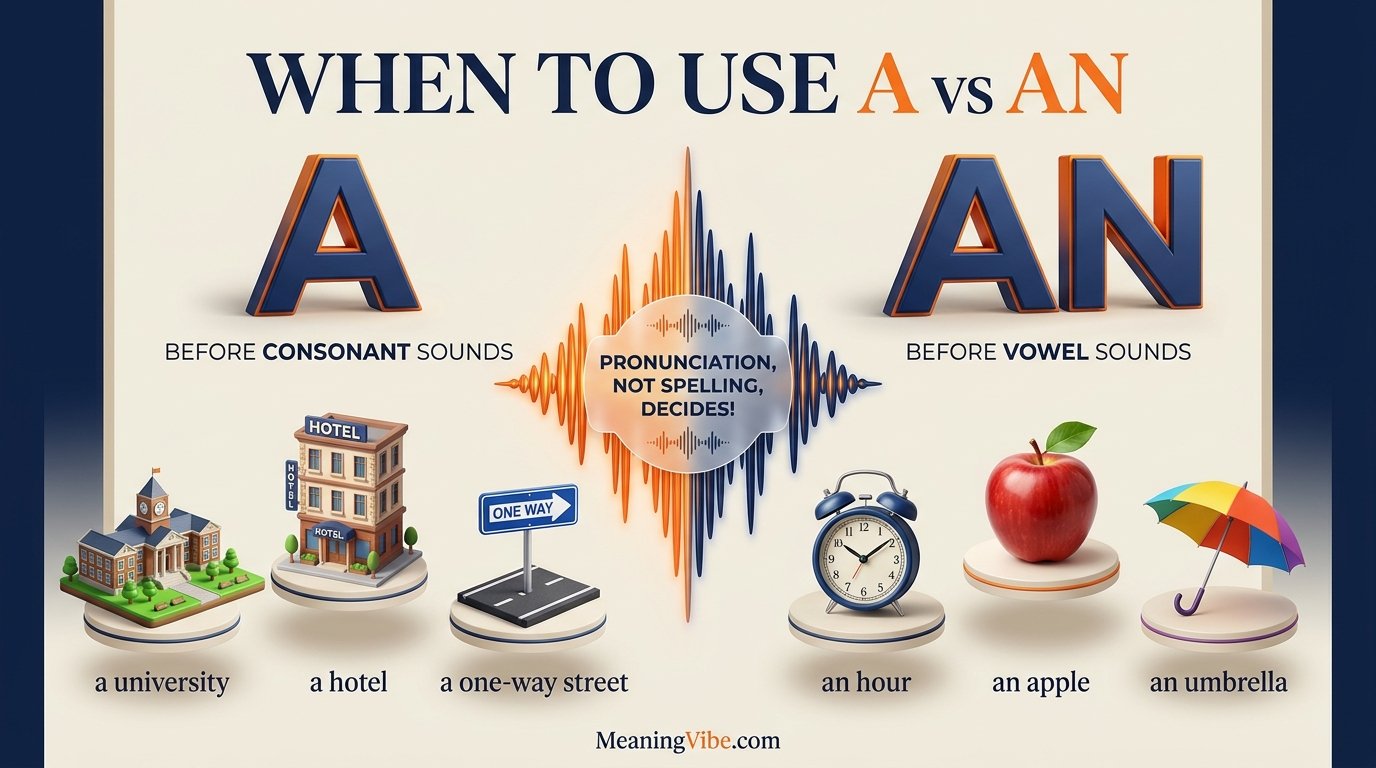
Frequently Asked Questions
1. What are the articles in English?
English has three articles, a, an and the, plus the zero article: the deliberate choice of no article. A and an form the indefinite article; the is the definite article. Articles are determiners before nouns (Cambridge Grammar; ThoughtCo).
2. What is the difference between a, an and the?
A and an introduce a noun the listener cannot yet identify: a first mention, or one of many. The points to an identified noun: mentioned before, unique, or specified by what follows. Zero article serves general statements.
3. What is the zero article?
The zero article is the deliberate choice of no article: Dogs are loyal, Water is essential, She speaks Spanish. It is real grammar, not an omission: the normal choice for general statements, names, languages, sports and meals.
4. How do I choose between a and an?
By the next sound, not the next letter. Say the next word aloud: a vowel sound takes an (an hour); a consonant sound takes a (a university). The British Council states the rule in exactly this form.
5. Why is it a university and not an university?
University begins with the consonant sound yoo. Pronunciation, not spelling, decides: a university, a uniform, a European country (Purdue OWL’s examples).
6. Why is it an hour and not a hour?
The h in hour is silent, so the word begins with a vowel sound. Silent h words take an: an hour, an honest answer, an heir. The British Council’s model: It took me an hour to get home.
7. Is it a historic event or an historic event?
This is a pronunciation strand. Where the h is sounded, as in most current American English, use a historic event; one textbook states flatly that an historical is incorrect in American English. Where the h is weak (older British usage), an historic survives.
8. Is it a MBA or an MBA?
An MBA. Abbreviations read as letters take the article of the first letter’s name: M is pronounced em, a vowel sound, so an MBA, an MP3 file, an SOS. Read as a word, the first sound decides: a UFO.
9. Why do we say she is a doctor but not she is doctor?
Jobs and professions take a or an: She is a doctor, He is an engineer. In the plural the article drops: They are teachers. Cambridge Grammar lists jobs as a core use; the British Council opens its page with it.
10. When do I use the?
When the listener can identify the noun: mentioned before (I saw a dog; the dog was friendly), unique (the sun), clear from the situation (pass me the salt), or specified by what follows (the book on the table).
11. Why is it the sun and the moon?
Because there is only one of each in our shared world. Unique things take the: the sun, the moon, the earth, the sky, the environment. Cambridge Grammar teaches this under things universally known.
12. Do superlatives always take the?
Yes, in normal use: the best. Superlatives, ordinals and the words only and same form the standard the set: the best day, the second chapter, the only copy, the same mistake.
13. Why is it the Nile but just Mount Everest?
Rivers, oceans, seas, deserts and ranges take the: the Nile, the Pacific, the Sahara, the Alps. Single mountains and lakes do not: Mount Everest, Lake Superior. Purdue OWL and Cambridge draw the line in the same place.
14. Why is it the United States and the Netherlands but only France and Japan?
Country names that are plural or built from a common noun take the: the United States, the United Kingdom, the Netherlands, the Philippines (the Republic, Kingdom, States or Union pattern). Plain single names take none: France, Japan.
15. Is it the Ukraine or Ukraine?
Current standard usage is Ukraine, with no article; the name counts as a plain country name. The Ukraine is a dated form in older texts, flagged here as historical.
16. Why do we say play the piano but play football?
Instruments traditionally take the: She plays the piano, He plays the violin. Sports and games take zero: play football, play chess. One strand: American English widely hears play piano without the, so the instrument rule is a strong default, not an absolute.
17. Why is it go to school but go to the school?
The purpose test decides. A pupil goes to school and a prisoner is in prison: the institution serves its purpose, so no article. A visitor goes to the school or the prison as a building, so the appears.
18. Is it in hospital or in the hospital?
A regional strand. British English uses in hospital for a patient receiving treatment; American English normally uses in the hospital for the same meaning. Both are correct in their own variety; mixing them is the error.
19. Why is there no article in by bus, at night and go home?
These are fixed zero article phrases, learned as wholes: by bus, by car, by train, but on foot; at night, at home, at work; go home; in bed.
20. Why do we say breakfast and dinner with no article?
Meals take zero article: We had breakfast at eight, Dinner is at seven. The returns when one particular meal is meant: The dinner we cooked last night was cold.
21. Why is it Life is short and not The life is beautiful?
Abstract and uncountable nouns in general statements take zero article: Life is short, Love is blind, Information is power. Adding the makes the noun specific: The life of a sailor is hard, pinned down by of a sailor.
22. Can I use a with uncountable nouns like information or advice?
No. A and an work only with singular countable nouns: not a information, not an advice. Use a partitive instead: a piece of information, a piece of advice, a bit of help.
23. Why is it a coffee when coffee is uncountable?
In ordering contexts, a coffee means a cup of coffee: the container is understood and countable. The same pattern gives two teas. As a substance in grammar exercises, coffee stays uncountable.
24. Do I repeat the article in a list: the cat and the dog, or the cat and dog?
Both exist. Repeat the article when the items are separate: I fed the cat and the dog, two animals. Drop the second when the pair forms one unit: a knife and fork, one set.
25. Why do headlines drop articles: Man bites dog, President signs bill?
Headline English is a space saving register that omits articles, auxiliaries and other small words. It is a register note, not general grammar: copying it into an essay produces missing article errors, in body copy and instructions alike.
26. Why does the have two pronunciations?
The is pronounced thuh before a consonant sound and thee before a vowel sound: the book, the apple. It is the spoken twin of the sound rule.
27. Do plural nouns take the?
Only when specific. Dogs are loyal is general and takes zero article; The dogs next door are loud is specific and takes the. Cambridge: the appears with plural nouns only for a specific set within the class.
28. Why is it the rich and the poor but not the rich people?
The plus an adjective names a whole group: the rich, the poor, the young, the French. The noun people is understood, not repeated. The rich people appears only for a specific subset: the rich people in this town.
29. Is it the radio, the internet and the TV?
Radio and internet take the: listen to the radio, on the internet. Television splits: watch TV with no article is standard for the medium, while the TV can name the set in the room.
30. Why is it in the morning but at night?
Fixed phrases are learned as wholes, and they are not symmetrical: in the morning, in the afternoon, in the evening, but at night, at noon, at midnight. No deeper rule explains the split.
31. Do languages and school subjects take articles?
No, in general statements: She speaks Spanish, He studies mathematics. The returns only when the language itself or one specific course is named: the Spanish language, the course I took.
32. Why is it a dog in I saw a dog, then the dog in the next sentence?
That is the first mention chain. A first mention introduces a new noun with a or an; every later mention is known, so it takes the. The British Council and Cambridge both teach articles through this chain first.
33. Can the come before a plural or uncountable noun?
Yes. The works with every noun type when the reference is specific: the books on my desk, the water in this bottle. Only a and an are restricted, to singular countable nouns, as Purdue OWL’s chart shows.
34. Why do we say the environment and the government?
These count as unique shared institutions and surroundings, like the sun: the environment, the government, the police, the weather. Cambridge groups them with things known to everyone.
35. Is it a European or an European?
A European. European begins with the yoo sound, a consonant sound, so the sound rule gives a: a European country, a European official. Purdue OWL lists a European country as its worked example for this exam trap.
36. Why is it an MP3 player, and what would make a MP3 wrong twice?
MP3 is read em-pee-three, beginning with a vowel sound, so an MP3 player. A MP3 fails the sound rule, and player, singular countable, still needs its article. Purdue OWL’s acronym rule: follow the sound as read.
37. Do I use an before words like historic, hotel and habitual?
Only if you do not sound the h. In standard American English the h is sounded in historic, hotel and habitual: a historic day, a hotel, a habitual liar. An historic and an hotel survive where the h was weak: a dated strand, not the rule.
38. What is the most common article mistake learners make?
No verified ranking exists, and none is printed. The gallery uses patterns the authorities flag: the before general statements, a before uncountables, letter rule choices like a engineer, the before peaks and plain countries, missing articles. Cambridge’s typical errors section, drawn from learner data, is the closest sourced evidence.
39. My first language has no articles. How should I learn them?
Expect a long project, not a one lesson fix: Russian, Chinese, Japanese, Korean and Polish manage without articles, so the known test is a new habit to build. Learn the three questions in order, then drill the first mention chain in your own writing. No statistics are printed: no fetched source quantifies first language error rates.
40. Are articles tested in IELTS and TOEFL?
Not as a separate section. Article accuracy is scored inside writing and speaking through grammatical range and accuracy, which is why teachers drill articles for exam candidates. No exam board page here publishes an article specific score.
41. Why is it the same and the only?
Same and only pick out one identified thing by definition, so they behave like unique nouns and take the: the same street, the only ticket left. They sit in the same set as superlatives and ordinals (Cambridge; Purdue).
42. How many rules do I actually need to learn articles?
Three questions cover most sentences: Is the noun singular and countable? Can the listener identify which one? Is the meaning general, or a name or fixed phrase? The exceptions bank (geography, instruments, institutions, fixed phrases) is then learned as a list.
Conclusion
Articles a an the rules reduce to three questions asked in order, plus a set of chunks learned whole. Run the gate, the known test and the general test, and most sentences decide themselves.
What remains is the exceptions bank: geography names, instruments, institutions and fixed phrases, memorised sets sitting on top of the flow.
Keep practising inside the cluster: the first conditional sentences and mixed conditional sentences pages drill general and specific reference, and direct speech vs indirect speech shows articles shifting inside reported stories. The full grammar cluster starts from the MeaningVibe homepage.