
One letter. That is all that separates a person who changes with the times from a person who simply picks something up and calls it their own. Yet in emails, essays, business plans, and adoption papers, the adapt vs adopt mix-up shows up again and again.
It matters more than you might think. Tell your boss you “adopted to the new system” and the sentence falls apart. Tell a court you “adapted a child” and the meaning shifts entirely.
Adapt vs Adopt
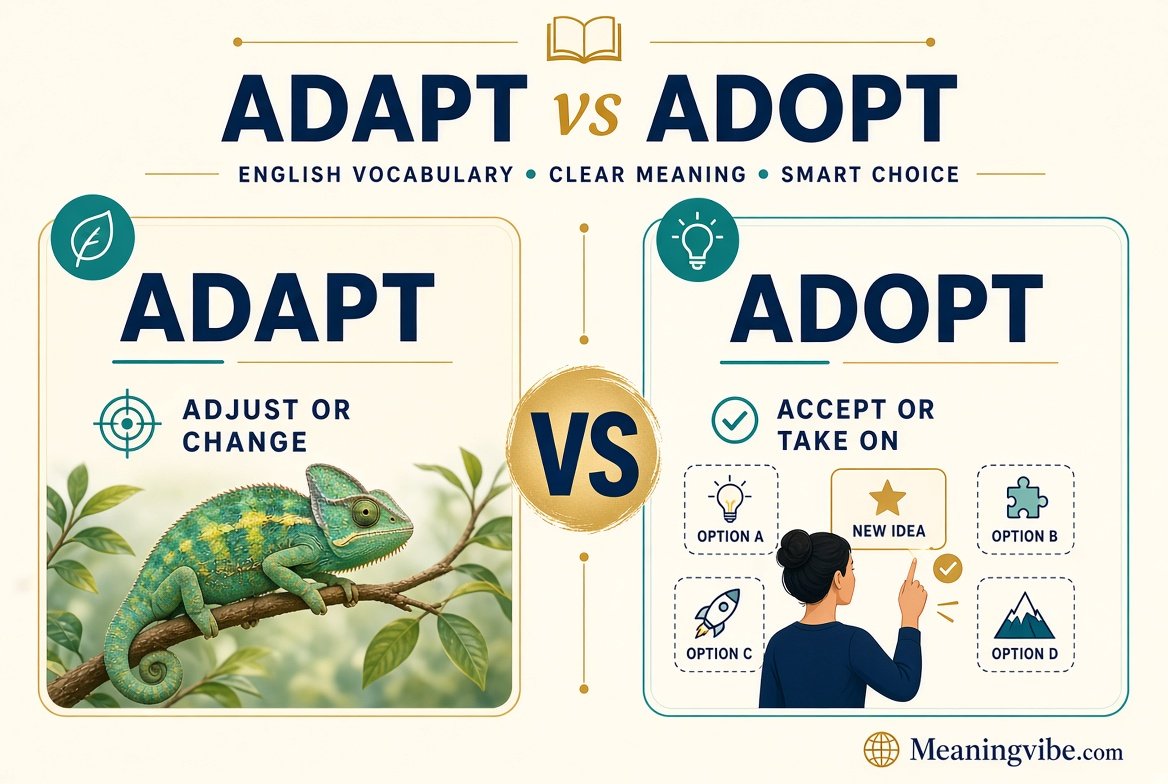
Adapt means to change or adjust something (or yourself) so it fits a new situation, purpose, or environment. Adopt means to take something on as your own, such as a child, a pet, a policy, a habit, or an idea, usually exactly as it is.
Short version: Adapt = adjust to fit. Adopt = choose and take as your own.
Key Takeaways
- You adapt to change, never “adopt to” change.
- You adopt a child, a pet, a policy, a method, or a name.
- You adapt a novel into a film, a recipe for a diet, or a plan for new conditions.
- Adapt is about modification. Adopt is about acceptance.
- Adopt is always followed by an object. Adapt can stand alone.
Adapt vs Adopt Meaning
Both words are verbs, and both deal with change in some way. That is exactly why people confuse them.
The difference is the kind of change. One word transforms the thing. The other transfers ownership of it.
What Does Adapt Mean?
To adapt means to adjust to new conditions or to modify something so it suits a new purpose. The focus is on fit.
You can adapt yourself, as in “She adapted to life in a colder climate.” You can also adapt a thing, as in “He adapted the recipe for a vegan diet.”
Adapt works in two grammatical ways. It can be intransitive (no object needed) or transitive (with an object).
- Intransitive: Some species adapt faster than others.
- Transitive: The teacher adapted the lesson for younger students.
What Does Adopt Mean?
To adopt means to take something up and make it your own. The focus is on choice and acceptance.
The most familiar meaning is legal. When a person adopts a child, they take on the full legal responsibilities of a parent.
The word also covers animals, ideas, names, and rules. A company can adopt a policy. A band can adopt a new sound. A shelter volunteer can adopt a rescue dog.
In everyday use, adopt is a transitive verb, so it normally needs an object. The thing being adopted is usually taken as it is, without being changed first.
Difference Between Adapt and Adopt
Here is the clearest way to see the difference between adapt and adopt side by side.
| Feature | Adapt | Adopt |
|---|---|---|
| Core meaning | Adjust or modify to fit | Take as your own |
| Main idea | Change | Choice |
| Does the thing change? | Yes | Usually no |
| Typical preposition | to, for, from | None needed |
| Grammar | Transitive or intransitive | Mainly transitive |
| Noun form | Adaptation | Adoption |
| Adjective form | Adaptable, adaptive | Adoptive, adoptable |
| Example | Adapt to a new city | Adopt a new policy |
Change vs Choice
Think of adapt as a change that happens to fit something. You bend, flex, or reshape.
Think of adopt as a decision to accept something. You say yes and take it in.
A company that adapts a software tool changes the tool to match its workflow. A company that adopts the tool changes its workflow to match the tool.
Grammar Differences
Adapt can work without an object. “Kids adapt quickly” is a complete sentence.
Adopt rarely stands alone in formal writing. “They adopted a rescue cat” gives the verb something to act on.
The preposition rule is just as useful. Adapt pairs naturally with “to.” Adopt does not.
Adopt or Adapt: Which One Should You Use?
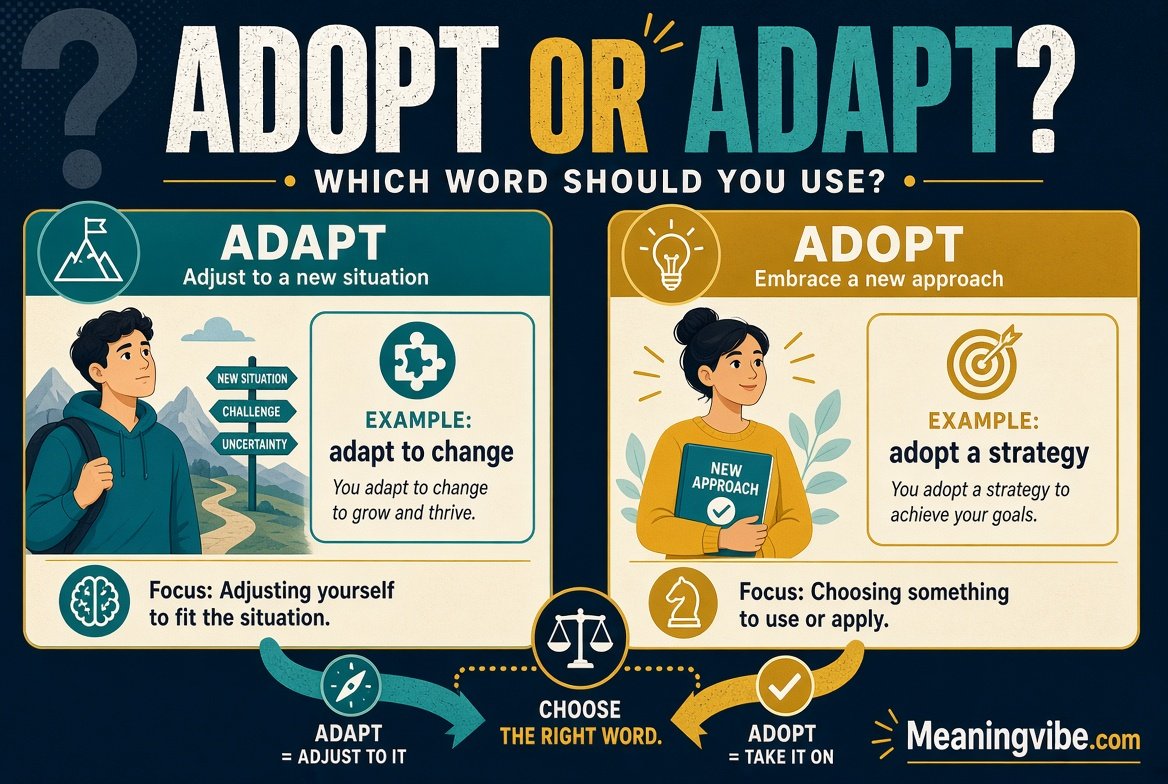
Writers often search for “adopt or adapt” in the middle of a sentence. Use these quick tests to decide in seconds.
Three Quick Tests
Test 1: The “to” test. If “to” follows the verb, you almost certainly need adapt. You adapt to something. You do not adopt to something.
Test 2: The “change” test. Ask whether something is being modified. If yes, use adapt. If something is simply being taken on as is, use adopt.
Test 3: The “own” test. Ask whether someone is making something their own. A child, a pet, a policy, a habit, a name. If yes, use adopt.
Pick the Right Word in Common Situations
| Situation | Correct word | Why |
|---|---|---|
| Adjusting to a new job | Adapt | You are changing yourself to fit |
| Taking in a rescue dog | Adopt | You are making the dog your own |
| Turning a book into a movie | Adapt | The story is being modified |
| Starting to use a new method | Adopt | You are taking it on as your own |
| Changing a recipe for allergies | Adapt | The recipe is being modified |
| Approving a new law | Adopt | The law is formally accepted |
How to Pronounce Adapt and Adopt
The two words look almost identical, and they also sound close. The vowel in the middle is the only real clue.
Adapt is pronounced ə-DAPT. The stressed vowel sounds like the “a” in “cat.”
Adopt is pronounced ə-DOPT in British English and ə-DAHPT in most American accents. The stressed vowel sounds like the “o” in “hot.”
Fast speech makes them blur together. That is one reason the confusion carries over into writing.
Adapt vs Adopt Word Origins
Knowing where the words come from makes them easier to remember.
Adapt comes from the Latin word aptare, meaning “to fit.” The root aptus gives us the English word “apt,” meaning suitable. So to adapt is literally to make something apt, or fitting.
Adopt comes from the Latin adoptare, built from ad (to) and optare (to choose). So to adopt is literally to choose for oneself.
The Memory Trick Hidden in the Spelling
This history gives you a handy shortcut.
- adAPT contains “apt,” meaning suitable. Adapt means to make suitable.
- adOPT contains “opt,” meaning to choose. Adopt means to choose.
Keep those two small words in mind and the choice between them becomes automatic.
Adapt vs Adopt in a Sentence
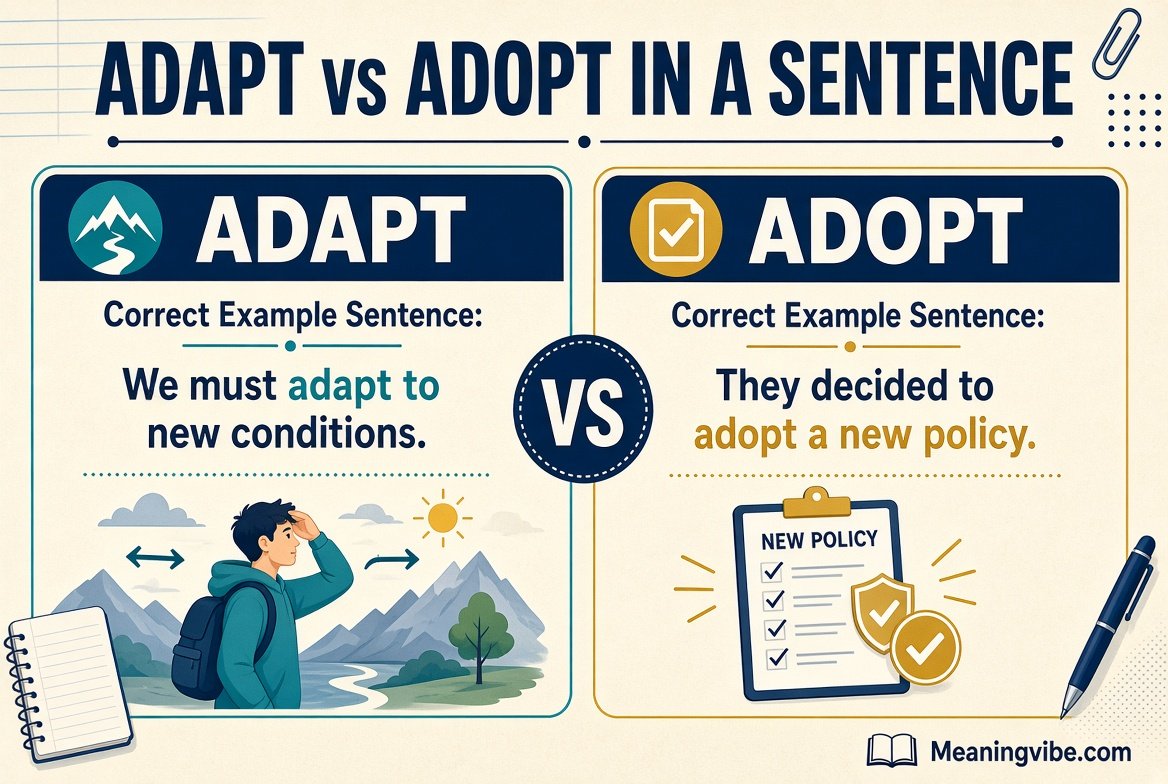
Examples make the difference stick. Read each pair slowly and notice what the verb is doing.
Adapt in a Sentence
- Animals adapt to their environment to survive.
- She adapted quickly to the new school.
- The chef adapted the dish for guests with nut allergies.
- We had to adapt our plans when the weather changed.
- The novel was adapted for the screen in 2019.
- Employees must adapt to new tools to stay competitive.
- He adapted his writing style for a younger audience.
- The company adapted its product for the American market.
Adopt in a Sentence
- The couple decided to adopt a child.
- The school board will adopt the new curriculum next month.
- Many families adopt pets from local shelters.
- She adopted a healthier morning routine.
- The committee voted to adopt the proposal.
- The startup adopted a remote-first policy.
- He adopted his mentor’s habit of writing every day.
- The country adopted a new constitution.
Adapt and Adopt in the Same Sentence
Sometimes both words belong in one sentence, and the difference becomes very clear.
- The company will adopt the new software and adapt its training program to match.
- Many teams adopt agile methods and then adapt them to their own culture.
- Parents who adopt an older child often adapt their routines to help the child settle in.
Adapt To vs Adopt To
This is the single most common error involving these two words. People write “adopt to the change” when they mean “adapt to the change.”
Adapt to is correct. It means adjust yourself to a new situation.
Adopt to is almost never correct. Adopt does not take “to” in this way.
Correct and Incorrect Examples
| Incorrect | Correct |
|---|---|
| We need to adopt to the new rules. | We need to adapt to the new rules. |
| She adopted to city life quickly. | She adapted to city life quickly. |
| Businesses must adopt to digital change. | Businesses must adapt to digital change. |
| It took him weeks to adopt to the climate. | It took him weeks to adapt to the climate. |
One exception exists. The phrase “adopt to” can appear when the word “to” begins a separate clause. For example, “They chose to adopt to give a child a home.” Here “to” belongs to “chose,” not to adopt.
Do You Adapt or Adopt a Strategy?
This question trips up professionals every day. The answer depends on what happens to the strategy.
You adopt a strategy when you take it on as it is. “The team adopted a mobile-first strategy.”
You adapt a strategy when you modify it to fit your situation. “The team adapted a competitor’s strategy to suit its smaller budget.”
Many good plans involve both steps. First you adopt an idea, then you adapt it to your own circumstances.
Adapt vs Adopt Synonyms and Antonyms
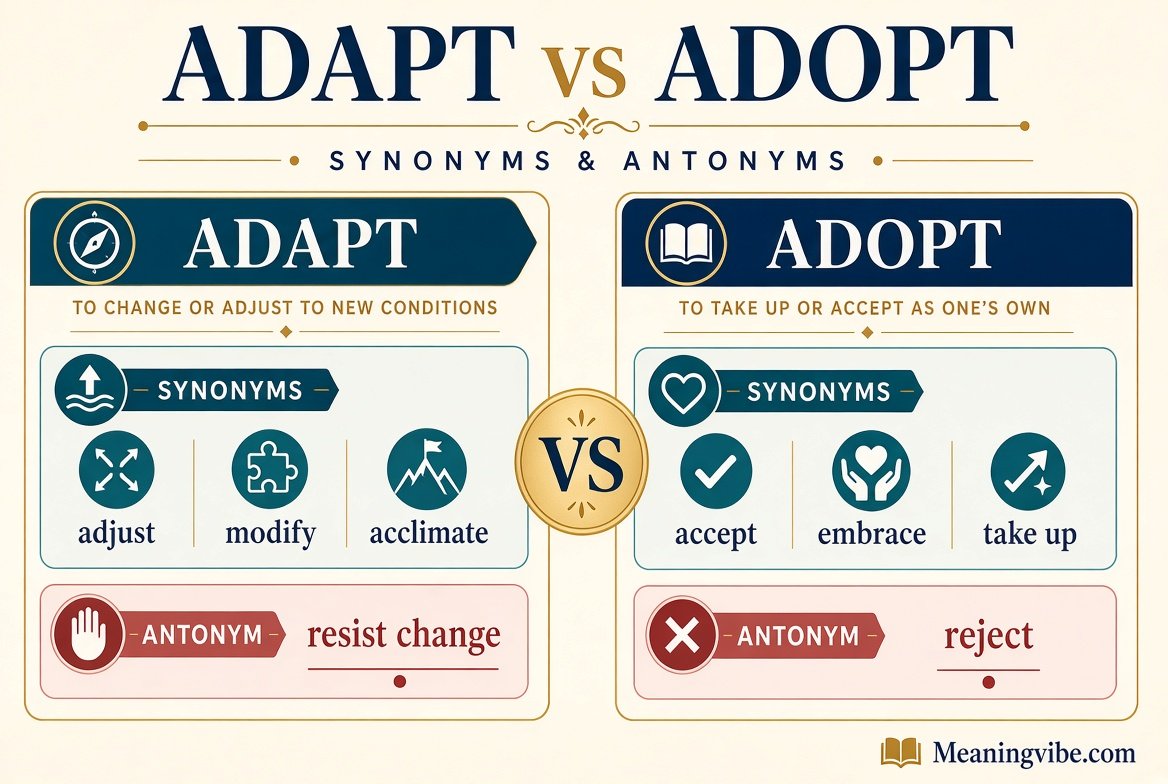
Synonyms help you check your choice. If a synonym fits cleanly, you probably picked the right word.
Synonyms for Adapt
- Adjust
- Modify
- Alter
- Adjust to
- Acclimatize
- Accommodate
- Tailor
- Convert
- Customize
- Reshape
Synonyms for Adopt
- Embrace
- Accept
- Take up
- Take on
- Choose
- Approve
- Assume
- Foster (in some contexts)
- Implement
- Espouse
Antonyms
The opposites also clarify each meaning.
- Adapt is the opposite of resist, preserve, or stay rigid.
- Adopt is the opposite of reject, abandon, or give up.
| Word | Close synonyms | Opposites |
|---|---|---|
| Adapt | Adjust, modify, tailor | Resist, preserve, stay the same |
| Adopt | Embrace, accept, take up | Reject, refuse, abandon |
Adapt vs Adopt Word Forms
Both words give rise to useful nouns and adjectives. Mixing these up causes the same errors.
| Base word | Noun | Adjective | Adverb | Verb forms |
|---|---|---|---|---|
| Adapt | Adaptation, adapter | Adaptable, adaptive | Adaptively | Adapts, adapted, adapting |
| Adopt | Adoption, adopter | Adoptive, adoptable | Not common | Adopts, adopted, adopting |
Adaptation vs Adoption
Adaptation means the act of adjusting, or the result of that adjustment. A film based on a book is an adaptation. A trait that helps an animal survive is an adaptation.
Adoption means the act of taking something on as your own. Legal adoption of a child and the adoption of new technology both use this word.
Adapter vs Adopter
An adapter is a device that lets one thing work with another, like a travel plug adapter. It can also mean a person who adapts a work. You will sometimes see “adaptor,” which is an accepted variant.
An adopter is someone who adopts. In technology, an “early adopter” is a person who starts using a new product before most others.
Adaptable vs Adoptive vs Adoptable
Adaptable describes someone or something that adjusts well. “She is adaptable in any workplace.”
Adoptive describes the family relationship. “Adoptive parents” are parents who have legally adopted a child.
Adoptable describes something or someone that can be adopted. “Adoptable pets” are animals available from shelters.
Adapt vs Adopt in Business
Business is where this pair gets the most attention. Leaders argue over whether to adapt a tool to the company or adopt a tool and change the company.
Both approaches have a place. The right choice depends on cost, speed, and how unique your processes really are.
The Adapt Approach in Business
Under the adapt approach, a company modifies a system or technology to match its existing processes. The software bends to the business.
This feels comfortable. Teams keep familiar workflows, and few people need retraining.
The downside appears over time. Custom changes can be expensive to build, hard to maintain, and slow down future upgrades.
The Adopt Approach in Business
Under the adopt approach, a company takes a proven system and changes its own processes to fit it. The business bends to the software.
Software providers such as SBS Software and Sopra Banking Software have argued that this “adopt, not adapt” mindset helps firms move faster and tap into best practices built into modern tools.
The risk is cultural. People must be willing to change how they work, and that takes strong leadership and clear communication.
Adapt vs Adopt Business Comparison
| Factor | Adapt approach | Adopt approach |
|---|---|---|
| Starting point | Your existing process | The tool’s built-in process |
| Who changes? | The software | The people and workflows |
| Speed of rollout | Slower | Faster |
| Customization cost | Higher | Lower |
| Upgrade ease | Harder | Easier |
| Change management | Lighter | Heavier |
| Best for | Truly unique processes | Standard, proven processes |
When Should a Business Adapt?
Adapt when a process gives you a real competitive edge. If a workflow is what makes your company different, keep it and shape the tool around it.
Adapt when regulations or customer needs demand a specific approach that no standard tool supports.
When Should a Business Adopt?
Adopt when your process is similar to what most companies in your industry do. Payroll, email, and basic accounting rarely need a custom approach.
Adopt when speed matters, when budgets are tight, or when your current process is outdated anyway.
The Hybrid Path: Adopt First, Then Adapt
Most mature organizations land in the middle. They adopt a standard solution for the core, then adapt small parts at the edges.
This keeps upgrades simple while protecting the few processes that truly set the business apart.
Adopt vs Adapt in Technology and Software
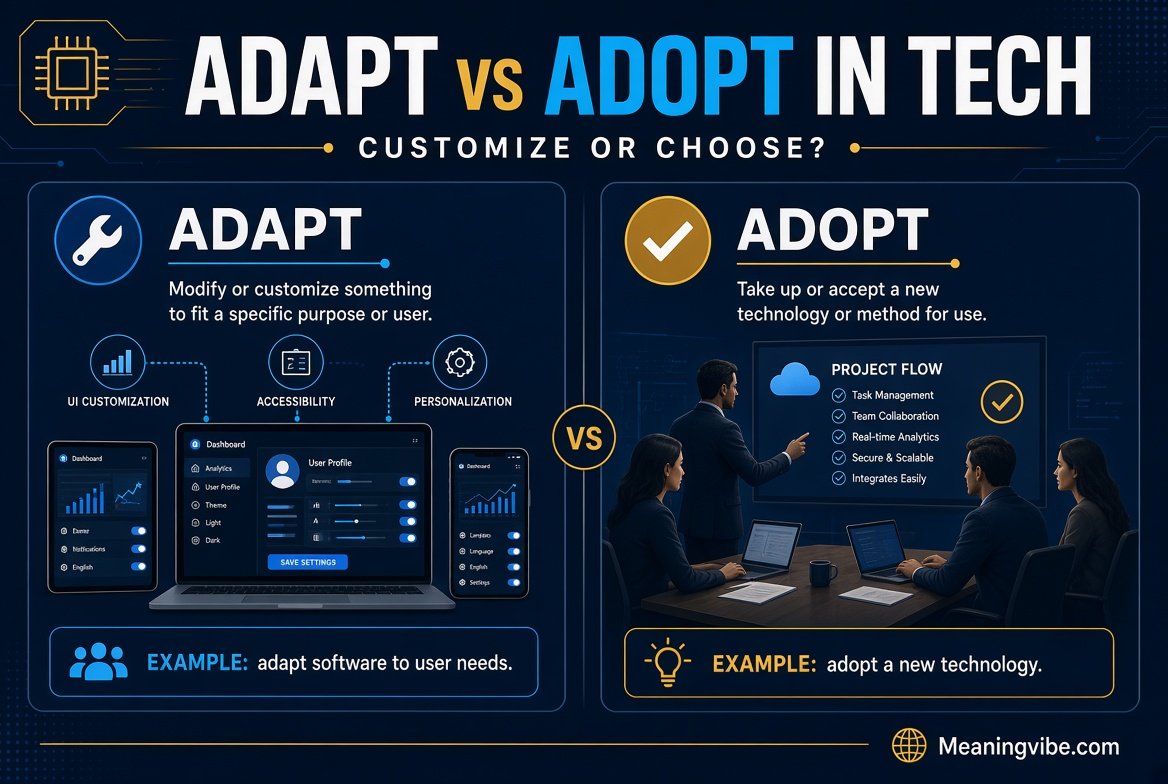
Technology shows the difference between these two words in action. Every rollout involves both.
Technology adoption describes how people and organizations begin using a new tool. Researchers studying this often cite the diffusion of innovations model by sociologist Everett Rogers, which describes groups such as innovators, early adopters, and laggards.
Technology adaptation describes how a tool gets modified to fit a user, a market, or a workflow. Localizing an app for a new language is a classic example.
Early Adopters vs Late Adopters
An early adopter tries new products soon after release. They accept risk in exchange for being first.
A late adopter waits until a product is proven. They give up novelty in exchange for reliability.
Neither group “adapts” in this phrase. They adopt, meaning they take the product on as their own.
Adopting AI Tools vs Adapting to AI
The rise of artificial intelligence gives a fresh example.
A company adopts an AI tool when it begins using it. A worker adapts to AI when they change their skills and habits to work alongside it.
The same story contains both verbs, each doing its own job.
Adapt vs Adopt in Education and Academic Writing
Teachers and researchers use both words constantly, and academic writing demands precision.
In education, a teacher adapts a lesson to meet the needs of different learners. A school district adopts a textbook or curriculum.
Adopting vs Adapting in Research
In research papers, “adopt” usually means a method was used as published. “We adopted the survey instrument from Smith.”
“Adapt” means the method was changed. “We adapted the survey instrument for use with teenagers.”
Reviewers pay close attention to this difference. Saying you adopted a tool signals you used it unchanged. Saying you adapted it signals you modified it, and readers expect details about what changed.
Adapt or Adopt a Document?
If you copy a document and use it as is, you adopt it. If you edit it to fit your needs, you adapt it.
Policy teams often adopt a model policy from a professional body, then adapt the wording to suit their organization.
Adapt vs Adopt in Biology and Nature
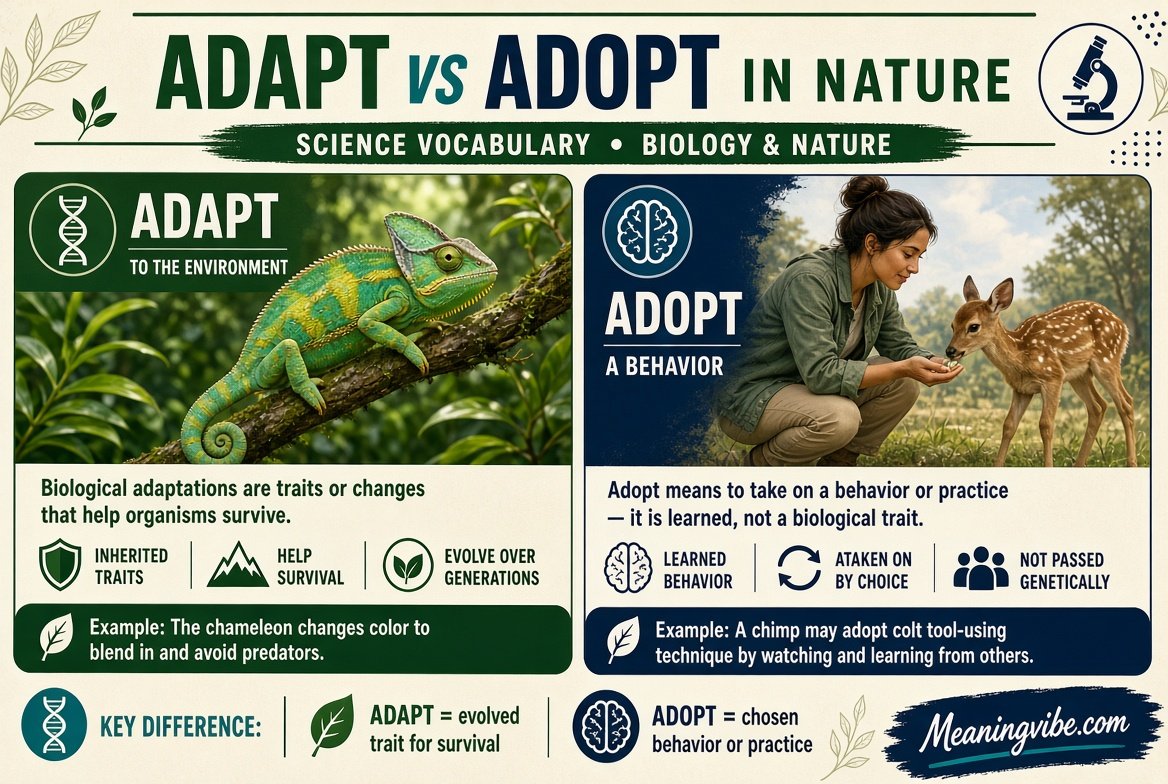
Biology gives us the oldest use of adapt. Living things change over generations to survive in their surroundings.
An adaptation is a trait that helps an organism survive and reproduce in its environment. A polar bear’s thick fur and a cactus’s water-storing stem are classic examples.
Adapt Means Change Over Time
In evolution, adaptation happens across many generations through natural selection. Individual animals also adapt in smaller ways, such as growing a thicker winter coat.
Notice that nobody is choosing here. That is what separates adapt from adopt. Adapting can happen without a decision. Adopting always involves one.
Do Animals Adopt?
Animals can adopt in the everyday sense. A wild animal may take in an orphaned young one of another family. Humans also adopt animals from shelters.
But when scientists describe survival traits, they always say adapt and adaptation, never adopt.
Adapt vs Adopt in Climate Change
Climate discussions use these words in a very specific way, and the distinction is useful.
Adaptation means adjusting to the effects of climate change. Building sea walls, planting drought-resistant crops, and redesigning cities for heat are all adaptation.
Mitigation means reducing the causes of climate change, such as cutting emissions.
Where Does Adopt Fit In?
Governments and companies adopt climate policies, targets, and technologies. A city might adopt a clean energy standard.
So the same climate story can use both verbs correctly. Communities adapt to rising temperatures, and governments adopt the rules that guide the response.
Adapt vs Adopt in Film, Books, and Music
Creative fields lean heavily on adapt. When a story changes form, it is adapted.
Novels are adapted into films, plays into musicals, comics into television series, and games into movies. The core story stays, but the form changes.
Adapt a Book Into a Movie
Adapting means making choices. Writers combine characters, cut subplots, and reshape scenes so the story works on screen.
The final piece is called an adaptation. A screenplay based on an existing novel is often credited as an “adapted screenplay.”
Adopt a Style or Sound
Artists adopt styles when they take on a look or sound as their own. A painter might adopt the palette of another painter. A musician might adopt a genre.
If the artist then changes that style to create something new, they are adapting it.
Adopt vs Adapt a Child or Pet
This is the most emotional use of adopt, and it is the one nobody confuses when speaking aloud.
To adopt a child means to legally become that child’s parent. The process involves courts, agencies, and paperwork that differ by state and country.
Families in the United States who want accurate legal guidance can start with their state child welfare agency or the federal Child Welfare Information Gateway.
Adopt a Pet
Adopting a pet means taking in an animal from a shelter or rescue. The phrase “Adopt, don’t shop” encourages this choice over buying from a breeder or store.
The pet becomes a family member, so the verb stays adopt.
Why You Never “Adapt” a Child
You would not say “We adapted a child” because adapt implies changing the child. Adopt means welcoming the child as your own.
Used correctly, though, adapt appears in adoption stories too. An adopted child adapts to a new home, and the family adapts to a new member.
Adapt vs Adopt in Law, Policy, and Government
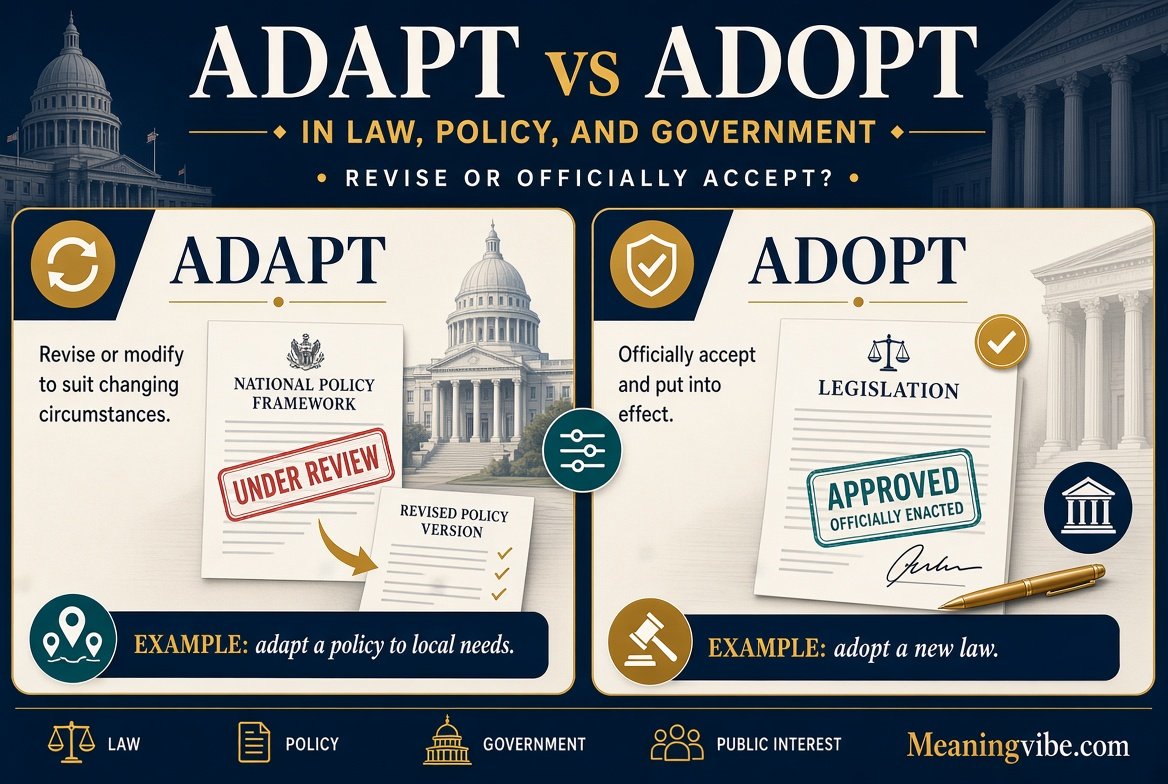
In government, adopt has a formal meaning. When a legislature or board adopts a law, resolution, or budget, it formally approves it.
“The council adopted the new zoning rules.” This does not mean the council changed the rules. It means it voted to accept them.
Adopted vs Adapted Legislation
A state might adopt a model law written by a national commission. It might adapt that same model law by editing sections to fit local needs.
The first is a straight acceptance. The second is a modified version.
Adapt vs Adopt in Culture, Habits, and Lifestyle
People use these words in everyday self-improvement too.
You adopt a habit when you take it on, such as a morning walk. You adapt a habit when you change it to suit your life, such as shortening that walk on busy days.
Adopting a New Culture vs Adapting to It
When someone moves abroad, they might adopt local customs, meaning they take them on as their own.
They also adapt to the new culture, meaning they adjust to unfamiliar surroundings. Both can be true at once.
Adopting a Mindset
Adopting a growth mindset means taking on that way of thinking. Adapting your mindset means shifting your thinking in response to circumstances.
Adopt and Adapt Together: The Best of Both
Some of the smartest decisions blend both ideas. Many people say “adopt and adapt” as a single piece of advice.
It means: take good ideas from others (adopt), then adjust them to your own situation (adapt).
How to Adopt and Adapt in Practice
- Find a proven idea, method, or tool.
- Adopt it as your starting point.
- Test it in your own setting.
- Adapt the parts that do not fit.
- Keep the parts that work as they are.
Why This Approach Works
Pure adoption can ignore local reality. Pure adaptation can reinvent the wheel.
Combining the two saves time and keeps what is unique about your situation.
Adapt or Die: Idioms and Phrases
Several well-known expressions use these verbs.
| Phrase | Meaning |
|---|---|
| Adapt or die | Change to survive or fail |
| Adapt to change | Adjust to new circumstances |
| Adapt on the fly | Adjust quickly without planning |
| Adopt a wait-and-see attitude | Take the position of waiting for results |
| Adopt a new approach | Start using a different method |
| Adopt, don’t shop | Choose rescue animals over buying |
| Adopt a stance | Take a particular position |
| Adapt and overcome | Adjust to beat a challenge |
Common Adapt vs Adopt Mistakes
Even careful writers slip here. Watch for these frequent errors.
Mistake 1: Using Adopt When You Mean Adapt
Wrong: “Our team adopted quickly to the new platform.”
Right: “Our team adapted quickly to the new platform.”
The sentence describes adjustment, so adapt is the verb.
Mistake 2: Using Adapt When You Mean Adopt
Wrong: “The family adapted a puppy last weekend.”
Right: “The family adopted a puppy last weekend.”
The family took the puppy as their own. Nothing was modified.
Mistake 3: Writing “Adopt To”
Wrong: “Children adopt to new routines.”
Right: “Children adapt to new routines.”
Mistake 4: Confusing Adaptation and Adoption in Reports
Wrong: “The adaptation of the policy took place in March.”
Right: “The adoption of the policy took place in March.”
If the policy was simply approved, it was adopted. If it was edited first, adaptation is the right noun.
Mistake 5: Overusing Adapt in Business Writing
Writers sometimes reach for adapt because it sounds active. Check whether anything is really being changed. If a company simply starts using a tool, adopt is the better word.
Mistake 6: Autocorrect and Typos
Because the words differ by one letter, spell check will not flag the wrong one. Both are real words, so proofread carefully for this pair.
Easy Ways to Remember Adapt vs Adopt
Memory tricks work best when they are simple. Pick the one that sticks for you.
Trick 1: Look for the Small Word Inside
adAPT holds “apt,” which means fitting. adOPT holds “opt,” which means choose.
Trick 2: The A and O Rule
A in adapt: Adjust. O in adopt: Own.
Trick 3: The Preposition Rule
If “to” comes next, pick adapt. Adopt never needs it for an object.
Trick 4: The Question Rule
Ask: “Is it changing, or is it being chosen?” Changing means adapt. Chosen means adopt.
Commonly Confused Words Like Adapt and Adopt
English is full of look-alike pairs that cause the same kind of slip. Building awareness of them improves your writing across the board.
Words That Look Alike
Pairs such as emersion and immersion look almost identical but point in opposite directions. The same attention to small spelling differences helps with adapt and adopt.
Dysregulated and disregulated are another close pair where one small prefix changes the meaning.
Words That Sound Alike
Some pairs trip people up because they sound almost the same. A good example is sell and sale, where one is a verb and the other is a noun.
Common Spelling Slips
Spelling errors also cause trouble. Guides on receive vs recieve, weird vs wierd, and speech vs speach show how a single transposed letter can make a word look wrong.
Likewise, input vs imput and across vs accross are quick reads that sharpen your proofreading eye.
Apostrophe and Preposition Problems
Small marks and small words cause big confusion too. Read about today’s vs todays and else’s vs elses for apostrophe rules.
For prepositions, the guide on relate to vs relate with pairs nicely with the “adapt to” rule above.
Adapt vs Adopt Practice Exercise
Test yourself. Fill each blank with adapt or adopt, then check the answers below.
- The museum decided to ____ a new ticketing system.
- Tourists often take days to ____ to the time difference.
- Her screenplay will ____ the novel for television.
- After years of volunteering, they chose to ____ a rescue greyhound.
- Managers must ____ their style to different teams.
- The board voted to ____ the new code of conduct.
- Plants in the desert ____ to survive with little water.
- He tried to ____ his grandmother’s recipe for a gluten-free diet.
Answers
- Adopt. The museum is taking up a new system.
- Adapt. Tourists adjust to the time difference.
- Adapt. The novel is being modified for a new medium.
- Adopt. They are taking in a dog as their own.
- Adapt. Managers adjust their style.
- Adopt. The board formally accepts the code.
- Adapt. Plants adjust to survive.
- Adapt. The recipe is being modified.
Adapt vs Adopt Cheat Sheet
Save this table for quick reference.
| Question | Answer |
|---|---|
| Is something being changed to fit? | Adapt |
| Is something being taken as your own? | Adopt |
| Does “to” follow the verb? | Adapt |
| Is a child, pet, or law involved? | Adopt |
| Are you describing survival traits? | Adapt |
| Are you describing approval of a rule? | Adopt |
| Is a book becoming a film? | Adapt |
| Is a company starting to use a tool? | Adopt |
| Are you making a recipe suit a diet? | Adapt |
| Are you copying a method exactly? | Adopt |
Why People Confuse Adapt and Adopt
Understanding the root of the confusion helps you avoid it.
First, the two words differ by only one letter. Second, they sound alike in fast speech. Third, both relate to change or acceptance, so the meanings feel connected.
Spell check also fails here. Because both are valid words, a wrong choice slips through unnoticed. The only real defense is a clear mental picture of what each word does.
Tips for Proofreading This Pair
- Search your document for both words and check each one.
- Read each sentence and ask: change or choice?
- Check every “adapt” for a following “to” or a thing being modified.
- Check every “adopt” for something being taken as is.
- Read the sentence aloud once to catch awkward phrasing.
Adapt vs Adopt in Everyday Conversation
You do not need to be writing a formal paper to use these words well. Everyday talk is full of them.
At work, you might say, “We adapted the schedule when two people were out.” At home, you might say, “We adopted a new bedtime routine.”
Friendly Examples
- “I’m still adapting to the new time zone.”
- “We’re adopting a kitten this weekend.”
- “She adapted her speech for the younger crowd.”
- “The team adopted a four-day work trial.”
- “Kids adapt faster than adults think.”
- “He adopted the family’s tradition of Sunday dinners.”
Professional Examples
- “Our department will adopt the updated reporting standards.”
- “We adapted the training to fit remote employees.”
- “The agency adopted the new guidelines in January.”
- “Please adapt the template to your own needs.”
Adapt vs Adopt Quick Reference for Writers
Different readers need different shortcuts. Use the one that matches your work.
For Students
Use adopt when describing a theory, method, or position you accepted as is. Use adapt when you changed a model, tool, or approach to suit your study.
For Business Writers
Use adopt when your company begins using a tool, policy, or standard. Use adapt when you reshape a product, plan, or process.
For Creative Writers
Use adapt for turning one form of story into another. Use adopt for taking on a voice, name, or style.
For ESL Learners
Learn the two prepositions first. Adapt goes with “to.” Adopt goes straight to its object.
Then practice with short sentences until the pattern feels natural.
Also Read:
- Relate To vs Relate With: Meaning, Difference & Correct Usage (2026)
- Window Seal vs Window Sill: Definitions, Examples & Usage (2026)
- Parents’ or Parent’s? What’s the Difference? Correct Usage Explained (2026)
- Minoot or Minute: Which Is Correct? Meaning, Pronunciation & Usage (2026)
- Sell vs. Sale: What’s the Difference? Meaning, Usage & Examples (2026)
- People Do or People Does: Which Is Correct? Grammar Rules & Examples (2026)
- Encorporate vs Incorporate: What’s the Difference? Correct Usage Explained (2026)
- Grately vs Greatly Explained: Meaning, Examples & Grammar Rules (2026)
- Emersion vs Immersion Explained: Definitions, Usage & Examples (2026)
- Accross vs Across: Meaning, Spelling and Correct Usage (2026)
- Dought vs. Doubt: Correct Spelling, Meaning & Usage Explained (2026)
- Dysregulated vs. Disregulated: What’s the Difference? (Complete Guide 2026)
- Speach or Speech? Stop Making This Common Spelling Mistake (2026 Guide)
- Fiending or Feening? Stop Making This Common Spelling Mistake (2026)
- Dammit vs. Damnit: What’s the Difference and Which Is Right? (2026)
- Is It Signor or Signer? The Difference Explained with Examples (2026)
- Wierd or Weird: Meaning, Correct Usage & Examples (2026)
- Elses vs. Else’s: Meaning, Grammar Rules & Examples (2026)
- Today’s vs. Todays: Meaning, Grammar & Examples (2026)
- Receive vs. Recieve: What’s the Difference and Which Is Right? (2026)
- Input vs. Imput: What’s the Difference and Which Is Right? (2026)
- Pricy vs. Pricey: What’s the Difference and Which Is Right? (2026)
Adapt vs Adopt FAQs
What is the difference between adapt and adopt?
Adapt means to change or adjust something to fit new conditions. Adopt means to take something on as your own. One is about change, and the other is about choice.
Is it adapt or adopt to change?
The correct phrase is “adapt to change.” You adjust yourself to change. You do not adopt to it.
Do you adapt or adopt a strategy?
You adopt a strategy when you take it on as it is. You adapt a strategy when you modify it to fit your situation. Many teams do both in order.
Can you say adopt to?
Almost never. “Adopt to” is a common error for “adapt to.” The only exception is when “to” starts a separate clause, as in “They chose to adopt.”
What does adapt mean in simple words?
It means to adjust or change so something works better in a new situation. A person can adapt to a new city, and a recipe can be adapted for a new diet.
What does adopt mean in simple words?
It means to take something as your own. That might be a child, a pet, a policy, or a habit.
Is adapt transitive or intransitive?
Both. “She adapted quickly” is intransitive. “She adapted the plan” is transitive.
Is adopt transitive or intransitive?
It is mainly transitive, meaning it takes an object, such as “adopt a child.” Some dictionaries also record a stand-alone use, as in “They hope to adopt.”
What is an example of adapt?
“Animals adapt to their environment to survive” is a classic example. Another is “He adapted the recipe for a vegan diet.”
What is an example of adopt?
“The couple decided to adopt a child” is the classic one. Another is “The company adopted a new policy.”
How do you remember adapt vs adopt?
Look for the small words inside. AdAPT holds “apt,” meaning suitable. AdOPT holds “opt,” meaning choose.
What is the noun form of adapt?
The noun is “adaptation.” A movie based on a book is an adaptation, and so is a body trait that helps a species survive.
What is the noun form of adopt?
The noun is “adoption.” It covers legal adoption of a child and the adoption of a new policy or technology.
What is the difference between adaptation and adoption?
Adaptation is the act of changing something to fit. Adoption is the act of taking something on as your own. Adaptation modifies, while adoption accepts.
What does adopt vs adapt mean in business?
To adapt is to change a tool or system to fit your existing processes. To adopt is to take a proven tool and change your processes to fit it.
What is the adopt not adapt approach?
It is a business mindset that favors using standard, proven solutions and changing internal processes to match. Supporters say it speeds up delivery and lowers customization costs.
Is it adopt or adapt a document?
If you use the document exactly as is, you adopt it. If you edit it to fit your needs, you adapt it.
What does it mean to adapt a book into a movie?
It means reshaping the story so it works in film. Writers change structure, trim characters, and rework scenes while keeping the core story.
What is an early adopter?
An early adopter is a person who starts using a new product or technology soon after it launches, before most other people do.
Should you adapt or adopt in a new job?
You adapt to a new job, meaning you adjust to the team and workplace. You adopt new tools, methods, or habits that your employer introduces.
Can you adapt and adopt at the same time?
Yes. Many situations call for both. A team can adopt a new method and adapt it to its own needs.
Is adapt vs adopt a common grammar mistake?
Yes. The words differ by one letter, sound alike, and both relate to change. Spell check will not catch the error, so careful proofreading helps.
How do you use adapt and adopt in a sentence?
“We adopted a new system and adapted our training to match it.” This sentence uses each verb in its correct role.
What are synonyms for adapt and adopt?
Synonyms for adapt include adjust, modify, and tailor. Synonyms for adopt include embrace, accept, and take up.
Do animals adapt or adopt?
Animals adapt to their environments over generations. Humans adopt animals into homes. Occasionally, animals also take in the young of other families.
What is the opposite of adapt and adopt?
The opposite of adapt is resist or stay the same. The opposite of adopt is reject or abandon.
Conclusion
The adapt vs adopt question comes down to one idea. Adapt is about changing to fit. Adopt is about choosing to take something as your own.
When you adjust yourself, a plan, a recipe, or a story to a new situation, you adapt. When you take on a child, a pet, a policy, or a habit, you adopt.
Remember the quick tests. Look for “to” after the verb and pick adapt. Look for something being made your own and pick adopt. Or just recall the small words inside: adAPT holds “apt,” and adOPT holds “opt.”
Smart people and smart organizations often do both. They adopt good ideas, then adapt them to their own world.
Keep this guide handy the next time you are unsure, and your writing will stay clear, correct, and confident.