
Direct speech vs indirect speech is the choice between two ways of carrying what someone said. Direct speech repeats the exact words inside quotation marks, and indirect speech reports the content inside your own sentence.
One name needs settling at the start. Indirect speech is the same form as reported speech, and direct speech is called quoted speech, so the four labels name two forms, not four.
Every rule and example here follows US conventions. Double quotation marks are the primary marks, and British differences appear only in one labeled note.
The Short Answer: Exact Words in Quotes vs Content in Your Own Sentence
Direct speech is a quotation, word for word. Maria said, “I am tired.” The quotation marks promise the reader that these were the speaker’s actual words, in her actual order.
Indirect speech is a report, not a quotation. Maria said that she was tired. The sentence carries what Maria meant, in the reporter’s words, with no quotation marks anywhere.
The Comparison Table: Feature by Feature, With the Decision Each Feature Drives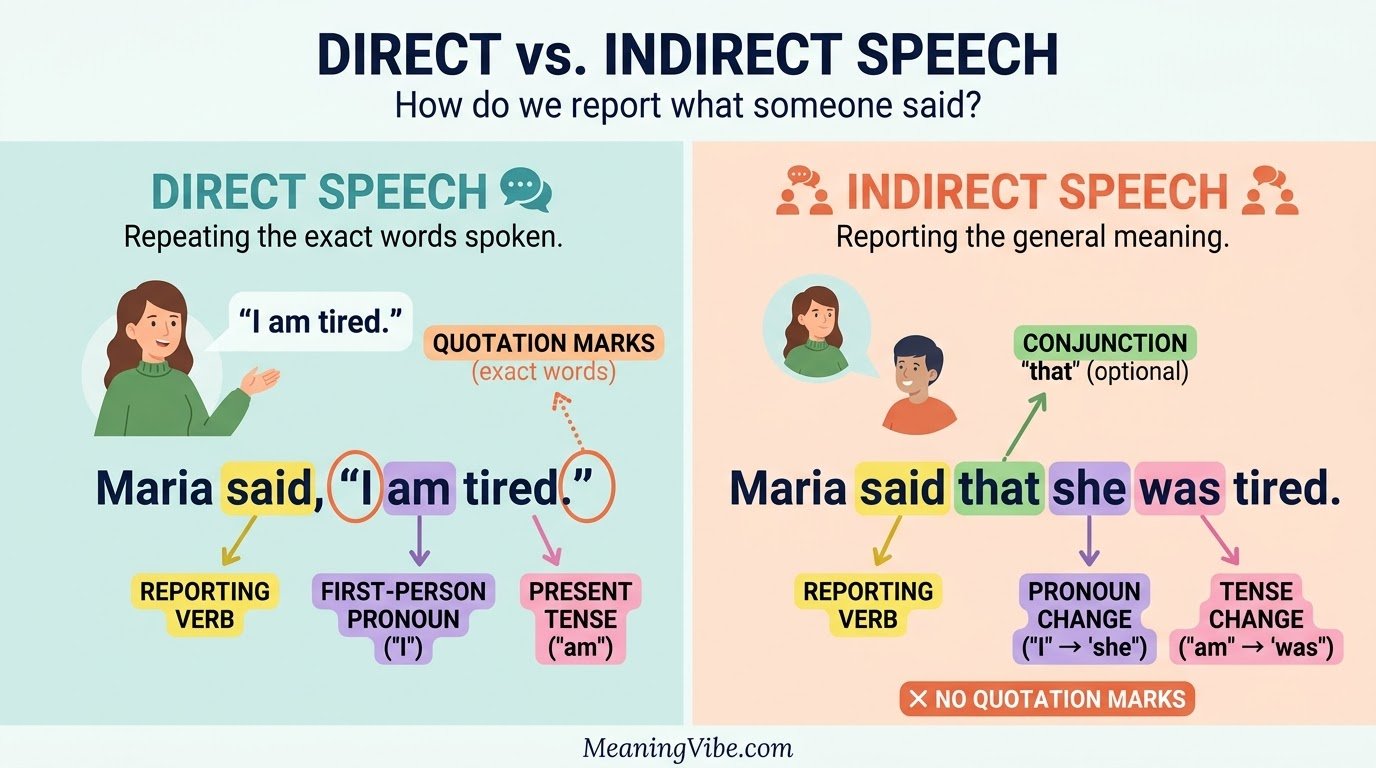
Read the table as a set of decisions, not just contrasts. Each row names a feature, shows both forms, and states the choice it forces on the writer.
|
Feature |
Direct speech |
Indirect (reported) speech |
The decision it drives |
|---|---|---|---|
|
Wording |
The speaker’s exact words |
The content in the reporter’s words |
Quote only wording you can accurately represent as a quotation; report the rest |
|
Punctuation |
Quotation marks, US double primary; comma before the quote; periods and commas inside |
No quotation marks; no comma after the reporting clause; period at the end, even for reported questions |
US mechanics are the rule set; British placement appears only labeled British |
|
Connector |
The quote itself follows the reporting clause |
That (optional) for statements; if or whether for yes or no questions; the question word for wh questions; to-infinitive for commands and requests |
Choose the pattern by sentence type before touching tenses |
|
Tense |
The tense the speaker used |
Backshift by default after a past reporting verb, with optional and no shift cells |
Run the no backshift decision before applying the ladder |
|
Pronouns |
The speaker’s pronouns |
Shifted by following the speaker and the listener |
Follow the people; repeat a name when a pronoun could point two ways |
|
Time and place words |
The speaker’s (today, here, now) |
Shifted only when the reporting context has moved |
Same day keeps today; the shift is conditional, never always |
|
Tone and voice |
The speaker’s tone, emphasis and style preserved |
Tone carried, if at all, by the reporting verb choice |
Never upgrade said to admitted or promised without evidence |
|
Best use |
Voice, drama, accuracy, evidence |
Summary, formality, integration |
The choice of form section: journalism, fiction, academic and news cases |
The wording row carries the deepest consequence. Because a quotation claims exactness, you may only quote wording you can accurately represent, and everything else belongs in a report.
What Direct Speech Is: Exact Words, Quotation Marks and the Reporting Clause
Direct speech presents the speaker’s words as a quotation. The Cambridge definition is the plainest: it repeats the exact words the person used, or how we remember their words.
The reporting clause can sit in three positions. Before the quote (She said, “I am leaving.”), after it (“I am leaving,” she said), or inside it, splitting the quote in two.
A split quote is called an interrupted quotation. “Thinking back,” he said, “she didn’t expect to win.” The second half restarts lowercase, because the sentence never actually ended.
The two part anatomy runs through both forms: the Cambridge Dictionary grammar entry on reported speech describes each speech report as a reporting clause plus a reported clause, and in direct speech the reported clause is the quotation.
What Indirect Speech Is: Reported Speech, the That-Clause and the Reporter’s Sentence
Indirect speech reports the content of what was said. It focuses on what the speaker meant rather than the exact words, and it rebuilds the content inside the reporter’s own sentence.
The reported clause changes shape with the sentence type. Statements usually take a that-clause, yes or no questions take an if or whether clause, and commands take a to-infinitive clause.
Two punctuation habits disappear in the report. There are no quotation marks, and a reporting clause placed before the reported clause takes no comma: She told me they had left.
The Terminology Box: Quoted, Reported, Narration and Inverted Commas
Direct speech is also called quoted speech. The two labels name the same form, and US school and style contexts use them interchangeably for the exact words inside quotation marks.
Indirect speech is also called reported speech. British and ESL publishers prefer reported speech, while the search query and US school grammar use indirect speech, so this page leads with the query term.
Narration change is the school grammar name used in Indian and Pakistani exam contexts. It has no currency in US classrooms and appears here once, for recognition only.
US Punctuation Mechanics for Direct Speech: The Full Rule Set
These are the US rules, stated as US rules. They are the standard in the United States, and they decide where every comma, period and question mark lands around a quotation.
Comma Before the Quote, Periods and Commas Inside, Marks by Scope
A reporting clause that introduces a quote takes a comma. She said, “I’m leaving.” A colon can do the same job after a complete independent clause in formal writing.
Periods and commas go inside the closing quotation marks, always. “I’m leaving,” she said. He called it “a mistake.” The punctuation comes before the final mark, with no exceptions in US style.
Question and exclamation marks follow scope instead. The mark goes inside when it belongs to the quoted words (He asked, “When will you be arriving?”) and outside when it belongs to the whole sentence.
Colons and semicolons always go outside the closing marks. And a quoted question keeps its own mark with no comma after it: “Are you ready?” she asked, with the reporting clause lowercase.
Capitalize the first word of a quoted complete sentence. She said, “The train is late.” A quoted fragment takes no capital, and neither does the second half of an interrupted quotation.
The full rule set is set out in one place: the Purdue OWL quotation marks guide states each placement rule with examples, and it is the authority this section follows from the first rule to the last.
British Style Differs: The Labeled Note
British publishing commonly reverses the quotation marks. Single marks are the primary pair and double marks sit inside them, the opposite of the US arrangement described above.
Neither convention is wrong inside its own system. The error is mixing them unlabeled, so every British form on this page stays inside this note and every example outside it is US style.
Say vs Tell: The Object Rule That Decides the Verb
Tell requires the listener as its object. You tell someone something: She told me that she was tired. Without the person, tell cannot carry a statement at all.
Say takes no listener object. She said that she was tired, or She said to me, “I am tired,” when a direct introduction names the listener with a preposition.
The two classic errors fail this one test. He said me is wrong because say rejects the bare object, and He told he was moving is wrong because tell demands one.
Learner lessons drill the same rule in shorter form: the 7ESL direct and indirect speech lessons warn against “He said me” and build the say and tell patterns as separate lessons for that reason.
Converting Direct to Indirect: The Five Step Overview
Conversion is a sequence of five decisions, in a fixed order. Work through them in order and most sentences convert cleanly, because each step removes one source of error before the next begins.
- Step 1: Drop the quotation marks. The report is your sentence now, so the exact words become content your sentence carries, and the comma before the quote disappears with the marks.
- Step 2: Choose the reporting verb and connector by sentence type. Statements take say or tell with an optional that, questions take ask, and commands and requests take the to-infinitive pattern.
- Step 3: Shift the pronouns by following the people. First person follows the original speaker, second person follows the listener, and third person stays exactly where it was.
- Step 4: Backshift the tense if the conditions call for it. A past reporting verb makes the one step back move the default, and the exceptions get their own section below.
- Step 5: Adjust time and place words only if the context moved. Today becomes that day when the day changed, and stays today when it did not, as the next sections show.
One decision sequence sits behind these steps: the CueLab direct and indirect speech lesson teaches conversion through four checks, who spoke, who listened, what the speaker was doing, and when and where the report happens.
The Summary Backshift Table, With the Strand Cells Flagged
This is the summary ladder after a past reporting verb. Unanimous rows print plainly, and the contested rows carry their strand inside the cell, because the disagreement is part of the rule.
|
Direct |
Indirect (usual) |
Strand or note |
|---|---|---|
|
present simple |
past simple |
Unanimous |
|
present continuous |
past continuous |
Unanimous |
|
present perfect |
past perfect |
Unanimous |
|
present perfect continuous |
past perfect continuous |
British Council |
|
past simple |
past perfect OR unchanged |
STRAND: Perfect English Grammar prints both; British Council says usually; school tables print past perfect flat |
|
past continuous |
past perfect continuous OR unchanged |
STRAND: British Council says usually changes |
|
past perfect |
unchanged |
Unanimous; nothing further to shift to |
|
will |
would |
Unanimous |
|
can |
could |
Unanimous |
|
may |
might |
Unanimous |
|
shall |
would OR should |
STRAND: future intention to would (Perfect English Grammar); obligation to should (school tables) |
|
must |
had to OR must retained |
STRAND: flat had to (school tables); both printed (Perfect English Grammar); meaning split by CueLab |
|
could, would, should, might, ought to |
unchanged |
Unanimous; already in shifted form |
|
be going to |
was or were going to |
Perfect English Grammar |
This table is an overview, and its depth lives elsewhere: our reported speech rules guide works through the full ladder, the modal strands and the still true scopings that the flagged cells only summarize here.
Pronouns Follow the People, Time Words Follow the Context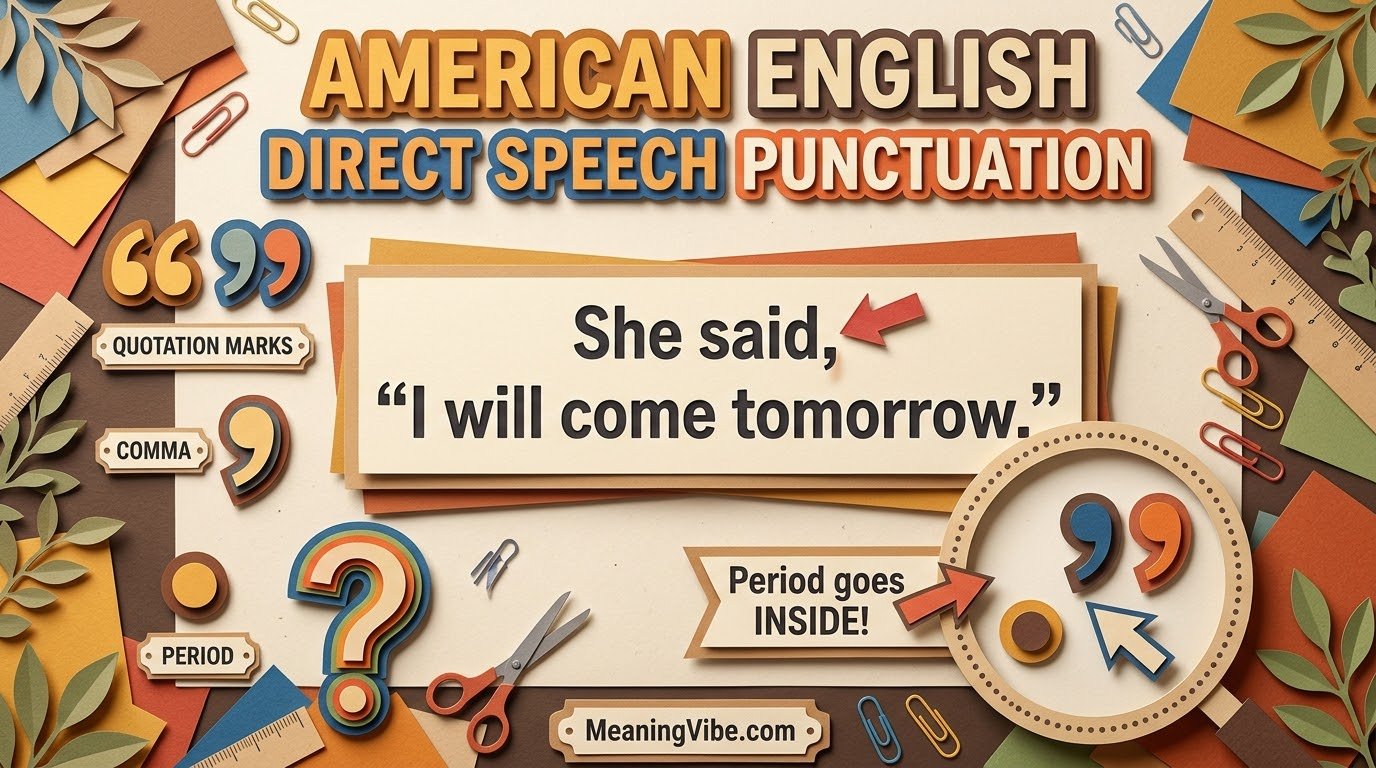
Pronouns follow the people, never a table alone. I becomes he, she or they when someone else reports the speaker, you becomes whoever was listening, and a name beats a pronoun that could point two ways.
Time and place words shift only when the reporting context has moved. Said on Monday and reported on Monday, today stays today; reported a month later, the same word becomes that day.
|
Direct word |
Reported word |
|---|---|
|
now |
then |
|
today |
that day |
|
tonight |
that night |
|
yesterday |
the day before |
|
tomorrow |
the next day |
|
ago |
before |
|
last week |
the week before |
|
next week |
the following week |
|
here |
there |
|
this |
that |
|
these |
those |
Two scenarios anchor the conditional rule. Julie says on Monday, “I’m leaving today”: reported that Monday she was leaving today, and a month later she was leaving that day.
The mirror case moves tomorrow forward instead: the 5 Minute English direct and indirect speech lesson shows Mina promising on Monday to call tomorrow, reported on Tuesday as Mina said she would call me today, because the report day moved.
When the Tense Does Not Change: The No-Backshift Decision in Short Form
A present or future reporting verb blocks the shift entirely. She says, “I love coffee” becomes She says that she loves coffee, because the reporting verb never moved into the past.
A statement that is still true makes the shift optional. She said she is tired and She said she was tired are both correct, and the choice says nothing about whether she recovered.
General truths and universal facts keep the present tense. The teacher said that the Earth revolves around the sun. Backshifting a fact of nature would report the wording, not the world.
Some forms have nothing left to shift. Past perfect stays past perfect, and could, would, should and might are already in their shifted forms, so the ladder simply stops at them.
The full decision is the depth this page hands off: our reported speech rules guide holds the complete no-backshift treatment, and this short form is the working version for conversion.
The Strands: Where Good Sources Disagree
Four conversion cells have more than one defensible answer. Each prints below as labeled source positions, because averaging them would teach a form no source actually holds.
Past Simple: Past Perfect or Unchanged
Both forms print side by side in one table: the Perfect English Grammar reported speech lesson gives She said that she had bought a car, or She said that she bought a car, and adds: you have a choice.
British Council softens the same cell to a default. Past simple usually changes to past perfect, which makes past perfect the classroom default and the unchanged form a real option beside it.
The two forms are the two halves of one strand: our past simple tense rules guide and our past perfect tense rules guide each teach their tense in full, and the reported sentence may legitimately land on either one.
Must: Three Positions and a Meaning Split
School tables print one replacement: must becomes had to. Right for obligation and wrong for deduction, it is a form the better sources refuse to print alone.
The meaning split is the decision this page teaches: the CueLab direct and indirect speech lesson sends a past obligation to had to, and keeps must for a deduction, as in He said the office must be empty.
Perfect English Grammar prints both forms without choosing. Its table allows must or had to for one sentence, and a style position held by the rules sibling keeps must unchanged.
Shall, and the Still True Scope
Shall splits by what it was doing. Future intention becomes would in the Perfect English Grammar table, while obligation and suggestion uses become should in the school tables, and the case is rare in modern US usage.
Still true scope runs from wide to narrow. British Council allows keeping the tense for anything still true or relevant, and Perfect English Grammar restricts the habit to general facts.
Reporting Questions, Commands, Requests and Exclamations: The Pattern per Type
Each sentence type converts through its own pattern. Choose the pattern by type before touching tenses or pronouns, because the connector is decided here.
|
Sentence type |
Reporting pattern |
Worked pair |
|---|---|---|
|
Statement |
say or tell + (that) + clause |
Maria said, “I am tired.” becomes Maria said that she was tired |
|
Yes or no question |
ask + if or whether + statement word order |
He asked, “Are you coming?” becomes He asked if I was coming |
|
Wh- question |
ask + question word + statement word order |
She asked, “Where do you live?” becomes She asked where I lived |
|
Command |
tell or order + object + to-infinitive |
The teacher said, “Open your books.” becomes The teacher told us to open our books |
|
Request |
ask + object + to-infinitive |
She said, “Please close the window.” becomes She asked me to close the window |
|
Exclamation |
statement of the content, emotion verb only if supported |
She said, “What a beautiful view!” becomes She exclaimed that it was a beautiful view |
Reported questions use statement word order and end with a period. He asked where I was going, never He asked where was I going, and no question mark closes the report.
Subject questions are the one pattern that looks unchanged. Who took the marker? becomes She asked who had taken the marker, because who is already the subject, so no second subject follows.
Question shaped requests convert by function, not by shape. “Could you pass the milk, please?” is a request, so it reports as She asked me to pass the milk, not as a question about ability.
Please disappears in the report, by design. Its politeness moves into the verb: ask carries it, and tell drops it.
Worked Examples: A Compact Verified Set by Sentence Type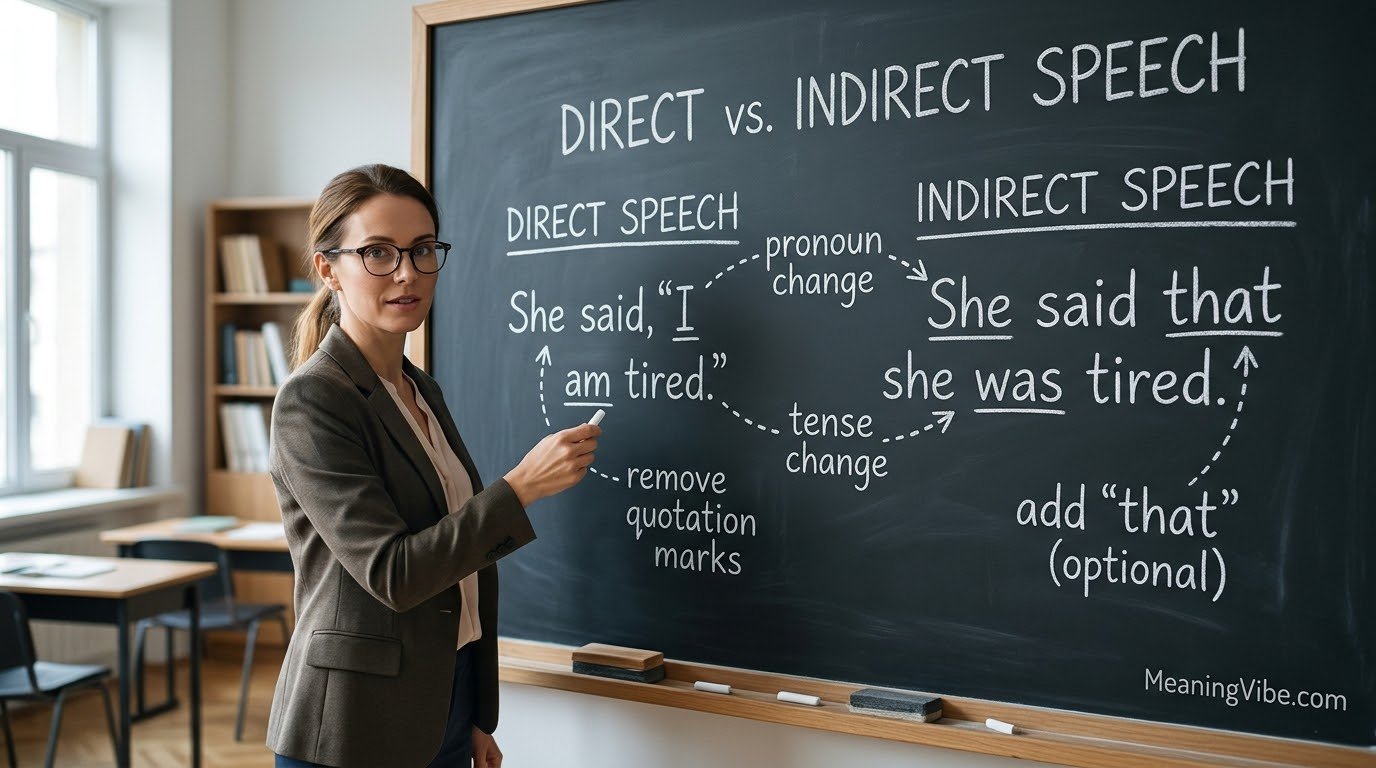
Every pair below is drawn from a checked bank and printed in US punctuation. The set is compact by design, and the full practice bank lives one link away.
Statements
|
Direct |
Indirect |
|---|---|
|
Maria said, “I am tired.” |
Maria said that she was tired |
|
Tom said, “I have finished the report.” |
Tom said that he had finished the report |
|
He said, “I will call you tomorrow.” |
He said that he would call me the next day |
|
The teacher said, “The Earth revolves around the sun.” |
The teacher said that the Earth revolves around the sun |
|
She said, “I must submit the form today.” |
She said that she had to submit the form that day |
Yes or No Questions
|
Direct |
Indirect |
|---|---|
|
He asked, “Are you coming?” |
He asked if I was coming |
|
The teacher asked, “Have you finished your homework?” |
The teacher asked if I had finished my homework |
|
She asked, “Will you be at the meeting?” |
She asked whether I would be at the meeting |
|
Tom asked, “Did you see the match?” |
Tom asked if I had seen the match |
Wh- Questions
|
Direct |
Indirect |
|---|---|
|
She asked, “Where do you live?” |
She asked where I lived |
|
She asked me, “Where is Julie?” |
She asked me where Julie was |
|
She asked, “Who took the marker?” |
She asked who had taken the marker |
|
He asked, “What time does the lesson start?” |
He asked what time the lesson started |
Commands and Requests
|
Direct |
Indirect |
|---|---|
|
The teacher said, “Open your books.” |
The teacher told us to open our books |
|
He said, “Don’t be late.” |
He told me not to be late |
|
The officer said, “Stand up.” |
The officer ordered the men to stand up |
|
She said, “Please close the window.” |
She asked me to close the window |
|
She said, “Could you pass the milk, please?” |
She asked me to pass the milk |
Exclamations and Special Patterns
|
Direct |
Indirect |
|---|---|
|
She said, “What a beautiful view!” |
She exclaimed that it was a beautiful view |
|
She said to me, “May you succeed!” |
She wished that I might succeed |
|
She said, “Let’s go for a walk.” |
She suggested going for a walk |
|
She said, “I promise I will finish it today.” |
She promised to finish it that day |
The complete bank, 87 worked pairs sorted by sentence type, sits in one place: our reported speech examples bank carries every pattern above at full length, for readers who want practice over summary.
Mistakes to Avoid: The Error Types That Fill Answer Keys
These error types recur across textbooks and answer keys. Each is shown wrong, then repaired, and none needs a named culprit: the pattern is the lesson.
- Keeping question word order in a reported question. Wrong: He asked where was I going. Right: He asked where I was going, because the reported clause runs in statement order.
- Giving say a listener object, or starving tell of one. Wrong: She said me that she was tired. Right: She told me that she was tired, because tell takes the person and say does not.
- Shifting a time word when the day has not changed. Wrong, reported the same day: Julie said she was leaving that day. Right: Julie said she was leaving today, because the context never moved.
- Placing the comma outside the closing quote in US style. Wrong: “I am tired”, she said. Right: “I am tired,” she said, because US style puts the comma inside the closing marks.
- Issuing a command verb with nobody commanded. Wrong: The officer ordered to stand up. Right: The officer ordered the men to stand up, because order requires an object to act on.
- Putting a summary inside quotation marks as if it were exact. Wrong: She said, “I might be a bit late,” when her message actually read “Running behind, sorry.” Right: She said she might be a bit late, reported without quotation marks.
When Writers Choose Each Form: Voice and Evidence vs Summary and Integration
Choose direct speech when the exact wording is the evidence. Testimony, official statements and interview answers carry legal and factual weight only in the words actually used, so the quote is the proof.
Choose it again when the voice is the point. A speaker’s tone, emphasis and style survive only inside quotation marks, which is why fiction dialogue and memorable lines are quoted, not reported.
Choose indirect speech when the content matters more than the wording. Summaries, academic arguments and routine news reports run faster in the reporter’s sentence, and the source claim integrates into your own reasoning.
Choose it whenever the exact words cannot be verified. If the wording is unknown, half remembered or unrecoverable, a report is the honest form, and quotation marks would make a claim you cannot support.
The reporting verb is part of the choice, and it can distort. Upgrading said to admitted or promised adds an interpretation the speaker may not support, so the neutral verb is the factual default.
Free indirect speech is the fiction technique between the two forms. It blends a character’s voice into the narrator’s sentence without quotation marks or a reporting clause, holding both voices at once.
Stay consistent inside one piece of writing. Switching forms mid-argument confuses readers about which words are evidence, and the Grammarly guide to direct and reported speech gives writers the same advice.
Speech is one of the two great transformation topics in this cluster: our active voice vs passive voice rules guide covers the other one, voice, and students usually meet the two transformations in the same school term.
The ladder steps have their own homes too: our present perfect tense rules guide teaches the perfect step, and our future simple tense rules guide teaches the will step that becomes would in a report.
Frequently Asked Questions
1. What is the difference between direct and indirect speech?
Direct speech repeats the speaker’s exact words inside quotation marks. Indirect speech reports the content in the reporter’s own sentence without them, as in She said, “I am tired” becoming She said that she was tired.
2. Is indirect speech the same as reported speech?
Yes, they are two names for one form. Reported speech is the British and ESL term, while indirect speech is the school grammar term and the one in the search query itself.
3. Does indirect speech use quotation marks?
No, quotation marks belong to direct speech only. They mark exact words, and an indirect report is the reporter’s sentence, so quoting a rewritten summary would present it as wording it never was.
4. How do you convert direct speech to indirect speech?
Work through five steps in order. Drop the quotes, choose the connector for the sentence type, shift pronouns, backshift if conditions call for it, and adjust time words if the context moved.
5. What is backshift?
Backshift is the one step move of a reported tense into the past. After a past reporting verb, work becomes worked and has finished becomes had finished, though the move is a default, not an absolute.
6. When do tenses NOT change in indirect speech?
Tenses stay put in five named cases. A present or future reporting verb, a statement still true, a universal truth, an immediate report, and forms like past perfect or could that have nothing left to shift.
7. Does past simple always change to past perfect?
No, and this is the strand school pages hide. Perfect English Grammar prints both forms, she had bought a car or she bought a car, and British Council calls the change usual, not required.
8. How do questions change into indirect speech?
Questions convert with ask and statement word order. Yes or no questions take if or whether, wh- questions keep their question word as connector, and the sentence ends with a period, never a question mark.
9. Why is there no question mark in indirect speech?
Because the reported clause is no longer a question. It is a statement about a question, so it ends with a period, unless the writer’s own sentence is the one doing the asking.
10. How do commands change into indirect speech?
Commands take tell or order, the person, and the to-infinitive. The teacher told us to open our books, and the negative runs He told me not to be late, with the object always present.
11. How do requests change into indirect speech?
Requests take ask, the person, and the to-infinitive. She asked me to close the window, and the politeness of the original rides on the verb ask rather than on keeping the word please.
12. What happens to please in indirect speech?
Please disappears, and its politeness moves into the verb. Ask and request carry it while tell and order drop it, because the report is the reporter’s sentence, not the speaker’s words.
13. What is the difference between say and tell?
Tell requires the listener as its object, and say does not. Tell me that is correct, say that is correct, and He said me fails because say rejects a bare listener object.
14. Is that always used in indirect speech?
No, that is optional in statements and absent elsewhere. Questions join with if, whether or the question word, commands join with the to-infinitive, and formal writing simply keeps that more often than speech does.
15. Why did today stay today in my answer?
Because the report was made on the same day. Time words shift only when the reporting context differs, so Julie leaving today on Monday is still leaving today when reported that same Monday.
16. When does tomorrow become today instead of the next day?
When the report is made the day after the speech. Mina promises on Monday to call tomorrow, and reported on Tuesday the promise day has arrived, so she would call me today.
17. How do pronouns change in indirect speech?
Pronouns change by following the people, not a table. First person follows the original speaker, second person follows the listener, third person stays, and a repeated name beats a pronoun that could point two ways.
18. What happens to must in indirect speech?
It depends on the meaning must carries. A past obligation becomes had to, a deduction keeps must, as in the office must be empty, and printing one replacement for both meanings is the error.
19. What happens to shall in indirect speech?
Shall splits into two strands by its job. Future intention becomes would in the Perfect English Grammar table, obligation and suggestion become should in the school tables, and the case is rare in modern US usage.
20. Do modal verbs like could and might change?
No, they are already in their shifted forms. Could, would, should, might and ought to stay unchanged in a report, and past perfect stays too, because neither has a further step back to take.
21. How do you report an exclamation?
Report an exclamation as a statement of its content. She said, “What a beautiful view!” becomes She exclaimed that it was a beautiful view, with an emotion verb added only when the context supports it.
22. How do you report Let’s?
Let’s reports through suggest, never through a person plus infinitive. She suggested going for a walk, or She suggested that we should go for a walk, and suggested us to go is always wrong.
23. When should a writer use direct speech?
Use direct speech when the exact wording carries weight. Testimony, official statements, interview evidence, distinctive voice and fiction dialogue all depend on the words actually used, so the quotation itself becomes the proof.
24. When should a writer use indirect speech?
Use indirect speech for summary, formality and flow. It compresses content into academic and news prose, and it is the honest form whenever the exact words are unknown or cannot be verified.
25. Where does the comma go in direct speech?
The comma goes before the opening quote after a reporting clause. She said, “I’m leaving,” shows both homes at once, since a following reporting clause pulls the comma inside the closing marks in US style.
26. Do periods go inside or outside quotation marks?
In US style, periods and commas go inside, always. He called it “a mistake.” British style places them by logic instead, and that difference appears on this page only inside its labeled British note.
27. Where does the question mark go when a quote is a question?
Inside the closing marks, with no comma after it. “Are you ready?” she asked, because the mark belongs to the quoted words and the reporting clause that follows stays lowercase.
28. Where does the question mark go when the sentence asks about a quote?
Outside the closing marks, because it belongs to the whole sentence. A sentence asking about a quote, like the one about “double-down,” keeps its mark outside, and colons and semicolons take the same outside position in US style.
29. Single or double quotation marks?
US style uses double marks first and single marks inside them. A quote within a quote takes single marks, while British publishing commonly reverses the pair, a difference this page labels rather than mixes.
30. Do you capitalize the first word of a quote?
Yes, when the quote is a complete sentence. She said, “The train is late,” while a quoted fragment and the second half of an interrupted quotation both stay lowercase.
31. What is an interrupted quotation?
An interrupted quotation is one split by its reporting clause. “Thinking back,” he said, “she didn’t expect to win,” with a comma inside the first part and a lowercase restart after the clause.
32. What is a reporting verb?
A reporting verb is the verb that introduces the speech. Say, tell and ask are the everyday set, and stance verbs like insisted, suggested and admitted replace part of the tone the quotation carried.
33. Why does was appear in She said she was tired if she is still tired?
Because backshift locates the statement at the time of speaking. It makes no claim that the fact expired, and She said she is tired is equally correct when the tiredness still holds now.
34. Can you change indirect speech back to direct speech exactly?
Not reliably, because one report can come from two originals. He said he was tired could restore I am tired or I was tired, so the exact original words cannot be rebuilt from a report.
35. What is narration in grammar?
Narration is the Indian school grammar name for this whole topic. Narration change is the conversion exercise itself there, the term has no currency in US classrooms, and this page mentions it once for recognition.
36. What are inverted commas?
Inverted commas is the British and Indian name for quotation marks. US sources say quotation marks and use double marks as the primary pair, so the exam term names the same punctuation in another convention.
37. Who is the subject in Who took the marker? when reported?
Who itself is the subject of the reported clause. She asked who had taken the marker, and adding a second subject after who produces the classic error this pattern exists to prevent.
38. Is Could you help me? a question or a request in indirect speech?
Function decides, not the question shape. As a request it becomes He asked me to help him, and as a genuine ability question it becomes He asked if I could help him.
39. What reporting verbs show tone?
Stance and manner verbs carry the tone. Insisted, suggested, shouted, recommended and implied each replace in one word part of what the quotation’s delivery conveyed, which is why the verb choice is an interpretation.
40. Does indirect speech change the meaning?
It can soften tone and emphasis, while content should stay equivalent. The reporting verb and the summary both select, so a rewritten summary must never sit inside quotation marks as if it were exact.
41. Why do textbooks say one step back for every tense?
Because an exam key needs exactly one right answer. A single ladder can be marked at scale, so school tables print it as absolute, while real usage keeps the optionality the strands on this page record.
42. Is He asked where was I going correct?
No, reported questions run in statement word order. He asked where I was going is the correct form, and keeping the question order inside a report is the most common reported speech error of all.
Conclusion
Direct speech vs indirect speech is finally a fidelity decision. Quote the words when the words themselves are the evidence, and report the content when your sentence needs the meaning more than the voice.
The mechanics are smaller than the decision. US punctuation for the quote, the five conversion steps for the report, and the strand check before any ladder is applied will handle almost every sentence.
The cluster around this page carries the depth and the practice: our reported speech rules guide for the full backshift system, our reported speech examples bank for the worked bank, and the wider grammar set indexed from the MeaningVibe home page.
Compare first, then convert with the decision, not the ladder. That order is the whole method: form first, pattern second, strands checked, and the exact words quoted only when you can stand behind them.