

Active to passive voice examples are easiest to learn as pairs. One sentence does the action, the other receives it, and the change between them follows the same four moves every single time.
Every pair on this page was checked before it was printed. Big example lists often promise a hundred pairs and quietly deliver duplicates, recycled sentences or broken conversions, so the set here is smaller and verified.
Each pair carries a short note on what moved. The object becomes the subject, be carries the tense, the main verb freezes as its past participle, and the doer stays optional throughout.
The hard cases are labeled, not hidden. Future continuous and perfect continuous passives are printed as three named positions, and the sentence types most lists skip get their own sections below.
A practice set with a separate answer key closes the page. Convert first, check after, and the error clinic shows the five breakage patterns that make printed pairs go wrong.
The Conversion in 60 Seconds: Object Up, Be Carries the Tense, Participle Frozen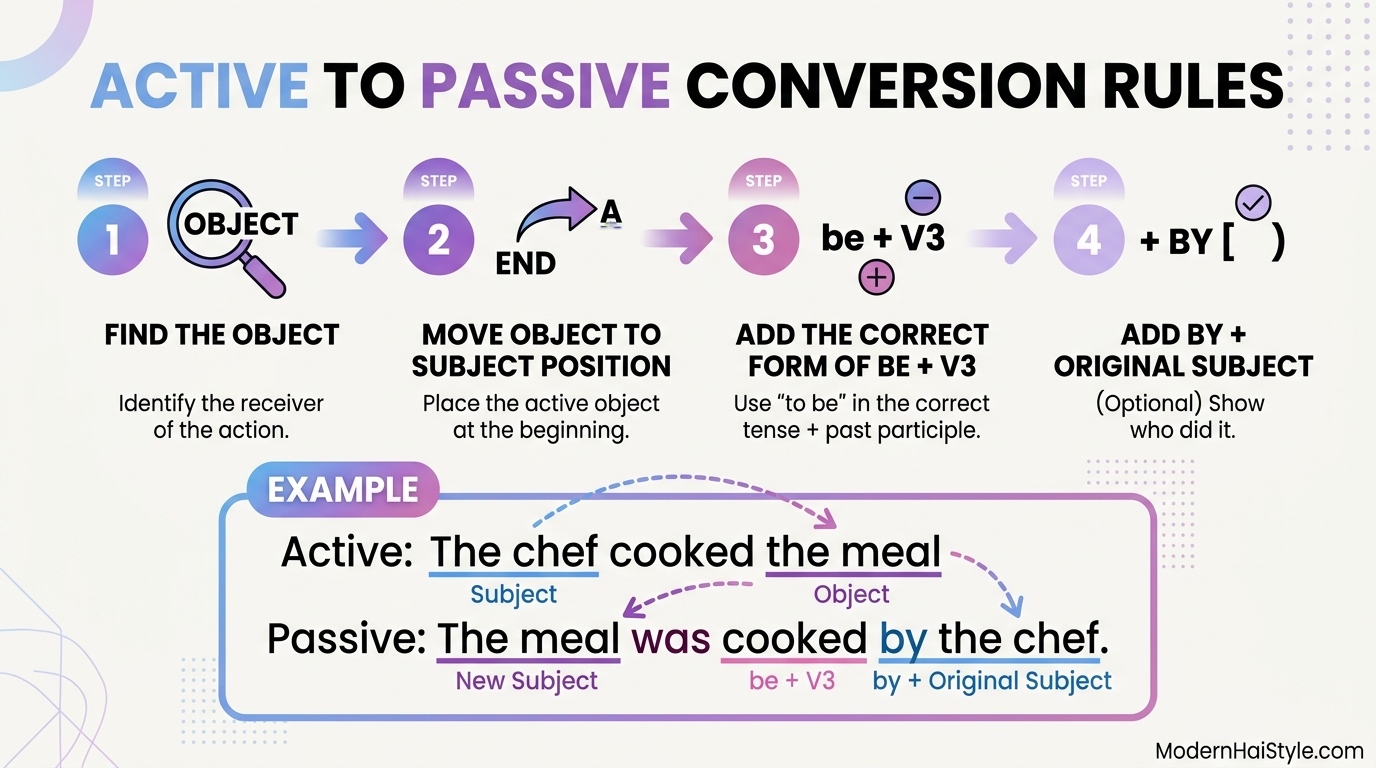
Four moves convert any active sentence with an object. Find the object, move it to the front, put be in the active verb’s tense, and freeze the main verb as its past participle.
The chef pair shows all four moves at once. The chef cooked the meal becomes The meal was cooked by the chef: meal moves up, cooked splits into was plus cooked, and the chef drops behind by.
- Move the object into the subject slot.
- Choose the be form that matches the active tense.
- Freeze the main verb as its past participle, V3.
- Add by plus the old subject, or drop the doer entirely.
A quick test confirms the result is a real passive. The subject must receive the action, not perform it, the check at the heart of the UNC Writing Center passive voice handout, hosted on Northwestern’s NuWrite site.
Be does all the tense work in the paradigm. The participle never changes shape, so the whole system reduces to the nine be forms in this table, the same table the Cambridge Dictionary passive forms page sets out in full.
|
Tense |
Passive pattern |
|---|---|
|
Present simple |
am/is/are + past participle |
|
Present continuous |
am/is/are being + past participle |
|
Present perfect |
has/have been + past participle |
|
Past simple |
was/were + past participle |
|
Past continuous |
was/were being + past participle |
|
Past perfect |
had been + past participle |
|
Future simple |
will be + past participle |
|
Future perfect |
will have been + past participle |
|
Modals |
modal + be + past participle |
Pronouns change case when they move behind by. I becomes me, we becomes us, she becomes her and they becomes them, while the tense itself never changes during a conversion.
Core Pairs by Tense, With a What-Moved Note on Every Pair
The core set below uses fresh sentences for each tense. One cast of characters recycled through every tense inflates a count without teaching anything, so each row here stands on its own.
Present Simple, Present Continuous and Present Perfect Pairs
Present simple passives run on is or are plus the participle. The continuous adds being, and the perfect adds been, and those two small words are the whole difference between the three rows.
|
Active |
Passive |
What moved |
|---|---|---|
|
Tom cleans the room. |
The room is cleaned by Tom. |
Object up; cleans becomes is cleaned. |
|
The gardener waters the plants. |
The plants are watered by the gardener. |
Plural subject takes are. |
|
She reads a book. |
A book is read by her. |
She shifts to by her. |
|
She is writing a letter. |
A letter is being written by her. |
Being carries the continuous. |
|
The students are writing essays. |
Essays are being written by the students. |
Are being matches the plural subject. |
|
She is making a cake. |
A cake is being made by her. |
Making freezes as made. |
|
The children have cleaned the bike. |
The bike has been cleaned by the children. |
Has been carries the perfect. |
|
The engineer has designed the bridge. |
The bridge has been designed by the engineer. |
Designed stays; been is added. |
|
She has written a beautiful poem. |
A beautiful poem has been written by her. |
Written is already the participle. |
The being and been rows are where learners slip. Dropping being flattens a continuous into a simple, and dropping been breaks the perfect, so both words earn their place in every row.
Past Simple, Past Continuous and Past Perfect Pairs
Past tenses swap is and are for was and were. Agreement still follows the new subject, so a plural receiver takes were being or had been exactly as the table shows.
|
Active |
Passive |
What moved |
|---|---|---|
|
The dog chased the cat. |
The cat was chased by the dog. |
Was plus chased; tense unchanged. |
|
The police arrested the thief. |
The thief was arrested by the police. |
Object up; agent kept. |
|
Newton discovered gravity. |
Gravity was discovered by Newton. |
Discovered freezes as discovered. |
|
Mother was cooking dinner. |
Dinner was being cooked by mother. |
Was being carries past continuous. |
|
They were watching a movie. |
A movie was being watched by them. |
They shifts to by them. |
|
The workers were building a bridge. |
A bridge was being built by the workers. |
Building freezes as built. |
|
He had finished the report. |
The report had been finished by him. |
Had been carries past perfect. |
|
The thief had stolen the jewelry. |
The jewelry had been stolen by the thief. |
Stolen is the participle. |
|
Someone had stolen my wallet. |
My wallet had been stolen. |
Unknown agent dropped. |
The wallet row drops its agent on purpose. Someone names nobody in particular, so the passive keeps the fact and loses the filler, a first taste of the agentless section below.
Future Simple, Future Perfect and Modal Pairs
Future and modal passives are the simplest rows in the system. Will and the modals already carry the tense, so plain be slots in front of the participle with nothing else to agree.
|
Active |
Passive |
What moved |
|---|---|---|
|
She will write a book. |
A book will be written by her. |
Will be plus written. |
|
The manager will approve your leave. |
Your leave will be approved by the manager. |
Approve freezes as approved. |
|
The company will hire ten new workers. |
Ten new workers will be hired. |
Company dropped as unimportant. |
|
They will have completed the work. |
The work will have been completed by them. |
Will have been, the longest be form. |
|
She will have written a letter. |
A letter will have been written by her. |
The participle stays written. |
|
She can solve the problem. |
The problem can be solved by her. |
Can be plus solved. |
|
You must complete the task. |
The task must be completed by you. |
Must be plus completed. |
|
You must follow the rules. |
The rules must be followed. |
Agent dropped: it is everyone. |
|
We should help the poor. |
The poor should be helped by us. |
We shifts to by us. |
Modal passives keep the modal’s meaning untouched. Can be solved still means ability and must be completed still means obligation, because the modal, not be, carries that layer of the sense.
One Sentence Through Every Tense: The Single-Sentence Paradigm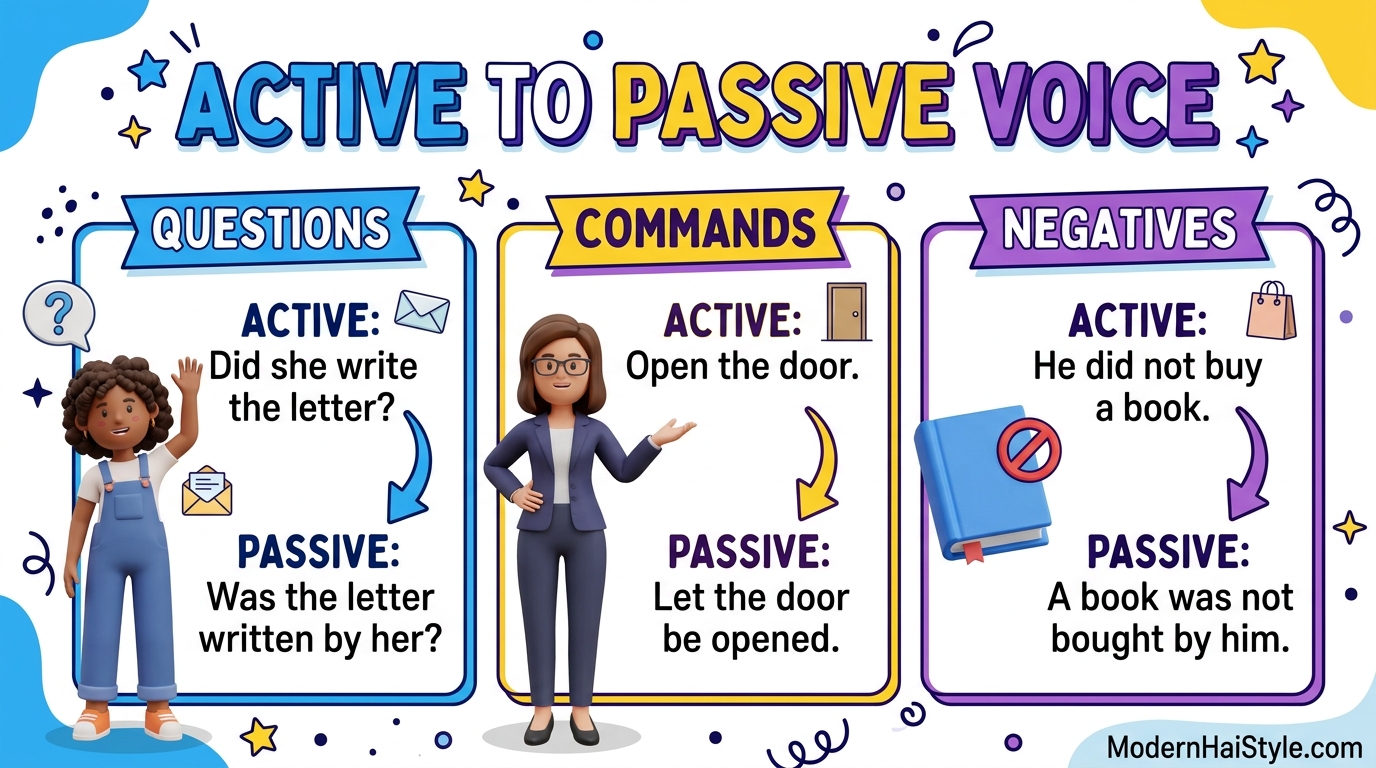
One sentence run through every tense exposes the machine. She writes a letter changes only its be form from row to row, which is why teachers reach for a single-sentence paradigm first.
|
Tense |
Active |
Passive |
|---|---|---|
|
Present simple |
She writes a letter. |
A letter is written by her. |
|
Present continuous |
She is writing a letter. |
A letter is being written by her. |
|
Present perfect |
She has written a letter. |
A letter has been written by her. |
|
Past simple |
She wrote a letter. |
A letter was written by her. |
|
Past continuous |
She was writing a letter. |
A letter was being written by her. |
|
Past perfect |
She had written a letter. |
A letter had been written by her. |
|
Future simple |
She will write a letter. |
A letter will be written by her. |
|
Future perfect |
She will have written a letter. |
A letter will have been written by her. |
|
Modal |
She must write a letter. |
A letter must be written by her. |
The paradigm is a teaching device, not a model for a whole page. Real example sets vary their sentences, and the Purdue OWL verbs, voice and mood page places voice beside mood for the same reason: form first, variety after.
The Contested Cells: Future Continuous and Perfect Continuous as Strands
Two cells of the paradigm have no settled answer. Future continuous and the perfect continuous tenses are printed three incompatible ways across grammar pages, so the three positions are set out here as strands.
|
Position |
The claim |
Where it leads |
|---|---|---|
|
Printed as a normal form |
Will be being plus participle is ordinary grammar. |
Pairs printed with no warning at all. |
|
Said not to exist |
Future continuous has no passive form. |
Learners told the conversion is impossible. |
|
Possible but rare and awkward |
The form exists, sounds strained, and is usually rephrased. |
The cautious teaching position. |
This page teaches from the third strand. At this time tomorrow she will be writing a letter can be forced into A letter will be being written by her, but almost nobody writes it.
The honest fix is a rephrase, openly labeled as one. A letter will be written by her keeps the future and drops the continuous aspect, and the Cambridge Dictionary passive forms page prints no future continuous row at all.
Perfect continuous passives strain the same way. She has been writing letters would need Letters have been being written by her, a form grammars describe as not often used and usually reworded.
The Sentence Types the Lists Skip
Questions: Yes/No, Wh- and Who to By Whom
Questions convert by moving be, not by rebuilding the sentence. The participle and the by phrase stay in place while be steps in front of the new subject to form the question.
|
Active question |
Passive question |
|---|---|
|
Did she write the letter? |
Was the letter written by her? |
|
Is she reading the book? |
Is the book being read by her? |
|
Has he finished the assignment? |
Has the assignment been finished by him? |
|
Will they finish the work? |
Will the work be finished by them? |
|
Who broke the cup? |
By whom was the cup broken? |
|
What did you buy? |
What was bought by you? |
Who questions change shape the most. Who becomes by whom and the verb turns passive, so Who wrote the book becomes By whom was the book written, formal but standard in exams.
Imperatives: The Let Form and the Requested-To Form (Exam Strand)
Commands have no subject, so the field teaches two workarounds. This is an exam-market strand rather than an authority form, and it is labeled that way wherever it appears on this page.
|
Command |
Exam passive |
|---|---|
|
Open the door. |
Let the door be opened. |
|
Close the window. |
Let the window be closed. |
|
Help me. |
Let me be helped. |
|
Do not touch the machine. |
Let the machine not be touched. |
|
Please bring my pen. |
You are requested to bring my pen. |
Requests soften into the requested-to form instead. Please help me becomes You are requested to help me, which keeps the politeness the bare Let form loses, and both forms are exam conventions.
Negatives, Two-Object Verbs and Prepositional Verbs
Negatives keep their not exactly where it was. He did not buy a book becomes A book was not bought by him, with not riding on the be form as it rode on did.
Two-object verbs honestly have two passives. She gave him a book becomes A book was given to him by her, or He was given a book by her, and the Collins Dictionary blog post on forming the passive explains the to that the first form needs.
Prepositional verbs must keep their preposition attached. They laughed at the joke becomes The joke was laughed at by them, and dropping the at breaks the verb, as the error clinic shows.
Infinitive and Gerund Passives: The Pairs Nobody Prints
Infinitive and gerund passives are the field’s empty cell. Example lists stop at tenses and modals, yet the EngQuiz passive voice guide carries paradigm rows for both, and real sentences use them every day.
|
Active |
Passive |
|---|---|
|
She hopes someone will promote her. |
She hopes to be promoted. |
|
The teacher made the class rewrite the essay. |
The class was made to rewrite the essay. |
|
He dislikes people interrupting him. |
He dislikes being interrupted. |
|
I remember someone giving me this book. |
I remember being given this book. |
Made is the pair worth memorizing. Active make takes the bare infinitive, rewrite with no to, while the passive restores it: was made to rewrite, a small trap exams love to set.
The get passive is the informal cousin of the be passive. The house got painted and He got injured during the game carry a casual, often unlucky coloring that the Cambridge Dictionary get passive page sets beside the neutral be form.
Agentless Pairs: When the By Phrase Is Dropped, and Why
Most real passives name no doer at all. The by phrase is dropped when the agent is unknown, obvious or unimportant, the three conditions the Purdue OWL active versus passive voice page gives for choosing the passive in the first place.
|
Passive |
Why the agent is dropped |
|---|---|
|
My phone was stolen. |
The thief is unknown. |
|
The suspect was arrested at 11 p.m. |
The police are obvious. |
|
The meeting was postponed. |
The decider is unimportant. |
|
Applications must be submitted by Friday. |
The notice speaks to everyone. |
|
English is spoken all over the world. |
The speakers are everyone. |
Dropping the agent is a decision, not a shortcut. Focus is a real use of the passive in the Cambridge Dictionary passive uses page, and the Grammar Monster passive voice page lists its own reasons for choosing the form deliberately.
The active original often hides behind someone or they. Someone stole my phone names nobody worth keeping, so My phone was stolen is not a lesser sentence, just an honest one.
Famous and Real-World Pairs: Hamlet, Mistakes Were Made, and the Science Bench
Hamlet is the field’s famous pair. Shakespeare wrote Hamlet becomes Hamlet was written by Shakespeare, and keeping the agent matters here because the doer is the whole point of the sentence.
Mistakes were made is the canonical agentless example. Grammar pages reach for it whenever responsibility is being avoided, and no sourced origin story stands behind it, so none is invented here.
Science writing keeps the method, not the scientist, in front. The solution was heated to 100 degrees Celsius and Samples were heated to 90 degrees put the procedure where a reader can repeat it.
Civic writing uses the same focus shift honestly. The city will reopen the bridge in March often reads better as The bridge will be reopened in March when the date outranks the council.
The old ban on the passive was never absolute. Strunk’s original text allowed the passive as frequently convenient and sometimes necessary, a nuance the Polytropy commentary on Strunk and White restores, and the Grammarly passive voice guide teaches the same balance.
Practice Set: 10 Conversions With a Separate Answer Key
Convert each sentence before scrolling to the key. The set mixes tenses, a question, a two-object verb and one exam-strand command, the same spread the sections above teach in order.
|
# |
Convert this sentence |
|---|---|
|
1 |
The gardener waters the plants every morning. |
|
2 |
She is reading a novel. |
|
3 |
They have repaired the road. |
|
4 |
The storm damaged the roof. |
|
5 |
Someone has stolen my bicycle. |
|
6 |
You must sign the form today. |
|
7 |
Did the committee approve the budget? |
|
8 |
She gave the children a story. |
|
9 |
The company will announce the results tomorrow. |
|
10 |
Open the window. |
The key sits apart so the set stays a real test. Each answer names its agent decision, because keeping or dropping the doer is half of what a conversion decides.
The Answer Key
|
# |
Passive answer |
|---|---|
|
1 |
The plants are watered by the gardener every morning. |
|
2 |
A novel is being read by her. |
|
3 |
The road has been repaired by them. |
|
4 |
The roof was damaged by the storm. |
|
5 |
My bicycle has been stolen. (Agent dropped: thief unknown.) |
|
6 |
The form must be signed today. (Agent dropped: signer obvious.) |
|
7 |
Was the budget approved by the committee? |
|
8 |
The children were given a story by her. (Also: A story was given to the children by her.) |
|
9 |
The results will be announced by the company tomorrow. |
|
10 |
Let the window be opened. (Exam strand.) |
Error Clinic: Broken Pairs and the Step That Broke
Printed pairs fail in five repeatable ways. Each pattern below shows the broken shape, names the step that broke, and prints the corrected conversion, with no page named and no error softened.
Tense drift swaps the be form mid-conversion. He had worn the uniform printed as The uniform has been worn by him trades past perfect for present perfect, and the fix restores had been.
A missing object cannot be promoted. The children are playing in the park has no object, so The park is being played in by the children invents one out of a place phrase.
Invented objects rescue intransitive verbs dishonestly. The dog barked loudly becomes A loud bark was made by the dog only by manufacturing a bark object the active sentence never had.
Ability belongs to the doer, not the thing. The problem will be able to be solved by him hands the ability to the problem; The problem can be solved by him keeps it with the solver instead.
Dropped prepositions break phrasal verbs quietly. The audio will be listened loses the to that listen to needs, and number drift, the bird is eating becoming the birds, breaks agreement the same way.
Every pattern traces back to one skipped check. Name the object, fix the tense on be, and ask whether the agent deserves its place, and all five failures become visible before printing.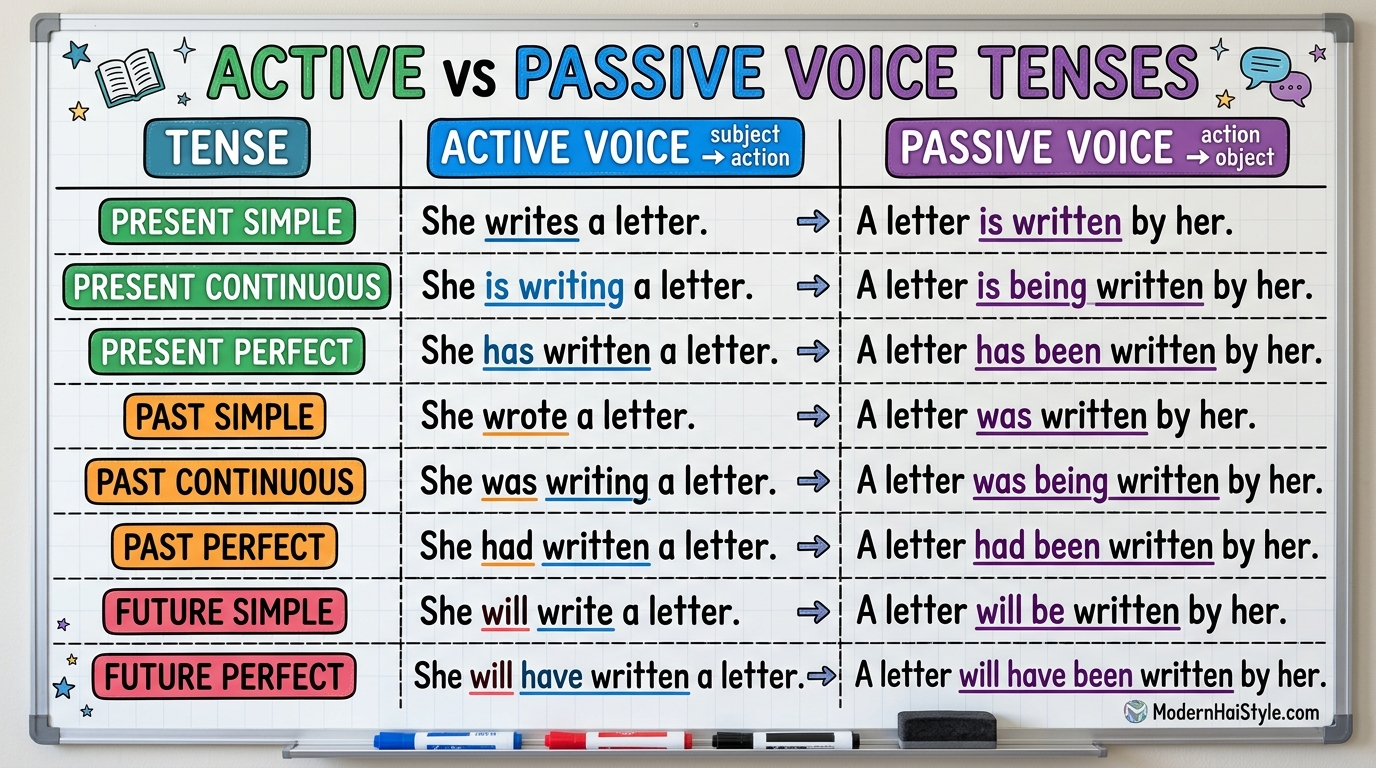
Frequently Asked Questions
1. What is the easiest way to change active to passive voice?
Move the object to the front and rebuild the verb around be. The chef cooked the meal becomes The meal was cooked by the chef, with be holding the tense and the participle frozen.
2. How do you change an active sentence into passive voice step by step?
Four steps convert any active sentence with an object. Make the object the subject, give be the original tense, freeze the main verb as its participle, then add by plus the old subject or drop the doer.
3. What is the formula for changing active voice to passive voice?
The formula is new subject plus be plus past participle plus optional by phrase. Be takes forms like is, was, is being, has been and will be, so the tense survives while the participle stays frozen.
4. Which form of the verb is used in passive voice, V1, V2 or V3?
The passive always uses V3, the past participle. Written, cooked, stolen and given never change shape, because the be form in front of them carries the tense for the whole verb phrase.
5. What is the passive voice of ‘She writes a letter’?
A letter is written by her. The object became the subject, writes split into is plus written to hold the present simple tense, and she changed case to her behind by.
6. What are 10 examples of active and passive voice?
Ten verified pairs anchor the core set on this page. The chef pair, the letter paradigm, Hamlet, the stolen phone, the modal problem pair, the door command and the two-object book pair are each printed in full with notes above.
7. What are examples of active and passive voice in the present simple tense?
Present simple passives use is or are plus the participle. Tom cleans the room becomes The room is cleaned by Tom, and The gardener waters the plants becomes The plants are watered by the gardener.
8. What are examples of active and passive voice in the present continuous tense?
Present continuous passives add being between be and the participle. She is writing a letter becomes A letter is being written by her, and She is making a cake becomes A cake is being made by her.
9. What are examples of active and passive voice in the present perfect tense?
Present perfect passives run on has been or have been plus the participle. The children have cleaned the bike becomes The bike has been cleaned by the children, with been doing the perfect work.
10. What are examples of active and passive voice in the past simple tense?
Past simple passives use was or were plus the participle. The dog chased the cat becomes The cat was chased by the dog, and The police arrested the thief becomes The thief was arrested by the police.
11. What are examples of active and passive voice in the past continuous tense?
Past continuous passives use was being or were being plus the participle. Mother was cooking dinner becomes Dinner was being cooked, and They were watching a movie becomes A movie was being watched by them.
12. What are examples of active and passive voice in the past perfect tense?
Past perfect passives use had been plus the participle for every subject. He had finished the report becomes The report had been finished by him, and Someone had stolen my wallet becomes My wallet had been stolen.
13. What are examples of active and passive voice in the future simple tense?
Future simple passives use will be plus the participle. She will write a book becomes A book will be written by her, and The company will hire ten new workers becomes Ten new workers will be hired.
14. What are examples of passive voice with modal verbs?
Modal passives place be between the modal and the participle. She can solve the problem becomes The problem can be solved by her, and You must complete the task becomes The task must be completed by you.
15. Does the future continuous tense have a passive form?
The honest answer is three positions, not one. Some pages print will be being plus the participle as normal, some deny the form exists, and the cautious position taught here calls it possible but rare, awkward and usually rephrased.
16. Can present perfect continuous be changed into passive voice?
Not in normal use, and grammars say so openly. She has been writing letters would need have been being written, a form described as not often used, so the honest conversion rephrases and labels the aspect change.
17. How do you change an imperative sentence into passive voice?
Exam teaching converts commands with Let plus object plus be plus participle. Open the door becomes Let the door be opened, requests soften into You are requested to, and both forms are labeled exam strands on this page.
18. What is the passive voice of ‘Open the door’?
Let the door be opened, in the exam-taught form. Commands have no subject to promote, so the Let construction does the work, while ordinary English more often keeps the command active or softens it into a request.
19. How do you change a question into passive voice?
Move be in front of the new subject and leave the rest in place. Did she write the letter becomes Was the letter written by her, because only the be form travels to form the question.
20. What is the passive voice of ‘Who wrote the book’?
By whom was the book written. Who turns into by whom, the object becomes the subject, and wrote becomes was written, a formal shape that exams still expect even though everyday speech avoids it.
21. Can a sentence with two objects have two passive forms?
Yes, a two-object verb honestly has two passive forms. She gave him a book becomes A book was given to him by her, or He was given a book by her, and both are correct.
22. Why is the ‘by’ phrase dropped in passive sentences?
The by phrase is dropped when the doer adds nothing. Unknown thieves, obvious police and unimportant deciders all disappear from real passives, which is why most passive sentences in print name no agent at all.
23. When should you omit the agent in a passive sentence?
Omit the agent when it is unknown, obvious or unimportant. Keep it when the doer is the news, as in Hamlet was written by Shakespeare, where removing Shakespeare would remove the point of the sentence entirely.
24. Can all active sentences be converted to passive?
No, only sentences with a suitable object convert cleanly. Intransitive verbs like arrive and happen have nothing to promote, reflexive objects block conversion, and a few forms survive only as strained exam shapes.
25. Can intransitive verbs be changed into passive voice?
No, intransitive verbs have no passive form. The river flows to the sea and The baby cried name no object, so there is nothing to move into the subject slot, and honest tables print exactly that.
26. What is the passive voice of ‘Someone stole my phone’?
My phone was stolen. Someone names nobody in particular, so the conversion drops the empty agent and keeps the fact, the commonest agentless pattern in everyday English.
27. How do you change passive voice back into active voice?
Reverse the same four moves. Promote the by phrase doer to subject, rebuild the verb in the original tense without be, and return the old subject to the object slot it came from.
28. What is the difference between voice and tense?
Voice is about who acts, tense is about when. The chef cooked and The meal was cooked share the past tense while differing in voice, so a sentence can change voice without changing its time.
29. What is the difference between passive voice and past tense?
They are different systems that often travel together. Past tense locates an event in time, passive voice rearranges who receives the action, and present passives like English is spoken prove the two are independent.
30. Is passive voice wrong or bad English?
No, passive voice is a normal part of English grammar. It misleads only when it hides a doer who should be named, and it serves science, notices and tact whenever the receiver matters more.
31. Is it always better to use the active voice?
No, active is a strong default, not a law. Passive wins when the receiver outranks the doer, when the doer is unknown, and when tact or method matters more than credit or blame.
32. Does active voice always make sentences shorter?
No, the passive usually runs longer, not shorter. Was cooked by the chef adds words to cooked, and claims that active always shortens are printed on this page as claims, never as facts.
33. How many passive sentences should a 1,000-word article have?
No verified quota exists, and any percentage ceiling is one writer’s arithmetic. This page prints no invented figure; the honest measure is whether each passive in the piece earns its place by focus, tact or necessity.
34. Can a sentence be active and passive at once?
A single clause sits in one voice, but a sentence can mix them. The chef cooked the meal and it was served hot runs an active clause into a passive one, which is ordinary, flexible English.
35. Is ‘We were told’ passive voice?
Yes, We were told is passive voice. Told is the participle of tell, were carries the past tense, and the teller is dropped, the same agentless pattern as My wallet had been stolen.
36. How can I improve my understanding of active and passive voice?
Practice in the order this page is built. Learn the four moves, read pairs with their what-moved notes, work the practice set before opening its key, and finish in the error clinic until the five breakage patterns look obvious.
37. Where can I practise active to passive voice with answers?
The practice set on this page is built for exactly that. Ten conversions mix tenses, a question, a two-object verb and a command, and the separate key names the agent decision inside every answer.
38. Is there a downloadable PDF of active and passive voice examples?
No PDF is offered here, and the page will not pretend otherwise. Two ranking pages in the research carry download offers, which is a demand signal, while this page keeps its pairs and key on one screen instead.
39. Does active and passive voice help in exams?
Yes, voice conversion is a set exam task in many school systems. The research field is dominated by exam boards and class notes, and the paradigm, the Let form and the by whom shape are the drilled items.
40. How can kids practise active and passive voice?
Short daily sets beat one long list. Five pairs a day, converted aloud with the what-moved note spoken, then checked against a key, builds the pattern faster than copying a hundred unexplained pairs.
41. When should we use passive voice?
Use the passive when the receiver matters more than the doer. Unknown agents, official notices, scientific methods and tactful responsibility all qualify, the same conditions the agentless section works through pair by pair.
42. What is the difference between active voice and passive voice?
In active voice the subject performs the action, in passive voice the subject receives it. The dog chased the cat and The cat was chased by the dog report one event from opposite ends.
Conclusion
Active to passive voice examples teach one machine, not a hundred sentences. The object moves up, be carries the tense, the participle freezes, and the doer stays only when it earns its place.
The contested cells stay labeled as strands. Will be being is printed here as possible but rare and awkward, never as an ordinary form and never as an impossibility, because both extremes mislead learners.
The skipped types are part of the skill. Questions, commands, negatives, two-object verbs and the infinitive and gerund pairs complete the map that bare tense lists leave unfinished.
Practice closes the loop that reading opens. Ten conversions with a separate key, then the error clinic, turn recognition into production, which is what exams and real writing both demand.
The wider library follows the same discipline. The guides collected at the ModernHaistyle home page attach every claim to a checked source, the habit this crowded and error-prone corner of grammar needs most.