

Fewer vs less is a counting choice with a one line rule: fewer is for items you count one by one, and less is for amounts you measure as a whole.
Fewer people attended this year. The hall needed less time to empty. One sentence counts heads; the other measures a stretch.
The dictionary record frames both halves: Merriam-Webster’s entry for fewer gives the counting word its territory, and Merriam-Webster’s entry for less carries the measuring word plus the usage discussion the exceptions come from.
What settles the hard cases is the machinery under the rule: a count test, an exception with five families, a bank of fixed patterns, and one honest paragraph of history.
The Comparison Matrix
|
Dimension |
Fewer |
Less |
|---|---|---|
|
Home territory |
Countable items, one by one |
Amounts measured as a whole |
|
Means |
Not as many |
Not as much |
|
Family |
Few, fewer, fewest; partner many |
Little, less, least; partner much |
|
Signature sentence |
Fewer people came |
Less time remains |
|
Measured wholes |
No: sums take less |
Yes: less than twenty dollars |
|
Fixed patterns |
Almost none |
One less, or less, no less than |
|
Failure mode |
Stretched onto masses and sums |
Spread over clear counted plurals in print |
Read the matrix by its family row, which the one line rule never mentions. Fewer descends from few and answers to many; less descends from little and answers to much, and the families never cross.
Read it again by its last row. Each word fails in exactly one direction, and the failures point opposite ways: fewer breaks when it is stretched, less breaks when it is spread.
The Count Test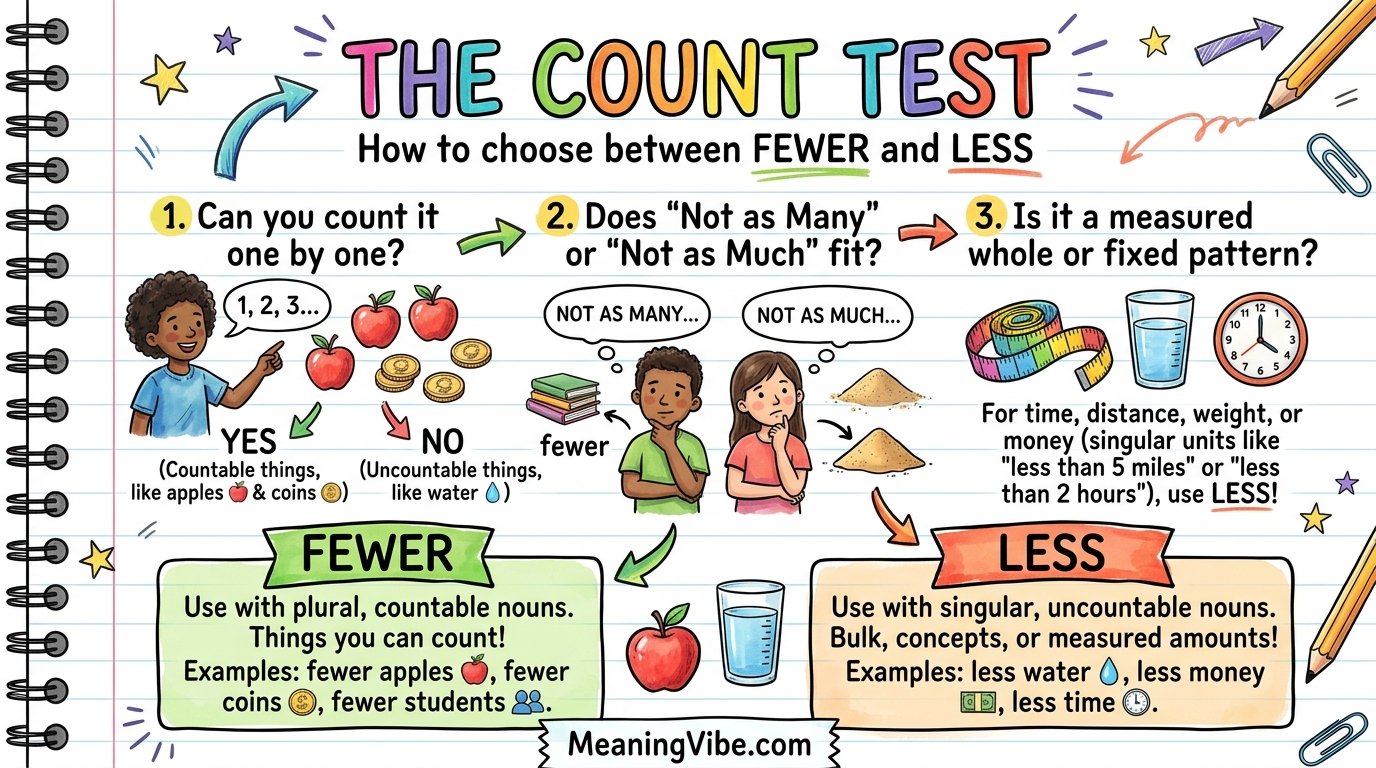
Three checks, run in order, settle nearly every sentence. The order matters: the fixed patterns and the measured wholes outrank the basic count, so the test checks them as it goes.
Check One: Can You Count Them One by One?
Ask whether the noun’s individuals can be numbered: one mistake, two mistakes, three mistakes. If the counting runs cleanly and the noun takes a plural, fewer is the edited choice.
Fewer mistakes, fewer bottles, fewer meetings, fewer votes: every one of them can be pointed at and counted. That pointing test is the whole of check one.
Check Two: The Many Much Bridge
Swap in the partner phrases and listen. If not as many fits the sentence, the word is fewer; if not as much fits, the word is less.
The bridge works because the pairs are welded: many and few count together, much and little measure together. A sentence that accepts ‘not as many people’ has already chosen fewer.
Check Three: Is It a Measured Whole or a Fixed Pattern?
Ask whether the quantity is read as one amount despite countable units (a sum of money, a stretch of time, a distance), or whether a fixed pattern is present.
Less than twenty dollars, less than three miles, one less worry, 250 words or less: check three closes all of them for less, and the sections below give each family its reasons.
Fewer: The Counting Word
Fewer is the comparative of few, the counting quantifier: few, fewer, fewest. It stands before plural nouns whose individuals a reader could, in principle, line up and number.
Its home sentences share one property: each item in them could be given its own tally mark. Fewer students, fewer errors, fewer ingredients, fewer emails, fewer complaints.
- There are fewer cars on the road since the toll rose.
- She made fewer mistakes on the second attempt.
- Fewer than ten people bought tickets, so the show was canceled.
- The recipe works with fewer ingredients than the original.
- Fewer voters turned out in the rain.
Notice what fewer refuses to do. It never measures (there is no fewer water), never totals a sum (fewer than twenty dollars sounds like a counting error), and never enters the fixed patterns.
Writers stretch fewer past its territory when the count rule is the only tool they own. The measured whole section below is the fence: sums, stretches, and statistics belong to less even when their units can be counted.
Less: The Measuring Word
Less is the comparative of little, the measuring quantifier: little, less, least. Its territory is everything poured, weighed, timed, or felt rather than counted.
It handles substances and abstractions with the same ease: less water, less sand, less traffic, less noise, less patience, less trouble. None of them lines up for a tally.
- Add less sugar than the recipe suggests.
- The new route has less traffic at noon.
- He felt less stress after the schedule changed.
- Less information reached the committee than expected.
- The tank holds less fuel than the gauge claims.
Less also carries jobs fewer never touches. It is the mathematician’s word (less than, less than or equal to), the accountant’s minus (fifty thousand, less tax), and the noun in less is more.
And less, historically, has always visited the counting side of the street. The thousand year record is in the history section; the practical consequence is that spoken less with plurals surprises no one, and only edited prose polices it.
The Measured Whole Exception
One principle explains every famous exception: when a quantity is read as a single amount, it takes less, even if its units are countable one by one. Merriam-Webster’s usage guide lists the families together.
|
Family |
Standard form |
Why |
|---|---|---|
|
Time |
Less than five years, less than a week |
A duration is one stretch, not a row of units |
|
Money |
Less than twenty dollars |
A sum is one amount, however many coins compose it |
|
Distance |
Less than three miles |
A route is one measurement on a scale |
|
Weight |
Less than ten ounces |
A weighing is one reading, not a count |
|
Statistics |
Less than 50,000 people |
The enumeration is reported as one figure |
The tell is substitution: replace the phrase with a single amount word and the sentence survives. Less than twenty dollars is ‘a small sum’; fewer than twenty dollars tries to count the sum itself, and the grammar objects.
The exception has a mirror edge. When the units step forward as individuals, fewer returns at once: fewer dollar bills in the register, fewer hours on the schedule, fewer mile markers on the road.
This is why editors call the exception a system rather than a loophole. The sentence is not asking how many units exist; it is asking how much quantity there is, and quantity is less’s native question.
Percentages Follow the Noun
Percentages inherit the rule from whatever they are percentages of. A percentage of people counts: fewer than 30 percent of voters, fewer than half the students.
A percentage of a substance or a budget measures: less than 30 percent of the water, less than half the budget is spent. The percent sign does not decide; the noun behind it does.
When the noun drops out and the figure stands alone, less than is the common default: less than half, less than 10 percent, less than a third. The bare fraction reads as a quantity, and quantity takes less.
Fractions behave identically. Fewer than half the committee (counted members) against less than half the cake (measured dessert) is the whole rule wearing an apron.
The Fixed Pattern Bank
|
Pattern |
Form |
Why |
|---|---|---|
|
After the number one |
One less worry |
Less is the typical choice after one |
|
After numbers generally |
250 words or less |
The limit reads as one measured length |
|
Emphasis |
No less than 500 guests |
The fixed emphasizing formula |
|
Approximation |
More or less fifty people |
A fully fixed idiom, no count test applies |
|
Mathematics |
Less than or equal to |
A relation between quantities |
|
Accounting |
Fifty thousand, less tax |
Less in its minus sense |
Fixed patterns outrank every rule in this article, including the count test. A pattern is a fossil: its word was set by history and repetition, and editing it to fit the rule produces the error it tries to avoid.
The classic casualty is one fewer, written by careful people applying the count rule to a subtraction. One less is what the language actually says, and the bank above is short enough to memorize whole.
The Supermarket Sign, Refereed
No sign in the world has absorbed more grammar complaints than the express lane’s ten items or less. The received rule condemns it: items are countable, so the sign should read fewer.
The referee’s record is more interesting. Merriam-Webster notes that less is the preferred choice in the or less construction, treats the checkout sign as standard usage, and observes that stores persuaded to switch to ‘items or fewer’ remain very much in the minority.
British retail found the exit door instead: Tesco changed its signs in 2008 to up to 10 items, deleting the contested word and satisfying the campaigners, as widely reported at the time.
The verdict an honest guide gives: a writer bound by a strict house style writes fewer, and the sign on the wall is defensible English. Both things are true, and pretending either away is how the argument never ends.
Fewest vs Least: The Superlative Pair
The comparatives have superlative twins, and the same split climbs one step up. Fewest crowns countable numbers: the fewest mistakes, the fewest votes, the fewest people in line.
Least crowns measured amounts: the least time, the least sugar, the least trouble, the least anyone could do. Degree and quantity take least, the way they take less.
The error twin to avoid is the least people, less people wearing a crown. It is common in speech, corrected in editing, and settled by the same count test one level up.
A document that keeps fewer and less straight will almost automatically keep fewest and least straight, because the family logic never changes: few counts at every level, little measures at every level.
What the Style Guides Say
|
Authority |
Position |
What it means for you |
|---|---|---|
|
AP Stylebook |
Fewer for individual items; less for amounts and sums treated as wholes |
The split, with its exception, is mandatory in US news style |
|
Merriam-Webster usage guide |
Less with countables is standard in the measured whole families and preferred in or less phrases |
The dictionary permits what the stylebook assigns |
|
The Copyeditor’s Handbook tradition |
The strict rule is impractical because of the exceptions |
Working editors teach rule plus exception map, never rule alone |
|
Chicago Manual of Style |
Follows the same count versus amount distinction in its usage guidance |
Book publishing and news publishing agree on the system |
For a plain language walk-through of the same system, Dictionary.com’s fewer vs less guide teaches it in the order most learners meet it: the count rule first, then the exceptions that matter.
Learner dictionaries frame the pair inside its family. For reference, Cambridge Dictionary entry for less presents less with its few and little relatives, which is why ESL teaching starts from the quantifier system rather than the isolated rule.
The authorities disagree about strictness at the edges, not about territory. Nobody prints fewer money, nobody serious requires fewer than twenty dollars, and nobody calls the supermarket sign illiterate. The contested ground is only the clear plural in edited prose.
Sentence Surgery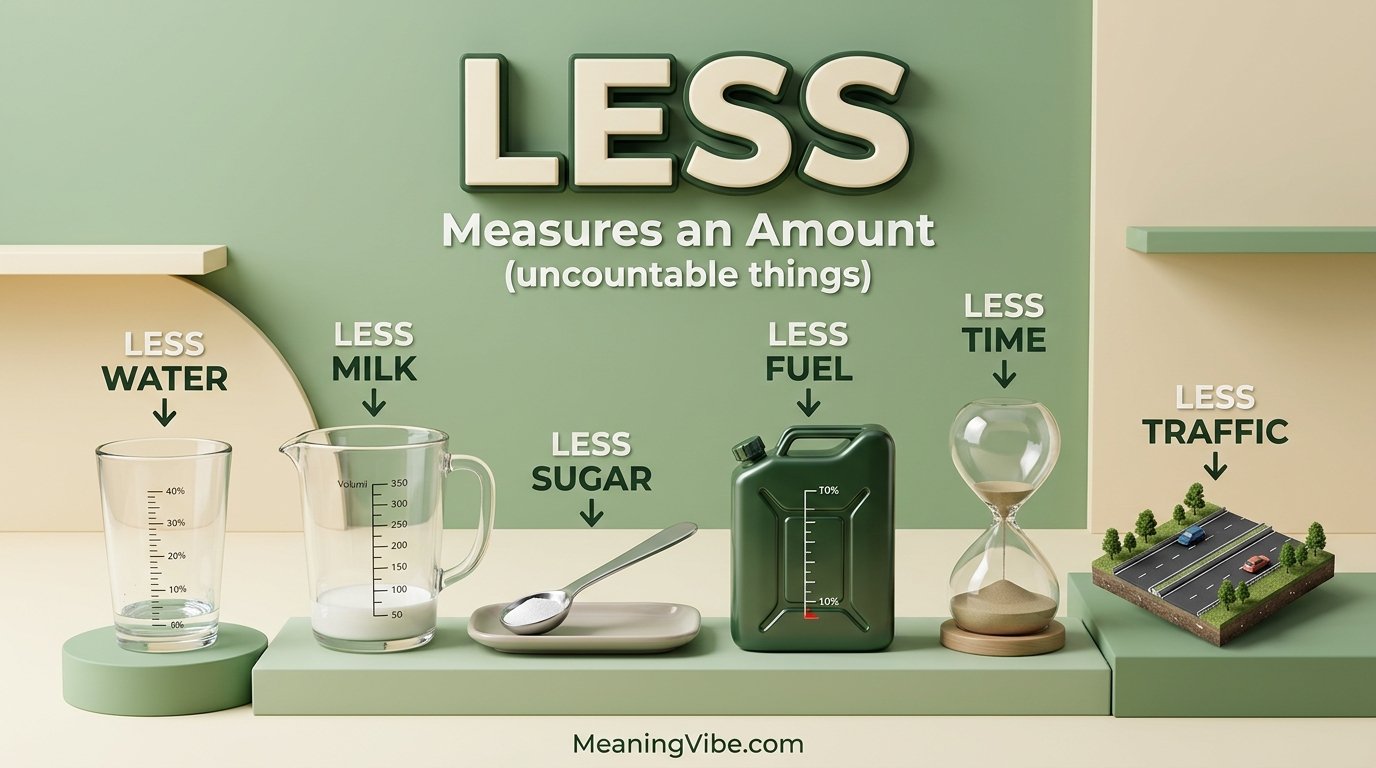
Sentences as writers submit them, corrected by check rather than taste. Each original fails exactly one step of the count test sequence.
|
As written |
The failing check |
The corrected sentence |
|---|---|---|
|
Less people attended the hearing this year. |
Check one: people count one by one |
Fewer people attended the hearing this year. |
|
The trip costs fewer than twenty dollars in fuel. |
Check three: a sum is a measured whole |
The trip costs less than twenty dollars in fuel. |
|
Add fewer water to the mixture. |
Check one: water measures, it does not count |
Add less water to the mixture. |
|
One fewer thing to worry about. |
Fixed pattern: after one, less is typical |
One less thing to worry about. |
|
The essay must be 500 words or fewer. |
Fixed pattern: a limit reads as one length |
The essay must be 500 words or less. |
|
Fewer traffic slowed the commute. |
Check one: traffic is a measured flow |
Less traffic slowed the commute. |
The pattern across the corrections cuts both ways, which is the article in miniature. Three errors spread less over things that count; three stretch fewer over amounts, sums, and patterns that measure.
The True History: A Preference From 1770
The history runs opposite to the classroom story. Less is the ancient word in this fight: it has been used with countable nouns for well over a thousand years, nearly as long as written English exists.
No grammarian objected for most of that millennium, because there was nothing to object to. Less of counted things was simply how English worked, in careful writing and careless alike.
The rule arrived in 1770, when the critic Robert Baker, in his Reflections on the English Language, set down what he himself presented as a personal preference: fewer for numbers, less for quantities.
Merriam-Webster’s verdict on what happened next deserves quoting in substance: somewhere along the way, Baker’s preference was generalized and elevated to an absolute, inviolable rule by the teachers and usage writers who followed him.
None of this makes the distinction fake. Edited English adopted Baker’s preference as a house standard, teaches it, and enforces it in its stylebooks, which is reason enough to follow it in print and no reason to believe it fell from the sky.
The Word Pair Cluster
This pair belongs to a family of words that separate on one clean test, and the habit transfers: find the test, run it, let the sentence grade itself. MeaningVibe collects the family.
- empathy vs sympathy: feeling with against feeling for, decided by where you stand
- imply vs infer: the speaker’s side against the listener’s side of one exchange
- complement vs compliment: praise against completion, one letter apart
- discrete vs discreet: separate units against tact, decided by where the letters sit
- stationary vs stationery: not moving against writing materials, decided by one vowel
- adapt vs adopt: adjusting yourself against taking something as your own
- assure vs ensure vs insure: three verbs of confidence, divided by what each one guarantees
- allude vs elude: hinting at something against escaping it
- elicit vs illicit: drawing out a response against what is forbidden
- cite vs site vs sight: quoting a source against a place and a sense
- precede vs proceed: going before against going forward, decided by direction
- disinterested vs uninterested: bored against impartial, the attitude pair
The transferable skill is identical across the cluster: resist the word that merely sounds right, and ask what job the word is doing in the sentence. Counting and measuring, for these two; function, for all of them.
Frequently Asked Questions
What is the difference between fewer and less?
Fewer counts items one by one: fewer people, fewer mistakes, fewer cars. Less measures amounts as a whole: less time, less water, less traffic.
The bridge: fewer pairs with many (not as many), less with much (not as much). One systematic exception matters: measured wholes take less, so less than twenty dollars, less than three miles.
What does fewer mean?
Fewer means a smaller number of separate, countable things: not as many. It is the comparative of few: few, fewer, fewest.
‘There are fewer cars on the road today’ counts vehicles one by one. Fewer stands before plural nouns whose individuals can be numbered: students, errors, ingredients, votes.
What does less mean?
Less means a smaller amount of something measured as a whole: not as much. It is the comparative of little: little, less, least.
Less traffic, less sugar, less stress: substances and abstractions that are poured, weighed, or felt rather than counted. Less also works in mathematics (less than) and formally as minus.
Which word is correct for people: fewer people or less people?
Fewer people, in edited English. People are counted one by one, and every major style guide keeps fewer for individual persons.
Less people is extremely common in speech, with centuries of usage behind it, but print copyeditors change it. The exception is statistical: a population read as one enumeration can take less, as in less than 50,000 people.
Is ‘less people’ grammatically wrong?
It depends on the court. By the house rules of edited American English, yes: people are countable individuals, and fewer is the required form.
By the historical record, less has modified countable nouns for over a thousand years. The accurate verdict: wrong for edited prose, unremarkable in speech, and worth fixing wherever an editor or examiner is the audience.
Is it ’10 items or less’ or ’10 items or fewer’?
The most argued sign in grammar. The received rule says fewer, because items are countable.
Merriam-Webster’s usage guide, however, calls less the preferred choice in the or less construction after numbers, and notes that stores using ‘items or fewer’ are very much in the minority. The sign is defensible English; a strict style guide still chooses fewer.
Why do we say ‘one less’ and not ‘one fewer’?
Because less is the typical choice after the number one, a pattern Merriam-Webster records directly: one less worry, one less thing to carry.
The construction treats the subtraction as a single amount removed. ‘One fewer’ appears in careful writing but sounds marked to most native ears. Fixed patterns outrank the general rule; this is one of them.
Fewer or less for time?
Less, when the time is a single stretch: less time, less than a week, less than five years. Time read as a measured whole behaves like water, not like chairs.
Fewer returns when the units are counted as individuals: fewer hours on the schedule, fewer working days than last year. Ask whether the sentence is about a duration or about counted units.
Fewer or less for money?
Less, when the money is a sum: less money, less than twenty dollars. A sum is read as one amount, however many coins compose it, which is why ‘fewer than ten dollars’ sounds unnatural.
Fewer appears when the individual bills or coins are the subject: fewer dollar bills in the register. The noun’s role, not its spelling, decides.
Fewer or less for distance and weight?
Less, in the standard measured forms: less than three miles, less than ten ounces. Merriam-Webster lists distance and weight among the families where less with countable units is standard.
Miles and ounces are read as amounts on a scale. Fewer returns for counted objects again: fewer mile markers, fewer suitcases, however heavy they are.
How do percentages work with fewer and less?
The percentage follows the noun it measures. Percentages of countable people and things take fewer: fewer than 30 percent of voters, fewer than half the students.
Percentages of substances and amounts take less: less than 30 percent of the water, less than half the budget. With the noun dropped, less than is the common default: less than half.
Is it ‘fewer than’ or ‘less than’ before a number?
Both, sorted by what the number measures. Before a count of individuals, edited English uses fewer than: fewer than ten people, fewer than three mistakes.
Before a measured whole, it uses less than: less than ten dollars, less than three miles. That is why ‘less than 50,000 people’ survives in statistics: the enumeration is one figure, one amount.
What does ‘no less than’ mean?
An emphasis formula meaning fully as much or as many as, used when a figure is meant to impress: no less than 500 guests attended.
Despite the countable guests, the fixed phrase takes less. ‘No fewer than’ exists with a more literal flavor of exact counting. In its emphasizing job, no less than is the established form.
What does ‘more or less’ mean?
Approximately, roughly, or to a certain extent: the job is more or less done; there were fifty people, more or less.
The phrase is fully fixed and has nothing to do with the countable rule; ‘more or fewer’ does not exist in this sense. Less lives inside idioms where the count test has no jurisdiction, like less than or equal to.
Who invented the fewer less rule?
The received rule seems to have originated with the critic Robert Baker, who in his 1770 Reflections on the English Language expressed a personal preference for fewer with numbers.
Merriam-Webster’s account is precise: Baker stated a preference, not a law, and later writers elevated it into an absolute rule. The distinction is about 250 years old as a rule; less with countables is over a thousand.
Has less always been used with countable nouns?
Yes, for well over a thousand years, nearly as long as there has been written English, according to Merriam-Webster’s usage research.
Old and Middle English writers used less of countable things without objection, because no rule yet forbade it. Fewer for counts is a refinement edited English adopted, not a boundary the language always had.
What is the count test for fewer vs less?
Ask two questions about the noun. Can its individuals be counted one by one: one mistake, two mistakes, three mistakes? Does it take a number and a plural naturally?
Yes to both means fewer: fewer mistakes, fewer bottles, fewer meetings. Measured instead of counted, poured, weighed, timed, or felt, means less: less confusion, less milk, less patience.
What is the many much bridge?
Fewer and less have partners that expose them. Fewer is the comparative of few, which pairs with many: many people, fewer people; not as many.
Less is the comparative of little, which pairs with much: much time, less time; not as much. If ‘not as many’ sounds right, the word is fewer. If ‘not as much’ sounds right, it is less.
Is ‘fewer money’ ever correct?
No. Money as a mass noun takes less: less money, much less money. Money cannot be pluralized or numbered directly; you count dollars, euros, or coins.
The neighbor case is the sum: less than twenty dollars, where dollars is countable in form but the phrase names one amount. Individual bills meant literally can take fewer in economics writing about physical notes.
Fewer or less for calories?
Edited usage splits by framing. Calories as a nutritional amount behave like a measured quantity, and ‘less calories’ is widespread.
Careful edited prose increasingly writes fewer calories, treating each calorie as a countable unit, and style conscious publications prefer fewer. Usage is genuinely divided; a house style should pick one and hold it.
What about ‘fewer than one’?
Fewer than one is the logical form for countable expectations: fewer than one person in a hundred, fewer than one accident per year in the statistics.
Less than one is the mathematical form for quantities: less than one percent, less than one liter. With a unit of measurement, less than one is standard; with a counted noun understood, fewer than one appears in careful writing.
Fewest or least: which superlative?
The superlatives follow their comparatives. Fewest is the superlative of few, for countable numbers: the fewest mistakes, the fewest votes.
Least is the superlative of little, for amounts: the least time, the least sugar, the least trouble. ‘The least people’ is the error twin of less people. Run the same count test, one level up.
Is ‘less than or equal to’ correct?
Yes, completely. In mathematics, less than names a relation between quantities, and less than or equal to is the fixed formal phrase.
Countability plays no role; the compared values are amounts on a continuum. It is one of less’s oldest and most technical jobs, it never alternates with fewer, and no prose style guide governs it.
Fewer or less for words in an essay limit?
Usage prefers less in the set formula: an essay of 250 words or less, a statement of 500 words or less. Merriam-Webster names this construction as one where less is preferred, because the limit reads as one measured length.
Fewer words is correct when words are counted as craft: she rewrote it in fewer words. Limit as a measure takes less; words as items under revision take fewer.
What does the AP Stylebook say about fewer and less?
The AP Stylebook keeps the classic distinction with the measured whole built in: fewer for individual items that can be counted, less for amounts and bulk quantities, including sums treated as single amounts.
That is why the distinction survives in American journalism. News copy writes fewer than ten people and less than ten dollars in the same story without contradiction.
What do dictionaries say about less with countable nouns?
Merriam-Webster’s usage guide states it directly: less is also sometimes used to refer to number among things that are counted, and in the measured whole families that use is standard, not a lapse.
The Copyeditor’s Handbook tradition adds that the strict rule is impractical given the exceptions. Dictionaries describe; style guides decide for their publications.
Is ‘less mistakes’ a common error?
In writing, Merriam-Webster notes, less with ordinary plural count nouns, as in ‘made less mistakes,’ is pretty rare and usually better avoided, though it occurs frequently in speech.
That asymmetry summarizes the topic: spoken English tolerates less almost everywhere; edited English reserves it for amounts and measured wholes. Default to fewer for clear plurals and less for clear masses, and you match edited prose.
Fewer or less for students and voters in a news report?
Fewer, when the individuals are the story: fewer students enrolled this fall, fewer voters cast ballots early. People in news copy are counted individuals, and AP style enforces it.
Less enters when the figure is one statistical enumeration or a percentage of a whole: less than 40 percent of eligible voters participated. The same event can take both words in one article.
How do you use fewer and less in the same sentence?
Pair a count with an amount and let each word do its own job: ‘The new process makes fewer mistakes in less time.’ ‘Fewer cars means less traffic.’
‘She packed fewer bottles and less food than last year.’ Contrast sentences are the fastest teaching tool for the pair: mistakes, cars, and bottles count; time, traffic, and food measure.
Is ‘less’ ever a noun or a preposition?
Yes. As a noun, less names the smaller amount: less is more; the lesser of two evils. In formal and accounting usage, less works like minus: a salary of fifty thousand, less tax.
These are established minor jobs that never alternate with fewer, and they explain why less feels at home in official documents where fewer would be impossible.
Why do supermarkets keep the ‘or less’ sign?
Because the construction is standard English and the customers understand it. Merriam-Webster observes that less is the preferred choice in number plus or less phrases.
Stores persuaded to switch to ‘items or fewer’ remain very much in the minority. Tesco’s UK change to ‘up to 10 items’ in 2008 solved the problem by deleting the contested word entirely, as widely reported coverage noted.
What is the difference between ‘a few’ and ‘a little’?
The positive small quantities split the same way. A few means a small number of countable things: a few friends, a few days.
A little means a small amount of an uncountable substance or abstraction: a little water, a little patience. Their comparatives inherit the split exactly, so learning the few little pair first makes fewer and less almost free.
Can fewer be used for time when hours are counted?
Yes, when the hours themselves are the countable units under discussion: fewer hours of daylight in December, the job takes fewer hours than it did.
This is the countable expression case. The same time that takes less as a duration (less time overall) takes fewer when the sentence is counting its units, hour by hour.
Which is correct on a test or exam?
Edited American tests enforce the classic system: fewer for items counted one by one, less for amounts, with the measured whole exceptions treated as standard, not as traps.
Expect clear cases (fewer people, less water) plus the famous exceptions (less than fifty dollars, one less problem). Run the count test, check for a measured whole, then check for a fixed pattern.
Is the fewer less distinction dying?
In speech, less has been expanding for centuries and the distinction is weak. In edited prose, the distinction is holding, because style guides keep teaching it.
Merriam-Webster’s summary: no definitive rule covers all possibilities, and native speakers do best guided by the ear. The realistic forecast: the pair survives as a marker of edited register, like who and whom.
What is the memory trick for fewer and less?
Fewer is the counting word: it belongs to few and many, the numbers family, for things you can count on your fingers.
Less is the measuring word: it belongs to little and much, the amounts family, for things you would pour into a jug. When stuck, ask the bridge question: not as many, or not as much?
Is ‘fewer than half’ or ‘less than half’ correct?
Both, sorted by what half is half of. Fewer than half the students, fewer than half the votes: the halves are counts of individuals.
Less than half the water, less than half the budget: the halves are amounts. With no noun following, less than half is the common default, because the bare fraction reads as a quantity.
How should a business report write quantities?
Apply the system in order. Count the countable: fewer returns, fewer defects, fewer open tickets. Measure the amounts: less downtime, less revenue.
Treat sums and durations as wholes: less than ninety days, less than a million dollars. The professional framing: discrete events take fewer, aggregates take less. One pass with the count test makes a report read as professionally edited.
Does British English follow the same rule?
Broadly yes in edited prose, with the same measured whole exceptions, and British usage authorities teach the distinction for formal writing.
The famous British episode is commercial: Tesco’s 2008 sign change to ‘up to 10 items’ after pressure from language campaigners. Everyday British speech, like American speech, uses less widely. The rule’s home on both sides of the Atlantic is the edited page.
What are the most common fewer less mistakes?
Four recur. Less with clear counted plurals in edited prose (less people, less mistakes), which editors change to fewer. Fewer stretched onto masses (fewer money, fewer traffic), wrong in every register.
Fewer forced into fixed patterns (one fewer as a default), where less is idiomatic. And fewer applied to measured wholes (fewer than fifty dollars), where the sum takes less.
How do you decide when the noun is hard, like problems or data?
Some nouns sit on the border. Problems count individually in most prose (fewer problems), though the answer can shift when problems are felt as a mass of trouble rather than itemized.
Data is a mass in much current usage (less data) and plural in formal scientific register; ‘fewer data points’ settles it. When a noun resists, rephrase to the unit you mean: points, cases, items, liters.
Fewer vs less in one rule I can remember?
Count it, fewer; measure it, less; and let the fixed patterns keep their less. Run three checks in order.
First the count test: countable one by one means fewer. Then the measured whole check: time, money, distance, weight, and statistics take less. Then the pattern check: one less, or less, and no less than are always less.
Conclusion
The fewer vs less difference is a sorting question, not a spelling test: fewer counts what stands in a row, and less measures what fills a container, a clock, or a sum.
Run the checks in order and the pair stops being an argument. Count first, bridge second, and let the measured wholes and the fixed patterns keep the less that history gave them.
One preference from 1770 still runs the edited page, and it earns its place every time a reader trusts a number in print. Count it or measure it; the sentence will take care of itself.