

When to use the has one test behind every correct answer. Use the when your listener can identify exactly which referent you mean, and leave it out when they cannot.
The referent counts as identified in four everyday ways. It was mentioned before, it is unique, words after the noun pin it down, or the situation makes it obvious.
If none of those holds, the noun is not identified yet. A first example takes a or an, and a general statement takes no article at all.
A Short Routing Passage Before the Routes
The full article system runs on three questions asked in order: is the noun singular and countable, can the listener identify it, and is the meaning general or a name?
Those questions belong to the wider system page in this cluster; here they are only a signpost. Choosing between a and an follows the next word’s sound, and that choice has its own topic elsewhere.
The Oxford Learner’s Dictionaries entry for article gives the base definition used throughout. An article is a determiner placed before a noun to shape its reference.
The One Test Behind Every Use of The
Identifiability is a claim about your listener, not the noun itself: the same noun changes its article as the conversation moves and knowledge grows.
A dog enters a story as a dog, because the listener knows nothing yet; two lines later it is the dog, now identified.
Nothing about the dog changed. Only the listener’s position changed, and the article records that change.
|
Route |
Test question |
With the |
Without the |
|---|---|---|---|
|
Did I name it before? |
the dog (second mention) |
a dog (first mention) |
|
Is there only one in our shared world? |
the sun |
a star |
|
Do later words pin it down? |
the book on the table |
a book |
|
Is it obvious in the scene? |
pass me the salt |
pass me a cloth |
|
Is it the winner of a set? |
the best, the first |
a good one |
|
Does the phrase carry the by custom? |
the radio, the internet |
watch TV |
|
Is it a system name, not a point? |
the Alps, the Nile |
Mount Everest, Lake Erie |
Run the routes in any order until one names itself; if none fits, the noun is probably general and the should come out. Cambridge Grammar’s entry on a, an and the states the same test in reference form.
Route 1: Already Mentioned, the Second Mention Route
The commonest route is the second mention: a noun is introduced once with a or an, and every later mention takes the, now identified.
Story chains run on this route from the first line: a man knocked at the door; the man was carrying a parcel.
News writing runs on it too: a suspect is arrested, and by the second sentence the report writes the suspect throughout.
Retold stories preserve the chain when wording changes. Our reported speech rules and reported speech examples pages drill the same habit: the chain never resets.
The error on this route is keeping a too long: writing a dog was black after the dog is established drops information the listener owns.
The reverse error happens too: opening with the dog before any dog exists sends the reader hunting for a mention that never came.
Story Chains and Report Chains
Each new noun restarts at a or an; each returning noun takes the, and the reader never loses the thread.
Passive sentences lean on this route: their subject is usually already identified, which is why it so often carries the.
Our guide to active voice vs passive voice rules shows that pattern in full: voice changes the sentence shape, not the identification underneath.
Route 2: Unique in the Shared World
Some referents need no first mention: the sun, the moon, the earth and the sky are one of a kind in the world both speakers share.
The listener identifies them from shared knowledge alone, so the first sentence about them can open with the: the environment, the weather, the government and the police.
The error here is dropping the: writing sun rises in the east breaks a route with no general statement exception.
Shared Surroundings and Shared Institutions
The route scales down to one room or street: the corner shop, the bus stop and the post office are unique inside the shared neighbourhood.
It also scales up to a whole country: the president, the parliament and the national bank are identified by the shared frame alone.
Route 3: Identified by What Follows, the Specification Route
This route is the hinge of the whole subject: words after a noun can identify it, and an identified noun takes the, however general it looked alone.
Water in general takes no article; the water in this bottle is one identified quantity, pinned down by the phrase after it.
The mechanism deserves its own name: the specified return. Add identifying words after a general noun, and the returns.
Cambridge Grammar states the mechanism in one sentence only: adding information after the noun makes a general noun specific, and the article changes.
Purdue OWL’s guide to using articles shows the same move: the dog that bit me is identified by its clause.
|
General form |
Specifying addition |
Identified form |
|---|---|---|
|
water |
in this bottle |
the water in this bottle |
|
a book |
on the table |
the book on the table |
|
dogs |
next door |
the dogs next door |
|
love |
of a mother |
the love of a mother |
|
a manager |
of the shop |
the manager of the shop |
|
advice |
you gave me |
the advice you gave me |
|
Paris |
of the 1920s |
the Paris of the 1920s |
|
information |
in this report |
the information in this report |
Of Phrases, Relative Clauses and Place Phrases
The of phrase is the commonest specifying device: the life of a sailor, the honesty of the witness and the end of the road are each identified by of.
A relative clause does the same job with a verb: the book you lent me needs no earlier mention, because the clause itself identifies it.
A place phrase works in smaller spaces: the flowers in your garden and the keys on the desk are picked out by where they are.
Abstract and uncountable nouns obey the route too: love is blind is general, while the love between them and the information in this report are each one identified case.
Specified Names: When Even a Name Takes The
A plain name is already identified, so it normally forbids the: Paris, France and Mount Everest carry none, since the name alone completes the identification.
Words after a name can narrow it to one version of itself: the Paris of the 1920s names a period slice, and of phrase names like the University of Oxford carry the too.
Route 4: Identified by the Situation
Some referents are identified by the scene itself: at a table, pass me the salt needs no earlier mention, because one salt cellar sits in the scene.
Close the door works the same way: the room holds one obvious door, and both people present know which one.
The British Council teaches this as its own route: only one in that context. Its cases are the family car and the village church, each unique locally, like the kettle in a kitchen.
Imagined scenes count once set: in the second conditional sentences on this site, an invented house takes the once the speaker has placed it.
Route 5: Set Membership, Superlatives, Ordinals, Only and Same
A superlative picks one winner from a set: the best, the biggest and the fastest, and set winners always take the.
Ordinals work by the same logic: the first chapter, the second attempt and the last train each name one position in an ordered set.
The words only and same complete the family: the only copy excludes every rival, and the same mistake points back at one identified error.
Same and different give the cleanest small proof: the same size claims identity with one known thing; a different size claims one of many others.
Dropping the here is a visible error: he is a best student fails, because best has already done the identifying that the records.
The Winner Set in Everyday Sentences
Superlatives appear far beyond exam sentences: the cheapest flight, the earliest train and the only way home are daily set decisions.
Dates in the spoken of form belong near this family. The Fourth of July carries the inside the spoken construction; written dates drop it, a register fact.
Route 6: Institutions and Media Conventions
Some nouns carry the by convention, as shared services: the radio, the internet, the newspaper and the cinema. Television is the exception.
|
Medium or service |
Form |
Why |
|---|---|---|
|
radio |
listen to the radio |
an identified service |
|
internet |
on the internet |
one unique shared system |
|
newspaper |
in the newspaper |
an identified publication object |
|
television, the medium |
watch TV, on TV |
the standing exception, no article |
|
television, the set |
the TV in the corner |
a physical object in the situation |
|
cinema |
go to the cinema |
a shared cultural venue |
|
theatre |
at the theatre |
a shared cultural venue |
Purpose Against Building, From the The Side
Institutions split into two families learners constantly merge: purpose uses take no article; building and service uses take the.
A pupil goes to school, because school names the purpose; a parent goes to the school, visiting the building, and buildings are identified places.
The same split runs through the whole set: a prisoner is in prison, while tourists visit the prison. The parent, the visitor and the inspector take the, and the article marks the shift.
Hospital is a labelled variety strand, never an absolute: British English sends a patient to hospital; American English normally says in the hospital.
Instruments print as a labelled strand too. The traditional form is she plays the piano; American English widely hears play piano, so the form with the is the safe default.
Group Adjectives, Families and the Paired Comparative
The plus an adjective names a whole group: the rich, the poor, the elderly and the unemployed, with the noun people understood and unspoken.
Nationality groups use the same device: the French names the people as a group, while French people in a general sentence is a plain plural.
Family names in the plural join the pattern: the Smiths are coming names the household as one group; Mr Smith alone takes none.
Generic the names a class through one representative member: the smartphone changed work, the wolf hunts at night. The bare plural claims the same; generic the is the formal, marked choice.
One the here identifies nothing at all: in the more, the merrier, the is an old form meaning by that much, kept whole in the paired comparative.
Route 7: Geography, System Names Against Point Names
Geography follows one contrast: system names take the, single point names take none, and the map divides cleanly along that line.
Rivers, oceans, seas, deserts and mountain ranges are systems; a peak, a lake, a city and a plain country are points or single names, standing bare.
|
Takes the |
Takes no article |
|---|---|
|
the Nile, the Amazon |
Mount Everest, Everest |
|
the Pacific, the Atlantic |
Lake Erie, Lake Superior |
|
the Sahara |
France, Japan, Canada |
|
the Alps, the Himalayas |
Paris, London |
|
the Great Lakes |
Lake Erie (one lake) |
|
the United States, the Netherlands |
India, Brazil |
Country names follow shape, not geography: names built from a plural or common noun take the, as in the United States, the United Kingdom, the Philippines.
Plain single names take nothing, whatever their size: France, Japan, Canada, and Ukraine in current standard usage.
Groups of lakes and islands take the as systems: the Great Lakes and the Bahamas, while Lake Erie stands bare.
Purdue OWL’s count and noncount page prints the matching general pairs: its guests, information and sugar examples show the same general against specific split.
Regions built as descriptions take the too: the Middle East, the West Coast and the north of England name identified stretches, not single points.
General truths run on the same contrast: the zero conditional sentences and present simple tense rules pages drill general statements where the is forbidden.
Where The Is Forbidden: The Wrongly Added The
Half of all the errors are additions, not omissions. General statements come first: dogs are loyal and water is essential speak of the whole class, which takes no article.
Adding the narrows a general statement by accident: the dogs are loyal claims one known set of dogs, a different sentence with a different meaning.
Names and titles forbid it for the opposite reason: a name is already fully identified, so President Biden, Doctor Lee and Captain Ortiz carry no article.
Languages, sports and meals stand bare as classes: she speaks Spanish, they play football, and breakfast is at eight.
ESLBase’s articles guide gives the zero article full standing as a system; here it matters as the rival that wins every general case.
Fixed Phrases With The, Learned Whole
A small set of phrases keeps the as a fixed form: in the morning, in the afternoon and in the evening are learned whole, beside at night with none.
Time phrases are not symmetrical: in the past and in the future keep the; at present, at noon and at midnight do not.
Seasons print as a labelled strand, not a rule: in summer is the season in general; in the summer usually points at one identified summer.
The weekend is a labelled variety strand too: British English says at the weekend, American English on the weekend, and a US text prints the American form.
Registers: Headlines Drop It, Documents Multiply It
Headline English is a space saving register that drops articles: man bites dog is a register form, and copying it into an essay is an error.
Documents move in the opposite direction: the following list and the previous section identify parts of the text itself, so formal prose runs dense with the.
Instructions and signs sit between the two: mind the step keeps its situational the, while short labels drop articles for space.
The Pair Bank: 60 With and Without Pairs
Read each pair as two sentences and a verdict, with the deciding route named. Story chains fill the third conditional sentences bank the same way, and the first conditional sentences page shows general if clauses against identified result clauses.
Class A: Second Mention Pairs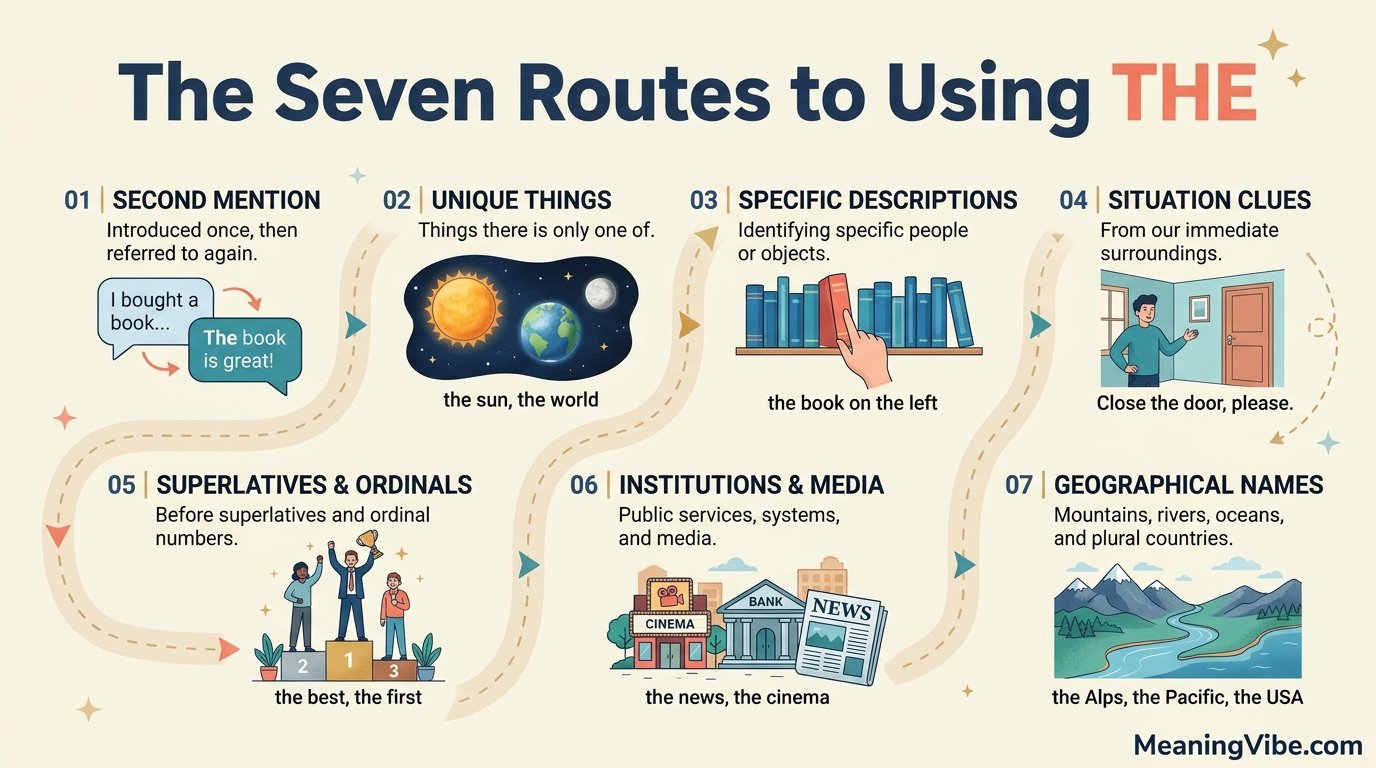
1. A dog ran in. The dog was black. First mention a; the return takes the. Route 1.
2. She adopted a cat. The cat sleeps all day. The chain continues. Route 1.
3. A letter arrived. The letter was from Ana. New noun a, known noun the. Route 1.
4. We hired a van. The van broke down. The second sentence identifies it. Route 1.
5. A man called. The man wanted the manager. Report chains, same rule. Route 1.
6. He bought a house. The house has a garden. Each new noun restarts at a. Route 1.
7. A suspect was arrested. The suspect refused comment. News chains switch after one mention. Route 1.
8. I read a report. The report was long. Identified by the first sentence. Route 1.
9. A bird landed. The bird was completely black. Description follows the known noun. Route 1.
10. They opened a window. The window faced the sea. Introduced, then identified. Route 1.
Class B: General Against Specified Pairs
11. Flowers are beautiful. The flowers in your garden are beautiful. Whole class bare; one set takes the. Route 3.
12. Water is essential. The water in this bottle is cold. Substance general; one bottle specified. Route 3.
13. Dogs are loyal. The dogs next door are loud. General plural bare; one set takes the. Route 3.
14. Love is blind. The love between them grew. Abstract general; one bond specified. Route 3.
15. Information is power. The information in this report is new. General uncountable; one report specified. Route 3.
16. Music helps me relax. The music at the party was loud. General; one event specified. Route 3.
17. Sugar is sweet. Pass me the sugar. The shared bowl identifies it. Routes 3 and 4.
18. Life is short. The life of a sailor is hard. The of phrase specifies it. Route 3.
19. Coffee keeps me awake. The coffee in this cup is strong. Substance general; one cup specified. Route 3.
20. Books open worlds. The books on my desk are mine. General plural; one set takes the. Route 3.
Class C: Geography Pairs
21. Lake Erie is wide. The Great Lakes are huge. One lake bare; the system takes the. Route 7.
22. Everest is high. The Himalayas are higher still. Peak bare; range takes the. Route 7.
23. France is in Europe. The Netherlands is in Europe too. Plain name bare; plural name takes the. Route 7.
24. The Nile is long. Lake Victoria feeds it. River the; single lake bare. Route 7.
25. Japan is an island nation. The Philippines is an island group. Single name bare; plural group the. Route 7.
26. The Pacific is vast. Hawaii sits in it. Ocean the; state name bare. Route 7.
27. Paris is the capital. The Paris of the 1920s was different. Plain name bare; one period specified. Route 3.
28. The Sahara is dry. Mali lies within it. Desert the; plain country bare. Route 7.
29. Canada is large. The United States is its neighbour. Plain name bare; union name the. Route 7.
30. The Alps cross Europe. Mont Blanc rises in them. Range the; single peak bare. Route 7.
Class D: Institution Pairs
31. She goes to school at eight. Her mother went to the school at nine. Pupil purpose bare; parent visit the. Route 6.
32. He is in prison. Tourists visited the prison museum. Prisoner purpose bare; building visit the. Route 6.
33. They go to church on Sundays. We photographed the church. Worship bare; the building the. Route 6.
34. Go to bed early. Sit on the bed. Sleeping bare; the furniture the. Route 6.
35. He is at work today. The office closes at six. Purpose bare; the located place the. Route 6.
36. She went to hospital in London. In the US she went to the hospital. British patient strand bare; American form the. Route 6 strand.
37. We go to the cinema on Fridays. Pupils go to school on Fridays. Shared venue the; purpose institution bare. Route 6.
38. He left by train. He left his bag on the train. Means bare; the actual vehicle the. Route 6.
39. Children go to school by bus. The bus at the gate is ours. Fixed means bare; one bus the. Routes 6 and 4.
40. She studies at university. The university hired new staff. Attendance bare; the employer the. Route 6.
Class E: Set, Group and Media Pairs
41. He is a good student. He is the best student. One of many a; the winner the. Route 5.
42. A first step helps. The first step is hardest. Any step a; the ordered position the. Route 5.
43. We need a copy. This is the only copy. Any copy a; the excluding word the. Route 5.
44. Try a different size. Try the same size. Non identity a; identity the. Route 5.
45. Rich people pay tax. The rich pay more here. General plural bare; group device the. Route 6.
46. French people live here. The French value bread. Plain plural bare; nationality group the. Route 6.
47. Listen to the radio. Watch TV after dinner. Service the; the medium exception bare. Route 6.
48. Read it on the internet. Read it in the newspaper. Unique system and publication both the. Route 6.
49. Smartphones changed work. The smartphone changed work. Bare plural general; generic the, the formal twin. Route 6.
50. The more, the merrier. More guests came later. Paired comparative keeps its old the; plain more none. Route 6.
Class F: Names, Titles and Fixed Phrase Pairs
51. President Biden spoke. The president spoke later. Title plus name bare; the role alone the. Names rule.
52. Mr Smith is coming. The Smiths are coming. One person bare; the household the. Route 6.
53. Oxford University is old. The University of Oxford is old. Modifier name bare; of phrase name the. Route 3.
54. Buckingham Palace is in London. The Palace of Westminster is too. Name plus noun bare; of phrase name the. Route 3.
55. In the morning we work. At night we rest. Morning keeps the; night is a fixed zero. Fixed phrases.
56. In the past it differed. At present it holds. Past keeps the; present sits in the at set. Fixed phrases.
57. The Fourth of July is a holiday. July 4 is the written date. Spoken of form keeps the; written date drops it. Register.
58. The manager of the shop called. She is a manager there. Specified post the; class membership a. Route 3.
59. Ukraine is in Europe. The United Kingdom is too. Modern plain name bare; union name the. Route 7.
60. Mind the step. Step forward, please. Situational instruction keeps the; bare command drops it. Routes 4 and register.
The Swap Gallery: 12 Errors, Corrected
Each error below swaps or drops one article. The correction follows it, with the route it broke named in the same line.
1. The dogs are loyal animals, as a general truth. Correct: Dogs are loyal. General statements forbid the; no route covers a whole class.
2. The water is essential for life. Correct: Water is essential. A general substance takes no article until words specify an amount.
3. The France is in Europe. Correct: France is in Europe. A plain country name is already identified.
4. She goes to the school every day, said of a pupil. Correct: She goes to school. The purpose use takes zero.
5. I had the breakfast at seven. Correct: I had breakfast at seven. Meals in general take no article.
6. Sun rises in the east. Correct: The sun rises in the east. A unique referent requires the.
7. He is a best student in class. Correct: He is the best student. Superlative winners take the. Route 5.
8. I need a manager of this shop. Correct: I need the manager of this shop. The of phrase specifies one holder. Route 3.
9. A dog was black, after the dog was introduced. Correct: The dog was black. Second mentions keep the. Route 1.
10. Close door, please, in ordinary prose. Correct: Close the door. The situation identifies one door. Route 4.
11. The Mount Everest is in Asia. Correct: Mount Everest is in Asia. A single peak forbids the. Route 7.
12. She plays football with the piano hands, mixed in one drill. Correct: She plays football, and she plays the piano. Sports forbid the; instruments keep the default.
Checking Your Own Writing: The Identification Pass
Proofread the as its own pass, separate from spelling. Ask of each the noun: can my reader pick out exactly which one I mean, and which route names it?
If no route names itself, the noun is probably general, so take the out. Then run the pass in reverse, hunting for bare nouns a route should have claimed, especially superlatives and second mentions.
Concordia University St Paul’s grammar guide collects the same classic errors, and McMaster University’s grammar guide offers practice with an answer key.
Mixed stories are the hardest practice ground. The mixed conditional sentences page chains identified nouns across two time frames, and direct speech vs indirect speech shows reference shifting between speakers.
Frequently Asked Questions
1. What does the actually signal to the listener?
The signals identifiability, not importance or size. It tells the listener they can pick out exactly which referent you mean, from the conversation, the situation or the words around it.
2. In a news report, why does a suspect become the suspect in the next sentence?
That is the second mention route at work. The first sentence introduces a new referent with a; every later sentence uses the because the referent is now on the record.
3. What is the meaning difference between I need the manager and I need a manager?
The first asks for one identified person, this place’s manager. The second asks for any manager available. Swapping the articles swaps the request.
4. Why does adding words after a noun so often force the?
Because the added words do the identifying. A book is any book; the book on the table and the book you lent me are each picked out by what follows.
5. Why do we say pass me the salt when nobody has mentioned salt before?
The situation identifies it. At a table there is one salt cellar in the shared scene, so no earlier mention is needed.
6. Why is the dogs are loyal wrong as a general truth, when the dogs next door is right?
A general truth speaks about the whole class, and whole class plurals take no article. The returns when the set narrows to an identifiable subset, like the dogs next door.
7. What does the plus an adjective mean in the unemployed need support?
The plus an adjective names a whole group of people, with people understood: the rich, the poor, the elderly, the unemployed.
8. Why do we say the French but French people with no the in a general sentence?
The French is the group adjective device applied to a nationality. French people in a general statement is a plain plural, so it takes no article until specified.
9. As an American writer, should I ever write in hospital?
In standard American English, no: the patient form is in the hospital. In hospital is the British purpose form, correct inside its own variety.
10. A parent writes I went to school this morning. Why is that wrong for a parent?
The zero form belongs to the person using the institution for its purpose, the pupil. A parent visits the building, so the parent went to the school.
11. Why do we say go to the cinema but go to school with no article?
The cinema is a shared cultural service, like the theatre and the radio. School in the pupil sense is a purpose institution, and purpose uses take no article.
12. Why does the internet always take the?
Because it is a unique shared system, one of a kind in the common world, like the sun. Unique referents take the from shared knowledge alone.
13. Why do we say in the newspaper but on TV with no article?
Print and radio are identified services: in the newspaper, on the radio. Television as a medium is the standing exception; the TV can still name the set.
14. Why is it the Great Lakes but Lake Erie?
Groups take the; single named points do not. The Great Lakes names a system of lakes, while Lake Erie is one lake with a plain name, like Lake Superior.
15. Why do the Himalayas take the while Everest, inside them, does not?
A range is a system name, and systems take the. A single peak is a point name and takes none, so one sentence can need the once and forbid it once.
16. Why do we say the Smiths are coming to dinner?
A family name in the plural names the whole household as one identified group: the Smiths, the Johnsons. One person’s name, Mr Smith, takes no article.
17. Why is it the University of Oxford but Oxford University?
The of phrase pattern carries the: the University of Oxford, the Palace of Westminster. Rebuilt as modifier plus noun, the name drops it: Oxford University.
18. Why does the tallest building in the world need the twice?
Each the does a different job. The first belongs to the superlative, one winner from a set; the second to a unique referent, the shared world.
19. Do dates need the in English?
Spoken American dates use it inside the of form: the Fourth of July. Written dates drop it: July 4, on June 21.
20. Why do we say the same size but a different size?
Same claims identity with one identified thing, so it takes the. Different claims non identity, one of many others, so it takes a.
21. In the sentence the only way is through, can only ever follow a instead?
No. Only singles out one identified option and excludes the rest, so it sits with superlatives and ordinals in the set family, and that family takes the.
22. What does the smartphone changed work mean, and how is it different from smartphones changed work?
Both are general statements built differently. The smartphone names the class through one representative member, the generic the; smartphones uses the everyday bare plural.
23. Why does the heart pumps blood use the for a general fact?
The heart is the generic the: one body part standing for the class in every body, standard in scientific prose. Everyday prose can write hearts pump blood.
24. When speakers say THE place to be with a strong thee, what is happening?
That is emphatic the, pronounced thee even before a consonant. It means the one and only, and it works because ordinary the already marks unique identification.
25. Why does the love of a mother take the when love alone does not?
The of phrase specifies the abstract noun. Love in a general statement takes no article; the love of a mother is one identified kind, pinned down by what follows it.
26. Why do we say in the past and in the future but at present?
These are fixed time phrases, learned as wholes, not symmetrical. Past and future are identified stretches; present sits in the at set with at night.
27. Is it in summer or in the summer?
Both are standard, as a labelled strand. In summer is the season in general; in the summer usually points at one identified summer.
28. Why do reports write the following and the previous so often?
Documents identify their own parts. The following list and the previous section point at one locatable stretch of text, so they take the by specification.
29. Why does the more, the merrier start with the when nothing is definite?
This the is a different historical word meaning by that much, preserved in the paired comparative: the more you practise, the easier it gets.
30. Why is the Paris wrong, but the Paris of the 1920s acceptable?
A plain name is already identified, so adding the is an error. When words after it narrow it to one period, the specified return can apply.
31. Why does President Biden take no the, but the president does?
A title attached to a name is part of the name, and names take no article. As a common noun it names an identified role, so it takes the.
32. Why do we say on the train but by train?
By train names the means of transport in a fixed zero phrase. On the train names the actual vehicle you are inside, so it takes the.
33. Is it at the weekend or on the weekend?
A variety strand. British English says at the weekend; American English says on the weekend. Both are correct in their own variety, and a US text prints on the weekend.
34. Why do we say go to work but go to the office?
Work is a purpose and state noun in the fixed zero set, with at work and at home. The office is one identified place, so it takes the.
35. Which the errors cost more in IELTS writing, adding it or dropping it?
No exam board publishes that ranking, and none is printed here. Both directions exist, and the direction follows the first language: article less languages drop, general the languages add.
36. What is the fastest self check for a the decision in my own sentence?
Ask: can my reader pick out exactly which one I mean? Then name the route. If none names itself, the noun is probably general and the should come out.
37. Why do we say the environment and the weather when nothing was mentioned?
Both are unique shared surroundings, identified by the shared world route with no first mention, grouped with the sun, the government and the police.
38. Why does a job title like the manager of the shop take the, but she is a manager does not?
The of phrase specifies the role: one identified post, one holder. She is a manager states class membership, one of many, so it takes a.
39. Why do we say listen to the radio in the morning but just watch TV at night?
Three families meet in one sentence. The radio is an identified service, in the morning is a fixed phrase with the, TV and at night are fixed zero forms.
40. Why is the water is essential wrong, when the water in this bottle is cold is right?
Water in general takes no article, like every uncountable general. The water in this bottle is one identified quantity, specified by the phrase after it.
41. Do plural country names always take the?
Yes in the standard lists: the Netherlands, the Philippines, the Bahamas, the United States. Plural or common noun names take the; plain names take none.
42. Why do newspaper names so often begin with The, as in The Washington Post?
The name was built as an identified institution, the paper of record for a place, and the article became part of the registered name.
Conclusion
When to use the comes down to one question asked well. Can your listener identify exactly which referent you mean, and if so, by which of the seven routes?
Where a route answers, write the with confidence. Where no route answers, the noun is general or a first example, and the should stay out. The full grammar cluster starts from the MeaningVibe homepage.