

Imply vs infer confuses more writers than almost any other verb pair, because the two words are not rivals for one job.
They are the two ends of a single act: a message leaves one mind and arrives in another, and each end has its own verb.
To imply is to suggest something indirectly, without stating it. To infer is to draw a conclusion from evidence, hints or clues. The speaker implies; the listener infers, every time, in that order.
Everything after this ruling exists to make it permanent: the direction table, two tests that settle any sentence, each word explored in full, the word family (implication, inference, implied, inferred), a spelling rule hiding inside inferred, and the honest story of a 400 year argument about whether the distinction even matters.
The Quick Ruling: One Message, Two Ends
Picture one small exchange. A manager says, “Some of us still have deadlines this week,” while looking at your empty desk. She has implied that you should get back to work.
You, hearing the words and seeing the look, infer that she means you.
Nothing in that scene allows the verbs to swap. She cannot infer her own hint into existence, and you cannot imply a conclusion inside your own head. Direction is the whole difference:
|
Imply |
Infer |
|
|---|---|---|
|
Who does it |
The speaker or writer (the sender) |
The listener or reader (the receiver) |
|
Direction |
Meaning travels OUT, into words |
Meaning travels IN, into a conclusion |
|
Plain swap word |
Suggest |
Conclude |
|
Core meaning |
To express indirectly, without stating |
To reach a conclusion from evidence |
|
Typical pattern |
imply that… |
infer from… that… |
|
Example |
Her silence implied disagreement |
I inferred from her silence that she disagreed |
The definitions follow dictionary consensus: Merriam-Webster’s entry for imply gives imply as expressing indirectly and indicating by necessary consequence, and Merriam-Webster’s entry for infer gives infer as reaching a conclusion based on facts or premises, or, with thin evidence, guessing and surmising.
One image from the teaching literature holds the pair perfectly: writing teacher Adrienne Robins calls them opposite sides of a single coin. Every implied message is a coin the sender flips; every inference is the same coin caught.
The Two Tests
Test 1: The sender test.
Ask one question about your sentence’s subject: is this person (or text, or thing) sending a message or receiving one? Sending takes imply. Receiving and concluding takes infer.
The test works because the verbs describe roles, and every sentence puts its subject in one role or the other.
Test 2: The swap test.
Replace the word with suggest or conclude and keep whichever fits. “Are you suggesting that I’m at fault?” fits, so the verb is implying.
“From the data we concluded that sales rose” fits, so the verb is inferred. Two seconds, no grammar knowledge required.
Run the tests together on the classic trap: “Are you inferring that I’m lazy?” The subject, you, is being accused of sending an accusation, so sender test says imply; swap test agrees (“Are you suggesting…?”).
The correct sentence is “Are you implying that I’m lazy?”, and it is the sentence this whole topic is famous for.
Imply: Putting a Message In
To imply is to load a message into words, tone, images or behavior without stating it outright. The message is genuinely there; it simply travels under the surface, and arriving is the audience’s job.
The Two Senses of Imply
The everyday sense is the hint: “His tone implied that the meeting had gone badly.” Merriam-Webster’s first definition is to express indirectly, and most sentences you will ever write use this sense.
The second sense is stricter and shows up in law, logic and careful argument: to indicate by necessary consequence. “Rights imply obligations” reports no hint; it says one thing logically contains another.
This is the imply of contracts and constitutions, entailment rather than suggestion.
Who and What Can Imply
People imply, constantly, in speech and writing. But the implier does not need to be a person, a point Dictionary.com’s imply vs infer guide and QuillBot both make and most guides miss:
- Texts imply: a novel implies its theme; the report implies that costs will rise.
- Statements imply: the spokesperson’s wording implied a resignation was coming.
- Situations imply: gray clouds imply a storm; an empty chair at the table implies an absence.
- Silence implies: her silence implied disagreement, the guidebook example that never wears out.
Anything that communicates indirectly can imply. Keep that list in mind, because the matching list for infer is much shorter, and the asymmetry is the lesson.
Imply and Its Neighbors: Suggest, Hint, Insinuate, Implicate
Four near neighbors divide imply’s territory by strength and tone:
|
Word |
Shade |
Example feel |
|---|---|---|
|
Hint |
The lightest touch, minimum statement |
A hint of a smile; hinting at a gift |
|
Suggest |
Neutral and open, puts an idea into the mind |
The data suggest a trend |
|
Imply |
Firmer: the unexpressed idea is logically tied to what was expressed |
Her remarks implied a threat |
|
Insinuate |
Imply with a shadow: sly, usually negative |
He insinuated that she had cheated |
|
Implicate |
Shows involvement, usually in wrongdoing |
The emails implicated two managers |
Merriam-Webster’s synonym note makes the imply and suggest distinction precise: suggest awakens an idea by association, while imply indicates a more definite, logical relation between what is said and what is meant.
And insinuate should be kept in reserve: choosing it accuses the speaker of being underhanded.
Infer: Carrying a Meaning Out
To infer is to conclude: to take evidence, premises, hints or clues and arrive at something not stated. If imply folds a message into words, infer is the act of unfolding it, a picture the etymology section will make literal.
Only minds infer. A reader, listener, scientist, detective or jury infers; a cloud, a text and a silence cannot, because concluding is something a mind does with what it receives.
The Conversation Sense
In dialogue, infer is imply’s answering move: the listener catches what was sent. “I implied that I was upset, and she correctly inferred why” is the pair working as designed, one sentence holding both ends of the exchange.
The giveaway pattern is infer from: the word from introduces the evidence the conclusion was drawn from. From his tone, from the data, from the footprints, from the way the meeting ended.
When your sentence contains evidence and a conclusion, infer is already waving at you.
The Evidence Sense: No Speaker Required
Infer’s larger life happens where nothing was implied at all. Researchers inferred the approximate age of an artifact from its markings; nobody hid that age in the markings on purpose.
The evidence simply supported a conclusion, and infer names the drawing of it.
This is the infer of science and statistics: conclusions about a population are inferred from a sample, effects are inferred from measurements, and the whole discipline of statistical inference is named for the act.
It is also why “the data inferred” is always wrong: data imply, suggest and support; people infer from data.
Inference in Reading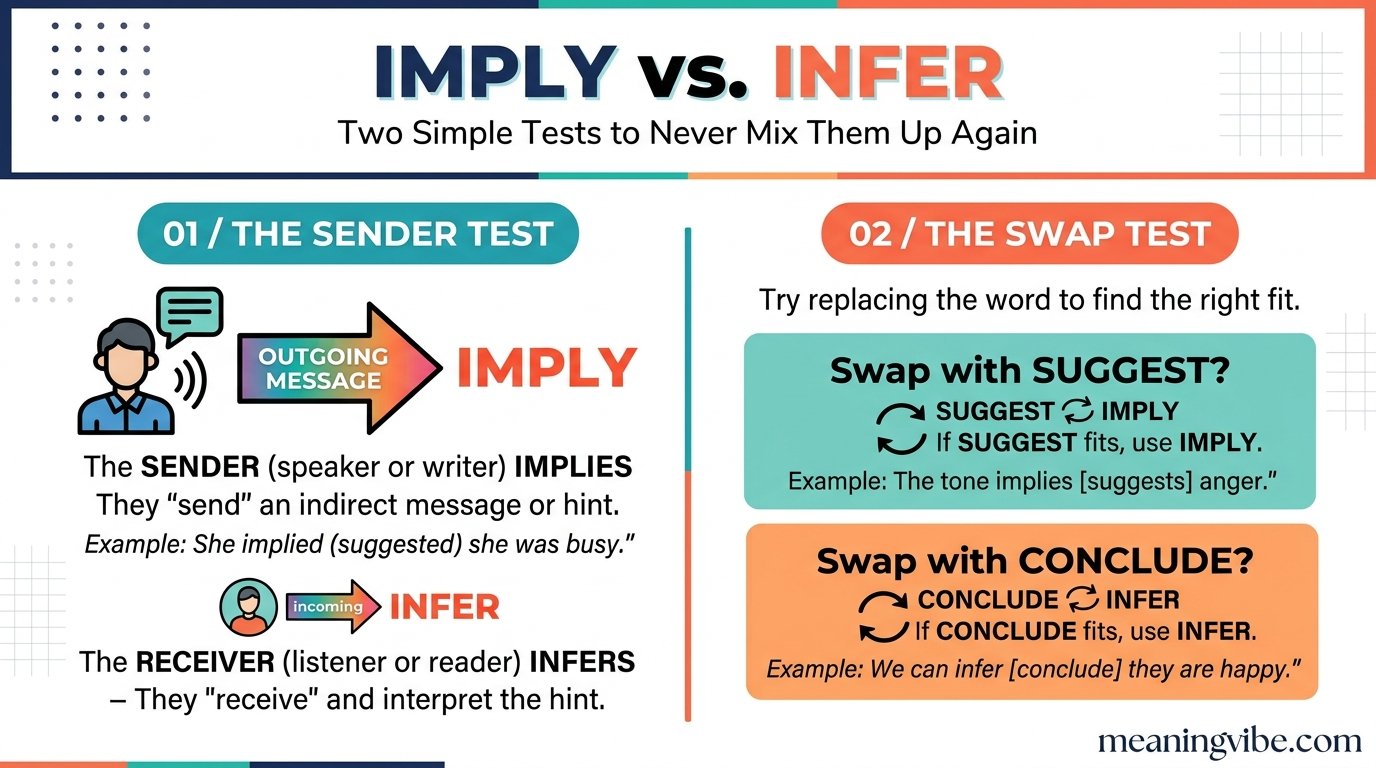
In school, infer becomes a named skill: making inferences, working out what a text means beyond its literal words using context clues and background knowledge. Why is the character nervous?
The text never says; the reader infers it from the bitten nails and the glance at the door.
Exam questions test exactly this move, which is why imply vs infer searches spike in term time.
The classroom rule and the newsroom rule are the same rule: the author implies, the reader infers, and a strong answer shows the evidence the inference stands on.
The Family Table: Implication vs Inference, Implied vs Inferred
The verbs do not travel alone. Each brings a noun and an adjective, and the family members obey the same direction as the verbs, which means one insight organizes six words.
|
Verb (the act) |
Noun (the thing) |
Adjective (describing it) |
|---|---|---|
|
Imply: the sender suggests |
Implication: what is suggested, or what follows |
Implied: hinted, not stated |
|
Infer: the receiver concludes |
Inference: the conclusion drawn |
Inferred: concluded from evidence |
Implication vs Inference
An implication travels out from a statement, study or action: it is what the thing suggests, and often what it sets in motion. “The implications of the study” are the ideas and consequences the study carries with it.
An inference is drawn in by a person: it is what someone concludes.
“Her inference from the survey data” is her reading of it, and it can be wrong in a way an implication cannot: people draw bad inferences from good implications every day.
The research report rule follows directly. Data and findings imply; researchers and readers infer. “The results imply a trend, from which we inferred that demand is shifting” is the pair doing professional work.
Implied vs Inferred
Implied describes the message at the sending end: an implied threat, an implied criticism, an implied promise, none of them stated, all of them sent.
Inferred describes the message at the receiving end: an inferred meaning, an inferred motive, concluded by whoever received it.
The same content routinely wears both adjectives from opposite viewpoints: what he implied, she correctly inferred. If your sentence cannot decide, ask whose side of the exchange it is standing on.
The Fixed Terms Built on Implied
Implied anchors a set of legal and everyday fixed terms, all using the sending side because the law reads them as understood without being stated:
- Implied warranty: a guarantee the law reads into a sale.
- Implied consent: permission understood from behavior or circumstances.
- Implied contract: obligations read from conduct rather than signatures.
You will never meet an “inferred warranty,” because these terms describe what the situation communicates, not what anyone concluded from it.
Forms and the Doubled R in Inferred
Both verbs are regular and transitive, each taking a that clause as its natural object: she implied that; we inferred that. Their forms differ in exactly one place, and it generates its own searches.
|
Base |
Third person |
Past |
Participle |
|---|---|---|---|
|
imply |
implies |
implied |
implying |
|
infer |
infers |
inferred |
inferring |
Infer doubles its r before ed and ing: inferred, inferring, never infered.
The reason is the general doubling rule: when a verb’s stress falls on its final syllable (in-FER), the final consonant doubles before a vowel suffix, the same pattern as referred, preferred and occurred.
Imply performs the other common spelling move instead, trading its y for an i: implied, implies. Between them, the pair quietly teaches both of English’s main verb spelling rules.
The Honest Debate: 400 Years of Overlap
Most guides present the distinction as a timeless law. The record, as Merriam-Webster’s entry for imply and Merriam-Webster’s entry for infer both print in their usage guide, is more interesting, and a trustworthy page should tell it straight.
Merriam-Webster’s position in its own words, paraphrased closely: using infer to mean suggest or hint is commonly identified as an error; in truth, the meanings of infer and imply have overlapped since the 16th century, making the distinction a matter of preference.
Those who honor the distinction limit infer to conclusions and surmises.
The history underneath: Shakespeare used infer in the suggest sense (“this doth infer the zeal I had to see him”), and nobody objected for centuries.
Usage authorities note the objection itself is a 20th century development, which then hardened into the standard classroom rule.
The suggest sense of infer is now rare in published writing and widely regarded as wrong, whatever its pedigree.
So the practical verdict has two honest halves. Descriptively, infer for imply has a long, distinguished history and appears in great writers.
Professionally, edited English keeps the distinction, editors enforce it, and readers who know it will judge the swap as an error.
In your own formal writing, correspondence and published work, keep the words apart: the distinction carries real information about who produced a meaning, and throwing it away buys nothing.
One more refinement the debate teaches: context can rescue or condemn. “He inferred that I was lying” is perfectly correct if he concluded it from evidence.
It is the error only when the writer meant he hinted it. The role test, not the phrase, decides.
Where the Words Come From: Folded In, Carried In
The etymologies are not decoration here; they are the two best memory devices this topic owns, because each word’s origin is a picture of its job.
Imply descends from Middle English implien, whose meanings included to enfold, surround and involve by inference, from Anglo-French, rooted in Latin implicare, to fold in.
To imply is literally to fold a message into your words, which is why its cousins are implicate, implicit and explicit (folded out).
Infer descends from Latin inferre, to carry or bring in (in- plus ferre, to carry, the root shared with transfer, refer, prefer and differ), entering English by 1529.
To infer is to carry a meaning in, from the evidence to the conclusion, which is precisely what a listener does.
Folded in at the sending end, carried in at the receiving end. The Latin images and the modern rule are the same picture drawn twice, fifteen centuries apart.
Sentence Surgery: Fixing the Famous Errors
|
Wrong |
Right |
Why |
|---|---|---|
|
Are you inferring that I’m at fault? |
Are you implying that I’m at fault? |
The accused person is the sender of the hint |
|
The data inferred a clear trend |
The data implied a clear trend (and we inferred one from it) |
Data cannot conclude; only minds infer |
|
I implied from his letter that he was well |
I inferred from his letter that he was well |
You received and concluded: infer, with from |
|
She inferred her disappointment in the review |
She implied her disappointment in the review |
She sent the message indirectly: imply |
|
He infered that the meeting was off |
He inferred that the meeting was off |
The r doubles: inferred |
|
The implications we drew from the report |
The inferences we drew from the report |
What readers draw are inferences; reports hold implications |
|
From her nod, he implied she agreed |
From her nod, he inferred she agreed |
The nod was evidence; he concluded from it |
|
The spokesperson inferred that cuts were coming |
The spokesperson implied that cuts were coming |
A spokesperson sends messages: imply |
|
What are you inferring by that remark? |
What are you implying by that remark? |
The remark’s sender is being challenged |
|
We can imply from the survey that users are unhappy |
We can infer from the survey that users are unhappy |
From plus a conclusion is infer’s home ground |
Read the why column as a set and a pattern emerges: nearly every real world error is infer wandering into imply’s job, because infer feels fancier.
The surgery habit that prevents all of them is the swap test applied at the keyboard, suggest or conclude, before the sentence leaves.
Memory Tricks That Actually Stick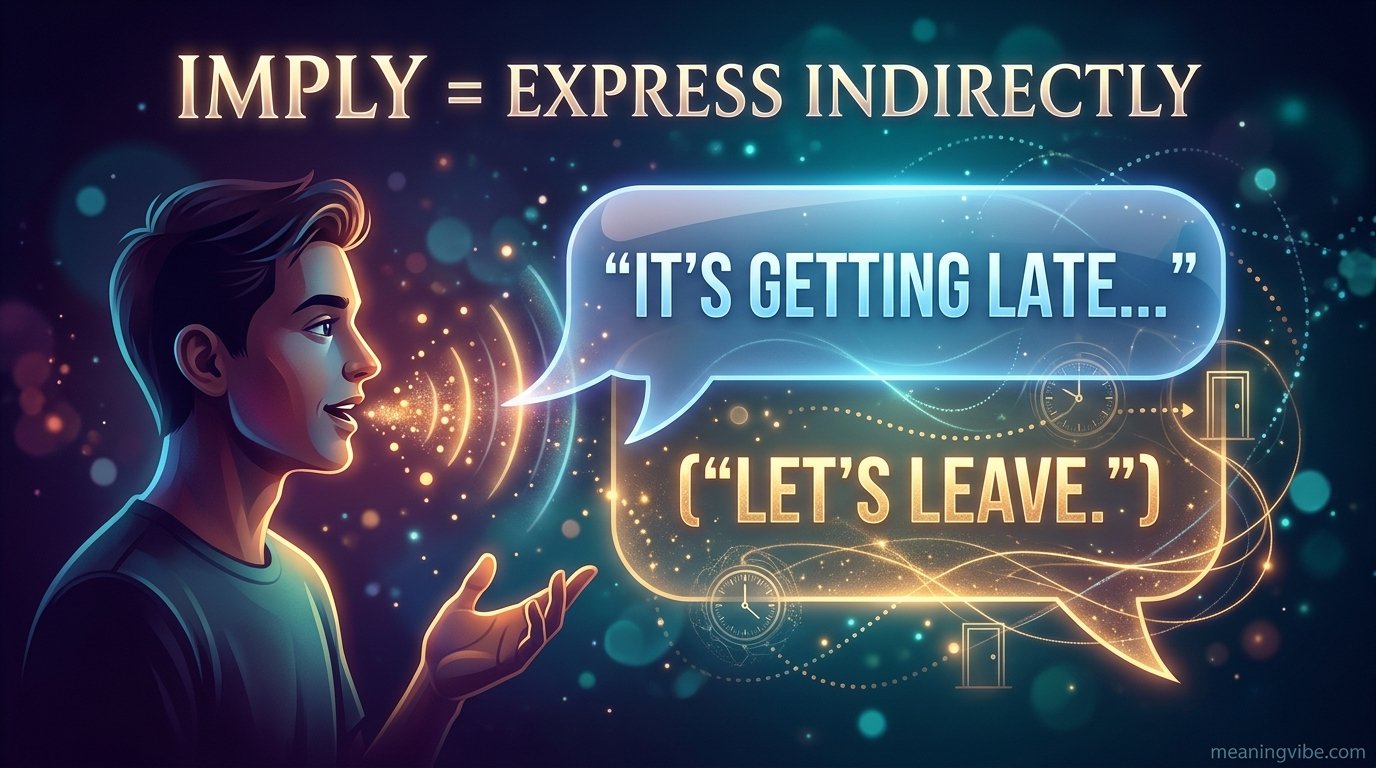
1. Insert and investigate.
Imply starts like insert: you put a message in. Infer starts like investigate: you dig a meaning out. The two I words at the start of each verb are the whole method.
2. Follow the coin.
Robins’ image again: imply and infer are opposite sides of one coin. If your subject is flipping the coin, imply; if your subject is catching it, infer.
One exchange, two roles, and a sentence can only stand on one side at a time.
3. Alphabetical order is chronological order.
Imply comes before infer in the alphabet, and the implied message comes before the inference in the world. Nothing can be inferred until something has been implied or observed, so the dictionary order rehearses the real order.
4. From belongs to infer.
When you catch yourself writing from after the verb (“ from the data,” “ from her tone”), the word in the gap is infer in the overwhelming majority of sentences. Evidence phrases are infer’s fingerprint.
5. Fold and carry.
The Latin pictures: imply folds in, infer carries in. If the meaning is being folded into words, imply; if it is being carried into a mind, infer. The oldest trick on this page is also the most durable.
Keep the Pair in Its Family
Imply vs infer is the direction pair in a cluster of word choices that all reward the same habit: asking what job the word is doing before asking how it is spelled.
The word pairs on Meaning Vibe cover the closest relatives.
The E aisle holds elicit vs illicit, emigrate vs immigrate, eminent vs imminent and emersion vs immersion, pairs where a syllable or a letter quietly reverses or relocates the meaning.
Role and direction pairs include disinterested vs uninterested, where the confusion is also about stance rather than spelling, and defuse vs diffuse, where one letter chooses between calming a situation and spreading through it.
Reference and mention pairs round out the set: allude vs elude (referring indirectly versus escaping), cite vs site vs sight, adapt vs adopt and assure vs ensure vs insure.
And for how pairs like these keep acquiring new territory, how online words and phrases change meaning across contexts traces the process this page’s debate section documents in miniature.
One Conversation, Both Verbs: A Worked Example
Rules settle into memory fastest when they are watched working. Take one ordinary exchange and label every move; The Blue Book of Grammar’s imply vs infer page teaches the pair the same way, by reading example sentences in both directions.
The scene. A flatmate comes home, looks at the untouched dishes, and says, “Interesting. The kitchen cleans itself now, apparently.”
What the flatmate did: implied. The sentence states a false fact (kitchens do not clean themselves) in order to send a real message: you left the dishes, again.
The accusation, the irony and the request were all implied, folded into a sentence that literally says none of them.
What you did: inferred. You heard the words, added the glance at the sink and the history of the rota, and concluded you were being asked, sarcastically, to wash up.
That conclusion is an inference, and the sentence reporting it runs “I inferred from her tone that she wanted the dishes done.”
Where it can go wrong. Suppose you answer, “Are you inferring that I’m lazy?” You have now accused her of drawing a conclusion, when your real charge is that she sent one.
The swap test exposes it instantly: “Are you suggesting that I’m lazy?” is the sentence you mean.
The same exchange, escalated in writing. In a workplace version, an employee writes, “This is the third time my hours have changed without notice.” The sentence implies a complaint about process and possibly about respect.
A manager reading it infers frustration, and, if the pattern supports it, a risk of resignation.
Notice how much professional weight the two verbs quietly carry. The employee never complained in so many words, which matters if the message is forwarded.
The manager’s inference is deniable in the opposite direction: it is a conclusion, not a quotation.
Whole negotiations turn on who implied and who merely inferred, which is why precise writers keep the pair in good order.
Frequently Asked Questions
What is the difference between imply and infer?
Imply is the sender’s verb: to suggest something indirectly, without stating it. Infer is the receiver’s verb: to conclude something from evidence, hints or premises. The speaker or writer implies; the listener or reader infers.
They are two ends of one exchange, not synonyms.
Who implies, the speaker or the listener?
The speaker (or writer) implies. Implying is putting a message into words, tone or behavior without stating it outright. If the person is producing the communication, the verb is imply.
Who infers, the speaker or the listener?
The listener (or reader) infers. Inferring is taking a meaning out of what was said, shown or observed. If the person is receiving and concluding, the verb is infer.
How do you use imply in a sentence?
Give the implier a hint to send: “Her silence implied that she disagreed.” “The report implies that costs will rise.” “Are you implying that I was late?” The subject implies, and the implied idea usually follows in a that clause.
How do you use infer in a sentence?
Give the inferrer some evidence to read: “From his tone, I inferred that he was upset.” “We can infer from the data that sales are rising.” “Readers infer the character’s motives.” The word from often introduces the evidence.
Can you infer something that nobody implied?
Yes. Infer also means concluding from evidence generally, with no sender involved: researchers infer an artifact’s age from its markings, and you infer rain from dark clouds. Nothing needs to be hinted for an inference to happen.
Can a text or a situation imply something?
Yes. Imply is not limited to people. A novel implies a theme, a spokesperson’s statement implies a resignation, and gray clouds imply a storm. Anything that communicates indirectly can imply; only a mind can infer.
Is it wrong to use infer to mean imply?
It is widely regarded as an error in careful writing, and editors will change it. Historically, though, the meanings have overlapped since the 16th century, and Merriam-Webster calls the distinction a matter of preference.
In formal writing, keep them separate anyway.
What did Shakespeare have to do with imply and infer?
Shakespeare used infer in the suggest sense, in the line “this doth infer the zeal I had to see him,” centuries before the objection existed.
Usage authorities cite the example to show the suggest sense of infer is old, even though modern edited writing avoids it.
When did people start objecting to infer for imply?
Only in the 20th century, according to usage authorities summarizing the record. For roughly four centuries the words overlapped without comment; the strict separation is a modern editorial preference that has since become the standard advice.
What does imply mean in simple words?
To say something without saying it directly: to hint or suggest. When you imply, the real message rides underneath your words, and the other person has to notice it.
What does infer mean in simple words?
To figure something out from clues: to conclude. When you infer, you take the hints, facts or signs in front of you and work out what they add up to.
What is an implication?
The noun partner of imply: an idea that is suggested indirectly, or a consequence that follows from something. “The implications of the study” are what the study suggests. Watch the second sense: implications can also be results that logically follow.
What is an inference?
The noun partner of infer: a conclusion reached from evidence or reasoning. “Her inference from the data” is what she concluded. In school, making inferences is the reading skill of working out what a text means beyond its literal words.
What is the difference between an implication and an inference?
Direction, again. An implication travels out from a statement, study or action (what it suggests or sets in motion). An inference is drawn in by a person (what they conclude from it). Statements have implications; readers draw inferences.
Implied vs inferred: what is the difference?
Implied describes the message as sent: an implied threat was hinted, not stated. Inferred describes the message as received: an inferred meaning was concluded by someone. The same content can be both: what he implied, she correctly inferred.
Is it inferred or infered?
Inferred, with a double r. When a verb ends in a stressed syllable with a single consonant, the consonant doubles before ed and ing: infer, inferred, inferring.
The stress in infer falls on the second syllable (in-FER), which triggers the doubling.
Are imply and infer synonyms?
No, not in careful usage. They name opposite moves in the same process: suggesting versus concluding.
Treating them as synonyms loses the information about who produced the meaning and who received it, which is exactly the information the pair exists to carry.
What is the easiest trick to remember imply vs infer?
Follow the message. Imply is the speaker putting a message IN (it starts like insert); infer is the listener digging the meaning OUT (it starts like investigate).
If meaning is leaving someone, imply; if it is arriving in someone’s mind, infer.
Does imply come before infer alphabetically, and does it matter?
It does, and teachers use it as a memory device: imply is alphabetically first because the implied message must exist before anyone can infer it. Sending precedes receiving in the alphabet and in the conversation.
What does “Are you implying that…?” mean?
It challenges a hint: the listener has inferred an accusation and asks the speaker to own it. It is almost always imply in this sentence, because the speaker is the one accused of sending the message.
“Are you inferring” reverses the roles and is the classic error.
Can silence imply something?
Yes, silence is one of the strongest carriers of implication in the examples dictionaries and guides use: “Her silence implied that she disagreed.” Nothing was said, and the message still arrived, which is why the listener could infer disagreement from it.
What is the difference between imply and insinuate?
Tone. Insinuate is imply with a shadow: it suggests something slyly, usually something negative or discreditable, and it hints that the speaker is being underhanded. Imply is neutral; you can imply good news as easily as bad.
What is the difference between imply and implicate?
Implicate means to show someone is involved in something, usually wrongdoing, or to entail.
It shares imply’s Latin folding root (implicare, to fold in), but its modern home is involvement and consequence: the evidence implicated him; the decision implicates the whole department.
What is the difference between infer and deduce?
Scope and certainty. Deduce is the logician’s word: deriving a conclusion that must be true if the premises are true.
Infer is the wider, everyday word for concluding from evidence, and its conclusions can be probable rather than certain, shading into surmise when evidence is thin.
What does infer mean in reading and school?
To work out what a text means beyond its literal words, using context clues plus what you already know.
Teachers call the conclusion an inference, and exam questions test it directly: what can you infer about the character, the author, the outcome?
What does infer mean in science and data?
To draw a conclusion from observations, measurements or samples, the heart of statistical inference, where conclusions about a population are inferred from a sample. No speaker implies anything; the evidence speaks and the researcher infers.
Where does the word imply come from?
From Middle English implien, meaning to enfold, surround and involve by inference, from Anglo-French, ultimately from Latin implicare, to fold in. The image is exact: to imply is to fold a message into your words.
Where does the word infer come from?
From Latin inferre, to carry or bring in (in- plus ferre, to carry), through Middle French; first known use in English in 1529. The image matches the job: the listener carries the meaning in, from the evidence to a conclusion.
What part of speech are imply and infer?
Both are transitive verbs: each takes an object. Imply’s object is the idea suggested (“she implied that…”); infer’s object is the conclusion reached (“we inferred that…”). Their noun partners are implication and inference; the adjectives are implied and inferred.
Can imply mean entail or involve?
Yes, that is its second dictionary sense: to indicate by necessary consequence rather than by statement. “Rights imply obligations” does not report a hint; it says one thing logically contains the other.
This is the imply of contracts, logic and careful argument.
Is “infer” ever correct in the sentence “He inferred that I was lying”?
Yes, if he concluded it: perhaps from evidence, tone or inconsistencies. The sentence is wrong only when the intended meaning is that he hinted or suggested it; then the word is implied. Ask what the subject did: send or conclude.
Why do so many people confuse imply and infer?
Because the two acts arrive as one event.
A hint and its uptake happen in the same moment, in the same sentence, between the same two people, so the words feel interchangeable even though they label opposite ends of the exchange.
How do I check my sentence quickly?
Swap test: replace the word with suggest (if it fits, imply) or conclude (if it fits, infer). Then confirm with the sender test: is the subject sending a message or drawing a conclusion?
The two tests together settle every ordinary sentence.
What is an implied warranty or implied consent?
Fixed terms built on the adjective implied: an implied warranty is a guarantee the law reads into a sale without it being stated; implied consent is permission understood from behavior or circumstances rather than spoken.
Both use implied because the term is understood, not expressed.
Does infer need the word “from” after it?
Often, but not always. Infer takes its conclusion as an object (“I inferred that she agreed”), and from introduces the evidence (“I inferred from her nod that she agreed”). When the evidence is the point, from earns its place.
Is surmise the same as infer?
Nearly, at the weak end. Merriam-Webster notes that when the evidence is slight, infer comes close to surmise, a guess formed with little proof. With solid evidence, infer is firm concluding; surmise stays a well informed guess.
What is implicature?
The linguistics term, from philosopher H. P. Grice, for what a speaker implies beyond the literal meaning of their words. If someone says “Nice weather” in a storm, the implicature is the opposite of the sentence.
It is the academic name for the territory imply works in.
Can animals or machines infer?
In the reasoning sense, yes, the word is used for any system that draws conclusions from inputs: scientists write that infants infer, animals infer, and models infer.
The verb belongs to minds and systems that conclude, and its use grows with AI vocabulary.
What should I write in a formal report: implied or inferred?
Match the role. Findings and data imply (they suggest); you and your readers infer (you conclude). “The results imply a trend” is right; “we inferred a trend from the results” is right; swapping them is the error reviewers notice.
Is one of the words more formal than the other?
No. Both are neutral, standard verbs at home in conversation, journalism, academia and law. The formality issue is precision, not register: careful writers keep the direction straight, especially in print.
What is the one line rule for imply vs infer?
The speaker implies; the listener infers. Messages travel out through imply and in through infer, and if you know which way your sentence’s meaning is moving, you already know the word.
Conclusion
Imply vs infer is a question of direction disguised as a question of vocabulary.
Messages travel out through imply, folded into words by a sender, and in through infer, carried to a conclusion by a receiver, and every member of the family, implication, inference, implied, inferred, keeps the same compass.
The distinction has survived a 400 year overlap, a Shakespearean counterexample and a century of organized objection, because it does real work: it says who produced a meaning and who merely received it.
Keep the two tests at your keyboard, sender and swap, and the pair will never cost you an edit again.
One exercise before you close this page: find the last delicate message you sent, the one where you chose your words carefully. Mark where you implied, and where the other person inferred.
If the two ends met, your implying was skillful; the gap between them is where this distinction earns its keep.