

Defuse vs diffuse confuses writers because the two words differ by one letter, sound almost identical, and both can make something less intense.
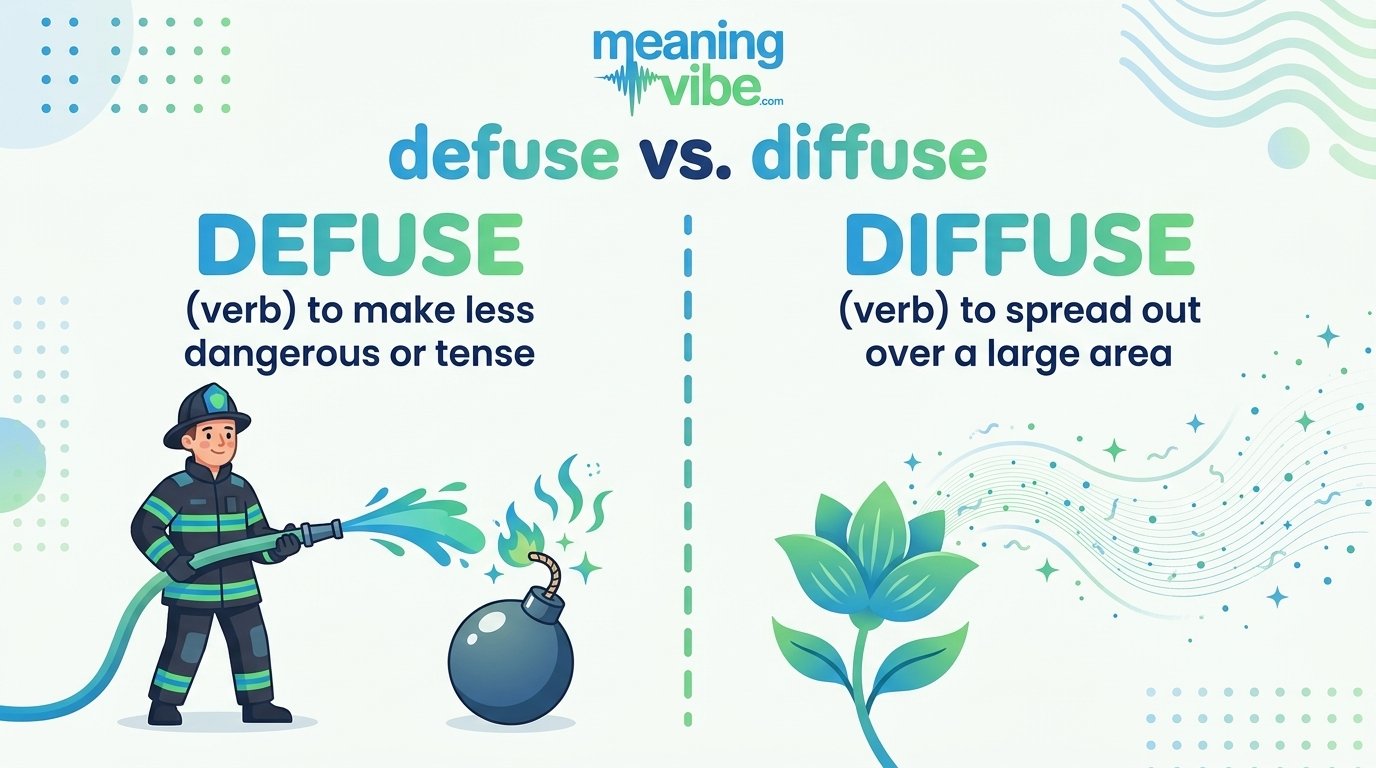
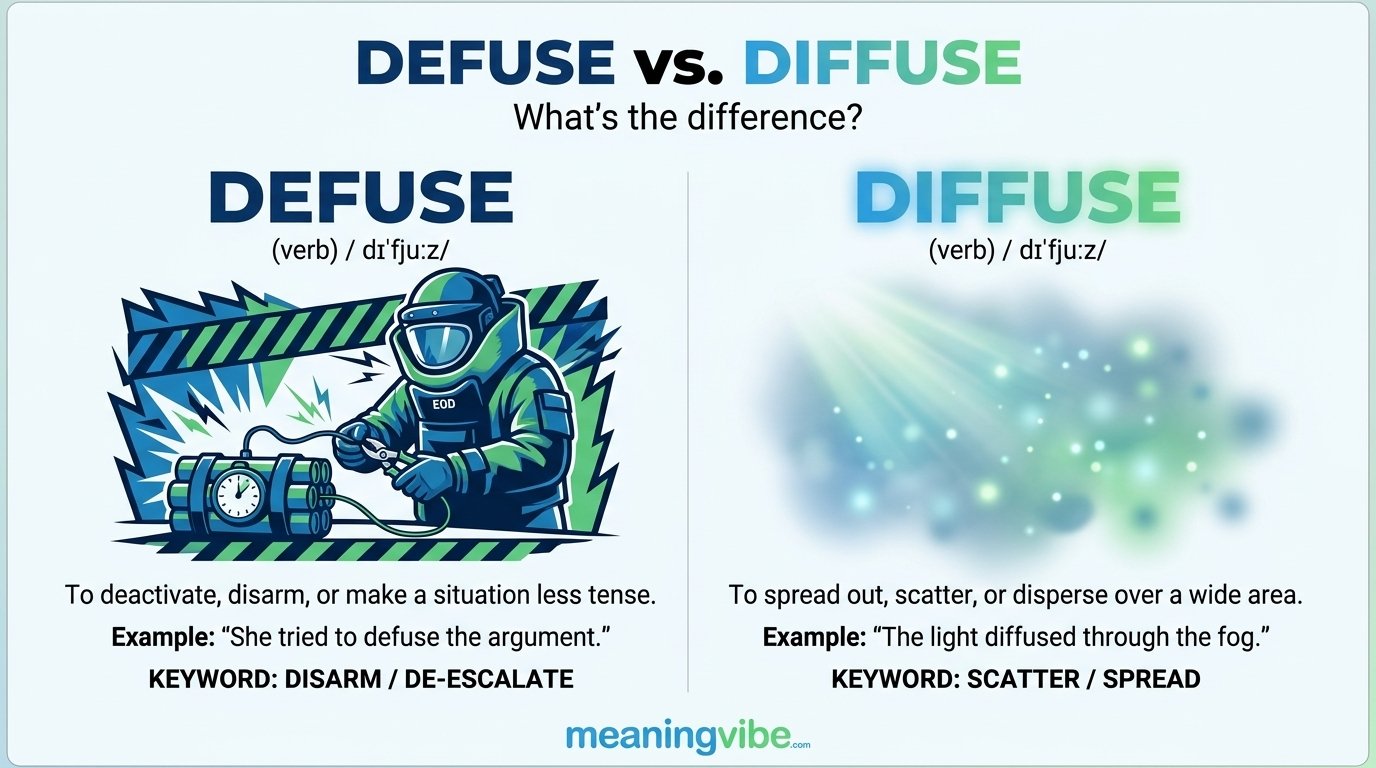
Defuse means to remove a fuse, make safe, or calm a tense situation. Diffuse means to spread out, scatter, or disperse, and as an adjective it means widely spread or wordy.
The fastest check uses two substitute phrases: make safe or calm for defuse, and spread for diffuse. If the substitute fits, the spelling follows.
Defuse vs Diffuse in One Line
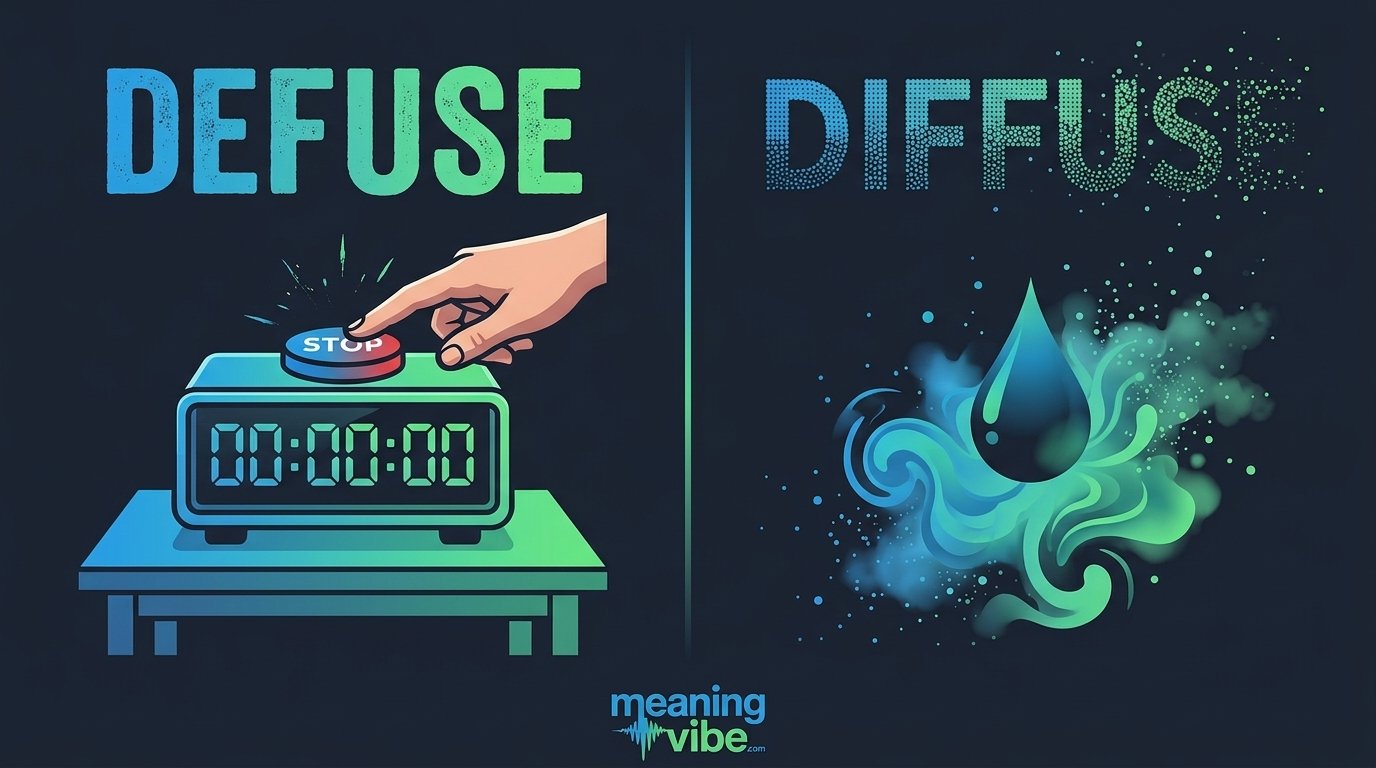
Defuse answers the question, “What removes danger or tension?” Diffuse answers the question, “What spreads outward and thins?”
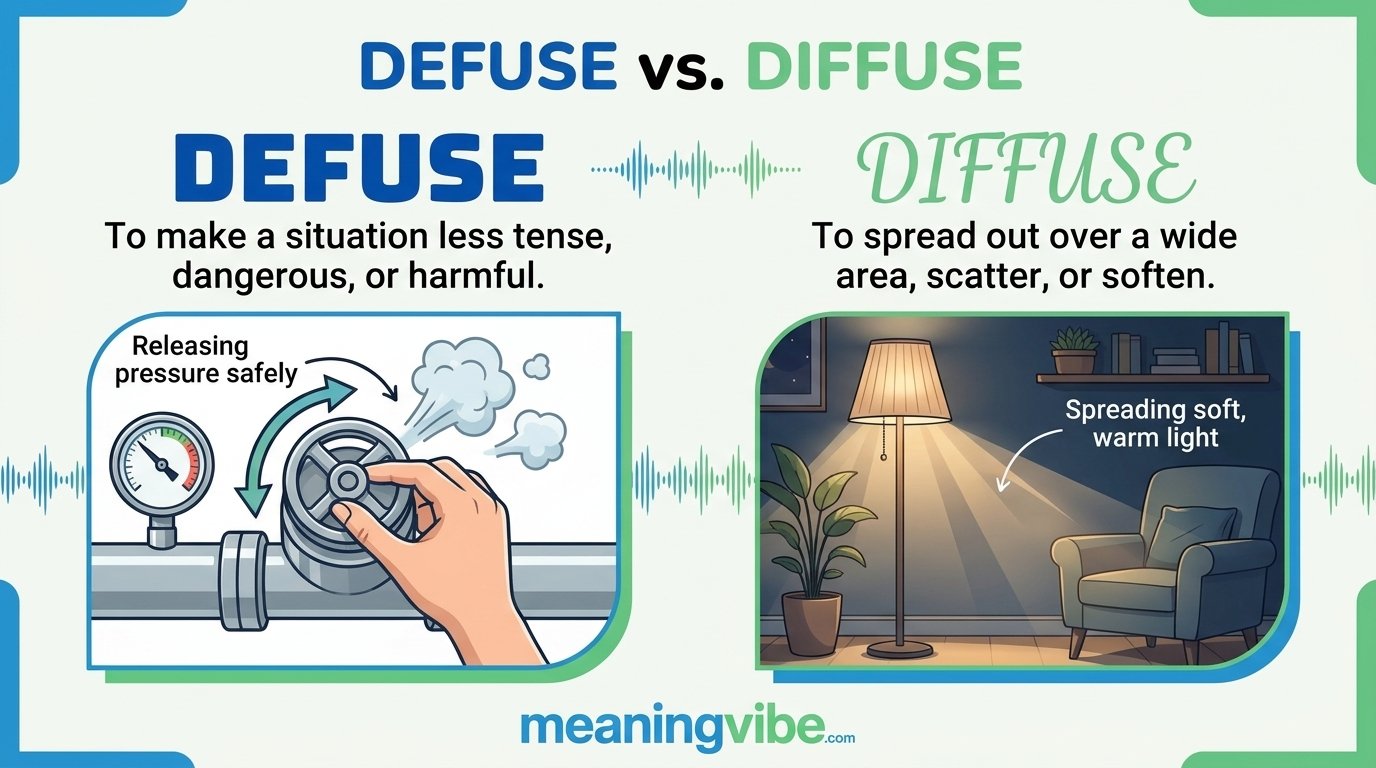
That split works for news, diplomacy, lighting, science, medicine, and writing. It also explains why “diffuse tension” fails as standard usage, even though it appears in some news copy.
| Word | Part of speech | Core meaning | Typical object |
| Defuse | Transitive verb only | Remove a fuse, make safe, calm | Bomb, crisis, tension, anger |
| Diffuse, verb | Verb | Spread, scatter, disseminate | Light, scent, smoke, information |
| Diffuse, adjective | Adjective | Widely spread, wordy | Diffuse light, diffuse pain, diffuse argument |
What Does Defuse Mean
Defuse is always a transitive verb, which means it needs an object. Someone defuses something, such as a bomb, a crisis, or an argument, and that object becomes safer or calmer.
Merriam-Webster defines defuse as removing the fuse from a mine or bomb, and as making something less harmful, potent, or tense. Those two senses, literal and figurative, cover almost every correct use.
Grammarphobia notes that defuse developed during World War II, with a first Oxford English Dictionary reference from 1943. The figurative sense followed in 1958, which shows how quickly a wartime word entered everyday speech.
Defuse Literally: Remove a Fuse
Literally, defuse means to remove or disable the fuse from an explosive device, so it cannot detonate. Police, military teams, and bomb squads are the usual subjects in news reports.
A headline might say, “Officers defused the device before it could explode.” That sentence uses defuse correctly, because a fuse and a danger are both present.
The word itself explains the action: de means remove, plus fuse, the trigger part. Merriam-Webster uses that same breakdown, comparing it to defanging, which means removing fangs.
Safety Note for Literal Bomb Examples
If you ever see a suspicious device, leave the area and contact authorities immediately. Do not touch the device, do not move it, and do not attempt any defusal yourself.
Word choice matters in safety writing, but safety action matters more. A correct sentence never replaces professional help, and no word explanation should suggest otherwise.
News writers should keep literal defuse for trained teams and official reports. Everyday writers should use figurative defuse for tension, and leave literal examples to professionals.
Defuse Figuratively: Calm a Tense Situation
Figuratively, defuse means to make a situation less dangerous, tense, or hostile. A mediator can defuse a dispute, a joke can defuse anger, and diplomacy can defuse a crisis.
The metaphor keeps the bomb image: a tense situation feels explosive, and calming it feels like removing its fuse. That image explains why defuse fits tension so naturally.
A secretary of state might work to defuse a regional crisis through talks. A manager might defuse a team row by listening first, then proposing a fair compromise.
Typical Objects of Defuse: Bomb, Crisis, Tension, Anger, Dispute
Defuse takes danger and tension objects, not spreading objects. Common objects include bomb, device, crisis, tension, anger, conflict, row, dispute, controversy, and backlash.
Jeremy Butterfield lists situation, crisis, tension, anger, conflict, and row as typical objects, and that list helps writers check their own sentences. If the object is not dangerous or tense, defuse probably fails.
A writer can defuse a controversy by publishing facts calmly, or defuse a backlash by changing a policy. In each case, the goal is safety and calm, not spreading.
What Does Diffuse Mean as a Verb
Diffuse as a verb means to spread, scatter, or pour out widely. Something can diffuse on its own, or someone can diffuse something through a space.
Merriam-Webster defines the verb as pouring out and permitting or causing something to spread freely, and as scattering. The Free Dictionary adds general physics senses, including undergoing diffusion.
That spreading idea appears in light, sound, heat, scent, smoke, gas, dye, rumours, and information. All of those things move outward from a source and become less concentrated.
Diffuse as Spread and Scatter
A scent can diffuse through a room after a door opens, while smoke can diffuse slowly across a hall. In both cases, particles move outward until they fill a wider area.
Rumours can diffuse across the internet, just as information can diffuse through a community. The spread may be fast or slow, but the direction is always outward.
A speaker’s voice can diffuse through an auditorium, reaching listeners in every corner. That use keeps the spreading idea, even though the thing spreading is sound, not a physical object.
Diffuse as Weaken by Scattering: Light, Scent, Sound
Diffuse can also mean to weaken or soften something by scattering it. Dirty window panes can diffuse sunlight into a murky haze, making light less harsh and less direct.
A lampshade can diffuse light throughout a room, softening shadows and reducing glare. A curtain can diffuse sound slightly, spreading it so no single point feels sharp.
That weakening happens because spreading thins something out. Light spread over a wide area feels softer, just as scent spread over a wide area smells fainter.
Diffuse in Science: Diffusion From High to Low Concentration
In science, diffusion is the passive movement of molecules from an area of high concentration to an area of low concentration. GetProofed uses dye in water as a clear example of that process.
When dye enters water, it diffuses until colour spreads evenly through the liquid. No stirring is needed for diffusion itself, although stirring can speed mixing by other means.
Gas diffuses through air in the same way, moving from a strong source toward weaker areas. That scientific sense keeps the core idea: outward movement until spread becomes even.
What Does Diffuse Mean as an Adjective
Diffuse as an adjective means widely spread, not concentrated, or not localised. It can also mean wordy or indirect when describing speech or writing.
Merriam-Webster lists the adjective sense as not concentrated or localised, with diffuse pain as a key example. The Free Dictionary adds a botany sense for loosely spreading growth, and a wordy sense for speech.
That adjective has no verb equivalent in defuse, which is why Grammarist stresses the rule: defuse never works as an adjective, while diffuse does. Only diffuse can describe a glow, a pain, or an argument directly.
Diffuse as Widely Spread: Light, Pain, Reflection
Diffuse light is soft light spread evenly, without harsh shadows or a single bright point. A frosted window creates diffuse light, while a bare bulb creates direct light.
Diffuse pain is pain spread over a wide area, not localised to one spot. Merriam-Webster explains that sense clearly, and medical writers use it to contrast with sharp, localised pain.
Diffuse reflection happens when light scatters in many directions from a rough surface. That contrast with specular reflection, which bounces cleanly, helps photographers and physicists describe surfaces precisely.
Diffuse as Wordy: Diffuse Argument, Diffuse Speech
A diffuse argument is one that spreads too widely, without focus or conciseness. GetProofed gives a diffuse speech example, where listeners fall asleep because points never land.
The Free Dictionary lists wordy and discursive speech as an adjective sense, with diffusely as the adverb and diffuseness as the noun. Those forms help writers critique style without using defuse by mistake.
A diffuse essay may contain good ideas, but they scatter across too many topics. A concise essay, by contrast, keeps ideas concentrated and easy to follow.
Diffuse Adjective Pronunciation: Final S, Not Z
The adjective diffuse is pronounced /dɪˈfjuːs/, with a final s sound, not a z sound. The verb diffuse is pronounced /dɪˈfjuːz/, with a final z sound.
The Free Dictionary notes that adjective pronunciation explicitly, and Quillbot provides separate audio files for verb and adjective forms. That final sound difference is small, but it marks a real grammar difference.
Learners should practise both forms aloud: “The light diffuses” with z, versus “a diffuse glow” with s. That pair teaches part of speech through sound as well as spelling.
Defuse vs Diffuse Comparison Table
| Feature | Defuse | Diffuse, verb | Diffuse, adjective |
| Part of speech | Transitive verb only | Verb | Adjective |
| Core idea | Remove danger, calm | Spread, scatter | Widely spread, wordy |
| Pronunciation | /diːˈfjuːz/ | /dɪˈfjuːz/ | /dɪˈfjuːs/ |
| Past form | Defused | Diffused | Not a verb form |
| Example | Defuse the crisis. | Light diffuses through glass. | A diffuse glow. |
| Wrong swap | Diffuse the crisis. | Defuse the light. | A defused glow. |
The table shows why defused versus diffused matters as well as defuse versus diffuse. Grammarist stresses that defused is correct for a bomb, while diffused is correct for spread light.
Pronunciation: Long E, Short I, and the Casual Merge
Pronunciation explains part of the confusion, because careful speech separates the words, while casual speech merges them. Learners should know both levels, not just one.
Defuse Verb: /diːˈfjuːz/
Defuse in careful speech is pronounced /diːˈfjuːz/, with a long ee sound in the first syllable. The Free Dictionary describes that long e as the sound in words like theme or discrete.
That long vowel matches the de prefix, which signals removal. Saying dee-fuse slowly helps learners hear the prefix and connect it to removing a fuse.
Diffuse Verb: /dɪˈfjuːz/
Diffuse as a verb in careful speech is pronounced /dɪˈfjuːz/, with a short i sound in the first syllable. The Free Dictionary compares that short i to words like rip or dip.
That short vowel matches the dif prefix, which signals apart or away. Saying dih-fuse slowly helps learners hear the difference from dee-fuse, even though the difference is subtle.
Diffuse Adjective: /dɪˈfjuːs/
Diffuse as an adjective is pronounced /dɪˈfjuːs/, with a short i and a final s sound. That final s distinguishes it from the verb form, which ends in z.
Quillbot notes separate audio for adjective and verb forms, which confirms that dictionaries treat them as distinct pronunciations. Writers who hear s should expect an adjective, not a verb.
In casual speech, both verbs often reduce to /dəˈfjuːz/, with a weak first vowel. The Free Dictionary notes that merge, which explains why spelling must rely on meaning, not sound alone.
Part of Speech Test
Part of speech gives a fast filter before meaning tests begin. If the grammar slot is wrong, the word is wrong, even if the letters look plausible.
Defuse Is a Transitive Verb Only
Defuse always takes an object, and it never works as an adjective or noun in standard use. Quillbot stresses that defuse always functions as a transitive verb meaning make safe or calmer.
A sentence like “The defuse bomb sat on the table” fails, because an adjective is needed there. The correct form is “The defused bomb sat on the table,” using the past participle as an adjective.
Similarly, “The defusing took a week” uses a gerund, which is a verb form acting as a noun. StartsWithY notes that gerund use, but it remains a verb form, not a separate noun entry.
Diffuse Is a Verb and an Adjective
Diffuse works as both a verb and an adjective, which makes it more flexible than defuse. As a verb, it spreads something; as an adjective, it describes something already spread.
“The light diffuses through glass” uses the verb, while “a diffuse glow fills the room” uses the adjective. Both sentences are correct, but they use different grammar and pronunciation.
That flexibility also creates errors, because writers may use diffuse where a verb like defuse is needed. Grammar alone cannot save a sentence when both words can fill a verb slot.
Defused Versus Diffused as Adjectives and Participles
Defused as a participle describes something made safe, as in a defused bomb or a defused crisis. Diffused as a participle describes something spread, as in diffused light or diffused scent.
Grammarist stresses that diffused is only necessary as a verb form, because the adjective is diffuse, not diffused. Writers should not write “a diffused glow” when they mean “a diffuse glow.”
That rule helps editors quickly: if the word describes a state of being spread, use diffuse; if it describes an action completed, use diffused for spreading or defused for calming.
The Substitution Test: Make Safe, or Spread
The substitution test works in two steps, and it handles almost every sentence in the pair. Replace the target word with a simple phrase, then read the sentence again.
Step 1, Try Make Safe or Calm
Replace the word with make safe or calm. If the sentence still makes sense, defuse is correct, because danger and tension are its core domains.
“They tried to make safe the hostage situation” works, just as “They tried to defuse the hostage situation” works. Linguix uses that exact hostage example as a wrong versus right pair.
Step 2, Try Spread
Replace the word with spread or scatter. If that version fits, diffuse is correct, because spreading is its core domain.
“The studio wanted to spread warm light across the set” works, just as “The studio wanted to diffuse warm light” works. Linguix uses that studio example as the opposite wrong versus right pair.
If neither substitute fits cleanly, the sentence may need rewriting. A vague sentence often hides the real meaning, and rewriting reveals whether danger or spreading is intended.
Etymology: Two Different Fuse Roots
Etymology proves that the pair shares letters, not meanings. Defuse and diffuse come from different roots, and those roots explain the modern split.
Defuse From De Plus Fuse, World War II, 1943
Defuse combines de, meaning remove or undo, with fuse, the trigger part of an explosive device. Merriam-Webster explains that breakdown plainly, and Grammarphobia dates the first Oxford reference to 1943.
That wartime origin fits the literal sense perfectly: removing a fuse makes a bomb harmless. The figurative sense followed in 1958, when writers applied the same image to crises and disputes.
Kirk Mahoney traces fuse to Italian fuso, meaning spindle, but that etymology should be checked against Oxford at writing time. The de plus fuse structure is stable, even if the deeper fuse history needs verification.
Diffuse From Latin Diffundere, to Pour Forth
Diffuse comes from Latin diffusus, the past participle of diffundere, meaning to pour forth or spread over. Merriam-Webster and The Free Dictionary both give that Latin root, with dis plus fundere, to pour.
Grammarphobia traces the adjective to around 1400, with an early sense of confused or indistinct, then the verb to pour out in the late 1500s. The widespread adjective sense followed in the early 1700s, as the reverse of confined or concentrated.
That long history explains why diffuse covers light, scent, information, and argument: all of those things pour forth and spread. The root is pouring, not removing a trigger.
Why the Shared FU Letters Do Not Mean Shared Meaning
Both words contain fu, but that overlap is accidental in modern English. Defuse uses fuse as a noun for a trigger, while diffuse uses fundere as a verb for pouring.
StartsWithY notes the spelling clue helpfully: defuse has one f, while diffuse has two f letters. That visual clue helps memory, but it does not prove a shared root.
Writers should treat the pair as false friends, not as cousins. Shared letters can mislead, while shared meaning would require a shared root, which this pair lacks.
Verb Forms and Related Forms Table
| Base word | Third person | Past tense | Present participle | Related noun |
| Defuse | Defuses | Defused | Defusing | Defusing, gerund only |
| Diffuse, verb | Diffuses | Diffused | Diffusing | Diffusion |
| Diffuse, adjective | Not a verb | Not a verb | Not a verb | Diffuseness |
“She defused the quarrel quickly” uses the past form for calming, while “Warm air diffused through the hall” uses the past form for spreading. StartsWithY gives both patterns in its forms table.
Diffusion is the science noun for the spreading process, while diffuser names a device that spreads light, scent, or air. Those related nouns belong to diffuse, never to defuse.
Defuse vs Diffuse in Context
Context turns abstract definitions into usable decisions. Four settings cover almost every real example a learner will meet, from newsrooms to laboratories.
News, Diplomacy, and Conflict
In news and diplomacy, defuse dominates, because crises, tensions, and disputes need calming. A diplomat works to defuse tensions between countries, while a mediator works to defuse a workplace row.
Merriam-Webster recent examples show that pattern clearly: envoys help defuse tensions, messages seek to defuse controversy, and efforts aim to defuse backlash. All of those objects are dangerous or tense.
Journalists must avoid writing “diffuse the situation” for those cases, even though Grammarist found that error in real news copy. Style guides treat defuse as the only correct choice for tension.
Lighting, Photography, and Sound
In lighting and photography, diffuse dominates, because light and sound need spreading and softening. A photographer uses a diffuser to create diffuse light, reducing harsh shadows on a face.
A lampshade diffuses light throughout a room, while a curtain diffuses sound slightly across a hall. Both uses keep the spreading idea, with softening as a welcome side effect.
A studio that wanted to defuse warm light would be using the wrong word, as Linguix shows. Light has no fuse to remove, so diffuse is the only correct choice there.
Science, Medicine, and Everyday Spread
In science, diffuse describes molecules, gases, dyes, and heat moving outward. A dye diffuses in water, a gas diffuses through air, and heat diffuses from a radiator through a room.
In medicine, diffuse pain means pain spread over a wide area, not localised to one spot. That wording helps clinicians describe symptoms, but it remains general information, not medical advice for any reader.
In everyday life, scent diffuses from flowers, smoke diffuses from a fire, and rumours diffuse through a school. All of those spreads happen without anyone removing a fuse.
Writing and Argument: Diffuse Versus Concise
In writing, a diffuse argument spreads too widely and loses focus. Editors may call a speech diffuse when points wander, repeat, or fail to land in a clear order.
That critique uses the adjective sense, not the verb sense. A writer does not defuse an argument by making it wordy; a writer makes an argument diffuse by spreading it too thin.
Concise writing, by contrast, keeps ideas concentrated and easy to follow. The opposite of diffuse in this sense is focused, tight, or concentrated, not defuse.
The Contested Case: Diffuse Tension
“Diffuse tension” appears often enough that learners ask whether it might be correct. The answer needs nuance, not a simple yes or no, because usage and style guides differ.
Prescriptive Standard: Defuse Tension
The prescriptive standard, used by most grammar and style resources, is clear: use defuse for tension, crisis, anger, and dispute. The Free Dictionary states that defuse will always be correct for making situations less tense, hostile, or dangerous.
That standard rests on meaning, not habit. Tension does not spread thinly like light; tension gets removed, calmed, or lessened, which matches defuse, not diffuse.
Teachers, editors, and exam markers should teach defuse tension as the standard form. Students who write diffuse tension in exams risk losing marks, even if they have seen the phrase online.
Why Diffuse Tension Appears in News Writing
Diffuse tension appears in news writing because diffuse can mean weaken by scattering, and tension weakening feels similar to light softening. Daily Writing Tips notes that softening link as a likely cause of the error.

Grammarist found real examples in news copy, including attempts to diffuse a bomb and diffuse a situation. Those examples show how widespread the error has become, not that it has become standard.
The Free Dictionary notes that some sources even consider diffuse tension correct, because the usage is so widespread. That descriptive note matters, but it does not override the prescriptive standard for careful writing.
Safe Rewrites: Ease, Calm, Soothe, Mitigate, Reduce
When a sentence feels ambiguous, rewrite it with a clearer verb. Daily Writing Tips lists ease, calm, soothe, mitigate, palliate, moderate, reduce, and lighten as safe alternatives.
“They worked to ease tensions” avoids the pair entirely, while “They worked to defuse tensions” uses the standard form. Both sentences are clear, and neither risks a contested usage mark.
Writers who quote a source that says diffuse tension should keep the quote exact, but add a note that standard usage prefers defuse. Quoting does not make a contested form standard.
Traps to Avoid: Infuse, Fuze, De-fuse, Diff Use
Four nearby traps catch even careful writers, because they share letters, sounds, or devices with the pair. Each trap needs a one-line rule to prevent confusion.
Diffuse Versus Infuse: Outward Versus Inward
Diffuse means outward movement, while infuse means inward movement. Merriam-Webster explains that contrast in its diffuse FAQ, with infuse meaning to steep, inject, or permeate with a quality.
Tea leaves infuse water by giving flavour inward to the liquid, while scent diffuses outward from flowers into a room. Direction decides: outward is diffuse, inward is infuse.
A writer who says “flavour diffuses into tea” may be understood, but “flavour infuses tea” is more precise. Direction, not just spreading, should guide that choice.
Fuse Versus Fuze: Check Military Spelling
Military sources sometimes spell the detonator device as fuze, while general English uses fuse for electrical fuses and bomb fuses. Writers should check a current dictionary or house style before using fuze in a military report.
That spelling trap does not change defuse, which keeps its standard spelling in both general and military writing. Do not invent defuze as a variant, because no dictionary lists it as standard.
If a quoted military source uses fuze, keep the quote exact, but use defuse in your own prose. Quoted spelling and author spelling can differ without creating an error.
De-fuse and Diff Use: Hyphen and Spacing Errors
Defuse is one word, with no hyphen, so de-fuse is incorrect in standard writing. Linguix lists that hyphenation trap explicitly, along with OCR errors that split words.
Diffuse is also one word, with no space, so diff use is incorrect. Spellcheckers often miss meaning errors, so writers must check context themselves, not rely on red underlines alone.
Context-aware grammar checks can help, but they cannot replace a meaning test. A spellchecker accepts both defuse and diffuse as real words, so it will not flag a swap.
Wrong Examples Corrected
Wrong examples teach faster than rules alone, because learners see the error and the fix side by side. Each row below keeps the same sentence structure, with only the target word changed.
| Wrong sentence | Correct sentence | Why it changes |
| They tried to diffuse the hostage situation. | They tried to defuse the hostage situation. | Danger needs defuse. |
| The studio wanted to defuse warm light. | The studio wanted to diffuse warm light. | Spreading light needs diffuse. |
| Police tried to diffuse the bomb. | Police tried to defuse the bomb. | A fuse needs defuse. |
| The scent defused through the room. | The scent diffused through the room. | Spreading scent needs diffuse. |
| She tried to diffuse the argument. | She tried to defuse the argument. | Calming needs defuse. |
| The lampshade defused the light. | The lampshade diffused the light. | Softening light needs diffuse. |
| His joke diffused the tension. | His joke defused the tension. | Calming tension needs defuse. |
| Rumours defused across the internet. | Rumours diffused across the internet. | Spreading rumours needs diffuse. |
| A defused glow filled the room. | A diffuse glow filled the room. | Adjective state needs diffuse. |
| The diffused bomb sat on the table. | The defused bomb sat on the table. | Made safe needs defused. |
Grammarist, Linguix, and Art of Grammar all use wrong and corrected pairs, and that format works well for learners. The key is to keep the rest of the sentence identical, so only the target word carries the lesson.
Memory Tricks That Actually Work
Memory tricks help only when they connect to meaning, spelling, or sound. The best tricks use a short phrase that survives under exam pressure.
De Means Remove, So Defuse Removes a Fuse
De often means remove or undo, as in deactivate, defrost, and defuse. If the sentence involves removing danger, defuse fits that prefix pattern.
Think “de-fuse removes the fuse,” and the literal sense becomes obvious. That prefix link also helps the figurative sense, where tension feels like a fuse waiting to blow.
Use the prefix trick as a first check, then run the substitution test as well. Prefix helps spelling, while substitution helps meaning, and both checks together catch most errors.
Dif Means Apart, So Diffuse Spreads Apart
Dif often means apart or away, as in diffuse, differ, and disperse. If the sentence involves spreading apart, diffuse fits that prefix pattern.
Kirk Mahoney uses that dif apart link as his main solution, and it works well for light, scent, and information. Things that spread apart become diffuse, not defuse.
That trick also explains diffusion in science: molecules move apart from a concentrated source toward weaker areas. Prefix, science, and everyday use all point the same way.
One F for Fuse, Two Fs for Far Spread, as a Mnemonic Only
Defuse has one f, while diffuse has two f letters. StartsWithY notes that spelling clue, and learners can link two f letters to far spread, as a mnemonic only.
That mnemonic is not etymology, but it helps visual learners remember the longer word for the wider action. A longer word for a wider spread feels intuitive, even if the history differs.
A simple chant helps younger learners: “Defuse danger, diffuse light.” Short, rhythmic rules stick better than long definitions during tests.
Quiz: Defuse or Diffuse, With Explanations
Choose defuse or diffuse for each blank, then check the answer and reason. Each explanation restates the make safe or spread rule in one line.
- Negotiators worked to ______ the crisis. Answer: defuse. Calming a crisis needs defuse.
- Sunlight ______ through the frosted window. Answer: diffused. Spreading light needs diffuse.
- Police ______ the suspicious device safely. Answer: defused. Making a device safe needs defuse.
- The scent of flowers ______ through the hall. Answer: diffused. Spreading scent needs diffuse.
- Her joke ______ the tension in the room. Answer: defused. Calming tension needs defuse.
- Rumours ______ quickly across social media. Answer: diffused. Spreading rumours needs diffuse.
- A ______ glow filled the studio. Answer: diffuse. Adjective state of spread light needs diffuse.
- The ______ bomb was taken away for study. Answer: defused. Made safe needs defused.
- Dye ______ in water until colour spread evenly. Answer: diffused. Science spreading needs diffuse.
- Diplomats hoped to ______ anger before talks failed. Answer: defuse. Calming anger needs defuse.
A score of eight or more shows a solid grasp of the pair. A lower score usually means tension examples need extra practice, not light or scent examples.
Common Mistakes to Avoid
- Using diffuse for a bomb. A bomb has a fuse to remove, so defuse is correct, never diffuse.
- Using diffuse for tension. Tension needs calming, so defuse is the standard form, even if diffuse appears online.
- Using defuse for light. Light has no fuse to remove, so diffuse is correct for spreading and softening light.
- Using defuse for scent. Scent spreads outward, so diffuse is correct, never defuse.
- Using diffused for a diffuse glow. The adjective is diffuse, while diffused is a verb form for spreading action.
- Using defused for spread light. Made safe needs defused, while spread light needs diffused or diffuse.
- Writing de-fuse with a hyphen. Defuse is one word, with no hyphen, in standard writing.
- Writing diff use with a space. Diffuse is one word, with no space, in standard writing.
- Treating diffuse as a synonym of defuse. Some low authority synonym lists make that error, but dictionaries keep the meanings separate.
- Relying on sound alone. Careful speech separates long e and short i, but casual speech merges them, so meaning must decide.
Tips for Writers, Teachers, and Learners
- Run the substitution test first. Try make safe or calm and spread, and keep the version that still makes sense.
- Check the object second. Danger and tension objects need defuse, while light, scent, and information objects need diffuse.
- Teach the adjective separately. Spend one lesson on diffuse light, diffuse pain, and diffuse argument, because that sense surprises learners.
- Teach pronunciation separately. Practise dee-fuse, dih-fuse verb, and dih-fuse adjective with final s, so sound supports grammar.
- Use real news examples. Show a crisis defused by talks, and a rumour diffused online, so contrast stays visible.
- Use real lighting examples. Show a diffuser creating diffuse light, so learners meet diffuse in its natural home.
- Practise with paired sentences. Write one danger sentence and one spreading sentence together, so contrast stays visible.
- Label contested usage clearly. Teach defuse tension as standard, and note diffuse tension as contested, not correct.
- Proofread with meaning in mind. Reading aloud helps rhythm, but only a meaning check catches a swapped defuse and diffuse.
- Keep a personal error list. Note each real mistake once, with its correction, and review that list before exams or important drafts.
FAQs
What is the difference between defuse and diffuse?
Defuse means make safe or calm, while diffuse means spread out. Defuse takes danger objects, while diffuse takes spreading objects.
Is it defuse or diffuse a bomb?
Use defuse for a bomb, because a bomb has a fuse to remove. Trained teams defuse devices, and readers should contact authorities, not attempt defusal.
Is it defuse or diffuse a tense situation?
Use defuse for a tense situation, because tension needs calming. Diffuse would wrongly suggest the situation spreads outward like light.
Can you diffuse tension?
In standard usage, no, use defuse tension. Some sources note diffuse tension as widespread usage, but most grammar resources do not accept it as standard.
What does defuse mean?
Defuse means to remove a fuse from an explosive device, or to make something less harmful, potent, or tense. Merriam-Webster gives both senses plainly.
What does diffuse mean as a verb?
Diffuse as a verb means to spread, scatter, or pour out widely. Light, scent, smoke, heat, rumours, and information can all diffuse.
What does diffuse mean as an adjective?
Diffuse as an adjective means widely spread, not concentrated, or wordy. Examples include diffuse light, diffuse pain, and a diffuse argument.
How do you pronounce defuse?
Defuse in careful speech is /diːˈfjuːz/, with a long ee sound. That long vowel matches the de prefix for removal.
How do you pronounce diffuse as a verb?
Diffuse as a verb is /dɪˈfjuːz/, with a short i and a final z sound. Casual speech often merges it with defuse, so meaning must decide spelling.
How do you pronounce diffuse as an adjective?
Diffuse as an adjective is /dɪˈfjuːs/, with a short i and a final s sound. That final s distinguishes it from the verb form.
What is the past tense of defuse?
The past tense is defused, as in “She defused the quarrel quickly.” That form also works as a participle for a made safe object.
What is the past tense of diffuse?
The past tense is diffused, as in “Warm air diffused through the hall.” That form describes spreading action, not a made safe object.
What does diffuse light mean?
Diffuse light means soft light spread evenly, without harsh shadows. Frosted glass, lampshades, and clouds all create diffuse light.
What does diffuse pain mean?
Diffuse pain means pain spread over a wide area, not localised to one spot. That wording is general information only, not medical advice.
What does diffuse argument mean?
A diffuse argument means a wordy, unfocused argument that spreads too widely. Concise writing keeps ideas concentrated instead.
What is the difference between diffuse and infuse?
Diffuse means outward movement, while infuse means inward movement. Scent diffuses outward, while flavour infuses tea inward.
What objects can you defuse?
You can defuse a bomb, device, crisis, tension, anger, conflict, row, dispute, controversy, or backlash. All of those objects involve danger or tension.
What objects can you diffuse?
You can diffuse light, sound, heat, scent, smoke, gas, dye, rumours, information, and culture. All of those objects can spread outward.
How can I remember defuse versus diffuse?
Use two links: de means remove, so defuse removes a fuse, while dif means apart, so diffuse spreads apart. Then run the substitution test.
What is the most common defuse versus diffuse mistake?
The most common mistake is writing diffuse for tension, crisis, or a bomb. A meaning check, not a sound check, prevents that error.
Conclusion
Defuse vs diffuse becomes easy once safety and spreading are kept apart. Defuse removes a fuse, calms tension, and makes danger safer, while diffuse spreads light, scent, information, and ideas outward.
Keep the two tests close: make safe or calm for defuse, and spread for diffuse. Add the adjective rule, diffuse light with final s, and most errors disappear.
Try the test on your next doubtful sentence, and let meaning, not sound, settle the spelling before you move on.