

Emigrate vs immigrate confuses many writers because both words describe the same move from different viewpoints. One word stresses leaving a country, while the other stresses entering a new one. Perspective decides the choice in almost every sentence.
Perspective matters more than spelling here, because both spellings are correct words. A writer who chooses by sound or habit can reverse the focus of a sentence without noticing. Reading for perspective prevents that reversal.
Preposition gives a second clue after perspective has pointed one way. Emigrate pairs naturally with from, naming the country left behind. Immigrate pairs naturally with to, naming the country entered.
Same person, same move can carry both labels without contradiction in different sentences. A woman who left Mexico for Canada is an emigrant from Mexico and an immigrant to Canada. Origin and destination simply change the label.
Formal writing raises the stakes for this small perspective difference. Academic essays, news reports, legal notes, and family histories all lose clarity when departure becomes arrival by accident. Precision protects meaning in each setting.
Table of Contents
ToggleThe Difference in One Line
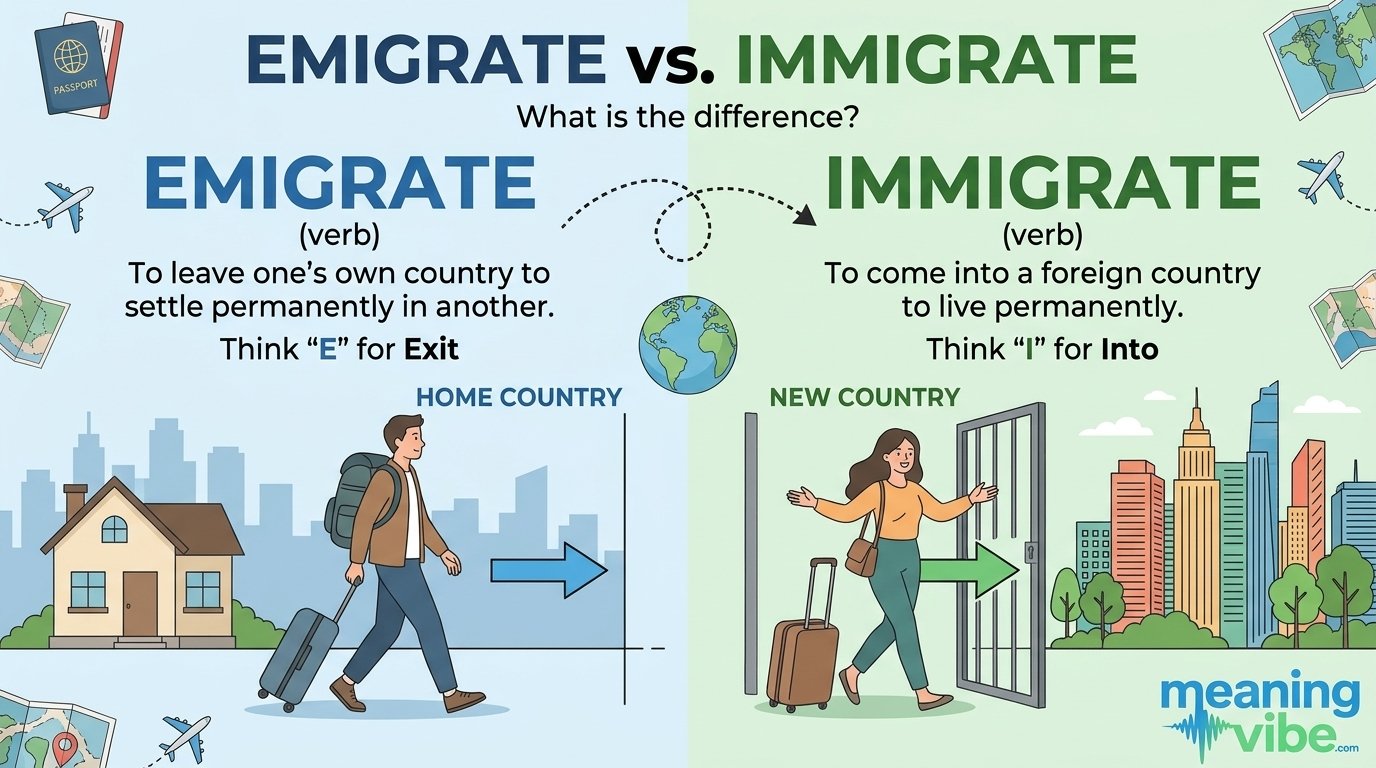
Emigrate means to leave a country or place of residence to live elsewhere. Immigrate means to enter a country, usually one where a person was not born, to live there. Leaving versus entering sums up the pair.
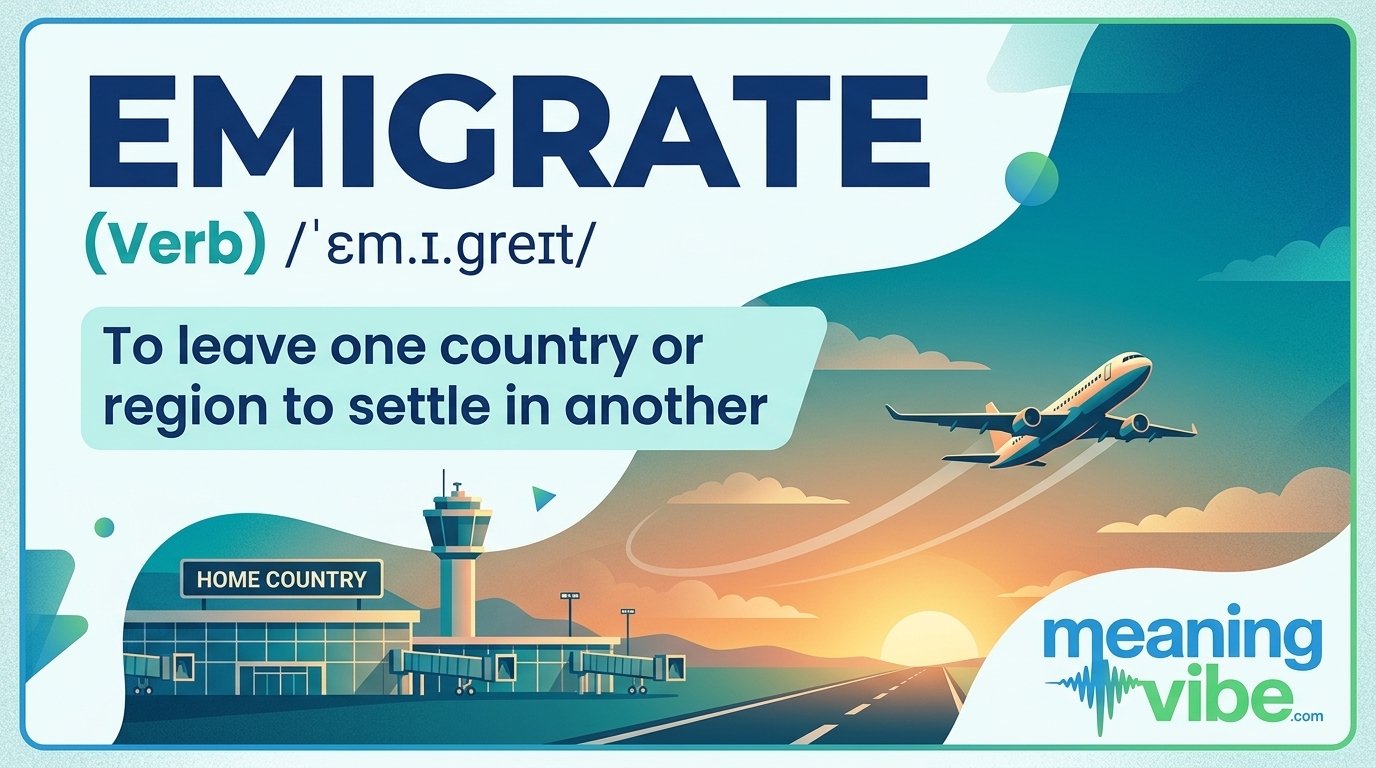
Focus explains the difference better than a list of synonyms alone. Emigrate focuses on the departure point, the country a person leaves. Immigrate focuses on the arrival point, the country a person enters and settles in.
Camera angle helps writers picture perspective before choosing a word. Imagine a camera in the old country watching someone leave, and emigrate fits that scene. Imagine a camera in the new country watching someone arrive, and immigrate fits that scene.
Combined sentences prove that both words can describe one journey without conflict. Maria emigrated from Mexico and immigrated to Canada in a single, clear sentence. Each verb keeps its own focus there.
Perspective also explains why immigrant appears more often than emigrant in news writing. Destination countries often dominate a story, so arrival language naturally takes the lead. Frequency alone never makes immigrate correct for a departure sentence.
Leaving or Entering Test in Brief
Step one finds the country that the sentence puts in focus. Ask whether the sentence cares more about the place left or the place entered. Focus answers that question before grammar does.
Step two matches leaving with emigrate and entering with immigrate in one move. Leaving points to emigrate from, entering points to immigrate to. Matching first prevents preposition errors later.
Step three checks the preposition that follows the verb in the draft. From after emigrate and to after immigrate confirm the standard modern pattern. A mismatch signals a sentence to revise or rethink.
Step four checks the person noun when a noun appears instead of a verb. Emigrant names a person leaving, immigrant names a person entering and settling. Person nouns follow the same perspective rule as verbs.
Step five reads the corrected sentence for logic from a fresh reader perspective. Ask whether the sentence claims someone left or arrived in a way that matches intent. Logic failure after correction means another revision remains.
What Emigrate Means
Emigrate is a verb meaning to leave a place of residence or country to live elsewhere. Merriam-Webster gives that definition plainly, with leaving as the central action. Settlement elsewhere follows departure, but departure leads the meaning.
Emigrate stresses departure rather than arrival, even when a destination appears later in the sentence. “She emigrated from Brazil to Portugal” still stresses Brazil as the starting point. Destination adds detail without changing focus.
Emigrate usually pairs with from in standard modern writing for that reason. Writers say emigrated from Ireland, emigrated from Germany, and emigrated from Mexico. From names the origin directly and clearly.
Emigrate does not require a destination in every sentence to work grammatically. “Many citizens chose to emigrate” stands alone when context already supplies the reason. Destination can stay implied when departure matters most.
Emigrate covers people leaving a country, region, or place of residence in dictionary use. Most examples involve countries, yet a person can emigrate from a region to settle elsewhere. Country remains the most common context by far.
Emigrate in Plain Language
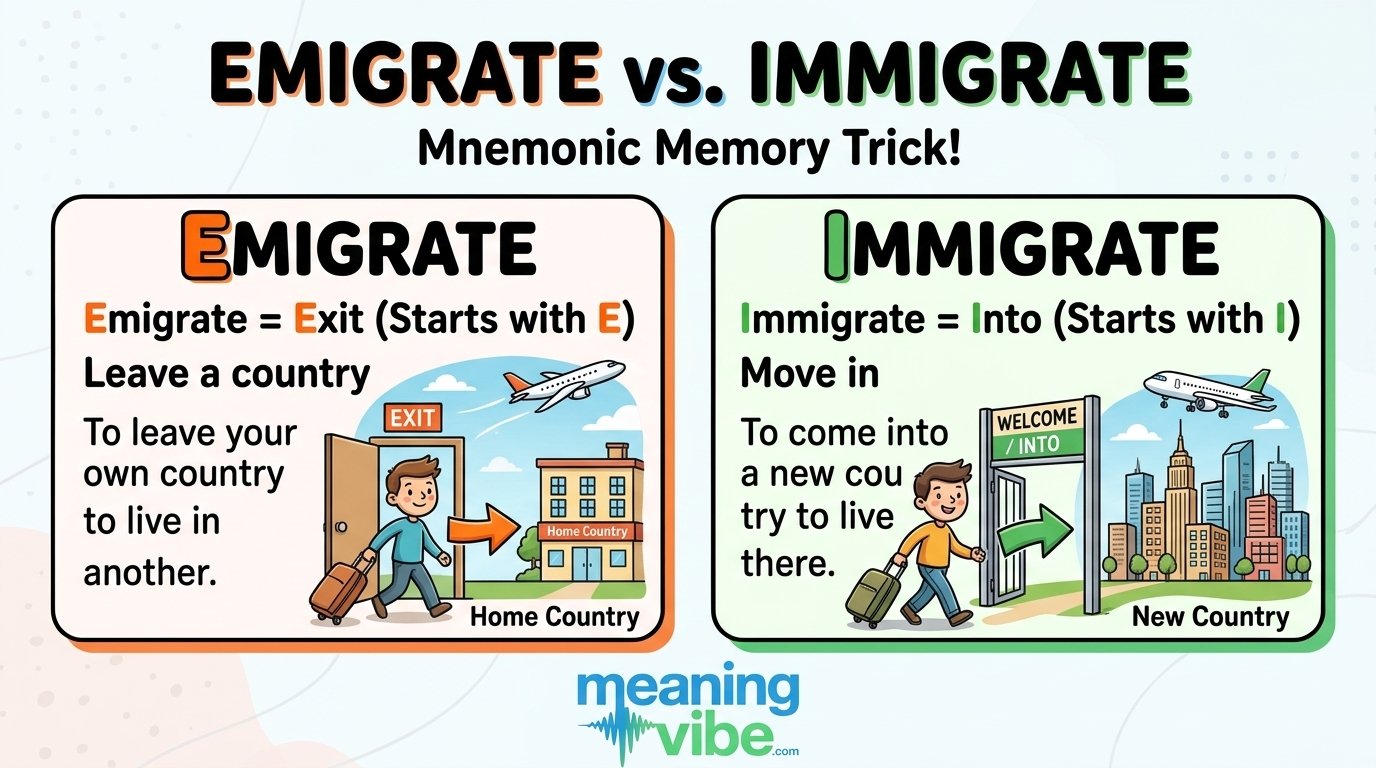
Think of emigrate as exit language for a move between countries. Exit starts with e, just as emigrate starts with e, and that link helps memory. Exit captures departure without adding legal meaning.
Think of a departure scene whenever emigrate appears in a sentence. Family members wave goodbye, luggage leaves a home, and a border crossing begins a new chapter. Departure imagery keeps focus on leaving.
Think of origin records whenever emigrate appears in history or genealogy writing. Origin archives list people as emigrants from a town, region, or country. Origin perspective shapes those records naturally.
Think of push factors whenever emigrate appears in policy or demographic writing. War, famine, unemployment, and political pressure can prompt emigration from a country. Push factors explain why people leave, not where they arrive.
Think of permanence carefully, because emigrate often implies settling elsewhere, not a short trip. A holiday abroad does not count as emigrating, even when a border is crossed. Settlement intent separates emigration from travel.
Verb Forms of Emigrate
Verb forms follow a regular pattern, which removes one common source of doubt. Present forms are emigrate and emigrates, past forms are emigrated, and the present participle is emigrating. No irregular spelling change interrupts the pattern.
Third person singular adds a simple s in present tense writing. She emigrates for work, he emigrates with family, and the family emigrates after careful planning. Subject and verb agreement still applies in every sentence.
Past tense and past participle share the same form, emigrated, in standard use. The family emigrated from Nigeria when the children were young, and they have emigrated since that year. Context shows tense, not a different spelling.

Present participle works as a verb form and as a gerund in different sentence roles. The family is emigrating this year, while emigrating for work remains a difficult decision. Neither use turns emigrating into a noun for the process itself.
Passive voice keeps emigrate as a verb even when the subject changes. Departure was prompted by emigration is awkward, so active voice usually reads better for this verb. Clear writers prefer “They emigrated” over convoluted passive forms.
| Form | Example |
|---|---|
| emigrate | They plan to emigrate next year. |
| emigrates | She emigrates for a new job. |
| emigrating | He is emigrating with his family. |
| emigrated | They emigrated from Ireland in the 1990s. |
| have emigrated | Many workers have emigrated since the crisis. |
Misspelling warning helps learners who add an extra m by habit. Emmigrate is incorrect, and the correct spelling always uses one m after e. Checking the first letters prevents a repeated error.
Emigrant and Emigration
Emigrant names a person who leaves a country of residence to live elsewhere. Merriam-Webster defines emigrant as one who leaves a place of residence or country to live elsewhere. Person identity follows departure perspective there.
Emigration names the process of leaving a country to live in another. A wave of emigration from a region describes many departures together, not one arrival. Process identity follows the same departure focus.
Emigrant versus immigrant depends entirely on which country frames the person. The same woman is an emigrant from Spain in Spanish records and an immigrant to Chile in Chilean records. Records change labels because perspective changes.
Emigration in policy writing often appears with rates, waves, and causes rather than individual stories. High emigration can strain a home country workforce, while low emigration may signal stability. Policy language needs that process noun for trends.
Emigre adds a related but distinct noun for some contexts, especially political exile. An emigre usually left for political reasons and carries a more specific, often literary, tone. Emigrant remains the neutral general term for most writing.
Mass emigration describes a large number of people leaving at roughly the same time. War, famine, economic collapse, or opportunity can trigger mass emigration from a region. Scale, not individual motive alone, defines that phrase.
What Immigrate Means
Immigrate is a verb meaning to enter and usually become established in a new country. Merriam-Webster adds the key detail: a country of which a person is not a native, for permanent residence. Entering and settling lead the meaning.
Immigrate stresses arrival rather than departure, even when an origin appears later in the sentence. “She immigrated to Canada from Mexico” still stresses Canada as the destination. Origin adds detail without changing focus.
Immigrate usually pairs with to in standard modern writing for that reason. Writers say immigrated to Australia, immigrated to France, and immigrated to the United States. To names the destination directly and clearly.
Immigrate does not require an origin in every sentence to work grammatically. “Many families immigrated for a better life” stands alone when context already supplies the destination. Arrival can stay implied when settlement matters most.
Immigrate covers people entering a country to live there, often with establishment over time. A visitor on a short trip does not immigrate by crossing a border alone. Settlement intent separates immigration from travel.
Immigrate in Plain Language
Think of immigrate as entry language for a move between countries. In starts with i, just as immigrate starts with i, and that link helps memory. Entry captures arrival without adding legal meaning.
Think of an arrival scene whenever immigrate appears in a sentence. Newcomers settle in a neighborhood, learn local customs, and build community ties over time. Arrival imagery keeps focus on entering and settling.
Think of destination records whenever immigrate appears in history or genealogy writing. Destination archives list people as immigrants to a city, region, or country. Destination perspective shapes those records naturally.
Think of pull factors whenever immigrate appears in policy or demographic writing. Jobs, safety, family reunion, and education can pull people toward a destination country. Pull factors explain why people choose a place, not why they leave.
Think of establishment carefully, because immigrate often implies becoming settled, not merely arriving. A newcomer immigrates when residence, work, schooling, or community life takes root. Establishment takes time after arrival itself.
Verb Forms of Immigrate
Verb forms follow a regular pattern, parallel to emigrate in every tense. Present forms are immigrate and immigrates, past forms are immigrated, and the present participle is immigrating. Parallel forms help learners remember both verbs together.
Third person singular adds a simple s in present tense writing. She immigrates for study, he immigrates with family, and the family immigrates after careful planning. Subject and verb agreement still applies in every sentence.
Past tense and past participle share the same form, immigrated, in standard use. The family immigrated to the United States when the children were young, and they have immigrated since that year. Context shows tense, not a different spelling.
Present participle works as a verb form and as a gerund in different sentence roles. The family is immigrating this year, while immigrating for work remains a difficult decision. Neither use turns immigrating into a noun for the process itself.
Transitive sense deserves a brief note for advanced readers checking dictionary entries. Merriam-Webster also lists immigrate as transitive meaning to bring in or send as immigrants, as in a program immigrating workers. Main use remains intransitive, entering a country oneself.
| Form | Example |
|---|---|
| immigrate | They plan to immigrate next year. |
| immigrates | She immigrates for a new job. |
| immigrating | He is immigrating with his family. |
| immigrated | They immigrated to Canada in the 1990s. |
| have immigrated | Many workers have immigrated since the crisis. |
Misspelling warning helps learners who confuse immigrant spelling with immigration spelling. Immigrate ends with ate as a verb, while immigration ends with tion as a process noun. Form and ending must match the job.
Immigrant and Immigration
Immigrant names a person who enters a new country intending to live there permanently. Destination perspective defines immigrant, just as origin perspective defines emigrant for the same person. Label changes with framing country.
Immigration names the process of entering a country to live there permanently. A wave of immigration to a country describes many arrivals together, not one departure. Process identity follows the same arrival focus.
Immigrant community language appears often in news, policy, and city writing. An immigrant community in a city consists of people who arrived from many countries and settled locally. Community identity follows destination, not origin alone.
Immigration in policy writing often appears with laws, bills, quotas, and programs rather than individual stories. An immigration bill that allows more skilled workers to enter a country stresses destination policy. Policy language needs that process noun for systems.
Immigration versus emigration in a single country report can confuse readers without perspective labels. High immigration to a country and high emigration from a neighboring country may describe overlapping moves. Labels must name the country in focus each time.
Immigrant as an adjective also appears before nouns such as community, family, and worker in modern writing. Immigrant workers means workers who immigrated, not workers who are leaving. Adjective use still follows destination perspective.
Master Word-Family Table
One table answers the pair faster than separate definitions scattered across a page. Keep this table near the top of any reference section for quick checking. Readers return to it during editing.
| Word | Job | Focus | Typical preposition | Example |
|---|---|---|---|---|
| emigrate | Verb | Leaving | from | They emigrated from Ireland. |
| emigrant | Person noun | Leaving | from | He is an emigrant from Spain. |
| emigration | Process noun | Leaving | from | Emigration from Mexico increased. |
| immigrate | Verb | Entering and settling | to | They immigrated to Canada. |
| immigrant | Person noun | Entering and settling | to | She is an immigrant to Chile. |
| immigration | Process noun | Entering and settling | to | Immigration to the United States rose. |
| migrate | Verb, neutral | Moving, general | to, from, between | Workers migrate between regions. |
| migrant | Person noun, neutral | Moving, often regular | to, from, between | Seasonal migrants follow harvest work. |
| migration | Process noun, neutral | Moving, general | to, from, between | Migration shapes regional labour markets. |
Table use during editing follows a simple habit for busy writers. Find the target word, check its focus in the table, and compare that focus with the sentence. Mismatch means the word or preposition must change.
Table limits matter for historical sentences and combined sentences that mix both words. A combined sentence can contain emigrated from and immigrated to at once, each passing its own test. Each word still passes separately there.
Pronunciation and Etymology
Pronunciation differs slightly between the two words, unlike true homophones in other pairs. Emigrate sounds like EH-muh-grayt, with em like ember at the start. Immigrate sounds like IH-muh-grayt, with im like import at the start.
Stress falls on the first syllable in American speech for both words. EH and IH contrast in that first syllable, while the remaining syllables sound nearly identical. Listening alone can still confuse fast speech, so spelling matters.
Dictionary respelling helps learners who need a plain sound guide without IPA symbols. Dictionary.com gives emigrate as /ˈɛm ɪˌgreɪt/, with a primary stress mark on the first syllable. Plain respelling EH-muh-grayt matches that pattern.
Spelling carries perspective in writing precisely because sound difference stays small. A reader sees e at the start of emigrate and i at the start of immigrate. Those letters, not sound alone, signal leaving versus entering.
Accent variation deserves a brief note for international readers and exam writers. Some speakers may soften the first vowel, but standard references keep the EH versus IH contrast for American English. Exam answers should follow dictionary pronunciation, not regional guesswork.
Latin Roots: E- Plus Migrare, In- Plus Migrare
Migrate traces back to Latin migrare, meaning to move from one place to another. All three verbs share that root, which explains why their core meanings overlap so closely. Shared root explains confusion, not identity.
Emigrate adds e-, a shortened form of ex-, meaning out of or from. Like exclude and excavate, emigrate carries an outward direction inside its prefix. Outward prefix matches departure focus exactly.
Immigrate adds in- or im-, meaning in or into, before migrare. Like implant and inject, immigrate carries an inward direction inside its prefix. Inward prefix matches arrival focus exactly.
Im- caution matters for learners who know im- can also mean not. In immigrate, im- means into, not not, as in import and implant. Context and root history prevent that false reading.
First known use adds historical weight without changing modern meaning. Merriam-Webster dates immigrate to around 1623 in its intransitive sense, showing long standard use. Oxford first citation for emigrate appears in 1782 in expert blog summaries, to verify at writing time.
Root memory tricks work better when they separate the prefixes cleanly. Link emigrate to exit and ex-, and link immigrate to in and into. Two different prefix stories prevent one blurred memory.
The Perspective Test in Full
Test step one asks the writer to name the country in focus. Write origin or destination in the margin before choosing a verb or noun. Focus labeling forces a perspective decision before spelling.
Test step two asks whether the sentence stresses leaving or entering. Leaving points to emigrate, emigrant, and emigration as a family. Entering points to immigrate, immigrant, and immigration as a family.
Test step three checks the preposition that follows the verb in the draft. From after emigrate and to after immigrate confirm the standard modern pattern. A mismatch signals a sentence to revise or rethink.
Test step four checks the person noun when a noun appears instead of a verb. Emigrant names a person leaving, immigrant names a person entering and settling. Person nouns follow the same perspective rule as verbs.
Test step five checks the process noun when a trend appears instead of a person. Emigration names departures, immigration names arrivals and settlement. Trend nouns follow the same perspective rule as verbs.
Test step six reads the corrected sentence for logic from a fresh reader perspective. Ask whether the sentence claims someone left or arrived in a way that matches intent. Logic failure after correction means another revision remains.
Worked Examples for the Test
Example one starts with a family history sentence that many writers get wrong under pressure. “My grandparents immigrated to the United States from Italy” passes every test step. Destination focus and to preposition both point to immigrate.
Example two starts with a departure sentence that tempts the wrong verb form. “Thousands emigrated from Asia Minor to Greece after the war” passes every test step. Origin focus and from preposition both point to emigrate.
Example three combines both words in one sentence without confusion. “Maria emigrated from Mexico and immigrated to Canada” passes both tests separately. Mexico is left, Canada is entered, and each verb keeps its focus.
Example four exposes a perspective error hidden inside fluent grammar. “Many people immigrated from Ireland in the 1800s” fails because from signals departure. Correction to emigrated from Ireland restores both perspective and preposition.
Example five exposes a different perspective error in the opposite direction. “She emigrated to Canada” fails modern standard style because to signals arrival. Correction to immigrated to Canada restores both perspective and preposition.
Example six exposes a noun error that verb tests alone would miss. “The archive lists him as an immigrant from Spain” mixes destination noun with origin preposition. Correction to emigrant from Spain or immigrant to Chile fixes perspective.
Migrate: The Neutral Umbrella
Migrate means to move from one place to another, often regularly or seasonally, without naming country direction alone. Birds migrate south for winter, workers migrate between regions for harvest jobs, and families migrate within a country for work. Neutral movement defines migrate.
Migrate covers people and animals, temporary and permanent moves, internal and international moves. That breadth makes migrate useful when direction or settlement stays unclear or unimportant. Specific verbs replace migrate when perspective matters.
Migrate differs from emigrate because migrate does not stress leaving a country as its focus. Workers who migrate between regions may return home after a season, while emigrants leave a country to settle elsewhere. Return possibility separates migrate from emigrate in many cases.
Migrate differs from immigrate because migrate does not stress entering and settling in a new country. Animals migrate without settling permanently in one destination, while immigrants enter and become established. Settlement separates immigrate from migrate in many cases.
Migrate as a fallback helps writers who know movement happened but lack perspective detail. “Many people migrated during the famine” states movement without claiming a specific origin or destination focus. Fallback use avoids false precision.
Migrant as a person noun follows the same neutral pattern as migrate itself. A migrant worker moves regularly for employment, often seasonally, without the settlement emphasis of immigrant. Regular movement defines migrant in that phrase.
Migration as a process noun covers movement patterns across populations, species, and regions. Migration shapes labour markets, ecosystems, and demographic reports without naming one country direction. Process breadth makes migration useful for trends.
Migrate Examples That Do Not Fit Emigrate or Immigrate
Birds migrate south during winter and return north in spring without settling permanently abroad. Seasonal return makes migrate correct, while emigrate and immigrate imply country settlement. Animal movement proves the umbrella use clearly.
Workers migrate between regions for harvest jobs and return home after each season ends. Temporary, repeated movement makes migrate correct, while immigrate would imply permanent settlement. Labour patterns prove the temporary use clearly.
Families migrate within a country from rural areas to cities for work and schooling. Internal movement without crossing a country border makes migrate correct, while emigrate and immigrate require country movement. Internal scope proves the broader use clearly.
Students migrate between universities for exchange programs and return home after one term. Short-term exchange makes migrate a loose general term, though move often reads better there. General movement language stays flexible in everyday use.
Legal Status Warning: What These Words Do Not Say
Neither word proves legal entry, illegal entry, citizenship, visa type, or permanent intent by itself. A person can immigrate through authorized channels or without authorization, and the verb alone does not say which. Legal status needs separate, explicit words.
Authorized and unauthorized carry legal meaning that emigrate and immigrate do not carry alone. Writers who need legal precision should add authorized, lawful, documented, undocumented, or visa holder as needed. Adjectives, not verbs, carry legal status there.
Citizenship language differs from migration language in law and policy writing. A person may immigrate without becoming a citizen, and a citizen may emigrate without losing citizenship automatically. Citizenship rules depend on country law, not on verb choice.
Refugee and asylum seeker carry protection meanings that immigrant does not carry alone. A refugee fled persecution and seeks protection, while an immigrant may move for work, family, or study. Protection status needs its own term in every case.
Expat and expatriate carry social and temporary connotations that immigrant does not carry alone. An expat often implies a temporary professional stay abroad, while immigrant implies settlement. Social connotation, not dictionary definition alone, separates those terms.
Sensitive writing demands neutral, accurate labels and respect for people described. Avoid using immigrant as a catch-all for legal, racial, or national groups in a story. Specific, sourced labels protect both accuracy and dignity in sensitive contexts.
Historical Usage: The Porous Border Box
Standard modern style prefers emigrate from and immigrate to in edited writing. Style guides, dictionaries, and learner guides all teach that preposition pattern as the default rule. Beginners should learn that rule first and use it consistently.
Historical usage complicates that rule in older American records and documents. Official Declaration of Intention forms, often called first papers, say “I emigrated to the United States of America from” a named place. That wording appears on many official forms, not as a typo.
Old directories also use emigrated to for people who settled in named American places. An 1873 county directory lists people who emigrated to various places in the United States, naming settlement towns directly. Historical writers used emigrated to as a settlement phrase.
Wisconsin history adds another twist that surprises modern readers. A Wisconsin Office of Emigration in 1852 to 1853 existed to attract people into the state, not to help people leave it. Office naming followed older, broader emigration language.
Congressional records add a late twentieth century example of the same overlap. Emigration Waiver language in the late 1970s speaks of people emigrating to the United States, West Germany, or Israel. Official language used emigrated to well beyond the nineteenth century.
Merriam-Webster porous note summarizes the expert position in plain language. That dictionary says the borders between these words are somewhat porous, with overlapping prepositions in significant evidence. Porous means overlapping, not meaningless, in that note.
Advanced rule for writers follows from that evidence without abandoning the standard rule. Use emigrate from and immigrate to in new writing, and read old records literally without correcting them silently. New writing follows style, old records follow history.
Genealogy: Reading Old Records Without Misreading Them
Genealogy readers meet emigrated to more often than modern style guides suggest. Passenger lists, census forms, directories, and naturalization papers use wording that reflects their own era. Era awareness prevents false error correction in family history.
Declaration of Intention deserves special care because it is a key naturalization record. That form, often called first papers, asked a person to declare intent to become a citizen. Wording “emigrated to the United States from” appears on many such forms.
Passenger lists focus on departure ports, arrival ports, ships, and passenger names in one record. A list may show a port of departure in Europe and a port of arrival in America without using emigrate or immigrate at all. Ports give perspective even when verbs stay absent.
Census records focus on residence, birthplace, and sometimes year of arrival in a new country. A census entry may list a person as born in Ireland and residing in New York, without naming emigration or immigration directly. Residence and birthplace together imply movement.
Directories focus on residence and occupation in a town at a given year. A directory may say a person emigrated to a town, meaning settled there, in older American usage. Modern translation should say immigrated to or settled in that town.
Family history writing should translate old wording into modern standard wording with a note. Write “He immigrated to the United States from Germany (record says emigrated to)” when clarity matters. Translation plus note preserves both accuracy and readability.
| Record type | Wording to expect | Modern translation |
|---|---|---|
| Declaration of Intention | Emigrated to the United States from Germany | Immigrated to the United States from Germany |
| Passenger list | Port of departure, port of arrival, ship name | Left Germany, arrived in the United States |
| Census record | Born in Ireland, residing in New York | Immigrated to the United States, origin Ireland |
| County directory | Emigrated to Yates County | Settled in Yates County, immigrated to the United States |
| Naturalization paper | Renounced allegiance, admitted as citizen | Became a citizen after immigration |
| Family memoir | Left home for America | Emigrated from home country, immigrated to America |
Record translation habit protects family history from both modernization errors and literal errors. Keep the original wording in quotes or notes, then give modern standard wording in narrative. Readers see both history and clarity at once.
Wrong Examples Corrected
Wrong examples teach faster than correct examples alone for many learners. Seeing an error marked wrong, with a reason attached, prevents silent repetition in future drafts. Correction tables make that learning visible.
Perspective errors often involve from and to swapped between the two verbs. “She emigrated to Canada” fails modern standard style because to signals arrival. Correction to immigrated to Canada restores perspective instantly.
Noun errors often involve emigrant and immigrant swapped between origin and destination. “He is an immigrant from Spain” mixes destination noun with origin preposition. Correction to emigrant from Spain or immigrant to Chile fixes perspective.
Process errors often involve emigration and immigration swapped in trend reporting. “High immigration from Poland” fails when Poland is the origin country in focus. Correction to high emigration from Poland restores trend perspective.
Migrate errors often involve using emigrate or immigrate for temporary or internal moves. “Birds immigrated south for winter” fails because birds do not settle as immigrants. Correction to migrated south restores neutral movement meaning.
| Wrong sentence | Correct sentence | Why it was wrong |
|---|---|---|
| She emigrated to Canada. | She immigrated to Canada. | To signals arrival, not departure. |
| Many people immigrated from Ireland in the 1800s. | Many people emigrated from Ireland in the 1800s. | From signals departure, not arrival. |
| He is an immigrant from Spain. | He is an emigrant from Spain. | Immigrant needs destination, emigrant needs origin. |
| High immigration from Poland worried officials. | High emigration from Poland worried officials. | Poland is origin in that sentence. |
| High emigration to the UK rose sharply. | High immigration to the UK rose sharply. | UK is destination in that sentence. |
| Birds immigrated south for winter. | Birds migrated south for winter. | Birds move seasonally, they do not immigrate. |
| Workers emigrated between regions for harvest jobs. | Workers migrated between regions for harvest jobs. | Between regions is neutral, temporary movement. |
| She immigrated from Brazil to Portugal. | She emigrated from Brazil to Portugal, or immigrated to Portugal from Brazil. | First form stresses Brazil, second stresses Portugal. |
| The family emmigrated from Cuba. | The family emigrated from Cuba. | Emmigrate is a misspelling, one m only. |
| The report discussed emmigration rates. | The report discussed emigration rates. | Emmigration is a misspelling, one m only. |
| He immigrated to France from Germany for a holiday. | He travelled to France from Germany for a holiday. | Holiday travel is not immigration. |
| They emigrated to America to visit relatives. | They travelled to America to visit relatives. | Visiting relatives is not emigration. |
Last rows warning matters because travel verbs differ from migration verbs in intent. Visiting relatives involves temporary travel, while emigrating and immigrating involve settling elsewhere. Intent, not border crossing alone, decides the verb.
Correction habit for every wrong example follows the same three moves. Mark the error, name the perspective mismatch, and rewrite the sentence fully. Partial correction leaves doubt for the next reader.
Contexts: Academic, Business, Legal, News, Genealogy, and Everyday
Academic writing uses emigrate and immigrate most often for history, demography, and sociology. A historian writes that Lutherans immigrated to Pennsylvania in the eighteenth century, stressing arrival in America. Perspective shapes historical argument there.
Academic emigration uses appear in studies of departure, brain drain, and population loss. Researchers study emigration from a region when skilled workers leave in large numbers. Departure focus drives policy questions about home countries.
Business writing uses immigrate for workforce, talent, and relocation discussions. A company may sponsor workers who immigrate to a country for skilled roles, stressing destination hiring. Destination focus fits recruitment language naturally.
Business emigration uses appear in reports on talent loss, office relocation, and market exit. A firm may track emigration of engineers from a country when local opportunities shrink. Departure focus fits talent loss language naturally.
Legal writing uses immigrate for visa, residence, and naturalization contexts with precise terms. A lawyer writes that a client immigrated to the United States under a family petition, then adds visa type separately. Verb plus visa term together give legal precision.
Legal emigration uses appear in exit, renunciation, and tax residence contexts with careful wording. A client who emigrated from a country may face exit tax or residence questions in that country. Departure focus fits exit law language naturally.
News writing uses both words in the same investigation story more often than other contexts. Reporters write that families emigrated from a war zone and immigrated to neighboring countries in one paragraph. Combined sentences test the pair hardest there.
Genealogy writing uses both words across records, memoirs, and family trees with era care. A family tree may list an ancestor as an emigrant from Ireland and an immigrant to America on different pages. Record perspective changes the label, not the person.
Everyday writing uses immigrate more often than emigrate in casual speech and news talk. People say “My grandparents immigrated to America” more often than “My grandparents emigrated from Italy” in family stories. Destination storytelling dominates everyday memory.
Exam writing rewards the perspective test because examiners check meaning, not only spelling. IELTS candidates who label origin or destination before choosing avoid a common perspective trap under time pressure. Practice with timed sentences builds that habit fastest.
Academic and History Examples
German Lutherans immigrated to Pennsylvania in the eighteenth century and shaped American Christmas traditions. Arrival focus fits American history writing, where destination settlement matters most. Origin details can follow without changing focus.
Irish families emigrated from Ireland in the nineteenth century during famine and economic hardship. Departure focus fits Irish history writing, where leaving home matters most. Destination details can follow without changing focus.
A study of emigration from a region measured departures, causes, and workforce effects over decades. Process focus on leaving lets researchers ask why people left, not where they settled. Research question controls perspective there.
A study of immigration to a city measured arrivals, settlement patterns, and community growth over decades. Process focus on entering lets researchers ask how newcomers settled, not why they left. Research question controls perspective there too.
Business and Policy Examples
A skilled worker program allows more workers to immigrate to a country for shortage occupations. Destination policy language stresses entry, selection, and settlement in the receiving country. Policy focus fits immigration terminology naturally.
A talent loss report warned that high emigration from a country could slow innovation and growth. Departure policy language stresses loss, causes, and retention in the sending country. Policy focus fits emigration terminology naturally.
A relocation guide for employees should use immigrate for destination arrival and emigrate for origin departure. Guide writers who mix those terms confuse relocation timelines and visa steps for readers. Consistent perspective protects guide usability.
A market exit report should not use emigrate for a company leaving a market without people moving. Companies exit markets, people emigrate from countries, and mixing those verbs creates confusion. People, not companies, emigrate and immigrate.
Legal and News Examples
A family petition case may state that a client immigrated to the United States in a given year. Year of arrival matters for residence and eligibility calculations in legal writing. Arrival focus fits legal timelines naturally.
An exit tax case may state that a client emigrated from a country in a given year. Year of departure matters for tax residence calculations in legal writing. Departure focus fits exit law timelines naturally.
A news report on a border crossing should name origin and destination clearly in one sentence. “Families emigrated from Syria and immigrated to Jordan” gives both perspectives without ambiguity. Dual perspective serves news accuracy best.
An editor corrected a draft that called survey results “immigration from Poland” before publication. Correction to emigration from Poland saved the story from implying Poland received those people. Editing protects both accuracy and reputation.
Memory Tricks That Actually Work
Emigrate equals exit works because both words begin with e. Writers who see e at the start should think leaving first. That visual cue survives even under deadline pressure.
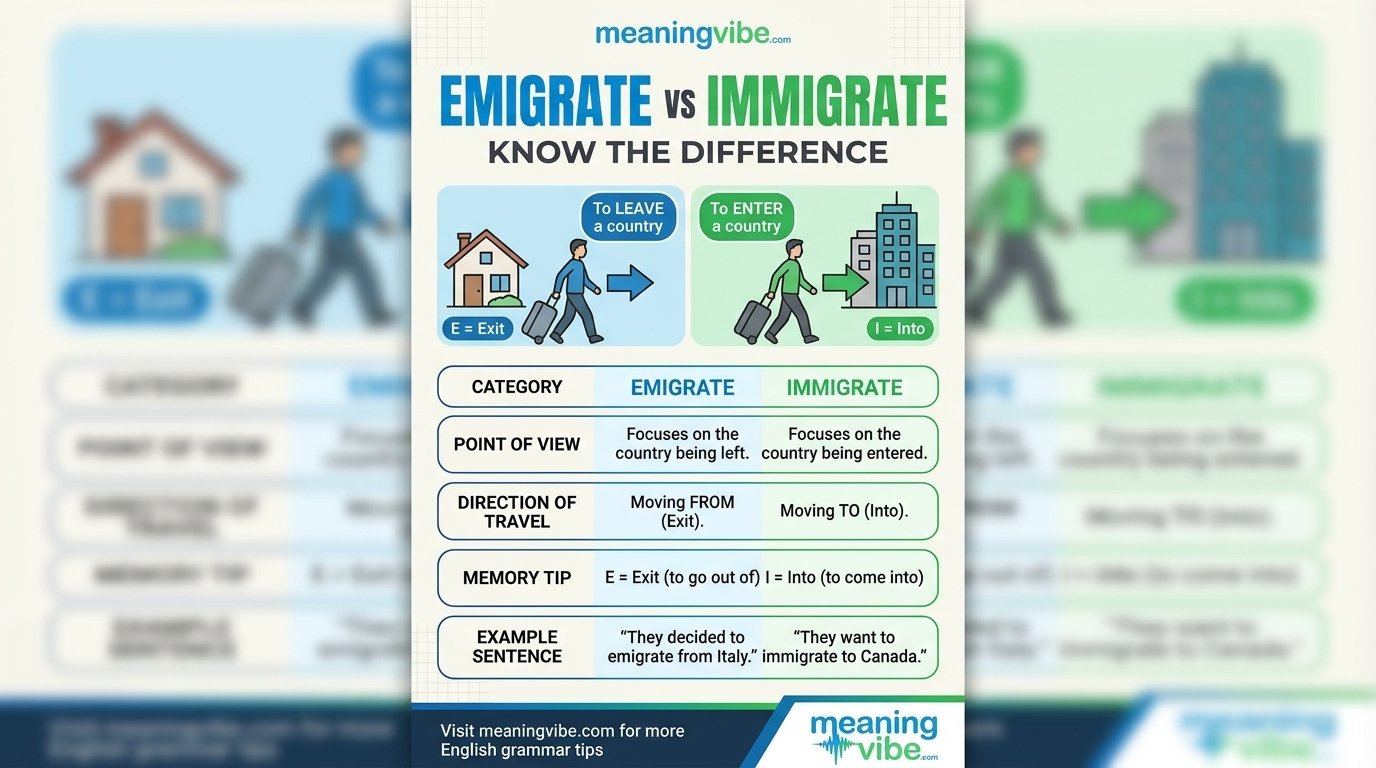
Immigrate equals in works because both words begin with i. Writers who see i at the start should think entering first. That visual cue survives even under deadline pressure too.
From versus to works as a preposition backup when perspective feels unclear. From after a verb points to emigrate, to after a verb points to immigrate. Preposition check confirms perspective choice quickly.
Camera angle trick helps writers who learn through images rather than rules. Camera in the old country means emigrate, camera in the new country means immigrate. Image recall beats abstract rule recall for many learners.
Same person trick helps writers who think emigrate and immigrate describe different people. Remember one woman can be an emigrant from Mexico and an immigrant to Canada at once. Dual identity breaks the opposite-people myth.
Migrate umbrella trick helps writers who need a safe general term. When perspective stays unclear, migrate states movement without claiming departure or arrival focus. Safe general terms prevent false precision.
Practice memory grows stronger when writers write ten sentences of their own. Ten self-written sentences beat ten memorized definitions because production forces a choice each time. Choice practice builds durable accuracy.
Editing memory grows stronger when writers reread only for perspective words in a final pass. A dedicated perspective pass catches emigrate and immigrate errors that a general proofread misses. Separate passes catch separate error types.
Quiz With Answers
Quiz instructions stay simple for learners at beginner, intermediate, and advanced levels. Choose emigrate, immigrate, emigrant, immigrant, emigration, immigration, or migrate for each blank, then check the answer and explanation below each item. Explanations matter more than scores alone.
Question 1: My grandparents decided to ______ to the United States from Italy.
Answer: immigrate. Destination focus and to preposition both point to immigrate.
Question 2: Thousands were compelled to ______ from Asia Minor to Greece after the war.
Answer: emigrate. Origin focus and from preposition both point to emigrate.
Question 3: Maria ______ from Mexico and ______ to Canada in the same year.
Answer: emigrated from Mexico and immigrated to Canada. Each verb keeps its own focus there.
Question 4: High ______ from Poland worried officials in Warsaw.
Answer: emigration. Poland is origin in that sentence, so process noun follows departure.
Question 5: High ______ to the United Kingdom rose sharply that decade.
Answer: immigration. United Kingdom is destination in that sentence, so process noun follows arrival.
Question 6: The archive lists him as an ______ from Spain.
Answer: emigrant. Person noun follows origin perspective, Spain is the country left.
Question 7: The registry identifies her as an ______ to Chile.
Answer: immigrant. Person noun follows destination perspective, Chile is the country entered.
Question 8: Birds ______ south for winter and return north in spring.
Answer: migrate. Seasonal, temporary movement fits the neutral umbrella verb best.
Question 9: Workers ______ between regions for harvest jobs each season.
Answer: migrate. Between regions and seasonal return fit neutral movement, not settlement.
Question 10: The old form says, “I ______ to the United States from Germany.” What does it mean in modern wording?
Answer: It means immigrated to the United States from Germany in modern standard wording. Old forms used emigrated to, a porous-border example, not a modern model.
Quiz scoring guidance keeps focus on learning rather than ranking for most readers. Eight or more correct answers show strong control of the pair in timed writing. Fewer correct answers point to the perspective test for review.
Quiz extension for advanced writers adds genealogy, policy, and combined sentences in one set. Advanced items should mix academic, legal, and news contexts in one set. Context shifts test whether the rule transfers beyond familiar examples.
Mistakes to Avoid
1. Using immigrate with from as the main verb when departure was meant tops the mistake list. Sentences such as “Many people immigrated from Ireland” fail modern standard perspective. From signals departure, so emigrate fits there.
2. Using emigrate with to as the main verb when arrival was meant tops the opposite mistake list. Sentences such as “She emigrated to Canada” fail modern standard perspective. To signals arrival, so immigrate fits there.
3. Treating emigrant and immigrant as different people tops the identity mistake list. One person can be both, depending on framing country, without contradiction. Identity follows perspective, not a fixed label.
4. Adding legal meaning that the verbs do not carry tops the sensitive mistake list. Immigrate does not prove legal entry, and emigrate does not prove citizenship loss. Legal status needs separate, explicit words every time.
5. Adding permanence that the context does not support tops the intent mistake list. Travel, visiting, and short stays do not count as emigrating or immigrating without settlement intent. Intent, not border crossing alone, decides the verb.
6. Using migrate for settlement when perspective matters tops the vague mistake list. “They migrated to Canada” may read acceptably in general writing, yet it hides arrival and settlement focus. Immigrate gives clearer perspective when settlement matters.
7. Copying old record wording as modern model sentences tops the genealogy mistake list. “Emigrated to the United States” on an old form does not make emigrated to standard in new writing. Old records need translation, not imitation.
8. Mixing person and process nouns in trend reporting tops the noun mistake list. “High immigration from Poland” confuses destination process with origin country. Process noun must match the country in focus.
9. Ignoring preposition after choosing the correct verb tops the editing mistake list. Correct verb plus wrong preposition still confuses readers about origin or destination. Verb and preposition must agree in perspective.
10. Skipping the logic read lets fluent but false sentences survive into publication. A sentence can sound smooth while claiming that departure is arrival or that travel is settlement. Logic reads catch meaning errors grammar checks miss.
Tips for Editors and Exam Writers
1. Label the country in focus before choosing a verb or noun in any uncertain sentence. Write origin or destination in the margin, then choose emigrate or immigrate to match. Labeling forces perspective before spelling.
2. Test the preposition with from for emigrate and to for immigrate after choosing. Preposition agreement confirms perspective faster than dictionary browsing during timed writing. Keep both prepositions ready as a mental tool.
3. Check the person noun when a noun appears instead of a verb in a draft. Emigrant follows origin, immigrant follows destination, and process nouns follow the same rule. Noun checks prevent trend reporting errors.
4. Read for logic third after perspective and preposition checks pass. Ask whether the sentence claims someone left or arrived in a way that matches intent. Logic failures demand revision even when grammar looks clean.
5. Run a perspective pass as a separate final proofread for any document with movement words. Search for emigrate, immigrate, emigrant, immigrant, emigration, and immigration separately, then test each occurrence with the perspective test. Separate passes catch errors general reading misses.
6. Keep a personal error list with your own repeated perspective mistakes across documents. Personal lists beat generic lists because they target actual habits, not possible habits. Review the list before submitting important work.
7. Use dictionary entries for first known use, senses, and prefix distinctions when doubt persists. Merriam-Webster distinguishes emigrate and immigrate by emphasis, not by different people, a distinction learner lists often miss. Dictionary nuance improves advanced writing.
8. Teach with combined sentences when helping students or colleagues learn the pair. Combined sentences such as emigrated from Mexico and immigrated to Canada test both words at once. Combined practice transfers better than isolated examples.
9. Match register to audience when choosing between migrate and the specific verbs. Academic and legal readers expect emigrate or immigrate, while general readers may accept migrate for movement. Register matching improves readability without losing accuracy.
10. Save legal terms for legal meaning, and save migration verbs for movement meaning. Authorized, unlawful, citizen, and permanent resident carry legal weight that emigrate and immigrate do not carry alone. Separation protects both writer and reader in sensitive contexts.
FAQs About Emigrate vs Immigrate
What is the difference between emigrate and immigrate?
Emigrate stresses leaving a country to live elsewhere, while immigrate stresses entering a new country to live there. Same person and same move can carry both labels, depending on perspective.
Can you emigrate to a country?
In modern standard writing, no, use immigrate to for arrival focus. Historical American records do say emigrated to, but that wording is a porous-border example, not a modern model.
Can you immigrate from a country?
In modern standard writing, no, use emigrated from for departure focus. Immigrated from mixes destination verb with origin preposition and confuses perspective.
Is emigrate the opposite of immigrate?
No, not in the sense of different people or opposite actions. Both describe the same move from different viewpoints, leaving versus entering. Opposite framing, same person, same journey.
What does emigrate mean in a sentence?
Emigrate means to leave a country or place of residence to live elsewhere. “They emigrated from Ireland in the 1990s” stresses Ireland as the origin. Destination can follow without changing focus.
What does immigrate mean in a sentence?
Immigrate means to enter a new country, usually one where a person was not born, to live there. “They immigrated to Canada in the 1990s” stresses Canada as the destination. Origin can follow without changing focus.
How do you remember emigrate vs immigrate?
Remember emigrate equals exit, both start with e, and immigrate equals in, both start with i. Use the leaving-or-entering test as the main check, with mnemonics as backup.
What is an emigrant?
An emigrant is a person who leaves a country of residence to live elsewhere. Origin perspective defines emigrant, just as destination perspective defines immigrant for the same person.
What is an immigrant?
An immigrant is a person who enters a new country intending to live there permanently. Destination perspective defines immigrant, just as origin perspective defines emigrant for the same person.
What is the difference between emigrant and immigrant?
Emigrant stresses the country left, immigrant stresses the country entered. A woman can be an emigrant from Spain and an immigrant to Chile at the same time.
What is emigration?
Emigration is the process of leaving a country to live in another. High emigration from a country describes many departures together, not one arrival.
What is immigration?
Immigration is the process of entering a country to live there permanently. High immigration to a country describes many arrivals together, not one departure.
What is the difference between emigration and immigration?
Emigration focuses on departures, immigration focuses on arrivals and settlement. Country in focus decides which process noun fits a trend sentence.
What is the difference between migrate and immigrate?
Migrate is neutral movement, covering people, animals, temporary moves, and internal moves. Immigrate is specific, entering a new country to become established there.
What is the difference between migrate and emigrate?
Migrate is neutral movement, covering temporary and internal moves as well as international moves. Emigrate is specific, leaving a country to live elsewhere.
What does migrate mean?
Migrate means to move from one place to another, often regularly or seasonally. Birds migrate south, workers migrate between regions, and families migrate within a country.
What is a migrant?
A migrant is a person who moves, often regularly, for work or better living conditions. Migrant worker usually implies seasonal or repeated movement, not permanent settlement alone.
What is the difference between immigrant and migrant?
Immigrant implies entering a new country to settle there, while migrant implies movement that may be regular, temporary, or internal. Settlement emphasis separates immigrant from migrant in many cases.
What is the difference between immigrant and expat?
Expat often implies a temporary professional stay abroad, with social connotations of privilege or choice. Immigrant implies settlement in a new country, without a temporary assumption. Context and connotation separate those terms.
What is the difference between immigrant and refugee?
Refugee implies flight from persecution or danger and a search for protection. Immigrant implies movement for work, family, study, or other reasons, without a protection claim alone. Protection status needs its own term.
How do you pronounce emigrate and immigrate?
Emigrate sounds like EH-muh-grayt, immigrate sounds like IH-muh-grayt, with stress on the first syllable. First vowel contrast, ember versus import, separates them in careful speech.
Are emigrate and immigrate homophones?
No, not in standard American speech, because the first syllables differ, EH versus IH. Fast speech can blur that difference, yet dictionary pronunciation keeps a small but real contrast.
What are the verb forms of emigrate?
Forms follow a regular pattern: emigrate, emigrates, emigrating, emigrated, have emigrated. Third person singular adds s, past forms use emigrated, and present participle uses emigrating.
What are the verb forms of immigrate?
Forms follow a regular pattern: immigrate, immigrates, immigrating, immigrated, have immigrated. Third person singular adds s, past forms use immigrated, and present participle uses immigrating.
Does immigrate mean legal entry?
No, immigrate alone does not prove legal entry, visa type, or authorization. Legal status needs separate words such as authorized, lawful, documented, or visa holder in every case.
Does emigrate mean you lose citizenship?
No, emigrate alone does not prove citizenship loss, renunciation, or tax change. Citizenship rules depend on country law and individual action, not on verb choice alone.
Conclusion on Emigrate vs Immigrate
Emigrate vs immigrate rewards a simple habit more than memorized definitions alone. Label the country in focus, match leaving with emigrate from and entering with immigrate to, and read the finished sentence for logic. That habit turns a perspective trap into a quick, confident choice.
Emigrate will serve writers whenever departure, origin, and leaving must lead a sentence. Immigrate will serve writers whenever arrival, destination, and settling must lead a sentence. Keeping those focuses separate protects meaning in every context from essays to family histories.
Try the habit on your next draft by searching for both verbs and both nouns, then testing each occurrence separately. Use the quiz above as a warm-up, then apply the perspective test to real sentences under deadline pressure. Accuracy built through practice lasts longer than accuracy borrowed from a single definition.