

Cite vs site vs sight confuses writers at every level, because all three words sound exactly the same and look deceptively similar.
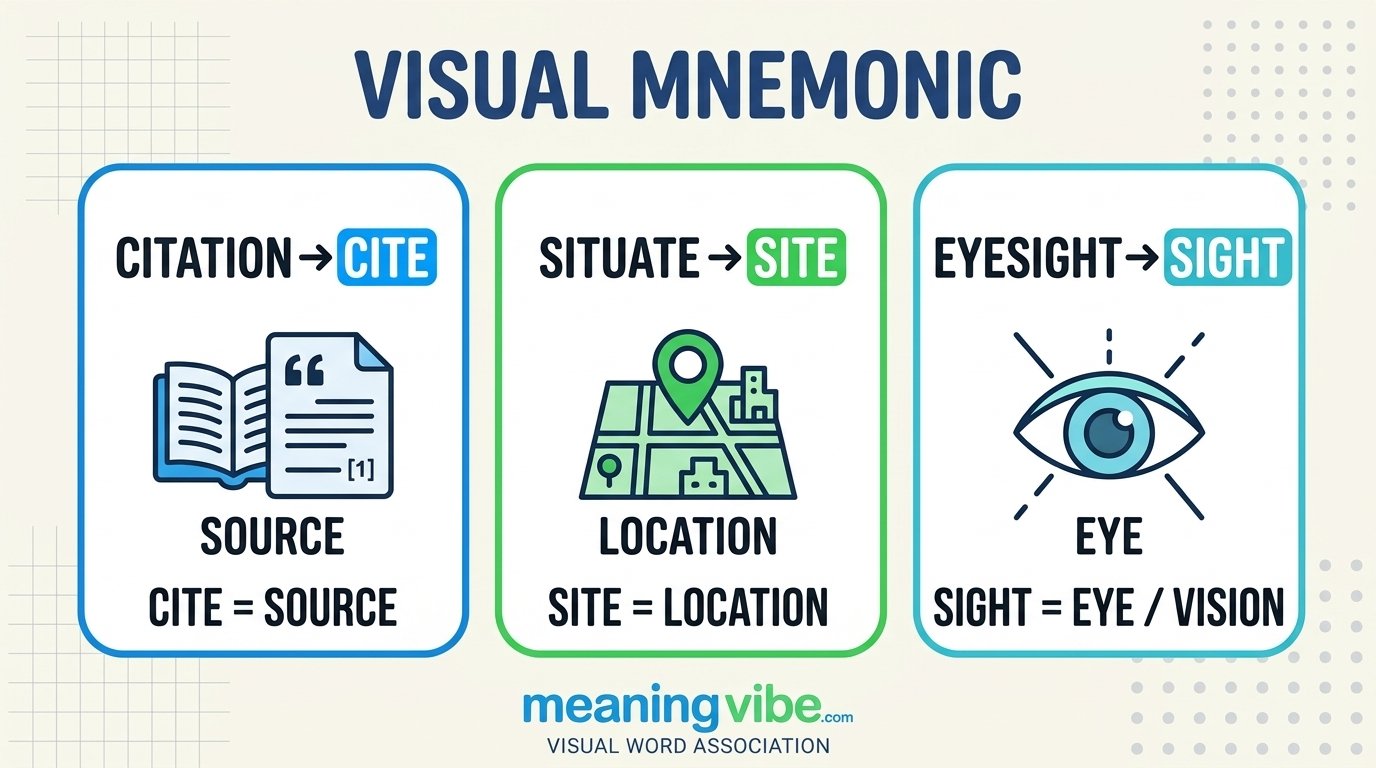
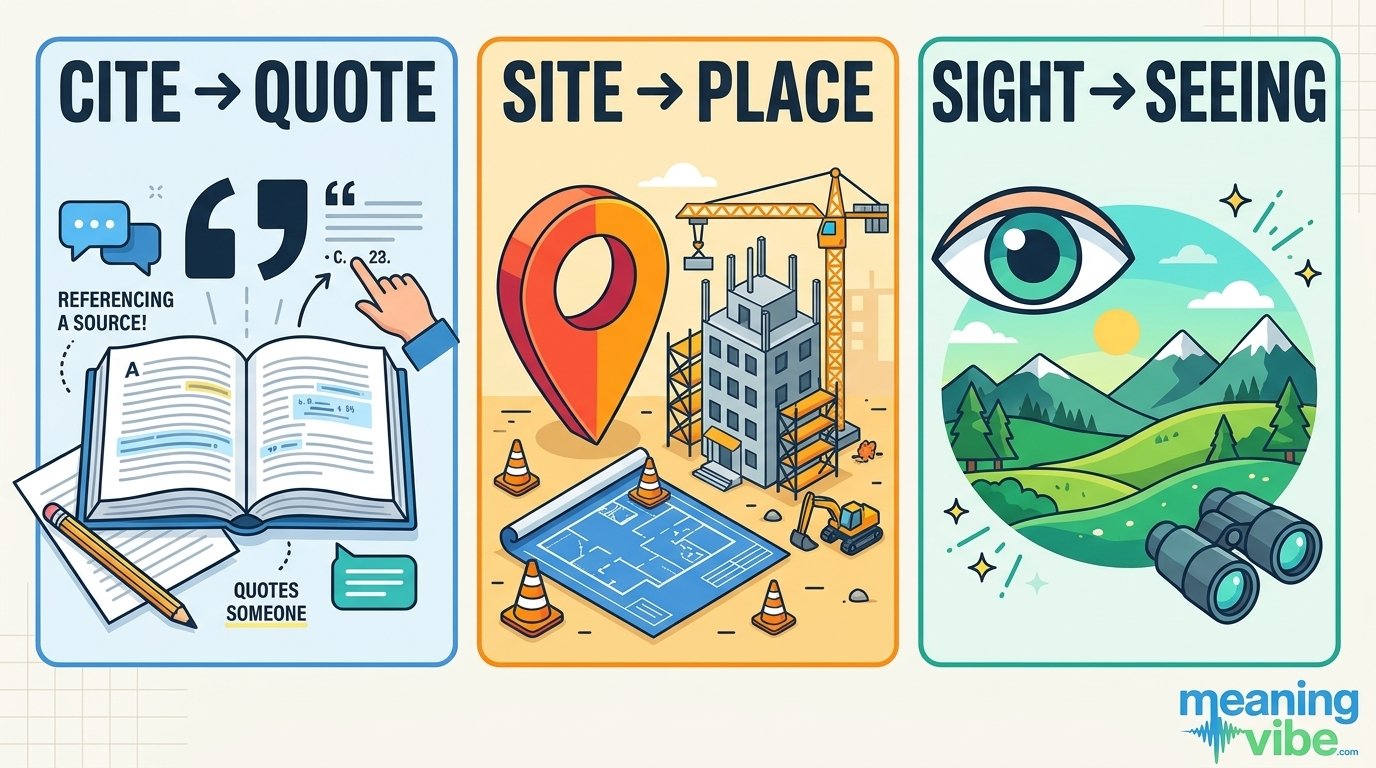
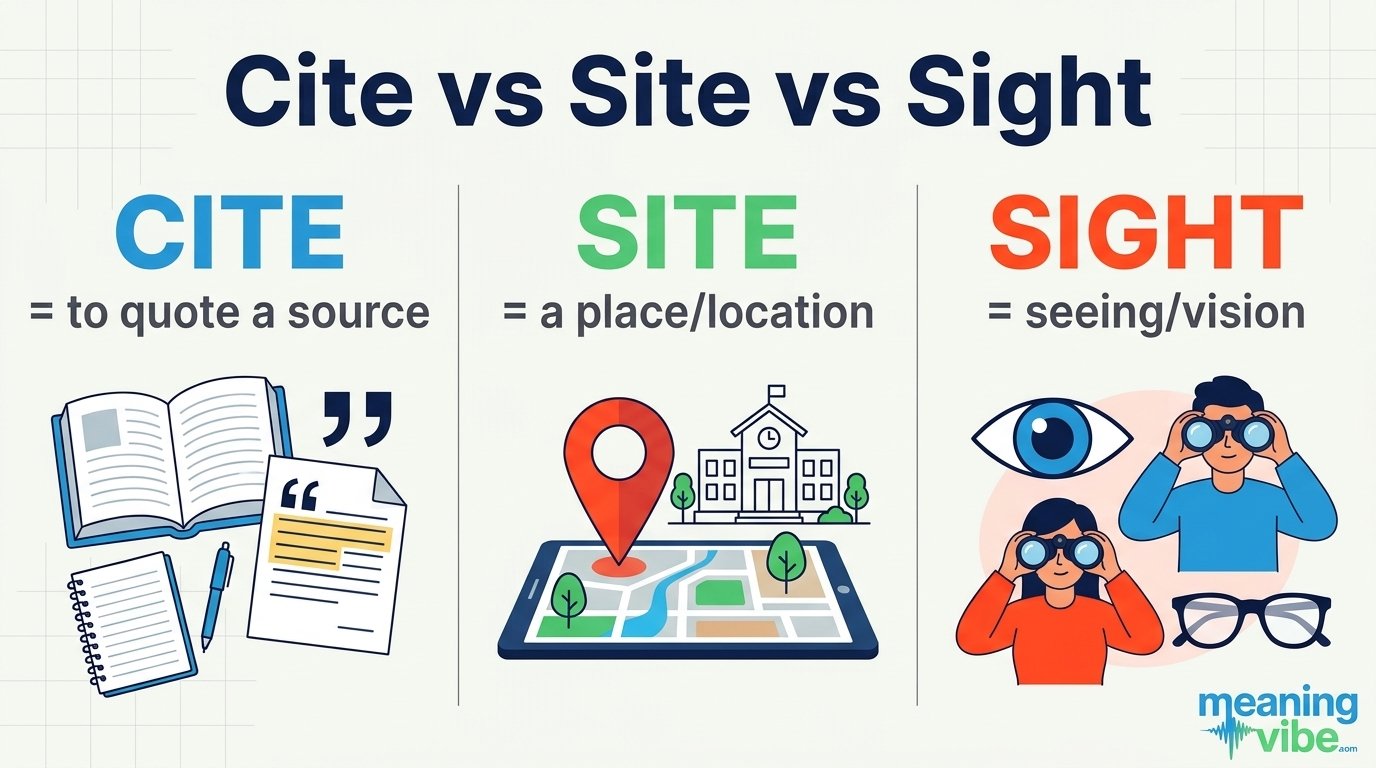
The difference is decided by meaning, not by sound: cite quotes a source, site is a place, and sight is seeing or something seen. If you are quoting, you need cite; if you are naming a location, you need site; if you are describing vision, you need sight.
Cite Quotes, Site Is a Place, Sight Is Seeing
Cite is a verb meaning to quote, refer to, or mention something as evidence, example, or authority. A professor who asks students to cite their sources, a lawyer who cites a court case, and a journalist who cites a government report are all using cite correctly. The action is always referencing: you point to a source, an example, or a reason that supports what you are saying.
Site is a noun meaning a location or place, and it can also be a verb meaning to place something in a location. A construction site, an archaeological site, a historic site, and a website are all locations, physical or digital. When site is used as a verb — “the building will be sited near the river” — it means the building will be placed there, not quoted or seen.
Sight is a noun meaning the ability to see, the act of seeing, or something that is seen, and it can also be a verb meaning to see or to aim. The Grand Canyon is a breathtaking sight, a person’s sight can improve with glasses, and a hunter can sight a target. That seeing core runs through every sense of sight, from eyesight to sightseeing to setting your sights on a goal.
All three words are pronounced /saɪt/, spelled SAIT in plain respelling, with no pronunciation difference in standard English. That shared sound is why spellcheckers often miss the error: cite, site, and sight are all valid spellings, so a spellchecker will not flag the wrong one. Only meaning — and part of speech — can choose between them, which is why this article teaches a meaning test, not a spelling rule.
Cite: Definition, Verb Forms, and Examples
What Does Cite Mean?
Cite, as a verb, means to quote or refer to a source, to mention something as an example, or to summon someone officially. Those three senses look different, but they share a core: cite brings something forward — a source, an example, or a person — into attention. A writer cites a study to support an argument, a speaker cites an example to illustrate a point, and a court cites a person to appear.
Cite is most often encountered in academic and professional writing, where citing sources gives credit, avoids plagiarism, and lets readers verify claims. “Please cite your sources in the essay” is the classic classroom instruction, because an essay without citations cannot be checked. In formal contexts, citing is not optional politeness; it is how evidence is shown, and a claim without a citation is a claim without support.
Cite’s verb forms are regular: cite, cites, cited, citing. “She cites three studies” uses the third-person singular, “the paper cited a 2023 report” uses the past tense, and “citing sources correctly” uses the present participle. The related noun is citation, and the related verb recite shares cite’s Latin root, which is why the citation/cite association is the strongest memory trick for this word.
Cite’s Two Opposite Senses: Honoured vs Summoned
Someone “cited for” an admirable act is officially and publicly honoured, while someone “cited for” wrongdoing is ordered to appear before a court to answer for it. That contrast confuses learners who assume cited is always negative or always positive, but context decides: a firefighter cited for bravery was honoured, while a driver cited for speeding was summoned. Both uses are cite, and both are formal, but their consequences are opposite.
The honoured sense appears in awards, commendations, and official recognition. “The young inspector was cited for his outstanding achievements” means he was publicly recognized, not punished, and the citation itself is the honour. That sense is common in military, police, and professional awards, where a citation is a written commendation.
The summoned sense appears in law, traffic, and court contexts, where cite means to order someone to appear. “He was cited for speeding on the highway” means he received a citation — a ticket or summons — requiring a court appearance or a fine. “The officer will cite you for a court appearance” uses the same sense, and it is the sense most readers meet in news reports about traffic and legal cases.
Do not assume cited is positive or negative without reading the rest of the sentence. The preposition that follows — cited for bravery versus cited for speeding — and the context — award ceremony versus traffic stop — tell you which sense applies. That context check is faster than a dictionary lookup, and it is the check editors use when they meet cited in a manuscript.
Cite Prepositions: Cite From, Cite As, Cite For
Cite from specifies the source from which a direct quote or passage is taken. “She cited a powerful passage from Shakespeare’s Hamlet” uses cite from to name the origin of the quote, and the passage itself is the object being quoted. That preposition answers the question “where did this come from?” and it is the most common cite preposition in academic writing.
Cite as presents something in a certain role or capacity, usually as an example. “He cited the incident as an example of poor customer service” uses cite as to frame the incident’s role, not its source. That preposition answers the question “in what role is this being mentioned?” and it is common in arguments, where an example is cited as evidence for a claim.
Cite for names the reason for a citation, whether honour or summons. “She was cited for bravery” and “he was cited for speeding” both use cite for, but one names an honour and the other names an offence. That preposition answers the question “for what was this citation issued?” and it is the preposition that most often reveals which opposite sense of cite applies.
| Preposition | Meaning | Example |
| Cite from | Source of a quote | She cited a passage from Hamlet. |
| Cite as | Role or example | He cited the incident as an example. |
| Cite for | Reason for honour or summons | She was cited for bravery. / He was cited for speeding. |
Site: Definition, Verb Forms, and Examples
What Does Site Mean?
Site, as a noun, means a location or place, whether physical or digital, present, former, or planned. A building’s construction site is where it is being built, a battle site is where a battle happened, an archaeological site is where digging happens, and a website is where a group of web pages lives. That location core runs through every sense of site, from a landfill site to a social networking site.
Site comes from Latin situs, meaning “place, position, site,” and it is related to situate (“to locate”) and situation (“relative position”). That etymology gives you the strongest memory trick for site: associate situate with site, because both words are about placing something in a position. If you can remember situate, you can remember site, because they share the same location meaning and the same Latin root.
Site is frequently used as a shortened form of website in contemporary English, to refer to the location of a group of web pages. “Visit our company’s site for more information” and “my favourite web site sells camping equipment” both use site for a digital location, not a physical one. That digital sense is now as common as the physical sense, and it is the sense most readers meet daily.
Site as a Verb: To Place a Building
Site, as a verb, means to fix or build something in a particular place, or to position it there. “I will site the slide near the swings” means the slide will be placed near the swings, while “the building will be sited in a particular location” means it will be built there. That verb sense is less common than the noun sense, but it is fully correct, and it is the sense most competitors miss when they call site a noun only.
Site’s verb forms are regular: site, sites, sited, siting. “The team sites the new building near the river” uses the present tense, “the building was sited in 1856” uses the past tense, and “siting a building” uses the present participle. Those forms must not be confused with sighting (seeing) or citing (quoting), even though all three share the /saɪt/ sound.
The verb sense of site appears in planning, construction, and real estate, where location decisions are formal. A planning report that says “the hospital will be sited on the north side” is making a location decision, not quoting a source or describing vision. If your sentence is about where something will be placed, site is the verb, even if the sentence also mentions a sight or a citation elsewhere.
Site Compounds: Construction, Archaeological, Historic, Website
Construction site is the most common site collocation, and it means the place where building work is happening. “The construction site was busy with workers and machinery” and “the construction site is closed” both use site for a physical work location. That collocation is so common that many learners first meet site in a construction context, which is why English Grammar Lessons calls site the “culprit” word — it is the one most often replaced by sight in error.
Archaeological site, historic site, and battle site all name places where something important happened or is being studied. “Mr Dodds claimed his tools had been stolen from the archaeological site” and “this was the site where the battle was fought” both use site for a place with historical or scientific significance. Those collocations show site’s range: it is not just a building plot, but any place defined by what happened or happens there.
Website is site’s most frequent digital compound, and it is now usually written as one word, though “web site” as two words is still seen. “Visit our site” is short for “visit our website,” and “a social networking site” is a site in the digital sense, not a physical location. When you write website, you are writing site in its digital sense, and the same location logic applies: a website is a place on the internet, just as a construction site is a place on land.
| Site collocation | Meaning | Example |
| Construction site | Place where building work happens | The construction site is off-limits. |
| Archaeological site | Place where digging/study happens | Tools were stolen from the archaeological site. |
| Historic site | Place with historical significance | The town hall was erected on the site in 1856. |
| Battle site | Place where a battle happened | This was the site where the battle was fought. |
| Website / web site | Digital location, group of web pages | Visit our company’s site for more information. |
Sight: Definition, Verb Forms, and Examples
What Does Sight Mean?
Sight, as a noun, means the ability to see, the act of seeing, or something that is seen. Those three senses share a seeing core: eyesight is the ability, catching sight is the act, and a beautiful sight is the thing seen. A person’s sight can be perfect after treatment, a sunset can be a beautiful sight, and a city can have sights worth visiting — all from the same seeing root.
Sight comes from Old English gesiht, meaning “the faculty or act of sight, thing seen,” and it is related to eyesight. That etymology gives you the strongest memory trick for sight: associate eyesight with sight, because both words are about seeing, and eyesight contains sight as its second element. If you can remember eyesight, you can remember sight, because they share the same vision meaning.
Sight is also a noun for a famous or interesting place in an area, as in “the sights of a city.” A tour guide who shows you the sights of New York or Washington is showing you things worth seeing, not locations in the site sense — though, as the overlap section explains, a sight can be at a site. That tourist sense is common in travel writing, and it is the sense most likely to be confused with site, because tourist sights are places too.
Sight as a Verb: To See, To Aim
Sight, as a verb, means to catch sight of something, to see it, or to aim at it. “When everyone is quiet, the archer will sight her target” means she will aim at it, while “if you sight a whale” means you see one. That verb sense is less common than the noun sense, but it is fully correct, and it is the sense most competitors miss when they call sight a noun only.
Sight’s verb forms are regular: sight, sights, sighted, sighting. “She sights the target” uses the present tense, “the whale was sighted off the coast” uses the past tense, and “sighting a comet” uses the present participle. Those forms must not be confused with siting (placing) or citing (quoting), even though all three share the /saɪt/ sound and the -ing ending in their participle forms.
The verb sense of sight appears in hunting, military, astronomy, and wildlife contexts, where seeing or aiming is the action. A comet that was “quite a sight to see” uses sight as a noun, while a comet that was “sighted” uses sight as a verb for the act of seeing it. That noun-verb pair — sight as a thing seen, sighted as the act of seeing it — is a useful test: if you can replace the word with “seen,” you need sight, not site or cite.
Sight Idioms: Set Your Sights On, Out of Sight, Sight Unseen
Set your sights on something means to figuratively look toward it as a goal, as if aiming at it. “She set her sights on becoming a doctor” does not mean she literally saw a doctor; it means she aimed at that goal. That idiom comes from sight-as-aiming, and it is the most common sight idiom in professional and motivational writing.
Out of sight, out of mind means something forgotten once it is no longer seen, while sight unseen means bought or accepted without being seen first. “He bought the house sight unseen” means he bought it without viewing it, which is a riskier version of the same seeing logic. Both idioms use sight in its vision sense, and neither can be replaced by site or cite without changing the meaning entirely.
Caught sight of means to suddenly see something, while lost sight of means to no longer see something or to lose track of it. “The boat came into sight on the horizon” and “she lost sight of her dog in the park” both use sight for the act of seeing, not for a location or a quotation. Those idioms are the phrases learners meet most in reading, and they are the phrases most likely to be misspelled as site in writing.
| Sight idiom | Meaning | Example |
| Set your sights on | Aim at as a goal | She set her sights on medical school. |
| Out of sight, out of mind | Forgotten once unseen | Out of sight, out of mind, he forgot the project. |
| Sight unseen | Without being seen first | He bought the house sight unseen. |
| Caught sight of | Suddenly saw | She caught sight of an eagle. |
| Lost sight of | No longer saw / lost track of | She lost sight of her dog in the park. |
| In sight / out of sight | Visible / not visible | The boat came into sight on the horizon. |
Cite vs Site vs Sight: The Master Comparison Table
| Feature | Cite | Site | Sight |
| Pronunciation | /saɪt/ (SAIT) | /saɪt/ (SAIT) | /saɪt/ (SAIT) |
| Part of speech | Verb | Noun, also verb | Noun, also verb |
| Core meaning | Quote, refer to, mention as evidence; summon | Location or place; place something there | Ability to see, act of seeing, something seen; see, aim |
| Origin | Latin citare (to rouse, call on, summon) | Latin situs (place, position) | Old English gesiht (faculty/act of sight, thing seen) |
| Related words | Citation, recite | Situate, situation, website | Eyesight, sightseeing |
| Typical example | Cite your sources in the essay. | The construction site is closed. | The sunset was a beautiful sight. |
| Memory trick | Citation → cite | Situate → site | Eyesight → sight |
| Common error | Writing site for cite | Writing sight for site | Writing site for sight |
Read that table as a decision tool, not as decoration. If your sentence needs a verb meaning “quote,” use cite; if it needs a noun meaning “place,” use site; if it needs a noun or verb meaning “seeing,” use sight. When a sentence seems to fit two columns — for example, a tourist sight at a historic site — use both words, one per role, because one word cannot do both jobs.
The table also settles the most common follow-up question: are they homophones? Yes, in standard English, all three are homophones — words that sound the same but have different spellings and meanings. That is why pronunciation cannot choose between them, and why a spellchecker cannot catch the error: all three spellings are valid, so only meaning can decide.
Verb Forms and Plurals: Cites, Sights, Sites, Sighting, Siting
| Base word | Third-person singular | Past tense | Present participle | Plural (noun) | Related noun |
| Cite (verb) | Cites | Cited | Citing | — (cite is a verb, not a noun) | Citation |
| Site (noun/verb) | Sites (verb) | Sited | Siting | Sites | Website, situation |
| Sight (noun/verb) | Sights (verb) | Sighted | Sighting | Sights | Eyesight, sightseeing |
Valid spellings can still be wrong for the intended meaning, and that is the key lesson of the plural forms. “Cites,” “sights,” and “sites” are all valid English words, but “the article cites two sites” is correct while “the article sites two cites” reverses the roles and obscures the meaning. Check the action and its object independently: cites is the action of referring, sites are the locations referred to, and sights are the things seen.
Sighting differs from siting, and that pair is the most confusing plural/participle pair in the triple. Sighting means seeing — “a whale sighting” is an act of seeing a whale — while siting means placing — “the siting of the building” is the act of placing a building. Those two -ing forms sound the same, look similar, and mean different things, so they deserve their own check when you write them.
Citation differs from sighting and siting, and it belongs only to cite. A citation is a line or short section taken from a piece of writing or a speech, or a reference to a source, and it is the noun that proves cite’s meaning. If your sentence needs a citation, you need cite; if it needs a sighting, you need sight; if it needs a siting, you need site.
The Five-Second Meaning Test: Verb, Place, or Seeing?
Part of Speech Plus Meaning, Combined
Step 1: Ask what job the word does in your sentence — verb, place, or seeing? If the slot needs a verb meaning “quote, mention, or summon,” use cite. If the slot needs a noun meaning “place or location,” use site. If the slot needs a noun or verb meaning “seeing, vision, or something seen,” use sight. That three-way question is faster than a dictionary lookup, and it works for almost every sentence in this article.
Step 2: Check part of speech as a backup, because cite is always a verb, while site and sight can be nouns or verbs. If your slot needs a verb and the meaning is “quote,” cite is the only fit, because site-as-verb means “place” and sight-as-verb means “see or aim.” Sophia Learning’s test uses this logic: if cite is a verb, it cannot fit a noun slot, so “the cite of Edie’s wedding” must be site, because a wedding venue is a location, not a quotation.
Step 3: Substitute the definition and read the sentence aloud. Replace cite with “quote,” site with “location,” and sight with “seeing or something seen,” then check whether the sentence still makes sense. “Please quote your sources” makes sense, so cite is correct; “please location your sources” does not, so site is wrong; “please seeing your sources” does not, so sight is wrong.
Step 4: If the sentence still feels unclear after the meaning test, check a dictionary, not a memory trick. Merriam-Webster lists cite as “to name in a citation, to mention as an example, or to order to appear in court,” site as “location,” and sight as “seeing or something seen,” and those definitions are the authority. A memory trick helps you recall the rule; a dictionary settles a disputed sentence.
When a Sight Is at a Site: The Overlap No Competitor Explains
A sight can be at a site, and that overlap is why the triple is harder than a simple three-way table suggests. The Grand Canyon is a breathtaking sight, and the Grand Canyon is also a site — a location — so the same place can be described with both words, in different roles. A tourist sight can occupy a historic site, and a historic site can contain many sights, because sights are things seen and sites are places where things are seen.
The dinosaur-bones sentence from WritingTips proves the overlap in one sentence: “The scientist said the dinosaur bones they uncovered at the excavation site were a sight.” Site names the location (the excavation), while sight names the thing seen (the bones as a spectacle). Both words are correct in that sentence, because each does a different job: site locates, sight describes what was seen at that location.
Use both words when a sentence needs both roles, and do not force one word to do both jobs. “We visited the site and saw the sights” is correct, because site names the place visited and sights names the things seen there. “We visited the sight and saw the sites” reverses the roles and confuses the reader, even though all three spellings are valid.
That overlap also explains why “sights of a city” and “sites of a city” are both correct, but mean different things. Sights of a city are the things worth seeing there — views, spectacles, attractions — while sites of a city are the locations themselves — historic places, battle sites, archaeological sites. A city guide that lists sights is listing experiences, while a history guide that lists sites is listing locations, and a good guide will list both, with the right word for each.
Wrong Examples, Corrected
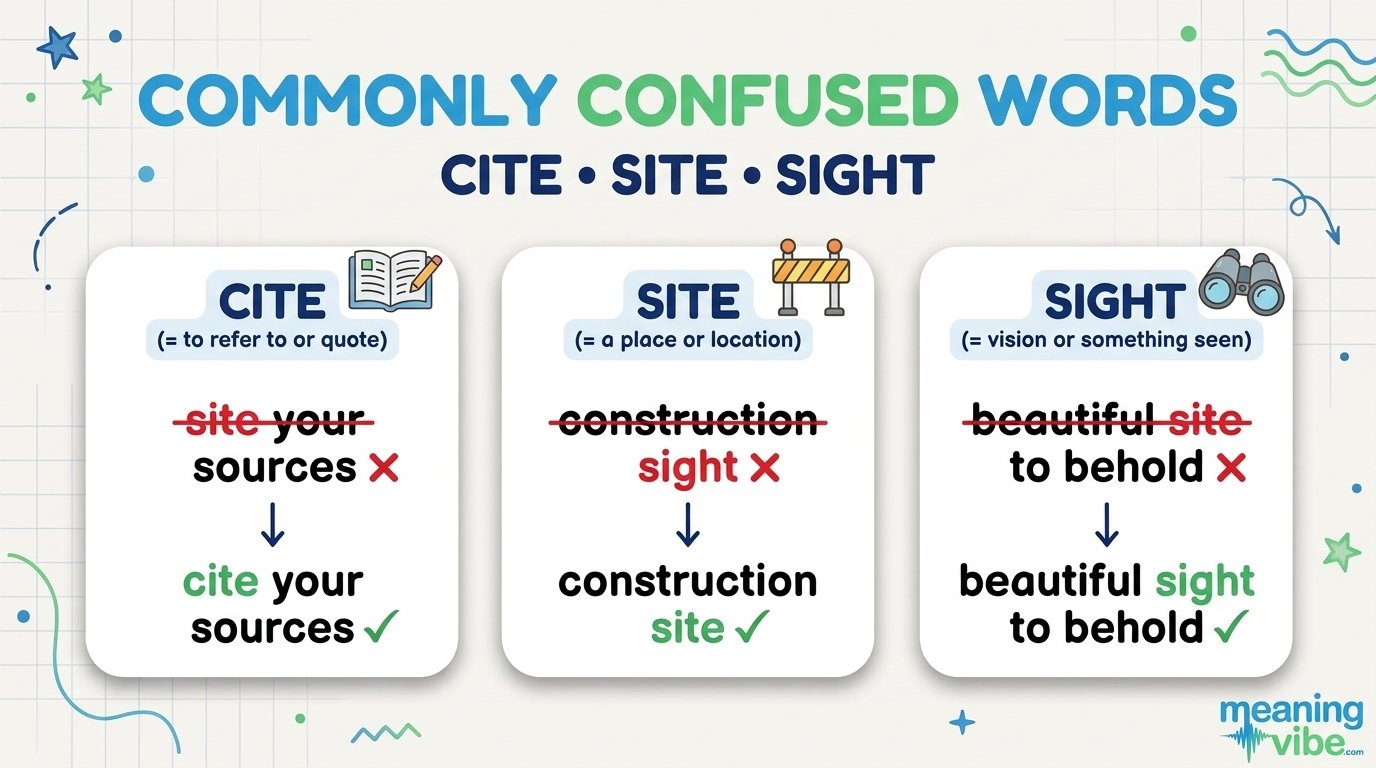
Incorrect: “Please site your sources.” That sentence is wrong, because sources are quoted, not located, so the verb must be cite. Correct: “Please cite your sources in the essay,” because citing gives credit and lets readers verify claims.
Incorrect: “The construction sight is closed.” That sentence is wrong, because a construction location is a site, not a vision, so the noun must be site. Correct: “The construction site is closed,” because site names the place where building work happens.
Incorrect: “The view was an amazing site.” That sentence is wrong, because a view is something seen, not a location, so the noun must be sight. Correct: “The view was an amazing sight,” because sight names something seen, and a view is the classic example of a sight.
Incorrect: “It was a beautiful site to behold.” That sentence is wrong for the same reason: something beheld is seen, so it is a sight, not a site. Correct: “It was a beautiful sight to behold,” because behold means to see, and sight is the noun for seeing.
Incorrect: “The new office building will be constructed at the cite.” That sentence is wrong, because a building’s location is a site, not a quotation. Correct: “The new office building will be constructed at the site,” because site names the place where the building will be.
Incorrect: “Please provide a sight for your data.” That sentence is wrong, because data needs a source reference, not a vision, so the verb must be cite. Correct: “Please provide a cite for your data” — though in formal writing, “please cite a source for your data” is more natural, because cite takes a source as its object, not a data point alone.
Pronunciation: All Three Sound Like SAIT
Cite, site, and sight are pronounced identically in standard English: /saɪt/, spelled SAIT in plain respelling. There is no pronunciation difference between them, which is why they are homophones and why pronunciation cannot help you choose. A speaker who says “cite” and a speaker who says “site” sound the same, and only the written spelling — and the meaning behind it — distinguishes them.
That shared pronunciation is also why the triple is a spelling problem, not a speaking problem. In speech, context tells the listener which word you mean: “cite your sources” is heard as a quotation instruction, while “construction site” is heard as a location, even though both sound like SAIT. In writing, context must do the same work, but the spelling must also be correct, because a reader cannot hear your intention.
Practice the triple aloud with a sentence that uses all three words, so the shared sound becomes familiar, not confusing. Say: “Cite the study, visit the site, and enjoy the sight.” Hearing SAIT three times in one sentence, with three different meanings, trains the ear to accept that sound and meaning are independent for this triple.
Why They Sound Alike but Mean Different Things: Three Histories
Cite From Latin Citare, Site From Latin Situs, Sight From Old English Gesiht
Cite comes from Latin citare, meaning “to rouse, call on, summon,” and it is the source of citation and recite. That calling sense explains cite’s two main uses: to call on a source as evidence, and to summon a person to court. Both are acts of calling forward — a source into an argument, a person into a courtroom — and that shared calling core is why cite’s senses, though different, feel related.
Site comes from Latin situs, meaning “place, position, site,” and it is related to situate and situation. That placing sense explains site’s location meaning and its verb sense: to site a building is to place it, and a situation is a relative position. Site’s history is entirely about place, with no connection to quoting or seeing, which is why Merriam-Webster calls the three words “completely unrelated in meaning, use, and history.”
Sight comes from Old English gesiht, meaning “the faculty or act of sight, thing seen,” with no Latin root at all. That Germanic history separates sight from cite and site, which are both Latin-derived, and it explains why sight’s spelling contains “gh” — a Germanic spelling pattern also seen in light and bright, which are also related to vision. BroadLearners’ “gh” trick uses that pattern: sight contains “gh” like light and bright, which are also vision words.
Three histories, one sound, is the whole story of this triple. Cite, site, and sight converged in pronunciation through sound changes in English, while their meanings stayed separate because their roots were separate. Knowing that history does not choose the word for you, but it explains why the confusion feels natural — the words were never related, they only sound related.
Citation Styles in One Paragraph: Why Citing Sources Matters
A citation is a line or short section taken from a piece of writing or a speech, or a reference to a source, and citing sources gives credit, avoids plagiarism, and lets readers verify claims. In academic writing, a citation needs actual source details — author, title, date, page — because spelling cite correctly does not by itself establish evidence for a claim. A research citation that names no source is not a citation, even if the verb cite is spelled correctly.

In-text citations and bibliographies are the two parts of a citation system, and their formats differ by style. APA, MLA, and Chicago each have their own in-text and bibliography rules, but all three styles share the same purpose: to show where an idea came from, so a reader can find it. That purpose is why “cite your sources” is a classroom and professional instruction, not just a spelling lesson.
Do not confuse a citation style with a spelling rule. APA does not tell you how to spell cite, and MLA does not tell you how to spell site; those styles tell you how to format a citation once you have chosen to cite. Spelling is decided by meaning, as this article teaches, while formatting is decided by the style guide your institution or publisher requires.
Memory Tricks That Actually Work
Citation, Eyesight, Situate
Trick 1: Associate citation with cite, because citation is the noun for cite’s action. If you can remember citation — a reference to a source — you can remember cite, because cite is the verb that creates a citation. That trick helps cite only, so pair it with two more tricks for site and sight.
Trick 2: Associate situate with site, because situate means to locate, and site means a location. If you can remember situate — to place something in a position — you can remember site, because site is the place where something is situated. That trick helps site only, and it is the trick Merriam-Webster itself suggests for this triple.
Trick 3: Associate eyesight with sight, because eyesight is the ability to see, and sight is seeing. If you can remember eyesight — vision — you can remember sight, because sight is the root of eyesight. That trick helps sight only, and it is the trick BroadLearners extends with the “gh” pattern: sight, light, and bright all contain “gh” and all relate to vision.
Trick 4: The tradesman’s entrance trick for site, from English Grammar Lessons, which uses the “te” in site to remind you of “tradesman’s entrance.” A site often describes a place where building work is taking place, and a building site is likely to have a tradesman’s entrance, so “te” in site triggers “tradesman’s entrance” and thus “building site.” That trick is memorable, but it only helps site in a construction context, so use it as a backup, not as your main rule.
| Trick | Helps recall | Weakness | Best for |
| Citation → cite | Cite = quote a source | Only helps cite | Academic writers |
| Situate → site | Site = location | Situate is itself uncommon | Formal writers |
| Eyesight → sight | Sight = seeing | Only helps sight | Visual learners |
| Tradesman’s entrance → site | Site = building place | Only helps construction site | Construction context |
| Meaning test | All three words, every sentence | Needs 5 seconds of thought | Every writer, every sentence |
Use tricks for recall, and use the meaning test for decisions. A trick that helps you remember a word is useful, but a trick that helps you choose the wrong word confidently is worse than no trick at all. That is why this article puts the meaning test first and the tricks second, even though competitors put tricks first.
Quiz: 10 Questions With Explanations
Question 1: This would be a good ______ for a park. Answer: site, because a park needs a location, not a quotation or a vision. Cite would mean quoting, sight would mean seeing, and neither fits a place for a park.
Question 2: Can you ______ a source for your opinion? Answer: cite, because a source is quoted or referred to as evidence, not located or seen. Site would mean a place, sight would mean vision, and neither fits a source reference.
Question 3: The boat came into ______ on the horizon. Answer: sight, because a boat coming into view is being seen, not located or quoted. Site would mean a place, cite would mean a quotation, and neither fits a boat appearing in view.
Question 4: The book store’s ______ is very popular with parents. Answer: site, because a book store’s location — in this K12 Reader example, its website — is a place, not a quotation or a vision. Sight would mean seeing, cite would mean quoting, and neither fits a store’s location.
Question 5: The comet was quite a ______ to see! Answer: sight, because a comet to see is something seen, a spectacle, not a location or a quotation. Site would mean a place, cite would mean a source, and neither fits a comet as a spectacle.
Question 6: Many historians ______ diaries as evidence. Answer: cite, because diaries are quoted as evidence, not located or seen. Site would mean a place, sight would mean vision, and neither fits diaries as evidence.
Question 7: They don’t know the exact ______ of the colonial settlement. Answer: site, because a settlement’s exact place is a location, not a quotation or a vision. Cite would mean quoting, sight would mean seeing, and neither fits a settlement’s place.
Question 8: Just the ______ of a snake was enough to scare Charles. Answer: sight, because seeing a snake — even just the sight of it — is a vision experience, not a location or a quotation. Site would mean a place, cite would mean a source, and neither fits seeing a snake.
Question 9: It is important to ______ many authorities when writing a paper. Answer: cite, because authorities are quoted as evidence in a paper, not located or seen. Site would mean a place, sight would mean vision, and neither fits authorities as evidence.
Question 10: Her ______ improved when she wore her glasses. Answer: sight, because glasses improve vision, the ability to see, not a location or a quotation. Site would mean a place, cite would mean a source, and neither fits vision improved by glasses.
Mistakes to Avoid
- Writing site for cite, as in “site your sources.” Fix: sources are quoted, so use cite, because cite’s object is a source, not a location.
- Writing sight for site, as in “construction sight.” Fix: a construction location is a site, because site’s object is a place, not a vision — and this is the most common error, per English Grammar Lessons.
- Writing site for sight, as in “beautiful site to behold.” Fix: something beheld is seen, so use sight, because sight’s object is something seen, not a location.
- Writing cite for site, as in “the building will be constructed at the cite.” Fix: a building’s location is a site, because site names a place, while cite names a quotation.
- Writing cite for sight, as in “a cite to behold.” Fix: something beheld is seen, so use sight, because sight names vision, while cite names a source.
- Confusing sighting with siting. Fix: sighting means seeing (a whale sighting), while siting means placing (the siting of a building), even though both sound like SAIT-ing.
- Confusing cites with sites in a plural sentence. Fix: check each word’s role independently — “the article cites two sites” is correct, while “the article sites two cites” reverses the roles.
- Assuming cite is always negative or always positive. Fix: cited for bravery is honoured, cited for speeding is summoned, and context — award versus traffic stop — decides which sense applies.
Expert Tips
- Ask what job the word does: verb, place, or seeing? Quote → cite, place → site, seeing → sight, and that three-way question is faster than a dictionary lookup.
- Check part of speech as a backup. Cite is always a verb, so it cannot fit a noun slot, while site and sight can be nouns or verbs with different meanings.
- Substitute the definition and read aloud. Quote, location, and seeing are the substitutes, and the one that makes sense is the spelling you need.
- Use citation, situate, and eyesight as anchors. Citation → cite, situate → site, eyesight → sight, and those three associations cover the whole triple.
- Check plurals and -ing forms independently. Cites, sights, and sites are all valid, so check each word’s role, not just its spelling, in a plural sentence.
- Remember sighting versus siting. Sighting is seeing, siting is placing, and that pair is the most confusing -ing pair in the triple.
- Remember cited’s opposite senses. Cited for bravery is honoured, cited for speeding is summoned, and context decides which sense applies.
- Use both words when a sentence needs both roles. A sight at a site is correct, because site locates and sight describes what was seen there.
- Do not rely on a spellchecker for this triple. All three spellings are valid, so a spellchecker will not flag the wrong one — only meaning can.
- Keep the cheat sheet beside you while editing. A one-page table with definitions, verb forms, the meaning test, and ten examples will prevent more errors than any grammar checker.
FAQs About Cite vs Site vs Sight
What is the difference between cite, site, and sight?
Cite means to quote or mention a source, site means a location, and sight means seeing or something seen. All three are pronounced /saɪt/, but they are unrelated in meaning, use, and history. Choose by meaning: quoting → cite, place → site, seeing → sight.
What does cite mean?
Cite means to quote or refer to a source, to mention something as an example, or to summon someone officially. A professor who asks students to cite their sources, a lawyer who cites a court case, and an officer who cites a driver for speeding are all using cite, though the last sense — summoning — differs from the first two.
What does site mean?
Site means a location or place, whether physical or digital, and it can also be a verb meaning to place something in a location. A construction site, an archaeological site, a historic site, and a website are all locations. When site is used as a verb — “the building will be sited near the river” — it means the building will be placed there.
What does sight mean?
Sight means the ability to see, the act of seeing, or something that is seen, and it can also be a verb meaning to see or to aim. The Grand Canyon is a breathtaking sight, a person’s sight can improve with glasses, and a hunter can sight a target. That seeing core runs through every sense of sight, from eyesight to sightseeing.
Are cite, site, and sight homophones?
Yes, in standard English, cite, site, and sight are homophones — words that sound the same but have different spellings and meanings. All three are pronounced /saɪt/, spelled SAIT in plain respelling, with no pronunciation difference. That shared sound is why they are confused in writing, even though their meanings are unrelated.
How do you pronounce cite, site, and sight?
All three are pronounced /saɪt/, spelled SAIT, with stress on the single syllable and no difference between them in standard English. There is no pronunciation trick that distinguishes them, because they sound identical. Only spelling and meaning distinguish them, which is why a meaning test, not a pronunciation guide, chooses between them.
Is cite a verb?
Yes, cite is a verb, and it is always a verb — it is never a noun in standard usage. Its forms are cite, cites, cited, and citing, and its related noun is citation. If your sentence slot needs a noun, cite cannot fit it, which is a useful part-of-speech test for this triple.
Is site a noun or a verb?
Site is both a noun and a verb. As a noun, it means a location or place; as a verb, it means to place or build something in a particular location. Its noun plural is sites, its verb forms are site, sites, sited, and siting, and context decides which role applies in a given sentence.
Is sight a noun or a verb?
Sight is both a noun and a verb. As a noun, it means the ability to see, the act of seeing, or something seen; as a verb, it means to see or to aim at something. Its noun plural is sights, its verb forms are sight, sights, sighted, and sighting, and context decides which role applies.
Can site be a verb?
Yes, site can be a verb meaning to fix or build something in a particular place. “I will site the slide near the swings” and “the building will be sited in a particular location” both use site as a verb for placing. That verb sense is less common than the noun sense, but it is fully correct, and it is the sense most short guides miss.
Can sight be a verb?
Yes, sight can be a verb meaning to see something or to aim at something. “When everyone is quiet, the archer will sight her target” uses sight for aiming, while “if you sight a whale” uses sight for seeing. That verb sense is less common than the noun sense, but it is fully correct, and it is the sense most short guides miss.
What is the difference between cites, sights, and sites?
Cites is the third-person singular verb form of cite (to quote), sights is the plural noun or verb form of sight (things seen, or acts of seeing), and sites is the plural noun or verb form of site (locations, or acts of placing). All three are valid words, but they do different jobs: “the article cites two sites” is correct, while “the article sites two cites” reverses the roles. Check each word’s role independently in a plural sentence.
What is the difference between sighting and siting?
Sighting means seeing — a whale sighting is an act of seeing a whale — while siting means placing — the siting of a building is the act of placing a building. Both -ing forms sound the same, look similar, and mean different things, so they deserve their own check when you write them. If your sentence is about seeing, use sighting; if it is about placing, use siting.
What is a citation?
A citation is a line or short section taken from a piece of writing or a speech, or a reference to a source, used as evidence or authority. In academic writing, a citation needs actual source details — author, title, date, page — because spelling cite correctly does not by itself establish evidence. An in-text citation is a citation inside the text, while a bibliography or reference list collects citations at the end.
Do I always need to cite sources?
In formal contexts like academic writing, professional reports, or legal documents, yes, you must cite sources to give credit, avoid plagiarism, and let readers verify information. In daily conversation, citing is not mandatory, but citing an example or reason can make a point more convincing. The requirement depends on context: formal writing requires citations, casual conversation does not, though accuracy matters in both.
What does “cited for speeding” mean?
“Cited for speeding” means a driver received a citation — a ticket or summons — for driving over the speed limit, requiring a fine or a court appearance. That is cite’s summoned sense, not its honoured sense, and the context — a traffic stop, not an award ceremony — tells you which sense applies. The citation itself is the legal notice, not a commendation.
What does “cited for bravery” mean?
“Cited for bravery” means a person was officially and publicly honoured for a brave act, with a written citation as the commendation. That is cite’s honoured sense, the opposite of the summoned sense, and the context — an award, not a traffic stop — tells you which sense applies. A citation for bravery is an honour, not a punishment.
Can a sight be at a site?
Yes, a sight can be at a site, because sights are things seen and sites are places where things are seen. The Grand Canyon is a breathtaking sight, and it is also a site — a location — so the same place can be described with both words, in different roles. A tourist sight can occupy a historic site, and a historic site can contain many sights, which is why real sentences often use both words.
Is “website” one word or two?
Website is now usually written as one word, though “web site” as two words is still seen, especially in older writing. Both forms refer to the same digital location — a group of web pages — and “visit our site” is short for “visit our website.” When in doubt, use the one-word form, because it is the current standard in most style guides.
What does “set your sights on” mean?
“Set your sights on” something means to figuratively look toward it as a goal, as if aiming at it. “She set her sights on medical school” does not mean she literally saw a school; it means she aimed at that goal. That idiom comes from sight-as-aiming, and it is the most common sight idiom in professional and motivational writing.
What does “sight unseen” mean?
“Sight unseen” means bought or accepted without being seen first, as in “he bought the house sight unseen.” That idiom uses sight in its vision sense, and it implies risk, because the buyer did not view the thing before buying it. It cannot be replaced by site or cite without changing the meaning entirely.
How do I remember cite, site, and sight?
Use the association system: citation → cite, situate → site, eyesight → sight, plus the meaning test: quoting → cite, place → site, seeing → sight. Those three associations cover the whole triple, and the meaning test covers every sentence: if the slot needs a verb meaning “quote,” use cite; if it needs a noun meaning “place,” use site; if it needs a noun or verb meaning “seeing,” use sight.
What is a cyte?
Cyte is a combining form denoting a mature cell, as in a science term, and it is pronounced /saɪt/ like cite, site, and sight. It is an edge case for science writing only, not a fourth core word in the triple, and it should not be taught alongside cite, site, and sight to general learners, or it will confuse the main distinction. Note it only if your audience writes about cells.
Which is correct: “cite your sources” or “site your sources”?
“Cite your sources” is correct, because sources are quoted or referred to as evidence, not located. “Site your sources” would mean placing your sources in a location, which is not what academic writing asks you to do. That pair — cite your sources versus site your sources — is the single most common cite/site error in student writing, and the meaning test settles it instantly.
Conclusion on Cite vs Site vs Sight
Cite vs site vs sight is a distinction you can master in five seconds, once you stop listening for a sound difference that does not exist and start checking meaning instead. Cite quotes a source, site is a place, and sight is seeing or something seen: cite your sources, visit the site, and enjoy the sight. That three-way rule — quoting → cite, place → site, seeing → sight — works for every example in this article, from a research paper to a construction site to a sunset, and it will work for your next sentence too.
Keep the rest of the system beside the rule, not instead of it. Remember citation → cite, situate → site, and eyesight → sight, remember that site can be a verb meaning to place and sight can be a verb meaning to see or aim, and remember that a sight can be at a site, so real sentences often need both words. Those details will not change your choice in most sentences, but they will prevent the errors that make a writer look careless: siting your sources, citing a construction location, or calling a sunset a site.
Use the quiz and the Related Topics links above to lock the distinction in, and check a dictionary for any sentence that still feels unclear. Start with the meaning test, substitute the definition, and read the sentence aloud — if “quote” fits, use cite, if “location” fits, use site, and if “seeing” fits, use sight. That habit, practiced on ten sentences, will make cite vs site vs sight a triple you never confuse again, in academic writing, journalism, business reports, and everyday English.