

Envelop vs envelope is a one letter spelling problem with a completely mechanical solution. One of these words does something, and the other one is something, and the final e is what tells them apart.
Envelop, without the final e, is a verb: to wrap, cover or surround completely. Envelope, with the final e, is a noun: the flat paper container you put a letter in.
That is the whole ruling, and everything after it on this page exists to make the ruling permanent: three tests that settle any sentence in seconds, the forms and the spelling trap inside them, the two pronunciations, and the surprising second life of the noun in biology, aviation and music.
The Quick Ruling: Envelop Does, Envelope Is
Start with the sentence that carries both words correctly, the one several grammar guides use because it proves the pair in a single line: He tore open the envelope as he was enveloped in anguish.
The paper thing got torn open, so it takes the e. The anguish did the surrounding, so its word is the verb, no e. Every sentence you will ever write with this pair works exactly the same way.
|
Envelop |
Envelope |
|
|---|---|---|
|
Spelling |
No final e |
Final e |
|
Part of speech |
Verb |
Noun |
|
Pronunciation |
en-VEL-up |
EN-vuh-lohp |
|
Core meaning |
To wrap, cover or surround completely |
A flat paper container for a letter; any covering layer |
|
Example |
Fog began to envelop the harbor |
She sealed the letter in an envelope |
|
Plural or forms |
envelops, enveloped, enveloping |
envelopes |
The definitions follow dictionary consensus: Merriam-Webster’s entry for envelop gives the verb as wrapping, covering and surrounding, and Merriam-Webster’s entry for envelope gives the noun as the paper container plus its extended covering senses.
One honesty note before the method. These two words are often called homophones, and they are not, quite: homophones sound identical, and this pair differs in stress and in its final vowel.
They are near homophones, close enough to blur in fast speech, different enough to learn apart by sound.
The Three Tests That Never Fail
Memorized rules fade; tests survive, because a test works on the sentence in front of you. Run any one of these three and the spelling chooses itself.
Test 1: The Spell Test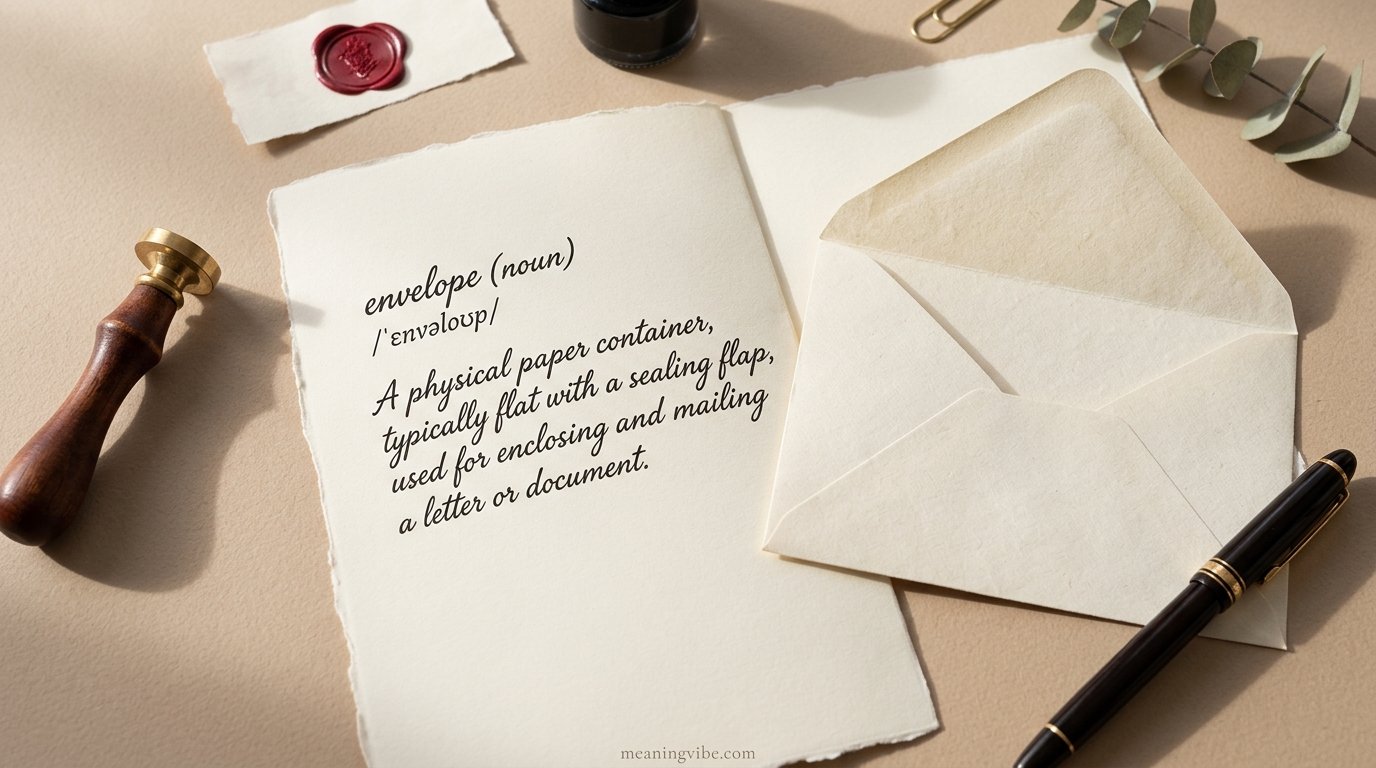
Look at the end of the word. If the thing in your sentence is paper, the word needs its final e, the same e that starts email, because both carry letters.
Flip it for the verb: envelop ends like develop, and develop is unmistakably a verb. Two everyday words, email and develop, stand guard over the two spellings permanently.
Test 2: The Sound Test
Say the sentence aloud and listen for the stress. The verb leans on its middle: en-VEL-up. The noun leans on its start and stretches its end: EN-vuh-lohp, the long o created by that silent final e.
If your mouth wants to say the short, tucked in version, you are speaking the verb. If it wants the long open ending, you are naming the noun.
Test 3: The Grammar Test
Look at the words around the gap. If a, an or the stands in front of it, the word is the noun, envelope, because articles only introduce nouns. “An envelop” is impossible English, which makes this test unusually reliable.
If to, will, has or a similar helper stands in front, or the word takes an object after it, the word is the verb, envelop.
And if you prefer substitution: replace the word with surround (verb, so envelop) or package (noun, so envelope) and see which one the sentence accepts.
Envelop: The Verb That Wraps and Surrounds
Envelop is the older word of the pair.
It has been in English since the 14th century, arriving from Old French envoluper, to wrap up, built from en- (in) plus a second element of unknown origin that also turns up in develop.
Its senses form one family: everything the verb describes is a complete surrounding. Dictionary definitions agree on three working senses:
- To wrap up in a covering: “She enveloped the gift in layers of tissue.”
- To serve as a covering for: “A membrane envelops the organ.”
- To surround entirely: “Darkness enveloped the valley by six.”
Notice what does the enveloping in good examples: fog, darkness, silence, warmth, mystery, arms. The verb is a favorite of descriptive writing precisely because its subjects are so often atmospheres, things that close around a person completely.
The Military Sense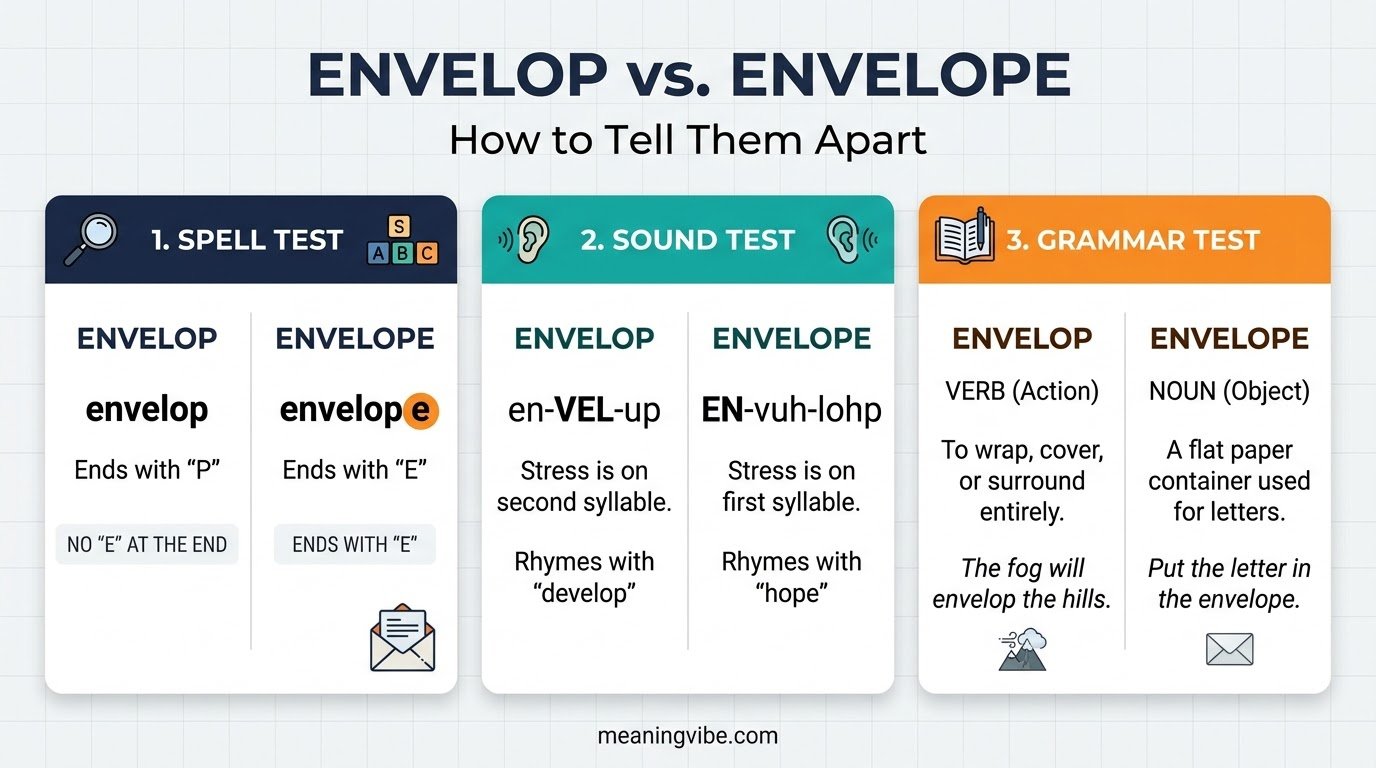
Envelop has one specialized sense worth knowing, because it appears in history books and strategy writing: to attack or surround an enemy force, traditionally on a flank, cutting it off from support.
“Their assignment was to envelop the head of the enemy column.” The maneuver as a noun is an envelopment, and once you have met the sense, military prose stops looking like it contains typos.
Enveloped In: The Phrase Family
The verb’s most common habitat is the phrase enveloped in, followed by whatever does the surrounding. The family is large and all figurative members work the same way:
- enveloped in fog or mist (weather closing in)
- enveloped in darkness or silence (senses shut down)
- enveloped in mystery or secrecy (information hidden, as if covered)
- enveloped in flames (the literal, dangerous member)
- enveloped in a hug or a blanket (the warm, physical member)
Every one of these takes the verb spelling, because in every one something is doing the surrounding. The phrase family is also where the reverse error breeds, addressed in the surgery section below.
A Register Note for Business Writers
Envelop is slightly literary in flavor. In fiction, journalism and formal prose it is perfect; in a routine business email, plainer verbs (surround, cover, wrap) often read cleaner.
That is a style choice, not a correctness rule. What is never a style choice is the spelling: whichever verb you pick, the action word in this pair is envelop, without the e.
The Forms of Envelop, and the P That Never Doubles
Most confusion traffic around this pair is not about the two base words at all. It is about their forms, and one form in particular generates its own searches.
|
Form |
Spelling |
Example |
|---|---|---|
|
Base verb |
envelop |
Fog can envelop the coast |
|
Third person singular |
envelops |
Night envelops the harbor |
|
Past tense and participle |
enveloped |
Mist enveloped the hills |
|
Present participle |
enveloping |
The enveloping fog hid the road |
|
Derived noun |
envelopment |
The envelopment of the position took hours |
|
Plural of the noun |
envelopes |
A pack of envelopes |
|
The noun itself |
envelope |
Put it in an envelope |
The P Rule
Here is the fact almost every guide omits: the final p of envelop does not double before a vowel suffix. The past tense is enveloped, never envelopped; the participle is enveloping, never envelopping.
The rule surprises writers because doubling is common after stressed syllables (admitted, regretted).
This word is a standing exception, and the Language Portal of Canada’s Writing Tips Plus states it plainly in its official writing guidance: the final p is not doubled before a suffix beginning with a vowel.
The Envelops Trap
One more form causes real damage: envelops. As a verb it is correct and common (“she envelops the present in paper”). As a plural it is always wrong, because the noun’s plural is envelopes, with the e and the s.
The fastest check is counting. If your sentence can count it (two, several, a stack of), the word is the noun and it needs the e: two envelopes. If something is doing it, the word is the verb: it envelops.
Envelope: The Noun You Can Hold
Envelope is the younger word: it entered English in the 16th century from French enveloppe, meaning a wrapper or enveloping layer, and the specific sense of a letter covering dates from the early 18th century.
The family relationship is the memory hook hiding in plain sight. The French noun was formed from the French verb: an enveloppe is the thing that does the envelopper-ing.
An envelope envelops a letter, which is why the two English words look like near copies.
The Mail Sense, Precisely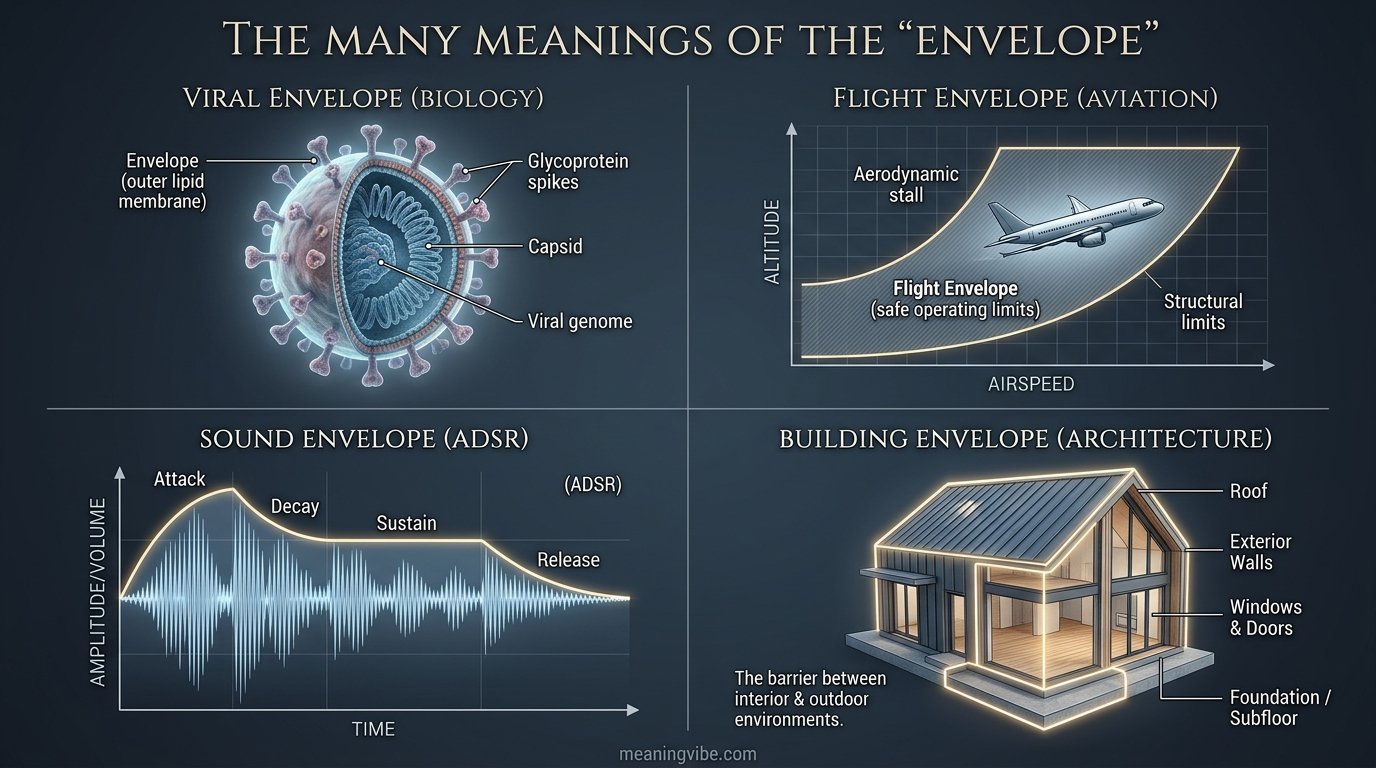
The everyday envelope is a flat, usually paper container with a sealable flap, made to enclose a letter or document. Around that core sits a small working vocabulary worth having:
- Window envelope: a transparent panel shows the address printed on the document inside; the bill and statement standard.
- Padded envelope (mailer): cushioned lining for small objects that need more than paper.
- Manila envelope: the sturdy brown office standard for documents.
- Self seal envelope: a peel and press flap that needs no moisture.
Addressing an Envelope, in Four Lines
The conventions are fixed and quick to state: the recipient’s name and address go in the center, the return address at the top left (or on the back flap in formal British style), and the stamp at the top right.
Write it a thousand times and the noun’s spelling writes itself with it. Nobody who addresses envelopes weekly confuses the word for the object in their hand.
Envelope Beyond Mail: The Sense Map
The noun escaped the post office centuries ago. Any field that needs a word for an outer boundary or a containing layer has adopted envelope, always with the e, because it is always a thing, never an action.
|
Field |
What “envelope” means |
In a sentence |
|---|---|---|
|
Mail and office |
The paper container for a letter |
The contract arrived in a plain envelope |
|
Biology |
The lipid membrane around some viruses |
Influenza is an enveloped virus with a fragile envelope |
|
Aviation |
The set of performance limits an aircraft may not exceed |
Test pilots explore the edges of the flight envelope |
|
Mathematics |
A curve tangent to a whole family of curves |
The sliding ladder traces an envelope curve |
|
Music and audio |
The shape of a sound over time, set by ADSR |
A slow attack gives the pad a soft envelope |
|
Electronics |
The varying outline of a signal’s amplitude |
The detector follows the signal envelope |
|
Architecture |
The building’s outer shell: walls, roof and seals |
A tight building envelope cuts heating costs |
|
Astronomy |
A star’s or comet’s outer layer of gas |
The comet’s envelope glows near the sun |
|
Balloons and airships |
The gas containing bag itself |
The airship’s envelope holds the helium |
Read the table vertically and a pattern teaches itself: in every field, envelope names a boundary you can point to. The verb never appears in these senses, because limits and membranes do not act; they enclose.
A language note fits here: words grow new senses by exactly this kind of borrowing, which is the process traced in how online words and phrases change meaning across contexts.
Envelope is a model case: one concrete object lending its name to every abstract boundary that resembles it.
How to Say Them: Pronunciation and the Stress Shift
Spelling separates the pair on the page; stress separates them in the ear. The respellings used by Cambridge Dictionary’s entry for envelop and the major dictionaries agree:
- Envelop: en-VEL-up. Stress on the second syllable; the first o shrinks to a short uh sound.
- Envelope: EN-vuh-lohp. Stress on the first syllable; the final o is long, lengthened by the silent e.
The silent e, in other words, is not decoration. It does two jobs at once: it marks the word as the noun, and it stretches the final vowel so your ear can hear the difference.
Remove it and the vowel collapses, which is precisely the verb’s sound.
The ON-velope Variant
Many speakers pronounce the noun’s first syllable like “on” (ON-vuh-lohp), a French influenced reading of the word’s origin. Dictionaries list it as an accepted variant, so neither pronunciation marks a speaker as wrong.
The verb has no such variant: its first syllable stays “en.” When in doubt in speech, stress is the safer signal than the first vowel: middle stress means verb, first syllable stress means noun.
Why the Homophone Label Fails
Calling the pair homophones predicts they are interchangeable in speech, and they are not: a listener hearing en-VEL-up knows an action is coming, and hearing EN-vuh-lohp expects an object.
The distinction is the same device English uses in pairs like advice and advise, where spelling and sound shift together.
That is also why reading your sentence aloud is a genuine editing tool for this pair.
The wrong word usually sounds wrong before it looks wrong, because your ear knows the stress pattern even when your eye skips the final e.
Two Idioms, Two Origins
Pushing the Envelope
To push the envelope is to go beyond the current limits of what is possible or acceptable. The origin surprises most people: it has nothing to do with mail.
The envelope here is the flight envelope, the plotted boundary of speed, altitude and load within which an aircraft can fly safely.
Test pilots were said to push the envelope when they deliberately expanded that boundary, and the phrase crossed into general English with that daring sense intact.
Idiom origins are a genre of their own on Meaning Vibe; what playing chicken means traces one from a game of daring, and this one comes from an even more literal test of nerve.
Back of the Envelope
A back of the envelope calculation is a quick, rough estimate, worked out informally on whatever paper is at hand. The image is an engineer sketching numbers on the back of a used envelope rather than opening a notebook.
This idiom does use the mail noun, envelope with its e, because a physical envelope is literally in the picture.
Between the two idioms, one borrows the boundary sense and the other the paper itself, and both keep the noun spelling.
Sentence Surgery: Ten Wrong Sentences Fixed
Rules teach; repairs stick. Each sentence below contains the error writers actually make, followed by the fix and the test that catches it.
|
Wrong |
Right |
The test that catches it |
|---|---|---|
|
Put the check in an envelop |
Put the check in an envelope |
“An” in front means the noun, with the e |
|
Darkness will envelope the town |
Darkness will envelop the town |
“Will” in front means the verb, no e |
|
The fog began to envelope the harbor |
The fog began to envelop the harbor |
“To” in front means the verb |
|
She bought a pack of envelops |
She bought a pack of envelopes |
You can count them, so the noun’s plural |
|
He was envelopped in a blanket |
He was enveloped in a blanket |
The p never doubles |
|
A hush envelope the room |
A hush enveloped the room |
The hush acts, so the verb (past tense) |
|
Seal the envelop before mailing |
Seal the envelope before mailing |
“The” in front means the noun |
|
Warmth will enveloppe you |
Warmth will envelop you |
No such spelling exists; the verb has no final e |
|
Two envelops sat on the desk |
Two envelopes sat on the desk |
The count word “two” means the noun |
|
The mist enveloping the valley (fine) |
The mist enveloping the valley |
Correct as written: participle of the verb |
Run the wrong column quickly and notice something encouraging: every single error is caught by one of the three tests. There is no sentence in English where this pair requires taste or luck.
Memory Tricks That Actually Stick
Collect the devices here and keep the one your brain likes; using two is not better than using one reliably.
1. E for the paper trail.
Envelope has its final e, email starts with e, and paper ends in r just as letter does. The e family (email, e-letter) belongs to the object you can hold.
2. Envelop ends like develop.
Develop, involve, revolve: verbs ending in that -velop, -volve music act. When your word is doing something, give it the verb’s ending too.
3. The riddle.
What word starts with e, ends with e, and has only one letter in it? An envelope, because it holds a letter. The riddle is centuries into its career as a memory device and still works on first hearing.
4. The envelope envelops.
The noun performs the verb: an envelope envelops a letter. Say the sentence once and the relationship, thing first with its e, action after without, is stored as a picture rather than a rule.
5. Count it or watch it act.
The five second habit that replaces all tricks under deadline: if you can count it, spell envelope; if you can watch it act, spell envelop. Counting and acting are the two jobs, and the words never swap them.
Keep the Pair in Its Family
This pair belongs to a large family of one letter traps, and the tests here transfer to most of them. The site’s word pairs cover the closest relatives in depth.
The E aisle alone holds elicit vs illicit, emigrate vs immigrate, eminent vs imminent and emersion vs immersion, four pairs where one letter or one syllable flips the meaning entirely.
Pairs built on the same verb and noun machinery as this one include device vs devise, the closest structural relative, and canvas vs canvass, where the extra s turns cloth into an activity.
And for pairs separated by history rather than grammar, born vs borne and draft vs draught show spelling doing the work that stress does here. One method, three tests, and the whole family gets easier.
The Origin Story: One French Verb, Two English Words
The pair’s resemblance is not a coincidence or a trap set by the language. It is a family relationship, and knowing it makes the distinction feel inevitable rather than arbitrary.
Old French had the verb envoluper, to wrap up. English borrowed it in the Middle Ages as envolupen, later envelop, and it has been the wrapping verb ever since.
The second element of the French word is of unknown origin, but it survives in one famous relative: develop, which is historically the unwrapping word, en- reversed.
Centuries later, French formed a noun from its own verb: enveloppe, the wrapper, the thing produced by wrapping. English borrowed that too, in the 16th century, as envelope.
It first meant any enveloping layer; the letter covering sense arrived in the early 18th century, as letter writing became everyday infrastructure.
So the noun is literally the verb’s child: an envelope is that which envelops.
The spelling kept the family resemblance, and English assigned the extra letter to the child, which is why the object, not the action, carries the final e.
The object itself is far older than the word.
The earliest known envelopes are hollow clay balls from ancient Mesopotamia, around 3500 BC, used to hold accounting tokens; paper versions followed in China after paper’s invention, and the folded, gummed diamond shaped envelope became standard only in the 19th century.
Choosing the Verb: Envelop and Its Rivals
Because envelop sits slightly literary, writers often reach for a neighbor. The neighbors are not interchangeable; each shades the surrounding differently, and choosing among them is the advanced skill this pair leads to.
|
Verb |
Shade of meaning |
Best for |
|---|---|---|
|
Envelop |
Complete, often atmospheric surrounding |
Fog, darkness, warmth, mystery: “Silence enveloped the room” |
|
Enwrap |
Physical wrapping, close and deliberate |
Parcels and people in cloth: “She enwrapped the gift” |
|
Surround |
Neutral, spatial, any degree of completeness |
Everyday and technical prose: “Fences surround the site” |
|
Encompass |
Including within a range or scope |
Abstract coverage: “The role encompasses three duties” |
|
Engulf |
Overwhelming, threatening, consuming |
Flames, waves, panic: “Fire engulfed the warehouse” |
|
Blanket |
Covering a surface evenly, like snow |
Weather and coverage: “Snow blanketed the town” |
Two practical rules follow. When the surrounding feels like an atmosphere or a mood, envelop is the precise word and its slight formality is an asset.
When the sentence is instructional or technical, surround and cover are cleaner, and nobody should pay a style price for a spelling they have now mastered.
Frequently Asked Questions
What is the difference between envelop and envelope?
Envelop (no final e) is a verb meaning to wrap, cover or surround completely. Envelope (with final e) is a noun, the flat paper container for a letter, and by extension any covering layer.
The final e changes the job, the sound and the meaning.
Is it envelop or envelope for a letter?
Envelope, always with the final e. The paper container is never spelled envelop in standard English. If the word follows a, an or the, it is the noun and it takes the e.
How do you pronounce envelop?
en-VEL-up, with the stress on the second syllable and the o reduced to a short uh sound. It rhymes roughly with develop, which shares its rhythm and its verb job.
How do you pronounce envelope?
EN-vuh-lohp, with the stress on the first syllable and a long o at the end, lengthened by the silent e. A common variant says the first syllable like “on” (ON-vuh-lohp); both are accepted.
Are envelop and envelope homophones?
No, not exactly. Homophones sound identical, and these two differ in stress and in the final vowel: en-VEL-up versus EN-vuh-lohp. They are near homophones, close enough to confuse in fast speech, different enough to teach apart.
Is envelop a real word?
Yes. Envelop is a standard verb in every major dictionary, in English since the 14th century, from Old French envoluper, to wrap up.
It is less common than the noun, which is why it looks like a misspelling to many readers.
Can envelope be used as a verb?
In standard modern English, no. The verb is envelop without the e. Writing “the fog will envelope the town” is a common error; the correct form is “the fog will envelop the town.”
What does envelop mean?
To wrap up in or as in a covering, to serve as a covering for, or to surround entirely. Fog envelops a harbor, darkness envelops a room, and troops in the military sense envelop an enemy’s flank.
What does enveloped mean?
Enveloped is the past tense and past participle of envelop: wrapped or surrounded completely. A figure enveloped in a cloak, a town enveloped in mist, a plan enveloped in mystery.
Is it enveloped or envelopped?
Enveloped, with one p. The final p of envelop is not doubled before a vowel suffix, a spelling rule stated in official guidance including the Language Portal of Canada. Envelopping and envelopped are always wrong.
What is the plural of envelope?
Envelopes. The noun adds a plain s. Do not confuse it with envelops, which is the third person singular of the verb: she envelops the gift in tissue; the gifts go in envelopes.
Can envelops ever be correct?
Yes, as a verb form: he envelops, she envelops, it envelops. Envelops is wrong only when used as the plural of the noun. Context decides: a verb slot takes envelops, a counted object takes envelopes.
What is the noun form of envelop?
Envelopment, meaning the act or state of enveloping, and in military writing the maneuver of surrounding an enemy force. There is also the rare agent noun enveloper, something or someone that envelops.
Where does envelope come from?
From French enveloppe, itself formed from the verb envelopper, to envelop. The noun entered English in the 16th century meaning a wrapper or enveloping layer; the specific sense of a letter covering dates from the early 18th century.
Where does envelop come from?
From Old French envoluper, to wrap up, built from en- (in) plus a second element of unknown origin that also appears in develop. The verb has been in English since the 14th century, earlier spelled envolupen and invelope.
Why do envelop and envelope look so alike?
Because the noun was formed from the verb. In French, enveloppe is the thing produced by envelopper, the act of wrapping.
English borrowed both, kept the spellings close, and let the final e mark the noun and lengthen its final vowel.
What does “pushing the envelope” mean?
Going beyond the current limits of performance or acceptability. It comes from aviation: the flight envelope is the set of speed, altitude and load limits an aircraft can safely operate within, and test pilots pushed that envelope to expand it.
What is a back of the envelope calculation?
A quick, rough estimate worked out informally, as if sketched on the nearest scrap of paper. Despite the name, it uses the noun envelope, and it signals approximation, not precision.
What is an envelope in biology?
The lipid membrane that surrounds some viruses, called enveloped viruses, including influenza and coronaviruses. The envelope is taken from the host cell’s membrane as the virus buds out, and it carries proteins the virus uses to enter new cells.
What is a flight envelope?
The full set of operating limits for an aircraft: the combinations of speed, altitude and load factor within which it can fly safely.
Engineers plot it as a boundary diagram, and flying outside the envelope risks structural failure or loss of control.
What is an envelope in music and electronics?
The shape of a sound or signal over time: how its level rises and falls. Synthesizers shape it with ADSR, attack, decay, sustain and release. The same word names the varying amplitude outline of any waveform.
What is an envelope in math?
A curve that is tangent to each member of a family of curves, forming their outer boundary. The classic picture is a ladder sliding down a wall: the curve its path sweeps out is the envelope of the ladder’s positions.
Are there other meanings of envelope?
Yes: the gas bag of a balloon or airship, a covering layer in general (the envelope of a seed), a star’s outer atmosphere in astronomy, and in construction the building envelope, the walls, roof and seals that separate inside from outside.
How can I remember which is which?
Use the paper test: envelope has an e at the end just as email starts with e, and both carry letters. And envelop ends like develop, its fellow verb.
If you can count it, it is the envelope; if it acts, it is envelop.
What is a quick test while writing?
Ask what job the word does. If you can put a, an or the in front of it, it is the noun, envelope.
If it follows to or will, or takes an object, it is the verb, envelop. Or substitute: package means envelope, surround means envelop.
Is the spelling the same in British and American English?
Yes. Unlike practice and practise, this pair does not split by region. British and American English both use envelop for the verb and envelope for the noun, with the same pronunciations.
Does envelope have a silent e?
Yes, and it is a working silent e: it signals the long o in the last syllable (lohp rather than lup) and marks the word as the noun. Envelop, without it, keeps the short reduced vowel.
What part of speech is enveloping?
It is the present participle of the verb envelop, used in continuous tenses (the fog is enveloping the coast) and as an adjective (an enveloping warmth, an enveloping sense of calm).
How do you use envelop in a sentence?
As an action with an object: “Mist began to envelop the hills.” “A hush enveloped the room.” “The scarf enveloped her shoulders.” Something always does the enveloping, and something is enveloped.
How do you use envelope in a sentence?
As a thing you can count, seal or hold: “She slipped the letter into an envelope.” “Write the address on the envelope.” “He bought a pack of envelopes.” If it can be plural, it is the noun.
Is “envelop the package” correct?
It can be: it means wrap or surround the package, which is a valid verb use. If you mean put the package’s contents into a mailing sleeve, the clearer sentence names the noun: put it in an envelope.
Why does my spell checker accept both words?
Because both are real words. Spell checkers catch non words, not wrong choices between two valid words. Grammar checkers do better, since they can read the part of speech your sentence needs, but the final check is the writer’s.
What does “enveloped in mystery” mean?
Completely surrounded by, or hidden within, mystery: the details are covered so nothing can be seen clearly. The phrase uses the verb’s covering sense figuratively, as do enveloped in fog, darkness, silence or secrecy.
What is the military meaning of envelop?
To attack or surround an enemy force, traditionally on a flank, cutting it off. The maneuver as a noun is an envelopment. It is the verb’s surrounding sense applied to tactics, and it appears in military history writing.
Can a person envelop another person?
Yes, usually in an embrace or a covering sense: “She enveloped the child in a hug,” or with a blanket. The subject does the surrounding, so the sentence needs the verb spelling, envelop.
What is a window envelope?
An envelope with a transparent panel through which the address printed on the enclosed document shows. It is a type of the noun, used for bills and statements, and it is spelled envelope like every other paper kind.
Is envelope a countable noun?
Yes: one envelope, two envelopes, a stack of envelopes. Countability is itself a test: verbs cannot be counted, so if your sentence counts it, the word must be the noun with the final e.
Does envelop have synonyms I can use instead?
Yes: wrap, enfold, surround, enclose, encompass, encircle, swathe, engulf and blanket, each with its own shade. In plain business writing these are often clearer than envelop, which has a slightly literary flavor.
What is the riddle about envelope?
The classic word riddle asks: what word starts with e, ends with e, and has only one letter in it? The answer is envelope, because an envelope holds a letter.
It is also a handy memory device for the final e.
How do you address an envelope correctly?
The recipient’s name and address go in the center, the return address at the top left (or on the back flap in formal British style), and the stamp at the top right.
The word for the object throughout is envelope, with the e.
Is “an envelop” ever correct grammar?
No. The article an can only precede a noun, and the noun is envelope. “An envelop” is always an error, which makes the article test reliable: a, an or the in front means the e spelling.
What is the fastest way to check my sentence?
Substitute: replace the word with surround (verb) or package (noun). Whichever fits is your spelling: surround takes envelop, package takes envelope. The test takes two seconds and works in every sentence.
Conclusion
Envelop vs envelope resolves to a single letter doing honest work.
The final e builds the paper object, lengthens its vowel and parks its stress at the front; without the e, the word gets up and acts, wrapping, covering and surrounding.
Keep the three tests within reach, spell test, sound test, grammar test, and the pair stops costing you edits.
And when a sentence resists all three, count it or watch it act: the noun can be counted, the verb can be watched, and neither has ever swapped jobs.
One small exercise before you close this page: take the last email or message you wrote and search it for both spellings.
If the pair behaved, you have the system already; if it did not, you now know exactly which test would have caught it.