

Disinterested vs uninterested confuses writers because both words describe a lack of interest, but only one of them means impartial, and the other one means bored.
Disinterested in careful standard use means impartial, unbiased, and free from a personal stake. Uninterested means not interested, bored, indifferent, or unengaged with a topic, event, or person.
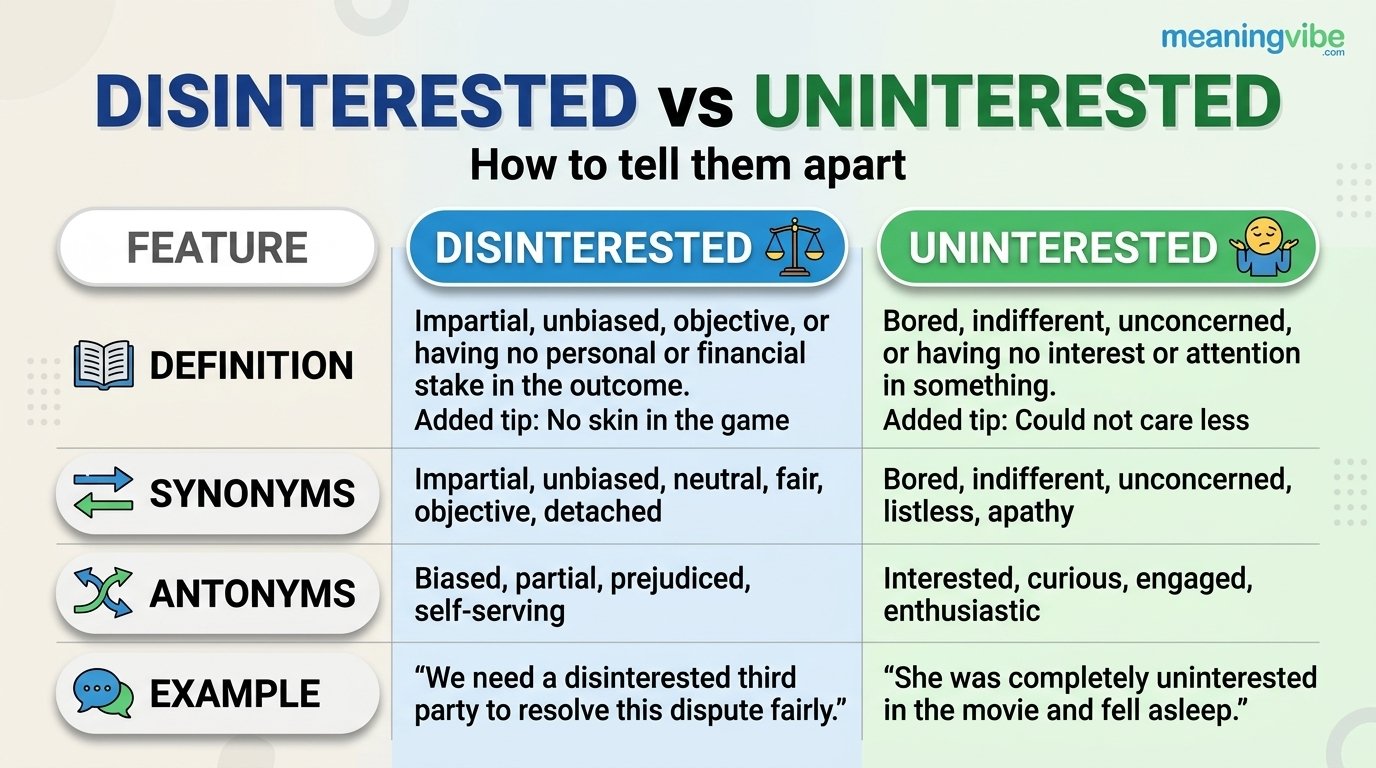
The fastest check uses two substitute words: impartial for disinterested, and bored for uninterested. If the substitute fits, the spelling follows, and the sentence stays clear.
Table of Contents
ToggleDisinterested vs Uninterested in One Line
Disinterested answers the question, “Does this person gain or lose from the outcome?” Uninterested answers the question, “Does this person care about the topic?”
A judge can be disinterested and deeply engaged at the same time, while a student can be uninterested and still have no stake at all. That contrast is the whole distinction in one sentence.
| Word | Core meaning | Key question | Typical person |
|---|---|---|---|
| Disinterested | Impartial, no personal stake | Who gains or loses? | Judge, referee, mediator, observer |
| Uninterested | Not interested, bored, indifferent | Who cares? | Student, audience, reader, viewer |
What Does Disinterested Mean
Disinterested means unbiased by personal interest or advantage, and not influenced by selfish motives. Dictionary.com gives that definition as the first and most widely accepted meaning.
A disinterested person has no horse in the race, no bet on the result, and no profit from one side winning. That person can still watch closely, listen carefully, and judge fairly.
Grammarly defines disinterested as without a vested interest, which explains its frequent use in legal and business writing. A judge, director, or investigator must be disinterested to be trusted.
The word does not mean cold, distant, or uncaring in its standard sense. A disinterested mediator may care deeply about fairness, while caring nothing about which side wins.
Disinterested as Impartial and Unbiased
An impartial person treats both sides by the same standard, without favouring one side. An unbiased person starts without a prior preference that would distort evidence or argument.
A disinterested observer is the classic example from Dictionary.com, because an observer can watch without gaining from the result. That observer may be curious, alert, and fully engaged.
A disinterested decision by a referee, cited by WordReference, means a decision made without selfish motives. The referee may love the sport, yet still judge a foul without favour.
That sense is why disinterested appears in phrases such as disinterested party, disinterested third party, and disinterested inquiry. Each phrase promises neutrality, not boredom.
Disinterested as Having No Personal Stake
A personal stake means a gain, loss, benefit, or advantage tied to an outcome. A disinterested person has no such stake, even if they know the people involved or understand the topic well.
Quick and Dirty Tips states the rule plainly: a disinterested person is impartial, unbiased, or has no stake in the outcome. That stake test is the most reliable test for the word.
A director who must approve a bid must be disinterested and receive no benefit from the transaction, as Grammarly shows. If that director would profit, the director is interested, not disinterested.
A mediator must be disinterested in the same way, because both sides must trust that the mediator will not favour one side. Trust fails when a hidden stake appears, even if the mediator seems fair.
A Disinterested Person Can Still Be Deeply Engaged
One of the most useful lessons for learners is that disinterested does not mean disengaged. A judge can follow every witness, a referee can watch every play, and an investigator can read every file.
Apostrophes, an Australian style blog, makes that point vividly: a disinterested judge or umpire may be extremely interested in what happens in front of them. The judge is interested in the case, but has no interest in the outcome.
That distinction turns on two meanings of interest: curiosity and attention on one side, and a stake or advantage on the other side. Disinterested negates the stake meaning, not the curiosity meaning.
A student who loves sport can be a disinterested spectator for a match between two teams they do not support. That student may cheer good play, yet still judge fairly, because neither team is theirs.
What Does Uninterested Mean
Uninterested means having or showing no feeling of interest, and being indifferent to a topic, activity, or person. Dictionary.com gives that definition directly, with a student and Shakespeare example.
An uninterested person may be bored, unconcerned, or simply unengaged, because the topic does not attract attention. That person may still be fair, kind, and intelligent in other areas.
Grammarly defines uninterested as not showing interest, with examples such as a student uninterested in maths who prefers social studies. That preference shows a lack of attraction, not a lack of fairness.
The word does not imply a stake, a bias, or a conflict of interest. An uninterested voter may ignore an election, while an interested voter with a stake may still vote unfairly in a different sense.
Uninterested as Bored
Bored means weary from lack of excitement, variety, or engagement, and it is the most common everyday sense of uninterested. A long, dull lecture can leave students uninterested, even if the topic matters.
Vocabulary.com phrases the bored sense bluntly: if you are uninterested, you do not give a hoot, and you are bored. That blunt phrasing helps learners remember the emotional tone.
A viewer who switches off a slow film is uninterested in that film, not disinterested in a legal sense. The viewer has no fairness duty, only a preference that the film failed to meet.
A reader who puts down a dull book is uninterested in that book, even if the book is well written for other readers. Boredom is personal, and it does not imply bias.
Uninterested as Indifferent and Unengaged
Indifferent means having no preference, concern, or strong feeling about a matter, and it overlaps with uninterested in many sentences. A person can be indifferent to a menu choice, a film genre, or a hobby.
Unengaged means not participating, not paying attention, or not investing effort, and it fits school, work, and audience contexts well. An uninterested audience may sit quietly, check phones, or leave early.
Quick and Dirty Tips lists bored, unconcerned, and indifferent together for uninterested, which shows the range from mild indifference to active boredom. All three share a lack of attraction.
A worker who is uninterested in a new policy may still follow it, because indifference does not always mean resistance. That worker simply does not care enough to argue, praise, or study it.
Uninterested Does Not Mean Impartial
Uninterested almost never means impartial in modern standard use, and learners should not use it for fairness contexts. Merriam-Webster usage research, cited by Quick and Dirty Tips, notes that uninterested rarely means disinterested.
A bored judge would be a problem, not a virtue, because a judge must pay attention to be fair. Calling a bored judge uninterested is accurate, while calling that judge disinterested would praise a flaw as a virtue.
A referee who is uninterested in a match may miss fouls, lose focus, or fail to control play. A referee who is disinterested in the outcome will still watch closely and enforce rules fairly.
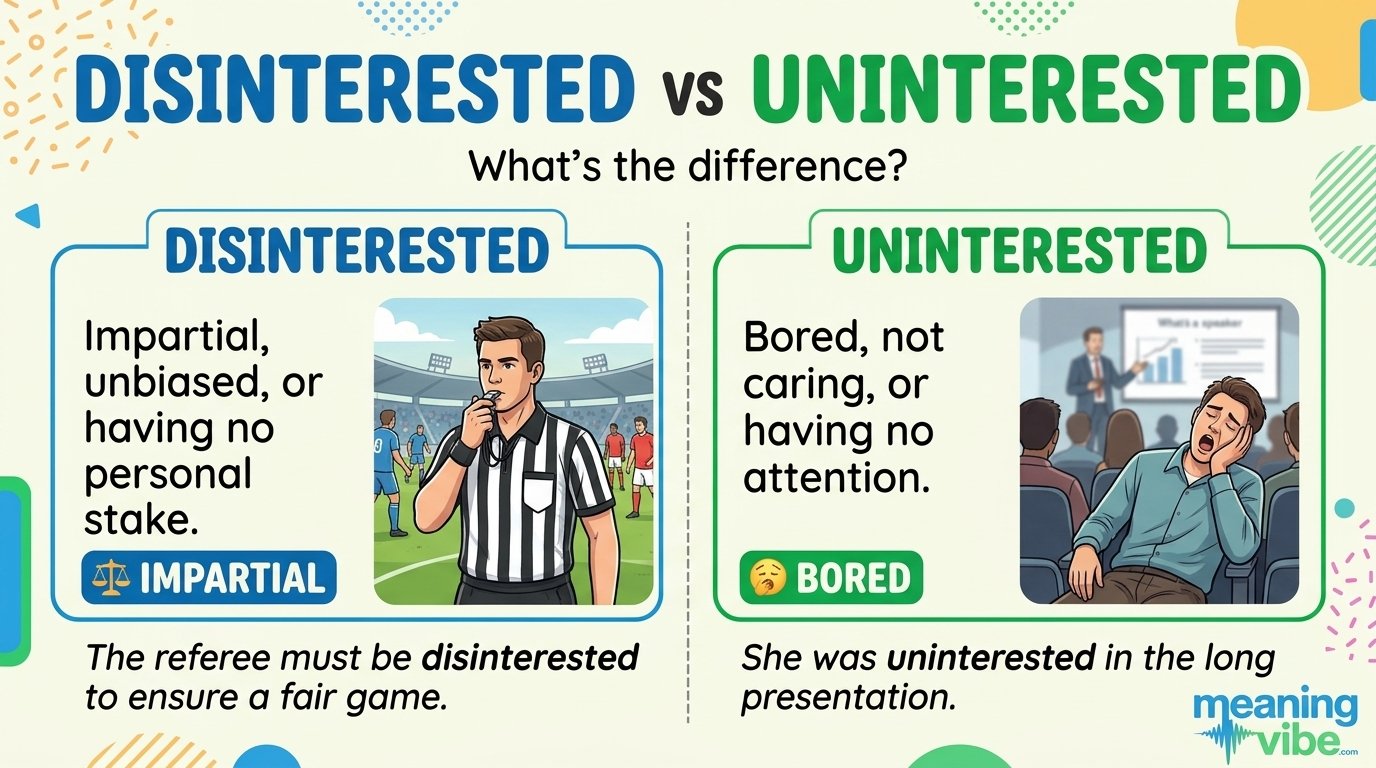
That contrast shows why the distinction matters in professional writing: one word praises neutrality, while the other criticises inattention. Swapping them can reverse the intended judgment.
Disinterested vs Uninterested Comparison Table
| Feature | Disinterested | Uninterested |
|---|---|---|
| Core meaning | Impartial, no personal stake | Not interested, bored, indifferent |
| Opposite | Partial, biased, interested in the outcome | Interested, engaged, curious, enthusiastic |
| Key test | Does the person gain or lose? | Does the person care? |
| Can the person be engaged? | Yes, often deeply engaged | No, by definition not engaged |
| Typical context | Law, business, sport, mediation, research | School, media, everyday preferences |
| Typical collocation | Disinterested party, observer, judge | Uninterested student, audience, reader |
| Second, contested meaning | Not interested, in dictionaries, objected to by style guides | Rarely impartial, in older or rare use |
| Safe replacement | Impartial, neutral, unbiased | Bored, indifferent, unengaged |
The table shows why context alone cannot always save a swapped word, because both words can appear in the same sentence with opposite meanings. A disinterested judge is praised, while an uninterested judge is criticised.
Two Meanings of Interest: Curiosity and Stake
The pair makes sense only when interest is split into two meanings. One meaning is curiosity, attention, and engagement, while the other meaning is a stake, advantage, or financial share.
Interest as Curiosity and Attention
Interest as curiosity means attention engaged by something new, pleasant, or important. A child shows interest in dinosaurs, a reader shows interest in a mystery, and a voter shows interest in a debate.
Uninterested negates that curiosity meaning: the child does not care about dinosaurs, the reader does not care about the mystery, and the voter does not care about the debate. That negation is clean and uncontested.
Dictionary.com explains that interested usually means having attention or curiosity engaged, which is why uninterested feels natural for boredom. Learners should anchor uninterested to that curiosity meaning first.
Interest as Stake, Advantage, and Benefit
Interest as a stake means a share, benefit, or advantage in an outcome, such as money, property, reputation, or power. A business owner has an interest in a deal, a parent has an interest in a school decision, and a player has an interest in a match result.
Disinterested negates that stake meaning: the person has no share, no benefit, and no advantage from one outcome over another. That negation is the traditional, careful meaning of disinterested.
Dictionary.com notes a less common definition of interested as influenced by personal or selfish motives, with a stake or money involved. That business and finance sense is the key to disinterested, not the curiosity sense.
A person can be interested in the curiosity sense and disinterested in the stake sense at the same time. That combination is exactly what a good judge, referee, or mediator must achieve.
Why the Same Root Produces Opposite Confusion
Both words come from interested, with different prefixes: dis for disinterested, and un for uninterested. Learners often assume different prefixes must mean the same negation, but here they negate different senses of interest.
Quick and Dirty Tips explains that disinterested means no ethical conflict, while uninterested means no curiosity, and that split follows the two interest meanings. That explanation is the clearest one-line history for students.
A useful paraphrase helps: disinterested means without an interest in the outcome, while uninterested means without interest in the topic. The first phrase uses interest as a noun for a stake, while the second uses it for attention.
History Twist: The Meanings Swapped Over Time
The history of the pair surprises most learners, because the modern distinction is newer than the words themselves. Dictionaries and usage guides agree on the broad twist, even when they disagree on current advice.
Disinterested Originally Meant Not Interested
Dictionary.com and Collins both note that disinterested originally meant not interested or indifferent, and that the bored meaning is a revival of an obsolete meaning. That original sense explains why many writers still use disinterested for boredom today.
Collins lists disinterested as not interested, with a usage note that many people consider that use incorrect. That note shows the tension between historical use and modern style advice in one entry.
WordReference gives a similar history: disinterested was originally used to mean not interested, while uninterested in its earliest use meant impartial. That swap is unusual, and it explains why the pair feels unstable.
Uninterested Originally Meant Impartial
Uninterested in its earliest use meant impartial, which is the opposite of its modern main meaning. Merriam-Webster usage research, cited by Quick and Dirty Tips, traces that early impartial sense clearly.
By various developmental twists, disinterested came to cover both senses, while uninterested settled mainly on not interested. Collins uses that exact framing, which helps learners see the shift as gradual, not sudden.
The current distinction between the two words emerged mainly with American usage writers in the late 1800s, according to Merriam-Webster usage research cited by Quick and Dirty Tips. That late emergence explains why older texts may use the words differently.
Modern Distinction Emerged in the Late 1800s
American usage writers in the late 1800s pushed the distinction that most style guides now teach: disinterested for impartial, uninterested for bored. That push succeeded in formal writing, but not completely in everyday speech.
Garner, author of Garner Modern English Usage, believes the distinction is worth preserving, even though many people have given up the fight, according to Quick and Dirty Tips. That belief shapes modern style advice, even when dictionaries record broader use.
Learners should not treat the late 1800s distinction as ancient or natural, because it is a deliberate style rule. Knowing its recent origin helps learners understand why dictionaries and style guides sometimes disagree.
Descriptive Use Versus Prescriptive Standard
Dictionaries describe how words are actually used, while style guides prescribe how words should be used in careful writing. The pair sits exactly on that boundary, so both views must be taught.
What Dictionaries Record: Both Senses Are Well Established
Dictionary.com states that both senses of disinterested are well established in all varieties of English, even though many argue it should only mean impartial. That statement is descriptive, not permissive for every context.
Collins lists disinterested as free from bias and as not interested, with a usage note about objections. WordReference lists unbiased first, then not interested, with a similar history note.
Vocabulary.com notes that disinterested appears almost twice as often as uninterested, and a quick scan shows it frequently means uninterested. That frequency claim is a competitor observation, not a verified corpus statistic, so it should be labelled as such at reuse.
The descriptive point matters for reading: when a novel, news article, or speech uses disinterested for boredom, the intended meaning is usually clear from context. Readers should not assume every such use is an error in comprehension, even if it is an error in style.
What Style Guides Advise: Reserve Disinterested for Impartial
Most style guides advise reserving disinterested for impartial, and using uninterested for bored or indifferent. Dictionary.com gives that advice directly, even while recording both senses.
Grammarly gives the same advice: preserve the distinction to avoid confusion, especially in legal and business contexts. Quick and Dirty Tips gives the same advice, with Garner as the authority for preservation.
The Australian style manual, cited by Apostrophes, states that disinterested often used to mean uninterested is not correct. That national style advice shows how strict some guides can be, even when dictionaries are broader.
For exams, formal essays, legal writing, and professional reports, the prescriptive standard is the safe choice. For casual speech, the descriptive use will usually be understood, but it may still be marked wrong in a test.
When Context Makes the Meaning Clear, and When It Does Not
Context often makes the intended meaning clear, as Dictionary.com notes, because a bored student and a neutral judge appear in different sentences. A sentence such as “She was disinterested in the film” will usually be read as bored, not impartial.
Context fails when the sentence could mean either sense, such as “The spectators were disinterested.” Grammar-Monster uses that exact trap: it is only correct for impartial if the writer means spectators did not support either side, even though the match may have been very interesting.
Context also fails in legal and business writing, where impartiality is a duty, not a mood. A sentence such as “The directors must be disinterested” must mean impartial, or the sentence loses its legal force.
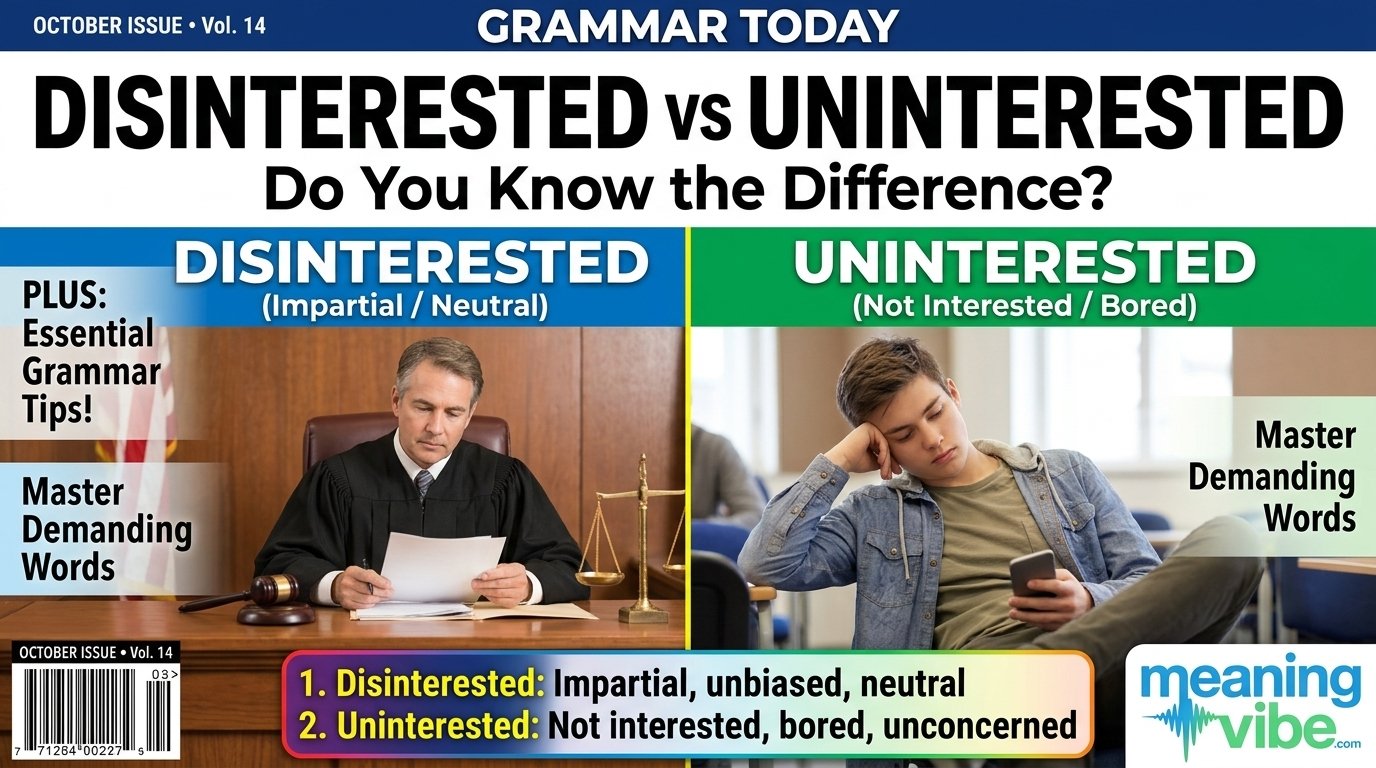
A safe writing habit is to avoid disinterested for boredom in any sentence where impartiality could also be intended. Use uninterested for boredom, and keep disinterested for fairness, and ambiguity disappears.
The Noun Problem: Disinterest Is Ambiguous
Disinterest as a noun inherits the same ambiguity as disinterested, because it can mean impartiality or lack of interest. That ambiguity makes the noun risky in precise writing, even when the adjective is clear in context.
Disinterest Can Mean Impartiality
Disinterest can mean freedom from bias, or the quality of being disinterested in the impartial sense. A phrase such as “the disinterest of the judge” could praise neutrality, if the context is legal.
That sense appears in phrases such as disinterestedness, the noun form listed by Collins and WordReference. That longer form is also ambiguous, because it can mean impartiality or indifference, depending on context.
Writers who need the impartiality sense should prefer impartiality, neutrality, or objectivity, which have no boredom sense. Those replacements remove ambiguity without changing the intended praise.
Disinterest Can Mean Lack of Interest
Disinterest can also mean lack of interest, boredom, or indifference, which is the sense most readers expect in everyday writing. A phrase such as “student disinterest” usually means students do not care, not that students are impartial judges.
That everyday sense makes disinterest a poor choice for legal writing, because a reader may hear boredom where fairness was intended. A legal sentence should not rely on context to rescue a key term.
Writers who need the boredom sense should prefer lack of interest, indifference, or boredom, depending on tone. Those replacements are clearer, and they avoid the noun ambiguity entirely.
Safer Replacements for the Noun
A simple replacement table helps editors fix noun errors quickly, without rewriting whole paragraphs. Each replacement keeps the intended meaning, while removing the ambiguity.
| Intended meaning | Avoid | Use instead |
|---|---|---|
| Impartiality | Disinterest | Impartiality, neutrality, objectivity |
| Lack of interest | Disinterest | Lack of interest, indifference, boredom |
| Impartial person | Disinterested party, ambiguous context | Impartial party, neutral observer |
| Bored person | Disinterested student, ambiguous context | Uninterested student, bored student |
That table is the most practical takeaway for editors, because it turns a history lesson into a one-line fix. Use it during proofreading, not just during study.
Related Words: Indifferent, Apathetic, Bored, Neutral, Objective
Related words help learners place the pair in a wider vocabulary map, without merging distinct meanings. Each related word has its own shade, and each shade matters in precise writing.
Indifferent: Neither for nor Against, or Not Caring
Indifferent can mean having no preference between options, or having no concern about a matter. A person indifferent to a menu choice has no preference, while a person indifferent to a cause has no concern.
That word overlaps with uninterested when it means not caring, but it also overlaps with neutrality when it means no preference. Writers should check whether preference or concern is the intended shade before using indifferent as a replacement.
A sentence such as “She was indifferent to the result” could mean she did not care, or she had no preference, and context must decide. That ambiguity is smaller than the disinterest ambiguity, but it still needs care.
Apathetic: Lack of Feeling or Energy
Apathetic means lacking feeling, interest, or energy, often with a sense of passivity or emotional flatness. An apathetic voter may not vote, not because of boredom alone, but because of disengagement from politics itself.
That word is stronger than uninterested in many contexts, because it suggests a deeper lack of motivation, not just a dull topic. A student uninterested in one lesson may still love school, while an apathetic student may have lost motivation broadly.
Writers should not use apathetic as a simple synonym for uninterested, because it adds a psychological shade that may not be intended. Use it only when lack of feeling, not just lack of attraction, is the point.
Bored: Weariness From Lack of Excitement
Bored means weary from lack of excitement, variety, or stimulation, and it is the most emotional synonym for uninterested. A bored audience wants something more engaging, while an indifferent audience may simply not care either way.
That emotional shade helps in narrative writing, where a character feeling is the point, but it hurts in formal writing, where a neutral description is better. A formal report should say uninterested, not bored, unless the emotion itself is evidence.
A sentence such as “The audience was bored” judges the performance, while “The audience was uninterested” describes attention. Both can be true, but they answer different questions.
Neutral, Objective, Impartial, Unbiased: The Fairness Family
Neutral means not taking sides, objective means based on facts rather than feelings, impartial means treating sides equally, and unbiased means free from prejudice. Those four words form the fairness family for disinterested.
A disinterested judge should be neutral, objective, impartial, and unbiased all at once, because each word covers a different aspect of fairness. Neutrality covers side-taking, objectivity covers evidence, impartiality covers treatment, and unbiased covers prejudice.
Writers who need a fairness word should choose the most precise member of that family, rather than defaulting to disinterested every time. That precision improves legal, business, and academic writing at once.
A researcher can be disinterested in funding, objective in method, and impartial in conclusion, all in the same study. Those three words work together, without repeating the same idea.
Disinterested vs Uninterested in Context
Context turns abstract definitions into usable decisions. Six settings cover almost every real example a learner will meet, from courtrooms to classrooms.
Law: Judges, Juries, Mediators, and Arbitrators
In law, disinterested is a duty, not a mood, because judges, jurors, mediators, and arbitrators must have no personal stake. Grammarly uses a judge and recusal example, while Grammar-Monster uses jury members who must be disinterested.
A judge who owns shares in a company before the court is interested, not disinterested, and must recuse or disclose that stake. A juror who knows a party personally may also be interested, even if that juror promises to be fair.
A disinterested mediator, cited by EnglishCurrent and LegalBrief AI, can facilitate talks without bias, because neither side fears a hidden advantage. That mediator may still be engaged, persuasive, and active throughout the session.
Legal writers should use disinterested only for that stake-free sense, and should use uninterested for a juror who stops paying attention. A bored juror is a fairness problem, not a fairness virtue.
Business: Directors, Investigators, and Third Parties
In business, disinterested directors, investigators, and third parties must evaluate deals, bids, and disputes without personal benefit. Grammarly uses directors who must be disinterested and receive no benefit from a transaction.
A disinterested investigator, cited by EnglishCurrent, can settle a dispute because neither side suspects a payoff. That investigator may still work hard, interview witnesses, and write a detailed report.
A disinterested third party, cited by EnglishCurrent as a common collocation, can give an objective answer before a purchase, because that party does not sell the product. That third party may still be curious about the product itself.
Business writers should avoid disinterested for a customer who does not care about a product, because that customer is uninterested, not neutral. A bored customer is a marketing problem, not a governance virtue.
Sport: Referees, Umpires, and Spectators
In sport, referees and umpires must be disinterested in the outcome, while spectators may be disinterested in the impartial sense or uninterested in the bored sense, depending on context.
Quick and Dirty Tips uses a referee with a bet as the classic negative example: a referee with a bet is interested, not disinterested. That bet creates a stake, even if the referee tries to be fair.
Grammar-Monster uses spectators as a trap: most spectators at a match were disinterested only if they supported neither side, even if the match was very interesting. If the spectators were bored, the correct word is uninterested.
A sports writer who writes “fans were disinterested” for a dull match risks praising neutrality where boredom was meant. That writer should write “fans were uninterested” for a dull match, and reserve disinterested for neutral officials.
School: Students, Readers, and Audiences
In school, uninterested dominates, because students, readers, and audiences are judged by attention, not by fairness duty. Dictionary.com uses a student uninterested in Shakespeare, while Grammarly uses a student uninterested in maths.
A teacher should not call a bored student disinterested, because that word would suggest the student is a neutral judge, not a disengaged learner. The correct word is uninterested, with a reason such as dull material or low relevance.
A student can be disinterested in a different sense, as a peer mediator for a class dispute, if that student has no stake in the outcome. That peer mediator may still care about fairness, while having no personal gain from either side winning.
That school example shows why both words can appear in the same classroom, for different roles. A bored learner is uninterested, while a neutral peer judge is disinterested.
Media and Politics: Observers, Commentators, and Voters
In media and politics, disinterested observers and commentators are valued for fairness, while uninterested voters and readers are a concern for engagement. Vocabulary.com uses disinterested researchers in a New York Times example, which shows the fairness sense in journalism.
A disinterested observer, cited by Dictionary.com as the best judge of behaviour, can report without favouring a party, candidate, or company. That observer may still follow the story closely, interview sources, and check facts.
An uninterested voter may ignore debates, skip news, or fail to vote, because politics does not attract attention. That voter is not impartial in a legal sense, but disengaged in a civic sense.
Media writers should not call a bored audience disinterested, because that would suggest the audience is a neutral jury, not a disengaged public. Audience engagement and audience neutrality are different problems, with different solutions.
Everyday Life: Films, Hobbies, and Relationships
In everyday life, uninterested dominates, because most everyday sentences describe preferences, not fairness duties. A person uninterested in football, cited by Quick and Dirty Tips, simply prefers another activity, such as watching a puppy show.
A person uninterested in a film, a hobby, or a new restaurant is expressing taste, not claiming neutrality. That person may still be fair about the film in a review, but fairness is not the point of the sentence.
A disinterested friend in everyday life usually means a friend with no stake in a dispute, such as a friend who can mediate between two other friends. That friend may still care about both friends, while having no gain from either side winning.
Everyday writers should default to uninterested for preferences, and save disinterested for mediation, judging, or advising contexts. That default prevents most everyday errors at once.
Fixed Phrases and Collocations Table
| Phrase | Word used | Meaning | Example |
|---|---|---|---|
| Disinterested party | Disinterested | Neutral party with no stake | A disinterested party mediated the dispute. |
| Disinterested third party | Disinterested | Outside neutral party | Ask a disinterested third party first. |
| Disinterested observer | Disinterested | Neutral watcher, no gain | A disinterested observer judged behaviour. |
| Disinterested judge | Disinterested | Judge with no stake | The judge must be disinterested. |
| Disinterested referee | Disinterested | Official with no bet or favour | The referee must be disinterested. |
| Disinterested inquiry | Disinterested | Neutral investigation | A disinterested inquiry reviewed the case. |
| Uninterested student | Uninterested | Student not engaged | The student was uninterested in maths. |
| Uninterested audience | Uninterested | Audience not engaged | The audience seemed uninterested. |
| Uninterested reader | Uninterested | Reader not engaged | The reader was uninterested in the topic. |
| Uninterested voter | Uninterested | Voter not engaged | The voter was uninterested in the debate. |
EnglishCurrent lists disinterested third party, observer, party, and inquiry as common collocations from corpus data, which shows how tightly disinterested binds to fairness roles. Those collocations rarely appear with uninterested, which binds to learners and audiences instead.
Traps to Avoid: Disinterested Observer, Uninterested Judge, and More
Four traps catch even careful writers, because they share people, settings, or sentences with the pair. Each trap needs a one-line rule to prevent confusion.
Trap 1: Disinterested Observer Versus Uninterested Audience
A disinterested observer watches without a stake, while an uninterested audience watches without attention. Both may sit in the same room, but they describe different qualities.
A court observer can be disinterested and alert, while a theatre audience can be uninterested and restless. Swapping those words would turn a praised observer into a bored one, or a bored audience into a neutral jury.
Writers should ask which quality matters: stake or attention. If stake matters, use disinterested; if attention matters, use uninterested.
Trap 2: Uninterested Judge Versus Disinterested Judge
An uninterested judge stops paying attention, misses evidence, or fails to control a trial. A disinterested judge pays attention, follows evidence, and has no stake in the outcome.
That pair is the highest stakes trap in the set, because it appears in legal writing where precision matters most. A single swapped word can turn a praise into a complaint, or a complaint into a praise.
Legal writers should proofread judge sentences twice, once for stake and once for attention. If either test fails, rewrite the sentence with impartial or bored, whichever is intended.
Trap 3: Disinterested in a Film Versus Uninterested in a Film
A person disinterested in a film, in dictionary use, could mean not interested in that film, but in style advice, that use is objected to. A person uninterested in a film clearly means not interested, with no style objection.
Dictionary.com gives a film example with disinterested for not interested, while style guides advise uninterested for that meaning. That split shows why learners should follow style advice for formal writing, even when dictionaries record broader use.
Everyday writers should use uninterested in a film, a book, or a hobby, and save disinterested for fairness contexts. That habit avoids the most common everyday error at once.
Trap 4: Disinterested Service Versus Uninterested Service
Disinterested service, cited by Vocabulary.com, means service without selfish motives, a virtue in ethics and business. Uninterested service means service without care, attention, or enthusiasm, a flaw in customer care.
A hotel that offers disinterested service in the old ethical sense promises fairness, not boredom. A hotel that offers uninterested service promises staff who do not care, which no hotel wants to advertise.
Writers should not use disinterested service for a bored staff member, because that would praise a flaw. Use uninterested service for bored staff, and impartial service for fair service, to keep the judgment clear.
Wrong Examples Corrected
Wrong examples teach faster than rules alone, because learners see the error and the fix side by side. Each row below keeps the same sentence structure, with only the target word changed.
| Wrong sentence, in careful standard use | Correct sentence | Why it changes |
|---|---|---|
| The judge was uninterested in the outcome. | The judge was disinterested in the outcome. | Fairness needs disinterested, not boredom. |
| The student was disinterested in maths. | The student was uninterested in maths. | Boredom needs uninterested, not impartiality. |
| The referee had a bet, so he was disinterested. | The referee had a bet, so he was interested. | A bet creates a stake, so neither fairness word fits. |
| Most spectators were disinterested in the dull match. | Most spectators were uninterested in the dull match. | Dull match means bored, not neutral. |
| Most spectators were uninterested in either team. | Most spectators were disinterested in either team. | No team preference means neutral, not bored. |
| She was disinterested in the film. | She was uninterested in the film. | Film preference needs uninterested in style advice. |
| The audience seemed disinterested. | The audience seemed uninterested. | Audience attention needs uninterested. |
| We need an uninterested mediator. | We need a disinterested mediator. | Mediation needs neutrality, not boredom. |
| The directors must be uninterested. | The directors must be disinterested. | Directors need no benefit, not boredom. |
| He was disinterested in learning piano. | He was uninterested in learning piano. | Learning preference needs uninterested. |
Grammarly, Grammar-Monster, and Dictionary.com all use wrong and corrected pairs, and that format works well for learners. The key is to keep the rest of the sentence identical, so only the target word carries the lesson.
Memory Tricks That Actually Work
Memory tricks help only when they connect to meaning, stake, or attention. The best tricks use a short phrase that survives under exam pressure.
Dis for Distance From the Outcome
Dis can suggest distance, detachment, or disconnection from an outcome, as BachelorPrint notes with disconnected, dispassionate, and distant. A disinterested person stands at a distance from the prize, not from the action.
Think “disinterested equals distant from the outcome,” and the fairness sense becomes obvious. That distance is about gain, not about attention, which is why a distant judge can still watch closely.
Use the distance trick as a first check, then run the stake test as well. Distance helps spelling, while stake helps meaning, and both checks together catch most errors.
Un for Unengaged, Uninvolved, and Unmoved
Un can suggest negation of engagement, as BachelorPrint notes with unengaged and uninvolved. An uninterested person is unengaged with the topic, uninvolved in the activity, and unmoved by the appeal.
Think “uninterested equals unengaged,” and the boredom sense becomes obvious. That unengagement is about attention, not about fairness, which is why a bored student can still be fair in other contexts.
Use the unengaged trick as a first check, then run the attention test as well. Prefix helps spelling, while attention helps meaning, and both checks together catch most errors.
Stake Test, Attention Test, and Swap Test
Three tests together decide almost every sentence in the pair. First, ask the stake test: does the person gain or lose from the outcome, and if not, disinterested may fit.
Second, ask the attention test: does the person care about the topic, and if not, uninterested may fit. Third, run the swap test: replace the word with impartial or bored, and keep the version that still makes sense.
A sentence that passes both stake and attention tests needs rewriting, because it mixes fairness and boredom. A sentence such as “The judge was bored but fair” is clearer than any single word choice.
A simple chant helps younger learners: “Disinterested is fair, uninterested is bored.” Short, rhythmic rules stick better than long definitions during tests.
Quiz: Disinterested or Uninterested, With Explanations
Choose disinterested or uninterested for each blank, then check the answer and reason. Each explanation restates the stake versus attention rule in one line.
- The judge must be ______ in the case. Answer: disinterested. Fairness needs no stake.
- The student was ______ in maths. Answer: uninterested. Boredom needs uninterested.
- We need a ______ third party to mediate. Answer: disinterested. Mediation needs neutrality.
- The audience seemed ______ during the dull play. Answer: uninterested. Dull play means bored.
- A ______ observer is the best judge of behaviour. Answer: disinterested. Neutral observation needs disinterested.
- She was ______ in football, so she watched a puppy show. Answer: uninterested. Preference needs uninterested.
- Directors must be ______ and receive no benefit. Answer: disinterested. No benefit needs disinterested.
- Most spectators were ______ in either team. Answer: disinterested. No team preference means neutral.
- Most spectators were ______ in the dull match. Answer: uninterested. Dull match means bored.
- He was ______ in mass transit, preferring cars. Answer: uninterested. Preference needs uninterested.
A score of eight or more shows a solid grasp of the pair. A lower score usually means spectator and judge examples need extra practice, not film and hobby examples.
Common Mistakes to Avoid
- Using disinterested for boredom in formal writing. Style guides advise uninterested for boredom, even though dictionaries record the broader use.
- Using uninterested for impartiality. Uninterested almost never means impartial in modern standard use, so do not use it for judges or mediators.
- Using disinterest for both meanings. The noun is ambiguous, so use impartiality for fairness and lack of interest for boredom.
- Calling a bored judge disinterested. A bored judge is a problem, while a disinterested judge is a virtue, so the swap reverses judgment.
- Calling a neutral referee uninterested. A neutral referee is praised, while an uninterested referee is criticised for inattention.
- Assuming context always saves a swap. Spectator sentences can mean either sense, so context fails when both readings are plausible.
- Ignoring the history twist. Disinterested originally meant bored, which explains why older texts and some modern writers use it that way.
- Treating indifferent as a perfect synonym. Indifferent can mean no preference or no concern, which overlaps with both words in different ways.
- Treating apathetic as a simple synonym. Apathetic adds lack of feeling and energy, which is stronger than simple boredom.
- Relying on spellcheck alone. Spellcheck accepts both words as real, so it will not flag a swapped disinterested and uninterested.
Tips for Writers, Teachers, and Learners
- Run the stake test first. Ask whether the person gains or loses, and if not, disinterested may fit.
- Run the attention test second. Ask whether the person cares, and if not, uninterested may fit.
- Run the swap test third. Replace the word with impartial or bored, and keep the version that still makes sense.
- Teach law examples first. Judge, referee, and mediator examples make the fairness sense vivid and memorable.
- Teach school examples second. Student, audience, and reader examples make the boredom sense vivid and memorable.
- Teach spectator traps third. Spectator sentences show why context can fail, and why precise words matter.
- Avoid the noun disinterest in precise writing. Use impartiality for fairness and lack of interest for boredom instead.
- Use paired sentences. Write one fairness sentence and one boredom sentence together, so contrast stays visible.
- Proofread judge and referee sentences twice. Check stake once and attention once, because those sentences carry the highest stakes.
- Keep a personal error list. Note each real mistake once, with its correction, and review that list before exams or important drafts.
FAQs
What is the difference between disinterested and uninterested?
Disinterested means impartial with no personal stake, while uninterested means not interested, bored, or indifferent. The stake versus attention test decides most sentences.
Does disinterested mean impartial?
Yes, in careful standard use, disinterested means impartial, unbiased, and free from personal advantage. That is the meaning style guides advise writers to preserve.
Does disinterested mean bored?
In dictionaries, yes, disinterested also means not interested, but many style guides object to that use. For formal writing, use uninterested for boredom instead.
Does uninterested mean impartial?
No, in modern standard use, uninterested almost never means impartial. It means not interested, bored, or unengaged, and it should not be used for judges or mediators.
What does uninterested mean?
Uninterested means having or showing no feeling of interest, being indifferent, bored, or unengaged. A student uninterested in maths prefers another subject, not fairness.
What is a disinterested party?
A disinterested party is a neutral party with no personal stake, benefit, or advantage in an outcome. That party can mediate, judge, or advise fairly.
What is a disinterested third party?
A disinterested third party is an outside neutral party, not one of the main sides in a dispute or deal. That party is trusted because no gain depends on the result.
What is a disinterested observer?
A disinterested observer is a neutral watcher with no gain from the outcome. Dictionary.com calls such an observer the best judge of behaviour.
Can a disinterested person be interested?
Yes, a disinterested person can be deeply interested in the case, match, or dispute itself. Disinterested negates a stake in the outcome, not curiosity about the action.
Can an uninterested person be fair?
Yes, an uninterested person can be fair in other contexts, but fairness is not what uninterested means. Uninterested describes attention, not neutrality, so it should not be used to praise fairness.
What is the difference between disinterested and indifferent?
Disinterested means impartial with no stake, while indifferent means having no preference or no concern. Indifferent overlaps with uninterested for not caring, but it can also mean no preference between options.
What is the difference between uninterested and apathetic?
Uninterested means not attracted to a topic, while apathetic means lacking feeling, interest, or energy more broadly. Apathetic is stronger and more psychological than simple boredom.
What is the difference between disinterested and neutral?
Neutral means not taking sides, while disinterested means having no personal stake. A neutral person may still have a stake, while a disinterested person has none, so the words overlap but are not identical.
What is the difference between disinterested and objective?
Objective means based on facts rather than feelings, while disinterested means free from personal stake. A disinterested researcher should also be objective in method, but the two qualities are distinct.
What does disinterest mean?
Disinterest can mean impartiality or lack of interest, so it is ambiguous in precise writing. Use impartiality for fairness and lack of interest for boredom instead.
Is disinterested or uninterested correct for a bored student?
Uninterested is correct for a bored student in careful standard use. Disinterested for a bored student is recorded in dictionaries, but style guides advise against it.
Is disinterested or uninterested correct for a judge?
Disinterested is correct for a judge with no stake, because a judge must be impartial. Uninterested for a judge would mean bored, which is a flaw, not a virtue.
Is disinterested or uninterested correct for a referee?
Disinterested is correct for a referee with no bet or favour, because a referee must be impartial. Uninterested for a referee would mean inattentive, which is a flaw.
Is disinterested or uninterested correct for an audience?
Uninterested is correct for a bored audience, because audience sentences usually describe attention. Disinterested for an audience only fits if the audience supports neither side.
How can I remember disinterested versus uninterested?
Use the stake test and the attention test: disinterested means distant from the outcome, while uninterested means unengaged with the topic. Then swap in impartial or bored to check.
Why are disinterested and uninterested confused?
They share the root interested, but interest has two meanings: curiosity and stake. Disinterested negates stake, while uninterested negates curiosity, which creates the confusion.
Did disinterested and uninterested swap meanings?
Yes, in broad history, disinterested originally meant not interested, while uninterested originally meant impartial. The modern distinction emerged mainly in late 1800s American usage writing.
Should I use disinterested for boredom in an exam?
No, for exams and formal writing, use uninterested for boredom and reserve disinterested for impartiality. That choice matches most style guides and exam markers.
What should I use instead of disinterest?
For fairness, use impartiality, neutrality, or objectivity, and for boredom, use lack of interest, indifference, or boredom. Those replacements remove ambiguity without changing meaning.
What is the most common disinterested versus uninterested mistake?
The most common mistake is using disinterested for boredom in formal writing, especially for students, audiences, and readers. A stake versus attention check prevents that error.
Conclusion
Disinterested vs uninterested becomes easy once stake and attention are kept apart. Disinterested praises impartiality, with no personal gain from the outcome, while uninterested describes boredom, indifference, or lack of engagement with a topic.
Keep three tests close: stake first, attention second, and impartial versus bored third as a swap check. Avoid the ambiguous noun disinterest in precise writing, and let context help only when it cannot also mean the opposite.
Try the test on your next doubtful sentence, and let fairness or boredom, not habit, settle the spelling before you move on.