

Eminent vs imminent confuses many writers because both words are adjectives that sound almost alike in speech. One word describes reputation and standing, while the other describes timing and nearness. Meaning, not spelling alone, decides the choice.
Reputation versus timing sums up the pair in four words for quick recall. Eminent points to who stands high in a field or position. Imminent points to what stands near in time, about to happen very soon.
Part of speech cannot decide this pair, unlike pairs where verb and adjective split cleanly. Both eminent and imminent describe nouns, so a writer must ask what kind of description fits the noun. Reputation or timing answers that question every time.
Spellcheck rarely saves a writer here because both spellings are correct words. A sentence can look fluent while calling a storm distinguished or a scholar about to happen. Reading for meaning, not only for spelling, catches the error.
Formal writing raises the stakes for this small sound difference. Academic essays, news reports, legal notices, and award citations all lose clarity when reputation becomes timing by accident. Precision protects credibility in each setting.
Table of Contents
ToggleThe Difference in One Line
Eminent means standing above others in quality, position, or reputation, prominent and respected. Imminent means ready to take place very soon, often looming, but not always bad. Standing high versus standing near captures the contrast.
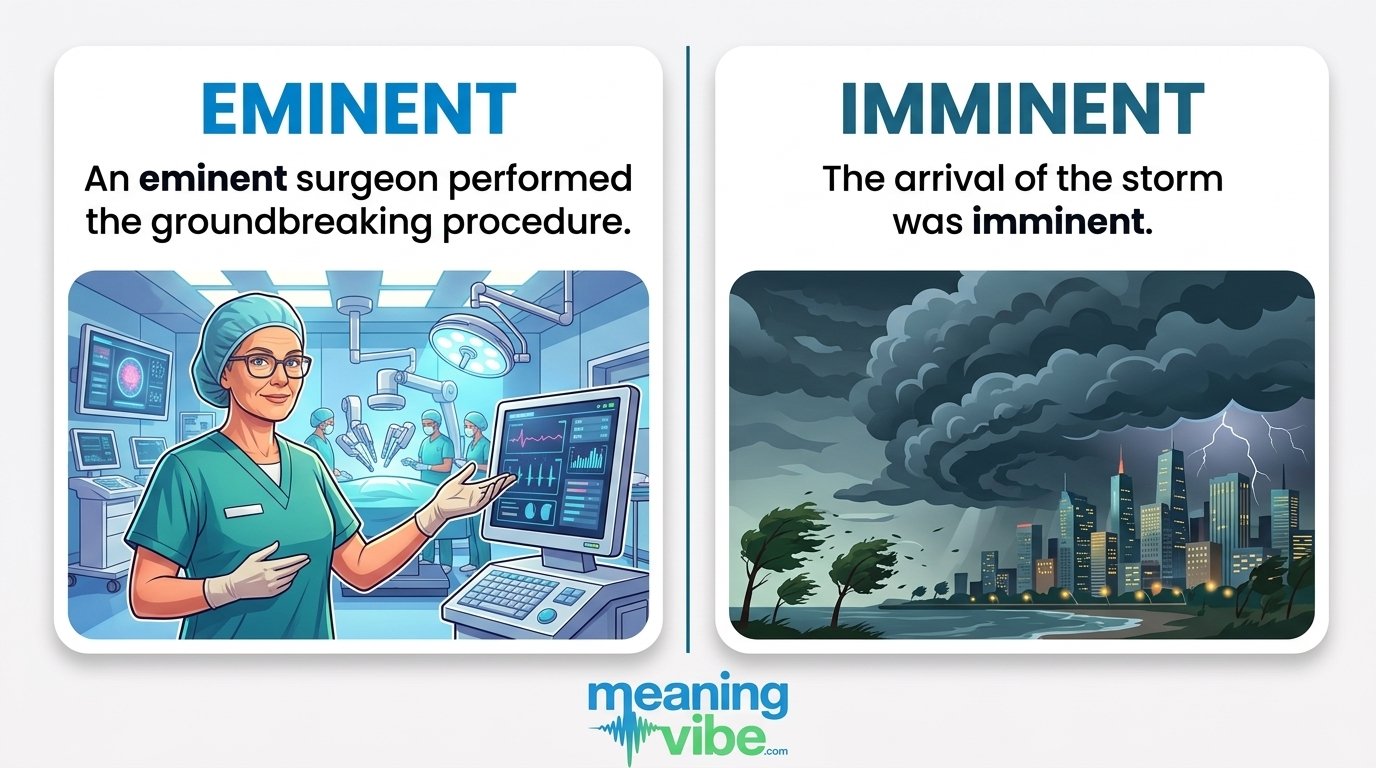
Focus explains the difference better than a list of synonyms alone. Eminent focuses on rank and respect earned or held over time. Imminent focuses on closeness in time, with an event approaching the present moment.
Person versus event gives a useful first check in most sentences, with limits noted later. Eminent usually describes people, such as scholars, surgeons, and judges. Imminent usually describes events or situations, such as storms, deadlines, and arrivals.
Combined sentences prove that both words can appear together without confusion when roles stay clear. An eminent scientist warned of an imminent storm in a single, clear sentence. Reputation describes the scientist, timing describes the storm.
Third word warning matters because immanent sounds exactly like imminent in standard speech. Immanent means inherent or existing within, mostly in philosophy and theology, not about to happen. Keep immanent in a separate box, not inside the main pair.
Reputation or Timing Test in Brief
Step one finds the thing described by the target word in the sentence. Underline the target word and read the noun it modifies, not only the word itself. Noun identity reveals whether reputation or timing fits.
Step two asks whether the sentence praises standing, rank, or respect for that thing. Praise for standing points to eminent in almost every case. Praise for timing never points to eminent in standard use.
Step three asks whether the sentence warns or notes that something approaches soon. Nearness in time points to imminent in almost every case. Nearness never points to eminent in standard use.
Step four tests a plain substitution in the same sentence structure. Replace the target with distinguished and then with about to happen. The substitution that preserves meaning reveals the correct word quickly.
Step five checks collocation, meaning the words that naturally partner with the target. Eminent partners with scholar, surgeon, and historian, while imminent partners with storm, danger, and deadline. Unnatural partnerships warn of an error even when grammar looks plausible.
What Eminent Means
Eminent is an adjective meaning exhibiting eminence, especially standing above others in quality or position. Merriam-Webster gives that definition plainly, with standing above as the central image. Prominence, not timing, defines eminent.
Eminent describes people most often in academic, medical, legal, and artistic writing. An eminent scholar leads a field through research, an eminent surgeon leads through skill, and an eminent judge leads through judgment. Field leadership explains the praise.
Eminent describes things too, when a thing stands out conspicuously in its class. An eminent position holds high rank, an eminent work stands above comparable works, and an eminent institution holds recognized prestige. Person use dominates, but thing use remains correct.
Eminent implies earned standing in most careful uses, not mere fame alone. A celebrity may be famous without being eminent in a scholarly field, while a quiet researcher may be eminent without wide fame. Accomplishment, not publicity alone, supports eminent.
Eminent register stays formal in most modern writing, fitting speeches, citations, and obituaries. Writers rarely call a friend eminent in casual conversation, even when respect runs deep. Formal tone matches formal standing there.
Eminent in Plain Language
Think of eminent as standing out above a crowd in a field. A mountain peak stands out above surrounding hills, and an eminent scholar stands out above peers. Height imagery captures reputation without adding timing.
Think of recognition over time whenever eminent appears in a sentence. Eminence grows through work, judgment, and contribution, not through a single moment. Time builds reputation, while imminent measures time approaching.
Think of field specificity whenever eminent appears without a field named. An eminent historian leads history, not medicine, and an eminent surgeon leads surgery, not law. Field context prevents vague praise from sounding empty.
Think of comparative strength whenever eminent appears beside prominent or distinguished. Prominent means noticeable, distinguished means respected for excellence, and eminent means even greater prominence for outstanding quality. Shade, not synonym identity, separates those words.
Think of award language whenever eminent appears in citations and introductions. “We welcome an eminent guest” signals honored standing before a speech begins. Introduction language uses eminent to confer respect publicly.
Eminence and Preeminent
Eminence names the quality of standing above others in position or reputation. Merriam-Webster lists eminence as the noun for someone or something in a lofty position. Noun use appears in phrases such as eminence in a field.
Eminence as a title appears in Catholic usage for a cardinal, a specific formal title. That title use differs from general eminence in a field, yet both share lofty position imagery. Context decides which sense applies in a sentence.
Eminently works as the adverb form, meaning in an eminent manner or to an eminent degree. A scholar is eminently qualified when qualifications stand clearly above ordinary standards. Adverb use remains formal and relatively rare.
Preeminent means having paramount rank, dignity, or importance, generally higher than eminent. Merriam-Webster notes that preeminent sometimes gets used simply to mean eminent, but careful writers keep the higher magnitude. Preeminent should signal top rank, not ordinary distinction.
Preeminence names the quality of paramount rank, parallel to eminence for eminent. A preeminent institution leads its field without close rival, while an eminent institution leads with recognized peers. Degree of leadership separates those nouns.
Word family clarity prevents confusion between eminence, eminently, and preeminence in editing. Eminence describes standing, eminently describes manner, and preeminence describes top standing. Family forms share a root without sharing a degree.
Eminent Examples by Context
In academia, an eminent historian receives invitations, citations, and honors across decades. Her books shape field debate, and younger scholars cite her work as a standard. Long influence, not one publication, supports eminent there.
In medicine, an eminent surgeon pioneers techniques that other surgeons adopt and teach. Patients seek her care for complex cases, and colleagues seek her judgment for difficult decisions. Skill and trust together support eminent there.
In law, an eminent judge writes opinions that shape doctrine and guide lower courts. Lawyers cite those opinions for reasoning quality, not merely for outcome. Reasoning influence supports eminent in legal writing.
In arts, an eminent author produces work that critics, readers, and peers treat as a benchmark. Her novels enter curricula and anthologies, and later writers respond to her themes. Enduring influence supports eminent there.
In public life, an eminent leader earns respect across parties or professions through service and judgment. Public trust grows from consistent conduct, not from a single speech or victory. Service record supports eminent there.
What Imminent Means
Imminent is an adjective meaning ready to take place, happening soon, often used of something bad or dangerous seen as menacingly near. Merriam-Webster gives that definition with readiness and nearness as central ideas. Timing, not reputation, defines imminent.
Imminent describes events and situations most often in news, warnings, and planning writing. An imminent storm approaches, an imminent deadline approaches, and an imminent arrival approaches. Approach in time defines each use.

Imminent often suggests a looming threat in dictionary examples, yet threat is not required by definition. An imminent announcement can bring welcome news, and an imminent birth can bring joy. Nearness alone, not badness alone, defines imminent.
Imminent does not guarantee that an event will happen, despite its urgency in tone. An imminent collapse can be prevented by intervention, and an imminent departure can be delayed by weather. Possibility, not certainty, accompanies imminence.
Imminent register spans formal warnings and everyday speech more widely than eminent. News anchors warn of imminent danger, managers warn of imminent deadlines, and friends note an imminent arrival. Urgency language fits many registers.
Imminent in Plain Language
Think of imminent as almost here, with an event pressing against the present moment. A train imminent at the platform arrives in moments, not hours or days. Almost here captures timing without adding reputation.
Think of looming whenever imminent appears with threat language in news writing. Dark clouds make a storm feel looming, and rising water makes flooding feel looming. Looming adds threat shade, while imminent alone adds timing.
Think of preparation whenever imminent appears in planning and safety writing. An imminent deadline demands action now, and an imminent evacuation demands movement now. Action urgency follows timing in those cases.
Think of welcome nearness whenever imminent appears with positive events in announcements. An imminent release excites fans, and an imminent reunion excites family members. Positive nearness proves imminent is not always bad.
Think of uncertainty whenever imminent appears without a fixed clock time. Imminent rarely gives a minute or hour, only a sense that time is short. Vague nearness, not a timetable, defines most imminent uses.
Imminence and Imminently
Imminence names the quality of being about to happen very soon. Writers use imminence in phrases such as the imminence of war or the imminence of change. Noun use appears in formal and academic writing more than everyday speech.
Imminently works as the adverb form, meaning in an imminent manner or very soon. A decision is expected imminently when announcement time approaches within hours or days. Adverb use suits news and business writing well.
Imminence in warnings often carries threat shade through context, not through noun meaning alone. The imminence of danger sounds threatening because danger supplies threat, while imminence supplies timing. Context supplies shade, noun supplies time.
Imminently in announcements often carries neutral or positive shade through context as well. An album due imminently excites listeners, while a verdict due imminently anxieties parties. Announcement context supplies shade there too.
Word family clarity prevents confusion between imminence, imminently, and imminent in editing. Imminence names timing quality, imminently describes timing manner, and imminent describes timing itself. Family forms share a root without sharing a job.
Imminence versus eminence in spelling deserves a final check during proofreading. One letter difference separates imminence and eminence, yet meanings diverge completely. Proofreaders should check that pair letter by letter.
Imminent Examples by Context
In weather, an imminent storm prompts shelter, warnings, and preparation before clouds arrive. Forecasters call a storm imminent when radar shows approach within a short window. Short window, not severity alone, supports imminent there.
In business, an imminent deadline prompts late work, prioritization, and communication with clients. Managers call a deadline imminent when hours remain, not weeks. Short remaining time supports imminent there.
In medicine, an imminent birth prompts delivery preparation and family readiness in a hospital. Clinicians call birth imminent when signs show delivery approaches very soon. Clinical signs, not calendar date alone, support imminent there.
In politics, an imminent announcement prompts speculation, preparation, and media staging before release. Officials call an announcement imminent when release approaches within hours or days. Release nearness supports imminent there.
In safety, an imminent danger prompts evacuation, shelter, or immediate protective action. Safety officers call danger imminent when harm approaches without intervention. Approach without intervention supports imminent there.
Master Triple-Word Table
One table answers the pair faster than separate definitions scattered across a page. Keep this table near the top of any reference section for quick checking. Readers return to it during editing, especially for immanent.
| Feature | Eminent | Imminent | Immanent |
|---|---|---|---|
| Part of speech | Adjective | Adjective | Adjective |
| Core meaning | Standing above others, respected | About to happen very soon | Existing within, inherent |
| Question it answers | Who stands high? | How soon? | Where does it exist? |
| Typical noun | Scholar, surgeon, historian | Storm, danger, deadline | Quality, presence, meaning |
| Noun form | Eminence | Imminence | Immanence |
| Adverb form | Eminently | Imminently | Immanently |
| Latin root | Eminere, stand out | Imminere, project | Immanere, remain in |
| Pronunciation | /ˈem.ə.nənt/ | /ˈɪm.ə.nənt/ | /ˈɪm.ə.nənt/ |
| Common error | Eminent storm | Imminent scholar | Immanent storm |
| Fixed phrase | Eminent domain | Imminent danger | Immanent presence |
Table use during editing follows a simple habit for busy writers. Find the target word, check its question in the table, and compare that question with the sentence. Mismatch means the word must change.
Table limits matter for sentences that mix all three words in one clause. A combined sentence can contain eminent agents, imminent meetings, and immanent introversion at once, each passing its own test. Each word still passes separately there.
Pronunciation and Etymology
Pronunciation differs by one short vowel sound between eminent and imminent in standard speech. Merriam-Webster notes that the two adjectives differ in pronunciation only by one short vowel sound, so confusion surprises no careful listener. Small sound difference creates large meaning risk.
Eminent sounds like /ˈem.ə.nənt/, with em like ember at the start and stress on the first syllable. Imminent sounds like /ˈɪm.ə.nənt/, with im like import at the start and stress on the first syllable. First vowel contrast carries the sound distinction.
Immanent sounds exactly like imminent in standard speech, according to Merriam-Webster. Pronunciation alone cannot separate immanent and imminent, so meaning and context must decide. Sound groups those two words, not meaning.
Dictionary audio helps learners who need to hear stress and vowel shape. Merriam-Webster and Cambridge both provide audio pronunciation for eminent and imminent, with the same first syllable contrast. Listening confirms sound, while meaning confirms spelling.
Accent variation deserves a brief note for international readers and exam writers. Some speakers may soften the first vowel, but standard references keep the em versus im contrast for American English. Exam answers should follow dictionary pronunciation, not regional guesswork.
Latin Roots: Minere, Eminere, Imminere, Immanere
Minere means to project or overhang in Latin, forming the shared root for eminent and imminent. Projection imagery explains both standing out and looming near in modern senses. Shared root explains confusion, not identity.
Eminere adds e-, meaning out from, to minere, producing to stand out. A person or thing stands out from peers when eminence applies, just as a peak stands out from hills. Outward projection matches reputation focus exactly.
Imminere adds im-, meaning upon, to minere, producing to project or threaten. An event projects toward the present when imminence applies, just as clouds project toward land. Inward projection matches timing focus exactly.
Immanere adds in- plus manere, to remain, producing to remain in or dwell within. A quality remains within a thing when immanence applies, just as meaning remains within a poem. Within imagery matches inherent focus exactly.
First appearance dates add historical weight without changing modern meaning. Merriam-Webster dictionary notes place eminent in the 15th century and imminent in the 16th century as English words, already distinct then. Age alone does not decide correctness, but it confirms stability.
Root memory tricks work better when they separate the roots cleanly. Link eminent to stand out, imminent to project toward, and immanent to remain within. Three different root stories prevent one blurred memory.
| Word | Latin source | Literal meaning | Modern meaning |
|---|---|---|---|
| eminent | eminere, e- plus minere | Stand out | Prominent, respected |
| imminent | imminere, im- plus minere | Project, threaten | About to happen soon |
| immanent | immanere, in- plus manere | Remain in | Inherent, existing within |
| preeminent | praeeminere, prae- plus eminere | Stand out before | Paramount rank |
The Reputation-or-Timing Test in Full
Test step one asks the writer to underline the target word and its noun. Reading the full clause around it matters more than staring at the word alone. Context reveals whether reputation or timing fits.
Test step two labels the job with a single word, reputation or timing, in a draft margin. Writers who label first choose correctly more often, because labeling forces a meaning decision before spelling. Guessing by sound skips that decision entirely.
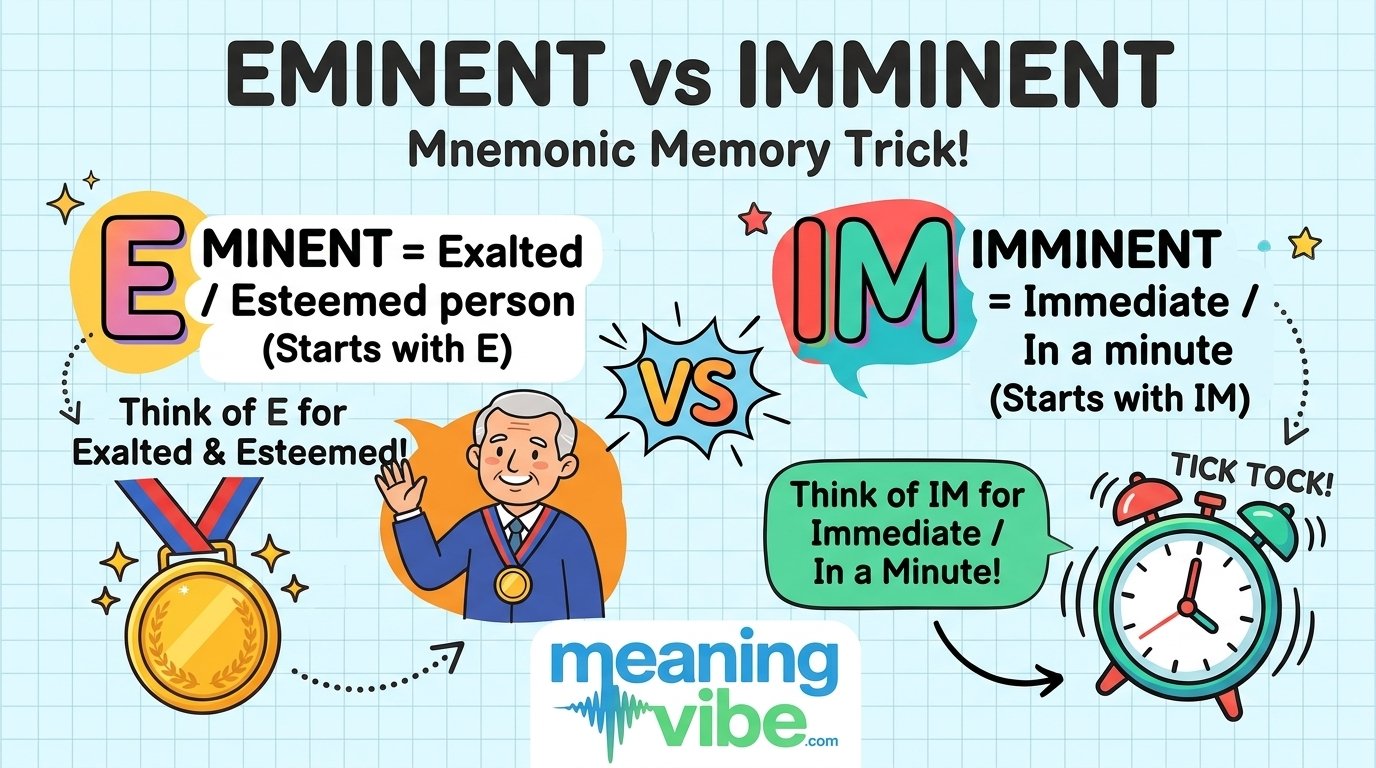
Test step three tries the substitution distinguished in place of the target word. “An eminent scholar” becomes “A distinguished scholar” naturally, so eminent fits there. Distinguished substitution failure signals a wrong word immediately.
Test step four tries the substitution about to happen in place of the target word. “An imminent storm” becomes “A storm about to happen” naturally, so imminent fits there. About to happen substitution failure signals a wrong word immediately.
Test step five checks collocation, meaning the words that naturally partner with the target. Eminent partners with scholar and surgeon, while imminent partners with storm and deadline. Unnatural partnerships warn of an error even when grammar looks plausible.
Test step six checks for a fixed phrase before finalizing any choice. Eminent domain never becomes imminent domain, even when a taking feels urgent. Fixed phrase check prevents legal meaning errors that substitution alone might miss.
Worked Examples for the Test
Example one starts with a scholar sentence that many writers get wrong under pressure. “She is an eminent researcher” passes every test step. Researcher reputation, distinguished substitution, and scholar collocation all point to eminent.
Example two starts with a storm sentence that tempts the wrong reputation word. “A storm is imminent” passes every test step. Storm timing, about to happen substitution, and storm collocation all point to imminent.
Example three combines both words in one sentence without confusion. “The eminent scientist warned of an imminent storm” passes both tests separately. Scientist reputation and storm timing each keep their own job there.
Example four exposes a meaning error hidden inside fluent grammar. “She is an imminent leader in her field” fails because a leader is not about to happen. Correction to eminent leader restores both reputation and logic.
Example five exposes a different meaning error in the opposite direction. “The arrival of the train is eminent” fails because arrival timing, not reputation, matters there. Correction to imminent arrival restores both timing and logic.
Example six exposes a triple-word error that pair tests alone would miss. “Kindness is an imminent quality” fails because kindness exists within character, not approaching in time. Correction to immanent quality restores inherent meaning there.
Collocations: What Each Word Naturally Pairs With
Collocation means the words that commonly appear together in natural English. Learning collocations speeds choice because familiar partnerships feel right instantly. Unfamiliar partnerships deserve a second look during editing.
Eminent collocations cluster around respected people and high-ranking things in formal fields. A speaker introduces an eminent guest, a university honors an eminent professor, and a court cites an eminent judge. Each noun names standing, not timing.
Imminent collocations cluster around approaching events, threats, and deadlines in news and planning. Forecasters warn of an imminent storm, managers warn of an imminent deadline, and officers warn of imminent danger. Each noun names timing, not reputation.
Immanent collocations cluster around inherent qualities in philosophy, theology, and criticism. Writers discuss immanent meaning in a poem, immanent presence in nature, and immanent value in a work. Each noun names an internal quality, not an approaching event.
Collocation tables help learners more than definition lists alone in many classrooms. Students remember eminent scholar and imminent storm as fixed partnerships faster than abstract rules. Fixed examples anchor abstract meaning.
Collocation limits matter when a new combination appears in creative or technical writing. A novel pairing can still be correct if reputation, timing, or inherent meaning passes the test in full. Familiarity guides, but it never replaces meaning and logic.
Eminent Collocations Table
| Collocation | Meaning in context | Example |
|---|---|---|
| eminent scholar | Leading researcher | The eminent scholar shaped the field. |
| eminent surgeon | Leading surgeon | The eminent surgeon pioneered the technique. |
| eminent historian | Leading historian | The eminent historian wrote the standard work. |
| eminent author | Respected author | The eminent author gave the keynote. |
| eminent scientist | Leading scientist | The eminent scientist warned of the storm. |
| eminent lawyer | Respected lawyer | The eminent lawyer argued the case. |
| eminent judge | Respected judge | The eminent judge wrote the opinion. |
| eminent professor | Leading professor | The eminent professor taught the seminar. |
| eminent leader | Respected leader | The eminent leader earned broad trust. |
| eminent expert | Leading expert | The eminent expert advised the panel. |
| eminent position | High-ranking position | She holds an eminent position. |
| eminent domain | Legal taking power | The city used eminent domain. |
Imminent Collocations Table
| Collocation | Meaning in context | Example |
|---|---|---|
| imminent storm | Storm approaching soon | An imminent storm prompted shelter. |
| imminent danger | Danger approaching soon | Imminent danger prompted evacuation. |
| imminent deadline | Deadline approaching soon | An imminent deadline prompted late work. |
| imminent threat | Threat approaching soon | An imminent threat prompted security action. |
| imminent arrival | Arrival approaching soon | An imminent arrival prompted preparation. |
| imminent collapse | Collapse approaching soon | Imminent collapse prompted evacuation. |
| imminent attack | Attack approaching soon | An imminent attack prompted defense. |
| imminent announcement | Announcement approaching soon | An imminent announcement prompted speculation. |
| imminent birth | Birth approaching soon | An imminent birth prompted delivery prep. |
| imminent departure | Departure approaching soon | An imminent departure prompted packing. |
| imminent release | Release approaching soon | An imminent release excited fans. |
| imminent change | Change approaching soon | Imminent change prompted planning. |
Immanent Collocations Table
| Collocation | Meaning in context | Example |
|---|---|---|
| immanent quality | Quality existing within | Speed is an immanent quality. |
| immanent presence | Presence existing within | God is immanent in creation. |
| immanent meaning | Meaning existing within | Meaning is immanent in the poem. |
| immanent nature | Nature existing within | Buddha nature is immanent in beings. |
| immanent value | Value existing within | Value is immanent in the work. |
| immanent reason | Reason existing within | Reason is immanent in argument. |
Eminent Domain: The Fixed Legal Phrase
Eminent domain names the right of a government to take private property for public use. Merriam-Webster defines that phrase plainly, with government power and public use as central ideas. Legal context, not timing, defines the phrase.
Actor in eminent domain is government, including federal, state, and local government in US law. A city, state agency, or federal body may invoke eminent domain for a road, bridge, school, or other public project. Private parties do not hold eminent domain power themselves.
Purpose in eminent domain must serve public use in US constitutional language, with state law adding detail. Roads, bridges, schools, utilities, and public facilities commonly appear as public use examples. Purpose limits, not urgency alone, control lawful use.
Compensation in eminent domain follows a just compensation standard, not a fixed price list. Property owners receive just compensation for property taken, with amount depending on valuation, law, and case facts. No single dollar figure applies across cases in US law.
Condemnation names the legal process through which government exercises eminent domain in many cases. A condemnation proceeding determines taking, valuation, and compensation through law and courts. Process language differs from power language, yet both connect to eminent domain.
General information warning matters for any legal phrase in a grammar resource. Eminent domain law varies by state, purpose, procedure, and case, so readers facing a taking need licensed legal advice. Grammar clarity never replaces legal advice there.
| Element | Eminent domain | Imminent domain, always wrong |
|---|---|---|
| Meaning | Government power to take property | No legal meaning, timing word misused |
| Actor | Government | None, phrase does not exist |
| Purpose | Public use | None, urgency does not create power |
| Compensation | Just compensation standard | None, no taking to compensate |
| Example | City used eminent domain for a road. | City used imminent domain, incorrect. |
| Test | Replace with government power, fits. | Replace with about to happen, fails. |
Fixed phrase test prevents the most common legal error in this pair. Ask whether the sentence discusses government, property, compensation, or public use. Those topics point to eminent domain every time, never imminent domain.
Hyphenation and capitalization rules for eminent domain stay simple in running text. Write eminent domain as two separate words, no hyphen, lowercase except at sentence start or in titles. Title capitalization follows normal title rules, not legal special rules.
Immanent: The Third Word, Kept Separate
Immanent means inherent, intrinsic, or spread throughout something, existing within rather than outside. Merriam-Webster places immanent mostly in philosophy and theology, where internal presence matters most. Within, not soon, defines immanent.
Immanent contrasts with transcendent in philosophical and theological writing. Transcendent means existing beyond or outside limits of experience, while immanent means existing within those limits. Contrast sharpens both terms for advanced readers.
Immanent examples in philosophy include meaning immanent in a poem and reason immanent in argument. Critics find meaning within a work, not meaning approaching from outside. Within location defines each example there.
Immanent examples in theology include divine presence immanent in creation and Buddha nature immanent in beings. Believers describe presence within the world, not presence arriving soon. Within presence defines each example there.
Immanent in everyday writing appears rarely, and many general readers never need it. Writers should use inherent or internal for general audiences when immanent feels too technical. Plain language beats rare vocabulary in most professional writing.
Immanence as a noun remains standard, despite one learner page claiming otherwise in search results. “The immanence of God was felt strongly” uses immanence correctly as a noun. Noun use follows the same pattern as eminence and imminence.
Triple-word combined sentence from writer guides shows all three jobs at once clearly. A writer faces immanent introversion, imminent meetings, and eminent literary agents at a conference. Introversion exists within, meetings approach soon, agents stand high.
Wrong Examples Corrected
Wrong examples teach faster than correct examples alone for many learners. Seeing an error marked wrong, with a reason attached, prevents silent repetition in future drafts. Correction tables make that learning visible.
Reputation errors often involve imminent used for respected people in introductions and citations. “She is an imminent researcher” fails because a researcher is not about to happen. Correction to eminent researcher restores reputation instantly.
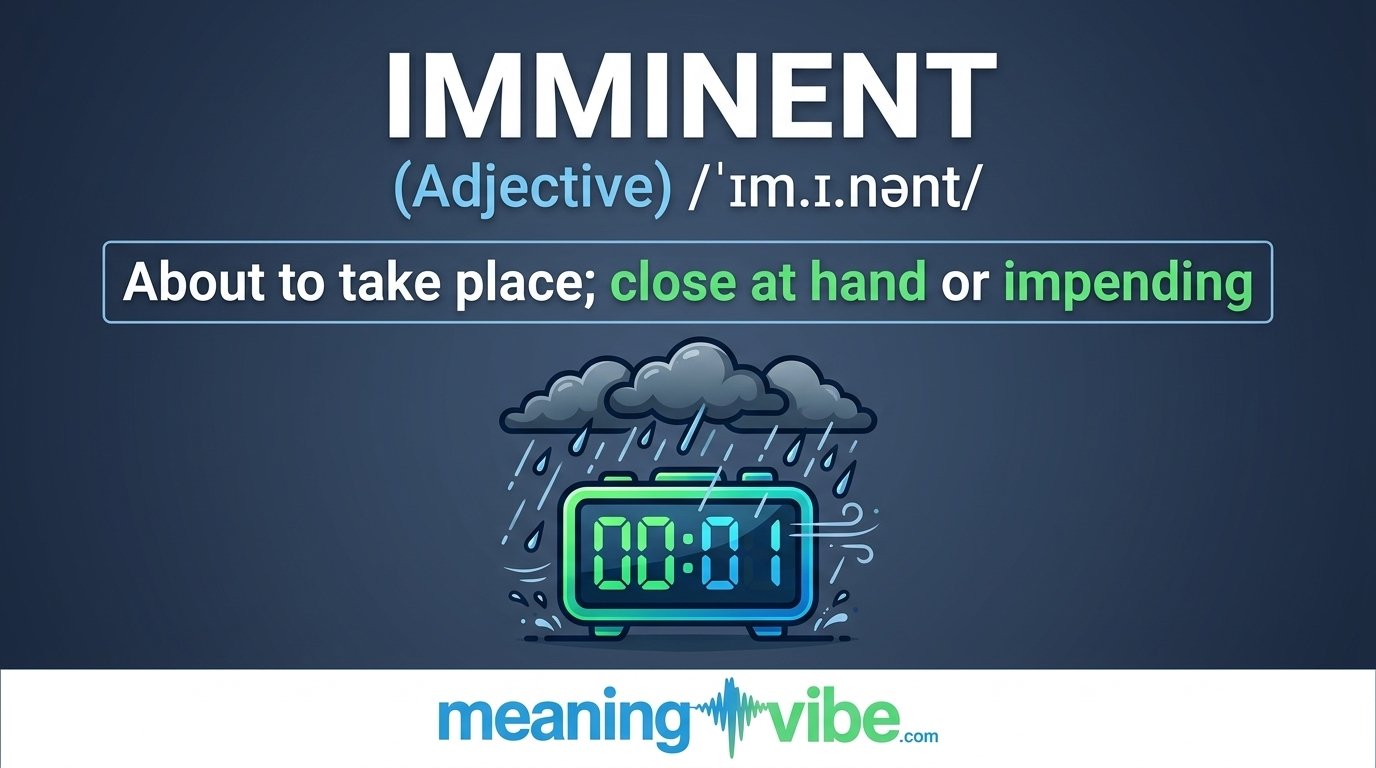
Timing errors often involve eminent used for approaching events in warnings and news. “The storm is eminent” fails because a storm is not distinguished or respected. Correction to imminent storm restores timing instantly.
Legal errors carry higher risk because meaning shifts can change a document’s force. “The state announced imminent domain” fails because imminent never names government taking power. Correction to eminent domain restores legal meaning instantly.
Triple-word errors often involve immanent swapped with imminent in philosophy and criticism. “Speed is an imminent quality” fails because speed exists within sports cars, not approaching in time. Correction to immanent quality restores inherent meaning instantly.
| Wrong sentence | Correct sentence | Why it was wrong |
|---|---|---|
| She is an imminent leader. | She is an eminent leader. | Leader reputation, not timing. |
| The storm is eminent. | The storm is imminent. | Storm timing, not reputation. |
| The arrival is eminent. | The arrival is imminent. | Arrival timing, not reputation. |
| The eminent danger forced evacuation. | The imminent danger forced evacuation. | Danger timing, not reputation. |
| The imminent professor gave a lecture. | The eminent professor gave a lecture. | Professor reputation, not timing. |
| The state used imminent domain. | The state used eminent domain. | Fixed legal phrase, never imminent. |
| Speed is an imminent quality. | Speed is an immanent quality. | Quality exists within, not approaching. |
| God is imminent in creation. | God is immanent in creation. | Presence exists within, not approaching. |
| The eminent meeting starts soon. | The imminent meeting starts soon. | Meeting timing, not reputation. |
| An imminent author will speak tomorrow. | An eminent author will speak tomorrow. | Author reputation, not timing. |
| The imminent scholar won a prize. | The eminent scholar won a prize. | Scholar reputation, not timing. |
| The eminent deadline passed quickly. | The imminent deadline passed quickly. | Deadline timing, not reputation. |
Last row warning matters because deadline timing stays imminent even after passage in narrative. A deadline described as approaching before passage takes imminent, while a deadline described as missed takes past language. Narrative time, not current time alone, decides there.
Correction habit for every wrong example follows the same three moves. Mark the error, name the meaning mismatch, and rewrite the sentence fully. Partial correction leaves doubt for the next reader.
Contexts: Academic, Business, Legal, News, Medical, Philosophical, and Everyday
Academic writing uses eminent most often for scholars, researchers, and institutions with long influence. A citation calls a researcher eminent when peers treat her work as a standard. Long influence, not one paper, supports eminent there.
Academic imminent uses appear in deadlines, conferences, and publication schedules with short horizons. A journal calls a submission deadline imminent when days remain, not months. Short horizon supports imminent there.
Business writing uses eminent for advisors, consultants, and leaders with recognized expertise. A firm hires an eminent consultant when clients trust her judgment across industries. Cross-industry trust supports eminent there.
Business imminent uses appear in mergers, announcements, and market changes with short horizons. A company calls a merger announcement imminent when release approaches within days. Release nearness supports imminent there.
Legal writing uses eminent domain for takings, condemnation, and public use with precise terms. A notice states that a city invoked eminent domain for a road project, then lists compensation process separately. Legal phrase precision protects notice validity there.
Legal imminent uses appear in threats, deadlines, and hearings with short horizons. A filing warns of imminent harm when action without intervention approaches quickly. Harm approach supports imminent there, not reputation.
News writing uses both words in the same story more often than other contexts. Reporters quote an eminent scientist warning of an imminent storm in one paragraph. Combined sentences test the pair hardest there.
Medical writing uses eminent for surgeons, researchers, and clinicians with leading skill. A hospital names an eminent surgeon for complex procedures requiring rare expertise. Rare expertise supports eminent there.
Medical imminent uses appear in births, deterioration, and emergencies with short horizons. Clinicians call birth imminent when signs show delivery approaches very soon. Clinical signs support imminent there, not calendar date alone.
Philosophical writing uses immanent for qualities existing within works, arguments, and experience. Critics argue that meaning is immanent in a poem, not imposed from outside. Within location supports immanent there, not timing.
Everyday writing uses imminent more often than eminent in casual speech and warnings. Friends say “Departure is imminent” before leaving, while eminent stays formal for introductions. Register difference explains frequency difference there.
Exam writing rewards the reputation-or-timing test because examiners check meaning, not only spelling. IELTS candidates who label reputation or timing before choosing avoid a common adjective trap under time pressure. Practice with timed sentences builds that habit fastest.
Academic and Research Examples
An eminent historian received a lifetime achievement award for books that reshaped field debate. Award committees cited decades of influence, not one popular title, in the citation. Decades of influence support eminent there.
An imminent conference deadline prompted late submissions, extensions, and organizer reminders in one week. Organizers called the deadline imminent when days remained, not months. Days remaining support imminent there.
An eminent scientist warned of an imminent climate tipping point in a peer-reviewed commentary. Scientist reputation and tipping point timing each keep separate jobs in that sentence. Combined sentence proves both tests at once.
An immanent theme in a novel emerges through repeated images, not through author interviews alone. Critics find theme within the text, even when authors stay silent about intent. Within location supports immanent there.
Business and Policy Examples
A board hired an eminent advisor after a crisis damaged trust with investors and regulators. Advisor reputation across multiple crises supported the hire, not one recent success. Cross-crisis reputation supports eminent there.
An imminent product launch prompted marketing, logistics, and support teams to prepare simultaneously. Launch teams called release imminent when days remained, not quarters. Days remaining support imminent there.
A policy notice invoked eminent domain for a highway expansion, listing public use and compensation process. Notice language used eminent domain correctly, never imminent domain, for legal clarity. Fixed phrase precision protects notice validity there.
A market report warned of imminent change after interest rate signals shifted sharply in one week. Report writers called change imminent when indicators pointed to near-term movement. Near-term indicators support imminent there.
Legal and News Examples
A condemnation notice stated that a city would use eminent domain to acquire land for a school. Notice listed public use and just compensation process in separate sections. Legal completeness protects notice validity there.
A court filing warned of imminent harm if an injunction was denied before trial. Filing writers called harm imminent when delay would make relief useless. Relief timing supports imminent there, not reputation.
A weather report quoted an eminent meteorologist warning of an imminent hurricane landfall. Meteorologist reputation and landfall timing each keep separate jobs in that sentence. Combined sentence proves both tests at once.
An editor corrected a draft that called a storm eminent before publication. Correction to imminent storm saved the story from implying that weather holds academic rank. Editing protects both accuracy and reputation.
Memory Tricks That Actually Work
Eminent equals Emmy works because Merriam-Webster itself suggests that link for memory. An eminent television personality might win an Emmy award, linking reputation to a prize. Prize imagery reinforces reputation without adding timing.
Imminent equals immediate works because both words share imm- at the start and timing sense. Immediate action and imminent action both press against the present moment. Shared prefix and shared timing reinforce each other.
Eminent equals expert works because both words begin with e and describe high standing. An eminent expert stands above peers through knowledge and accomplishment. Expert imagery reinforces reputation without adding timing.
Distinguished versus about to happen works as a substitution backup when mnemonics feel weak. Try distinguished for eminent and about to happen for imminent in the same sentence. Substitution that preserves meaning reveals the correct word.
Person versus event works as a first check in most sentences, with fixed phrase limits noted. People usually take eminent, events usually take imminent, and eminent domain takes neither pattern. First check guides, fixed phrase check finishes.
Combined sentence memory helps writers who face both words together in news stories. Remember eminent scientist warned of an imminent storm as a model sentence for combined use. Model sentences reduce combined-sentence errors sharply.
Practice memory grows stronger when writers write ten sentences of their own. Ten self-written sentences beat ten memorized definitions because production forces a choice each time. Choice practice builds durable accuracy.
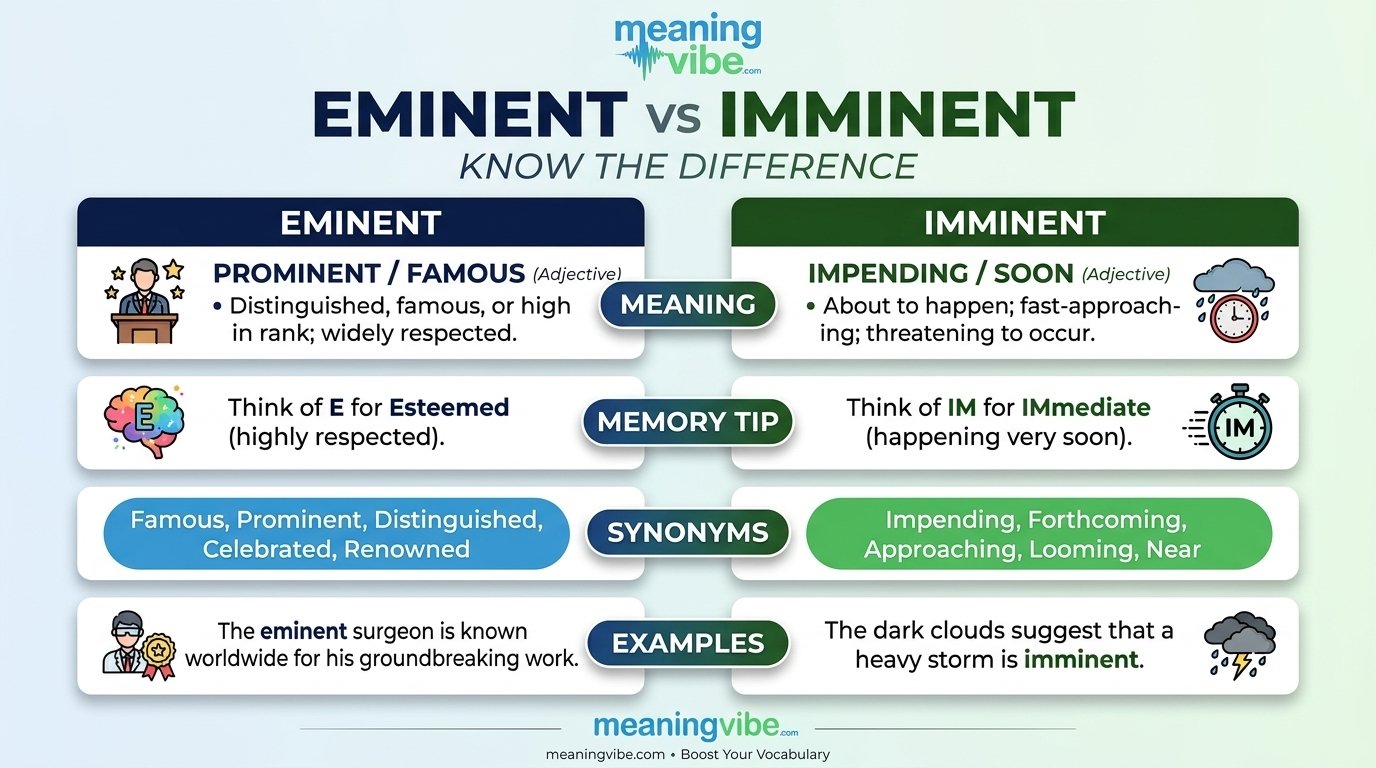
Editing memory grows stronger when writers reread only for adjective pairs in a final pass. A dedicated adjective pass catches eminent and imminent errors that a general proofread misses. Separate passes catch separate error types.
Quiz With Answers
Quiz instructions stay simple for learners at beginner, intermediate, and advanced levels. Choose eminent, imminent, or immanent for each blank, then check the answer and explanation below each item. Explanations matter more than scores alone.
Question 1: She is an ______ researcher known worldwide for her work.
Answer: eminent. Researcher reputation, not timing, fits eminent there.
Question 2: The dark clouds suggested that a storm was ______.
Answer: imminent. Storm timing, not reputation, fits imminent there.
Question 3: The state announced ______ domain to build a new highway.
Answer: eminent. Fixed legal phrase for government taking power, never imminent domain.
Question 4: Speed is an ______ quality of sports cars.
Answer: immanent. Quality exists within sports cars, not approaching in time.
Question 5: With the deadline ______, everyone worked late into the night.
Answer: imminent. Deadline timing, not reputation, fits imminent there.
Question 6: The university invited an ______ guest speaker for commencement.
Answer: eminent. Guest speaker reputation, not timing, fits eminent there.
Question 7: The ______ scientist warned of an ______ storm in her report.
Answer: eminent scientist, imminent storm. Scientist reputation and storm timing each keep separate jobs.
Question 8: The threat of flooding is ______ due to heavy rain this week.
Answer: imminent. Flooding timing, not reputation, fits imminent there.
Question 9: Kindness is an ______ quality, taught or not, in that argument.
Answer: immanent. Quality exists within character, not approaching in time.
Question 10: At the conference, writers faced ______ introversion, ______ meetings, and ______ agents.
Answer: immanent introversion, imminent meetings, eminent agents. Within, timing, and reputation each keep separate jobs there.
Quiz scoring guidance keeps focus on learning rather than ranking for most readers. Eight or more correct answers show strong control of the trio in timed writing. Fewer correct answers point to the reputation-or-timing test for review.
Quiz extension for advanced writers adds legal, philosophical, and combined sentences in one set. Advanced items should mix academic, legal, and news contexts in one set. Context shifts test whether the rule transfers beyond familiar examples.
Mistakes to Avoid
1. Using imminent for respected people tops the mistake list for this pair in learner writing. Sentences such as “She is an imminent researcher” fail meaning immediately. A researcher is not about to happen.
2. Using eminent for approaching events tops the opposite mistake list for this pair. Sentences such as “The storm is eminent” fail meaning immediately. A storm is not distinguished or respected.
3. Using imminent domain for government taking power tops the legal mistake list. Sentences such as “The state used imminent domain” fail legal meaning immediately. Fixed phrase always takes eminent, never imminent.
4. Using imminent for inherent qualities tops the triple-word mistake list. Sentences such as “Speed is an imminent quality” fail meaning immediately. Quality existing within takes immanent, not imminent.
5. Trusting spellcheck alone leaves all these errors invisible in many drafts. Spellcheck approves eminent, imminent, and immanent because all three exist in standard dictionaries. Human meaning checks must follow spellcheck passes.
6. Assuming imminent always means bad narrows a broader word incorrectly in many drafts. Imminent announcements, births, releases, and arrivals can be welcome events approaching soon. Nearness, not badness alone, defines imminent.
7. Assuming imminent always means inevitable overstates urgency in many drafts. An imminent collapse can be prevented, and an imminent departure can be delayed. Possibility, not certainty, accompanies imminence.
8. Assuming eminent always means a person narrows a broader adjective incorrectly in many drafts. Eminent position, eminent work, and eminent domain all describe things, not people. Standing, not personhood alone, defines eminent.
9. Mixing all three words in one sentence without testing each word separately causes triple errors. Combined sentences need three tests, one for eminent, one for imminent, and one for immanent. Single-test editing misses later errors.
10. Skipping the logic read lets fluent but false sentences survive into publication. A sentence can sound smooth while calling a scholar about to happen or a storm distinguished. Logic reads catch meaning errors grammar checks miss.
Tips for Editors and Exam Writers
1. Label the job first before choosing a word in any uncertain sentence. Write reputation, timing, or within in a draft margin, then choose eminent, imminent, or immanent to match. Labeling forces meaning before spelling.
2. Test a substitute with distinguished for eminent and about to happen for imminent. Substitution reveals meaning faster than dictionary browsing during timed writing. Keep both substitutes ready as a mental tool.
3. Check collocation second after meaning and substitution have pointed one way. Eminent partners with scholar, imminent partners with storm, and immanent partners with quality. Collocation confirms, but never replaces, meaning.
4. Check for a fixed phrase third after collocation checks pass. Eminent domain never becomes imminent domain, even when a taking feels urgent. Fixed phrase check prevents legal meaning errors that substitution alone might miss.
5. Run an adjective pass as a separate final proofread for any document with confused words. Search for eminent, imminent, and immanent separately, then test each occurrence with the reputation-or-timing test. Separate passes catch errors general reading misses.
6. Keep a personal error list with your own repeated adjective mistakes across documents. Personal lists beat generic lists because they target actual habits, not possible habits. Review the list before submitting important work.
7. Use dictionary entries for synonym shades, Latin roots, and fixed phrases when doubt persists. Merriam-Webster distinguishes eminent from prominent, distinguished, and renowned by degree and shade, a distinction learner lists often miss. Dictionary nuance improves advanced writing.
8. Teach with combined sentences when helping students or colleagues learn the trio. Combined sentences such as eminent scientist warned of an imminent storm test two words at once, while immanent introversion adds a third test. Combined practice transfers better than isolated examples.
9. Match register to audience when choosing between immanent and plainer words. Academic and theological readers expect immanent, while general readers may prefer inherent or internal. Register matching improves readability without losing accuracy.
10. Save legal terms for legal meaning, and save timing words for timing meaning. Eminent domain, just compensation, and public use carry legal weight that imminent never carries. Separation protects both writer and reader in sensitive contexts.
FAQs About Eminent vs Imminent
What is the difference between eminent and imminent?
Eminent describes reputation and standing above others, while imminent describes timing and nearness to happening soon. Reputation versus timing decides every standard sentence.
What does eminent mean?
Eminent means standing above others in quality, position, or reputation, prominent and respected. An eminent scholar leads a field through work and influence over time.
What does imminent mean?
Imminent means ready to take place very soon, often looming, but not always bad. An imminent storm approaches soon, while an imminent announcement can bring welcome news.
What does immanent mean?
Immanent means inherent or existing within something, mostly in philosophy and theology. Immanent meaning exists within a poem, not approaching from outside.
What is the difference between eminent and immanent?
Eminent describes standing above others, while immanent describes existing within something. Standing high differs from existing inside in both image and use.
What is the difference between imminent and immanent?
Imminent describes timing, about to happen soon, while immanent describes location, existing within something. Timing versus within decides every standard sentence there.
Are eminent and imminent homophones?
No, not exactly, because they differ by one short vowel sound in standard speech. Eminent sounds like /ˈem.ə.nənt/, imminent sounds like /ˈɪm.ə.nənt/, with stress on the first syllable.
Are imminent and immanent homophones?
Yes, in standard speech, immanent is pronounced exactly like imminent, according to Merriam-Webster. Meaning and context, not sound, must separate imminent and immanent in writing.
How do you pronounce eminent and imminent?
Eminent sounds like EM-uh-nuhnt, imminent sounds like IM-uh-nuhnt, with stress on the first syllable. First vowel contrast, ember versus import, separates them in careful speech.
How do you remember eminent vs imminent?
Remember eminent equals Emmy, for a distinguished television personality, and imminent equals immediate, for something occurring in short time. Use the reputation-or-timing test as the main check, with mnemonics as backup.
Can a person be imminent?
No, not in standard meaning, because a person is not an event about to happen. “She is an imminent researcher” fails meaning, while eminent researcher fits reputation.
Can a storm be eminent?
No, not in standard meaning, because a storm holds no reputation or distinguished standing. “A storm is eminent” fails meaning, while imminent storm fits timing.
Can an event be eminent?
Rarely, and only when an event stands out conspicuously, such as an eminent occasion in formal language. Most events take imminent for timing, not eminent for reputation, in standard use.
Can a person be eminent?
Yes, most eminent uses describe people with leading standing in a field. An eminent surgeon, scholar, judge, and author all fit reputation meaning clearly.
Is imminent always bad?
No, imminent describes timing, not badness alone, even though many dictionary examples involve threats. Imminent births, releases, and announcements can be welcome events approaching soon.
Is imminent always a threat?
No, threat shade comes from context words such as danger, collapse, and attack, not from imminent alone. Imminent arrival carries no threat, while imminent danger carries threat through danger itself.
Is imminent always inevitable?
No, an imminent event can be prevented, delayed, or changed before it happens. Imminent collapse can be prevented by intervention, and imminent departure can be delayed by weather.
Can imminent describe a welcome event?
Yes, imminent births, reunions, releases, and announcements all fit timing meaning without threat. Welcome nearness proves imminent is not always bad in standard use.
Is eminent always a person?
No, eminent can describe a thing standing out, such as an eminent position, work, or institution. Eminent domain describes a legal power, not a person, in fixed phrase use.
Can eminent describe a thing?
Yes, when a thing stands conspicuously above comparable things in quality or rank. An eminent work stands above other works, and an eminent institution holds recognized prestige.
What is eminent domain?
Eminent domain is the right of a government to take private property for public use. Compensation follows a just compensation standard, not a fixed price, and law varies by jurisdiction.
Is it imminent domain or eminent domain?
Always eminent domain in standard legal language, never imminent domain. Imminent domain has no legal meaning and confuses timing with government power.
What is just compensation in eminent domain?
Just compensation is the legal standard for payment when government takes private property. Amount depends on valuation, law, and case facts, not on a single fixed figure.
What is eminence?
Eminence is the noun for standing above others in position or reputation. Eminence in a field describes lofty standing, while eminence as a title applies to a cardinal in Catholic usage.
What is imminence?
Imminence is the noun for being about to happen very soon. Imminence of danger describes timing quality, with threat shade coming from danger itself, not from imminence alone.
Conclusion on Eminent vs Imminent
Eminent vs imminent rewards a simple habit more than memorized definitions alone. Label reputation, timing, or within, test a substitute, check collocation, and check for a fixed phrase. That habit turns a sound-alike trap into a quick, confident choice.
Eminent will serve writers whenever standing, rank, and respect must lead a sentence. Imminent will serve writers whenever nearness, approach, and soonness must lead a sentence. Keeping those jobs separate protects meaning in every context from essays to legal notices.
Try the habit on your next draft by searching for all three spellings and testing each occurrence separately. Use the quiz above as a warm-up, then apply the reputation-or-timing test to real sentences under deadline pressure. Accuracy built through practice lasts longer than accuracy borrowed from a single definition.