

If you’ve ever paused mid-sentence wondering whether to type “modeling” or “modelling,” you’re not alone. This is one of the most common spelling mix-ups in English, and the reason isn’t bad grammar — it’s geography.
Both words are spelled correctly. The one you should use depends entirely on which version of English your reader expects.
This guide breaks down the exact rule, where it came from, how it applies across fashion, data science, mathematics, and everyday writing, and how to stay consistent no matter what you’re working on.
Modeling or Modelling – Quick Answer
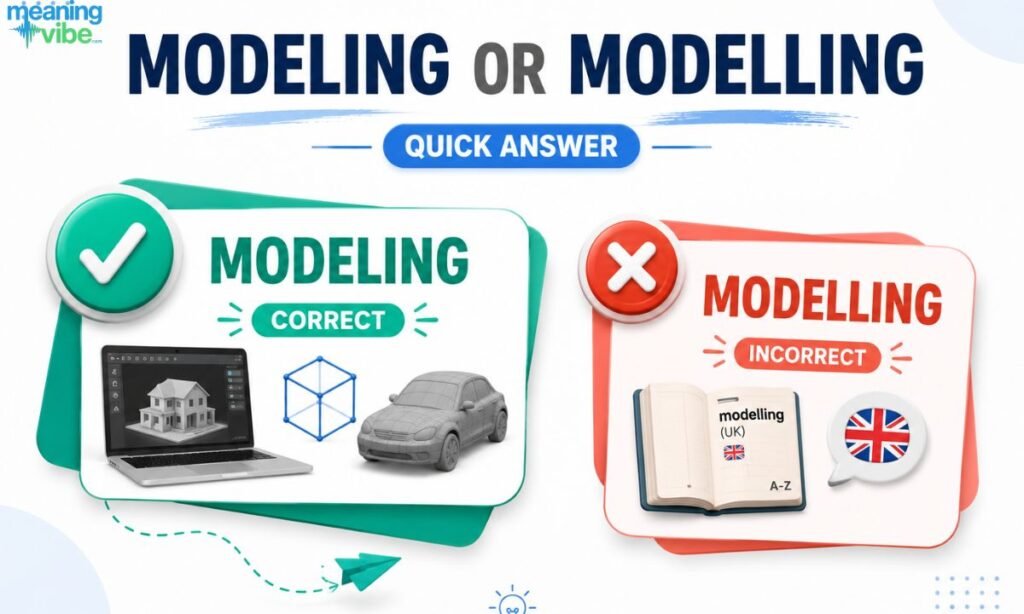
Both spellings are correct. Neither is a typo.
- Modeling (one “L”) is standard in American English.
- Modelling (two “L”s) is standard in British English, as well as in Canada, Australia, New Zealand, and most Commonwealth countries.
There is no difference in meaning, pronunciation, or usage between the two. The only thing that changes is regional spelling convention — the same split you see in words like traveling/travelling and labeling/labelling. Pick one form and use it consistently throughout a single piece of writing.
The Origin of Modeling / Modelling
The word traces back to the verb “model,” which entered English through French and Italian roots referring to a small representation or pattern of something. When English speakers added the “-ing” suffix to build the present participle or gerund, two competing spelling conventions emerged.
American English generally follows a rule where, if the final syllable of a word isn’t stressed, the ending consonant is not doubled before adding a suffix. Since the stress in “model” falls on the first syllable, American style keeps a single “L,” producing modeling.
British English, on the other hand, tends to double the final consonant before “-ing” or “-ed” regardless of where the stress falls. That convention gives us modelling.
This isn’t a modern invention — the double-L pattern has been part of British spelling norms for centuries and applies consistently across similar verbs.
British English vs American English Spelling

The modeling/modelling divide is part of a much larger pattern of spelling differences between the two dialects. Here’s how it compares to similar word pairs:
| American English | British English |
| Modeling | Modelling |
| Traveling / Traveled | Travelling / Travelled |
| Labeling / Labeled | Labelling / Labelled |
| Canceling / Canceled | Cancelling / Cancelled |
| Color | Colour |
| Favorite | Favourite |
Notice the pattern: whenever a British verb ends in a single vowel plus a consonant, that final consonant tends to get doubled before “-ing” or “-ed.” American English usually skips the doubling unless the last syllable is stressed (compare “control” → “controlling,” which doubles the L in both dialects because the stress falls there).
Which Spelling Should You Use?

The right choice comes down to your audience, not a grammar rule you’re breaking.
- Writing for a US audience or American publication? Use modeling, modeled, and modeler.
- Writing for a UK, Canadian, Australian, or New Zealand audience? Use modelling, modelled, and modeller.
- Writing for a global or mixed audience? Either form works, but pick one and stay consistent across the entire document, website, or brand voice guide.
- Not sure which style guide applies? Check your CMS, editorial guidelines, or spellchecker language setting (US English vs UK English) before you start writing.
Consistency matters more than which version you choose. Switching between “modeling” and “modelling” in the same article looks careless and can hurt readability and professionalism.
Modeling or Modelling in Data Science
In data science, machine learning, and statistics, the term refers to the process of building a mathematical or computational representation of a real-world system — commonly called predictive modeling or statistical modeling.
- American tech and data science publications almost universally use modeling (e.g., “predictive modeling,” “data modeling,” “model training”).
- UK-based research papers and universities more often use modelling (e.g., “statistical modelling,” “risk modelling”).
Since the global tech industry is heavily influenced by US-based companies and platforms, “modeling” is the more common spelling in software documentation, API references, and machine learning literature — even outside the US.
Modeling or Modelling UK
In the United Kingdom, modelling is the standard and expected spelling in virtually every context — fashion, academic writing, engineering, and business communication.
UK newspapers, universities, and government publications consistently use the double-L form. If you’re writing content for a UK-based brand, client, or audience, “modelling” is the safer and more professional choice.
Modeling or Modelling Examples
Seeing the word in context makes the distinction easier to remember. Both examples below are grammatically correct — the only difference is regional spelling.
- She has been modeling activewear for the brand since 2023. (US)
- She has been modelling activewear for the brand since 2023. (UK)
- Researchers are modeling the spread of the virus using new data. (US)
- Researchers are modelling the spread of the virus using new data. (UK)
- The architect built a 3D modeling file before construction began. (US)
- The architect built a 3D modelling file before construction began. (UK)
Modeling or Modelling Grammar
Grammatically, “modeling” and “modelling” function identically. Both can serve as:
- A gerund: “Modeling is her full-time career.”
- A present participle: “She is modeling a new collection.”
- An adjective: “He took a modeling class.”
- Part of a compound noun: “modeling agency,” “modelling contract.”
The past tense follows the same regional split: modeled (US) vs. modelled (UK), and the agent noun follows suit too: modeler (US) vs. modeller (UK).
Also Read This: Receive vs. Recieve: What’s the Difference and Which Is Right? (2026)
Modeling or Modelling Fashion
In the fashion and entertainment industry, both spellings appear depending on where the publication, agency, or brand is based. A modeling agency in New York will use “modeling” on its website and contracts, while a modelling agency in London will use “modelling.”
International fashion brands sometimes standardize on American spelling globally simply because it’s the more widely recognized form online, but this isn’t a fixed rule — it’s a branding choice.
Mathematical Modeling or Modelling
In mathematics and engineering, the term describes representing a real-world process using equations, algorithms, or simulations for example, climate modeling, financial modeling, or 3D modeling.
As with data science, American journals and textbooks default to “modeling,” while British and Commonwealth academic institutions default to “modelling.” If you’re submitting a paper, always match the spelling convention required by the journal or institution’s style guide.
Common Mistakes with Modeling / Modelling
- Mixing both spellings in the same document. This is the single most common error and immediately signals inconsistent editing.
- Assuming one spelling is “more correct.” Neither is more accurate or more formal — it’s purely regional.
- Ignoring the related word forms. Writers often fix “modeling” vs. “modelling” but forget to match “modeled/modelled” and “modeler/modeller” in the same piece.
- Overriding a client’s or publication’s style guide. If a UK client asks for British English, using “modeling” throughout is a real inconsistency, not a stylistic choice.
Modeling / Modelling in Everyday Examples
| Context | American English | British English |
| Fashion career | modeling career | modelling career |
| Data science | predictive modeling | predictive modelling |
| 3D design | 3D modeling software | 3D modelling software |
| Behavior demonstration | modeling good habits | modelling good habits |
| Finance | financial modeling | financial modelling |
| Clay/sculpture | modeling clay | modelling clay |
Modeling or Modelling – Google Trends & Usage Data
Search interest data consistently shows “modeling” as the higher-volume global search term, largely because the United States generates the largest share of English-language search traffic. However, “modelling” retains strong, steady search volume across the UK, Canada, Australia, India, and other Commonwealth nations.
Neither term is fading — both remain in active, widespread use, reinforcing that this is a live regional split rather than an outdated variant.
Keyword Comparison Table
| Term | US Spelling | UK Spelling |
| Base verb (-ing form) | modeling | modelling |
| Past tense | modeled | modelled |
| Agent noun | modeler | modeller |
| Career/industry | modeling industry | modelling industry |
| Academic/technical use | mathematical modeling | mathematical modelling |
| Adjective form | modeling agency | modelling agency |
Conclusion
“Modeling” and “modelling” are simply two correct spellings of the same word, separated by geography rather than grammar.
American English keeps a single “L,” while British and Commonwealth English doubles it a pattern that runs through dozens of similar verbs like traveling/travelling and labeling/labelling.
Whether you’re writing about a fashion career, a machine learning pipeline, or a mathematical simulation, the meaning stays exactly the same.
The only decision you need to make is which audience you’re writing for — then stay consistent from the first paragraph to the last.