

Have you ever typed the word “recieve” and paused, wondering if it looked right? You’re not alone. This is one of the most common spelling mix-ups in the English language, tripping up students, professionals, and even native speakers on a daily basis.
The good news is that the answer is simple and permanent. In this guide, you’ll learn the correct spelling, why so many people get it wrong, the grammar rules behind it, and how to make sure you never second-guess yourself again.
Receive / Recieve – Quick Answer
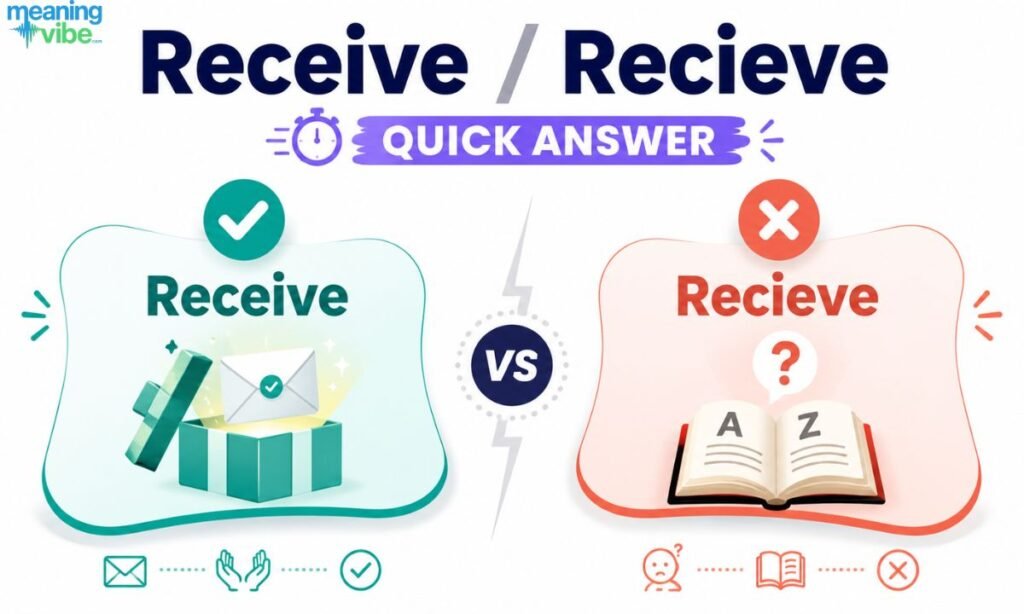
“Receive” is the only correct spelling. “Recieve” is always a misspelling, with no exceptions.
| Spelling | Status | Why |
| Receive | ✅ Correct | Follows the “e before i after c” pattern |
| Recieve | ❌ Incorrect | Breaks the standard spelling rule |
No dictionary, style guide, or grammar authority recognizes “recieve” as a valid word. If you’ve written it that way in an email, essay, or report, it’s time to make the switch for good.
Receive or Recieve in English
In standard English, “receive” is a verb that means to get, accept, or be given something. It’s used constantly in everyday conversation, business writing, and formal documents alike.
Some quick examples of correct usage:
- I will receive my paycheck on Friday.
- She received a thank-you card from her client.
- We are receiving applications until next week.
No matter the tense or context, the spelling never changes to “recieve.” Whether you’re writing a text message or a legal contract, “receive” is the version you want.
Receive or Recieve Grammar
The confusion between these two spellings comes down to one classic grammar rule taught in nearly every English classroom: “I before E, except after C.”
Here’s how it plays out:
- When “i” and “e” appear together and make a long “ee” sound, “i” usually comes first — as in believe, achieve, and relief.
- But when that same “ee” sound follows the letter “c,” the order flips, and “e” comes before “i” — as in receive, ceiling, and deceive.
Since “receive” contains a “c” right before the “ei” combination, the rule requires “e” before “i.” That’s exactly why “receive” is correct and “recieve” is not.
Like most English spelling rules, this one has exceptions elsewhere in the language (think weird or science), but “receive” isn’t one of them. It follows the rule precisely.
Receive or Recieve Examples
Seeing the word used correctly in real sentences is one of the fastest ways to make the spelling stick. Here are some practical examples across different situations:
Everyday communication:
- He didn’t receive my text message until this morning.
- Please let me know once you receive the package.
Business and professional writing:
- The company will receive payment within 30 days.
- Our team received positive feedback from the client.
Academic and formal use:
- Students who complete the course will receive a certificate.
- The proposal received approval from the board.
Notice how the spelling stays identical, regardless of tense (receive, received, receiving) or context. The consistency makes it easier to memorize once you commit the pattern to memory.
Receive or Recieve Meaning
Beyond spelling, it helps to fully understand what the word actually means and how it functions in a sentence.
Receive is a transitive verb, meaning it needs an object to complete its meaning. Its core definitions include:
- To take or accept something that is given, sent, or delivered
- To be the recipient of an action, message, or item
- To formally welcome or greet someone (a less common, more formal usage)
Examples of this secondary meaning include phrases like “The ambassador received foreign dignitaries at the embassy,” where “receive” means to formally welcome rather than simply accept an item.
In nearly all modern usage, though, “receive” refers to accepting or being given something — a package, an email, feedback, an award, or even an idea.
Also Read This: Pricy vs. Pricey: What’s the Difference and Which Is Right? (2026)
The Origin of Receive / Recieve
Understanding where a word comes from can make its spelling feel far less arbitrary. “Receive” has a long linguistic history that traces back through several languages.
The word entered English through Middle English as “receiven,” which itself came from the Old French word “receivre.” That French term was rooted in the Latin word “recipere,” a combination of “re-” (meaning “back”) and “capere” (meaning “to take”). Put together, the original meaning was essentially “to take back” or “to take in.”
As the word moved from Latin to French to English, the “ei” spelling pattern after the “c” was preserved throughout its evolution. That’s why, centuries later, we still write “receive” with the same letter order today. The misspelling “recieve” has never been part of that historical lineage — it’s simply a modern error caused by confusion with the more common “ie” pattern.
British English vs American English Spelling
One question people often ask is whether “receive” is spelled differently in British English compared to American English, similar to how “colour” and “color” differ.
The answer is straightforward: there is no regional difference. Both British and American English use the exact same spelling — “receive” — with no variation in letters, hyphenation, or style.
| Region | Correct Spelling | Notes |
| British English (UK) | Receive | Identical spelling and meaning |
| American English (US) | Receive | Identical spelling and meaning |
| Australian/Canadian English | Receive | Identical spelling and meaning |
This consistency sets “receive” apart from many other English words that do shift between dialects. Regardless of where your audience is located, “receive” is always the safe, correct choice.
Which Spelling Should You Use?
At this point, the answer should be clear: always use “receive.” There is no context — formal, informal, academic, or conversational — where “recieve” is acceptable.
Here’s a simple decision guide:
- Writing a professional email? Use receive.
- Texting a friend? Use receive.
- Drafting a school essay? Use receive.
- Filling out a business form? Use receive.
If you ever find yourself unsure while typing, a few memory tricks can help:
- Rely on the rule: “I before E, except after C” applies directly here.
- Break it into chunks: Think of the word as re + cei + ve. The middle chunk “cei” always follows this exact pattern.
- Compare it to related words: Receipt, receiver, and deceive all follow the same “e before i after c” structure, reinforcing the pattern across your vocabulary.
Common Mistakes with Receive
Even after learning the rule, certain habits can cause the error to slip through. Here are the most frequent mistakes writers make with this word:
- Autocorrect gaps: Not all spell-checkers catch “recieve” automatically, especially in informal apps or messaging platforms.
- Confusing it with similar words: People sometimes mix up “receive” with “receipt,” “perceive,” or “conceive,” second-guessing all of them at once.
- Overreliance on memory instead of rules: Writers who memorize the word by sight (rather than understanding the rule) are more likely to make errors under time pressure.
- Typing speed errors: Fast typing can cause letters to transpose, even when the writer knows the correct spelling.
A quick way to avoid these slip-ups is to proofread key documents manually rather than relying solely on automated tools, especially for professional or academic writing where accuracy matters most.
Receive in Everyday Examples
“Receive” shows up constantly across different areas of daily life. Here’s how it’s typically used in various settings:
In the workplace:
- Employees receive their salaries on a set schedule.
- Managers receive performance reports monthly.
In customer service:
- Customers receive confirmation emails after placing an order.
- Support teams receive and respond to tickets throughout the day.
In personal life:
- Friends receive invitations to birthday parties.
- Family members receive holiday cards each year.
In education:
- Graduates receive diplomas at commencement.
- Students receive grades at the end of each term.
Across all these examples, the spelling remains fixed. Only the surrounding context changes, never the word itself.
Receive – Google Trends & Usage Data
Search interest in the correct spelling of “receive” remains consistently high year-round, driven largely by students, professionals, and non-native English speakers looking to confirm their writing before sending important messages.
Related search terms that frequently appear alongside “receive or recieve” queries include:
- “receive spelling rule”
- “i before e except after c”
- “receive vs recieve grammar”
- “how to spell receive correctly”
- “receive meaning in English”
This pattern suggests that spelling confusion around “receive” isn’t a passing trend — it’s a persistent, ongoing challenge tied to how the word sounds versus how it’s written. Because the “ee” sound typically pairs with “ie” in English (as in believe or achieve), writers instinctively want to apply that same pattern to “receive,” even though the rule requires the opposite order after “c.”
Comparison Table
For a quick, at-a-glance reference, here’s a summary comparison of “receive” against other commonly confused “ei/ie” words:
| Word | Correct Spelling | Rule Applied | Example Sentence |
| Receive | Receive (not Recieve) | E before I after C | I will receive the results tomorrow. |
| Deceive | Deceive (not Decieve) | E before I after C | Don’t try to deceive your teammates. |
| Ceiling | Ceiling (not Cieling) | E before I after C | The ceiling needs a fresh coat of paint. |
| Believe | Believe (not Beleive) | I before E | I believe you’re right about this. |
| Achieve | Achieve (not Acheive) | I before E | She worked hard to achieve her goals. |
| Friend | Friend (not Freind) | I before E | He’s my closest friend from college. |
This table highlights a useful pattern: any word with “cei” almost always places E before I, while most other “ee”-sounding words place I before E. Recognizing this pattern makes it far easier to spell “receive” — and similar words — correctly every time.
Conclusion
The debate between “receive” and “recieve” isn’t really a debate at all — “receive” is correct, and “recieve” is simply a common spelling error. By understanding the “I before E, except after C” rule, recognizing the word’s Latin and French origins, and practicing with real examples, you can eliminate this mistake from your writing permanently.
Whether you’re sending a professional email, writing a school assignment, or texting a friend, remembering this one rule will help you spell “receive” correctly every single time — no autocorrect required.