

You are typing a text, you feel frustrated, and suddenly you freeze. Is it dammit or damnit? This tiny word trips up more writers than almost any other exclamation in English, and autocorrect does not always help.
The confusion makes sense. Both spellings look plausible, both sound almost identical when spoken aloud, and both show up constantly in books, texts, and social media. But only one of them is recognized by major dictionaries as standard.
This guide gives you a clear, no nonsense answer, backed by grammar rules, real usage examples, and search data, so you never have to pause mid sentence again.
Dammit or Damnit – Quick Answer
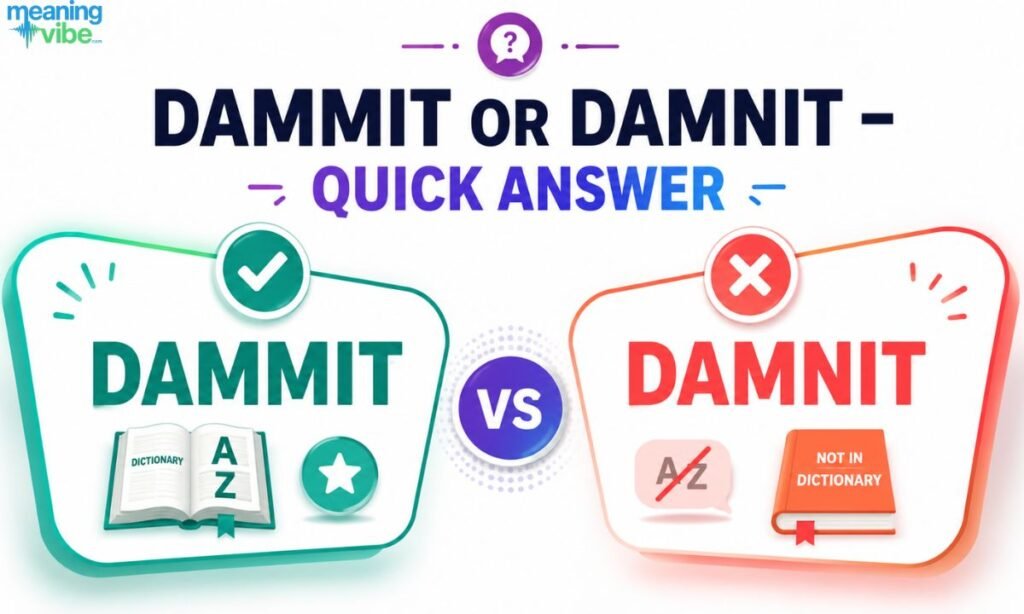
Dammit is the correct and dictionary recognized spelling. Damnit is a common misspelling that many people type because it feels closer to the root word damn.
Here is the fastest way to remember it:
- Dammit = correct, one word, double m
- Damnit = incorrect, common typo, single m
- Damn it = correct, two words, more formal and emphatic
If you only take one thing from this article, take this: when in doubt, write dammit.
Dammit vs Damnit on Reddit
Search Reddit threads on this topic and you will find a fairly consistent pattern. Most native English speakers instinctively type dammit, and grammar focused subreddits regularly correct users who write damnit.
A few patterns show up again and again in these discussions:
- Commenters point to dictionaries like Merriam Webster, which lists dammit but not damnit as a standard entry
- Writers admit they typed damnit for years without realizing it was nonstandard
- Some users argue damnit feels more natural because it keeps the n from damn
- Fiction writers debate which spelling reads better in dialogue
The takeaway from these community discussions matches what style guides say: dammit wins by a wide margin in both formal recognition and everyday preference.
Dammit vs Damnit Grammar
From a pure grammar standpoint, dammit is a contraction style interjection formed by blending damn and it into a single word. When two words merge like this, English spelling conventions often adjust the final consonant, which is why the n from damn effectively gets absorbed and the m doubles instead.
Damnit tries to keep both the n and the following it stuck together without that adjustment. This is not how the word evolved in actual usage, which is why grammar resources and dictionaries treat it as an error rather than an accepted variant.
A simple grammar rule to hold onto:
- Damn plus it, spoken naturally, drops the n sound
- The written form that matches that sound is dammit
- Damnit tries to preserve a sound that nobody actually says
Damn it, written as two separate words, is grammatically the most formal option. It reads slower, hits harder in serious contexts, and is often used when a writer wants extra emphasis rather than a quick, breezy exclamation.
Dammit vs Damnit Examples
Seeing the word in context makes the difference much easier to remember.
Correct usage:
- Dammit, I left my keys at the office again.
- She muttered dammit under her breath when the printer jammed.
- Dammit, we missed the last train by two minutes.
Incorrect usage:
- Damnit, I left my keys at the office again.
- She muttered damnit under her breath when the printer jammed.
More formal, two word version:
- Damn it, this is exactly the kind of mistake we cannot afford.
- Damn it all, I told you this would happen.
Notice how dammit fits casual speech and texting, while damn it fits slower, more deliberate frustration.
The Origin of Dammit or Damnit
The phrase traces back to the older expression damn it, a combination of the verb damn and the pronoun it, used since at least the eighteenth century as a mild curse expressing frustration or anger.
Over time, spoken English naturally dropped the n sound when the two words ran together in casual speech. Writers eventually began spelling the word the way people actually said it, which produced dammit, doubling the m to preserve the short vowel sound in damn.
Damnit appeared later as a logical but ultimately unsuccessful attempt to keep the original letters of damn and it intact without changing the sound. Because it never matched natural pronunciation, it never gained the same acceptance in dictionaries or style guides.
This same pattern shows up in related expressions like goddammit, which follows the identical doubling rule and is far more common than the alternative goddamnit.
British English vs American English Spelling
One question that comes up often is whether British and American English treat this word differently. The short answer is no, not in any meaningful way.
| Feature | American English | British English |
| Preferred spelling | Dammit | Dammit |
| Pronunciation | DAM it | DAM it |
| Formality level | Informal | Informal |
| Dictionary recognition | Merriam Webster | Oxford English Dictionary |
| Two word version | Damn it | Damn it |
Unlike spelling pairs such as color and colour, or realize and realise, dammit does not have separate regional standards. Both American and British dictionaries recognize the same double m spelling, and both treat damnit as nonstandard.
Which Spelling Should You Use?
Your choice really comes down to tone and setting, not region or dialect.
Use dammit when:
- You are texting or messaging casually
- You are writing dialogue that should sound like natural speech
- You want a quick, punchy expression of frustration
- You are writing for blogs, social media, or informal content
Use damn it when:
- You want a more deliberate, weighty tone
- The sentence needs extra emphasis or seriousness
- You are writing narrative prose where pacing matters
- You want to separate the words for dramatic effect
Avoid damnit in almost every situation. It carries no stylistic advantage over dammit, it is not recognized in dictionaries, and it can make otherwise polished writing look careless.
Common Mistakes with Dammit or Damnit
Even experienced writers slip up here. The most frequent errors include:
- Typing damnit because the eye reads damn plus it as two separate familiar words
- Assuming damn it and dammit are interchangeable in every context, when tone actually differs
- Using dammit in formal writing such as reports, essays, or professional emails
- Forgetting the double m and writing damit
- Overusing the word so often that it loses its emotional impact
A simple fix: if you are unsure while typing, pause and ask whether you are writing casual dialogue or formal prose. Casual and quick means dammit. Slower and weighted means damn it. Neither situation calls for damnit.
Dammit or Damnit in Everyday Examples
This word shows up everywhere, from novels to everyday conversation.
- Text messages: Dammit, traffic is terrible today.
- Social media captions: Dammit, Monday again.
- Fiction dialogue: I love you, dammit, and I am not sorry about it.
- Frustrated exclamations: Dammit, the file will not save.
- Emphasis in speech: Damn it, we worked so hard for this.
Notice that almost every casual, real world example favors dammit, while damn it appears more often in emotionally heavier or written narrative contexts.
Dammit or Damnit – Google Trends and Usage Data
Search interest data consistently shows dammit receiving significantly higher search volume than damnit, which reflects both its correct status and its far more common usage in writing.
Ngram data from digitized books tells a similar story. Damn it remains the most frequently printed form overall because it is the original phrase, dammit follows as the widely accepted contracted spelling, and damnit trails far behind both, appearing mostly in casual internet writing rather than edited publications.
This pattern matters for writers because search engines and readers alike expect the standard spelling. Using damnit can subtly reduce credibility, even in informal content.
Comparison Table: Dammit vs Damnit vs Damn it
| Version | Correctness | Formality | Common Use Case |
| Dammit | Correct, dictionary recognized | Informal | Texting, casual dialogue, blogs |
| Damn it | Correct, original phrase | Formal to neutral | Narrative prose, emphasis, serious tone |
| Damnit | Incorrect, common typo | Not applicable | Should be avoided entirely |
Conclusion
The rule is simple once you see it clearly. Dammit is correct, damn it is correct in its more formal two word form, and damnit is a typo that dictionaries and style guides do not recognize. When you want a quick, natural sounding exclamation, reach for dammit.
When you want extra weight and emphasis, use damn it. Skip damnit altogether, and your writing will stay clean, credible, and correctly spelled every single time.