

Have you ever typed “imput” instead of “input” and hit send before you noticed? You’re not the only one. This mix-up shows up constantly in emails, forms, and social posts — and it’s one of the easiest spelling errors to fix once you understand why it happens.
Here’s the short version: only one of these words is real. The other is a sound-based typo that has somehow spread across the internet despite never appearing in a single dictionary. This guide breaks down the meaning, origin, grammar, and real-world usage of “input” so you never second-guess the spelling again.
Input or Imput – Quick Answer
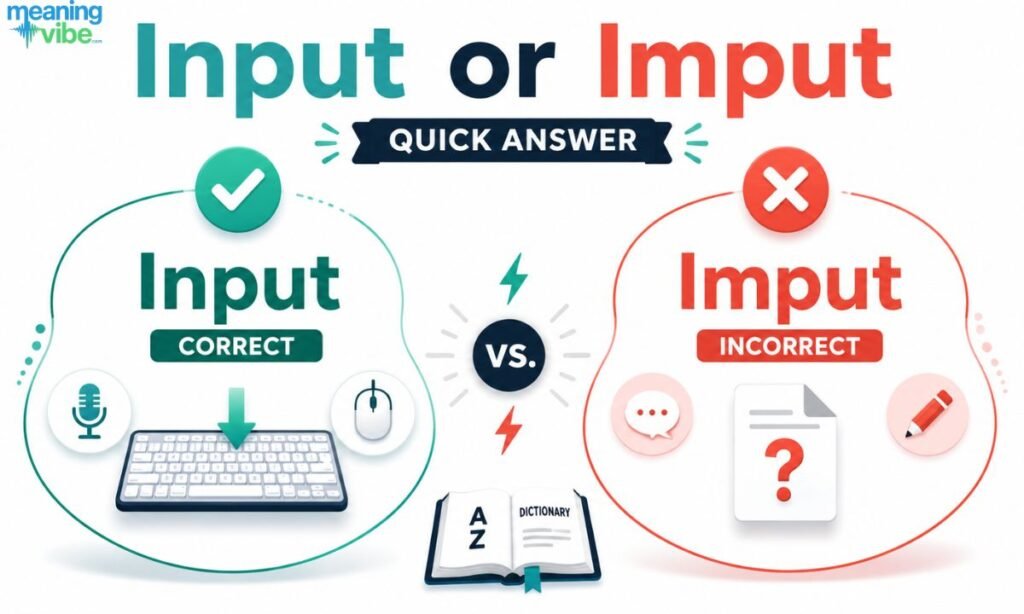
“Input” is the only correct spelling. “Imput” does not exist in any English dictionary — not Merriam-Webster, not Oxford, not Cambridge.
| Input | Imput | |
| Valid English word? | ✅ Yes | ❌ No |
| Found in dictionaries? | ✅ Yes | ❌ No |
| Part of speech | Noun and verb | None — misspelling |
| Meaning | Data, ideas, or feedback put into a system | No independent meaning |
| Correct usage | “Please give your input on the plan.” | Never correct |
If you remember nothing else from this article, remember this: input = in + put. You put something in. There’s no “m” anywhere in the logic of the word.
The Origin of Input or Imput
“Input” is a compound word built from two familiar English pieces: the prefix “in-“ (meaning into) and the verb “put” (meaning to place). Put them together and the meaning is right there in the spelling — something placed into a system, process, or conversation.
The word existed in limited technical and scientific writing long before computers, but it exploded in popularity during the mid-20th century as computing terminology went mainstream. Engineers needed a clean word for “what goes into a machine before it produces output,” and “input” fit perfectly.
“Imput,” on the other hand, has no independent history. It isn’t a shortened form, a regional variant, or an older spelling that fell out of use. It’s simply a phonetic slip that got typed often enough to look familiar — which is exactly why it keeps tripping people up.
Quick fact check:
- First technical use: late 19th century
- Mainstream boom: mid-20th century, alongside computer science
- Dictionary status of “imput”: never listed, in any edition
Input or Imput Meaning
Input (noun): Something contributed to a process — data, ideas, energy, money, or feedback.
- “We need everyone’s input before finalizing the budget.”
Input (verb): To enter data or information into a system.
- “Please input your details into the form.”
Imput: Has no accepted meaning. It is always treated as a spelling error of “input,” though it’s sometimes confused with a completely different word — impute (explained below).
Because “input” functions as both a noun and a verb without changing form, it’s what linguists call a case of zero derivation — one spelling, multiple grammatical jobs. That flexibility is part of why the word feels so natural in so many contexts, from office meetings to software manuals.
Input or Imput Examples
Seeing the correct word in context makes the spelling stick faster than any rule does.
As a noun:
- Her input shaped the final design of the app.
- The team gathered input from every department before launch.
- Garbage input leads to garbage output — a golden rule in tech.
As a verb:
- He input the sales figures into the spreadsheet.
- Staff are required to input attendance data daily.
- She had already input the numbers before the meeting started.
Incorrect usage to avoid:
- ❌ “We need your imput on this proposal.”
- ❌ “Please imput the client’s information.”
- ❌ “The system requires imput before it can run.”
Every one of those sentences should use “input” instead — swapping the “m” for an “n” is the only fix needed.
Input or Imput Grammar
Understanding how “input” behaves grammatically helps you avoid awkward phrasing, not just spelling mistakes.
- Noun form: Often treated as an uncountable (mass) noun — “input” rather than “an input.” However, the plural “inputs” is common and accepted in business and technical writing when referring to multiple distinct contributions (e.g., “data inputs from three sensors”).
- Verb form: “Input” can be used in present, past, and past participle forms. Both “input” and “inputted” are grammatically acceptable as the past tense, though “input” is more common in modern American usage.
| Tense | Example |
| Present | I input the data every morning. |
| Past | She input (or inputted) the results yesterday. |
| Present participle | They are inputting new records now. |
| Past participle | The figures have been input into the system. |
“Imput” has no grammatical forms because it isn’t a word — there’s no “imputted” or “imputting” that carries meaning.
Also Read This: Pricy vs. Pricey: What’s the Difference and Which Is Right? (2026)
British English vs American English Spelling
Good news: this isn’t a case where British and American English disagree, like “colour” versus “color.” “Input” is spelled identically on both sides of the Atlantic.
The only real difference shows up in the past tense preference:
| Region | Preferred past tense | Notes |
| American English | “input” | Simpler, more common in tech and business writing |
| British English | “input” or “inputted” | Both accepted; “inputted” appears more often in traditional or formal contexts |
So whether you’re writing for a US audience or a UK audience, the spelling stays the same — “imput” is wrong everywhere.
Which Spelling Should You Use?
Always use “input.” There is no context — formal, casual, technical, academic, or conversational — where “imput” is the correct choice.
A simple way to lock in the right spelling:
- Think of the meaning first. You’re putting something in, so write “in” + “put.”
- Say it slowly. In-put — two clear syllables, no “m” sound if you enunciate carefully.
- Use a grammar checker. Tools like Grammarly or built-in spellcheckers will flag “imput” instantly.
- Watch for keyboard slips. On many keyboards, “n” and “m” sit close together, so a rushed typing session is a common culprit.
Common Mistakes with Input or Imput
Even confident writers fall into a few predictable traps. Here are the ones worth watching for:
- Typing “imput” out of speed, not ignorance. Fast typing and autocorrect quirks are the biggest causes, not a lack of knowledge.
- Confusing “input” with “impute.” These are two entirely different words. Impute means to attribute blame, responsibility, or cause to someone — it has nothing to do with entering data.
- Overusing “input” when a more specific word fits better. Sometimes “feedback,” “suggestion,” or “comment” is clearer and adds variety to your writing.
- Forgetting the plural rule. The plural of input is “inputs,” used correctly in phrases like “data inputs” or “multiple stakeholder inputs.”
- Assuming “imput” is a regional spelling. It isn’t recognized in American, British, Canadian, or Australian English.
Input vs. Impute: A Quick Comparison
| Input | Impute | |
| Meaning | To enter or contribute data/ideas | To attribute blame or cause to someone |
| Part of speech | Noun and verb | Verb only |
| Tone | Neutral or positive | Often formal, sometimes negative |
| Example | “Please input the totals.” | “They imputed the error to poor planning.” |
Input or Imput in Everyday Examples
“Input” shows up far beyond computer screens. It’s a genuinely versatile word across daily life:
- Workplace: “Leadership asked for employee input before rolling out the new policy.”
- Education: “Student input shapes how the curriculum evolves each semester.”
- Technology: “The app won’t process the request without valid user input.”
- Creative projects: “The director welcomed input from the whole cast during rehearsals.”
- Home life: “We asked the kids for their input on where to go for vacation.”
These examples show why the word matters in practically every setting where people share ideas, enter data, or contribute to a decision.
Input or Imput – Google Trends & Usage Data
Search interest for “imput” has stayed consistently present online, largely because it’s a search people type when they’re unsure of the spelling — not because it’s a word gaining acceptance. Meanwhile, “input” remains one of the most searched and used terms in business, education, and technology writing, driven by its role in everything from user experience design to workplace collaboration.
Typos like “imput” tend to spike in casual environments — social media comments, quick chat messages, and unedited first drafts — and drop sharply in polished, professional, or published content, where spellcheckers and editors catch the error before it goes live.
Comparison Table: Input vs Imput
| Category | Input | Imput |
| Correct spelling | ✅ Yes | ❌ No |
| Dictionary entry | Merriam-Webster, Oxford, Cambridge | None |
| Grammatical role | Noun, verb | N/A |
| Past tense | Input / Inputted | N/A |
| American English | Correct | Incorrect |
| British English | Correct | Incorrect |
| Common cause of confusion | N/A | Nasal sound blending (“n” shifts toward “m” before “p”) |
| Appropriate in professional writing | ✅ Always | ❌ Never |
Frequently Asked Questions
Is “imput” ever correct? No. “Imput” is always a misspelling of “input” and doesn’t appear in any standard dictionary.
Why do people write “imput” instead of “input”? It usually comes from pronunciation — the “n” sound naturally blends toward an “m” sound before “p” when spoken quickly.
Is “input” a noun or a verb? Both. It works as a noun (a contribution or data) and as a verb (to enter data into a system).
What’s the past tense of “input”? Both “input” and “inputted” are accepted, though “input” is more common in American English.
Is “imput” the same as “impute”? No. “Impute” is a real word meaning to attribute blame or cause, while “imput” has no meaning at all.
Does British English spell it differently? No. “Input” is spelled the same in British and American English; only past-tense preference varies slightly.
Conclusion
The difference between “input” and “imput” comes down to one simple fact: only one of them is a real word. “Input” — built from “in” and “put” — is correct in every context, from casual conversation to professional reports and technical documentation. “Imput” is a common phonetic slip, not a legitimate spelling, regional variant, or alternate form.
The next time your fingers (or your ears) try to talk you into that extra “m,” remember the logic behind the word: you’re putting something in. Spell it that way, and you’ll never have to second-guess it again.