

Typing a quick message and suddenly second guessing yourself over “someone elses phone” or “someone else’s phone” is more common than most writers admit. This tiny word trips up native speakers, ESL learners, students, and even professional editors, because “else” doesn’t behave like a normal noun.
This guide gives you the quick answer first, then walks through the grammar rule, the history behind it, regional spelling questions, real world examples, and the mistakes to avoid so you never hesitate over this again.
Elses or Else’s – Quick Answer
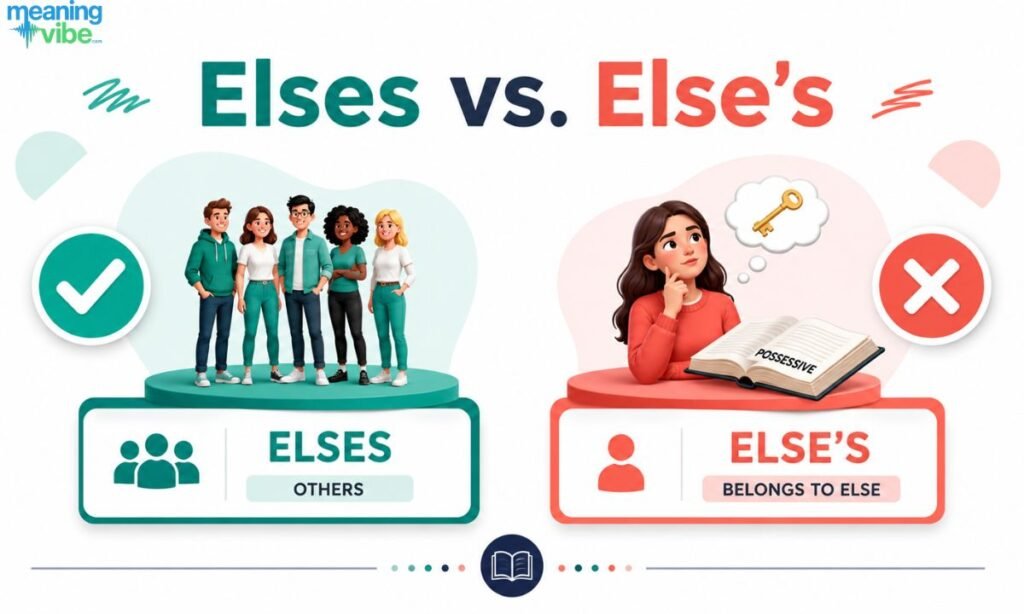
Else’s is correct. Elses is not a recognized word in standard English.
Here’s the short version before we go deeper:
- Use else’s whenever you want to show that something belongs to another, unspecified person.
- Never use elses, with or without an apostrophe, in formal or informal writing.
- The rule stays identical in both American and British English.
- “Else” has no plural form, so there is nothing for “elses” to represent.
If you remember only one line from this article, remember this: possession with “else” always takes an apostrophe before the s, never after, and never without one at all.
Elses or Else’s in a Sentence
Seeing the word in context makes the rule click faster than any definition can. Here’s how else’s functions naturally inside real sentences:
- That is someone else’s umbrella, not mine.
- I don’t want to hear anyone else’s opinion right now.
- This mistake wasn’t anybody else’s fault.
- Whose jacket is this? It must be somebody else’s.
Notice that “else’s” attaches to the end of the whole phrase, “someone else,” “anyone else,” “somebody else,” not to the pronoun by itself. That’s the detail most learners miss.
Elses or Else’s Meaning
“Else’s” is the possessive form of “else,” a word that means “different,” “other,” or “in addition.” On its own, “else” can’t own anything, since it functions as an adverb or adjective rather than a standalone noun.
But when it’s paired with an indefinite pronoun like someone, anyone, everyone, nobody, or somebody, the combined phrase acts like a single compound noun, and that compound noun can take a possessive ending.
So when you write “everyone else’s coat,” you’re really saying “the coat belonging to every other person here.” The apostrophe plus s attaches to the entire two word unit, not to a plural form of “else,” because that plural form doesn’t exist.
Also Read This: Modeling or Modelling: Correct Spelling, Meaning & Examples (2026)
Everyone Else’s or Elses
The correct phrase is always everyone else’s.
Writers sometimes assume that because “everyone” refers to a group, the possessive should land differently, maybe on “everyone” instead of “else,” or maybe by pluralizing “else” into “elses” to match the group idea. Neither instinct holds up in standard grammar.
Correct examples:
- Everyone else’s homework was collected before mine.
- I read everyone else’s feedback before writing my response.
- Her performance was better than everyone else’s.
Incorrect: “everyone elses,” “everyone’s else,” “everyone else’s’s.”
Anyone Elses or Else’s
Just like the example above, the answer is anyone else’s.
- Did anyone else’s flight get delayed today?
- I haven’t seen anyone else’s application yet.
- This problem isn’t anyone else’s responsibility but mine.
“Anyone else’s” follows the exact same pattern as “someone else’s” and “everyone else’s.” Once you internalize the rule for one indefinite pronoun, it applies cleanly to all of them, including “no one else’s,” “nobody else’s,” and “somebody else’s.”
Elses or Else’s Examples
A wider set of examples helps lock the rule in for good. Below are natural, everyday sentences using else’s correctly across different tones and contexts.
| Context | Example Sentence |
| Casual conversation | This isn’t my seat, it’s someone else’s. |
| Workplace email | Please don’t use anyone else’s login credentials. |
| Academic writing | The researcher cited someone else’s findings without permission. |
| Social media | Stop comparing your life to everyone else’s highlight reel. |
| Legal or formal | The property in question belongs to somebody else’s estate. |
Across every register, from texting to legal documents, the rule never bends. There’s no casual exception that allows “elses” to slip through.
The Origin of Elses or Else’s
To understand why “elses” feels tempting but stays wrong, it helps to look at where “else” came from. The word traces back to Old English “elles,” meaning “otherwise” or “in another way.” For centuries, “else” functioned purely as an adverb, describing an alternative rather than naming a person or thing.
Because it started as an adverb and not a noun, English never developed a natural plural for it. Regular nouns like “book” or “cat” pluralize by adding s, and then form possessives by adding an apostrophe after that s when plural, or before it when singular.
“Else” skipped that entire evolutionary path. It only gained a possessive form once it started pairing with indefinite pronouns like “someone” and “anyone” to form compound expressions, and English speakers needed a way to show that these new compound units could own something.
That’s why grammarians treat “someone else” as a single possessive unit rather than two separate words each following their own rule. The apostrophe goes at the very end of the phrase because the phrase itself, not just “else,” is what’s doing the possessing.
British English vs American English Spelling
Unlike genuine transatlantic spelling differences such as “colour” versus “color” or “organise” versus “organize,” this is not a regional issue at all.
| Feature | British English | American English |
| Correct possessive | else’s | else’s |
| Incorrect form | elses | elses |
| Regional variation | None | None |
| Formal usage | else’s | else’s |
| Informal usage | else’s | else’s |
Both varieties of English inherited “else” from the same linguistic root and apply identical possessive rules to it. So if you’ve been searching for a British spelling exception to justify “elses,” you won’t find one, because it doesn’t exist on either side of the Atlantic.
Which Spelling Should You Use?
Always use else’s. There is no scenario in standard written English, academic, professional, casual, or creative, where “elses” is the accepted spelling.
A simple test you can run mentally before hitting send or submit:
- Ask yourself if you’re showing ownership or belonging.
- If yes, attach an apostrophe and s to the full phrase (“someone,” “anyone,” “everyone,” plus “else”).
- Never add a plain s to “else” without an apostrophe.
- Never add an apostrophe after an s that doesn’t already exist.
If you follow those four steps, you’ll produce a correct possessive every single time, regardless of which pronoun comes before “else.”
Common Mistakes with Elses or Else’s
Even confident writers slip up here, usually in one of these five ways:
- Dropping the apostrophe entirely: “This is someone elses bag” instead of “someone else’s bag.”
- Misplacing the apostrophe: “someone’s else bag” instead of “someone else’s bag.”
- Treating “elses” as a plural noun: assuming multiple people means multiple “elses,” which isn’t how the word works since “else” has no plural form.
- Confusing it with “else is”: some writers wrongly contract “else is” into “else’s” in the wrong context, then apply that logic backward to possession.
- Autocorrect interference: some keyboards and writing tools flag “else’s” as an error and suggest “elses,” which then gets accepted without a second look.
Proofreading out loud helps catch most of these, since “someone elses” sounds noticeably off once you hear it spoken slowly.
Elses or Else’s in Everyday Examples
Beyond formal writing, this possessive shows up constantly in daily communication, often without anyone noticing the grammar happening underneath.
- Texting a friend: “Is this your umbrella or someone else’s?”
- Parenting: “That’s not your toy, it’s someone else’s.”
- Customer service: “This order was placed under someone else’s account.”
- Journalism: “The statement reflects someone else’s opinion, not the company’s official position.”
- Classroom instructions: “Do not copy anyone else’s assignment.”
These examples show that the rule isn’t confined to grammar textbooks. It surfaces in ordinary conversations dozens of times a week, which is exactly why getting it right matters for everyday clarity, not just academic correctness.
Elses or Else’s – Google Trends & Usage Data
Search interest in this exact grammar question has grown steadily over recent years, driven largely by ESL learners, content writers, and students preparing for English proficiency exams. Search behavior tends to cluster around a few recurring patterns:
- Highest search volume comes from English-learning regions, particularly South Asia, Southeast Asia, and parts of Africa, where English is widely taught as a second language.
- Searches spike around the start of academic terms, when students write more formal essays and reports.
- Content creators and copywriters frequently search this term while proofreading client work, since a missed apostrophe here is one of the more common self-editing catches.
- Voice assistants and predictive text tools have contributed to confusion, since spoken English naturally erases the audible difference between “else’s” and a hypothetical “elses.”
While exact volume figures shift month to month, the consistent pattern across available data is that “else’s” clearly outperforms “elses” in searches specifically asking which form is correct, confirming that most people already sense something is off with “elses” even before they look it up.
Comparison Table: Elses vs Else’s
| Feature | Elses | Else’s |
| Grammatically correct | No | Yes |
| Recognized in dictionaries | No | Yes |
| Used in formal writing | Never | Always, when showing possession |
| Used in American English | No | Yes |
| Used in British English | No | Yes |
| Common in casual speech | Occasionally by mistake | Standard |
| Plural form of “else” | Doesn’t exist | Not applicable |
| Correct example | N/A | “That is anyone else’s choice.” |
Conclusion
The rule behind elses or else’s is simpler than it first appears once you understand why “else” behaves the way it does. Because “else” started as an adverb rather than a noun, it never picked up a plural form, which means “elses” was never a real option to begin with.
Whenever you’re showing that something belongs to an unspecified person, whether it’s someone, anyone, everyone, or somebody, the apostrophe and s attach to the very end of that phrase: else’s. This holds true across American English, British English, formal documents, and casual texts alike.
Keep that one consistent rule in mind, and you’ll write this possessive correctly every time, without ever needing to second guess yourself again.