

A ship slides into harbor at dawn. A baby takes a first breath. Two very different scenes, yet the word that names each one sounds exactly the same when spoken aloud.
That is the whole puzzle behind berth vs birth. The two words are perfect homophones. They share the same sound, nearly the same spelling, and not a single drop of the same meaning. Write “she gave the dog a wide birth” and a sharp-eyed reader will smile. Write “the berth of a child” and the sentence collapses.
Berth vs Birth
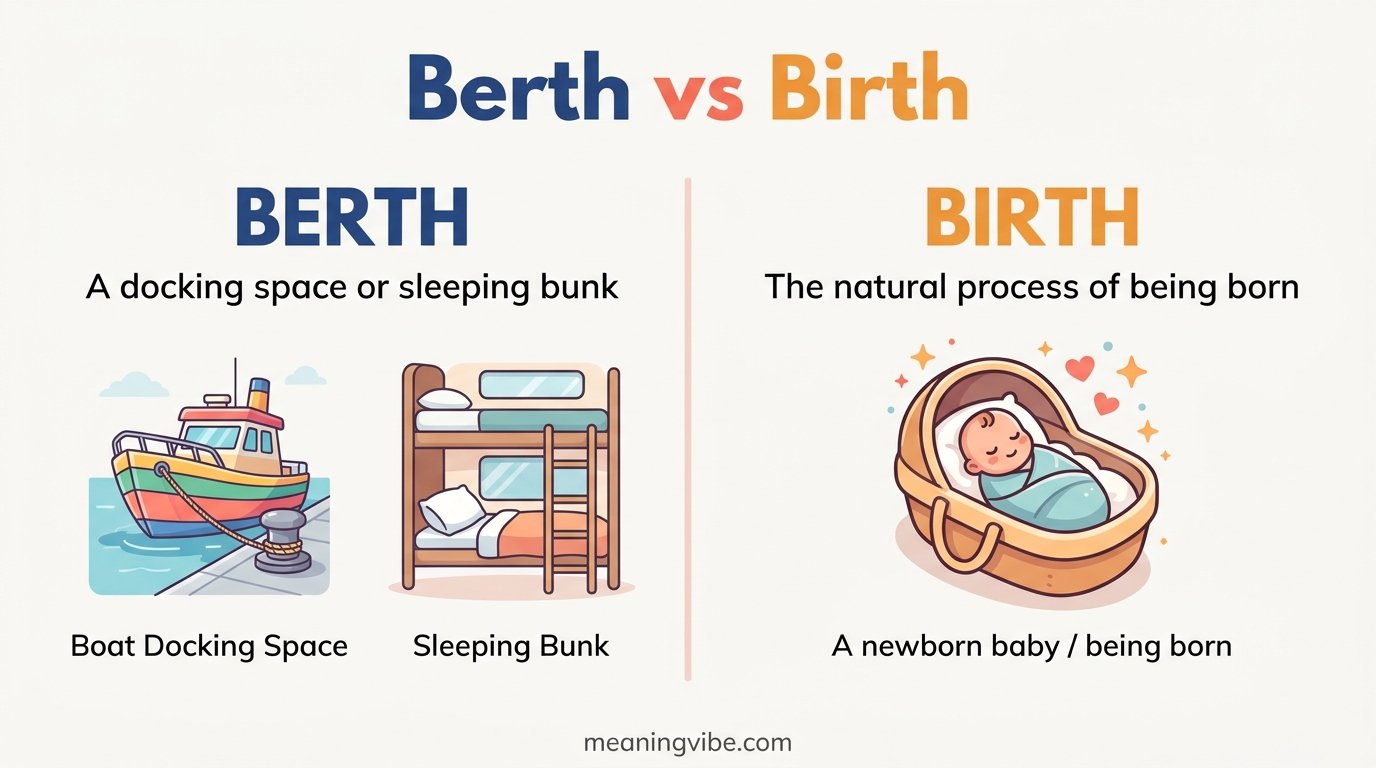
Berth means a place where a ship docks, a sleeping bunk on a ship or train, or a safe distance, as in “a wide berth.” Birth means the act of being born, or the beginning of something.
Short version: Berth = a place or space. Birth = a beginning.
Key Takeaways
- Berth and birth are homophones, so they sound identical.
- Use berth for docking spots, sleeping bunks, and safe distance.
- Use birth for being born, origins, and the start of something new.
- The idiom is “give a wide berth,” never “wide birth.”
- You give birth, you do not give berth.
- Both words are mostly nouns, with rare verb uses.
- Context is the only clue when you hear these words.
Berth vs Birth Meaning
Both words are short, both end in “th,” and both look almost the same on the page. Yet their meanings sit in separate worlds.
One word belongs to the sea and to travel. The other belongs to life and to beginnings.
What Does Berth Mean?
Berth has several related meanings. All of them involve a space set aside for something.
- A place where a ship is moored or docked.
- A bed or bunk on a ship, train, or bus.
- A safe distance, especially in the idiom “wide berth.”
- A position or place, such as a spot in a tournament or a job.
Here are examples of each use.
- The cruise ship reached its berth at noon.
- We booked a lower berth on the overnight train.
- She gave the muddy dog a wide berth.
- The team earned a berth in the final.
What Does Birth Mean?
Birth means the act or process of being born. It also means the start or origin of something.
- Her birth was celebrated by the whole family.
- The birth of the internet changed the world.
- He is a Texan by birth.
- The birth of the company happened in a garage.
Berth and Birth as Verbs
Both words can also work as verbs, although these uses are far less common.
To berth a ship means to bring it into its docking space. “The captain berthed the vessel at dawn.”
To birth something means to bring it into being. “She birthed a new idea.” Many writers prefer “gave birth to” in formal writing.
Difference Between Berth and Birth
Here is the clearest way to see the difference between berth and birth side by side.
| Feature | Berth | Birth |
|---|---|---|
| Core meaning | Docking spot, bunk, safe distance | Being born, a beginning |
| Main idea | Space or place | Start or origin |
| Typical setting | Ships, trains, travel | Families, origins, launches |
| Word type | Mostly noun, sometimes verb | Mostly noun, rarely verb |
| Pronunciation | /bɜːrθ/ | /bɜːrθ/ |
| Famous idiom | Give a wide berth | Give birth |
| Related word | Berthing | Birthday |
| Example | A berth on a ship | The birth of a baby |
Place vs Beginning
The simplest rule is this. Berth is about a place or a space. Birth is about a beginning.
A ship needs a berth. A baby needs a birth.
Sound vs Spelling
Because the pronunciation is identical, spelling is the only thing that separates these words in writing.
Spell check will not help, since both words are real. Only careful reading will catch a mix-up.
Berth or Birth: Which One Should You Use?
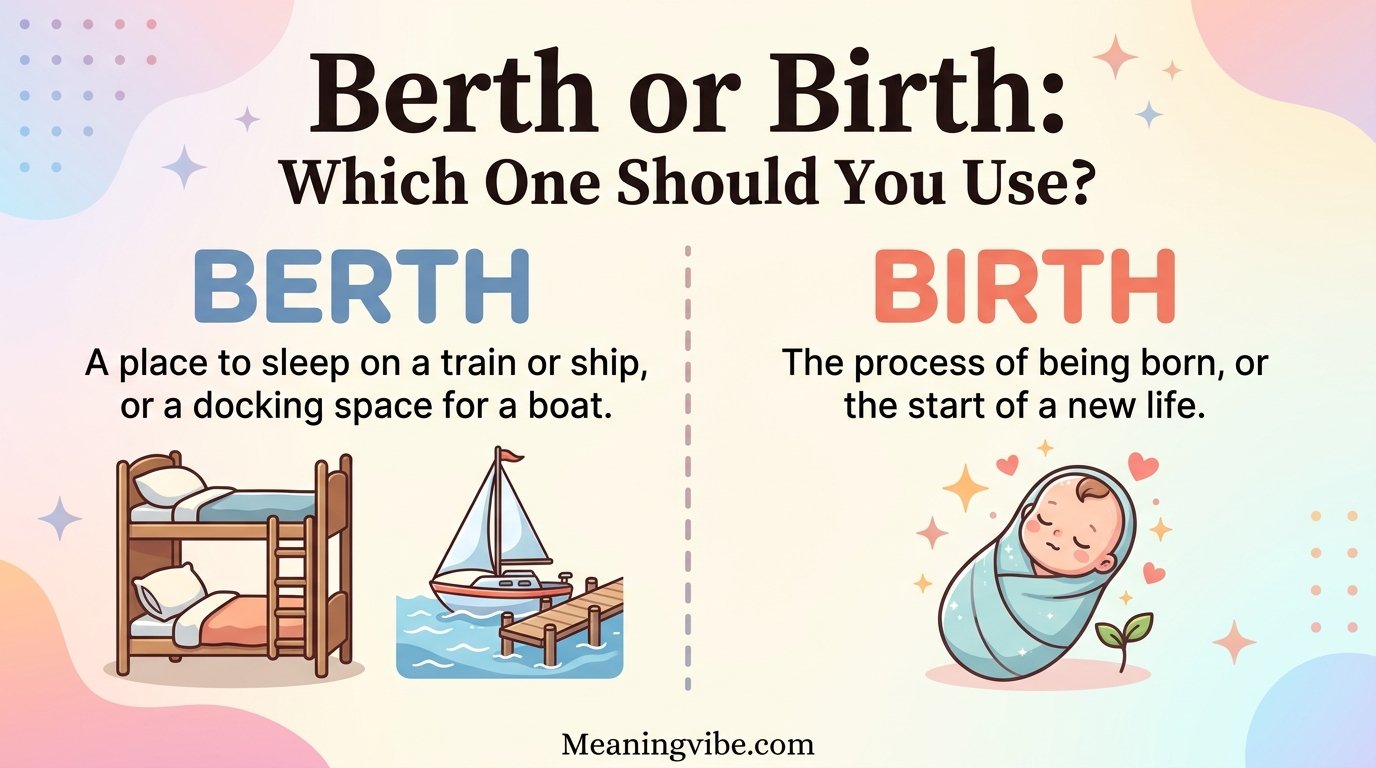
Writers often type “berth or birth” and stop. These quick tests settle the question in seconds.
Three Quick Tests
Test 1: The “being born” test. Ask whether something is being born or created. If yes, use birth.
Test 2: The “space” test. Ask whether you mean a docking spot, a bunk, or a safe distance. If yes, use berth.
Test 3: The “wide” test. If the word follows “wide,” you need berth. Keeping a wide distance is never a birth.
Pick the Right Word in Common Situations
| Situation | Correct word | Why |
|---|---|---|
| A ship arrives at the dock | Berth | A docking space |
| A mother has a baby | Birth | A person is born |
| A sleeper train bunk | Berth | A sleeping space |
| A company is founded | Birth | A beginning |
| Staying away from danger | Berth | A safe distance |
| A person’s place of origin | Birth | Where one is born |
| Qualifying for a tournament | Berth | A place in the field |
How to Pronounce Berth and Birth
Both words are pronounced the same way: /bɜːrθ/. The vowel is the “ur” sound, as in “her,” followed by a soft “th.”
Because they sound identical, listeners have to rely on context. The sentence around the word usually makes the meaning clear.
Why the Spelling Differs
The two words developed from different roots, which is why they ended up spelled differently even though they now sound alike.
Berth vs Birth Word Origins
Knowing where each word comes from makes the difference easier to remember.
Berth appeared in English in the early 1600s. It first meant convenient sea room for a ship. Dictionaries say its exact origin is uncertain, but it probably combines the verb “bear” with the ending “-th,” as in “strength” or “health.”
By the early 1700s, berth also meant a place where sailors slept on a ship. Later it spread to trains and to non-nautical settings.
Birth is a much older word. It comes from the same family as “bear,” meaning to carry or to bring forth. Its core idea is the act of bringing a child into the world.
The Memory Trick Hidden in the Spelling
This history gives you simple pictures to hold on to.
- bERth has an e, like sleep, rest, and wide. Think of a wide berth or a restful bunk.
- bIrth has an i, like I. Think of your own birthday or creating something yourself.
Berth vs Birth in a Sentence
Examples make the rule stick. Read each sentence and notice what the word describes.
Berth in a Sentence
- The ferry pulled into its berth just before sunset.
- I reserved the upper berth on the night train.
- Most people give an angry bear a wide berth.
- The harbor has berths for over two hundred boats.
- The striker helped the team win a berth in the semifinals.
- The captain berthed the ship carefully in the wind.
- Every sleeper car has two berths per compartment.
- She earned a berth on the national squad.
Birth in a Sentence
- The birth of their daughter was the happiest day of their lives.
- Her date of birth is printed on the certificate.
- The birth of rock music changed popular culture.
- He is a French citizen by birth.
- The hospital recorded three hundred births last month.
- The scientist witnessed the birth of a new theory.
- Spring marks the birth of new leaves.
- She gave birth to twins in March.
Berth and Birth in the Same Sentence
Sometimes both words appear together, and the contrast becomes very clear.
- After the birth of their son, the family booked a berth on a cruise ship.
- The captain, a Scot by birth, steered the ship to its berth.
- Since the birth of the new harbor, every ship has a guaranteed berth.
Wide Berth vs Wide Birth
This is the most common mistake involving these words. People write “wide birth” when they mean “wide berth.”
Wide berth is correct. It means a safe, generous distance.
Wide birth is almost never correct. It makes no sense in English.
What Does “Give a Wide Berth” Mean?
To give someone or something a wide berth means to keep well away from them. The idiom comes from sailing, where a ship needed plenty of open water, or “sea room,” to pass another ship or a hazard safely.
The nautical image still shows. You leave space so nothing collides.
Correct and Incorrect Examples
| Incorrect | Correct |
|---|---|
| Give the snake a wide birth. | Give the snake a wide berth. |
| She gave him a wide birth in the hallway. | She gave him a wide berth in the hallway. |
| Drivers should give cyclists a wide birth. | Drivers should give cyclists a wide berth. |
| I gave the puddle a wide birth. | I gave the puddle a wide berth. |
Why the Mistake Happens
Because the two words sound the same, writers pick the more familiar one. “Birth” is far more common, so it often sneaks into the idiom.
Remember the picture of a ship keeping its distance, and you will not forget the spelling.
Give Birth vs Give Berth
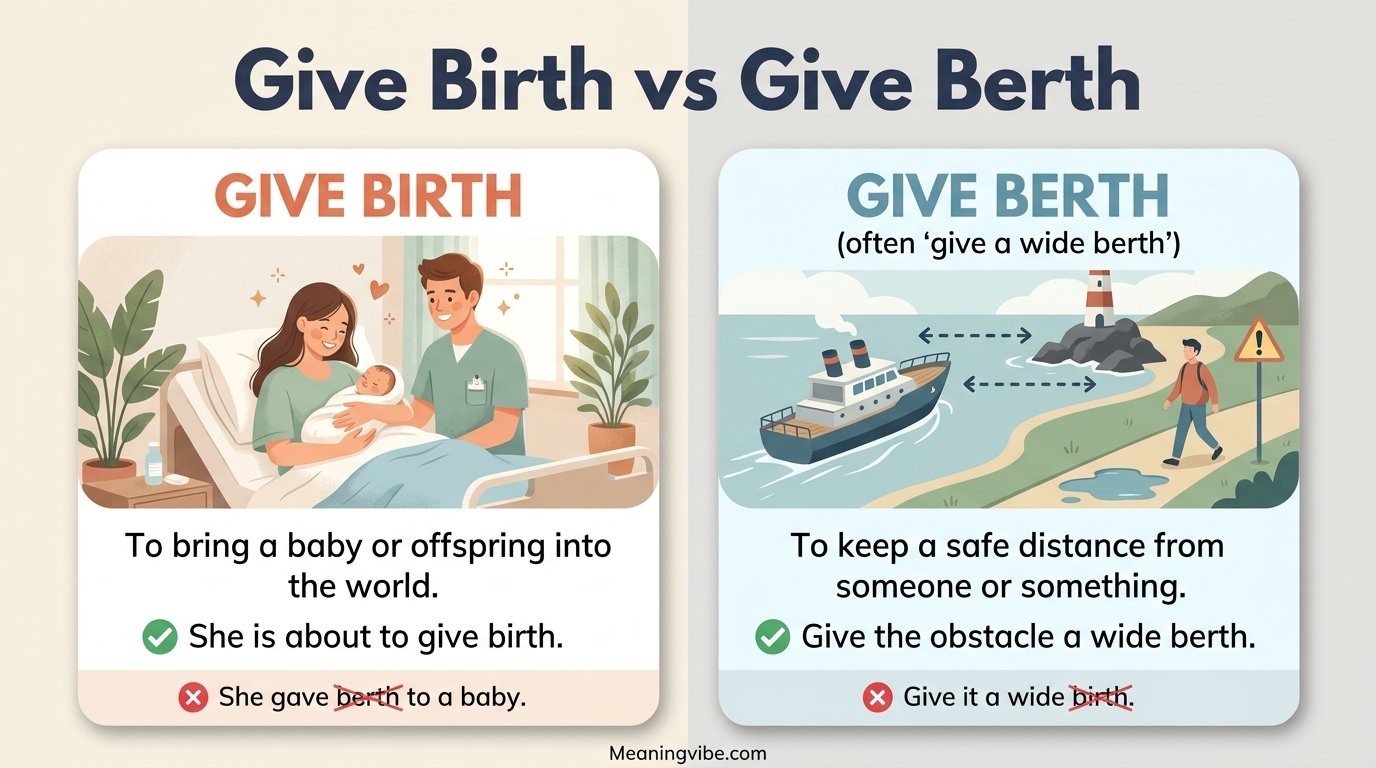
The idiom reverses. Here you need birth, not berth.
Give birth means to bear a child, or to produce something new. “She gave birth to a healthy boy.” “The film gave birth to a new genre.”
Give berth is not a standard phrase. It is a spelling error.
The Related Phrase “Give a Wide Berth”
Notice the difference. You give birth to a baby. You give a wide berth to a hazard. Both verbs use “give,” but the second word changes everything.
Berth Meanings in Detail
Berth is a flexible word. Each meaning keeps the idea of a space reserved for something.
A Docking Space for Ships
A berth is the place where a ship is moored. Harbors have many berths, and large ports assign them to arriving vessels.
“The tanker waited for a free berth.”
A Sleeping Bunk
On ships, trains, and some buses, a berth is a bed built into the vehicle. Overnight trains often sell upper and lower berths.
“I prefer the lower berth because it is easier to reach.”
A Safe Distance
The idiom “wide berth” describes a safe distance. It originally meant sea room around a ship.
A Place or Position
Berth can also mean a place in a team, a tournament, or a job. Sports reporters use it often.
“The club secured a berth in the playoffs.”
Berth as a Verb
To berth a ship means to bring it into its docking space. It can also mean to give a ship or person a berth. The use is mostly nautical.
Birth Meanings in Detail
Birth is a far more common word in everyday English.
The Act of Being Born
This is the primary meaning. It refers to a baby coming into the world.
“The birth took place at home.”
The Beginning of Something
Birth also describes the start of an idea, a movement, a company, or a nation.
“The birth of democracy in Athens shaped Western politics.”
Origin and Descent
By birth means by origin, ancestry, or the circumstances of one’s arrival into the world.
“She is Canadian by birth but lives in Spain.”
Birth as a Verb
To birth something means to bring it into existence. Writers sometimes use it for ideas or projects. In careful writing, “give birth to” is more common.
Common Phrases With Birth
Many everyday terms use birth. Spelling each correctly matters.
| Phrase | Meaning |
|---|---|
| Give birth | To bear a child or create something |
| Date of birth | The day a person was born |
| Birth certificate | An official record of birth |
| Birthplace | The place where someone was born |
| Birthday | The yearly date of birth |
| Birth rate | The number of births in a population |
| Birth control | Methods to prevent pregnancy |
| By birth | By origin or ancestry |
| Birthright | A right a person has from birth |
| Birthmark | A mark on the skin from birth |
| Birth name | The name given at birth |
| Rebirth | A second beginning |
Common Phrases With Berth
Berth has fewer common phrases, but they are important.
| Phrase | Meaning |
|---|---|
| Wide berth | A safe distance |
| Lower berth | The bottom bunk |
| Upper berth | The top bunk |
| Sleeping berth | A bed on a train or ship |
| Dock berth | A mooring space for a ship |
| Berth in the final | A place in the last round |
| Secure a berth | Win a place or reserve a space |
| Berthing fees | Charges for using a dock |
Berth in Travel Writing
Travel writers use berth for train and ship accommodations. “A first-class berth costs more but offers extra room.”
Berth in Sports Writing
Sports reporters use berth for a place in a competition. “They clinched a berth in the championship.”
Berth vs Birth Synonyms and Antonyms
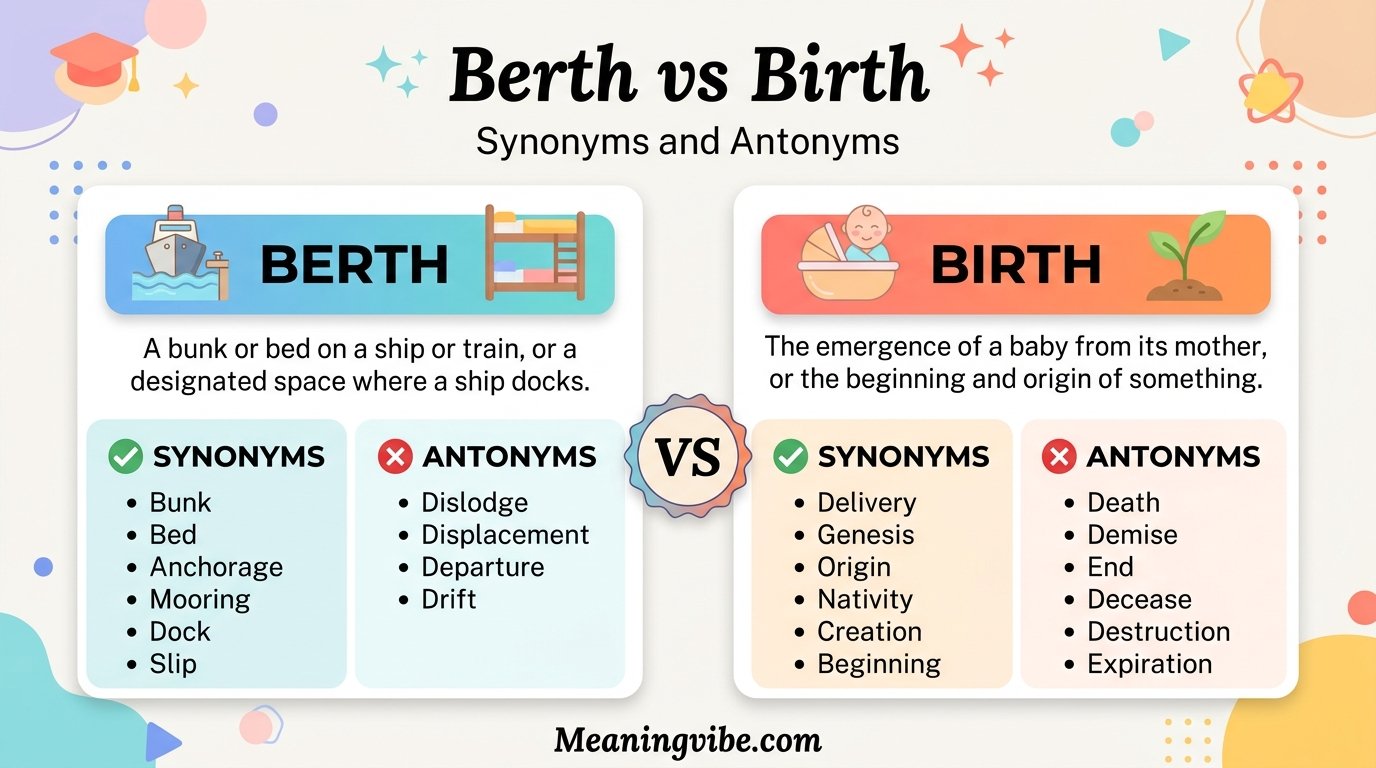
Synonyms help you check your choice. If a synonym fits cleanly, you probably picked the right word.
Synonyms for Berth
- Dock
- Mooring
- Anchorage
- Bunk
- Bed
- Sleeping space
- Place
- Position
- Slot
- Distance
Synonyms for Birth
- Delivery
- Arrival
- Origin
- Start
- Beginning
- Genesis
- Emergence
- Dawn
- Creation
- Nativity
Antonyms
The opposites also clarify each meaning.
- Berth as a distance is the opposite of closeness. As a place, it has no clean opposite.
- Birth is the opposite of death, end, or demise.
| Word | Close synonyms | Opposites |
|---|---|---|
| Berth | Dock, bunk, mooring | Closeness (for distance) |
| Birth | Beginning, origin, arrival | Death, end |
Berth vs Birth Word Forms
Both words have related forms. Mixing these up causes similar slips.
| Base word | Related forms | Examples |
|---|---|---|
| Berth | Berths, berthed, berthing | The ship berthed at dawn. |
| Birth | Births, birthed, birthing | The birthing room is ready. |
Birthing vs Berthing
Birthing relates to childbirth, as in “birthing classes” and “birthing centre.”
Berthing relates to docking, as in “berthing fees” and “berthing area.”
Berthed vs Birthed
Berthed describes a ship that has docked.
Birthed describes something that was brought into being. It is informal when used for babies, so many writers choose “gave birth to.”
Birth vs Born vs Borne
These words share a root, and writers often confuse them as well.
| Word | Meaning | Example |
|---|---|---|
| Birth | Noun for being born | The birth was easy. |
| Born | Adjective or verb for coming into life | She was born in May. |
| Borne | Past participle of “bear” meaning carried | He has borne the cost. |
Born vs Borne
Use born for coming into life. Use borne for carrying something, such as a burden or a cost.
“Born” appears in “She was born in 1990.” “Borne” appears in “The family has borne many hardships.”
The Related Word “Bear”
Both “birth” and “berth” connect back to the verb “bear,” which helps explain why they look alike. Bear can mean to carry, to give birth to, or to tolerate.
Berth vs Birth in Travel and Transport
Travel is the natural home of berth. Overnight journeys depend on it.
Train Berths
Sleeper trains offer berths in compartments. Upper berths are cheaper but require climbing. Lower berths are easier to reach.
“We shared a four-berth compartment on the night train.”
Ship Berths
On ships, a berth can be a cabin bed or a docking space. Both meanings use the same word.
Bus and Plane Berths
Some long-distance buses and aircraft offer lie-flat berths. The word still means a bed built into a vehicle.
Where Birth Appears in Travel
Birth appears in travel documents. Your passport lists your date and place of birth. Border officials may ask for a birth certificate for children.
Berth vs Birth in Ports and Shipping
Ports use berth every day.
Port Berths
A harbor has many berths for different vessels. Container ships, ferries, and cruise liners each use specific berths.
Berthing
Berthing is the process of bringing a ship into its docking space. Harbor pilots and tugboats often help.
Berthing Fees
Marinas and harbors charge fees for berths. Rates depend on boat length and time spent in port.
Berth vs Birth in Medicine and Family
Birth dominates this world. Health care uses the word constantly.
Childbirth
Childbirth is the process of delivering a baby. Hospitals, midwives, and doctors support the process.
Birth Records
A birth certificate is an official record of a person’s birth. Governments issue them, and they are needed for passports, school enrollment, and benefits.
Birth Rate and Statistics
Birth rate measures the number of births in a population. Governments and researchers track it to understand population trends.
Rare Use of Berth in Medicine
Berth rarely appears in medical writing. If it does, it usually means a bed or bunk in an ambulance or ship’s infirmary.
Berth vs Birth in Sports and Competition
Sports writers use berth to mean a place in a competition.
Earning a Berth
Teams earn berths in playoffs, finals, and tournaments. “They secured a berth in the World Cup.”
Birth in Sports Writing
Sports writers use birth for the start of a team, league, or rivalry. “The birth of the league happened in 1920.”
Common Mistake
Writing “birth” for a tournament place is a common error. “They earned a birth in the final” should be “berth.”
Berth vs Birth in Business and Technology
Both words show up in business writing.
Birth of a Company
Writers describe a company’s start as its birth. “The birth of the startup took place in a garage.”
Birth of an Idea
Ideas, products, and industries also have births. “The birth of the smartphone changed daily life.”
Berth in Business
Berth also means a job or position. “She found a berth at a top firm.” This use is more literary and less common.
Berth vs Birth in Literature and Writing
Writers lean on both words for imagery.
Birth as a Metaphor
Authors use birth as a metaphor for beginnings. “The birth of a new era.”
Berth as a Metaphor
Authors use wide berth to show avoidance. “Everyone gave the old house a wide berth.”
Nautical Fiction
Sea novels use berth often. Characters sleep in berths, dock at berths, and give rocks a wide berth.
Berth vs Birth in Everyday Life
You do not need to be writing a novel to use these words well. Everyday life gives plenty of chances.
At home, you might say you gave a grumpy neighbor a wide berth. At a family gathering, you might talk about the birth of a new baby.
Friendly Examples
- “I gave the wet paint a wide berth.”
- “The birth of my niece was joyful.”
- “We booked a lower berth for the night train.”
- “He is a New Yorker by birth.”
- “They gave the barking dog a wide berth.”
- “Her birthday is in June.”
Professional Examples
- “Ensure the vessel reaches its berth by noon.”
- “Please provide your date of birth on the form.”
- “The team secured a berth in the final.”
- “The birth of the new division was announced Monday.”
Common Berth vs Birth Mistakes
Even careful writers slip here. Watch for these frequent errors.
Mistake 1: Writing “Wide Birth”
Wrong: “Give the cliff a wide birth.”
Right: “Give the cliff a wide berth.”
The idiom is about distance, so berth is correct.
Mistake 2: Writing “Give Berth”
Wrong: “She gave berth to a boy.”
Right: “She gave birth to a boy.”
Birth means being born.
Mistake 3: Writing “A Birth on a Train”
Wrong: “I booked a birth on the night train.”
Right: “I booked a berth on the night train.”
A train bunk is a berth.
Mistake 4: Writing “Berth Certificate”
Wrong: “Please bring your berth certificate.”
Right: “Please bring your birth certificate.”
Official records use birth.
Mistake 5: Writing “Berth Date”
Wrong: “Enter your berth date.”
Right: “Enter your date of birth.”
Mistake 6: Writing “A Birth in the Final”
Wrong: “They earned a birth in the final.”
Right: “They earned a berth in the final.”
A place in a competition is a berth.
Mistake 7: Autocorrect and Typos
Because both words are real, spell check will not flag the wrong one. Proofread this pair by hand.
Easy Ways to Remember Berth vs Birth
Memory tricks work best when they are simple. Pick the one that sticks for you.
Trick 1: The Letter I Rule
bIrth has an I. Think “I was born” or “my birthday.”
Trick 2: The Letter E Rule
bErth has an e, like sleep, rest, and wide. Think of a wide berth or a restful bunk.
Trick 3: The Ship Rule
If you can picture a ship, a dock, or a bunk, use berth.
Trick 4: The Baby Rule
If you can picture a baby, a beginning, or a certificate, use birth.
Commonly Confused Words Like Berth and Birth
English is full of homophones and look-alike pairs. Learning to spot them improves your writing across the board.
Words That Sound Alike
Some pairs trip people up because they sound almost the same. A good example is sell and sale, where one is a verb and the other is a noun.
Pricy and pricey are another pair where tiny spelling changes confuse writers.
Words That Look Alike
Pairs such as emersion and immersion look almost identical but point in opposite directions.
Dysregulated and disregulated are another close pair where a small prefix changes the meaning.
Encorporate and incorporate also show how one letter can create a non-word.
Common Spelling Slips
Spelling errors also cause trouble. Guides on receive vs recieve, weird vs wierd, and speech vs speach show how one swapped letter can make a word look wrong.
Likewise, doubt vs dought, input vs imput, and across vs accross sharpen your proofreading eye.
Preposition and Apostrophe Problems
Small words and small marks cause big confusion too. The guide on relate to vs relate with covers a tricky preposition.
For apostrophes, read about today’s vs todays, else’s vs elses, and parents’ vs parent’s.
Words That Are Not Words
Some pairs include a made-up spelling. See window seal vs window sill for a real-word mix-up, and minoot or minute for a spelling that does not exist.
Berth vs Birth Practice Exercise
Test yourself. Fill each blank with berth or birth, then check the answers below.
- The ferry reached its ____ at noon.
- She gave ____ to a healthy baby girl.
- Always give a wide ____ to a nervous horse.
- Please attach a copy of your ____ certificate.
- We booked a lower ____ on the night train.
- The ____ of the company took place in 1995.
- The team clinched a ____ in the final.
- He is Irish by ____.
Answers
- Berth. A docking space.
- Birth. A baby was born.
- Berth. A safe distance.
- Birth. An official record of being born.
- Berth. A sleeping bunk.
- Birth. The beginning of a company.
- Berth. A place in a competition.
- Birth. Origin by being born.
Berth vs Birth Cheat Sheet
Save this table for quick reference.
| Question | Answer |
|---|---|
| Is it a docking spot? | Berth |
| Is it a sleeping bunk? | Berth |
| Is it a safe distance? | Berth |
| Is it a place in a tournament? | Berth |
| Is someone being born? | Birth |
| Is it the start of something? | Birth |
| Is it a document or date? | Birth |
| Does the phrase say “give ___ to a baby”? | Birth |
| Does the phrase say “wide ___”? | Berth |
Why People Confuse Berth and Birth
Understanding the confusion helps you avoid it.
First, the two words sound identical. Second, they differ by only one letter. Third, “birth” is much more common, so the eye expects it.
Spell check also fails here. Because both words are valid, a wrong choice slips through unnoticed.
Tips for Proofreading This Pair
- Search your document for both words and check each one.
- Ask whether the sentence is about a place or a beginning.
- Check every “wide” for berth.
- Check every baby, certificate, or date for birth.
- Read the sentence aloud and picture the scene.
Berth vs Birth Quick Reference for Writers
Different readers need different shortcuts. Use the one that matches your work.
For Students
Use birth for being born and for beginnings in history and science. Use berth for docking and sleeping spaces, and for the idiom “wide berth.”
For Travel Writers
Use berth for ship docks and sleeper train bunks. Use birth only when you mean someone’s origin or a document.
For Journalists
Use berth for places in tournaments. Use birth for the start of movements or organizations.
For ESL Learners
Learn the two idioms first. “Wide berth” means keep your distance. “Give birth” means bear a child.
Then practice with short sentences until the pattern feels natural.
Also Read:
- Relate To vs Relate With: Meaning, Difference & Correct Usage (2026)
- Window Seal vs Window Sill: Definitions, Examples & Usage (2026)
- Parents’ or Parent’s? What’s the Difference? Correct Usage Explained (2026)
- Minoot or Minute: Which Is Correct? Meaning, Pronunciation & Usage (2026)
- Sell vs. Sale: What’s the Difference? Meaning, Usage & Examples (2026)
- People Do or People Does: Which Is Correct? Grammar Rules & Examples (2026)
- Encorporate vs Incorporate: What’s the Difference? Correct Usage Explained (2026)
- Grately vs Greatly Explained: Meaning, Examples & Grammar Rules (2026)
- Emersion vs Immersion Explained: Definitions, Usage & Examples (2026)
- Accross vs Across: Meaning, Spelling and Correct Usage (2026)
- Dought vs. Doubt: Correct Spelling, Meaning & Usage Explained (2026)
- Dysregulated vs. Disregulated: What’s the Difference? (Complete Guide 2026)
- Speach or Speech? Stop Making This Common Spelling Mistake (2026 Guide)
- Fiending or Feening? Stop Making This Common Spelling Mistake (2026)
- Dammit vs. Damnit: What’s the Difference and Which Is Right? (2026)
- Is It Signor or Signer? The Difference Explained with Examples (2026)
- Wierd or Weird: Meaning, Correct Usage & Examples (2026)
- Elses vs. Else’s: Meaning, Grammar Rules & Examples (2026)
- Today’s vs. Todays: Meaning, Grammar & Examples (2026)
- Receive vs. Recieve: What’s the Difference and Which Is Right? (2026)
- Input vs. Imput: What’s the Difference and Which Is Right? (2026)
- Pricy vs. Pricey: What’s the Difference and Which Is Right? (2026)
Frequently Asked Questions (FAQs)
What is the difference between berth and birth?
Berth means a docking space, a sleeping bunk, or a safe distance. Birth means the act of being born or the beginning of something.
Are berth and birth homophones?
Yes. Both are pronounced /bɜːrθ/, so they sound identical. Only spelling and context separate them.
Is it wide berth or wide birth?
The correct phrase is “wide berth.” It means a safe distance. “Wide birth” is a common spelling error.
What does give a wide berth mean?
It means to keep well away from someone or something. The idiom comes from sailing, where ships needed open water to pass safely.
Is it give birth or give berth?
The correct phrase is “give birth.” It means to bear a child or to produce something new. “Give berth” is an error.
What does berth mean in simple words?
It means a space set aside for something. That could be a ship’s docking spot, a bunk on a train, or a safe distance.
What does birth mean in simple words?
It means the act of being born. It also means the start of something, such as a company or an idea.
What is a berth on a train?
It is a bed or bunk built into a sleeper train. Many trains offer upper and lower berths.
What is a berth on a ship?
It can mean the docking spot where a ship is moored. It can also mean a bunk or bed on board.
What does it mean to earn a berth?
It means to win a place, especially in a tournament or competition. “They earned a berth in the final.”
Is berth a noun or a verb?
It is mostly a noun. As a verb, it means to bring a ship into its docking space.
Is birth a noun or a verb?
It is mostly a noun. As a verb, it means to bring something into existence, but “give birth to” is more common.
What is a birth certificate?
It is an official document that records a person’s birth, including the date, place, and parents. Many forms of identification require it.
What does by birth mean?
It describes something you have because of when, where, or to whom you were born. “She is Canadian by birth.”
What is the origin of the word berth?
It appeared in the early 1600s meaning sea room for a ship. Dictionaries say it probably comes from “bear” plus “-th.”
What is the origin of the word birth?
It is an old word from the same family as “bear,” meaning to carry or bring forth.
What does birthing mean?
It relates to childbirth, as in birthing classes and birthing centres.
What does berthing mean?
It refers to bringing a ship into its docking space, as in berthing fees and berthing area.
What is the difference between born and borne?
Born is for coming into life. Borne is for carrying something, such as a cost or a burden.
How do you pronounce berth and birth?
Both are pronounced /bɜːrθ/, with the “ur” sound and a soft “th.”
How do you remember berth vs birth?
Birth has an “i” like “I was born.” Berth has an “e” like “sleep,” “rest,” and “wide.”
What are synonyms for berth and birth?
Synonyms for berth include dock, bunk, and mooring. Synonyms for birth include beginning, origin, and arrival.
Is berth vs birth a common spelling mistake?
Yes. The words sound identical and look similar. Spell check will not catch the error, so careful proofreading helps.
How do you use berth and birth in a sentence?
“After the birth of their son, the family booked a berth on a cruise ship.” This sentence uses each word correctly.
Conclusion
The berth vs birth question comes down to one clear idea. Berth is about a place or a space, such as a ship’s dock, a sleeper bunk, or a safe distance. Birth is about a beginning, such as a baby being born or a company being founded.
When you picture a ship, a bunk, or a wide gap, use berth. When you picture a baby, a certificate, or a new start, use birth.
Remember the quick tests. The idiom is “wide berth,” and you “give birth.” Or recall the letters: birth has an “i” like “I was born,” and berth has an “e” like “sleep” and “wide.”
Keep this guide handy the next time you hesitate, and your writing will stay clear, precise, and confident.