

Precede vs proceed is decided by one question: does your sentence need something standing after the word, or somewhere for the action to go?
To precede is to come before something in time, order, position or rank. To proceed is to move forward or continue with an action. The first verb looks backward along a line; the second looks forward along it.
The confusion runs three layers deep. The meanings point in opposite directions, the grammar differs (one verb demands an object, the other forbids one), and the spellings differ by two letters inside the most rule bound verb family in English.
Everything below settles all three layers: the ruling table, two tests that decide any sentence, each verb explored in full, the phrases on signs and screens where you met these words, a six relative family map, the famous spelling rule, and surgery on the errors people actually type.
The Quick Ruling: One Line, Two Directions
Picture a graduation ceremony. The dean’s name precedes the graduates’ names in the printed program, because her part comes first.
Then the ceremony itself proceeds: speech follows speech, row follows row, until the last name is called.
Same event, same line of people, opposite jobs. Precede describes the order the parts stand in. Proceed describes the event moving through that order. Direction is the whole difference:
|
Precede |
Proceed |
|
|---|---|---|
|
Core meaning |
To come before |
To go forward, to continue |
|
What it needs next |
A follower: the thing it comes before |
A direction or continuation: with, to, from, as |
|
Grammar |
Transitive: takes a direct object |
Intransitive: never takes a direct object |
|
Plain swap words |
Come before, go ahead of |
Continue, carry on, go ahead with |
|
Signature patterns |
precede X; was preceded by X; precede X with Y |
proceed with; proceed to; proceed from; proceed as planned |
|
Pronunciation |
pri-SEED |
pruh-SEED |
|
Example |
A speech precedes the awards |
Please proceed to your seats |
The definitions follow dictionary consensus. Merriam-Webster’s entry for precede lists coming before, being earlier than, going in front of and outranking among its senses, and Merriam-Webster’s entry for proceed lists continuing after a pause, going on in an orderly way and coming forth from a source.
Usage expert Bryan Garner frames the pair in one line worth keeping: both words can mean to go ahead, but in different senses. Precede goes ahead of someone; proceed goes ahead with something.
The Two Tests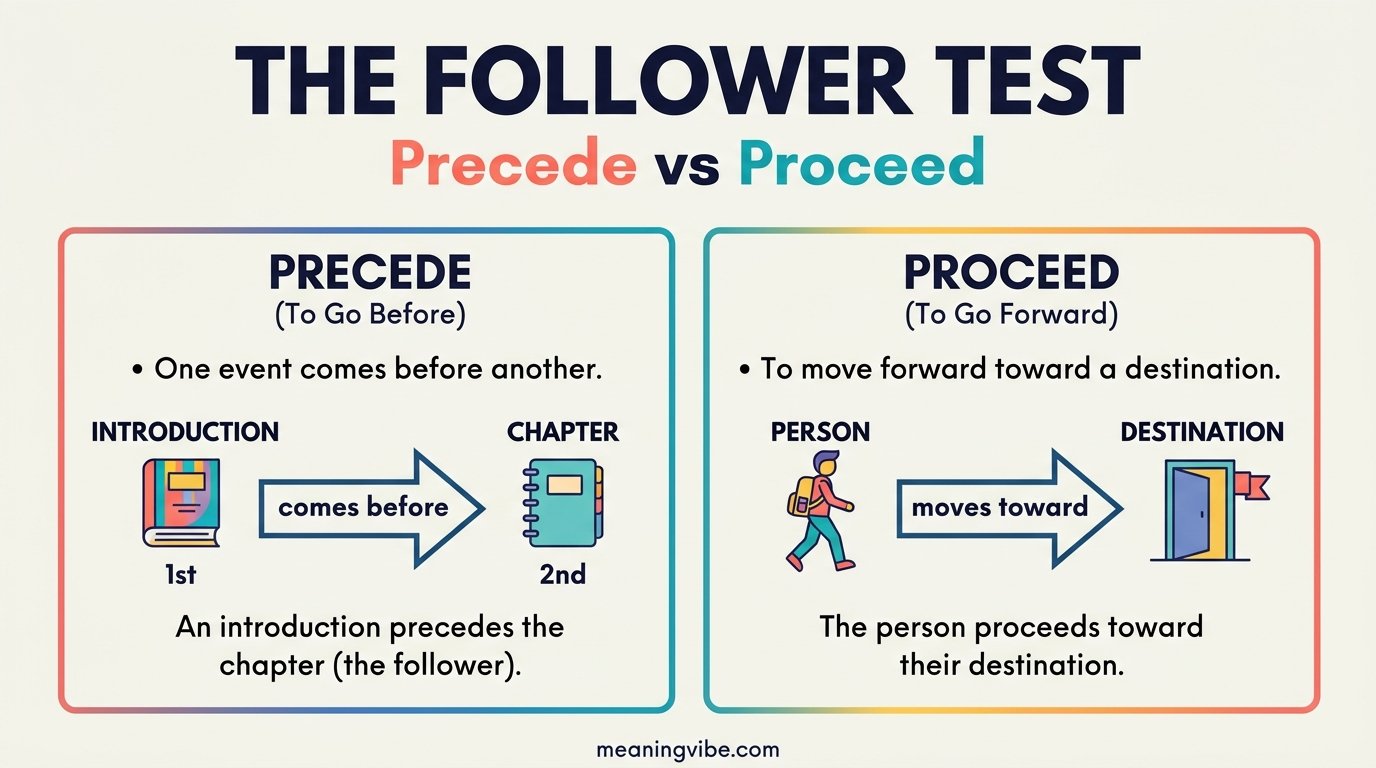
Test 1: The Follower Test
Ask whether your sentence supplies something that follows the verb’s action. Precede is a two item verb: nothing precedes alone, because coming before only makes sense with a second thing standing after it.
“The introduction precedes the chapter” passes: the chapter follows. “Please precede to the gate” fails: no follower is named, only a destination, and destinations belong to the other verb.
Test 2: The Direction Test
Ask where the sentence is going. If an action continues, a person moves forward, or a process rolls on in order, the verb is proceed, and it will want a preposition: with, to, from, as planned.
Together the tests also run on grammar. Precede is transitive and takes a direct object; proceed is intransitive and cannot.
So “proceed the plan” fails twice: the meaning is wrong (nothing comes before anything) and the grammar is impossible (proceed has no object slot). “Proceed with the plan” fixes both at once.
Precede: Standing Earlier in the Line
To precede is to stand earlier: earlier in time, earlier in a sequence, further forward in a physical line, or higher in a ranking. In every sense, something else stands after it.
Time and Order
The everyday sense is sequence. Lightning precedes thunder in the standard teaching example, because the flash reaches your eye before the sound reaches your ear.
Chapters precede chapters, planning precedes execution, and the overture precedes the opera. If you can draw a timeline and place your subject on the earlier mark, precede is your verb.
Place and Front
Precede also works in space: to go in front of. The honor guard precedes the hearse; the lead car precedes the motorcade; she preceded him into the room, in Merriam-Webster’s own example pattern.
This sense explains the ceremony uses. In a procession, the people at the front precede everyone behind them, and a program lists parts in the order they precede one another.
Rank and Importance
The dictionary’s first listed sense is the formal one: to surpass in rank, dignity or importance. One official precedes another at a state dinner, and the seating follows that ranking exactly.
That ranking made visible is an order of precedence, the ceremonial list that fixes who enters, sits and is announced before whom. It is a live concern every graduation season and at every official function.
The Preface Pattern: Precede X With Y
One sense hides inside a distinctive pattern. To precede a speech with a warning is to put the warning in front of the speech: precede here means to preface, to cause something to be preceded.
Watch the geometry. The thing after with is the front item, the thing that does the preceding. She preceded her announcement with an apology means the apology came first.
The Passive Habit: Was Preceded By
Precede spends much of its life in the passive voice: the film was preceded by an introduction, dinner was preceded by drinks, the launch was preceded by months of testing.
The reason is spotlight control. The passive lets the later, larger event hold the subject position while the earlier item is still reported. Style guides note the pattern because formal writing reaches for it constantly.
Proceed: Moving Forward Through the Action
To proceed is to keep an action moving: to continue after a pause, to go on in an orderly way, or to begin and carry on the next step.
Its subject is an actor or a process, never a position in a line.
Continue After a Pause
The central sense resumes something interrupted. After the intermission, the play proceeded. After the interruption, she proceeded with her presentation, in the dictionary’s example pattern.
Notice the built in timeline. Proceed often implies a stop and a restart, or at least a checkpoint passed: the guard checked the pass, then waved the car through to proceed.
Orderly Business
Proceed also describes a process rolling on as arranged: the meeting will proceed as planned, the work is proceeding well, the trial proceeded to closing arguments.
This is the proceed of minutes, agendas and news reports. It certifies that the machine is moving in order, neither stalled nor derailed, which is why officials reach for it in statements.
The Source Sense: Proceed From
The oldest sense runs the other direction entirely: to come forth from a source. Strange sounds proceeded from the room; advice proceeds from good intentions, in Merriam-Webster’s synonym note.
Hold onto this sense, because it is the parent of the money noun. What comes forth from a sale or a fundraiser is its proceeds, as the family section shows.
The Legal Use: Proceed Against
In legal English, to proceed against someone is to institute legal proceedings against them. The phrase is formal and deliberate, signaling that a case is being formally carried forward.
It is one reason the noun proceedings belongs to courts and formal bodies. Legal and conference proceedings are both, at root, business being proceeded with in an orderly way.
The Four Frames of Proceed
Proceed never travels alone; it takes a preposition partner, and the partner announces which sense is active:
|
Frame |
Sense |
Example |
|---|---|---|
|
proceed with |
Continue an action |
We proceeded with the inspection |
|
proceed to (a place) |
Move forward toward |
Passengers proceeded to Gate 12 |
|
proceed to (do something) |
Go on to the next action |
He proceeded to explain the delay |
|
proceed from |
Come forth from a source |
A murmur proceeded from the crowd |
|
proceed against |
Start legal action |
The agency proceeded against the firm |
|
proceed as |
Continue in the arranged way |
The vote proceeded as scheduled |
Learn the frames and the verb is learned. If none of them fits your sentence, the verb you need is probably not proceed at all.
The Signage Test: Phrases You Have Already Met
Most searchers met proceed five minutes before searching, on a sign, a screen or a loudspeaker. The phrases below are the word’s public life, and every one of them takes proceed, never precede.
|
Phrase |
Where you meet it |
Why proceed |
|---|---|---|
|
Proceed with caution |
Road signs, warnings |
You are told to move forward carefully |
|
Proceed to checkout |
Shopping sites and stores |
You are sent forward to the next step |
|
Proceed to Gate 12 |
Airport announcements |
You are directed to move to a place |
|
Please proceed |
Buttons, forms, officials |
A polite command to continue |
|
Proceed as planned |
Statements, minutes |
The process continues in its arranged order |
The pattern is not an accident. Instructions speak to a mover, someone about to act, and proceed is the verb of acting forward.
Precede cannot appear in any of these frames, because no follower is being named. When a sign seems to offer you a choice between the two words, the choice has already been made by the frame.
Run the signage test in reverse on your own writing. If your sentence could be spoken by an official to people about to move, proceed is almost certainly right.
If your sentence could be printed in a program listing the order of events, precede is almost certainly right. Official voice versus program voice settles most real cases.
The Family Map: Six Relatives, Three Pronunciations
The pair does not travel alone. Six relatives share the root, the confusion and the searches, and two of them change pronunciation completely, which is why they trap readers who know the verbs perfectly.
|
Relative |
Part of speech |
Pronunciation |
Meaning |
|---|---|---|---|
|
preceding |
adjective |
pri-SEED-ing |
Coming before, previous |
|
proceeding |
noun, verb form |
pruh-SEED-ing |
A formal step; continuing |
|
proceedings |
plural noun |
pruh-SEED-ings |
Events of a meeting; a legal action; a conference record |
|
proceeds |
plural noun |
PROH-seeds |
Money from a sale, event or transaction |
|
precedent |
noun |
PRES-uh-dent |
An earlier act or decision used as a guide |
|
precedence |
noun |
PRES-uh-dense |
Priority in rank or order |
Precedent vs Precedence
These two cause their own searches. A precedent is a thing: an earlier ruling or act that guides later ones, as when a court decision sets a precedent for future cases.
Precedence is a ranking: the priority one thing holds over another. Safety takes precedence over speed; a senior official takes precedence in the seating order. Merriam-Webster’s entry for precedent gives the guide and example senses in full.
The pronunciations keep them apart in careful speech. Both move the stress to the first syllable, PRES, and end in a weak syllable, dent versus dense. Neither sounds like the verbs they descend from.
Proceedings: Meetings, Courts and Conferences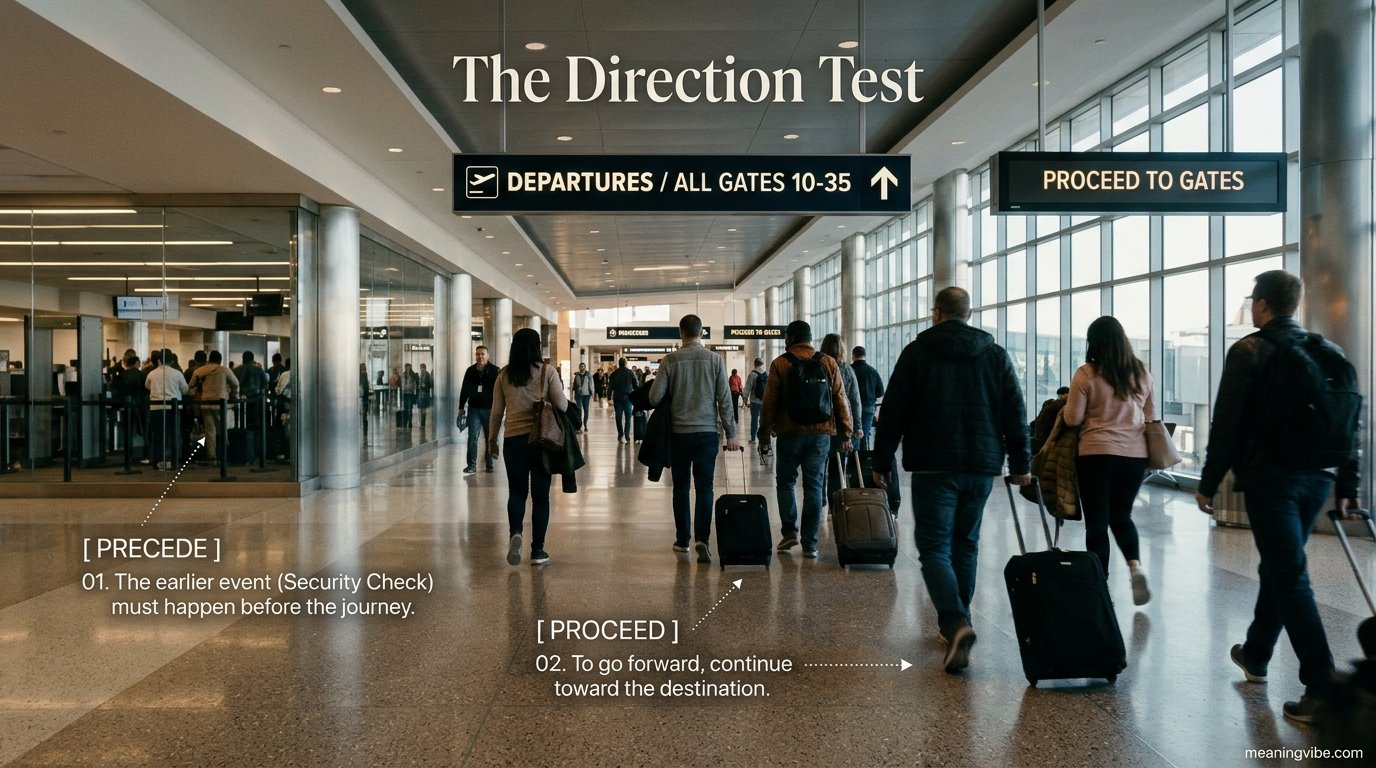
Proceedings names business gone through in order. It covers three territories that share that idea: the events of a formal meeting or occasion, a legal action as a whole, and the published record of a conference.
The third use surprises people. Conference proceedings are the collected papers and talks of an academic meeting, published as its official record.
When a program says the proceedings began at nine, it means the event; when a library holds the proceedings, it means the book.
Proceeds: The Money Noun
Proceeds is the family’s money word: the amount that comes forth from a sale, an auction, a benefit concert or a business transaction. The proceeds of the sale were donated; the charity reported record proceeds.
Its pronunciation is its warning label. As a noun it is PROH-seeds, first syllable stressed, while the verb proceeds is pruh-SEEDS. Same spelling, different stress, different job: the stress shift is how English marks the noun.
Proceeds is also plural in form, like earnings and takings. Careful usage writes “the proceeds were donated,” treating the sum as the collection it names.
Preceding and Proceeding: The Participle Pair
The two ing forms mirror the verbs exactly. Preceding means coming before and works as an adjective for earlier units: the preceding year, the preceding chapter, the preceding speaker.
Proceeding means continuing or moving forward: the work is proceeding well. It is also a noun for a single formal step, especially in law, though the plural proceedings is far more common.
The swap test works here too. If the word describes an earlier unit in a sequence, preceding; if it describes an action underway, proceeding.
The Spelling Rule: Cede, Ceed and Sede
One spelling system governs this whole verb family, and it is the most quotable rule in English spelling. The Canadian Style, the Government of Canada’s official style guide, states it in one breath:
|
Ending |
Members |
|---|---|
|
-ceed |
Only three verbs: exceed, proceed, succeed |
|
-sede |
Only one verb: supersede |
|
-cede |
Everything else: accede, antecede, cede, concede, intercede, precede, recede, secede |
Memorize the exceptions and the rule is free. If a verb with this sound is not exceed, proceed, succeed or supersede, it ends in cede, with no further thought required.
That is why precede ends in cede and proceed ends in ceed, and why the choice feels arbitrary until the rule is known. Inside the family, spellings were assigned once; the rule simply reports the assignment.
Why Supersede Stands Alone
Supersede’s odd spelling has a genuine reason. The cede family descends from Latin cedere, to go or yield, but supersede descends from supersedere, to sit on top of or abstain.
The Grammarphobia Blog’s study of these endings, working from the Oxford English Dictionary, lays out exactly this split. The sede ending preserves a different ancestry, which is why supercede is wrong every time it is typed.
Preceed: The Misspelling the Pair Produces
Preceed is not a word. Dictionary.com’s proceed vs precede guide flags it directly as a misspelling of precede, and its cause is obvious: proceed’s ceed ending colonizes its neighbor.
The defense is the rule itself. Precede is not on the three verb ceed list, so its ending must be cede. A spellchecker will catch preceed, but only the rule prevents the writer from typing it.
The same discipline protects in the other direction. Proceeding, proceeded and proceeds all keep the ceed stem; nothing in the proceed family ever shortens to a single e in the middle.
Sentence Surgery: Fixing the Errors People Actually Type
|
Wrong |
Right |
Why |
|---|---|---|
|
Please precede to the gate |
Please proceed to the gate |
A destination with no follower takes proceed to |
|
Dinner was proceeded by drinks |
Dinner was preceded by drinks |
Drinks came before dinner: precede, in its passive habit |
|
We will proceed the plan tomorrow |
We will proceed with the plan tomorrow |
Proceed is intransitive; it needs the preposition with |
|
The introduction will proceed the speech |
The introduction will precede the speech |
The introduction stands before the speech in order |
|
After the break, we preceded with the meeting |
After the break, we proceeded with the meeting |
Continuing an action is proceed’s central sense |
|
He preceeded his remarks with thanks |
He preceded his remarks with thanks |
Preceed is not a word; precede ends in cede |
|
The proceeds was donated to the fund |
The proceeds were donated to the fund |
Proceeds is plural in form and takes plural agreement |
|
Safety takes precedent over speed |
Safety takes precedence over speed |
Priority is precedence; a precedent is a guiding earlier case |
|
The preceding negotiations are going well |
The ongoing negotiations are proceeding well |
Underway action takes proceeding, not the adjective of order |
|
A murmur preceded from the crowd |
A murmur proceeded from the crowd |
Coming forth from a source is proceed’s oldest sense |
Read the why column as a set and three patterns cover nearly everything. Follower errors use proceed where an order is described. Frame errors drop proceed’s preposition.
Family errors swap a relative (precedent for precedence, singular agreement for proceeds) while the main verbs stay correct. Each pattern has its own test above, and the tests are faster than re-reading the sentence.
Memory Tricks That Hold
1. Pre walks with previous. Precede keeps company with previous, preview and preface: all carry pre, all mean before. If the word belongs with the before family, it is spelled with pre and cede.
2. Pro walks with progress. Proceed keeps company with progress, proceed to the future and professional forward motion: pro means forward. If the sentence is moving, the pro word is the right word.
3. Three, one, and the rest. The spelling compresses to a count: three verbs in ceed, one in sede, and the rest in cede. Recite exceed, proceed, succeed, supersede, and every other member spells itself.
4. Programs and officials. Printed programs list what precedes what; officials tell people to proceed. Match the voice of your sentence to the voice of the setting and the verb follows.
Keep the Pair in Its Family
Precede vs proceed is the direction and order pair in a cluster of word choices that all reward one habit: asking what job the word is doing before asking how it is spelled. The word pairs on Meaning Vibe cover the closest relatives.
The direction pairs come first. imply vs infer turns on the same geometry as this page, a message leaving one mind and arriving in another, and emigrate vs immigrate splits leave from enter the way this pair splits before from forward.
The spelling driven pairs include envelop vs envelope, where one letter assigns two different jobs, and cite vs site vs sight, where three words share a sound and divide the work of quoting, placing and seeing.
Form and stance pairs round out the set: elicit vs illicit, eminent vs imminent, emersion vs immersion and disinterested vs uninterested each punish the reader who guesses from sound instead of checking the job.
Tool pairs add device vs devise and canvas vs canvass, a noun against a verb and a cloth against a campaign. And for the process this whole cluster documents, defuse vs diffuse leads naturally to how online words and phrases change meaning across contexts, which traces how pairs keep gaining new territory.
One Event, Both Verbs: A Graduation, Labelled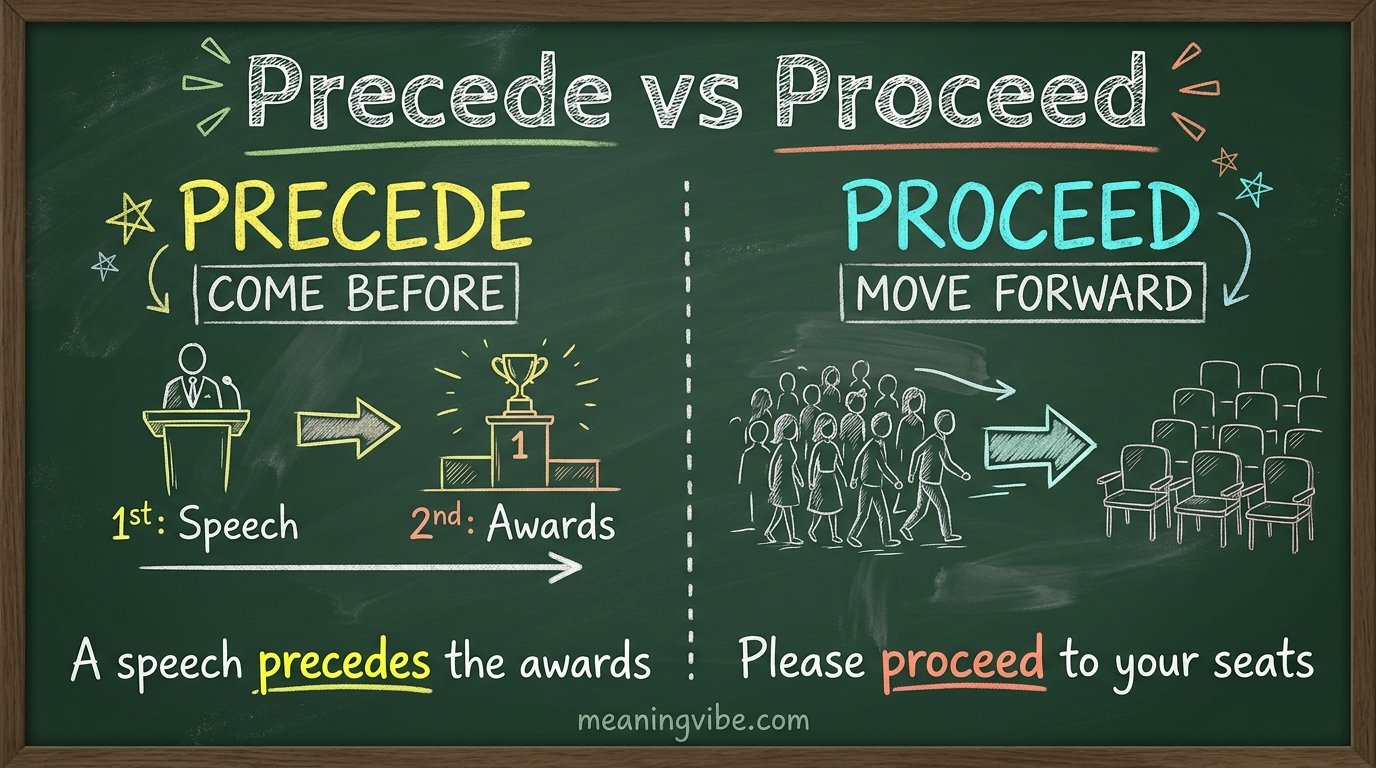
Rules settle fastest when watched at work. Take one graduation ceremony and label every verb, frame by frame.
The printed program. The program lists the processional first, then the welcome, then the keynote, then the conferring of degrees. Each item precedes the next: the welcome precedes the keynote, and the keynote precedes the conferring.
The program also notes that the graduates’ names are preceded by a short fanfare. Same page, same verb, in its passive habit: the fanfare comes first, the names hold the spotlight.
The ceremony itself. At nine o’clock the ceremony proceeds. The marshal leads the procession down the aisle, which means, in the spatial sense, that the marshal precedes the graduates as they proceed to their seats.
Two verbs share one sentence without colliding. The graduates are proceeding (moving forward) while the marshal is preceding them (standing in front). Direction and order, side by side, each doing its own job.
The middle hour. The keynote speaker preceded her address with a story about her own graduation, using the preface pattern. Then, after a pause for applause, she proceeded to deliver the address itself.
Notice the order of the two moves. The story stands before the speech, so precede frames it. The speech then goes forward as the next action, so proceed frames that. The timeline chooses the verbs; the writer only reports it.
The close. The dean announces that the reception will proceed as planned on the lawn. In the printed report the next morning, the university notes that the ceremony was preceded by a week of rehearsals.
And when the alumni association sells commemorative photographs, the announcement reads that the proceeds support scholarships. The money noun closes the event, descended from the sense of what comes forth.
One morning held all six family members: precede, proceed, preceded by, precede with, proceed as planned and proceeds. That density is exactly why this pair anchors formal writing, and why the tests matter more than the definitions.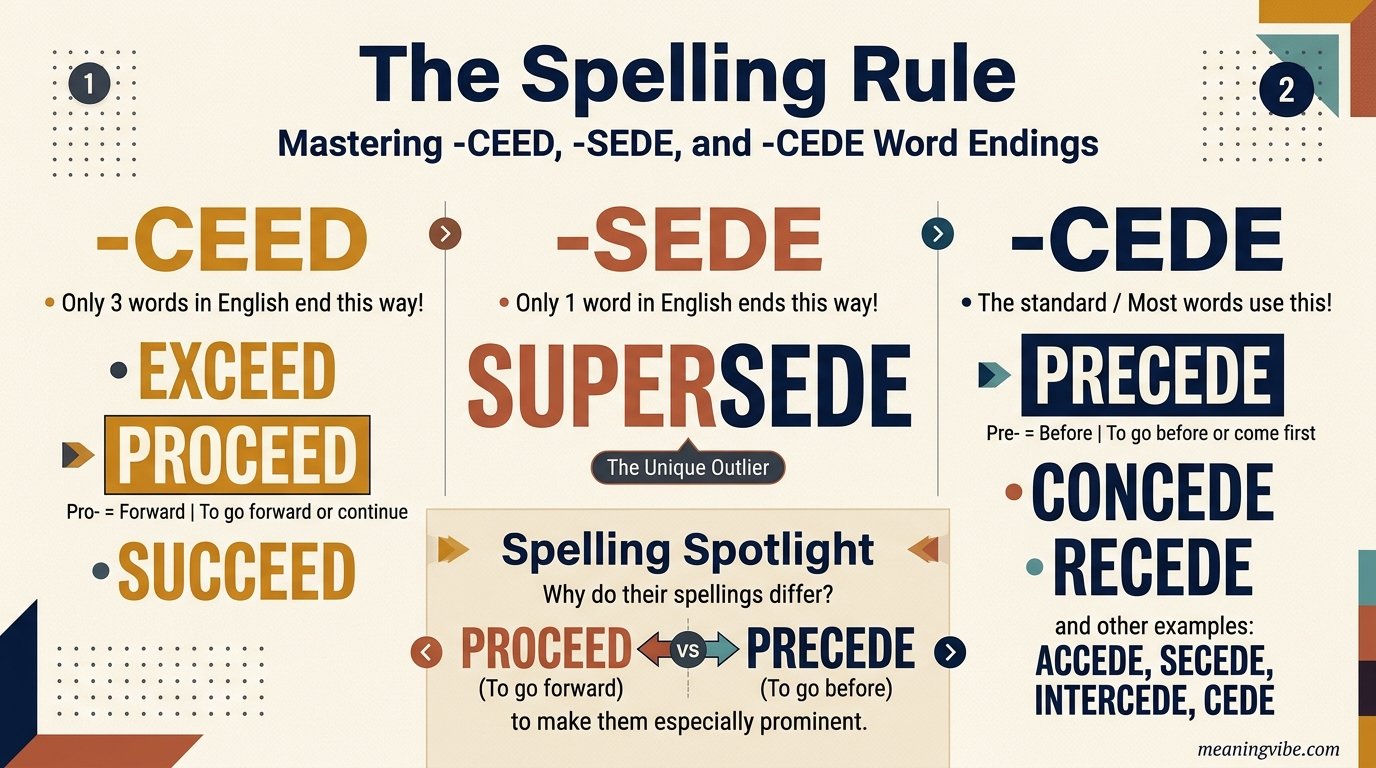
Frequently Asked Questions
What is the difference between precede and proceed?
Precede means to come before something in time, order, position or rank: something must follow it. Proceed means to move forward or continue with an action: something is underway.
Precede looks backward at what stands earlier in line; proceed looks forward at the next step.
What does precede mean?
Precede is a transitive verb meaning to be, go or come before something, to be earlier than it, to go in front of it, or to outrank it.
Dictionaries also give a preface sense: to precede a speech with an introduction is to put the introduction first.
What does proceed mean?
Proceed is an intransitive verb meaning to continue after a pause, to go on in an orderly way, to begin and carry on an action or movement, and, in a second sense, to come forth from a source, as in sounds proceeding from a room.
Which word means come before?
Precede. If one thing stands earlier than another in time, order, place or rank, it precedes the other: the introduction precedes the first chapter, and lightning precedes thunder.
Which word means continue or go ahead?
Proceed. When an action continues after a pause, or a person moves forward as instructed, the verb is proceed: the meeting proceeded after the break, and passengers proceeded to the gate.
Is it proceed with caution or precede with caution?
Proceed with caution. The sign tells you to move forward carefully, which is proceed’s job. Precede cannot fit, because nothing is coming before something else in that instruction.
Please proceed to the gate or precede to the gate?
Proceed to the gate. The announcement instructs travelers to move forward to a place, which is proceed plus the preposition to. Precede would require an object that you are going in front of.
Is preceed a word?
No. Preceed is a common misspelling of precede, created by borrowing the ceed ending of proceed. The correct spelling is precede, ending cede, like most verbs with this sound.
What is the past tense of precede?
Preceded. The full set is precedes, preceded and preceding, and all keep the cede stem. The planning that preceded the launch is a typical formal use.
What is the past tense of proceed?
Proceeded. The full set is proceeds, proceeded and proceeding. After the interruption, she proceeded with her presentation is the classic dictionary pattern.
What is the difference between preceding and proceeding?
Preceding means coming before: the preceding year is the earlier one. Proceeding means continuing: the work is proceeding well. One looks back along the line; the other moves forward along it.
What does proceeds mean as a noun?
Proceeds (PROH-seeds) is the money obtained from a sale, event or transaction, always plural: the proceeds of the auction went to charity. It grows from proceed’s oldest sense, to come forth from a source.
Is proceeds singular or plural?
Proceeds is plural in form and takes plural agreement in careful usage: the proceeds were donated. It names a sum as a collection, like earnings or takings.
What is the difference between precedent and precedence?
A precedent (PRES-uh-dent) is an earlier act or court decision used as a guide. Precedence (PRES-uh-dense) is priority in rank or order. Both descend from precede, and both move the stress to the first syllable.
How do you pronounce precede and proceed?
Both end in the same stressed SEED syllable. They differ only in the weak first syllable: precede is pri-SEED and proceed is pruh-SEED. The near identical sound is why the pair is confused in speech and then in spelling.
Are precede and proceed homophones?
Not quite. They are near homophones: the first syllables differ slightly, pri versus pruh, in careful speech. In fast speech they can merge, which pushes the real burden onto spelling and context.
Can proceed take a direct object?
No. Proceed is intransitive, so it cannot be followed directly by a noun. You proceed with a plan, to a place, from a source or against a person, always through a preposition. Precede is the transitive one: it precedes something.
Why is proceed the plan wrong?
Because proceed has no object slot for the plan to fill. The grammatical sentence is proceed with the plan. Editors treat the missing preposition as a reliable sign that the writer actually needed a different verb, often begin or continue.
Is precede transitive or intransitive?
Transitive in its main senses: it takes an object, the thing that comes after it. A speech precedes the ceremony. In the preface pattern it can carry two: she preceded the speech with a warning.
Why is precede so often used in the passive voice?
Because writers want the later, larger event as the subject: the concert was preceded by a talk. The passive keeps the main event in the spotlight while still reporting what came first.
What does proceed to do something mean?
It means to go on to do the next thing in a sequence, often after finishing or interrupting something else: he thanked the panel and proceeded to take questions.
It can also carry a dry irony when the next action is unwelcome or predictable.
What does proceed from mean?
It marks source or origin: strange sounds proceeded from the room, or advice that proceeds from good intentions. This is proceed’s oldest sense, coming forth from a source, and it explains the noun proceeds.
What does proceed against mean?
In legal English, to proceed against someone is to institute legal proceedings against them. The phrase belongs to formal and legal writing and is one reason proceedings is the noun for a court or formal action.
What is an order of precedence?
A ceremonial ranking that fixes who goes, sits or is announced before whom at official events. It is precedence in action, and it descends directly from precede’s rank sense.
Which verbs end in ceed in English?
Only three common verbs: exceed, proceed and succeed. Everything else with the sound ends in cede, like precede and concede, and one verb, supersede, ends in sede. The Grammarphobia Blog’s study of these endings states the same rule in explainer form.
Why is supersede spelled with sede, not cede?
Because its root differs. The cede family comes from Latin cedere, to go. Supersede comes from supersedere, to sit on top of or abstain, and the spelling preserves that ancestry. Supercede is always wrong.
Precede vs succeed: what is the difference?
Precede means to come before; succeed, in its sequence sense, means to come after or follow: the vice president succeeded the president. They are the two directions of one line.
Succeed’s other sense, to achieve success, is the one used most in daily life.
Proceed vs progress: what is the difference?
Progress is chiefly a noun (and a verb with a slightly different rhythm) for forward movement and improvement generally.
Proceed is the verb of continuing a specific action or moving as directed: work is progressing, and the committee proceeded with the vote.
What is a good trick to remember precede vs proceed?
Follow the prefixes and their families. Pre is before, like previous and preview, and precede keeps their company. Pro is forward, like progress and proceed to the future.
If the sentence is about order, choose the pre word; if it is about moving on, choose the pro word.
What does precede with mean in she preceded her speech with a warning?
That is precede’s preface sense: to put one thing in front of another. She placed the warning before the speech. The pattern is precede X with Y, and Y is the item standing in front.
Is the meeting will proceed as planned correct?
Yes, completely. Proceed as planned is one of the verb’s most standard collocations: the event continues in the orderly way intended. It appears in minutes, news reports and announcements everywhere.
Why is dinner was proceeded by drinks wrong?
Because proceed cannot mean come before, in active or passive form. Drinks came before dinner, so the sentence needs precede: dinner was preceded by drinks. The error reverses the direction of the whole timeline.
Can precede describe rank, not just time?
Yes. Dictionaries list surpassing in rank, dignity or importance as a core sense. In protocol, one official precedes another in the order of precedence, and in an organization a senior title can precede a junior one on a formal list.
What is the difference between a proceeding and proceedings?
A proceeding is one formal step or action, especially in law. Proceedings, plural, names the events of a meeting, a legal action as a whole, or the published record of a conference.
What are conference proceedings?
The published record of what was presented and said at an academic conference: papers, abstracts and talks collected in a volume or site. The word comes from proceed in its orderly business sense, the business that was gone through.
Does precede always need something after it?
In practice, yes: the verb points at a follower. Even when the follower is obvious from context, the sentence implies it.
That need for a second item is the fastest field test: if nothing follows in your sentence, you almost certainly need proceed or another verb.
What does the preceding year mean?
The year that came immediately before the current or referenced one: results improved over the preceding year. Preceding works as an adjective meaning previous, and time periods, chapters, pages and paragraphs are its most common partners.
Does lightning precede or proceed thunder?
Precede. The flash reaches the eye before the sound reaches the ear, so lightning precedes thunder. It is the standard teaching example because the order is physical and easy to remember.
How do usage experts describe this confusion?
Bryan Garner, in Garner’s Modern English Usage, notes the pair is confused even by otherwise literate people, and that both may mean to go ahead, but in different senses. The problem is direction and spelling, not knowledge.
Where do precede and proceed come from?
Both end in Latin cedere, to go. Precede comes from praecedere, to go in front of, first used in English in the 15th century. Proceed comes from procedere, to go forward, first used in the 14th.
Is it the speakers precede or proceed onto the stage in a ceremony program?
The speakers are listed in the order they come before one another, so a program note about order uses precede: the keynote precedes the panel. When the ceremony itself moves on to the next item, it proceeds.
What is the one line rule for precede vs proceed?
Precede needs a follower and means come before; proceed needs a direction and means go forward or continue. Ask what your sentence is missing: something standing after it means precede, somewhere to go or something to continue means proceed.
Conclusion
Precede vs proceed is a question of geometry disguised as a question of spelling.
Precede points backward along a line and needs a follower standing after it; proceed points forward along the same line and needs a direction to move in.
The family keeps the same map: preceding looks back, proceedings roll forward, proceeds come forth, and precedent and precedence fix the order things stand in.
Keep the two tests at your keyboard. If something follows, precede; if something continues, proceed.
And let the spelling rule ride along: three verbs in ceed, one in sede, precede with the rest in cede. Run the tests on the next formal sentence you write, and this pair will never cost you an edit again.