

Bare vs bear is the mix-up that turns a polite request into an awkward invitation. Type “please bare with me” in a work email, and you have technically asked the reader to uncover something. Say a client has “bear minimum” needs, and you have invited a grizzly into the meeting.
The two words sound exactly alike, yet one describes a forest animal and the burden of carrying, while the other describes nakedness and emptiness. How can one tiny vowel swap change so much? Read on, and you will never hesitate over these two again.
Bare vs Bear:
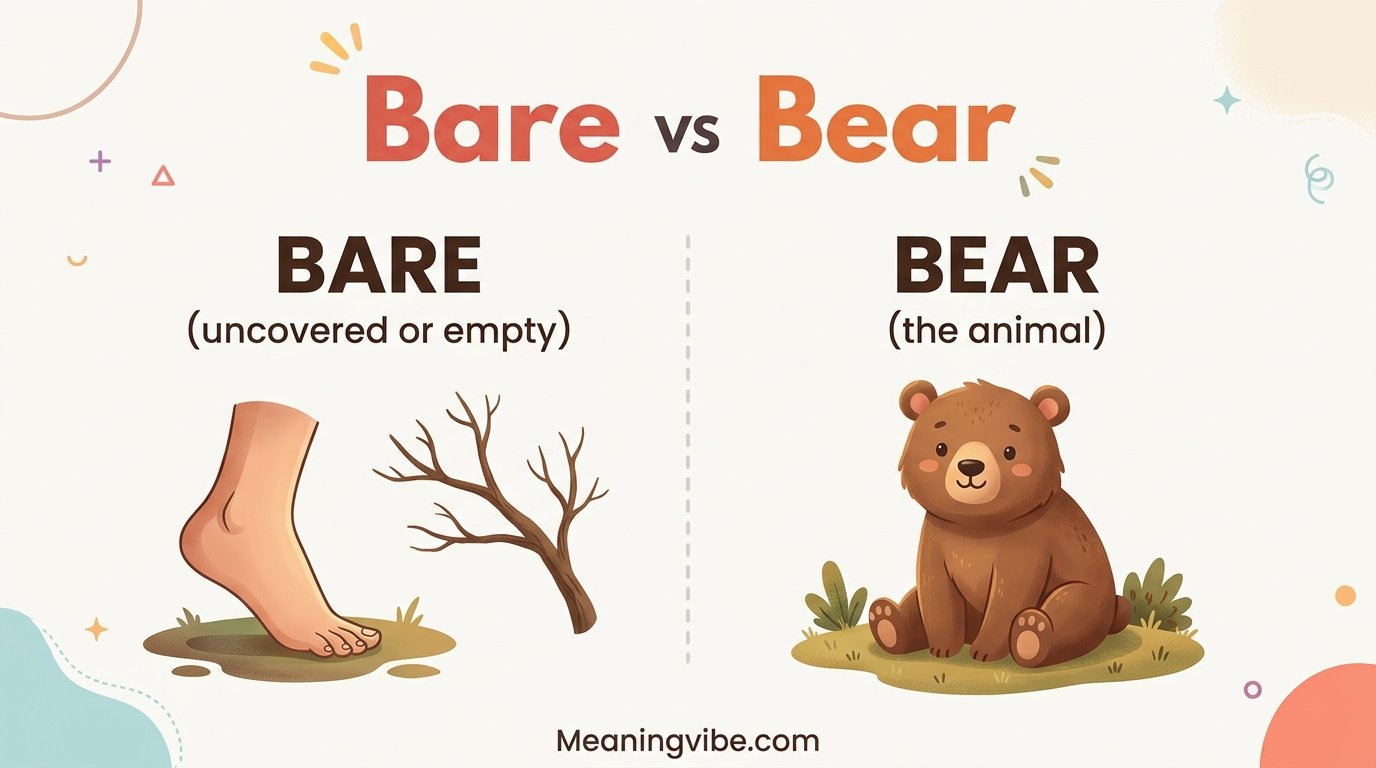
Bear is a verb that means to carry, endure, or produce, and it is also the name of the animal. Bare is an adjective that means uncovered or empty, and it is also a verb that means to uncover.
If you are carrying, tolerating, or talking about the animal, use bear. If you are uncovering, exposing, or describing something plain and empty, use bare.
Definition Box
| Word | Part of speech | Core meaning | Example |
|---|---|---|---|
| Bear | Verb | To carry, endure, or give rise to | Please bear with me. |
| Bear | Noun | A large furry mammal | A bear crossed the trail. |
| Bare | Adjective | Uncovered, empty, or basic | The walls were bare. |
| Bare | Verb | To uncover or expose | The dog bared its teeth. |
One Sentence Each
- She could not bear the noise any longer.
- He walked across the sand with bare feet.
The Fastest Memory Trick
A bear has ears, and the word bear contains the letters “ear.” Bare ends in “are,” so think of what you are when nothing covers you.
What Does Bear Mean?
Bear is one of the busiest words in English. It works as a verb with several meanings and as a noun for the animal.
Almost every use of bear shares one idea: holding or carrying something, whether weight, pain, a name, or a child.
Bear as a Verb: To Carry or Support
The most literal meaning is to hold up a weight. A bridge bears the load of traffic, and a shelf bears the weight of books.
- The old beam could not bear the weight.
- The bridge is built to bear heavy trucks.
- She bore the groceries up three flights of stairs.
Bear as a Verb: To Endure or Tolerate
Bear also means to put up with something unpleasant. This sense gives us the phrase “can’t bear it.”
- I cannot bear the heat.
- He bore the pain without complaint.
- Few people can bear that kind of pressure.
Bear as a Verb: To Give Birth or Produce
Bear can mean to give birth to a child or to produce fruit, flowers, or results. It is a formal and slightly old-fashioned choice for childbirth, but it is still common in writing.
- She bore three children.
- The apple tree bears fruit every autumn.
- His efforts finally bore results.
Bear as a Verb: To Carry Something Abstract
You can bear a name, a mark, a resemblance, a grudge, or a responsibility. In each case, the thing is carried in a figurative sense.
- The building bears her name.
- He bears a strong resemblance to his father.
- She does not bear a grudge.
- The manager bears responsibility for the outcome.
Bear as a Noun: The Animal
As a noun, a bear is a large, heavy mammal with thick fur. The word is also used for the toy and for the cartoon and mascot versions of the animal.
- A brown bear fished in the river.
- The child hugged her teddy bear.
- The polar bear is built for icy water.
Bear Pronunciation
Bear is pronounced like “bair,” and it rhymes with “care,” “hair,” and “chair.” It is a homophone of bare.
Because the sounds are identical, only the spelling and the meaning can tell them apart.
Forms of Bear
| Form | Example |
|---|---|
| Bear | Please bear with me. |
| Bears | She bears the cost herself. |
| Bore | He bore the news calmly. |
| Borne | The weight was borne by the pillars. |
| Born | The baby was born in May. |
| Bearing | Thank you for bearing with me. |
| Bearable | The heat was barely bearable. |
| Unbearable | The delay was unbearable. |
Bear Synonyms
- Carry
- Support
- Endure
- Tolerate
- Stand
- Produce
- Yield
- Hold up
Bear Examples in a Sentence
- The table is strong enough to bear the weight of the cake.
- I can’t bear to watch the ending.
- The tree bears fruit twice a year.
- Please bear with me while the page loads.
- A mother bear protected her cubs.
What Does Bare Mean?
Bare is about being uncovered or stripped down. It describes something that has nothing on it, nothing in it, or nothing extra.
It works as an adjective most of the time, and it can also work as a verb.
Bare as an Adjective: Uncovered
The basic meaning is without clothing or covering. A person’s feet, arms, or shoulders can be bare, and so can a floor or a wall.
- The children ran across the beach with bare feet.
- The room had bare walls and no furniture.
- A bare bulb hung from the ceiling.
Bare as an Adjective: Empty
Bare can mean empty or lacking supplies. A cupboard or a shelf can be bare when nothing is left.
- By Friday the pantry was bare.
- The shelves were bare after the sale.
Bare as an Adjective: Basic or Minimal
Bare can also mean no more than the minimum. In this sense, it pairs with words such as minimum, essentials, and necessities.
- She did the bare minimum to pass.
- They packed only the bare essentials.
- The report gave the bare facts and nothing more.
Bare as a Verb: To Uncover or Reveal
As a verb, bare means to expose something to view. It can be used literally or figuratively.
- The dog bared its teeth.
- He bared his soul in the speech.
- The storm bared the old roots of the tree.
Bare Pronunciation
Bare is pronounced “bair,” exactly like bear. It rhymes with “care,” “air,” and “share.”
Forms of Bare
| Form | Part of speech | Example |
|---|---|---|
| Bare | Adjective or verb | The branches were bare. |
| Barer | Adjective, comparative | The desert looked barer each day. |
| Barest | Adjective, superlative | The barest hint of a smile appeared. |
| Bares | Verb | She bares her heart in her poems. |
| Bared | Verb, past | He bared his teeth. |
| Baring | Verb | The cliff was baring its rocky face. |
| Barely | Adverb | She barely made it on time. |
| Bareness | Noun | The bareness of the room felt cold. |
Bare Synonyms
- Naked
- Uncovered
- Exposed
- Empty
- Plain
- Stark
- Basic
- Mere
Bare Examples in a Sentence
- The hikers left their boots behind and walked with bare feet.
- The tree stood bare in the winter wind.
- He opened the fridge, and the shelves were bare.
- She bared her teeth in a fierce smile.
- Only the bare bones of the plan were ready.
Bare vs Bear: Side-by-Side Comparison
Seeing the two words side by side makes the difference clear. Keep this table nearby when you are editing.
| Feature | Bear | Bare |
|---|---|---|
| Main meaning | Carry, endure, or the animal | Uncovered, empty, or to uncover |
| Parts of speech | Verb and noun | Adjective and verb |
| Core idea | Holding something | Having nothing covering it |
| Pronunciation | bair | bair |
| Typical phrase | Bear with me | Bare minimum |
| Typical object | A weight, a pain, a name | A body part, a wall, a fact |
| Sample sentence | He bore the burden. | The cupboard was bare. |
Spelling at a Glance
Bear has the letters “ea,” just like “ear,” “hear,” and “wear.” Bare has the letters “are,” just like “care,” “share,” and “stare.”
If you picture the animal, you will picture the “ea.” If you picture a naked foot, you can picture the “are.”
Why Do People Confuse Bare and Bear?
The reason is simple: they are perfect homophones. Both are pronounced “bair,” so your ear gives you no clue, and you must rely on memory for the spelling.
Many everyday phrases also use one or the other, and writers copy them from memory without checking.
The Phrase Problem
Expressions such as “bear with me,” “bear in mind,” and “bare minimum” are spoken far more often than they are written. When a person finally types one, the spelling is a coin flip unless they know the rule.
That is why “bare with me” is one of the most common mistakes in emails.
Other Pairs That Cause the Same Trouble
If you enjoy untangling look-alike words, you may also like allude vs elude, adapt vs adopt, and adverse vs averse.
Each pair follows the same pattern as bare and bear: one small change in spelling leads to a very different meaning.
Spellcheck Will Not Help
Both words are real, so writing software rarely flags the error. A sentence such as “Please bare with me” passes spellcheck but fails a meaning check.
You have to read for sense, not just for spelling.
Bear With Me or Bare With Me: Which Is Correct?
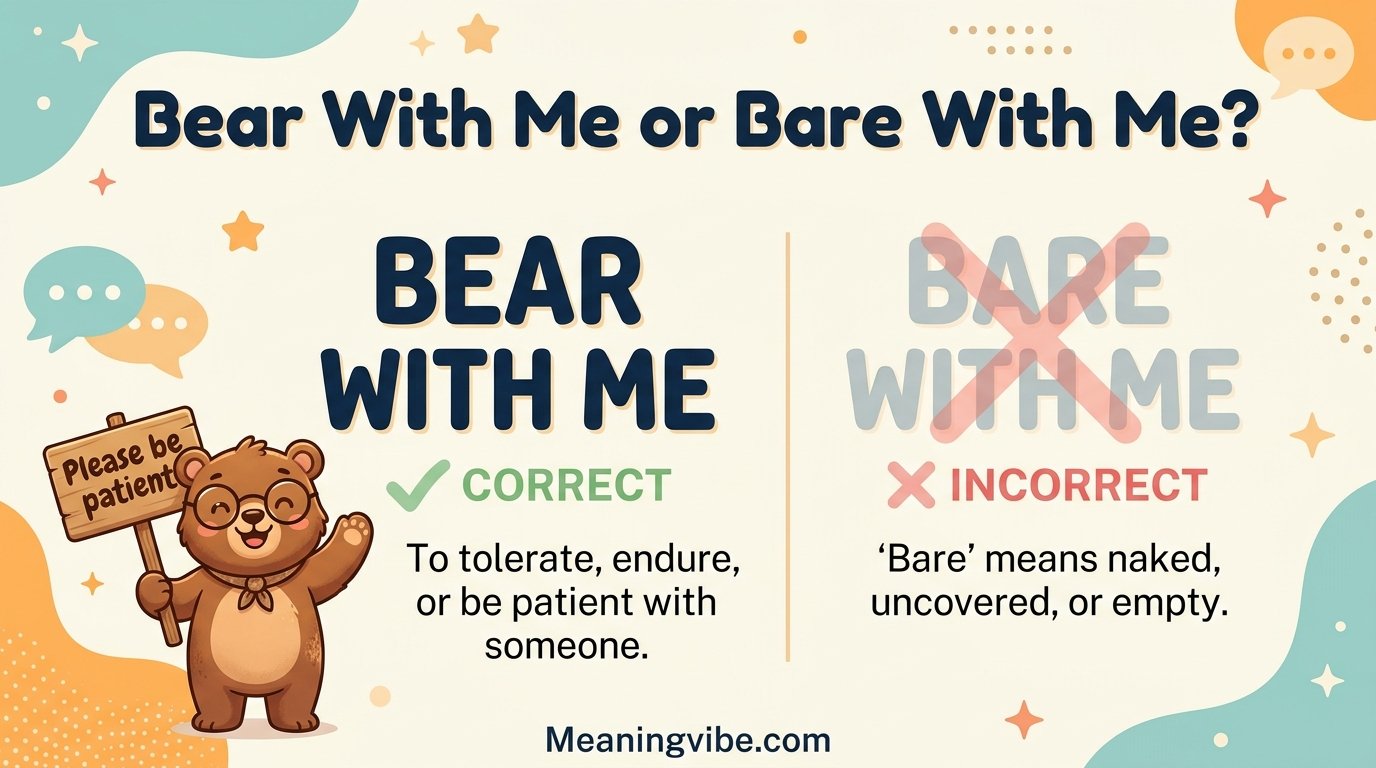
The correct phrase is “bear with me.” It is a polite request for patience, and it uses the verb bear in the sense of putting up with something.
“Bare with me” is a spelling mistake in nearly every situation. Taken literally, it would mean uncover yourself with me, which is not what anyone intends.
Why Bear With Me Is Correct
The phrase asks someone to endure a short delay or an awkward moment alongside you. The verb that means to endure is bear.
- Please bear with me while I find the file.
- Bear with me as the system restarts.
- Thank you for bearing with me.
Incorrect Versions to Avoid
- Please bare with me while I explain.
- Bare with me for a moment.
- Thanks for baring with me.
Related Phrases
| Phrase | Meaning | Example |
|---|---|---|
| Bear with me | Be patient with me | Please bear with me. |
| Bear with us | Be patient with our team | Bear with us during the upgrade. |
| Bearing with me | Being patient with me | Thanks for bearing with me. |
| If you will bear with me | Polite request for patience | If you will bear with me, I will explain. |
Bear in Mind or Bare in Mind?
The correct phrase is “bear in mind,” meaning to keep something in your thoughts. The verb is bear because you are carrying the idea in your mind.
- Bear in mind that the office closes at five.
- Please bear in mind the budget limits.
- Bear in mind that results may vary.
Bare Minimum or Bear Minimum?
The correct phrase is “bare minimum.” Here bare means stripped down to the least possible, so the phrase means nothing more than the absolute minimum.
- He did the bare minimum to pass the class.
- Keep spending to the bare minimum.
- The bare minimum requirement is a high school diploma.
A Quick Check
You cannot carry a minimum, so the verb bear makes no sense here. The adjective bare fits, because it means stripped of anything extra.
Bare Necessities, Bare Bones, and Bare Essentials
Bare often pairs with words that describe the basics. In each of these phrases, bare means plain, basic, or stripped down.
| Phrase | Meaning | Example |
|---|---|---|
| Bare necessities | The most basic needs | They packed the bare necessities. |
| Bare essentials | Only what is truly needed | The room had the bare essentials. |
| Bare bones | The simplest form | The plan was just the bare bones. |
| Bare facts | Plain facts with no extras | She stated the bare facts. |
| Bare minimum | The least possible | He met the bare minimum. |
Bear Fruit, Bear the Brunt, and Other Phrases With Bear
Bear also lives in dozens of idioms. Most of them rely on the idea of carrying, enduring, or producing something.
| Phrase | Meaning | Example |
|---|---|---|
| Bear fruit | Produce good results | The plan finally bore fruit. |
| Bear the brunt | Take the worst of something | The coast bore the brunt of the storm. |
| Bear witness | Provide evidence or testify | The ruins bear witness to the fire. |
| Bear a grudge | Hold resentment | She bears no grudge. |
| Bear responsibility | Be accountable | The leader bears responsibility. |
| Bear the cost | Pay the expense | The buyer bears the cost of shipping. |
| Bear resemblance | Look similar | He bears resemblance to his uncle. |
| Bear in mind | Remember | Bear in mind the deadline. |
| Bear down | Press or push hard | Bear down on the final stretch. |
| Bear out | Confirm or support | The data bear out her claim. |
| Bear up | Cope under strain | She is bearing up well. |
| Grin and bear it | Endure with a smile | You have to grin and bear it. |
Bear Left and Bear Right
In directions, bear means to turn gently in a direction. It is common on road signs and in navigation.
- Bear left at the fork in the road.
- Bear right after the bridge.
Bare Your Soul, Lay Bare, and Other Phrases With Bare
Bare also appears in figurative phrases. These almost always mean revealing or exposing something.
| Phrase | Meaning | Example |
|---|---|---|
| Bare your soul | Share deep feelings | He bared his soul in the letter. |
| Lay bare | Expose or reveal | The report laid bare the problems. |
| Bare one’s teeth | Show teeth in anger | The wolf bared its teeth. |
| Bare-faced | Shameless and open | A barefaced lie |
| Bare-handed | Without tools or gloves | He caught it bare-handed. |
| Barefoot | Without shoes | They walked barefoot on the grass. |
| Bare naked | Completely undressed | The baby ran bare naked down the hall. |
Bear Arms or Bare Arms?
Both spellings are real, and they mean different things. “Bear arms” means to carry weapons, while “bare arms” means uncovered arms.
The famous phrase about the right to bear arms uses the verb bear in the sense of carrying.
Examples
- Soldiers bear arms in service of their country.
- She wore a sleeveless top that left her arms bare.
- He joked that it was too cold to go outside with bare arms.
Bear Market vs Bull Market

In finance, a bear market is a long period when prices fall. Its opposite is a bull market, when prices rise.
The word here is always bear, as in the animal. The name is often explained by the way a bear swipes downward with its paws, although the origin is debated.
- Investors grew nervous during the bear market.
- Analysts expect the bull market to continue.
- A bear market is often defined as a sustained drop in prices.
Bear Hug, Teddy Bear, and Animal Phrases
Bear also appears in everyday compound words that refer to the animal.
- Bear hug: a tight, warm embrace
- Teddy bear: a stuffed toy
- Polar bear: an Arctic mammal
- Grizzly bear: a large North American bear
- Bear cub: a young bear
- Bear market: a market in decline
Borne vs Born: Past Forms of Bear
Bear has two past participles, and they cause their own confusion. Born refers to birth, while borne refers to carrying or enduring.
| Word | Use | Example |
|---|---|---|
| Born | Brought into life | She was born in June. |
| Borne | Carried or endured | The weight was borne by the beams. |
| Borne | Having given birth (active use) | She has borne two sons. |
| Borne | In compound words | Airborne and waterborne |
A Quick Rule
If the sentence says “was born” or “were born,” use born. If something has been carried, supported, or endured, use borne.
- The idea was born in a small café.
- The cost was borne by the company.
- The disease is waterborne.
Barely, Bareness, and Other Forms of Bare
Bare also gives us useful related words. The best known is barely, which means only just.
- She barely made the train.
- He barely spoke during dinner.
- The room was barely furnished.
Common Mix-Ups
Barely has the same root idea as bare: stripped down to almost nothing. The adverb bearly does not exist.
Bearing vs Baring
Bearing and baring are close, and they come from the two different verbs. Bearing is the present participle of bear, while baring is the present participle of bare.
| Word | From | Meaning | Example |
|---|---|---|---|
| Bearing | Bear | Carrying or enduring | Thank you for bearing with me. |
| Baring | Bare | Uncovering | The dog was baring its teeth. |
Bearing as a Noun
Bearing is also a noun. It can mean a person’s way of carrying themselves, a direction, or a relevance to a topic.
- The general had a proud bearing.
- The ship adjusted its bearing to the north.
- The evidence has no bearing on the case.
Bare vs Bear in Everyday Life
You will meet both words in many ordinary situations. These examples show the pattern in action.
At Home
- The shelves are bare, so we need groceries.
- The floor was bare after the carpet came up.
- I can’t bear the smell of paint.
At Work
- Please bear with me while I share my screen.
- The report covers the bare facts.
- The manager bears responsibility for the plan.
In Nature
- A bear came out of the woods near the cabin.
- The trees stood bare in the winter.
- The orchard bears fruit every summer.
In Travel
- Bear left at the roundabout.
- They hiked in bare feet along the shore.
- We packed only the bare necessities.
Bare vs Bear vs Bear’s vs Bears
Plurals and possessives add another layer. A few small notes can keep your writing clean.
| Word | Meaning | Example |
|---|---|---|
| Bears | More than one bear, or the verb | Bears hibernate. The tree bears fruit. |
| Bear’s | Belonging to one bear | The bear’s den was hidden. |
| Bears’ | Belonging to many bears | The bears’ territory was large. |
| Bares | Uncovers (verb) | She bares her feelings. |
If you want a refresher on apostrophes, see parents’ vs parent’s and today’s vs todays.
Word Origins: Where Bare and Bear Come From
Bare and bear sound the same today, but they began as three separate words in Old English. Looking at their roots helps explain why their meanings stay so far apart.
Each word has its own path, and none of them started as a twin.
Origin of Bear (the Verb)
The verb bear comes from the Old English word beran, meaning to carry. It belongs to an ancient family of words connected to carrying and bringing, which is why it still covers weight, burdens, and children.
Origin of Bear (the Animal)
The animal name comes from the Old English word bera. It is widely thought to mean “the brown one,” a nickname rather than the animal’s older name.
Many scholars believe earlier peoples avoided saying the true name out loud, so the nickname replaced it.
Origin of Bare
Bare comes from the Old English word bær, meaning naked or uncovered. Its meaning has stayed remarkably steady for over a thousand years.
Roots at a Glance
| Word | Old English root | Core idea |
|---|---|---|
| Bear (verb) | beran | To carry |
| Bear (animal) | bera | The brown one |
| Bare | bær | Naked or uncovered |
How to Remember the Difference Between Bare and Bear
Good memory tricks are short and easy to picture. Choose the one that feels most natural to you.
Trick 1: Bears Have Ears
The word bear contains the letters “ear.” Picture a bear with big round ears, and you will remember the spelling.
Trick 2: Bare Means “Are” Nothing on It
Bare ends with “are.” Think of a bare floor: all you are left with is the floor.
Trick 3: Use Forbear
The word forbear, which means to hold back or tolerate, contains the verb bear. If you can link bear to forbear, you will never confuse it with bare.
Trick 4: Carry or Cover
Ask yourself one question: is something being carried, or is something uncovered? Carried means bear, and uncovered means bare.
Trick 5: Replace and Test
Try replacing the word with a simple phrase.
- Endure or carry: bear
- Uncovered or empty: bare
- Reveal: bare
The Ultimate Cheat Sheet
| If the sentence is about… | Use |
|---|---|
| Asking for patience | Bear |
| Carrying weight | Bear |
| Giving birth or producing fruit | Bear |
| The animal | Bear |
| Naked feet | Bare |
| An empty shelf | Bare |
| The least possible | Bare |
| Exposing a feeling | Bare |
Common Mistakes With Bare and Bear
Mistakes tend to follow a few predictable patterns. Learn them once, and you will spot them for good.
Mistake 1: Bare With Me
Wrong: Please bare with me while I search. Right: Please bear with me while I search.
Mistake 2: Bare in Mind
Wrong: Bare in mind that the store closes early. Right: Bear in mind that the store closes early.
Mistake 3: Bear Minimum
Wrong: He did the bear minimum. Right: He did the bare minimum.
Mistake 4: Bear Feet
Wrong: The kids ran around in bear feet. Right: The kids ran around in bare feet.
Mistake 5: Bare Fruit
Wrong: The tree bares fruit. Right: The tree bears fruit.
Mistake 6: Bear Naked
Wrong: He stood there bear naked. Right: He stood there bare naked.
Mistake 7: Trusting Spellcheck
Both words are correct spellings, so software seldom catches the mix-up. Only you can check the meaning.
Correct and Incorrect Examples Table
| Incorrect | Correct |
|---|---|
| Please bare with me. | Please bear with me. |
| Bare in mind the deadline. | Bear in mind the deadline. |
| She did the bear minimum. | She did the bare minimum. |
| The kids walked in bear feet. | The kids walked in bare feet. |
| The orchard bares fruit. | The orchard bears fruit. |
| The cupboard was bear. | The cupboard was bare. |
Spelling Slips That Look Like This One
Bare and bear belong to a large family of tricky spellings. Learning how they work can help you spot other pitfalls.
For more practice, try receive vs recieve, weird vs wierd, and speech vs speach.
Writers who struggle with similar-looking words may also like input vs imput, dought vs doubt, and pricy vs pricey.
More Word Pairs That Trip Up Writers
If bare and bear confused you, these pairs are worth a look. Each has a simple rule that will save you time.
- Sell vs sale for a classic verb and noun mix-up
- Dysregulated vs disregulated for medical and psychology writing
- Encorporate vs incorporate for business and legal writing
- Relate to vs relate with for picking the right preposition
- Window seal vs window sill for home and repair terms
Grammar Notes Worth Keeping Nearby
Word choice is only part of clear writing. Apostrophes and verb agreement trip up many writers too.
Read else’s vs elses for another apostrophe rule. For agreement, people do or people does settles a common question.
Practice Exercises: Bare or Bear?
Testing yourself is the fastest way to lock in the difference. Fill each blank with bare, bear, bears, bore, or borne.
Exercise 1: Fill in the Blank
- Please ______ with me while the video loads.
- The shelves were ______ after the holiday rush.
- A large ______ wandered into the campsite.
- She did only the ______ minimum on the project.
- The old bridge cannot ______ heavy trucks.
- The apple tree ______ fruit every year.
- The children ran across the sand in ______ feet.
- He ______ the loss with great dignity.
Answers
- bear
- bare
- bear
- bare
- bear
- bears
- bare
- bore
Exercise 2: Correct the Sentence
Rewrite each sentence with the right word.
- Bare in mind that the museum closes at six.
- The room had only bear walls.
- I cannot bare the noise.
Answers
- Bear in mind that the museum closes at six.
- The room had only bare walls.
- I cannot bear the noise.
Exercise 3: True or False
- Bear with me means be patient with me. (True.)
- Bare minimum means the least possible. (True.)
- Bare can mean to uncover. (True.)
- Bear can only refer to the animal. (False. It is also a verb.)
- The phrase bear naked is correct. (False. The phrase is bare naked.)
- Born refers to birth, while borne refers to carrying. (True.)
A Simple Editing Checklist for Writers
Before you publish, run a quick check on every sentence that contains one of these words. It takes only a few seconds.
- Is something being carried, endured, or produced? Use bear.
- Is it an animal? Use bear.
- Is something uncovered, empty, or stripped down? Use bare.
- Is someone revealing a feeling or a fact? Use bare.
- Does the phrase ask for patience or mean “remember”? Use bear.
- Does the phrase mean the least possible? Use bare.
Tips for Better Writing
- Read the sentence aloud and picture the meaning, not the sound
- Use “be patient with me” as a test for “bear with me”
- Use “stripped down” as a test for “bare”
- Double-check set phrases before sending a professional email
Bare vs Bear in Different Types of Writing
Each kind of writing leans on these words in its own way. Knowing the pattern helps you choose without thinking.
| Writing type | Bear often appears in | Bare often appears in |
|---|---|---|
| Business emails | Bear with me, bear in mind | Bare minimum, bare facts |
| Fiction | Burdens, grudges, animals | Bare feet, bare walls |
| News | Bear market, bear the cost | Laid bare, bare details |
| Academic writing | Bears out, bears on | Bare statistics |
| Everyday speech | Can’t bear it | Bare essentials |
| Directions | Bear left, bear right | Rarely |
When a Simpler Word Works Better
Both words can sound formal in the right phrase. In a quick message, “be patient,” “remember,” and “least” are often more natural than the longer idioms.
Save the formal phrases for emails, reports, and documents where tone matters.
Why Using the Right Word Matters
A single wrong letter can change the meaning of a sentence completely. In a business email, “bare with me” can look careless, and in a report, “bear minimum” can hurt your credibility.
Precise word choice also helps your writing sound confident and professional.
Benefits of Getting It Right
- Clearer emails, reports, and essays
- Greater credibility with clients and managers
- Fewer awkward or unintentionally funny mistakes
- Better results on exams and applications
- More confidence when writing for the public
Also Read:
- Allude vs Elude: Meaning, Difference, Examples and Correct Usage 2026
- Adapt vs Adopt: Meaning, Difference, Examples and Correct Usage 2026
- Adverse vs Averse: Meaning, Difference, Examples and Correct Usage 2026
- Relate To vs Relate With: Meaning, Difference & Correct Usage (2026)
- Window Seal vs Window Sill: Definitions, Examples & Usage (2026)
- Parents’ or Parent’s? What’s the Difference? Correct Usage Explained (2026)
- Minoot or Minute: Which Is Correct? Meaning, Pronunciation & Usage (2026)
- Sell vs. Sale: What’s the Difference? Meaning, Usage & Examples (2026)
- People Do or People Does: Which Is Correct? Grammar Rules & Examples (2026)
- Encorporate vs Incorporate: What’s the Difference? Correct Usage Explained (2026)
- Dought vs. Doubt: Correct Spelling, Meaning & Usage Explained (2026)
- Dysregulated vs. Disregulated: What’s the Difference? (Complete Guide 2026)
- Speach or Speech? Stop Making This Common Spelling Mistake (2026 Guide)
- Fiending or Feening? Stop Making This Common Spelling Mistake (2026)
- Dammit vs. Damnit: What’s the Difference and Which Is Right? (2026)
- Is It Signor or Signer? The Difference Explained with Examples (2026)
- Wierd or Weird: Meaning, Correct Usage & Examples (2026)
- Elses vs. Else’s: Meaning, Grammar Rules & Examples (2026)
- Today’s vs. Todays: Meaning, Grammar & Examples (2026)
- Receive vs. Recieve: What’s the Difference and Which Is Right? (2026)
- Input vs. Imput: What’s the Difference and Which Is Right? (2026)
- Pricy vs. Pricey: What’s the Difference and Which Is Right? (2026)
Frequently Asked Questions (FAQs)
What is the difference between bare and bear?
Bear means to carry, endure, or produce, and it is also an animal. Bare means uncovered, empty, or to uncover.
Is it bear with me or bare with me?
The correct phrase is “bear with me.” It is a polite request for patience, and bare with me is a spelling mistake.
Is it bear in mind or bare in mind?
It is “bear in mind.” The verb bear means to carry an idea in your thoughts.
Is it bare minimum or bear minimum?
It is “bare minimum.” Bare means stripped down to the least possible.
Are bare and bear homophones?
Yes, both are pronounced “bair.” Only the spelling and context show which word is meant.
What does bare mean?
Bare means uncovered, empty, or without anything extra. As a verb, it means to uncover or expose.
What does bear mean?
As a verb, bear means to carry, endure, support, or produce. As a noun, it is a large furry mammal.
Is it bare feet or bear feet?
It is “bare feet.” The word means uncovered or without shoes.
Is it bear naked or bare naked?
The standard phrase is “bare naked,” where bare means uncovered. Bear naked is a misspelling.
What is the difference between born and borne?
Born refers to being brought into life, as in “she was born in May.” Borne refers to carrying or enduring, as in “the cost was borne by the company.”
What does bear fruit mean?
It means to produce good results, as in “the plan finally bore fruit.” It comes from trees that produce fruit.
What does bear market mean?
A bear market is a long period when prices fall, usually in the stock market. The opposite is a bull market.
Is it right to bear arms or right to bare arms?
The phrase about carrying weapons uses bear, as in “bear arms.” Bare arms means uncovered arms.
What is the difference between bearing and baring?
Bearing comes from bear and can mean carrying or enduring. Baring comes from bare and means uncovering.
What does barely mean?
Barely means only just or almost not at all. It comes from the idea of being stripped down to almost nothing.
What is the easiest way to remember bare vs bear?
A bear has ears, and the word bear contains “ear.” Bare ends in “are,” so link it to being uncovered.
Conclusion
Bare vs bear comes down to a simple choice: is something being carried, or is something uncovered? Bear means to carry, endure, or produce, and it names the animal. Bare means uncovered, empty, or basic, and it can also mean to expose.
Remember the key phrases. You bear with someone, bear in mind, and bear fruit. You do the bare minimum, lay things bare, and walk in bare feet.
Use the trick that works for you: bears have ears, and bare is what you are when nothing covers you. Check set phrases before you send an email, because spellcheck will not catch this mix-up.
With a little practice, these two homophones become easy to handle. Correct word choice keeps your writing clear, confident, and professional.