

Ascent vs assent is a trap that no spellchecker can save you from, because both words are real, both are spelled correctly, and both sound exactly the same out loud. A hiker reaches the summit after a brutal ascent. A senator nods her head in assent. Swap them, and the sentence collapses into nonsense.
So how can two words that sound identical mean such different things? Keep reading, and you will learn the meaning, the origins, the memory tricks, and the real-world situations where this tiny mix-up quietly changes a message.
Ascent vs Assent:
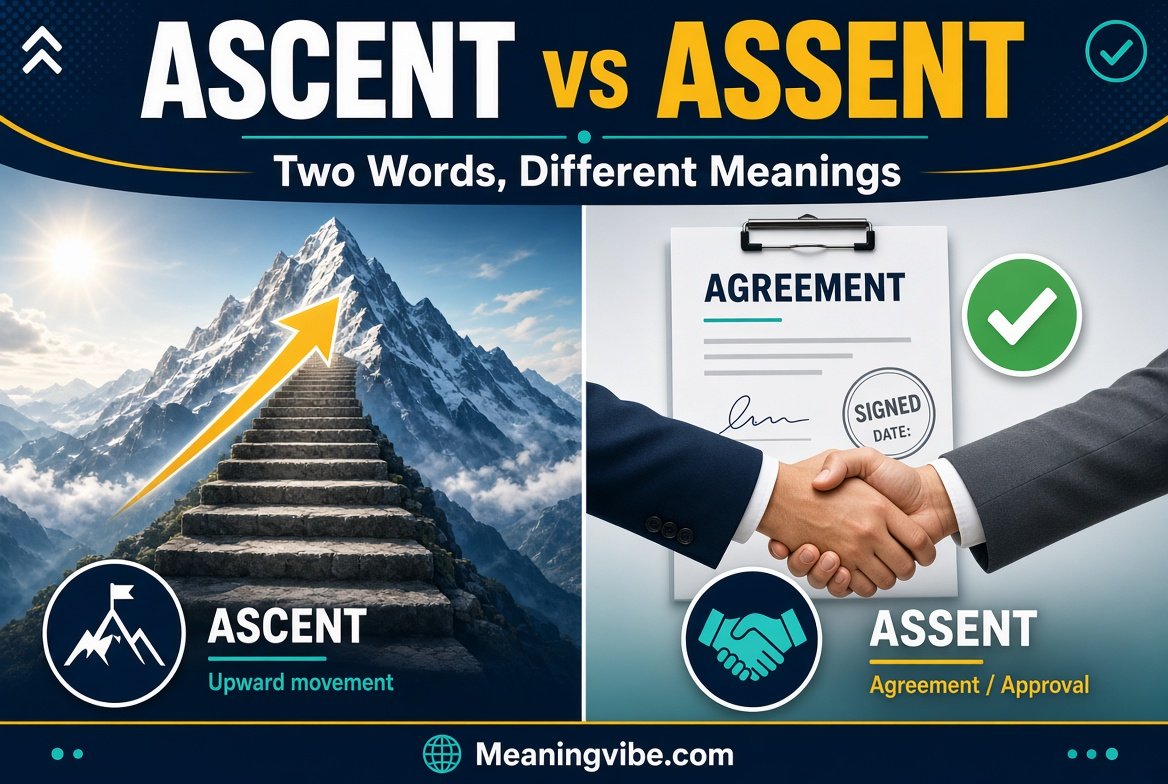
Ascent is a noun that means an upward movement, climb, or rise. Assent means agreement or approval, and it works as both a noun and a verb.
If something is going up, use ascent. If someone is saying yes, use assent.
Definition Box
| Word | Part of speech | Core meaning | Pronunciation |
|---|---|---|---|
| Ascent | Noun | The act of going up, a climb, or a rise | uh-SENT |
| Assent | Noun and verb | Agreement, approval, or to agree | uh-SENT |
One Sentence Each
- The ascent to the summit took six hours.
- The board gave its assent to the new budget.
The Fastest Memory Trick
Pair each word with its opposite. The opposite of ascent is descent, and the opposite of assent is dissent.
Ascent and descent share the letters “sc.” Assent and dissent share the letters “ssent.”
What Does Ascent Mean?
Ascent describes the act of moving upward. It can be physical, such as climbing a hill, or figurative, such as rising in a career or in power.
The word is always a noun. When you need an action word, you switch to the verb ascend.
Ascent Definition
Ascent is a noun meaning the act or process of rising, climbing, or going up. It can also mean an upward slope or path.
Both meanings share one idea: movement toward a higher point.
Ascent Pronunciation
Ascent is pronounced uh-SENT, with the stress on the second syllable. The first syllable is a soft “uh” sound.
This is exactly how assent is pronounced, which is why the two words are true homophones.
Forms and Related Words
| Word | Part of speech | Example |
|---|---|---|
| Ascent | Noun | The ascent was steep and rocky. |
| Ascend | Verb | The climbers ascend at dawn. |
| Ascended | Verb, past | The balloon ascended slowly. |
| Ascending | Verb or adjective | They took the ascending path. |
| Ascension | Noun | The ascension of the new leader surprised many. |
| Ascendant | Adjective or noun | The party is ascendant in the polls. |
Where Ascent Is Used
Ascent appears in mountaineering, aviation, space travel, career writing, and literature. It is one of the most flexible words for describing upward progress.
- Mountaineering: the ascent of Everest
- Aviation: the ascent of a plane after takeoff
- Space travel: the ascent stage of a spacecraft
- Careers: a rapid ascent to the top of the company
- Politics: the ascent of a leader to power
- Everyday life: the ascent of a long staircase
Ascent Synonyms
- Climb
- Rise
- Upward movement
- Mounting
- Advance
- Elevation
- Upswing
- Uphill path
Ascent Examples in a Sentence
- The ascent of the mountain took two full days.
- Her ascent to the executive team surprised no one.
- The rocket’s ascent was smooth and steady.
- We began the ascent to the fifth floor on foot.
- The path’s steep ascent tested every hiker in the group.
What Does Assent Mean?
Assent means agreement. It describes the moment someone says yes, approves, or accepts what has been proposed.
Unlike ascent, assent can work as a verb too. You can give your assent, or you can assent to a plan.
Assent Definition
Assent is a noun meaning agreement, approval, or consent. As a verb, it means to agree to something, often after thought or with some reluctance.
The word often carries a formal tone and appears in legal, political, and official writing.
Assent Pronunciation
Assent is pronounced uh-SENT, the same as ascent. Only the spelling and context show which word is intended.
This is why you must rely on meaning and not sound when choosing between them.
Forms of Assent
| Form | Part of speech | Example |
|---|---|---|
| Assent | Noun | She nodded her assent. |
| Assent | Verb | The committee will assent to the plan. |
| Assents | Verb | He assents to every request. |
| Assented | Verb, past | They assented to the terms. |
| Assenting | Verb or adjective | There were assenting voices in the room. |
Where Assent Is Used
Assent is common wherever formal approval matters. It appears in government, law, research, and professional communication.
- Politics: royal assent for a bill
- Law: assent to a contract or settlement
- Research: a young participant’s assent to join a study
- Business: management’s assent to a proposal
- Daily life: a nod of assent in a meeting
Assent Synonyms
- Agreement
- Approval
- Consent
- Acceptance
- Permission
- Acquiescence
- Concurrence
- Go-ahead
Assent Examples in a Sentence
- The city council gave its assent to the new park.
- She nodded in assent as the speaker made his point.
- Both parties assented to the revised terms.
- The proposal passed by general assent.
- He would not assent to anything unfair.
Ascent vs Assent: Side-by-Side Comparison
Use this table whenever you pause over the spelling. It shows the key differences at a glance.
| Feature | Ascent | Assent |
|---|---|---|
| Meaning | Upward movement, climb, or rise | Agreement or approval |
| Part of speech | Noun only | Noun and verb |
| Core idea | Going up | Saying yes |
| Opposite | Descent | Dissent |
| Related verb | Ascend | Assent (same word) |
| Pronunciation | uh-SENT | uh-SENT |
| Typical setting | Mountains, careers, flight | Law, government, meetings |
| Sample sentence | The ascent was exhausting. | The panel gave its assent. |
Spelling at a Glance
Ascent has “sc” in the middle, as in “scale” a mountain. Assent has a double “s,” as in “yes.”
If you can picture the letters, you can usually choose the right word.
Why Do People Confuse Ascent and Assent?
The main reason is simple: the words are perfect homophones. When two words sound identical, your ear gives you no help, and you must rely entirely on your memory of the spelling.
Their spellings are also only a couple of letters apart. That makes a typo easy and a mistake hard to notice.
Homophones Are Everywhere in English
English has hundreds of sound-alike pairs. If you enjoy untangling them, you may also like allude vs elude, adapt vs adopt, and adverse vs averse.
Each pair works the same way as ascent and assent: a small spelling change shifts the entire meaning.
Spellcheck Will Not Catch It
Because both words are valid, writing software rarely flags the error. A sentence such as “She gave her ascent to the plan” passes a spelling check but fails a meaning check.
You must read for sense, not just for spelling.
Ascent vs Assent vs Accent: What About the Third Word?
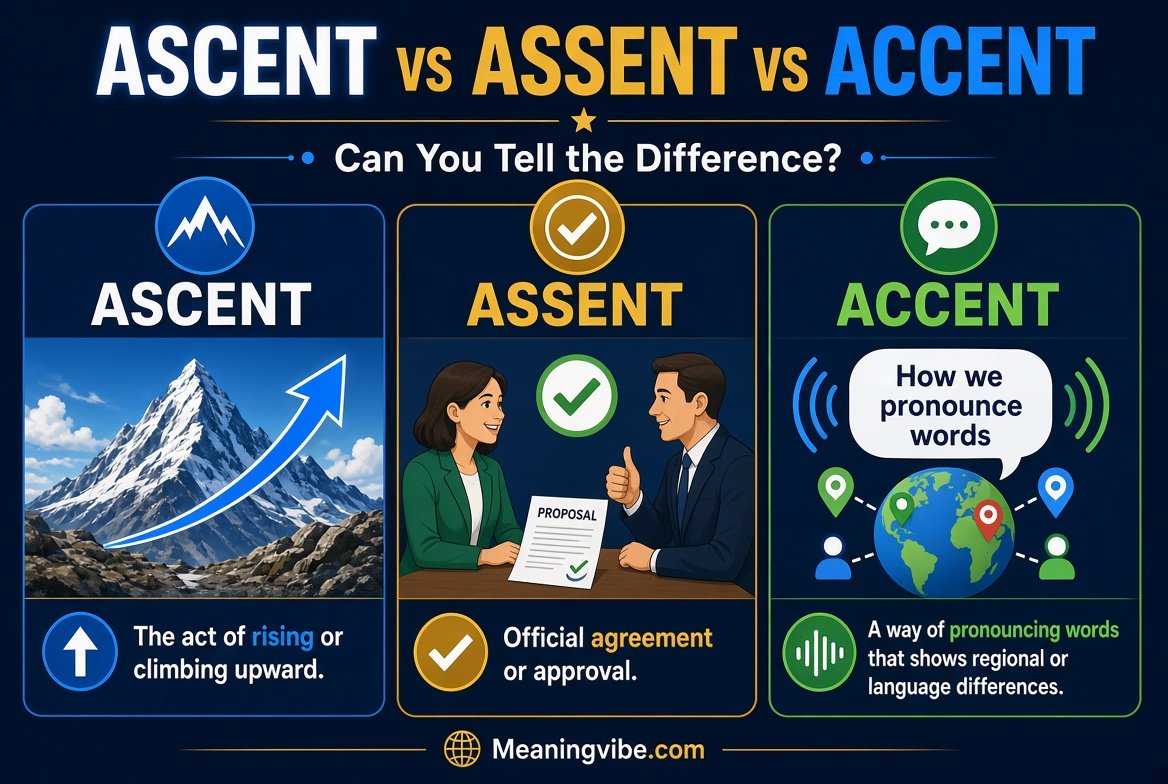
Accent is the third member of this confusing family. It looks similar, but it is pronounced differently and has an entirely separate meaning.
An accent is a way of pronouncing words, a stress mark, or a distinctive feature that draws the eye.
Pronunciation Differences
| Word | Pronunciation | Stressed syllable |
|---|---|---|
| Ascent | uh-SENT | Second |
| Assent | uh-SENT | Second |
| Accent | AK-sent | First |
Accent Examples
- She speaks with a warm Southern accent.
- The designer added a gold accent to the room.
- The French word has an acute accent over the letter e.
One Table for All Three
| Word | Meaning | Example |
|---|---|---|
| Ascent | Climb or rise | The ascent was long. |
| Assent | Agreement | She gave her assent. |
| Accent | Way of speaking or emphasis | He has a Scottish accent. |
Ascent vs Descent: The Opposite Pair
Ascent has a built-in opposite, which makes it easy to remember. Descent means the act of going down.
If you can think of the opposite word, you can usually confirm the meaning.
Examples With Ascent and Descent
- The ascent took three hours, but the descent took only one.
- The plane’s ascent was smooth, and its descent was even smoother.
- His career ascent was followed by a sudden descent.
Why This Trick Works
Ascent and descent share “sc,” so the connection is easy to picture. If the situation could logically be reversed by “going down,” ascent is the word you want.
Assent vs Dissent: The Opposite Pair
Assent also has a clear opposite. Dissent means disagreement or a difference of opinion.
When you doubt whether a sentence needs assent, ask whether dissent would make sense in its place.
Examples With Assent and Dissent
- The committee gave its assent, and only one member voiced dissent.
- Silence is often read as assent, but it can also hide dissent.
- Justices may write a dissent when they disagree with the majority.
A Shared Spelling Pattern
Assent and dissent both end with “ssent.” Seeing the shared letters is often enough to lock the right spelling in your head.
Ascent vs Ascend vs Ascension: Choosing the Right Form
Ascent is the noun. Ascend is the verb, and ascension is another noun with a more formal or religious feel.
Picking the right form keeps your grammar clean.
| Form | Part of speech | Meaning | Example |
|---|---|---|---|
| Ascent | Noun | The act of climbing or rising | The ascent was steep. |
| Ascend | Verb | To go up or rise | They ascend the tower at dusk. |
| Ascension | Noun | A rising to a higher position or state | The ascension of the new king was celebrated. |
| Ascendant | Adjective | Rising in power or influence | An ascendant star in politics |
Common Slip: Using Ascent as a Verb
Because assent works as a verb, writers sometimes treat ascent the same way. That is incorrect.
Wrong: The climbers will ascent the mountain tomorrow. Right: The climbers will ascend the mountain tomorrow.
Assent vs Consent vs Agree vs Approve
Assent has several close cousins, and each carries its own shade of meaning. Choosing the right one helps your writing sound precise.
| Word | Best used for | Example |
|---|---|---|
| Assent | Agreement, often formal or after thought | The council gave its assent. |
| Consent | Permission, especially legal or personal | You need written consent. |
| Agree | General, everyday agreement | We agree on the plan. |
| Approve | Official or favorable judgment | The manager approved the request. |
| Accept | Receiving something willingly | She accepted the offer. |
Assent Versus Consent
Both words involve agreement, but consent usually suggests permission with legal weight. Assent can be softer, sometimes a basic agreement without full legal authority.
In research involving young people, for example, a child may give assent while a parent or guardian gives formal consent.
Using Assent as a Verb
When assent is a verb, it is usually followed by the word “to.” The structure is simple and formal.
- The senator assented to the amendment.
- They assented to the new schedule.
- I will not assent to those conditions.
Royal Assent: A Famous Use of the Word
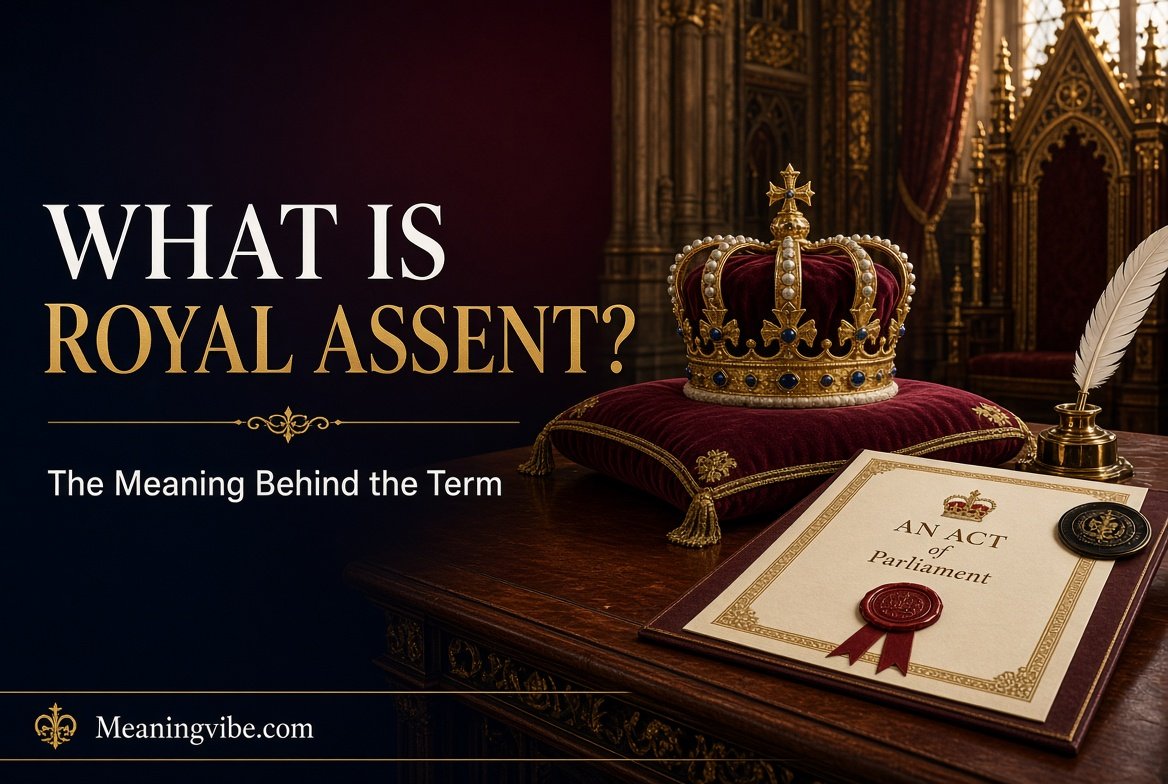
Royal assent is the formal approval of a bill by the monarch or the monarch’s representative, which turns the bill into law. It is one of the best-known uses of assent.
The term appears in countries that follow a parliamentary system with a monarch as head of state.
How Royal Assent Works in Brief
A bill passes through the legislature, and then it receives formal approval. Once that approval is given, the bill becomes an Act.
In practice, the approval is a formality in many countries. The legislature has already made the real decision.
Example Sentences
- The bill received royal assent and became law.
- The governor general gave assent to the legislation.
- Parliament waited for royal assent before the law took effect.
Assent in Law, Research, and Medicine
Assent carries real weight in professional settings. It often marks the point at which someone agrees to take part in something.
Understanding the difference between assent and consent can prevent errors in documents and policies.
Assent in Legal Writing
In contracts and court documents, assent describes a person’s agreement to the terms. A valid agreement generally requires that both sides give their assent.
- Mutual assent is the shared agreement that forms a contract.
- A party may express assent in writing, in words, or by actions.
Assent in Research With Young Participants
When children take part in research, they are usually asked to give assent. This means they agree to participate in language they can understand.
Parents or guardians typically provide the formal consent. Together they make sure the child is willing and protected.
Assent in Healthcare
In medical settings, a patient who cannot give full legal consent may still be asked for assent. This respects their voice in decisions about their own care.
Ascent in Mountaineering, Flight, and Space
Ascent is the word of choice whenever something rises toward a peak. It appears across adventure writing, science, and engineering.
The word fits any journey where height is gained.
Mountaineering
- The ascent of the peak began before sunrise.
- Climbers prepared carefully for the final ascent.
- The guide planned a slow ascent to help the group adjust to the altitude.
Aviation
- Pilots monitor the plane’s rate of ascent after takeoff.
- The balloon’s ascent was quiet and graceful.
Space Travel
In space exploration, the ascent stage is the part of a spacecraft that lifts off from a surface. The Apollo lunar module, for example, used an ascent stage to return astronauts from the Moon.
Everyday Uses
- The ascent of the staircase left her breathless.
- We admired the steady ascent of the sun over the hills.
Ascent as a Figure of Speech: Careers, Fame, and Power
Ascent often describes upward movement in a career or in society. In this sense, it is a metaphor for rising through ranks and gaining influence.
The word works well in both positive and neutral contexts.
Examples
- Her rapid ascent to the top of the company impressed investors.
- The singer’s ascent to stardom took less than a year.
- His political ascent began in a small town.
- The team’s ascent in the rankings surprised many fans.
Pairing With Words of Direction
Ascent often partners with words like “to,” “up,” and “toward.” Those small words reinforce the sense of climbing.
- Ascent to power
- Ascent up the ladder
- Ascent toward success
Common Phrases With Ascent and Assent
Phrases are a great way to learn word usage because they stick together in memory. These are the ones you will see most often.
| Phrase | Meaning | Example |
|---|---|---|
| Nod in assent | Show agreement with a nod | She nodded in assent. |
| Give assent | Formally agree | The board gave its assent. |
| By common assent | With everyone agreeing | By common assent, they chose her. |
| Royal assent | Formal approval of a law | The bill received royal assent. |
| Rapid ascent | Quick rise | His rapid ascent shocked everyone. |
| Steep ascent | Hard upward climb | The steep ascent tired us. |
| Final ascent | Last climb to the top | The final ascent began at dawn. |
Using Both Words in One Sentence
Because the words are such a perfect pair, they make memorable sentences together. Seeing them side by side can lock the difference in.
- The team gave its assent to the plan, and the ascent began at dawn.
- With the guide’s assent, the group started its ascent.
- Her ascent to the board was possible only after the chairman’s assent.
- The council’s assent came just before the hikers’ ascent of the ridge.
Word Origins: Where Ascent and Assent Come From
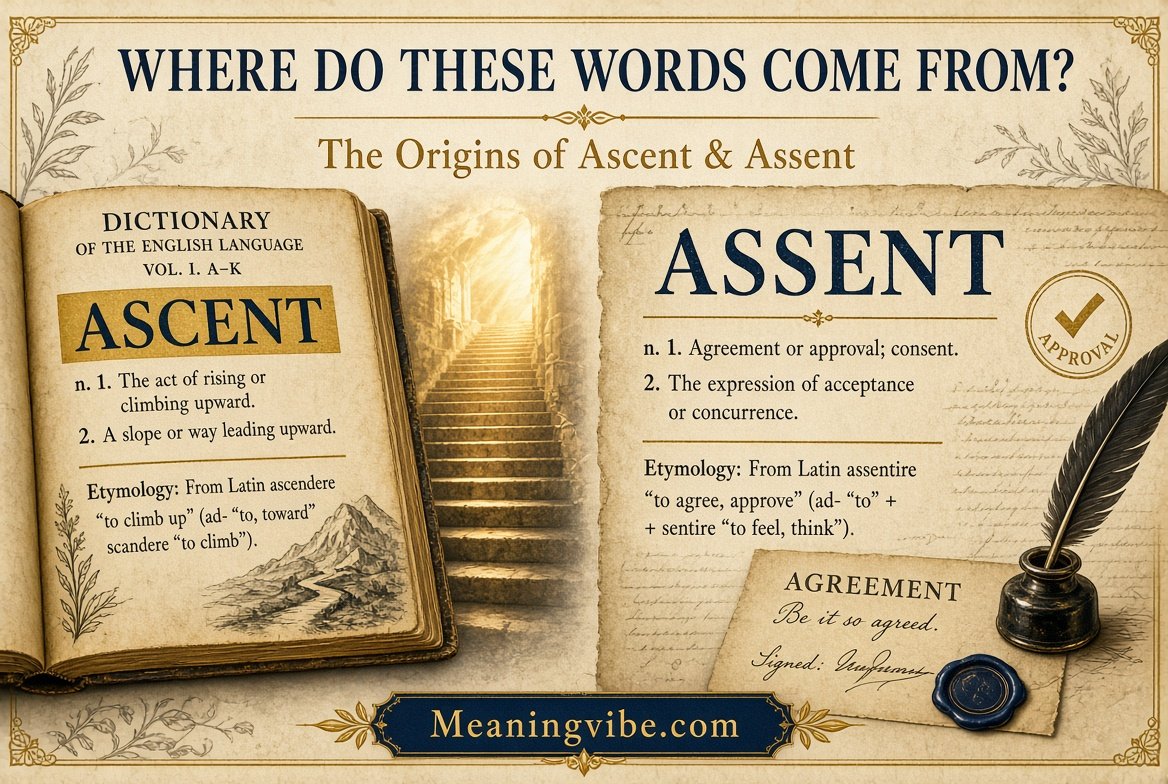
Both words travelled into English from Latin, either directly or through French. Their roots show why one is about climbing and the other is about agreeing.
A quick look at the history can make the meanings easier to keep apart.
Origin of Ascent
Ascent is connected to the Latin verb ascendere, which means to climb up. It is closely related to the English verb ascend and was shaped by the pattern of the word descent.
Every time you see “scend” in a word, think of climbing or moving along a level.
Origin of Assent
Assent comes from the Latin assentari and assentire, which relate to agreeing with or approving. It entered English centuries ago and has kept its sense of agreement ever since.
The root “sent” also appears in words such as consent, dissent, and sentiment, all tied to feeling and judgment.
Roots at a Glance
| Word | Latin idea | Modern meaning |
|---|---|---|
| Ascent | To climb up | Upward movement |
| Assent | To agree with | Agreement or approval |
| Descent | To climb down | Downward movement |
| Dissent | To think differently | Disagreement |
| Consent | To feel together | Permission |
How to Remember the Difference Between Ascent and Assent
Good memory tricks are short and visual. Choose the one that feels natural and use it every time you write one of these words.
Trick 1: Use the Opposites
Ascent pairs with descent. Assent pairs with dissent.
If the sentence would still make sense with the opposite word, you know which family you are in.
Trick 2: See the “C” and the “SS”
The “c” in ascent can remind you of a climb. The double “s” in assent can remind you of “yes.”
Trick 3: Picture a Mountain
Imagine a mountain whenever you write ascent. The letters “sc” look a bit like a path winding upward.
Trick 4: Think of a Nod
Picture a person nodding in agreement whenever you write assent. The nod is a physical sign of the word.
Trick 5: Replace and Test
Replace the word with “climb” and see if the sentence still works. Then try “agreement.”
- The ______ to the summit was long. Climb fits, so use ascent.
- She gave her ______ to the plan. Agreement fits, so use assent.
The Ultimate Cheat Sheet
| If the sentence is about… | Use |
|---|---|
| Climbing a mountain | Ascent |
| A career rising quickly | Ascent |
| A rocket going up | Ascent |
| Agreeing to a plan | Assent |
| Approving a bill | Assent |
| A nod of agreement | Assent |
Common Mistakes With Ascent and Assent
Mistakes tend to follow a few predictable patterns. Learn them once, and you will catch them for the rest of your writing life.
Mistake 1: Using Ascent for Agreement
Wrong: The manager gave his ascent to the proposal. Right: The manager gave his assent to the proposal.
Mistake 2: Using Assent for Upward Movement
Wrong: The assent of the mountain took five hours. Right: The ascent of the mountain took five hours.
Mistake 3: Using Ascent as a Verb
Ascent is a noun only. The verb is ascend.
Wrong: The hikers ascent the cliff. Right: The hikers ascend the cliff.
Mistake 4: Confusing Assent With Accent
Wrong: She spoke with a strong assent. Right: She spoke with a strong accent.
Mistake 5: Trusting Spellcheck
Spellcheck sees two correct spellings and moves on. Only you can decide which meaning fits.
Correct and Incorrect Examples Table
| Incorrect | Correct |
|---|---|
| She nodded her ascent. | She nodded her assent. |
| The ascent of the board came quickly. | The assent of the board came quickly. |
| The pilot began the assent after takeoff. | The pilot began the ascent after takeoff. |
| He will ascent the stairs. | He will ascend the stairs. |
| The lawmakers gave their ascent to the bill. | The lawmakers gave their assent to the bill. |
Spelling Slips That Look Like This One
Ascent and assent belong to a big family of tricky spellings. Learning how one works can help you spot others.
For more practice, try receive vs recieve, weird vs wierd, and speech vs speach.
Writers who struggle with similar-looking words may also like input vs imput, dought vs doubt, and pricy vs pricey.
More Word Pairs That Trip Up Writers
If ascent and assent confused you, these pairs are worth a look. Each has a simple rule that will save you time.
- Sell vs sale for a classic verb and noun mix-up
- Dysregulated vs disregulated for medical and psychology writing
- Encorporate vs incorporate for business and legal writing
- Relate to vs relate with for picking the right preposition
- Window seal vs window sill for home and repair terms
Grammar Notes Worth Keeping Nearby
Word choice is only part of clear writing. Apostrophes and verb agreement trip up many writers too.
Read parents’ vs parent’s, today’s vs todays, and else’s vs elses for apostrophe rules. For agreement, people do or people does settles a common question.
Practice Exercises: Ascent or Assent?
Testing yourself is the fastest way to remember the difference. Fill each blank with ascent, assent, ascend, or accent.
Exercise 1: Fill in the Blank
- The ______ of the volcano took most of the day.
- The board gave its ______ to the merger.
- The climbers will ______ the ridge at sunrise.
- She nodded in ______ as he explained the plan.
- The rocket’s ______ was perfectly smooth.
- He has a charming Irish ______.
- The mayor will not ______ to the new tax.
- The company’s ______ to market leader took five years.
Answers
- ascent
- assent
- ascend
- assent
- ascent
- accent
- assent
- ascent
Exercise 2: Correct the Sentence
Rewrite each sentence with the right word.
- The senator gave her ascent to the bill.
- The hikers began their assent at dawn.
- The manager will ascent the ladder of success.
Answers
- The senator gave her assent to the bill.
- The hikers began their ascent at dawn.
- The manager will ascend the ladder of success.
Exercise 3: True or False
- Ascent can be used as a verb. (False. The verb is ascend.)
- Assent can mean agreement. (True.)
- Ascent and assent are pronounced differently. (False. Both are uh-SENT.)
- The opposite of assent is dissent. (True.)
- Accent is pronounced the same way as ascent. (False. Accent is AK-sent.)
- A child may give assent while a parent gives consent. (True.)
A Simple Editing Checklist for Writers
Before you publish, run a quick check on any sentence that contains one of these words. It takes only a few seconds.
- Is something moving up? Use ascent.
- Is someone agreeing or approving? Use assent.
- Do you need a verb meaning to rise? Use ascend.
- Do you need a verb meaning to agree? Use assent, followed by “to.”
- Is someone speaking in a regional way? Use accent.
Tips for Better Writing
- Read the sentence aloud and imagine the meaning, not the sound
- Replace the word with “climb” or “agreement” to test it
- Use consent for legal permission and assent for simple agreement
- Avoid both words in casual messages if “yes” or “climb” works better
Ascent and Assent in Different Types of Writing
The right word matters in every kind of writing, but the tone around it changes. Here is how both words behave in the places you are most likely to use them.
Academic Writing
Scholars use assent when they describe agreement among participants, experts, or institutions. They use ascent when they describe a rise in influence, ideas, or a field.
- Participants gave verbal assent before the interview began.
- The ascent of digital media reshaped the industry.
Business Emails and Reports
In the workplace, assent signals formal approval, while ascent describes growth or promotion. Both words add a professional tone when used sparingly.
- We need the director’s assent before we release the budget.
- The brand’s ascent in the market followed a bold rebrand.
News and Journalism
Reporters often use ascent for climbs, launches, and political rises. They use assent for votes, approvals, and official decisions.
- The expedition completed its ascent in record time.
- The governor’s assent made the bill law.
Creative and Everyday Writing
Storytellers use ascent to build a sense of effort and height. They use assent to show a quiet moment of agreement between characters.
- The ascent was silent except for the crunch of snow underfoot.
- A faint smile and a nod were all the assent she needed.
A Quick Tone Guide
| Writing type | Ascent often describes | Assent often describes |
|---|---|---|
| Academic | Rise of ideas or fields | Participant or committee agreement |
| Business | Growth and promotion | Management approval |
| News | Climbs, launches, political rises | Votes and official approvals |
| Fiction | Physical or emotional climbs | Quiet agreement between characters |
| Everyday | Stairs, hills, hikes | A nod or a yes |
When a Simpler Word Works Better
Both words sound formal, so they can feel heavy in casual writing. In a quick message, “climb” and “agreement” or “yes” are often more natural.
Save ascent and assent for moments when you want a polished or serious tone.
Why Using the Right Word Matters
A single wrong letter can change the meaning of a sentence completely. In business, law, and academic writing, that kind of mistake weakens your credibility.
Precise word choice also helps your writing read as confident and professional.
Benefits of Getting It Right
- Clearer emails, reports, and essays
- Greater credibility in formal documents
- Fewer misunderstandings in legal or official writing
- Better results on exams and applications
- More confidence when writing for the public
Also Read:
- Allude vs Elude: Meaning, Difference, Examples and Correct Usage 2026
- Adapt vs Adopt: Meaning, Difference, Examples and Correct Usage 2026
- Adverse vs Averse: Meaning, Difference, Examples and Correct Usage 2026
- Relate To vs Relate With: Meaning, Difference & Correct Usage (2026)
- Window Seal vs Window Sill: Definitions, Examples & Usage (2026)
- Parents’ or Parent’s? What’s the Difference? Correct Usage Explained (2026)
- Minoot or Minute: Which Is Correct? Meaning, Pronunciation & Usage (2026)
- Sell vs. Sale: What’s the Difference? Meaning, Usage & Examples (2026)
- People Do or People Does: Which Is Correct? Grammar Rules & Examples (2026)
- Encorporate vs Incorporate: What’s the Difference? Correct Usage Explained (2026)
- Dought vs. Doubt: Correct Spelling, Meaning & Usage Explained (2026)
- Dysregulated vs. Disregulated: What’s the Difference? (Complete Guide 2026)
- Speach or Speech? Stop Making This Common Spelling Mistake (2026 Guide)
- Fiending or Feening? Stop Making This Common Spelling Mistake (2026)
- Dammit vs. Damnit: What’s the Difference and Which Is Right? (2026)
- Is It Signor or Signer? The Difference Explained with Examples (2026)
- Wierd or Weird: Meaning, Correct Usage & Examples (2026)
- Elses vs. Else’s: Meaning, Grammar Rules & Examples (2026)
- Today’s vs. Todays: Meaning, Grammar & Examples (2026)
- Receive vs. Recieve: What’s the Difference and Which Is Right? (2026)
- Input vs. Imput: What’s the Difference and Which Is Right? (2026)
- Pricy vs. Pricey: What’s the Difference and Which Is Right? (2026)
Frequently Asked Questions (FAQs)
What is the difference between ascent and assent?
Ascent means an upward movement or climb. Assent means agreement or approval.
Are ascent and assent homophones?
Yes, both are pronounced uh-SENT. Only the spelling and context show which one is meant.
Is ascent a noun or a verb?
Ascent is a noun only. The matching verb is ascend.
Is assent a noun or a verb?
Assent works as both. You can give your assent, or you can assent to a plan.
What is the opposite of ascent?
The opposite is descent, which means a downward movement. The two words share the letters “sc.”
What is the opposite of assent?
The opposite is dissent, which means disagreement. Both assent and dissent end with “ssent.”
What does royal assent mean?
It is the formal approval of a bill by a monarch or the monarch’s representative. Once given, the bill becomes law.
What is an example of ascent in a sentence?
“The ascent to the summit took six hours.” It describes the act of climbing upward.
What is an example of assent in a sentence?
“The committee gave its assent to the budget.” It describes formal agreement.
Do you say assent to or assent with?
The standard pattern is “assent to,” as in “She assented to the plan.” “Assent with” is not standard.
What is the difference between assent and consent?
Consent usually means permission with legal weight, while assent is agreement that can be softer. In research, a child may give assent and a parent gives consent.
How is accent different from ascent and assent?
Accent is pronounced AK-sent and refers to a way of speaking or a point of emphasis. Ascent and assent are both pronounced uh-SENT.
What is the difference between ascent and ascension?
Ascent is the act of climbing or rising. Ascension is a related noun with a more formal or religious feel, as in a rising to a higher position.
Can you use ascent for a career?
Yes, ascent works well for a rise in career or status, as in “her rapid ascent to CEO.” It is a figurative use of the word.
What is the easiest way to remember ascent vs assent?
Link ascent to descent and assent to dissent. Picture a climb for ascent and a nod for assent.
Does spellcheck catch ascent and assent mistakes?
Usually not, because both are correct spellings. You must check the meaning of the sentence yourself.
Conclusion
Ascent vs assent comes down to one question: is something going up, or is someone saying yes? Ascent is a noun for climbing and rising, while assent means agreement and works as a noun and a verb.
Remember the opposites. Ascent pairs with descent, and assent pairs with dissent. Add the picture of a mountain for ascent and a nod for assent, and the choice becomes automatic.
Use ascend when you need a verb for rising, and keep accent for how people speak. Read your sentence for meaning, since spellcheck will not catch this mix-up.
With these tricks, you can write both words confidently every time. Clear word choice makes your writing sharper, more professional, and easier to trust.