

A fugitive slips past the police. A speaker drops a sly hint about a rival without ever saying the name. Both stories involve a verb that sounds like “uh-LOOD,” and that is exactly where the trouble starts.
Tell your readers a thief “alluded” capture and the sentence collapses. Say a politician “eluded to” a scandal and an editor reaches for a red pen. The allude vs elude mix-up is small, but it makes writers look careless at the worst moment.
Allude vs Elude
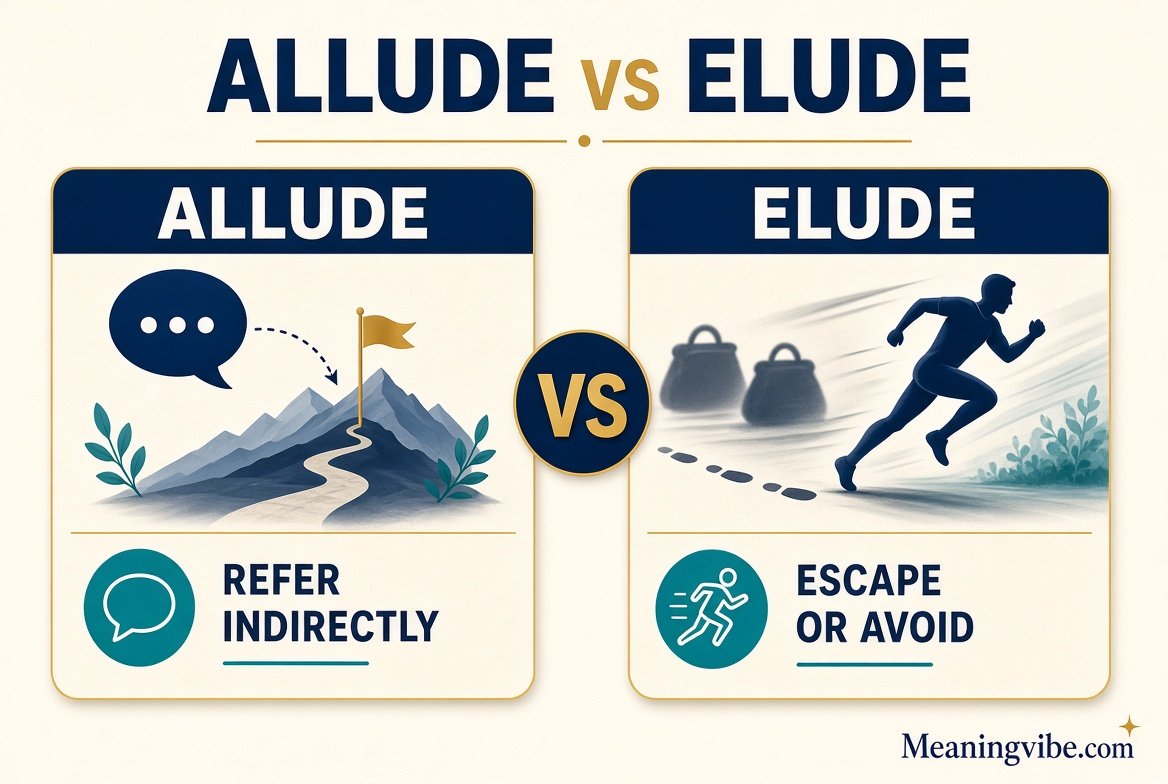
Allude means to refer to something indirectly, by hinting at it without naming it. Elude means to escape, evade, or slip away from someone or something, including understanding or memory.
Short version: Allude = hint at. Elude = escape from.
Key Takeaways
- You allude to something, always with the word “to.”
- You elude something directly, with no preposition. A suspect eludes the police.
- Allude is about words and references. Elude is about escape and avoidance.
- “Elude to” is almost always wrong. The correct phrase is “allude to.”
- Elude also describes ideas, names, or goals that stay out of reach.
- The related nouns are allusion (a hint) and elusion (an escape, rarely used).
Allude vs Elude Meaning
Both words are verbs. Both come from the same Latin root. Yet they describe two completely different actions.
One word is about communication. The other is about escape.
What Does Allude Mean?
To allude means to refer to something in an indirect way. You hint at a person, event, or idea without stating it outright.
The word almost always takes the preposition “to.” You allude to something.
- She alluded to a past disagreement without giving details.
- The speaker alluded to the recession with a quiet joke.
- The painting alludes to a famous myth.
- He kept alluding to his promotion all evening.
If you name the thing directly, you are not alluding. You are referring, mentioning, or quoting.
What Does Elude Mean?
To elude means to escape or avoid someone or something, often with skill, speed, or cleverness. It can also mean to stay beyond someone’s grasp or understanding.
Elude is a transitive verb. It takes a direct object and no preposition.
- The thief eluded the police for three days.
- The fox eluded the hunters again.
- The answer eluded the scientists for decades.
- His name eludes me right now.
Elude also covers goals that never arrive. “Victory eluded the team all season” means the team never managed to win.
Difference Between Allude and Elude
Here is the clearest way to see the difference between allude and elude side by side.
| Feature | Allude | Elude |
|---|---|---|
| Core meaning | Hint at, refer indirectly | Escape, evade, avoid |
| Main idea | Indirect reference | Slipping away |
| Typical partner | The word “to” | A direct object |
| Grammar | Intransitive with “to” | Transitive |
| Noun form | Allusion | Elusion (rare) |
| Adjective form | Allusive | Elusive |
| Example | Allude to a scandal | Elude capture |
| Pronunciation | uh-LOOD | ih-LOOD |
Hint vs Escape
Allude is about speech or writing. Someone makes a reference without spelling it out.
Elude is about movement, memory, or understanding. Something slips away.
A comedian alludes to a politician. A prisoner eludes the guards.
Grammar Differences
Allude needs “to” before the thing mentioned. “She alluded to the meeting.”
Elude never takes “to” when it means escape. “She eluded the reporters.”
This small grammar difference is one of the quickest ways to check yourself.
Elude or Allude: Which One Should You Use?
Writers often type “elude or allude” and freeze. These quick tests settle the question in seconds.
Three Quick Tests
Test 1: The “hint” test. Ask whether someone is mentioning something indirectly. If yes, use allude.
Test 2: The “escape” test. Ask whether something is escaping, slipping away, or staying out of reach. If yes, use elude.
Test 3: The “to” test. If “to” follows the verb and introduces what was mentioned, use allude.
Pick the Right Word in Common Situations
| Situation | Correct word | Why |
|---|---|---|
| A speaker hints at a scandal | Allude | An indirect reference |
| A criminal runs from police | Elude | An escape |
| A novel refers to a Greek myth | Allude | A literary reference |
| A word is on the tip of your tongue | Elude | It slips out of memory |
| A teacher hints a test is coming | Allude | An indirect mention |
| A team never wins a title | Elude | The goal stays out of reach |
How to Pronounce Allude and Elude
The two words sound very close, and that is a big reason they get mixed up in writing.
Allude is pronounced uh-LOOD. The first syllable is a soft “uh,” like the “a” in “about.”
Elude is pronounced ih-LOOD, or sometimes ee-LOOD. The first syllable sounds like the “i” in “it” or the “ee” in “see.”
The stress falls on the second syllable in both words. In fast speech, the soft first vowel blurs, so careful writers double-check the spelling.
Allude vs Elude Word Origins
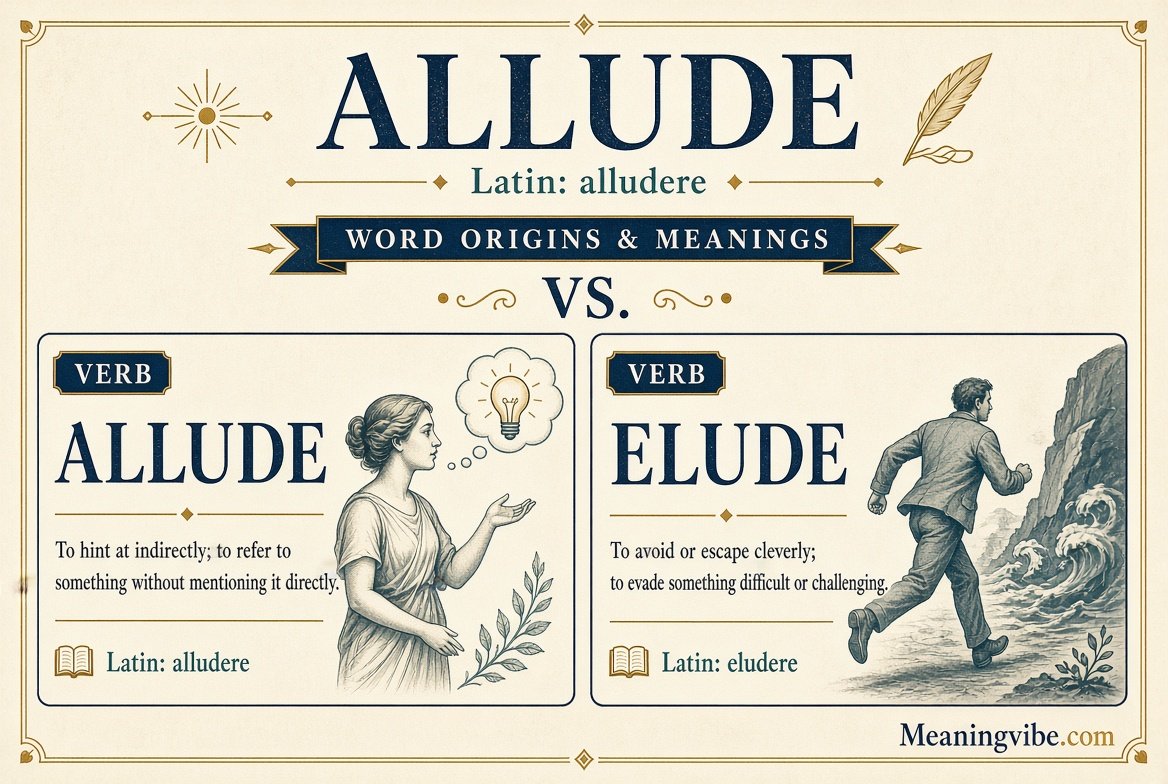
Both words come from the same Latin verb, ludere, which means “to play.” That shared root explains why they look so alike.
Allude comes from the Latin alludere, often explained as “to play beside” or “to play with.” The idea is a playful, indirect nod toward something.
Elude comes from the Latin eludere, meaning “to deceive” or “to evade.” The idea is playing a trick to get away.
The Memory Trick Hidden in the Roots
This history gives you a picture to hold on to.
- Allude plays beside a subject, nodding at it without stating it.
- Elude plays a trick to slip away.
Other words share the same root. Delude, collude, prelude, interlude, and illusion all trace back to ludere.
Allude vs Elude in a Sentence
Examples make the rule stick. Read each sentence and notice what the verb is doing.
Allude in a Sentence
- The author alludes to Shakespeare throughout the novel.
- She alluded to her plans but gave no details.
- The report alludes to several earlier studies.
- He often alludes to his childhood in his speeches.
- The ad cleverly alludes to a classic movie scene.
- The mayor alluded to budget cuts during the meeting.
- The song alludes to a famous love story.
- Her smile alluded to a secret she was keeping.
Elude in a Sentence
- The suspect eluded police by changing cars.
- Sleep eluded him the night before the exam.
- The solution has eluded engineers for years.
- A gold medal eluded the athlete again.
- The shy deer eluded every camera.
- Her name eludes me at the moment.
- The meaning of the poem eluded most readers.
- The cat eluded capture under the porch.
Allude and Elude in the Same Sentence
Sometimes both words fit in one sentence, and the contrast is very clear.
- The detective alluded to a suspect who had eluded capture for years.
- She alluded to the idea, but its full meaning eluded her listeners.
- The senator alluded to the scandal, yet the truth still eludes reporters.
Allude To vs Elude To
This is the most common error involving these two words. People write “elude to” when they mean “allude to.”
Allude to is correct. It means to hint at something.
Elude to is almost never correct. Elude does not take “to” when it means escape.
Correct and Incorrect Examples
| Incorrect | Correct |
|---|---|
| She eluded to a recent argument. | She alluded to a recent argument. |
| The speaker eluded to the budget. | The speaker alluded to the budget. |
| He alluded the police for hours. | He eluded the police for hours. |
| The suspect alluded capture. | The suspect eluded capture. |
Why the Mistake Happens
Both words sound nearly the same when spoken. The “to” that follows allude feels natural, so writers attach it to elude by mistake.
If you hear yourself say “to” after the verb, you almost certainly need allude.
Alluded vs Eluded
Past tense forms cause the same confusion, so a quick comparison helps.
Alluded means hinted at. “He alluded to a problem.”
Eluded means escaped or slipped away. “The problem eluded him.”
| Form | Allude | Elude |
|---|---|---|
| Base | Allude | Elude |
| Third person | Alludes | Eludes |
| Past | Alluded | Eluded |
| Present participle | Alluding | Eluding |
Alluded To in Passive Sentences
Allude works in the passive voice too. “The incident was alluded to in the report.”
Elude rarely appears in the passive. Most writers keep it active, as in “The thief eluded the guards.”
Allude vs Elude Synonyms and Antonyms
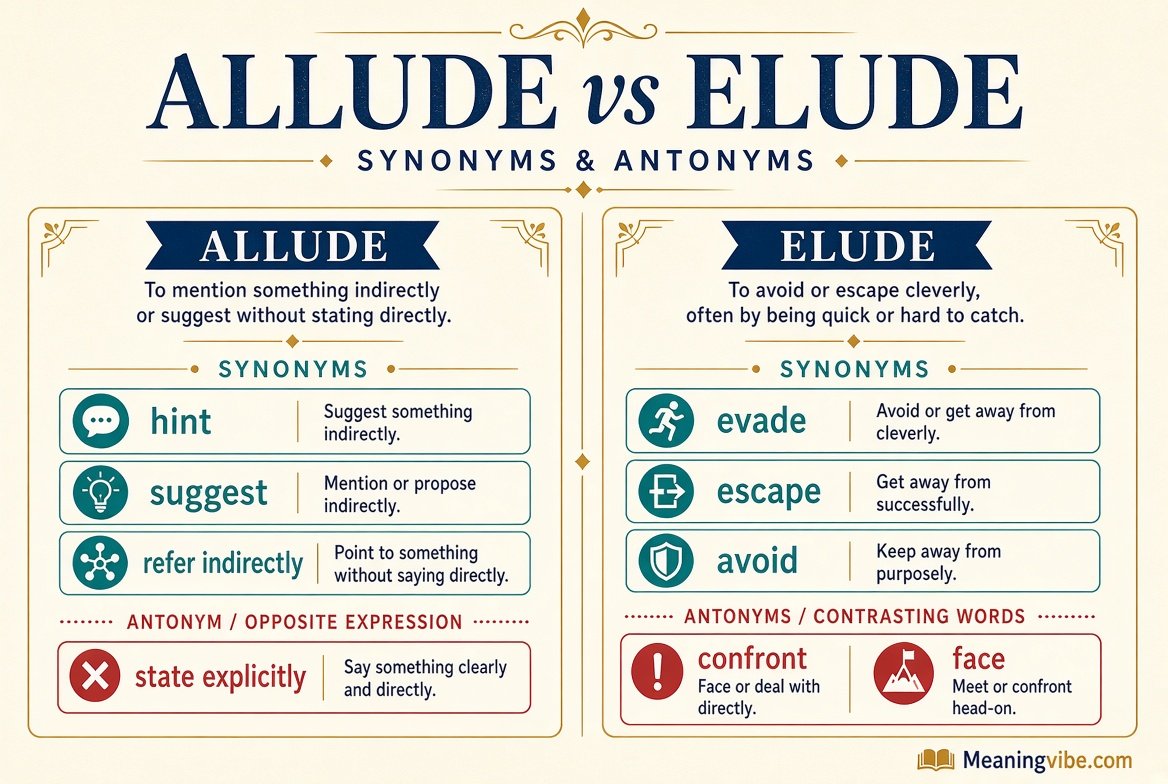
Synonyms help you check your choice. If a synonym fits cleanly, you probably picked the right word.
Synonyms for Allude
- Hint at
- Refer to
- Suggest
- Imply
- Mention in passing
- Touch on
- Insinuate
- Intimate
- Point to
- Nod to
Synonyms for Elude
- Escape
- Evade
- Dodge
- Avoid
- Slip away from
- Get away from
- Shake off
- Outrun
- Baffle
- Puzzle
Antonyms
The opposites also clarify each meaning.
- Allude is the opposite of state directly, declare, or name outright.
- Elude is the opposite of catch, capture, grasp, or achieve.
| Word | Close synonyms | Opposites |
|---|---|---|
| Allude | Hint, refer, imply | State, declare, name |
| Elude | Escape, evade, dodge | Catch, capture, grasp |
Allude vs Elude Word Forms
Both words give rise to useful nouns and adjectives. Mixing these up causes the same errors.
| Base word | Noun | Adjective | Adverb |
|---|---|---|---|
| Allude | Allusion | Allusive | Allusively |
| Elude | Elusion, elusiveness | Elusive | Elusively |
Allusion
An allusion is an indirect reference to something. Writers often make literary allusions to the Bible, mythology, or famous plays.
“Achilles’ heel” is a common example. It alludes to a figure from Greek myth.
Elusive
Elusive describes something hard to find, catch, or understand. “The elusive snow leopard rarely appears on camera.”
It also describes ideas that are hard to grasp. “Happiness can feel elusive.”
Elusion
Elusion is the act of eluding. The word is rare, and most writers choose “escape” or “evasion” instead.
Allusive
Allusive describes writing or speech full of allusions. An allusive poem hints at many other works.
Elusive vs Illusive
These two adjectives are easy to mix up. Elusive means hard to catch or pin down. Illusive means deceptive or based on an illusion.
Most writers need elusive. Illusive is rare and often a typo.
Allusion vs Illusion vs Elusion vs Delusion
This set of look-alike nouns trips up even careful writers.
| Word | Meaning | Example |
|---|---|---|
| Allusion | An indirect reference | The poem is an allusion to Romeo and Juliet. |
| Illusion | A false impression or trick of the senses | The magician created an illusion. |
| Elusion | The act of escaping or evading (rare) | His elusion of the guards was impressive. |
| Delusion | A false belief held despite evidence | He lived under a delusion of fame. |
| Collusion | Secret cooperation for a bad purpose | The firms were accused of collusion. |
Allusion vs Illusion
An allusion points to something. An illusion tricks you.
“The film contains an allusion to a classic western.” “The mirrors created an illusion of space.”
Illusion vs Delusion
An illusion is a false impression that often disappears once you look closely. A delusion is a false belief that stays even when proof says otherwise.
Allude vs Refer vs Mention vs Imply
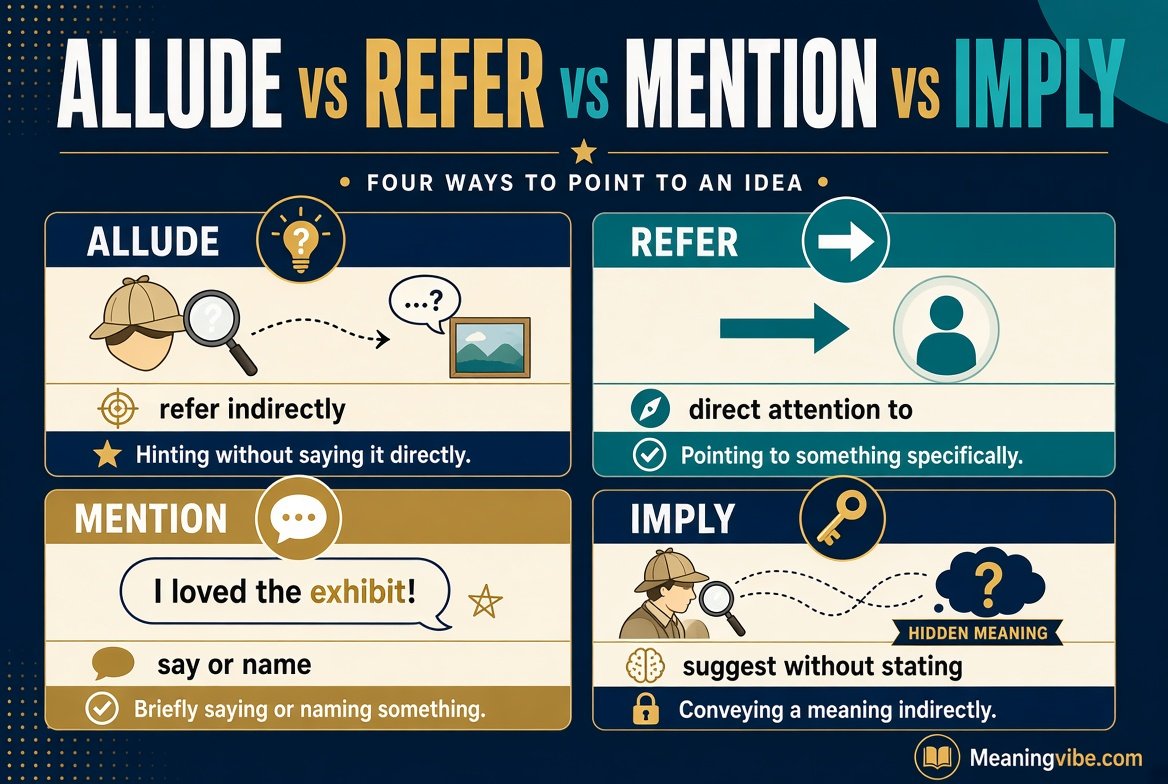
These four verbs overlap, so the right choice depends on how direct you are.
| Verb | Direct or indirect? | Example |
|---|---|---|
| Refer | Direct | She referred to the contract by name. |
| Mention | Direct but brief | He mentioned the deadline. |
| Allude | Indirect | She alluded to a problem without naming it. |
| Imply | Indirect, suggests a meaning | His tone implied he was upset. |
Allude vs Refer
If you name the thing, you refer to it. If you hint at it, you allude to it.
Many writers use allude when they simply mean refer. Careful editors flag this.
Allude vs Imply
Allude points to a specific person, event, or work. Imply suggests a meaning without stating it, and it doesn’t need to point to anything specific.
“She alluded to the merger” names a topic, quietly. “Her silence implied agreement” suggests a meaning.
Allude vs Elude in Literature and Writing
Literature is the natural home of allude. Authors have used allusions for centuries.
A literary allusion is a brief reference to a well-known person, event, myth, or text. Readers who spot it feel rewarded.
Common Types of Allusion
- Biblical allusions refer to figures and stories from the Bible.
- Mythological allusions refer to Greek and Roman myths, such as Pandora’s box.
- Historical allusions refer to real events or people.
- Literary allusions refer to other books and plays.
- Pop culture allusions refer to films, music, or television.
Why Writers Use Allusions
An allusion adds layers of meaning in very few words. It signals shared knowledge between the writer and the reader.
“He met his Waterloo” alludes to a famous defeat without explaining it.
Where Elude Appears in Writing
Elude appears when characters escape danger or when ideas stay unclear. A detective novel may feature a villain who eludes capture.
Poets also use elude for fleeting feelings, such as a memory that eludes the speaker.
Allude vs Elude in Speech and Politics
Public speakers use both words, and the contrast is easy to spot.
Politicians often allude to opponents or controversies without naming them. This lets them make a point while staying polite or avoiding legal trouble.
Subtle References in Debates
“We all remember what happened last year” is an allusion. The speaker hints at an event and lets the audience fill in the details.
Eluding Questions
Reporters often say a politician eluded a question, meaning the person avoided giving a direct answer.
“Eluded” suggests skillful dodging. It is stronger than simply declining to answer.
Allude vs Elude in Law Enforcement and Sports
Escape stories are the natural home of elude.
Police reports often say a suspect eluded officers or eluded capture. The word suggests a clever or lucky getaway.
Wildlife and Hunting
Wildlife writers say animals elude predators by speed, camouflage, or cunning. A gazelle eludes a cheetah. A fox eludes hounds.
Sports Examples
Sports commentators use elude for athletes who dodge defenders or fail to win a title.
- “The running back eluded three tacklers.”
- “A championship has eluded the franchise for decades.”
Can You Allude in Sports?
Yes. A coach might allude to a lineup change without announcing it. The word still means an indirect hint.
Allude vs Elude in Science, Memory, and Learning
Elude has a figurative life in thinking and learning. Allude has a quieter role.
When Answers Elude Us
Scientists say a cure or explanation eludes researchers when they cannot find it. The phrase signals that the answer exists but stays out of reach.
When Memory Eludes You
Everyone knows the tip-of-the-tongue feeling. A name or word eludes you when you cannot recall it, even though you know you know it.
When Sleep Eludes You
“Sleep eluded her” is a very common phrase. It means she could not fall asleep despite trying.
How Teachers Allude
A teacher might allude to an upcoming test by saying “You should review chapter four.” The hint is clear without a direct announcement.
Allude vs Elude in Everyday Life
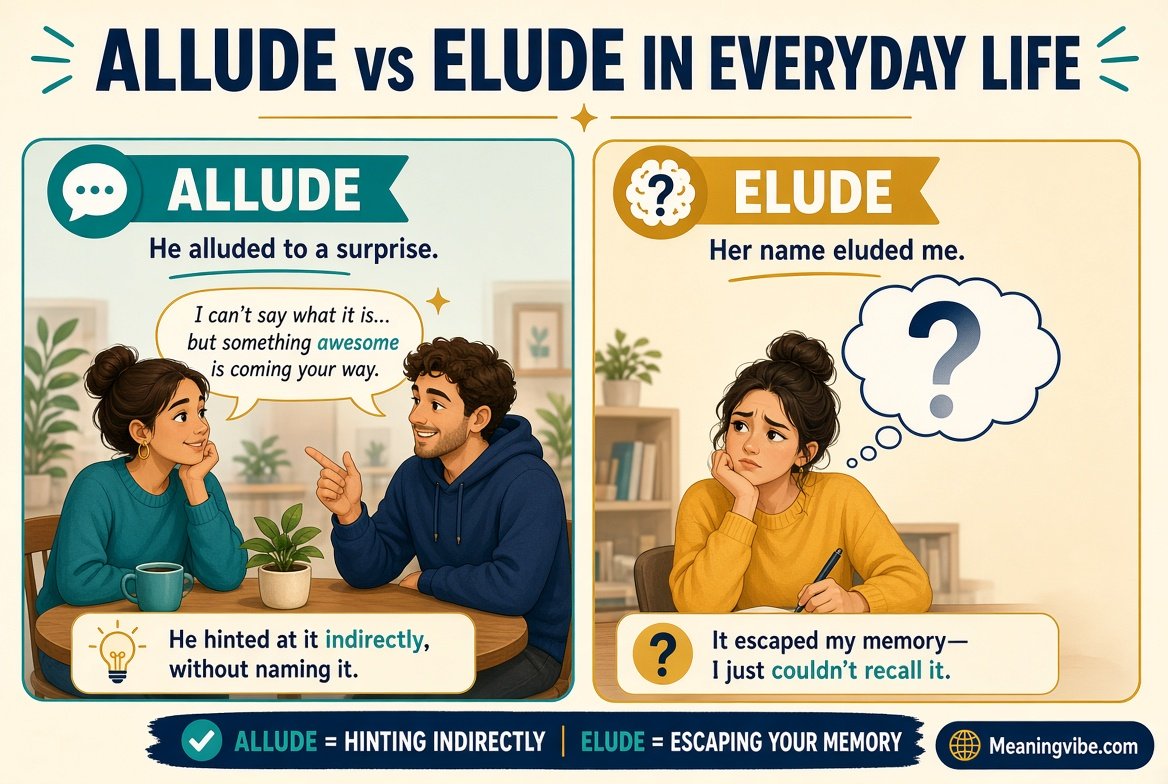
You do not need to be writing a novel to use these words well. Everyday life gives plenty of chances.
At home, you might say a friend alluded to a surprise party. At work, you might say a solution has eluded the team.
Friendly Examples
- “She alluded to a big announcement.”
- “My keys eluded me all morning.”
- “He kept alluding to the trip.”
- “The right word eludes me.”
- “Fame eluded him his whole life.”
- “She alluded to her plans for the weekend.”
Professional Examples
- “The CEO alluded to upcoming changes.”
- “The cause of the error has eluded our engineers.”
- “The report alludes to earlier findings.”
- “Profitability has eluded the division this year.”
Phrases and Collocations With Allude and Elude
Certain word pairs appear again and again. Learning them makes your writing smoother.
| Common with allude | Common with elude |
|---|---|
| Allude to a story | Elude capture |
| Allude to a rumor | Elude the police |
| Allude to a problem | Elude detection |
| Allude to the past | Elude understanding |
| Allude briefly to | Elude notice |
| Was alluded to | Elude pursuit |
| Cleverly alludes to | Success eludes |
| Subtly alluded to | Sleep eludes |
| Often alludes to | Meaning eludes |
| Vaguely alluded to | Narrowly eluded |
Common Phrases
“The answer eludes me” means you cannot find or recall it.
“Sleep eludes me” means you cannot fall asleep.
“Elude capture” means to avoid being caught.
“Alludes to” means hints at.
Common Allude vs Elude Mistakes
Even careful writers slip here. Watch for these frequent errors.
Mistake 1: Writing “Elude To”
Wrong: “The author eluded to a hidden message.”
Right: “The author alluded to a hidden message.”
The author hinted at something, so allude is the verb.
Mistake 2: Writing “Allude” for Escape
Wrong: “The thief alluded the guards.”
Right: “The thief eluded the guards.”
The thief escaped, so elude is correct.
Mistake 3: Using Allude for a Direct Mention
Wrong: “The speaker alluded to the budget by name and gave figures.”
Right: “The speaker referred to the budget by name and gave figures.”
If the mention is direct, use refer or mention.
Mistake 4: Mixing Up Allusion and Illusion
Wrong: “The novel is full of illusions to Greek myths.”
Right: “The novel is full of allusions to Greek myths.”
An allusion is a reference. An illusion is a false impression.
Mistake 5: Using Elusive for Illusive
Wrong: “The illusive animal avoided every camera.”
Right: “The elusive animal avoided every camera.”
Elusive means hard to catch. Illusive means deceptive.
Mistake 6: Autocorrect and Typos
Because both words are real, spell check will not flag the wrong one. Proofread this pair by hand.
Easy Ways to Remember Allude vs Elude
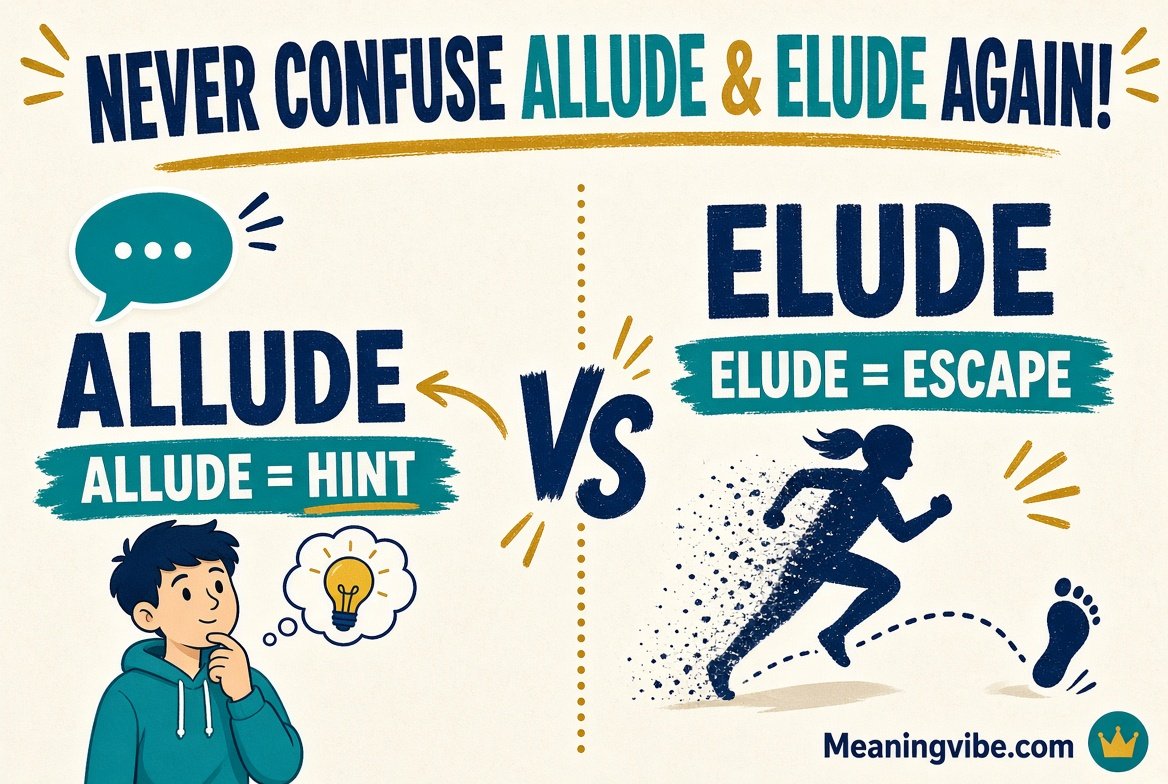
Memory tricks work best when they are simple. Pick the one that sticks for you.
Trick 1: E for Escape
Elude starts with E, like escape. If someone or something is getting away, use elude.
Trick 2: A for Aside
Allude starts with A, like aside. An allusion is an aside, a hint made on the side without stating the point.
Trick 3: The “To” Rule
If “to” follows the verb and introduces what was mentioned, pick allude. Elude never needs it.
Trick 4: The Question Rule
Ask: “Is something being hinted at, or is something escaping?” Hinted means allude. Escaping means elude.
Commonly Confused Words Like Allude and Elude
English is full of look-alike pairs. Learning to spot them improves your writing across the board.
Words That Look Alike
Pairs such as emersion and immersion look almost identical but point in opposite directions. The same careful eye helps with allude and elude.
Dysregulated and disregulated are another close pair where a small prefix changes the meaning.
Words That Sound Alike
Some pairs trip people up because they sound nearly the same. A good example is sell and sale, where one is a verb and the other is a noun.
For another near-twin pair, see encorporate vs incorporate.
Common Spelling Slips
Spelling errors also cause trouble. Guides on receive vs recieve, weird vs wierd, and speech vs speach show how one swapped letter can make a word look wrong.
Likewise, doubt vs dought and input vs imput are quick reads that sharpen your proofreading eye.
Preposition and Apostrophe Problems
Small words and small marks cause big confusion too. The guide on relate to vs relate with pairs nicely with the “allude to” rule above.
For apostrophes, read about today’s vs todays and else’s vs elses.
Allude vs Elude Practice Exercise
Test yourself. Fill each blank with allude or elude, then check the answers below.
- The poem seems to ____ to an ancient legend.
- The fugitive managed to ____ police for a week.
- Success has always ____ him.
- She ____ to a possible promotion in her speech.
- The answer to the puzzle continues to ____ us.
- The film ____ to a classic detective story.
- Sleep will ____ you if you drink coffee late.
- The manager ____ to layoffs without using the word.
Answers
- Allude. The poem hints at a legend.
- Elude. The fugitive escaped capture.
- Eluded. Success stayed out of reach.
- Alluded. She hinted at a promotion.
- Elude. The answer stays out of reach.
- Alludes. The film hints at a story.
- Elude. Sleep stays away.
- Alluded. The manager hinted at layoffs.
Allude vs Elude Cheat Sheet
Save this table for quick reference.
| Question | Answer |
|---|---|
| Is someone hinting at something? | Allude |
| Is something escaping or slipping away? | Elude |
| Does “to” follow and introduce the topic? | Allude |
| Is a suspect getting away? | Elude |
| Is a name stuck on the tip of your tongue? | Elude |
| Is a book referring to a myth? | Allude |
| Do you need the noun for an indirect reference? | Allusion |
| Do you need an adjective for hard to catch? | Elusive |
| Do you need a word for a false impression? | Illusion |
Why People Confuse Allude and Elude
Understanding the confusion helps you avoid it.
First, the words differ by only one vowel. Second, they sound almost identical in fast speech. Third, they share the same Latin root.
Spell check also fails here. Because both words are valid, a wrong choice slips through unnoticed.
Tips for Proofreading This Pair
- Search your document for both words and check each one.
- Ask whether the sentence is about a hint or an escape.
- Check every “allude” for a following “to.”
- Check every “elude” for a direct object.
- Read the sentence aloud and test it with “hint at” or “escape from.”
Allude vs Elude Quick Reference for Writers
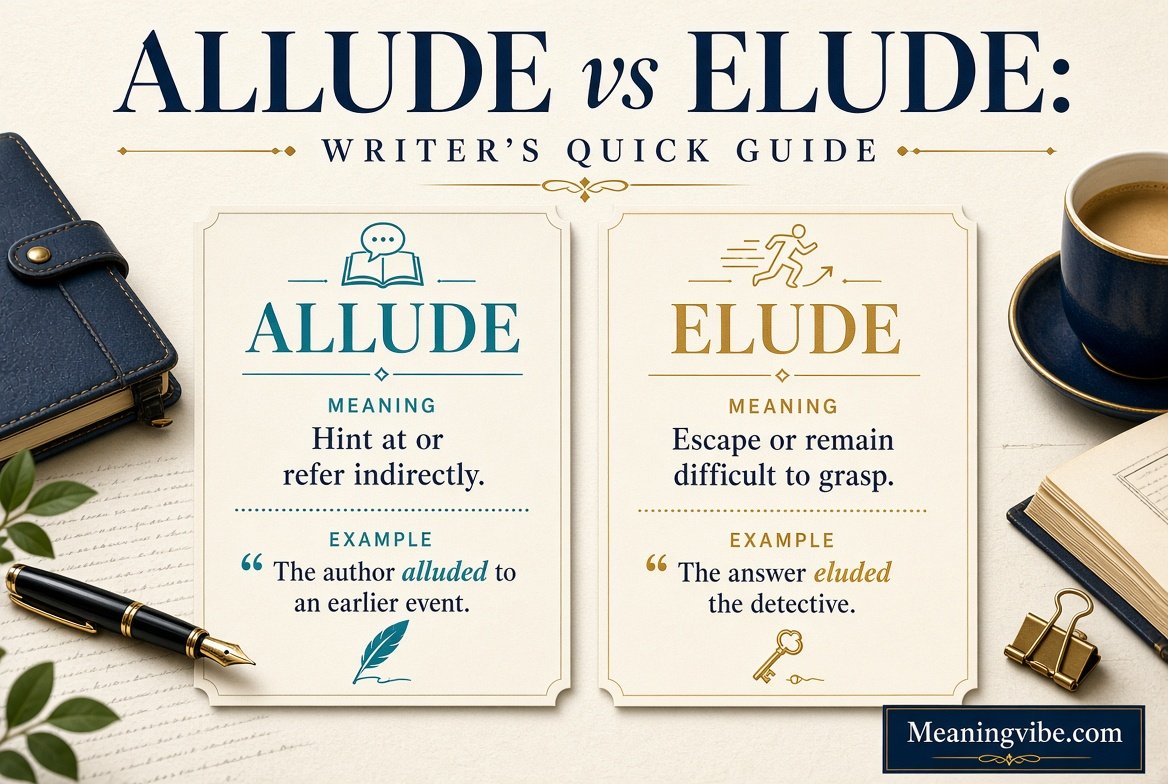
Different readers need different shortcuts. Use the one that matches your work.
For Students
Use allude when a text or speaker hints at something. Use elude when something escapes or stays out of reach.
For Journalists
Use allude for subtle references. Use elude for suspects, answers, and goals that slip away. Use refer when the mention is direct.
For Creative Writers
Use allude for literary and cultural references. Use elude for characters who escape and for fleeting memories or feelings.
For ESL Learners
Learn the partners first. Allude goes with “to.” Elude goes straight to its object, like capture, police, or understanding.
Then practice with short sentences until the pattern feels natural.
Also Read:
- Relate To vs Relate With: Meaning, Difference & Correct Usage (2026)
- Window Seal vs Window Sill: Definitions, Examples & Usage (2026)
- Parents’ or Parent’s? What’s the Difference? Correct Usage Explained (2026)
- Minoot or Minute: Which Is Correct? Meaning, Pronunciation & Usage (2026)
- Sell vs. Sale: What’s the Difference? Meaning, Usage & Examples (2026)
- People Do or People Does: Which Is Correct? Grammar Rules & Examples (2026)
- Encorporate vs Incorporate: What’s the Difference? Correct Usage Explained (2026)
- Grately vs Greatly Explained: Meaning, Examples & Grammar Rules (2026)
- Emersion vs Immersion Explained: Definitions, Usage & Examples (2026)
- Accross vs Across: Meaning, Spelling and Correct Usage (2026)
- Dought vs. Doubt: Correct Spelling, Meaning & Usage Explained (2026)
- Dysregulated vs. Disregulated: What’s the Difference? (Complete Guide 2026)
- Speach or Speech? Stop Making This Common Spelling Mistake (2026 Guide)
- Fiending or Feening? Stop Making This Common Spelling Mistake (2026)
- Dammit vs. Damnit: What’s the Difference and Which Is Right? (2026)
- Is It Signor or Signer? The Difference Explained with Examples (2026)
- Wierd or Weird: Meaning, Correct Usage & Examples (2026)
- Elses vs. Else’s: Meaning, Grammar Rules & Examples (2026)
- Today’s vs. Todays: Meaning, Grammar & Examples (2026)
- Receive vs. Recieve: What’s the Difference and Which Is Right? (2026)
- Input vs. Imput: What’s the Difference and Which Is Right? (2026)
- Pricy vs. Pricey: What’s the Difference and Which Is Right? (2026)
Frequently Asked Questions (FAQs)
What is the difference between allude and elude?
Allude means to hint at something indirectly. Elude means to escape or evade someone or something, including understanding or memory.
Is it allude to or elude to?
The correct phrase is “allude to.” “Elude to” is a common error. Elude takes a direct object and no “to.”
What does allude mean in simple words?
It means to mention something without saying it outright. A speaker can allude to a problem without naming it.
What does elude mean in simple words?
It means to escape or avoid, often with skill. A thief can elude the police, and a name can elude your memory.
What is an example of allude?
“The author alludes to Shakespeare in every chapter.” Another is “She alluded to a surprise without giving details.”
What is an example of elude?
“The suspect eluded police for three days.” Another is “Sleep eluded him all night.”
Is allude transitive or intransitive?
Allude is intransitive. It needs the preposition “to” before what is mentioned, as in “allude to a story.”
Is elude transitive or intransitive?
Elude is transitive. It takes a direct object, as in “elude capture.”
What is the noun form of allude?
The noun is “allusion,” meaning an indirect reference. A literary allusion hints at a well-known story or figure.
What is the noun form of elude?
The noun is “elusion,” but it is rare. Most writers say “escape” or “evasion” instead.
What does elusive mean?
Elusive means hard to find, catch, or understand. An elusive animal rarely lets itself be seen.
What is the difference between elusive and illusive?
Elusive means hard to catch or pin down. Illusive means deceptive or based on an illusion. Most writers need elusive.
What is the difference between allusion and illusion?
An allusion is an indirect reference. An illusion is a false impression or a trick of the senses.
What is the difference between illusion and delusion?
An illusion is a false impression that often fades when you look closer. A delusion is a false belief that persists despite evidence.
Can a person allude to themselves?
Yes. A speaker can allude to their own past without naming it, such as “when I was young, things were different.”
Can an answer elude you?
Yes. An answer eludes you when you cannot find or recall it. “The answer eludes me” is a common phrase.
What does it mean when sleep eludes you?
It means you cannot fall asleep even though you want to. It is a common way to describe a sleepless night.
What is a literary allusion?
It is a short reference to a well-known person, event, myth, or text. “Achilles’ heel” alludes to Greek myth.
Is allude the same as refer?
Not quite. Refer is direct and names the subject. Allude is indirect and only hints at it.
Is allude the same as imply?
No. Allude points to a specific person, event, or work indirectly. Imply suggests a meaning without stating it, with no need for a specific target.
How do you pronounce allude and elude?
Allude is uh-LOOD. Elude is ih-LOOD or ee-LOOD. Both stress the second syllable.
How do you remember allude vs elude?
Elude starts with E, like escape. Allude starts with A, like aside, because an allusion is an indirect aside.
What are synonyms for allude and elude?
Synonyms for allude include hint at, refer to, and suggest. Synonyms for elude include escape, evade, and dodge.
Is allude vs elude a common grammar mistake?
Yes. The words differ by one vowel, sound alike, and share a Latin root. Spell check will not catch the error, so careful proofreading helps.
How do you use allude and elude in a sentence?
“The detective alluded to a suspect who had eluded capture for years.” This sentence uses each verb in its correct role.
Conclusion
The allude vs elude question comes down to one clear idea. Allude means to hint at something indirectly. Elude means to escape, evade, or slip beyond reach.
When a speaker, writer, or artwork makes a quiet reference, use allude and remember the word “to.” When a suspect, answer, memory, or goal slips away, use elude and drop the preposition.
Remember the quick tests. Look for a hint and the word “to,” and pick allude. Look for an escape, and pick elude. Or recall the letters: E is for escape, and A is for aside.
Keep this guide handy the next time you hesitate, and your writing will stay clear, precise, and confident.