

Picture a doctor reading a patient’s chart. It says “adverse reaction.” Now picture a friend who says, “I’m not adverse to spicy food.” One of those sentences is perfect. The other contains a quiet mistake that thousands of people make every day.
That mistake lives inside the adverse vs averse puzzle. The two words look like twins, sound nearly the same, and both carry a negative feeling. Yet they point in completely different directions.
Adverse vs Averse
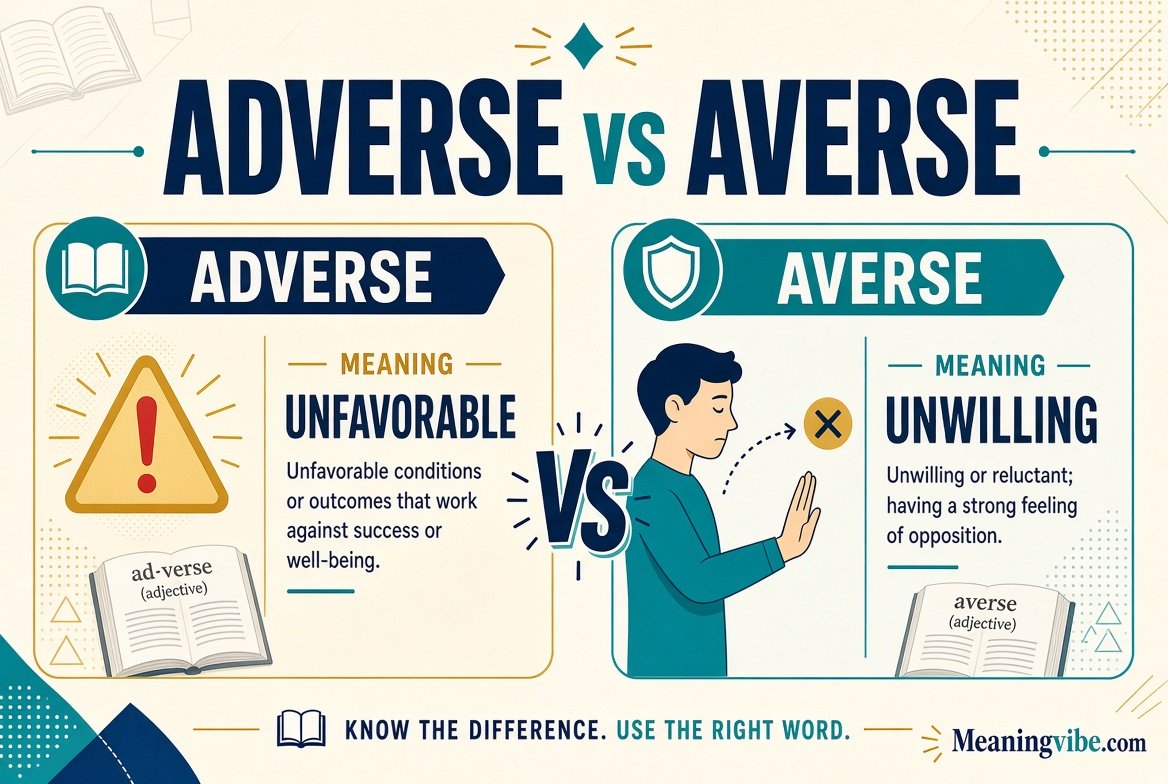
Adverse means harmful, unfavorable, or working against something. It usually describes things such as conditions, effects, reactions, or events. Averse means strongly disliking or being reluctant about something. It describes how a person feels.
Short version: Adverse describes a bad thing. Averse describes a person who dislikes a thing.
Key Takeaways
- Use adverse for harmful conditions, effects, weather, reactions, and outcomes.
- Use averse for a person’s dislike, reluctance, or opposition.
- Averse is almost always followed by “to,” as in “averse to risk.”
- Adverse is usually followed by a noun, as in “adverse effects.”
- “Adverse to” exists but is far less common than “averse to.”
- The noun for averse is aversion. The noun for adverse is adversity.
Adverse vs Averse Meaning
Both words are adjectives, and both come from the same Latin root. That shared history explains the confusion, but their modern jobs are quite different.
One word describes the nature of a thing. The other describes the feeling of a person.
What Does Adverse Mean?
Adverse means harmful, unfavorable, or opposing. It describes something that works against a person, plan, or result.
The word usually applies to outside forces rather than personal feelings. Weather, side effects, market conditions, and legal rulings can all be adverse.
- The adverse weather forced the airline to cancel the flight.
- The patient had an adverse reaction to the medication.
- Rising costs had an adverse effect on profits.
- The court issued an adverse ruling against the company.
What Does Averse Mean?
Averse means having a strong dislike of something or being unwilling to do it. It describes a person’s attitude.
The word almost always appears with “to.” A person is averse to something.
- She is averse to taking big financial risks.
- He is not averse to a little hard work.
- Many teenagers are averse to waking up early.
- The committee seemed averse to change.
Difference Between Adverse and Averse
Here is the difference between adverse and averse in one clear view.
| Feature | Adverse | Averse |
|---|---|---|
| Core meaning | Harmful, unfavorable | Disliking, reluctant |
| What it describes | Things, events, conditions | People and their feelings |
| Typical partner word | A noun (effects, weather) | The word “to” |
| Noun form | Adversity | Aversion |
| Adverb form | Adversely | Aversely (rare) |
| Example | Adverse side effects | Averse to risk |
| Pronunciation | ad-VURS or AD-vurs | uh-VURS |
Thing vs Person
The simplest rule is this. Adverse usually describes a thing. Averse usually describes a person.
Weather can be adverse, but weather cannot be averse. A person can be averse to bad weather, but a person is rarely described as adverse.
Harm vs Reluctance
Adverse is about harm or opposition. It signals that something works against a goal.
Averse is about reluctance. It signals that someone wants to avoid something.
Grammar Differences
Adverse often comes before a noun. You will see “adverse conditions,” “adverse reaction,” “adverse impact,” and “adverse event.”
Averse usually comes after a linking verb and takes “to.” You will see “is averse to,” “are averse to,” and “was never averse to.”
Averse or Adverse: Which One Should You Use?
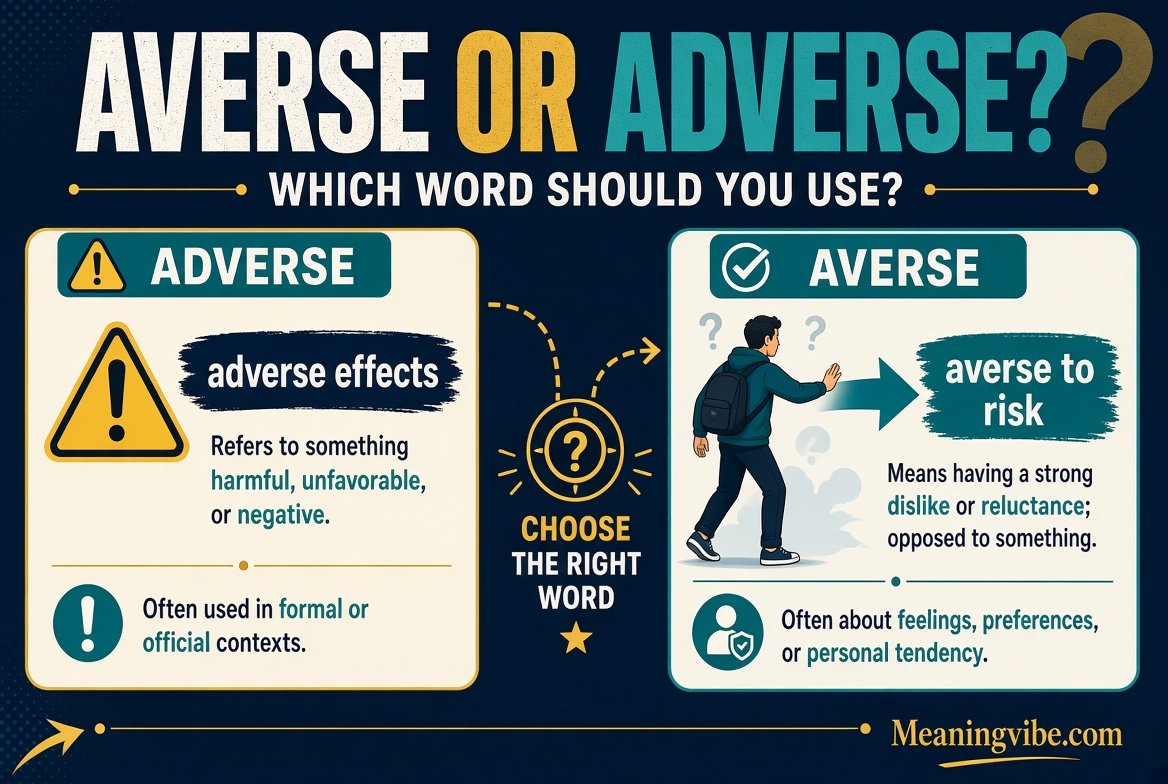
Writers often type “averse or adverse” and stop. These quick tests settle the question in seconds.
Three Quick Tests
Test 1: The “person” test. Ask whether you are describing a person’s feeling. If yes, use averse.
Test 2: The “harm” test. Ask whether something is harmful, unfavorable, or working against a goal. If yes, use adverse.
Test 3: The “to” test. If “to” follows the word and a person is doing the disliking, use averse.
Pick the Right Word in Common Situations
| Situation | Correct word | Why |
|---|---|---|
| A medicine causes a bad reaction | Adverse | A harmful effect |
| An investor avoids risky stocks | Averse | A personal attitude |
| A storm ruins a picnic | Adverse | Harmful conditions |
| A child refuses to eat vegetables | Averse | A personal dislike |
| A policy hurts small businesses | Adverse | A harmful impact |
| A manager resists new software | Averse | A reluctant person |
How to Pronounce Adverse and Averse
The two words sound close, and that is a big reason they get mixed up in writing.
Adverse is pronounced ad-VURS, with stress on the second syllable. Many speakers also say AD-vurs, with stress on the first. Both are accepted in standard English.
Averse is pronounced uh-VURS, with stress on the second syllable.
Notice that adverse has a clear “d” sound in the middle, while averse does not. Listen for that “d” and you can tell them apart in speech.
Adverse vs Averse Word Origins
Both words come from the Latin verb vertere, which means “to turn.” That one root explains why they look so alike.
Adverse comes from the Latin adversus, meaning “turned toward” or “facing against.” Think of something turned to face you in opposition.
Averse comes from the Latin aversus, meaning “turned away.” Think of a person turning away from something they dislike.
The Memory Trick Hidden in the Roots
This history gives you a handy picture.
- Adverse faces you. It comes toward you as an obstacle.
- Averse turns away. The person pulls back from the thing.
Other words share this root too. Avert means to turn away. Divert, convert, reverse, and invert all carry the same idea of turning.
Adverse vs Averse in a Sentence
Examples make the rule stick. Read each sentence and notice what the word describes.
Adverse in a Sentence
- Adverse weather delayed the marathon by two hours.
- The drug can cause adverse effects in some patients.
- Adverse market conditions slowed the company’s growth.
- The new tax had an adverse impact on local shops.
- Her health suffered under adverse working conditions.
- The jury returned an adverse verdict.
- Adverse publicity damaged the brand’s reputation.
- The team played well despite adverse circumstances.
Averse in a Sentence
- He is averse to confrontation.
- Most children are averse to bedtime.
- She is risk averse and prefers savings accounts.
- The mayor was not averse to compromise.
- Cats are often averse to water.
- I am not averse to trying a new restaurant.
- The board seemed averse to bold decisions.
- Some employees are averse to remote work.
Adverse and Averse in the Same Sentence
Sometimes both words fit in one sentence, and the contrast becomes very clear.
- Investors who are averse to risk often avoid markets with adverse conditions.
- A patient averse to needles may worry about adverse reactions to injections.
- Because he was averse to conflict, he ignored the adverse comments.
Averse To vs Adverse To
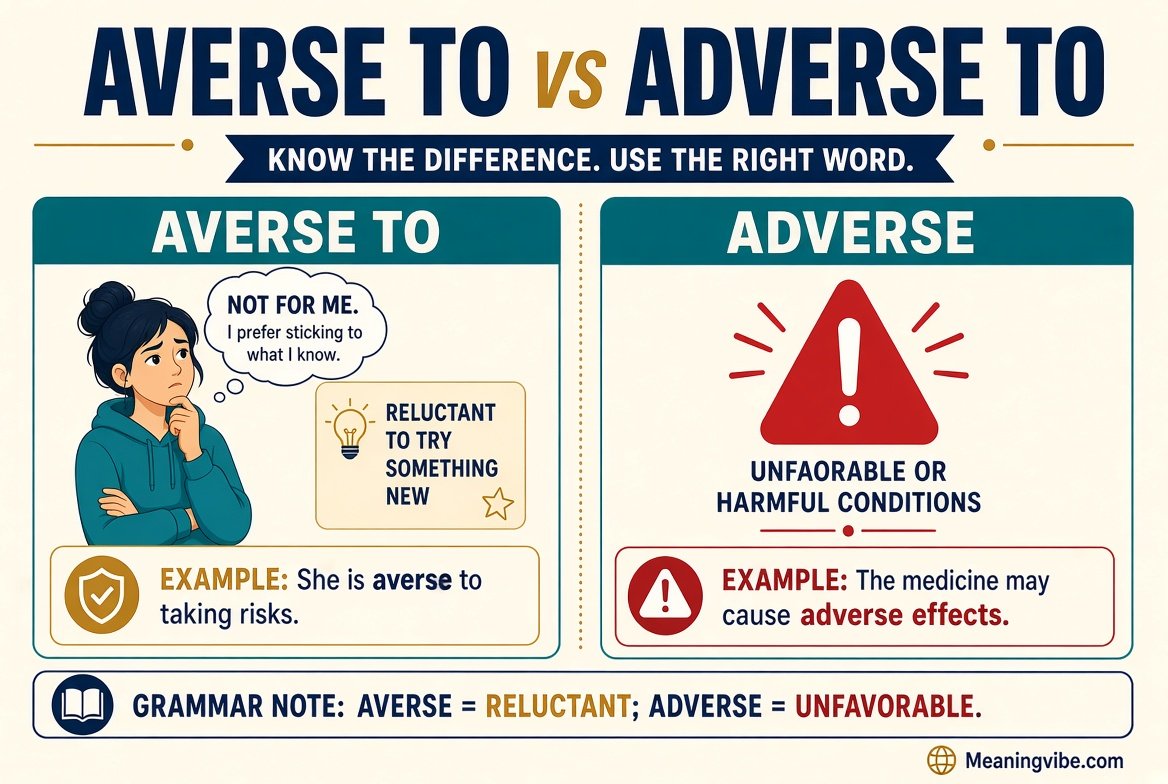
This pair of phrases causes the most confusion of all.
Averse to is the standard phrase. It means disliking or reluctant about something. “He is averse to loud music.”
Adverse to appears much less often. It means harmful or opposed to something. “The ruling was adverse to the company’s interests.”
Correct and Incorrect Examples
| Incorrect | Correct |
|---|---|
| I’m not adverse to helping. | I’m not averse to helping. |
| She is adverse to taking risks. | She is averse to taking risks. |
| He was adverse to the idea of moving. | He was averse to the idea of moving. |
| They are not adverse to feedback. | They are not averse to feedback. |
The Rare Case for Adverse To
Formal and legal writing sometimes uses “adverse to” in the sense of “opposed to” or “contrary to.” For example, “a position adverse to the interests of the estate.”
In everyday writing about a person’s feelings, stay with averse to. It is almost always the right choice.
Averse To or Averse From?
Some older style guides prefer “averse from.” You may spot it in British texts or older books.
Modern usage has settled on “averse to,” especially in American English. Dictionaries list it as the standard form.
If your reader is in the United States, use averse to. It sounds natural and avoids any hint of an old-fashioned tone.
Adverse vs Averse Synonyms and Antonyms
Synonyms help you check your choice. If a synonym fits cleanly, you probably picked the right word.
Synonyms for Adverse
- Harmful
- Unfavorable
- Negative
- Detrimental
- Hostile
- Damaging
- Opposing
- Contrary
- Unfortunate
- Hindering
Synonyms for Averse
- Reluctant
- Opposed
- Unwilling
- Resistant
- Loath
- Disinclined
- Hesitant
- Allergic (informal)
- Hostile (to an idea)
- Antipathetic
Antonyms
The opposites also clarify each meaning.
- Adverse is the opposite of favorable, beneficial, helpful, or positive.
- Averse is the opposite of eager, willing, keen, or fond of.
| Word | Close synonyms | Opposites |
|---|---|---|
| Adverse | Harmful, unfavorable, detrimental | Favorable, beneficial, helpful |
| Averse | Reluctant, opposed, loath | Eager, willing, keen |
Adverse vs Averse Word Forms
Both words give rise to useful nouns and adverbs. Mixing these up causes the same kind of slips.
| Base word | Noun | Adverb | Related terms |
|---|---|---|---|
| Adverse | Adversity | Adversely | Adversary, adversative |
| Averse | Aversion | Aversely (rare) | Aversive, averting |
Adversity vs Aversion
Adversity means hardship, misfortune, or a difficult situation. “She showed courage in the face of adversity.”
Aversion means a strong dislike or a feeling of wanting to avoid something. “He has an aversion to heights.”
Adversely vs Aversely
Adversely is common. It means in a harmful or unfavorable way. “The delay adversely affected sales.”
Aversely is rare and nearly unheard of in modern writing. Most writers rephrase instead.
Adversion and Aversity: Words That Do Not Exist
Two near-miss words trip people up. “Adversion” and “aversity” are not recognized English words.
If you mean a strong dislike, write aversion. If you mean hardship, write adversity.
Adversary and Aversive
An adversary is an opponent or enemy. It shares its root with adverse because both involve facing against.
Aversive describes something unpleasant that a person wants to avoid. Psychologists use it in terms such as “aversive stimulus.”
Adverse vs Averse in Medicine and Healthcare
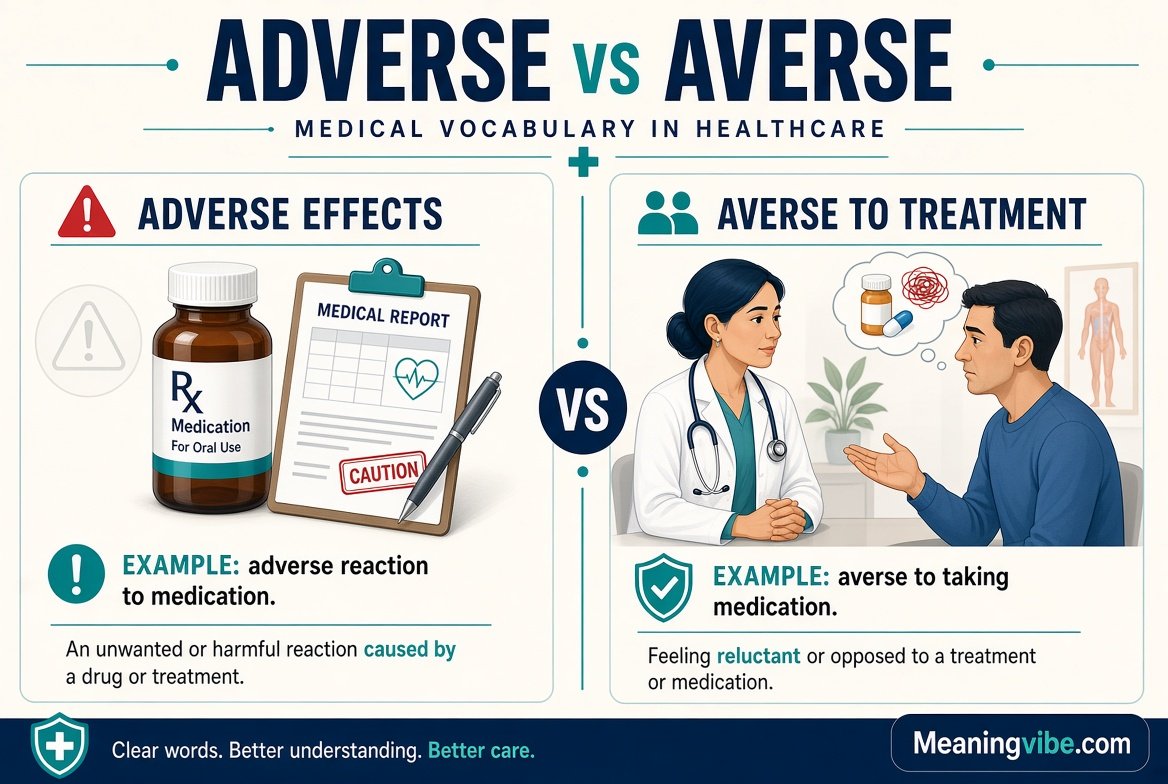
Medical writing uses adverse constantly. It is one of the most important precision words in healthcare.
An adverse effect is an unwanted, harmful result of a treatment. An adverse reaction is a harmful response to a drug or product.
Adverse Event vs Adverse Reaction
The two terms are related but not identical.
An adverse event is any unwanted medical occurrence during or after treatment, whether or not the treatment caused it. The U.S. Food and Drug Administration (FDA) collects reports of these events through its MedWatch program.
An adverse reaction suggests a causal link. The treatment is believed to have caused the problem.
Adverse Effect vs Side Effect
Side effect is the everyday term. Adverse effect is the more formal, clinical term.
A side effect can be harmless or even helpful. An adverse effect is, by definition, harmful or unwanted.
Where Averse Appears in Healthcare
Averse appears when describing a patient’s attitude. A patient might be needle averse, risk averse about surgery, or averse to taking daily pills.
Doctors and nurses often use the word aversion in this setting. For instance, “The patient shows a strong aversion to hospital visits.”
Adverse vs Averse in Law
Legal writing relies on adverse in several well-known phrases.
Each phrase uses adverse to signal opposition or harm to a party’s interests.
| Legal phrase | Meaning |
|---|---|
| Adverse possession | Gaining legal title to land by openly occupying it for a set period |
| Adverse party | The opposing side in a lawsuit |
| Adverse ruling | A court decision that goes against a party |
| Adverse witness | A witness who gives testimony harmful to the side that called them |
| Adverse inference | A conclusion drawn against a party who fails to provide evidence |
| Adverse action | A negative decision such as denying credit or employment |
Adverse Possession Explained
Adverse possession is a legal doctrine that can transfer ownership of land to a person who occupies it openly and continuously for a long period. The required time and conditions vary by state, so anyone with a real case should speak with a licensed attorney.
The word “adverse” here means the occupation is against the owner’s rights.
Adverse Action in Employment and Credit
In the United States, an adverse action often means a negative decision, such as declining a loan or rejecting a job applicant based on a background report. Federal laws require specific notices in many of these cases.
Again, adverse describes the harmful nature of the decision, not anyone’s feelings.
Can a Judge Be Averse?
Yes, but the meaning changes. A judge who is averse to lengthy delays dislikes them. That is a personal attitude, so averse fits.
A judge who issues an adverse ruling gives a decision that harms a party. That is a harmful outcome, so adverse fits.
Adverse vs Averse in Finance and Economics
Money talk is full of both words, and getting them right signals professionalism.
Risk Averse and Risk Aversion
A risk-averse investor prefers safer choices even if the possible return is lower. The related noun is risk aversion.
You will see this phrase in finance textbooks, investment guides, and business news.
- A risk-averse saver chooses a savings account over stocks.
- Risk aversion tends to rise during uncertain times.
- Some bond buyers are highly risk averse.
Loss Aversion
Loss aversion is an idea from behavioral economics. Psychologists Daniel Kahneman and Amos Tversky showed that people tend to feel the pain of a loss more strongly than the joy of an equal gain.
This is why many people hold onto losing investments too long.
Adverse Selection
Adverse selection is an economics term for a situation in which one side of a deal has more information than the other. Economist George Akerlof made the idea famous in his work on used cars.
Insurance is a common example. People who know they are high risk may be more likely to buy coverage.
Adverse Market Conditions
Analysts also speak of adverse market conditions, meaning an economic climate that works against businesses or investors. Recessions, high inflation, and sudden shocks all count.
Notice the pattern. Risk-averse describes people. Adverse conditions describe the environment.
Adverse vs Averse in Business
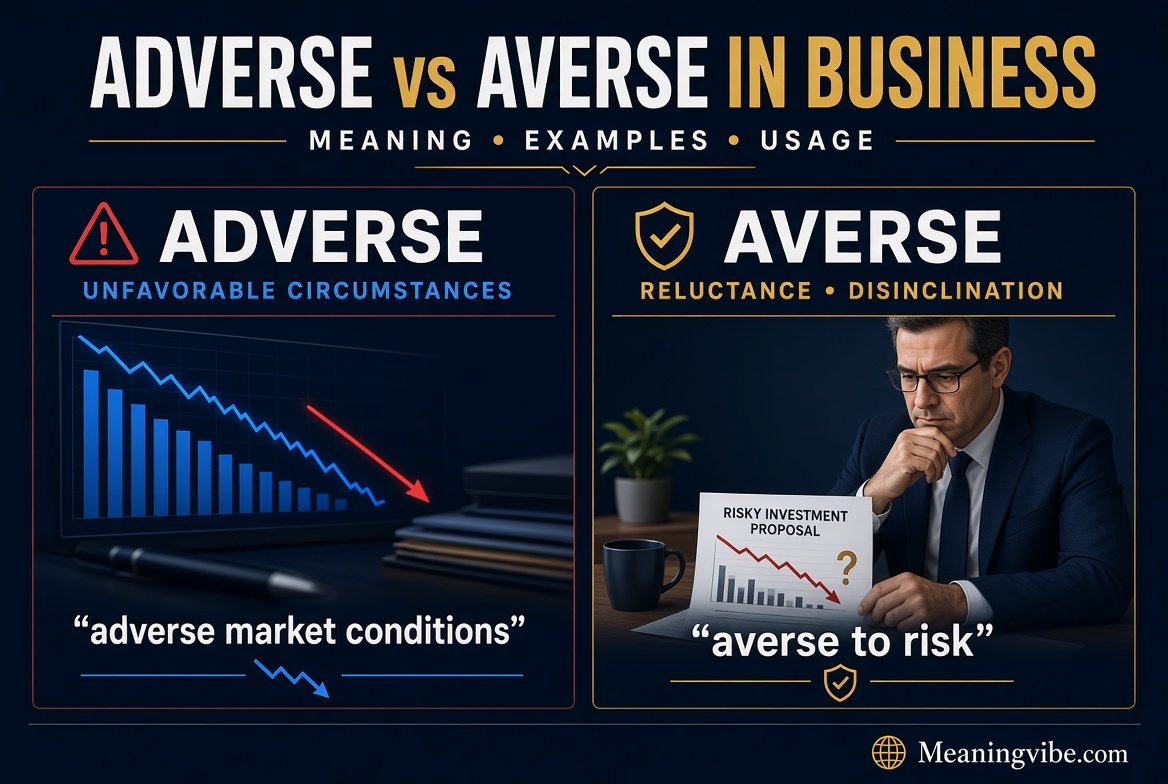
Business writing uses both words, and the contrast is easy to spot.
Adverse in Business
Companies talk about adverse effects on revenue, adverse changes in regulation, and adverse publicity. Contracts often include an “material adverse change” clause, which lets a party respond if the situation worsens significantly.
All of these describe harmful conditions or outcomes.
Averse in Business
Leaders describe teams as averse to change or averse to risk. HR professionals might note that employees are averse to long meetings.
All of these describe human attitudes.
Business Examples Side by Side
| Adverse examples | Averse examples |
|---|---|
| Adverse economic conditions | A risk-averse board |
| An adverse court ruling | Managers averse to change |
| Adverse effects on supply chains | Customers averse to price hikes |
| Adverse media coverage | Staff averse to remote work |
Adverse vs Averse in Weather and Nature
Weather is the classic home of adverse. Storms, floods, heat waves, and icy roads are all adverse conditions.
News reports often say “adverse weather” when conditions threaten travel or safety. Airlines and sports leagues use the phrase when postponing events.
Why Weather Is Never Averse
Weather has no feelings, so it cannot be averse. You can say a hiker is averse to cold, but not that the cold is averse to hikers.
Adverse Conditions in Nature
Ecologists describe harsh environments as adverse conditions for plants and animals. Drought, extreme cold, and poor soil all qualify.
Organisms that survive these conditions are often called resilient.
Adverse vs Averse in Psychology and Mental Health
Psychology uses both words in specific ways, and precision matters.
Aversion and aversive describe unpleasant feelings or stimuli that people want to avoid. Researchers use “aversive stimulus” for something that causes discomfort.
Adverse appears in phrases such as adverse life events. Researchers have studied adverse childhood experiences, often called ACEs, and their links to later health outcomes.
Aversion in Everyday Psychology
Many people have a food aversion, a fear aversion, or an aversion to certain textures. In each case, the person feels a strong urge to avoid something.
Adversity and Resilience
Adversity describes hard experiences. Resilience describes the ability to recover from them.
Writers often pair these words: “She showed resilience in the face of adversity.”
Adverse vs Averse in Everyday Life
You do not need a medical or legal reason to use these words well. Everyday life gives plenty of chances.
At home, you might say you are averse to cold showers. At work, you might say adverse conditions delayed a project.
Friendly Examples
- “I’m not averse to pizza for dinner.”
- “My dog is averse to thunderstorms.”
- “The adverse traffic made us late.”
- “She is averse to crowds.”
- “Adverse road conditions closed the highway.”
- “He’s averse to asking for help.”
Professional Examples
- “The committee is averse to unnecessary spending.”
- “Adverse conditions may affect delivery times.”
- “Our clients are risk averse and favor stable returns.”
- “We reported the adverse events to the regulator.”
Phrases and Collocations With Adverse and Averse
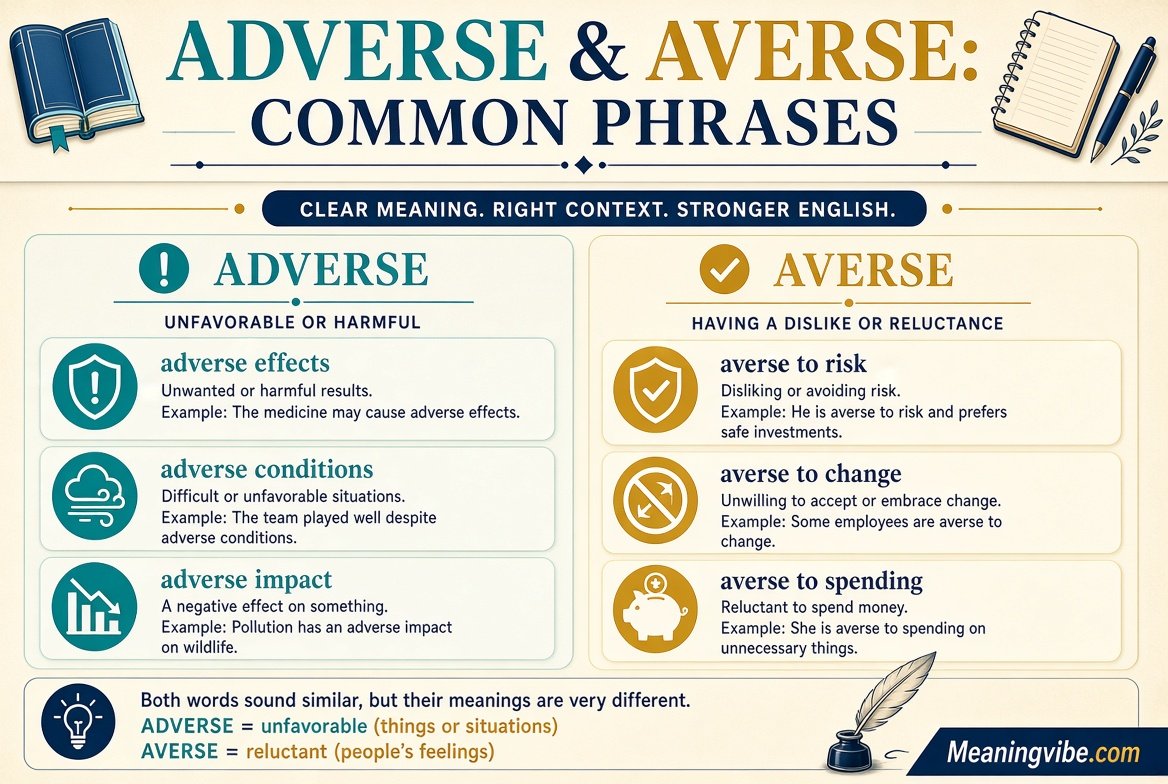
Certain word pairs show up again and again. Learning them makes your writing smoother.
| Common with adverse | Common with averse |
|---|---|
| Adverse effect | Averse to risk |
| Adverse reaction | Averse to change |
| Adverse event | Not averse to |
| Adverse weather | Risk averse |
| Adverse conditions | Loss averse |
| Adverse impact | Averse to conflict |
| Adverse outcome | Averse to criticism |
| Adverse publicity | Averse to the idea |
| Adverse ruling | Never averse to |
| Adverse circumstances | Strongly averse to |
Be Careful With “Not Averse To”
“Not averse to” is a gentle way of saying “willing to” or “open to.” It sounds polished and slightly formal.
“I’m not averse to a compromise” means “I’m open to a compromise.”
Common Adverse vs Averse Mistakes
Even careful writers slip here. Watch for these frequent errors.
Mistake 1: Writing “Not Adverse To”
Wrong: “I’m not adverse to working weekends.”
Right: “I’m not averse to working weekends.”
The sentence describes a person’s willingness, so averse is correct.
Mistake 2: Writing “Averse Weather”
Wrong: “Averse weather closed the school.”
Right: “Adverse weather closed the school.”
Weather is a condition, not a feeling.
Mistake 3: Writing “Averse Reaction” for a Medical Event
Wrong: “The patient had an averse reaction to the drug.”
Right: “The patient had an adverse reaction to the drug.”
Medical harm always takes adverse.
Mistake 4: Using “Adversion” or “Aversity”
Wrong: “He has an adversion to spiders.”
Right: “He has an aversion to spiders.”
Adversion is not a word. The correct noun is aversion.
Mistake 5: Forgetting “To” After Averse
Wrong: “She is averse taking risks.”
Right: “She is averse to taking risks.”
Averse needs “to” before the thing being disliked.
Mistake 6: Autocorrect and Typos
Because both words are real, spell check will not flag the wrong one. Proofread this pair by hand.
Easy Ways to Remember Adverse vs Averse
Memory tricks work best when they are simple. Pick the one that sticks for you.
Trick 1: The Letter D Rule
Adverse has a d, like danger, damage, and disaster. Adverse describes bad things.
Trick 2: The Letter A Rule
Averse starts with av, like avoid. Averse means wanting to avoid something.
Trick 3: The Turning Picture
Adverse faces against you. Averse turns away. Picture someone turning their head away from a plate of food they dislike.
Trick 4: The Question Rule
Ask: “Is something harmful, or does someone dislike it?” Harmful means adverse. Disliked means averse.
Commonly Confused Words Like Adverse and Averse
English is full of look-alike pairs. Learning to spot them improves your writing across the board.
Words That Look Alike
Pairs such as emersion and immersion look almost identical but point in opposite directions. The same careful eye helps with adverse and averse.
Dysregulated and disregulated are another close pair where a small prefix changes the meaning.
Words That Sound Alike
Some pairs trip people up because they sound nearly the same. A good example is sell and sale, where one is a verb and the other is a noun.
Common Spelling Slips
Spelling errors also cause trouble. Guides on receive vs recieve, weird vs wierd, and speech vs speach show how one swapped letter can make a word look wrong.
Likewise, doubt vs dought and input vs imput are quick reads that sharpen your proofreading eye.
Preposition and Apostrophe Problems
Small words and small marks cause big confusion too. The guide on relate to vs relate with pairs nicely with the “averse to” rule above.
For apostrophes, read about today’s vs todays and else’s vs elses.
Adverse vs Averse Practice Exercise
Test yourself. Fill each blank with adverse or averse, then check the answers below.
- The patient reported an ____ reaction to the antibiotic.
- My grandfather is ____ to new technology.
- ____ weather conditions grounded all flights.
- She is not ____ to a challenge.
- Rising interest rates had an ____ effect on home sales.
- Many investors are ____ to risk during a recession.
- The company faced ____ publicity after the recall.
- He has always been ____ to public speaking.
Answers
- Adverse. A harmful medical reaction.
- Averse. A person’s dislike of new technology.
- Adverse. Harmful weather conditions.
- Averse. A person’s willingness, expressed with “not averse to.”
- Adverse. A harmful effect on sales.
- Averse. Investors’ attitude toward risk.
- Adverse. Harmful publicity.
- Averse. A person’s reluctance.
Adverse vs Averse Cheat Sheet
Save this table for quick reference.
| Question | Answer |
|---|---|
| Is something harmful or unfavorable? | Adverse |
| Does a person dislike or resist something? | Averse |
| Does “to” follow, with a person doing the disliking? | Averse |
| Are you describing weather or conditions? | Adverse |
| Are you describing a drug’s harmful effect? | Adverse |
| Are you describing risk attitude? | Averse |
| Is it a legal phrase like adverse possession? | Adverse |
| Do you need the noun for strong dislike? | Aversion |
| Do you need the noun for hardship? | Adversity |
Why People Confuse Adverse and Averse
Understanding the confusion helps you avoid it.
First, the words differ by only one letter. Second, they share the same Latin root. Third, both carry a negative feeling, so they seem interchangeable.
Spell check also fails here. Because both words are valid, a wrong choice slips through unnoticed.
Tips for Proofreading This Pair
- Search your document for both words and check each one.
- Ask whether the word describes a thing or a person.
- Check every “averse” for a following “to.”
- Check every “adverse” for something harmful or unfavorable.
- Read the sentence aloud and listen for the “d” sound.
Adverse vs Averse Quick Reference for Writers
Different readers need different shortcuts. Use the one that matches your work.
For Students
Use adverse when you describe harmful conditions or effects in an essay. Use averse when you describe a person’s or group’s reluctance.
For Business Writers
Use adverse for markets, events, rulings, and effects. Use averse for people, teams, and investors who avoid risk or change.
For Healthcare Writers
Use adverse for events, reactions, and effects. Use averse for a patient’s attitude or aversion.
For ESL Learners
Learn the two partners first. Averse goes with “to.” Adverse goes with a noun like effects, weather, or conditions.
Then practice with short sentences until the pattern feels natural.
Also Read:
- Relate To vs Relate With: Meaning, Difference & Correct Usage (2026)
- Window Seal vs Window Sill: Definitions, Examples & Usage (2026)
- Parents’ or Parent’s? What’s the Difference? Correct Usage Explained (2026)
- Minoot or Minute: Which Is Correct? Meaning, Pronunciation & Usage (2026)
- Sell vs. Sale: What’s the Difference? Meaning, Usage & Examples (2026)
- People Do or People Does: Which Is Correct? Grammar Rules & Examples (2026)
- Encorporate vs Incorporate: What’s the Difference? Correct Usage Explained (2026)
- Grately vs Greatly Explained: Meaning, Examples & Grammar Rules (2026)
- Emersion vs Immersion Explained: Definitions, Usage & Examples (2026)
- Accross vs Across: Meaning, Spelling and Correct Usage (2026)
- Dought vs. Doubt: Correct Spelling, Meaning & Usage Explained (2026)
- Dysregulated vs. Disregulated: What’s the Difference? (Complete Guide 2026)
- Speach or Speech? Stop Making This Common Spelling Mistake (2026 Guide)
- Fiending or Feening? Stop Making This Common Spelling Mistake (2026)
- Dammit vs. Damnit: What’s the Difference and Which Is Right? (2026)
- Is It Signor or Signer? The Difference Explained with Examples (2026)
- Wierd or Weird: Meaning, Correct Usage & Examples (2026)
- Elses vs. Else’s: Meaning, Grammar Rules & Examples (2026)
- Today’s vs. Todays: Meaning, Grammar & Examples (2026)
- Receive vs. Recieve: What’s the Difference and Which Is Right? (2026)
- Input vs. Imput: What’s the Difference and Which Is Right? (2026)
- Pricy vs. Pricey: What’s the Difference and Which Is Right? (2026)
Frequently Asked Questions (FAQs)
What is the difference between adverse and averse?
Adverse means harmful or unfavorable and usually describes things like weather, effects, or reactions. Averse means strongly disliking or reluctant and describes a person’s feelings.
Is it adverse to or averse to?
“Averse to” is the standard phrase for a person’s dislike, as in “averse to risk.” “Adverse to” is rare and appears mostly in formal or legal writing to mean harmful or contrary to.
Can you say “not adverse to”?
In everyday writing, “not averse to” is the correct phrase. “Not adverse to” is a common error when the meaning is “open to” or “willing.”
What does adverse mean in simple words?
It means harmful, unfavorable, or working against something. Bad weather and drug side effects are classic examples.
What does averse mean in simple words?
It means not liking something and wanting to avoid it. A person can be averse to risk, crowds, or change.
What is an example of adverse?
“Adverse weather forced the airline to cancel the flight.” Another is “The drug caused adverse effects in some patients.”
What is an example of averse?
“She is averse to taking risks.” Another is “He is not averse to hard work.”
What does risk averse mean?
It describes a person who prefers safer choices and avoids risk, even if the possible reward is lower. The noun is risk aversion.
What is the noun form of adverse?
The noun is “adversity,” meaning hardship or misfortune. “She grew stronger through adversity.”
What is the noun form of averse?
The noun is “aversion,” meaning a strong dislike. “He has an aversion to heights.”
Is “adversion” a word?
No. “Adversion” is not a recognized English word. Use “aversion” for a strong dislike.
Is “aversity” a word?
No. The word you want is “adversity” if you mean hardship.
What is an adverse effect?
An adverse effect is an unwanted, harmful result of a treatment, drug, or action. Doctors use the term in clinical writing.
What is the difference between adverse effect and side effect?
Side effect is the everyday term, and it can be harmless or even helpful. Adverse effect is the formal term for an unwanted, harmful outcome.
What is an adverse event?
It is any unwanted medical occurrence linked in time to a treatment, whether or not the treatment caused it. Regulators such as the FDA collect these reports.
What does adverse reaction mean?
It means a harmful response to a medicine, food, or product. It suggests the product likely caused the problem.
What does adverse possession mean?
It is a legal doctrine that can transfer land ownership to someone who occupies it openly and continuously for a long period. Rules vary by state, so consult an attorney.
What is adverse selection?
It is an economics concept in which one party has more information than the other, leading to unbalanced outcomes. Insurance markets are a common example.
What is loss aversion?
Loss aversion is the tendency to feel the pain of a loss more strongly than the pleasure of an equal gain. Kahneman and Tversky helped make the idea famous.
What is the difference between adversity and aversion?
Adversity is hardship or a difficult situation. Aversion is a strong dislike or urge to avoid something.
Can a person be adverse?
Rarely. People are normally described as averse. A person can be an adversary, which comes from the same root as adverse and means an opponent.
How do you pronounce adverse and averse?
Adverse is ad-VURS or AD-vurs. Averse is uh-VURS. Listen for the “d” sound in adverse.
How do you remember adverse vs averse?
Adverse has a “d” like damage and danger. Averse starts with “av” like avoid.
What are synonyms for adverse and averse?
Synonyms for adverse include harmful, unfavorable, and detrimental. Synonyms for averse include reluctant, opposed, and loath.
Is adverse vs averse a common grammar mistake?
Yes. The words differ by one letter, sound alike, and share a root. Spell check will not catch the error, so careful proofreading helps.
How do you use adverse and averse in a sentence?
“Investors who are averse to risk avoid markets with adverse conditions.” This sentence uses each word in its correct role.
Conclusion
The adverse vs averse question comes down to one clear idea. Adverse describes something harmful or unfavorable. Averse describes a person who dislikes something and wants to avoid it.
When you talk about weather, effects, reactions, rulings, or conditions, use adverse. When you talk about a person’s feelings, such as an aversion to risk or change, use averse.
Remember the quick tests. Look for a person and the word “to,” and pick averse. Look for harm, and pick adverse. Or recall the pictures: adverse faces against you, and averse turns away.
Keep this guide handy the next time you hesitate, and your writing will stay clear, precise, and confident.