

Present perfect tense examples work best when every sentence carries its reason, the job the tense is doing and what is true now because of it.
A bare list teaches the shape of the tense and nothing else. You can copy a hundred sentences and still not know when to build one yourself.
So this bank is organized by use first and by form second, with the reason attached to every example. Read a set, and the pattern starts to fire on its own.
How This Bank Is Organized
Two doors lead into the same sentences. The use door answers speaking and exam needs, where the question in your head is what you want to say.
The form door answers homework needs, where the question is a shape: give me five negatives, five questions, five with yet.
That format is borrowed and improved from the best bank in the field. The EnglishThrive examples page annotates its model sentences with small relevance notes, and the habit is worth standardizing.
|
Set |
Count |
Signal words |
Best for |
|
Experience |
20 |
ever, never, before, times |
Speaking, exams, small talk |
|
Results and news |
20 |
just, now implied |
Daily life, headlines |
|
Duration |
15 |
for, since |
Interviews, biographies |
|
Recent past |
15 |
just, already, yet |
Messages, updates |
|
Unfinished time |
10 |
today, this week, so far |
Reports, diaries |
The Formula in One Line
Every example in this bank is built from one formula: subject plus have or has plus the past participle. I have finished. She has finished.
Negatives park not after the auxiliary, and questions move the auxiliary to the front. The participle never changes shape, which is why the bank stays readable.
Contractions are the spoken norm inside examples, so you will see I’ve and she’s throughout. The Perfect English Grammar lesson prints the short forms inside its form tables for the same reason.
Experience Examples: The Life Window
Experience sentences range across your whole life up to now, asking or claiming what is inside it. Ever asks, never denies, and counted visits measure it.
Have you ever flown in a helicopter? Experience question: ever ranges across the whole life window, and the honest answer is a short Yes, I have or No, never.
I have never eaten sushi. Experience denial: never carries the negative alone, and the claim covers everything up to this moment.
She has visited Paris three times. Counted experience: the visits sit inside her life record, still open to a fourth.
We have seen that film before. Experience with before: the watching is past, and the knowing is present, which is why it excuses you from watching again.
He has never broken a bone. Lucky experience record: the zero count is the news, and the window is still open for fate to change it.
Have you ever met a famous singer? Experience question for small talk: the window framing keeps it light, because no date is being demanded.
They have climbed that mountain twice. Counted achievement: two ascents in the record, stated without dates because the record is the point.
I have read this novel twice. Experience with a book: twice claims familiarity now, which is why you can discuss the ending.
She has never driven on a motorway. Experience gap: the never marks an empty space in the record, often the start of a plan.
Have you ever lost your passport abroad? Travel experience question: ever plus a mishap, the classic opener for travel stories.
We have tried every dish on this menu. Completed coverage: the menu still exists, and the trying has filled it.
He has spoken in public many times. Experience as credential: the count supports a present claim about his ability.
I have never slept in a tent. Experience gap, plainly owned: the sentence invites the story of why, which is its social job.
She has won the spelling prize twice. Counted achievement at school scale: the record matters more than either ceremony’s date.
Have you ever written a poem? Experience question: the ever framing asks about the record, not about last Tuesday, so a childhood attempt counts.
They have been to Japan once. Experience with been: they went and returned, and the trip sits in the record as knowledge of the place.
I have tried olives once. Single trial experience: once is enough to ground an opinion now, which is the sentence’s whole point.
He has run a marathon. Achievement experience: no date attached, because the claim is about the runner he now is.
We have never missed this festival. Unbroken record: the never spans every year to now.
Have you ever swum in the sea at night? Experience question with atmosphere: the life window framing makes it a story invitation, not an interrogation.
Result and News Examples: What Is True Now
Result sentences report a past event through its standing consequence, the situation it left behind.
I have lost my keys. The standing result: the keys are still missing now, and the door problem is current, not history.
She has broken her arm. Result on the body: the break is past, the cast and the limitations are present facts.
The train has arrived. Fresh news: the arrival matters because the train is here now, ready to board.
We have run out of milk. Household result: the empty fridge is the present fact the sentence actually reports.
He has just left the office. Very recent result: just marks minutes ago, and he is gone now, which is what the listener needs.
The minister has resigned. News announcement: the perfect is the headline tense because the office stands empty from now.
Scientists have found a new species. News result: the finding enters the record now.
I have finished my homework. The schoolchild’s result: the work is done now, and the evening is free, which is the real message.
She has locked the door. Result as reassurance: the locking is past, the safety is present, so the questioner can relax.
The baby has woken up. Household news: the waking just happened, and the house’s quiet period is officially over.
They have sold their house. Life change result: the sale is complete, and their address is now a present question.
It has stopped raining. Weather result: the stopping is the news because the sky is usable now.
He has cut his finger. Small injury result: the cut explains the plaster and the wince in the present moment.
The price of bread has gone up. Change result: prices moved, and the new level is what shoppers face now.
We have missed the bus. Result with a consequence queue: the bus is gone, the wait begins, and plans shift now.
She has found her ring. Happy result: the finding cancels the loss, and the ring is back in the present.
The team has won the match. Sports result: the victory is the standing fact fans celebrate.
I have spilled coffee on my shirt. Visible result: the sentence explains the stain everyone can see right now.
The road has been closed. Passive result: been carries the passive, and the closure, not the closer, is the present fact.
He has forgotten his umbrella. Result with a forecast attached: the forgetting is past, and the getting wet is still to come.
Duration Examples: For and Since
Duration sentences measure a state from a past start to now. For takes the length of the period, since takes the starting point itself.
They have been married for fifty years. Duration with for: the period is measured, and the marriage continues into the present.
She has lived in Liverpool all her life. Duration across a whole life: all her life works like the longest possible for phrase.
We have known each other since school. Duration with since: school names the starting point, and the knowing has run from then to now.
I have worked here for six years. The interview standard: for plus the period claims continuing service up to today.
He has owned this shop since 2010. Since with a year: the date is a starting point, not a finished period, so the perfect is correct.
It has not rained for weeks. Negative duration: the dry stretch is measured to now, and the gardens show it.
They have lived abroad since 2019. Duration with a move as the start: the sentence reports where life happens now.
She has studied English for three years. Learner duration: the studying may pause on weekends, and the state of studying still holds.
We have been friends since childhood. Since with a life stage: the starting point is fuzzy and the friendship is exact.
The museum has stood here for a century. Duration for things: for measures a building’s standing time too.
I have had this car since May. Since with a month: have had looks odd and is correct, possession measured from May to now.
He has played for the same club for a decade. Loyalty duration: the for phrase turns ten seasons into one continuing fact.
We have waited for twenty minutes. Short duration to now: the waiting is still in progress as the sentence lands.
She has been a teacher for fifteen years. Career duration: the for phrase is the summary every biography needs.
They have owned the farm for generations. Deep duration: the for phrase stretches across lifetimes.
Recent Past Examples: Just, Already, and Yet
Recent past sentences report events close behind now: just for minutes, already for sooner than expected, yet for the still pending.
She has just arrived. Just example: the arrival is minutes old, and she is here now to be greeted.
We have just eaten. Just with a consequence: the eating is fresh past, and the fullness explains refusing more food.
I have already sent the report. Already in a positive: the sending beat the expectation, and the inbox proof exists now.
Have you finished yet? Yet in a question: the expected finishing is being checked against now, hopefully.
He has not called yet. Yet in a negative: the expected call is still missing, and the waiting continues.
The film has already started. Already with mild alarm: sooner than the latecomer hoped, and the dark room proves it.
I have just heard the news. Just as a receipt stamp: the hearing is seconds old, and the reaction is still forming.
She has already paid the bill. Already closing a worry: the paying is done ahead of asking, so the table can relax.
Have they replied yet? Yet question about messages: the reply belongs to the expected set and has not landed.
We have not decided yet. Yet negative as a status report: the decision is pending, and no one should act on it.
He has just woken up. Just at the day’s edge: the waking is fresh, and the grogginess is the present evidence.
I have already read this email. Already marking a duplicate: the forwarding was unnecessary.
The guests have just left. Just with a social result: the house is empty now, and the clearing up can begin.
Has she emailed yet? Yet question, third person: has fronts the sentence, and yet waits at the end.
They have already booked the tickets. Already with planning: the booking is complete before the asking, and seats are secured now.
Unfinished Time Examples: Today, This Week, So Far
Unfinished time sentences count events inside a period still running, so these examples name their windows proudly.
I have read two reports this week. This week is still running, and the count of two can grow before Friday.
It has rained twice today. Today’s window is open until midnight, and twice is the running total so far.
We have sold forty tickets so far. So far marks the running count inside the open selling period, with more expected.
She has written three emails this morning. Said while the morning still runs: the window is open, and a fourth email may join.
He has scored twice this season. The season is unfinished, so the tally belongs to the present perfect’s home ground.
I have not slept well this week. Negative inside an open week: the week can still redeem itself with one good night.
They have met twice this month. The month continues, and the twice is a progress report, not a final record.
The shop has had a busy day so far. So far again: the day’s busyness measured to this moment.
We have raised two hundred pounds so far. Fundraising count in an open campaign: the total is real and still climbing.
She has published two posts today. Today’s open window holds two posts, and the day may well add a third.
One Event, Two Framings: Contrast Pairs
Pairs teach faster than rules. The same event is printed in both tenses below, and the only thing that changes is the framing.
The past simple files the event in a closed period, often with the time attached. The present perfect claims the event through an open window or a standing result.
|
The event |
Past simple framing |
Present perfect framing |
What shifts |
|
Lost keys |
I lost my keys yesterday. |
I have lost my keys. |
Closed incident vs still missing now |
|
Meeting him |
I met him in 2022. |
I have met him before. |
Dated history vs life record |
|
Visiting Rome |
We visited Rome in 2019. |
We have visited Rome. |
Trip filed away vs experience owned |
|
Breaking a leg |
She broke her leg last winter. |
She has broken her leg. |
Old story vs cast on now |
|
Finishing homework |
He finished at nine o’clock. |
He has finished his homework. |
Timetable fact vs free evening now |
|
Rain |
It rained last night. |
It has rained twice today. |
Closed weather vs today’s open count |
|
Selling a house |
They sold their house in 2020. |
They have sold their house. |
Archived sale vs address changed now |
|
Seeing a film |
I saw it on Friday. |
I have seen it before. |
One viewing dated vs knowing it now |
|
Losing a passport |
She lost her passport in Spain. |
She has lost her passport. |
Trip anecdote vs embassy problem now |
|
Winning a match |
The team won on Saturday. |
The team has won the match. |
Fixture result vs champions now |
Three reading habits make the table teach. First, find the time word: its presence almost always signals the closed framing.
Second, ask what is true now in the right hand column: something always is, from a missing key to a changed address.
Third, notice that the right hand column never names its time. The moment a finished time word appears, the sentence must move left.
The Form Index: Examples by Shape
Homework asks by shape, so the tense is re-sorted here by form, reasons still attached.
I have cleaned the room. Positive, first person: the cleaning is done, and the tidy room is the present evidence.
She has passed her exam. Positive, third person: has carries the sentence, and the celebration is the standing result.
We have not finished yet. Negative with yet: the full not form is the careful written shape, and the work continues.
He hasn’t replied. Contracted negative: hasn’t is the spoken and informal written norm, and the silence continues.
Have you seen my phone? Yes no question: have fronts the sentence, and the phone’s absence is the present problem.
Has the train arrived? Third person question: has fronts, the participle follows the subject, and the platform waits on the answer.
How long have you lived here? Wh question measuring duration: the answer will need for or since, which the question quietly demands.
What have you done? Wh question with a result flavor: usually asked while looking at the consequence, from a mess to a miracle.
Have you eaten? Yes, I have. Short answer pair: English answers with the auxiliary alone, and repeating the participle sounds wrong.
Has she called? No, she hasn’t. Negative short answer: the contracted hasn’t does the whole job in speech.
You have met him, haven’t you? Question tag: the tag copies the auxiliary and flips the polarity, asking for confirmation.
She has called, hasn’t she? Third person tag: hasn’t she expects agreement that the call happened and matters now.
The report has been sent. Passive: has been plus the participle, used because the sender is obvious or unimportant.
The windows have been cleaned. Plural passive: have agrees with windows, and the clean glass is the visible result.
She has been to the shop. Been for the completed trip: she went, she returned, and the shopping is home.
She has gone to the shop. Gone for the ongoing absence: she is still there, which is why she cannot answer the door.
It is the best meal I have ever eaten. Superlative pattern: the comparison ranges across the life window.
This is the first time I have driven. First time pattern: the counting frame takes the present perfect for the event being counted.
We’ve already paid. Contracted positive with already: the spoken shape of a settled bill, complete before the asking.
They’ve just arrived. Contracted positive with just: fresh arrival in its natural spoken dress, bags still in hand.
Domain Sets: The Tense at Work, on the Road, at the Table
School examples dominate the internet’s banks, but the tense earns its living elsewhere. These short sets show the same uses wearing work clothes.
At work, the tense carries updates and handoffs. I have just sent the figures reports a delivery whose proof sits in an inbox now.
The update has been installed explains a changed machine, and we have fixed the login bug closes a ticket by its standing result.
On the road, it runs experience and mishaps. Have you ever been to Lisbon opens the conversation, and the answer builds a travel record.
She has lost her passport is the tense as an emergency report: the loss is past, the embassy visit is the present consequence.
At the table, it handles taste and timing. I have never tried snails states a gap in the record that dinner can now fill.
Have you eaten yet checks an expected event against now, which is why yet lives at the end of the question.
The Wrong Examples, Quarantined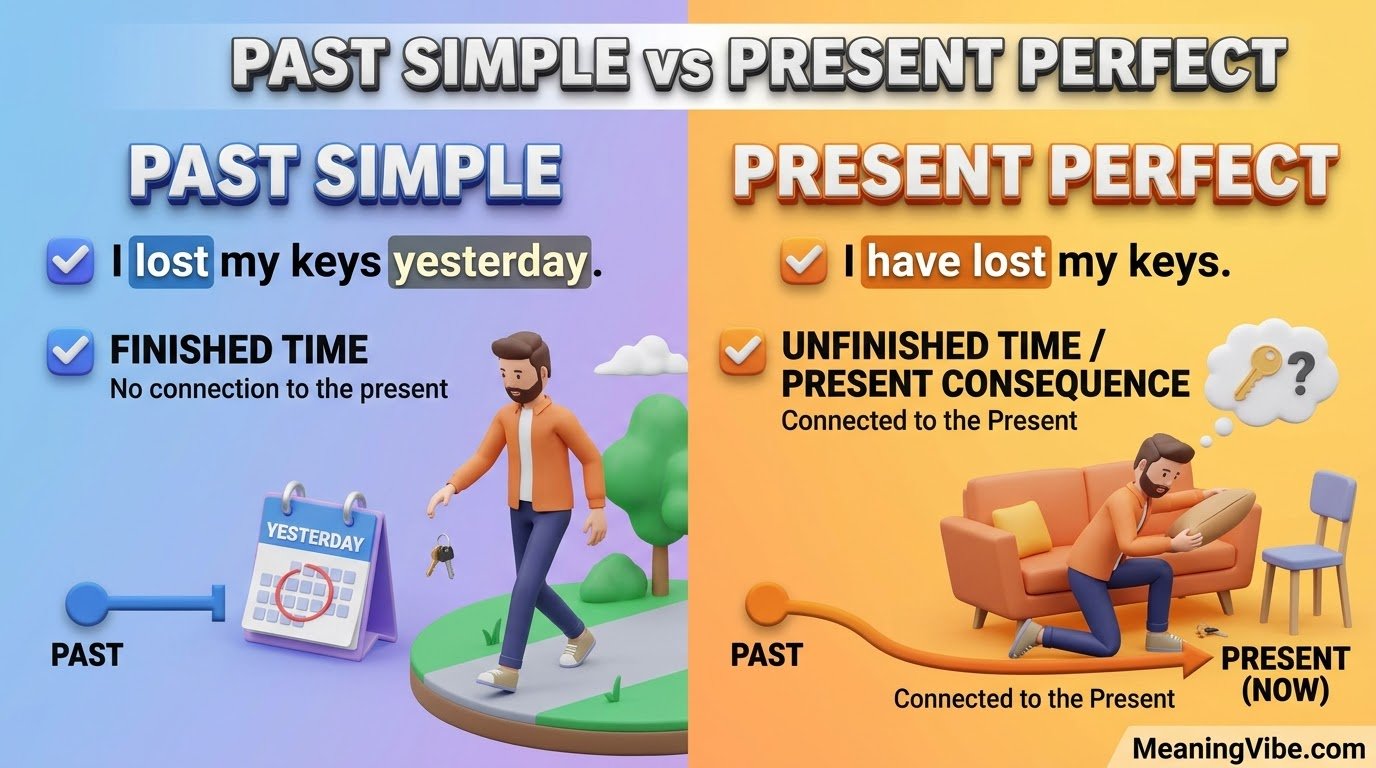
A clean bank matters because learners copy banks verbatim. The sentences below are printed only to be corrected, never to be lifted.
|
Wrong example |
Corrected |
The fault |
|
I have seen him yesterday. |
I saw him yesterday. |
Finished time marker inside an open window |
|
She has went home. |
She has gone home. |
Past simple form in the participle slot |
|
I have saw the film. |
I have seen the film. |
Saw is not the participle; seen is |
|
He have finished. |
He has finished. |
Third person takes has, not have |
|
Have you ever went there? |
Have you ever been there? |
Went cannot serve as a participle |
|
I have lived here since five years. |
I have lived here for five years. |
Since takes a point, for takes a period |
|
She hasn’t did it. |
She hasn’t done it. |
Did is past simple; done is the participle |
|
We have meet them before. |
We have met them before. |
Base form where the participle belongs |
Notice the pattern across the faults: participle errors outnumber everything else. The participle table behind any bank is therefore not decoration; it is the repair kit.
The finished time fault stays first in the table on purpose. It is the one error that even advanced learners produce under pressure.
Make Your Own: Ten Templates
Copying ends and generating begins here. Each template keeps the window open while you swap in your own verb and your own life.
1. The experience question
Have you ever plus participle: Have you ever ridden a camel? Fire it at anyone and a story comes back.
2. The proud record
I have plus participle plus count: I have run three marathons. Achievements live here, undated and owned.
3. The standing result
I have just plus participle: I have just sent it. The freshest result shape, built for messages and updates.
4. The duration claim
I have plus state plus for or since: I have lived here since 2021. Interviews run on this rail.
5. The pending check
Have you plus participle plus yet: Have you signed it yet? The expected event, politely chased.
6. The honest gap
I have never plus participle: I have never tried surfing. Gaps stated cleanly invite plans, not apologies.
7. The news flash
Name has plus participle: The council has approved the plan. Headline grammar in one line.
8. The passive update
It has been plus participle: It has been delivered. The doer steps aside and the result takes the stage.
9. The running count
We have plus participle plus number plus so far: We have raised nine hundred so far. Open periods love this shape.
10. The superlative boast
It is the best plus noun plus I have ever plus participle: the best coffee I have ever tasted. Save it for when it is true.
More Grammar Patterns to Practise Next
Example banks grow stronger inside a cluster of pattern guides. The MeaningVibe home page collects the neighbouring contrasts this site teaches.
Pairs of words confuse in the same way tenses do, by near identity. The quiet vs quite guide settles two spellings that differ by one letter and one syllable.
Verb pairs reward the same framing habit as tense pairs. The raise vs rise guide turns on whether an object receives the action, a test you can run on any sentence.
Meaning neighbours need their own verdicts. The imply vs infer guide draws one line that examples alone cannot hold, and The precede vs proceed guide draws another.
Adjective traps behave like finished time markers, small words with outsized damage. The discrete vs discreet guide is one classic pair, and The elicit vs illicit guide is the other.
Noun neighbours close the set. The moral vs morale guide rewards the same slow reading you practiced here, and The stationary vs stationery guide does the same for two spellings, while The cite vs site vs sight guide untangles three words at once.
Usage shades matter at the advanced edge too. The reluctant vs reticent guide adds the speech shade, and The complement vs compliment guide covers the praise trap.
The historic vs historical guide separates age from importance, while The sensual vs sensuous guide and The tortuous vs torturous guide complete the shelf beside this bank.
Credits and the Hygiene Note
The annotation habit on this page follows The EnglishThrive examples page, whose relevance notes showed that a bank can teach while it lists.
The situation exemplars echo the British Council LearnEnglish reference, whose finished time ban this bank’s hygiene promise simply enforces at scale.
Every sentence here was written for this bank across ten everyday domains, then checked twice: once for the participle, once for the window.
Frequently Asked Questions
1. What are 10 examples of the present perfect tense?
I have finished my homework, She has visited Paris, We have lived here for years, He has just left, and Have you ever tried sushi? open the bank.
One hundred more follow, sorted by use, each with its reason attached.
2. What are examples of the present perfect tense?
Present perfect tense examples are sentences like I have lost my keys, where have plus a past participle reports a past event through what is true now.
This page collects them by use: experience, results, duration, recent past, and unfinished time.
3. What is an example of the present perfect for experience?
Have you ever ridden a horse? is the classic experience example.
Ever asks across the whole life window up to now, and the short answers are Yes, I have and No, I have never ridden one.
4. What is an example of the present perfect for a present result?
I have lost my keys is the standard result example.
The losing happened earlier, and the tense is chosen because the result stands now: the keys are still missing and the door is still shut.
5. What are present perfect examples with just?
She has just arrived and We have just eaten are typical just examples.
Just sits between have and the participle and marks an event finished moments ago, with the result still fresh.
6. What are present perfect examples with already?
I have already sent the report is a standard already example.
Already marks completion sooner than expected and sits mid sentence in positives, or at the end in surprised questions like Have you already finished?
7. What are present perfect examples with yet?
We have not started yet and Have you eaten yet? show the two homes of yet.
It belongs to negatives and questions about expected events and sits at the end of the sentence.
8. What are present perfect examples with ever and never?
Have you ever been to Japan? and I have never flown cover the pair.
Ever lives in questions, never carries the negative by itself, and both range across the whole life window to now.
9. What are present perfect examples with for and since?
They have been married for fifty years and She has lived here since 2019 show the split.
For takes a period of time, since takes the starting point, and both measure duration up to now.
10. What are negative present perfect examples?
I have not finished yet and She has not called are standard negatives.
Not sits after have or has, the short forms contract to haven’t and hasn’t, and yet often closes the sentence.
11. What are question examples in the present perfect?
Have you seen my phone? and Has the train arrived? show the shape.
Have or has moves in front of the subject, the participle stays third, and the answer is a short Yes, I have or No, I haven’t.
12. What are short answer examples in the present perfect?
Yes, I have and No, she hasn’t are the standard short answers.
English answers with the auxiliary alone, never Yes, I have seen, and the negative short answer contracts naturally.
13. What are passive present perfect examples?
The report has been sent is a standard passive example.
The passive present perfect is have or has plus been plus the participle, used when the doer is unknown, obvious, or unimportant.
14. What are present perfect examples in daily life?
I have lost my keys, We have run out of milk, She has just woken up, and Have you eaten yet? are daily life staples.
The tense runs errands, meals, messages, and small emergencies all day.
15. What are present perfect examples at work?
I have just sent the figures and The update has been installed are typical work examples.
Updates, arrivals, fixes, and handoffs all report through present results, which is exactly the tense’s home ground.
16. What are present perfect examples for travel?
Have you ever been to Lisbon?, We have visited three islands, and She has lost her passport cover travel.
Experience questions open conversations, and travel mishaps report as present problems.
17. Why do example lists avoid yesterday in present perfect sentences?
Because yesterday names finished, closed time, and the present perfect reports through an open window.
Banks avoid it in examples so learners do not copy the one hard error: I have seen him yesterday.
18. Can the same event be an example of both past simple and present perfect?
Yes.
Framing decides: I visited Rome in 2019 files the trip as finished history, while I have visited Rome claims the experience as part of your life now.
Both sentences are correct about the same trip.
19. What is the difference between I lost my keys and I have lost my keys as examples?
I lost my keys files the loss as past news, often with a time attached.
I have lost my keys reports the standing result: the keys are still gone, and the problem is current.
20. What are been and gone example sentences?
She has been to the shop means she went and returned.
She has gone to the shop means she is still there.
Been serves experience and completed trips, gone serves current absence.
21. What are present perfect examples with this week?
I have read two reports this week and It has rained twice this week are standard.
This week is unfinished time while the week is still running, so the present perfect is the natural home.
22. What are present perfect examples with superlatives?
It is the best meal I have ever eaten is the classic pattern.
Superlatives and ordinals pair with the present perfect because the comparison ranges across the whole open window of experience.
23. What are first time present perfect examples?
This is the first time I have driven is the standard pattern.
After it is the first, second, or third time, English uses the present perfect for the event being counted.
24. What are present perfect examples for kids?
Kids learn short, concrete examples first: I have finished my homework, She has lost her tooth, We have painted a picture.
Form sets with pictures and answers suit children better than adult bank pages.
25. How many present perfect examples should a beginner learn?
A core of twenty covers the ground: five experience, five results, five duration, five recent.
Learn those with their reasons, produce your own versions, then grow into the full bank by use.
26. Which present perfect examples do IELTS speakers need most?
Speakers need experience and duration examples most: Have you ever questions with full answers, and for and since sentences about studies, work, and home town.
Those two sets carry most speaking part one answers.
27. Do Americans say present perfect examples differently?
In speech, yes, at the edges: Americans often say I just ate and Did you finish yet where British standard keeps the perfect.
The examples themselves stay the same in careful writing and exams.
28. What are wrong present perfect examples to avoid copying?
Avoid copying I have seen him yesterday, She has went, and I have saw it.
Finished time markers, past simple forms in the participle slot, and base forms after have are the three classic faults.
29. Why is I have seen him yesterday not a correct example?
Because the tense looks back from now across time that has not closed, and yesterday is closed.
The British Council states the ban flatly: never use the present perfect with adverbials of finished past time.
30. What are present perfect examples with contractions?
I’ve finished, She’s called, We haven’t eaten yet, and They’ve arrived are standard.
Contractions are the spoken norm in examples, while form tables show the full have and has beside them.
31. What are present perfect examples with irregular verbs?
I have seen it, She has gone home, He has written two books, and We have eaten use irregular participles.
Seen, gone, written, and eaten must be learned as vocabulary, since no ed rule makes them.
32. What are present perfect examples with regular verbs?
I have finished, She has played well, We have cleaned the room, and It has rained use regular participles.
Regular participles end in ed, spelled from the base verb with the usual spelling adjustments.
33. What are present perfect examples in news style?
The minister has resigned, Shares have fallen, and A new species has been discovered are news style examples.
Headlines and reports use the tense for fresh events with present consequences.
34. What are present perfect examples of changes over time?
They have grown so much and The town has changed completely are standard change examples.
The tense suits changes because the before and after are both visible from now.
35. What are present perfect examples of achievements?
She has won three awards and He has climbed Everest are achievement examples.
Achievements are claimed inside the life window, with no finished time attached, which is the experience use at its proudest.
36. What are how long present perfect examples?
How long have you lived here? is answered with duration: I have lived here for six years or since 2020.
The question measures from a past start to now, the tense’s home measurement.
37. What are present perfect examples with so far?
We have sold forty tickets so far and It has rained twice so far are standard.
So far measures the count inside the still open period, and it pairs naturally with the present perfect.
38. What are present perfect examples with recently?
I have recently changed jobs and Have you seen her recently? are typical.
Recently and lately belong to the unfinished recent stretch, so the present perfect is their natural partner.
39. How can I make my own present perfect examples?
Take a template and swap the verb: I have just plus participle, Have you ever plus participle, We have lived here since plus year.
Keep the window open, attach no finished time, and say what is true now.
40. What is a dialogue example of the present perfect?
A natural exchange runs: Have you finished yet?
Yes, I have just sent it. Great, I haven’t checked mine yet.
Questions, short answers, just, and yet all fire inside four lines of real talk.
41. Are present perfect examples the same in British and American English?
Mostly, yes.
The bank is shared, and the differences sit at the recent past edge in speech and in a few participles like gotten.
42. Where can I practice present perfect examples with answers?
Work this page in order: read a set with its reasons, cover the annotations and say them yourself, then write five of your own per template.
Exercise sets with keys, like the reference sites use, test production afterward.
Conclusion
Present perfect tense examples teach the tense the way it is actually learned: sentence by sentence, with the reason visible on each one.
Hold the three habits from this bank. Sort by use before form, print pairs when the past simple tempts you, and keep finished time words out of the perfect entirely.
Then generate, do not just copy. The templates turn this bank into your own examples, written about your work, your town, and your record.
That is the honest promise of present perfect tense examples done well: not a list to memorize, but a pattern you can run on any verb life hands you.