

Plain vs plane defeats careful writers for one honest reason: the two words sound exactly alike and descend from the same Latin root meaning flat. Sound cannot help you, and the shared root cannot help you either.
What decides the spelling is family. Plain does two jobs: it describes things as simple or clear, and it names flat land. Plane does three: it flies, it is drawn in geometry, and it flattens wood.
Learn the five families and the pair stops being a guess. Every phrase you meet, from plane ticket to plain clothes to the Great Plains, belongs to one family, and the family carries the spelling with it.
Plain vs Plane at a Glance
|
Family |
Word |
Job |
Example |
|---|---|---|---|
|
The describer |
plain |
Adjective: simple, unadorned, clear, frank |
A plain shirt, the plain truth |
|
The land |
plain |
Noun: a large flat area of land |
The Great Plains |
|
The aircraft |
plane |
Noun: short for airplane |
The plane landed at dawn |
|
The surface |
plane |
Noun: a flat surface or level |
Points on the same plane |
|
The tool |
plane |
Noun and verb: the woodworking tool, to flatten |
Plane the board smooth |
Read the table as a sorting machine. If the word describes, or names land, it is plain. If it flies, sits in a geometry problem, or shaves wood, it is plane.
The pronunciation never changes; Grammarly’s plain vs plane guide gives both words the same sound, PLAYN, which is precisely why the families must do the work.
Two wrinkles deserve honesty up front. The land is the exception: the flattest thing in the language takes plain, not plane, and this page will say so openly rather than hide it.
And the famous idiom plain sailing began life inside plane’s world, in navigation. Both wrinkles get their own sections below.
The Family Test: Five Questions, Five Seconds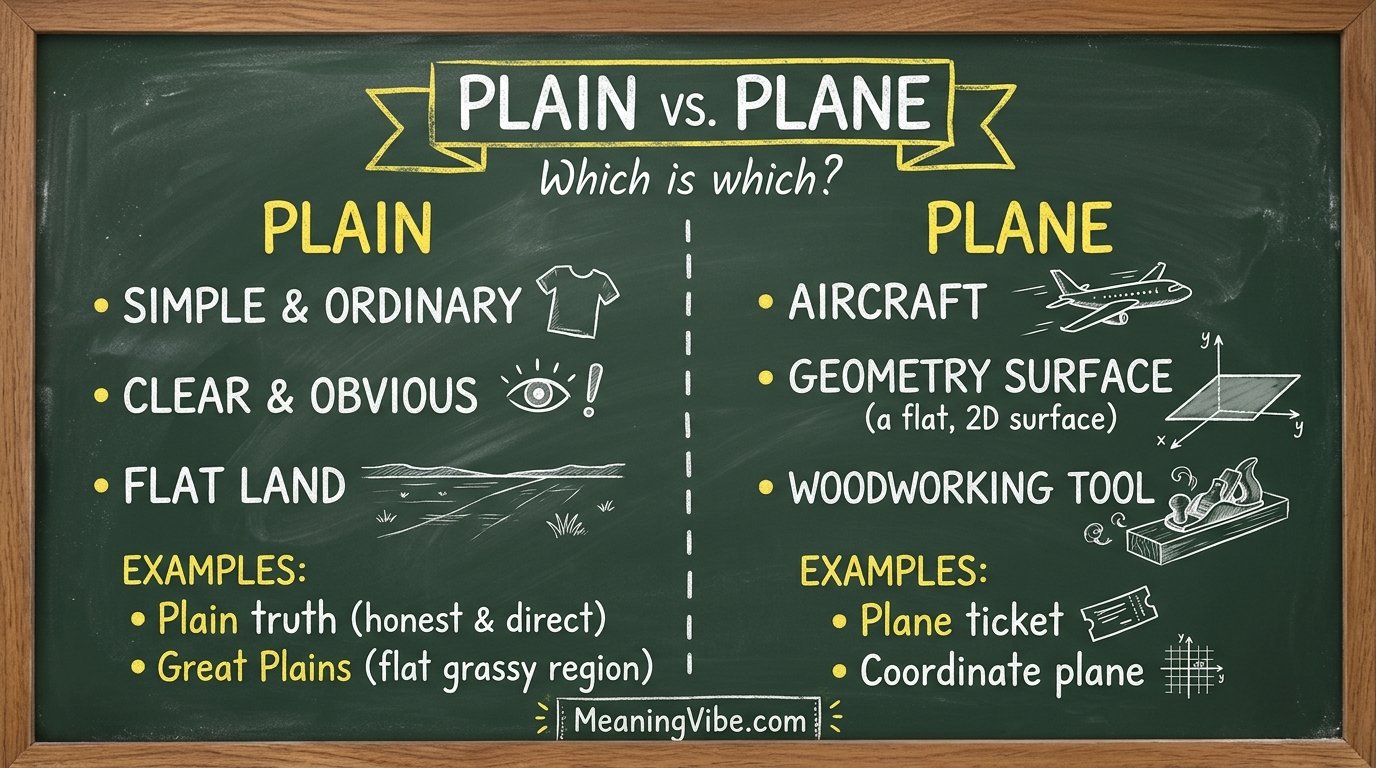
Step 1: Does it fly? If the thing has wings, engines, or a boarding gate, the word is plane. Plane ticket, plane crash, plane ride: the whole travel family sorts here, and no other test is needed.
Step 2: Is it drawn or leveled? If the thing is a flat surface in geometry, or a level of skill, thought, or existence, the word is plane. Same plane, higher plane, coordinate plane: the surface family and its levels.
Step 3: Does it flatten wood? If a blade, a bench, or a curl of shaved wood is involved, the word is plane. The tool, and the verb made from it, belong to the third family.
Step 4: Does it describe? If the word tells you something is simple, unadorned, clear, or frank, the word is plain. A describing word with no wings, no diagram, and no blade is plain every time.
Step 5: Is it land? If the thing is a flat stretch of country, the word is plain, plural plains. This is the exception step, and it exists because the land noun is older than the spelling split that created plane.
Run the steps in order and notice what they assume. The first three steps all end at plane because plane’s families are things: a machine, a surface, a tool.
The last two end at plain because plain’s jobs are describing and naming land, the two things plane never does.
Plain the Describer: Simple, Clear, Frank
Plain’s largest job is describing, and its senses grow from one image: something lying flat and open, with nothing on it and nothing hidden. From flat and open come simple, then clear, then honest. The family’s four everyday branches all grow on that stem.
Simple and unadorned. A plain shirt has no pattern. A plain room has no ornament. Plain food has nothing added. In each, plain reports an absence: no decoration, no extras, no fuss. If you can list what is missing, you are in this branch.
Clear and obvious. The plain truth. Plain facts. As plain as day. Make it plain. Here plain reports visibility: the thing lies open where anyone can see it.
This branch powers plain English, the movement for clear official writing, and it is the branch most worth mastering.
Frank and direct. Plain speaking, a plain spoken farmer, plain talk. Unadorned language shades into honest language: nothing decorative also means nothing evasive. The tone can praise (refreshingly honest) or criticize (blunt), but the spelling and the sense stay the same.
Ordinary and unremarkable. A plain face, a plain Jane, plain folk. This is the unadorned branch turned toward people and judged plain. It is the one branch that can wound, and careful writers use it knowing it carries a verdict, not just a description.
Plain for Food, Fabric, and Products
Product language runs on the unadorned branch. Plain yogurt is unflavored. A plain bagel has no seeds or seasoning. Plain paper is the ordinary printer tray setting. Plain text is text with no formatting codes. Each phrase promises the version with nothing added.
Recipes import one more: plain flour, the British term for flour without a raising agent, close to American all purpose flour. American readers meet it in imported cookbooks and baking shows.
It is the same unadorned sense wearing an apron, and it is never plane flour.
The product test is instant. If the word promises a basic version of something, it is plain. Products cannot fly, sit in geometry, or shave wood, so the plane families never compete for these slots.
Plain the Adverb: Plain Wrong
Plain has one extra job no competitor teaches. In informal speech it works as an intensifier adverb: plain wrong, plain stupid, plain crazy, just plain tired. The sense is utterly, completely, with the describing word stretched into emphasis.
Usage guides mark the adverb informal, and it belongs to conversation and lively prose rather than reports or formal letters. It is worth knowing for two reasons: readers will meet it, and it belongs entirely to plain. Plane has no adverb life at all.
Plain the Land: The Exception That Proves the Root
Here is the wrinkle, stated plainly. A plain is a large area of flat land, usually low, with few trees.
The flattest thing in the language is spelled with the describing word, not the surface word, and any honest page on this pair must explain why.
The land noun is old. Plain arrived through Old French centuries before English spelling settled, and the land sense came with it, straight from Latin planus.
When the technical senses later took the plane spelling, the land was already named and stayed where it was.
Proofed’s word choice guide to plane and plain makes the same observation from the proofreading side: the land noun is the use of plain that sits closest to plane’s surface idea. Close in meaning, settled in different centuries.
Meaning cannot settle this one; history already did.
The Great Plains and the Named Plains
The family’s flagship is the Great Plains, the vast grassland of central North America running from Canada through the Midwest to Texas.
Prairie, farming, and ranching country: if a reader pictures one plain, this is the one, and its plural is the lesson in itself.
The named family is wide. Coastal plains run along shorelines. Flood plains are the flat lands beside rivers that flood first, a term with legal weight in insurance and building rules.
Abyssal plains lie on the deep ocean floor, among the flattest surfaces on Earth, and still spelled plain.
Geography writing therefore has one fixed rule. Landforms take plain, always, however flat they are. The geometry surface takes plane, always, however landlike a diagram looks. The two flat things in English divided the spellings between them, and the border has held for centuries.
Plane Family One: The Aircraft
The plane most readers picture first is the aircraft, and its history is the surface family in disguise. Plane is the clipped form of airplane, the everyday shortening English settled on. Nobody clips a word this hard unless the short form was already waiting.
It was. Early aviation writers used plane for the flat lifting surfaces of flying machines: the wings. A biplane carries two such surfaces, a triplane three.
The machine was named for its surfaces, so the aircraft sense was born inside the geometry family and simply grew wings.
That history makes the travel phrases easy to keep. Plane ticket, plane crash, plane ride, paper plane: if it flies or pretends to, plane.
The collocations run the same way: catch a plane, miss the plane, board the plane, the plane landed, the plane took off.
Errors here are the pair’s most visible because travel writing is everywhere. Plain ticket is the classic, typed daily by learners and hurried travelers alike. The family test kills it in one step: tickets do not describe, and they are not land. They fly.
Plane Family Two: The Flat Surface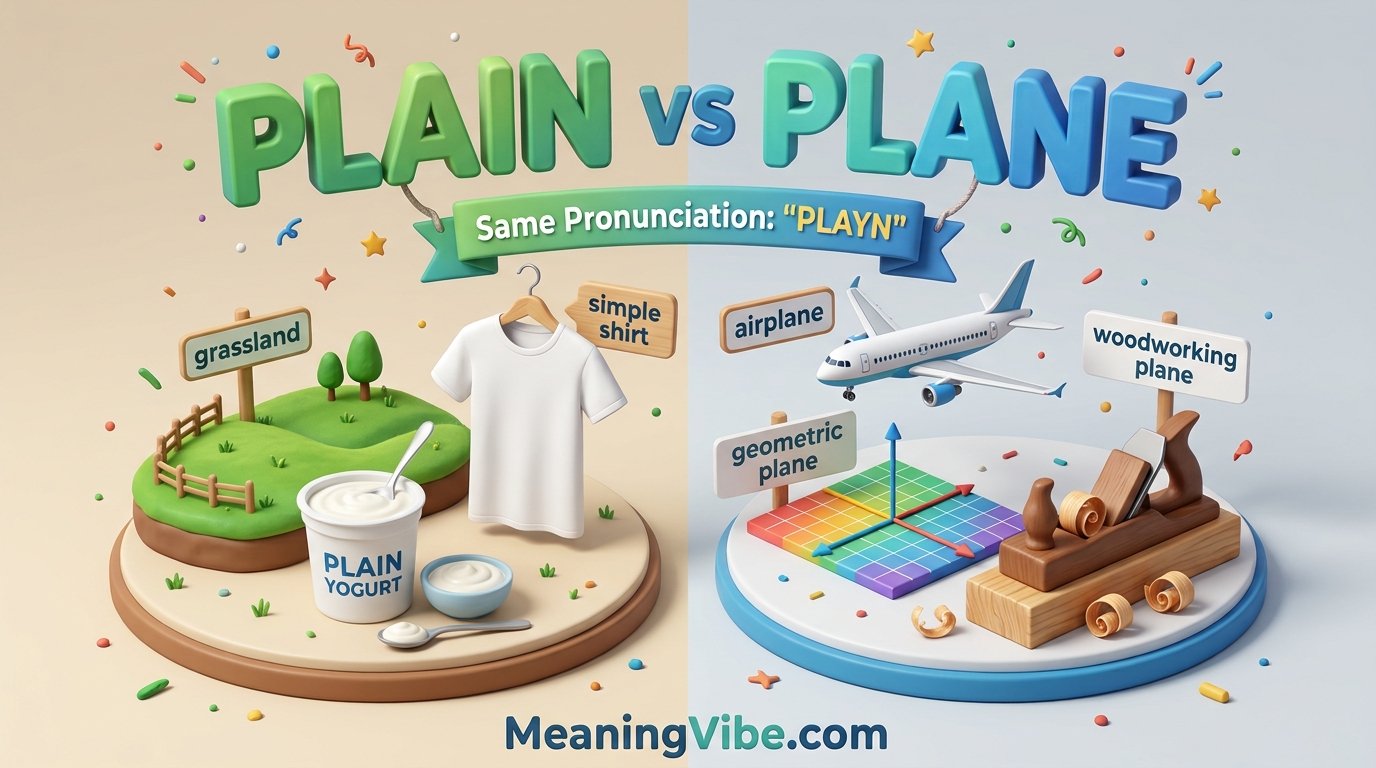
The second family is the mathematician’s plane: a perfectly flat surface that extends infinitely in every direction, with no thickness at all. It is one of geometry’s founding ideas, defined by what it contains: infinitely many points and lines, all lying flat together.
School phrases fix the spelling early. Plane geometry studies flat figures. A plane figure is a two dimensional shape. The coordinate plane is the x and y grid. Parallel planes never meet; intersecting planes meet in a line.
Every one of these is plane, and none can be plain.
The inclined plane carries the family into physics: a ramp, one of the classical simple machines, trading distance for force. It is the geometry surface tilted and put to work, and it is the surface sense most adults remember from school.
Coplanar and On the Same Plane
Points, lines, or figures lying in one plane are coplanar, and the phrase students type is on the same plane. Search behavior shows the wrong version, on the same plain, entered constantly in homework, which makes this phrase the family’s highest value teaching target.
The fix is one picture. A plain is grassland; points cannot lie on grass in a geometry proof. If the sentence is about points, lines, or figures sharing a flat surface, the surface family owns it, and the spelling is plane.
Levels: The Same Plane, a Higher Plane
Flat surfaces stack, and language borrowed the stack. To be on the same plane as someone is to share their level. To operate on another plane is to work at a different level of skill or thought.
A higher plane of existence extends the picture into philosophy and fantasy.
These figurative uses stay in the surface family, because the image is levels, not land. Writers of fiction meet the phrase constantly: planes of existence are a worldbuilding staple. In every register, technical or fantastic, a level is a plane.
Plane Family Three: The Tool That Flattens
The third family is the oldest plane of all: the woodworking tool. A plane is a hand tool with a flat sole and a sharp, angled blade.
Pushed along a board, it shaves off thin curls and leaves the wood flatter, smoother, and truer than it found it.
The family has sizes for stages of work. Jack planes do the rough flattening. Smoothing planes finish the surface. Block planes, small enough for one hand, trim end grain and small parts. Bench planes, router planes, and shoulder planes fill out the bench.
The name is the meaning again: the tool is called a plane because it makes a plane surface. Root, tool, and geometry all say flat. Of the three families, this is the one where the Latin ancestor shows through most clearly.
To Plane: The Verb With Two Lives
Plane is also a verb, in two senses the explainer pages miss. In the workshop, to plane is to smooth wood with the tool: plane the board, plane it down, planed smooth.
The verb is the tool in action and belongs to every woodworking sentence.
On water, to plane is to glide: a speedboat planes when its hull rises and skims the surface at speed. Hydroplaning extends the sense to a car tire skimming on a wet road.
The image is still the flat surface, now moving fast across another one.
Both verbs matter for the pair because they expose a common competitor error. Plane is not always a noun, whatever simplified guides claim. Plain, by contrast, has no standard verb use in modern prose at all. Verbs on this pair belong to plane.
The Sailing Story: One Phrase, Two Spellings, Both Correct
The pair’s best story begins on a chart table. Old navigation had a simplified method for working out a ship’s position: treat the sea as flat, plot the course on a plane chart, and accept small errors over short distances.
The method was called plane sailing, the surface family at sea.
It was genuinely the easy method. Its rival, Mercator’s sailing, allowed for the curvature of the Earth and demanded harder mathematics. Plane sailing traded accuracy for simplicity, which is exactly the trade the modern idiom remembers: easy, straightforward progress with nothing in the way.
The Phrase Finder’s plain sailing research traced the phrase through print, and the record is more interesting than the usual story. The plain spelling appears for the technique as early as 1683, in a manual for ship boys.
The plane sailing spelling is in print by 1749. For centuries, the two spellings served side by side, because the words themselves were not yet fully separated.
So the popular claim that plain sailing is simply plane sailing misspelled is too simple, and this page does not print it. The technique’s sense is the plane sense, beyond doubt.
But the spelling history is tangled, and when the phrase turned figurative in the 1800s, plain is the spelling that won the idiom.
Modern usage is therefore a clean split, and the plane sailing entry reflects it in its own entry structure. The technique, in navigation writing, is plane sailing. The idiom, meaning easy and trouble free progress, is plain sailing. A project is plain sailing.
A seamanship textbook teaches plane sailing. Both spellings are correct, in their own waters.
The Phrase Bank: Fixed Phrases, Sorted by Family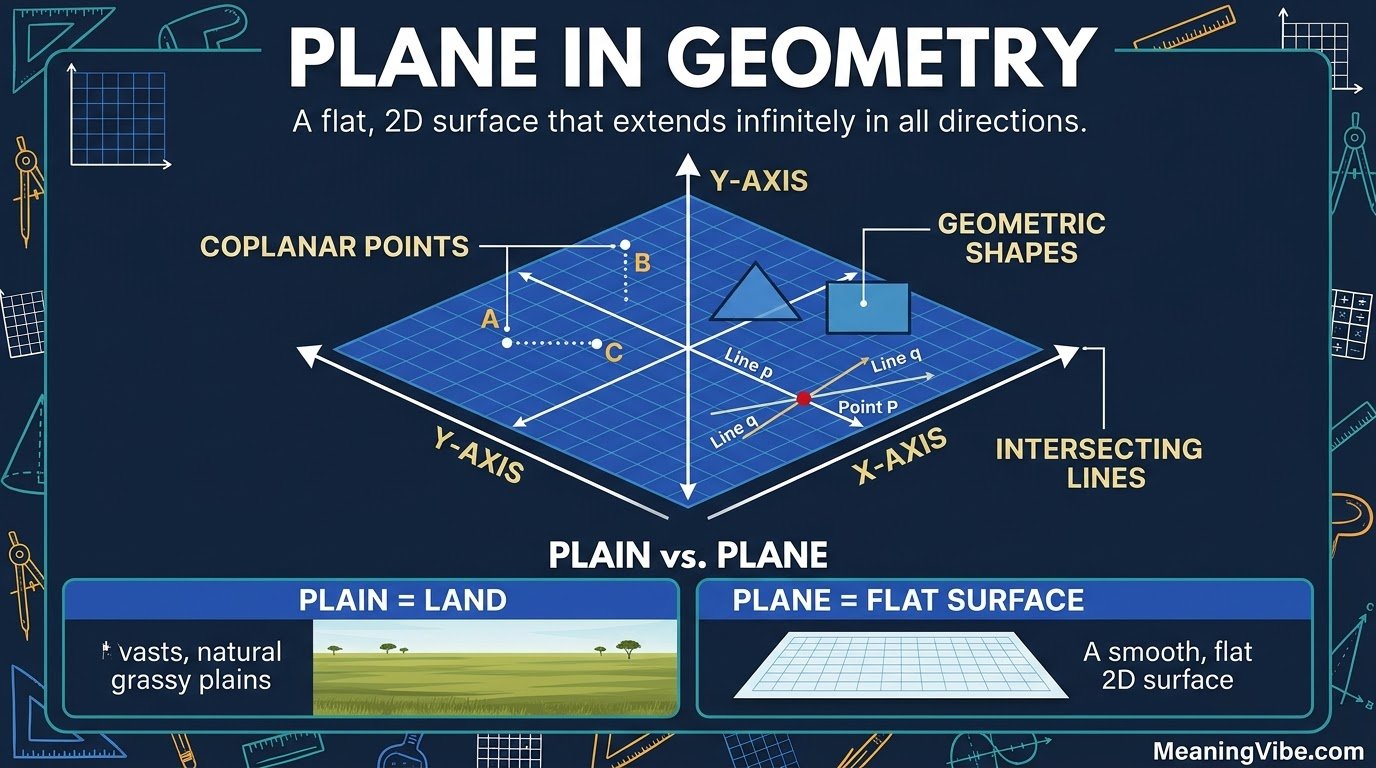
Most real encounters with this pair are phrase encounters. The phrase arrives whole, and its spelling was settled long ago. Learn the two banks and most documents sort themselves.
|
Phrase |
Word |
Why |
|---|---|---|
|
Plane ticket |
plane |
The ticket is for the aircraft |
|
Plane crash, plane ride |
plane |
The aircraft family in the news |
|
On the same plane |
plane |
One flat surface, or one level |
|
A higher plane |
plane |
Levels are the surface family, figuratively |
|
Coordinate plane |
plane |
The geometry grid |
|
Inclined plane |
plane |
The ramp, a simple machine |
|
Plain clothes |
plain |
Ordinary, unadorned clothing, no uniform |
|
Plain English |
plain |
Clear language, the clarity branch |
|
In plain sight |
plain |
Open to view, unconcealed |
|
Plain as day |
plain |
Obvious, the clarity branch |
|
Plain sailing |
plain |
The idiom: easy progress |
|
Plain yogurt, plain flour |
plain |
Nothing added, the unadorned branch |
|
The Great Plains |
plain |
The land family, plural plains |
Read the banks by their worlds. The plane phrases belong to machines, diagrams, and levels. The plain phrases belong to describing and to land.
A new phrase can be sorted the moment you ask which world it lives in, and the bank grows by family rather than by memorized list.
Notice also what is missing. There is no idiom family built on the aircraft or the tool: planes fly and flatten, but they do not star in sayings.
The idioms (sight, day, sailing, Jane) all grew from plain’s describing senses, because idioms are made of descriptions, not machines.
The Plurals Check: Plains Are Lands, Planes Fly or Flatten
When a sentence offers a plural, the pair checks itself. Plains with an i can only be lands: the northern plains, coastal plains, the plains tribes. Nothing else in English multiplies into plains, so the i is a signature.
Planes with an e multiplies everything else: two planes on the runway, intersecting planes in a proof, a chess player operating on several planes, a cabinetmaker’s set of bench planes. Aircraft, surfaces, levels, tools: four families of things, one plural.
Use the check in reverse while editing. If your plural sentence is about land, the i must be there. If it is about anything else in this pair, the e must be.
It is the fastest audit on this page, ten seconds for a whole document.
The Error Catalogue: Swaps That Change the Picture
|
Error |
Correction |
Why it matters |
|---|---|---|
|
Plain ticket |
Plane ticket |
The ticket flies; the wrong word grounds it |
|
On the same plain (geometry) |
On the same plane |
Points share a surface, not a grassland |
|
Plane clothes officer |
Plain clothes officer |
The clothing is unadorned, not airborne |
|
Plane truth |
Plain truth |
Truth is described as clear; it cannot fly |
|
Plane text file |
Plain text file |
The text is unformatted, the unadorned sense |
|
The Great Planes |
The Great Plains |
Landforms are the land family, plural plains |
|
Plain geometry |
Plane geometry |
The geometry branch belongs to the surface family |
|
A plain of existence |
A plane of existence |
Levels are surfaces in the figurative stack |
Two patterns organize the catalogue. First, every error moves a phrase into the wrong family, and the reader’s picture breaks: a ticket that cannot fly, points grazing on grassland.
Second, the errors cluster by writer type: travelers mistype ticket, students mistype same plane, news writers mistype clothes.
The cluster habit helps here too. Documents that swap this pair often swap its neighbors on the same pages.
The sound pairs like imply vs infer, the office pairs like stationary vs stationery, and the spelling pairs like envelop vs envelope all live in the same drafts. One careful pass, family by family, can catch the whole set.
The Wider Family of Pairs at MeaningVibe
This pair belongs to a working cluster at MeaningVibe, and the cluster runs on the same discipline: one deciding question per pair.
Pairs like complement vs compliment, discrete vs discreet, elicit vs illicit, cite vs site vs sight, precede vs proceed, and moral vs morale each turn on a single test, the way this pair turns on family.
Readers who master the family test here usually find the neighboring tests feel familiar within minutes.
Worked Examples and a Ten Sentence Practice Set
The families in one sentence. The plane crossed the plain at dawn, its passengers eating plain yogurt while the pilot, in the calmest sense, was on another plane entirely. Four families, four spellings, one sound.
If you can sort that sentence, you can sort the pair.
Ten sentences. Choose plain or plane.
1. She booked a ___ ticket to Denver for Friday.
2. The officer in ___ clothes watched the platform.
3. Three points define a ___ in geometry.
4. After the repairs, the rest of the move was ___ sailing.
5. Buffalo once crossed the Great ___ in huge herds.
6. He smoothed the shelf with a block ___.
7. That is the ___ truth, and everyone in the room knew it.
8. The two chess masters play on a different ___ from the rest of us.
9. She ordered the ___ bagel, with nothing on it.
10. Points A, B, and C lie on the same ___.
Answer key. 1 plane (the ticket flies). 2 plain (unadorned clothing). 3 plane (the geometry surface). 4 plain (the idiom). 5 Plains (the land, plural). 6 plane (the tool).
7 plain (the clarity branch). 8 plane (a level). 9 plain (nothing added). 10 plane (coplanar points share a surface).
Score the set by its traps. Sentence 4 is the sailing split: the idiom takes plain even though the technique takes plane. Sentence 5 is the land exception in plural form. The rest are pure family sorting, and the family test repairs every miss.
Frequently Asked Questions
What is the difference between plain and plane?
Family and job. Plain is the describing word (simple, clear) and the noun for flat land. Plane is three noun families: the aircraft, the flat geometry surface, and the wood tool. If it flies, is drawn, or flattens, plane; if it describes or is land, plain.
What does plain mean?
As an adjective: simple, unadorned, ordinary, or clear (a plain shirt, the plain truth). As a noun: a large area of flat land with few trees. As an informal adverb: utterly (plain wrong). It reached English through Old French from Latin planus, flat.
What does plane mean?
Three families. The aircraft, clipped from airplane. The flat surface: in geometry an infinitely extending two dimensional surface, and by extension a level. And the woodworking tool that smooths wood, with the verb to plane. One spelling, three families, sorted by context.
Are plain and plane homophones?
Yes, true homophones: both are pronounced PLAYN, one syllable, in every major variety of English. Sound gives no clue, and spellcheck accepts both words, so it can never catch the swap. Only the sentence’s meaning, sorted by family, can choose.
Is it plane ticket or plain ticket?
Plane ticket, always. The ticket belongs to the aircraft, and the aircraft family takes plane. Plain ticket would describe a very unadorned ticket. This is the pair’s most common real world error, and the family test settles it in seconds: if it flies, plane.
Plane crash or plain crash: which is correct?
Plane crash. The crash involves an aircraft, so the sky family word applies. Plain belongs to describing and to land. News and travel writing keep this sorted without exception, because readers picture the aircraft the moment the phrase appears.
Is it plain clothes or plane clothes for undercover police?
Plain clothes. Officers in plain clothes wear ordinary civilian clothing instead of a uniform, so the describing sense of plain applies: plain clothes officer, plain clothes detective. Plane clothes is an error with no meaning at all; nothing about the outfit flies or flattens.
What is a plain in geography?
A large area of flat or gently rolling land, usually low, with few trees, formed by sediment, erosion, or ancient seas. The family includes the Great Plains, coastal plains, flood plains, and abyssal plains on the ocean floor. The land noun is always plain, plural plains.
What are the Great Plains?
The vast grassland region of central North America, running from Canada through the US Midwest to Texas: flat to rolling prairie, now largely farming and ranching country. The name also teaches the plural: plains with an i are lands; planes with an e fly or flatten.
What is a plane in geometry?
One of geometry’s building blocks: a perfectly flat surface extending infinitely in all directions, with no thickness, containing infinitely many points and lines. Points or lines lying in one plane are coplanar. Plane geometry studies figures inside a single plane. The surface is always plane.
What does coplanar mean?
Lying in the same plane. Points, lines, or figures are coplanar when one flat surface contains them all. Any three points are always coplanar; a fourth may not be. The spelling inside coplanar is plane; on the same plain is a known geometry error.
On the same plane or on the same plain?
On the same plane, in every technical and figurative use: geometry points, and levels of skill or status. Plain would move the points onto a grassland. Students search the wrong version constantly, which is why the phrase earns its own answer.
What is an inclined plane?
One of the classical simple machines: a flat surface set at an angle, a ramp, trading distance for force when lifting loads. Ramps, loading slopes, and switchback roads are inclined planes. It belongs to the surface family and is the physics classroom’s most common meeting with the word.
What is a plane in woodworking?
A hand tool with a flat sole and a sharp angled blade that shaves thin curls from wood to flatten, smooth, or size it: block planes, jack planes, smoothing planes, bench planes. The tool is named for what it produces, a flat and even surface.
What does to plane mean as a verb?
Two verb lives. In woodworking, to plane is to smooth or shave wood with a plane. In motion, to plane is to glide or skim: a boat planes as its hull rises and skims the water; hydroplaning is a tire skimming on wet roads.
Plain sailing or plane sailing?
For the idiom meaning easy progress, the standard modern spelling is plain sailing. Plane sailing is the older navigation term for charting as if the sea were a flat plane, still used by navigators. A project is plain sailing; a textbook teaches plane sailing.
Where does the phrase plain sailing come from?
From navigation. Plane sailing found a ship’s position treating the sea as a plane surface, simpler than Mercator’s sailing with its curved Earth. The Phrase Finder’s plain sailing research prints plain for the technique in 1683 and plane sailing by 1749; plain won the idiom in the 1800s.
What is a plane tree?
A large shade tree of the genus Platanus, including the London plane, planted in cities for its broad leaves and tolerance of pollution. It is a smaller branch of the plane family that learner dictionaries include, and a classic extra sense readers meet after the big three.
What does plain mean in plain English?
Clear, direct, easy to understand: plain English, plain language, the plain truth, make it plain. The clarity sense grew from the flat, open root: what lies flat and open is easy to see. It powers the plain English movement for clear official writing.
What does plain mean for food, like plain yogurt?
Unflavored, without additions: plain yogurt, a plain bagel, a plain omelet, plain rice. The unadorned branch of plain at work: nothing added, nothing patterned. Menus and recipes use it constantly, and learners meet it early, which is why food questions recur in this pair’s searches.
Is it plain flour or plane flour?
Plain flour, in British and Commonwealth recipes: flour without a raising agent, close to US all purpose flour. American readers meet the term in imported recipes and baking shows. It is the unadorned sense (nothing added), and plane flour is simply an error.
What does in plain sight mean?
Visible and unconcealed, often surprisingly so: hidden in plain sight. Plain here means clear and open to view, so sight pairs with the describing family. The visibility idioms all take plain: in plain view, plain as day, plain to see. None takes plane.
What does as plain as day mean?
Completely obvious: as plain as day, as plain as the nose on your face. Plain in its clarity sense likens obviousness to daylight visibility. The idiom anchors the rule for learners: where the meaning is obvious or clear, the spelling is plain.
What does plain spoken mean?
Frank and direct in speech, sometimes bluntly: a plain spoken farmer, plain speaking, plain talk. Plain carries the honesty branch of the describing senses, unadorned language. It shades toward praise (honest) or criticism (too blunt) with tone, but the spelling never changes.
Can plain be an adverb?
Yes, informally, as an intensifier: plain wrong, plain stupid, plain crazy, just plain tired. Usage guides mark it informal, at home in conversation and lively prose rather than formal writing. It is one of plain’s extra jobs that plane never shares.
What is a plain Jane?
A woman or girl described as ordinary and unadorned in appearance, and by extension anything plain looking, like a plain Jane sedan. The rhyming name made the phrase sticky in the 1900s. It uses plain’s ordinary sense and is mildly unflattering, which usage notes usually flag.
How do you remember plain vs plane?
Sort by family, not sound. If it flies, is drawn in geometry, or shaves wood, plane (the e belongs to engine). If it describes something as simple or clear, plain. Learn the exception cold: flat land is plain, plural plains.
Do plain and plane come from the same root?
Yes. Both trace to Latin planus and planum, flat and level. Plain came through Old French, keeping the describing senses and the land. The plane spellings settled for technical senses in the 1600s and 1700s; the aircraft sense arrived in the 1900s, clipped from airplane.
Why is an airplane called a plane?
Plane is the clipped everyday form of airplane, and the longer word was built on plane: early aviation writers used plane for the flat lifting surfaces, the wings (a biplane has two). Airplane named the machine for its surfaces. The aircraft is the surface family wearing wings.
What is a plane figure and plane geometry?
A plane figure is a flat, two dimensional shape lying in one plane: triangles, circles, polygons. Plane geometry is the branch studying those figures, against solid geometry’s three dimensional objects. Both are school staples, and both belong to the surface family, spelled plane.
What is a coordinate plane?
The flat grid formed by a horizontal x-axis and a vertical y-axis crossing at the origin, used to locate points by paired numbers. School mathematics uses it daily, and it is the geometry sense learners write most: coordinate plane, never coordinate plain.
What is a higher plane of existence?
The level branch of plane, extended figuratively. A plane is a flat level, so existence and thought can be pictured as stacked levels: a higher plane, a spiritual plane, on another plane entirely. Fantasy and philosophy writing use it heavily, and the figurative level always takes plane.
Is plaine a word?
Not in modern English. Plaine is an archaic spelling of plain from Middle and early modern texts, before the spellings settled. Some learner sites list it as a third option, which overcomplicates the pair. Quote it in historical material only; never choose it in modern writing.
Plain truth or plane truth?
Plain truth. Truth here is described as clear, honest, and unadorned, which is plain’s clarity branch: the plain truth, plain facts. Plane truth has no standard meaning. The describing test settles it instantly: truth cannot fly, be drawn, or shave wood.
What is plain text in computing?
Text without formatting: no bold, fonts, or layout codes, stored in files any program can read. It is the unadorned sense again, text stripped to its simple state. Security writing uses it too (never store passwords in plain text). It is always plain, never plane text.
Is it plain paper or plane paper for a printer?
Plain paper: ordinary uncoated office paper, the standard tray setting on printers and copiers. Plain in the unadorned sense, paper with nothing special about it. Plane paper is a confusion with geometry paper; the printer setting is a fixed product term and always plain.
Can plane be an adjective?
Yes, in technical use: plane geometry, a plane surface, a plane figure, plane trigonometry. What matters for the pair is the territory split: plane as a describing word stays inside geometry and levels, while everyday describing (simple, clear, ordinary) belongs to plain.
Plains or planes: which plural do I need?
Ask what is multiplying. Lands multiply as plains: northern plains, coastal plains. Aircraft, surfaces, levels, and tools multiply as planes: two planes landed, intersecting planes, bench planes. The plural is the pair’s fastest self check; the i and e announce the family.
What does on a different plane mean?
On a different level: of skill, thought, or existence, pictured as stacked flat levels. The chess master plays on a different plane; the sequel operates on another plane. It is the level branch of plane used figuratively, and like every level use it takes plane.
How do you use plain and plane in a sentence?
The classic teaching sentence uses both: The plane crossed the plain at dawn. More pairs: She ordered plain yogurt before boarding the plane. Points on the same plane were drawn across a map of the plains. One sentence can hold both words correctly.
What is a flood plain and why is it spelled plain?
The flat land beside a river that floods first, named in insurance maps and building rules. It belongs to the land family: plains are landforms, like coastal plains and the Great Plains, and landforms take plain. No geometry is involved, so plane never appears.
Plain vs plane: which mistakes matter most?
Three, in order. Plane ticket written as plain ticket, travel writing’s classic. On the same plain in geometry work, where the surface is plane. Plane clothes for plain clothes in news writing. Each is a family swap, and the family test catches all three.
Conclusion
Plain vs plane resolves the moment the families are visible. If the word describes something as simple, clear, or ordinary, or if it names flat land, it is plain. If it flies, sits in a geometry problem, or flattens wood, it is plane.
Keep the tools in order: the family test for meaning, the land exception remembered openly, the plurals check for a fast audit, and the sailing split for the one phrase where both spellings live.
With those four, the pair stops being a coin flip. It becomes a sorting you finish in seconds, every time.