

Zero conditional sentences state how the world works: If you heat ice, it melts. No possibility, no prediction, no occasion: a condition, and the result that follows every single time the condition is met.
The formula is the shortest in the conditional family, and this page gives it in one line below. The real work is the generality decisions: whether a claim is a fact, a habit, a rule or a personal truth, and where this type ends and the first conditional begins.
The centre of the page is a classified bank of 100 sentences in eleven sections, sorted by kind of truth. It is the foundation page of the conditional set on MeaningVibe, beneath the live First Conditional Sentences and Second Conditional Sentences pages and the third conditional page delivered with them.
What a Zero Conditional Sentence Is
A zero conditional sentence joins a condition to its automatic result. The if clause names the condition, and the main clause names what always happens when that condition is true.
It is the grammar of facts, laws, habits, rules and instructions. A speaker states a standing pattern of the world, a workplace, a body or a machine, and the sentence holds for every occasion that fits it.
Both halves are real, and both halves are general. That pairing separates this type from the whole family: the first conditional is real but occasional, and the second and third, covered in the Cambridge Dictionary grammar entry on conditionals, are unreal.
The Formula and the Two Clauses
|
Clause |
Form |
Example piece |
|---|---|---|
|
If clause (condition) |
if + subject + present simple |
If you heat ice |
|
Main clause (result) |
subject + present simple |
it melts |
|
Instruction variant |
if clause + imperative |
If the alarm rings, leave |
The tense is the Present Simple Tense Rules used twice, third person s included in both clauses: If she works late, she misses dinner. One form, no auxiliaries, no modals required, which is why this is the first conditional learners meet.
The clauses can change places freely: Metal expands if you heat it. The comma follows the order, after a leading if clause and nowhere else, exactly as in the rest of the family.
The When Test and the Always Test
The when test is this conditional’s signature check. Replace if with when or whenever: When you heat ice, it melts. The meaning survives untouched, because the result was never in doubt. The EngQuiz zero conditional page builds its whole explanation on this certainty, and rightly.
The swap works only here. In a first conditional sentence, when is not a free variant: it quietly promises that the event will happen, while if leaves it open. A substitution that costs nothing is proof that certainty was already total.
The always test patrols the other border. Ask whether the claim holds every time, as a fact, habit or rule. If the sentence is really about one specific future occasion, it belongs to the first conditional, however similar its if clause looks.
Whenever deserves its own note inside the when family. It adds emphasis on repetition without exception: Whenever the shop closes early, someone complains promises that no early closing has ever passed quietly. Teachers reach for it when learners understand the pattern but not yet its force.
100 Zero Conditional Sentences
The bank prints 100 classified items in eleven sections, sorted by kind of truth and by the decision each group teaches. The largest example set among the teaching pages, the Knackpath zero conditional collection, prints 40 examples sorted by life domain; this bank sorts by scope instead, because scope is what decides the type.
Section A: Scientific Facts (14)
- If you heat ice, it melts.
- If you heat water to 100 degrees, it boils.
- If the temperature drops below zero, water freezes.
- If you mix red and blue, you get purple.
- If you mix blue and yellow, you get green.
- If plants get enough sunlight, they grow.
- Metal expands if you heat it.
- If you drop an object, it falls to the ground.
- If you mix oil and water, they separate.
- If the sun sets, it gets dark.
- If you boil water, it evaporates.
- If you put a magnet near iron, the iron moves toward it.
- If you heat oil in a pan, it starts to smoke.
- If it rains heavily, rivers rise.
Section B: General Truths and Everyday Cause and Effect (12)
- If you exercise regularly, you stay fit.
- If people eat too much sugar, they gain weight.
- If you save money every month, it grows.
- If a shop gives good service, customers come back.
- If you read every day, your vocabulary grows.
- If children play outside, they sleep better.
- If you plug in a phone, it charges.
- If a car runs out of fuel, it stops.
- If you park in the sun, the car gets hot inside.
- If students practice, they improve.
- If you leave milk out of the fridge, it goes bad.
- If prices go up, people buy less.
Section C: Habits and Routines (12)
- If I get up early, I go for a run.
- When I get home, I take off my shoes.
- If it’s sunny on Sundays, we have lunch in the garden.
- If my son eats candy at night, he stays awake.
- If the boss is away, the office is much quieter.
- If I have time in the morning, I walk to work.
- When my phone dies, I use my laptop.
- If we finish work early, we play tennis.
- If she works from home, she listens to music.
- If they visit us, we cook pasta.
- If the traffic is bad, he takes the train.
- If I read in bed, I fall asleep quickly.
Section D: Personal Truths (10)
- If I drink coffee after six, I can’t sleep.
- If I eat peanuts, I get sick.
- If my sister is stressed, she goes for a run.
- If I skip breakfast, I get a headache.
- If I eat too fast, my stomach hurts.
- If he drinks milk, he feels ill.
- If I am tired, I get a bit grumpy.
- If she hears loud music, she gets a headache.
- If I swim in cold water, my hands go numb.
- If my dog hears the doorbell, he barks.
Section E: Instructions, Imperative Main Clause (10)
- If you feel sick, stay at home.
- If the alarm rings, leave the building immediately.
- If the printer jams, open the side panel.
- If you have any questions, call me.
- If the screen freezes, hold the power button.
- If you aren’t sure, ask the teacher.
- If the light flashes red, press reset.
- If the package is damaged, take a photo.
- If you need help, press zero.
- If it rains during the trip, wear your jacket.
Section F: Rules, Laws and Procedures (8)
- If you park here, you get a ticket.
- If visitors arrive, they must sign in.
- If a student is late three times, the school calls the parents.
- If you don’t pay the bill on time, the bank charges a fee.
- If a player touches the ball with a hand, the referee gives a free kick.
- If employees work overtime, they receive extra pay.
- If you break the rules, you get a warning.
- If a passport expires, it becomes invalid.
Section G: Negatives (10)
- If plants don’t get water, they die.
- If I drink coffee late, I don’t sleep well.
- If you don’t study, you don’t improve.
- If she doesn’t eat breakfast, she feels weak by noon.
- If it doesn’t rain for weeks, the ground dries out.
- If we don’t lock the bikes, someone takes them.
- If he doesn’t wear glasses, he can’t read the board.
- If the battery doesn’t charge, the device doesn’t start.
- If you don’t save the document, you lose your changes.
- If they don’t feed the cat, it hunts birds.
Section H: Questions (6)
- What happens if you mix blue and yellow?
- Do you sleep well if you exercise in the evening?
- If it rains, do the streets flood in your town?
- What do you do if your phone dies?
- Does metal expand if you heat it?
- If babies are hungry, do they always cry?
Section I: When and Whenever Variants (6)
- When you heat water, it boils.
- Whenever I am tired, I go to bed early.
- When it snows, the roads become slippery.
- Whenever the shop closes early, someone complains.
- When my phone battery is low, it beeps.
- Whenever the sun goes down, it gets cold in the desert.
Section J: Same Event Pairs, Zero vs First (6 Pairs, 12 Sentences)
One event, told two ways. The first line states the standing pattern; the second predicts one occasion, and will is the visible trace of that single change.
A machine, zero vs first.
- If you press this button, the machine starts.
- If you press this button, the machine will start.
Rain, zero vs first.
- If it rains, the ground gets wet.
- If it rains this afternoon, the ground will get wet.
Coffee, zero vs first.
- If I drink coffee late, I can’t sleep.
- If I drink coffee tonight, I won’t sleep.
Study, zero vs first.
- If students study regularly, they pass their exams.
- If you study tonight, you will pass tomorrow’s test.
Heating, zero vs first.
- If you heat ice, it melts.
- If you heat the ice now, it will melt in a minute.
A phone call, zero vs first.
- If my boss calls, I answer immediately.
- If my boss calls this evening, I will answer immediately.
Section K: Wider Forms, Labelled as Strands (6)
The last six sentences are recognition forms, printed with their labels. The past zero describes finished eras in past forms, and modal main clauses state general possibilities and rules. Produce the present simple pattern from Sections A to J; learn to read these.
- If it rained, the streets flooded. (past zero: whenever it rained, in that place and era)
- If I ate dairy, I got sick. (past zero: a finished childhood pattern)
- If the alarm rang, everyone evacuated the building. (past zero: an old procedure)
- If metal gets hot, it can burn you. (modal main clause: can, a general possibility)
- If a child runs a fever, she must see a doctor. (modal main clause: must, a rule)
- If you heat the mixture slowly, it may thicken. (modal main clause: may, a general tendency)
Truth by Scope: Science, General, Habit, Personal
Every sentence in the bank runs the same logic at a different scope, and naming the scope is the fastest way to check a doubtful sentence.
|
Scope |
Population |
Bank section |
Example shape |
|---|---|---|---|
|
Scientific fact |
Everyone, everywhere |
A |
If you heat water to 100 degrees, it boils |
|
General truth |
People and things in general |
B |
If prices go up, people buy less |
|
Habit and routine |
A person, a family, a workplace |
C |
When I get home, I take off my shoes |
|
Personal truth |
One body, one life |
D |
If I eat peanuts, I get sick |
Competitor pages teach the laboratory scope and stop. Learners then meet the structure in their own speech, about coffee, sleep and headaches, with no model for it. Section D exists because the personal scope is the one beginners actually need first.
A scope warning: shrinking the population does not weaken the every time requirement. A personal truth is a claim about all of one person’s occasions, and a sentence true only sometimes about yourself is not a zero conditional either.
The Imperative Form: Standing Instructions
Section E carries the form that manuals, safety notices and classrooms run on: the if clause in the present simple, the main clause an imperative. If the printer jams, open the side panel. If you feel sick, stay at home.
The teaching point is the word standing. This imperative is not an order for one occasion; it is a permanent rule of the system, true whenever the condition occurs. That is why it belongs to this conditional and why technical writing teaches this type before all others.
The paired study of the two real conditionals at TypesOfSentences gives the imperative its proper place beside the fact form, and learners writing instructions should read the two treatments together: one structure for what always happens, one for what must always be done.
Zero vs First: The Border Decisions
Against the first conditional, everything is decided by scope. The First Conditional Sentences page covers the occasional member: if plus present simple, will plus base verb, one real future event. This page owns the general member, and Section J prints the border on identical events.
Two habits settle doubtful cases. Run the when test: if when fits for free, the sentence is general. Then run the occasion test: if a word like tomorrow, tonight or this evening sits naturally in the sentence, it has already become a first conditional about one event.
The remaining family borders are quicker. The second conditional imagines an unreal present, and the third an unreal past; both announce themselves with past forms and would. The zero conditional is the only member whose world is entirely real, which is why the Future Simple Tense Rules forms never appear inside it.
Wider forms deserve one honest paragraph. Some broad descriptions also print zero type sentences with a Present Continuous Tense Rules if clause, If you are working late, you miss dinner, and past forms for finished eras appear in Section K. These are recognition strands. The production rule for learners stays narrow: present simple in both clauses, modelled on the Past Simple Tense Rules contrast that the past strand borrows.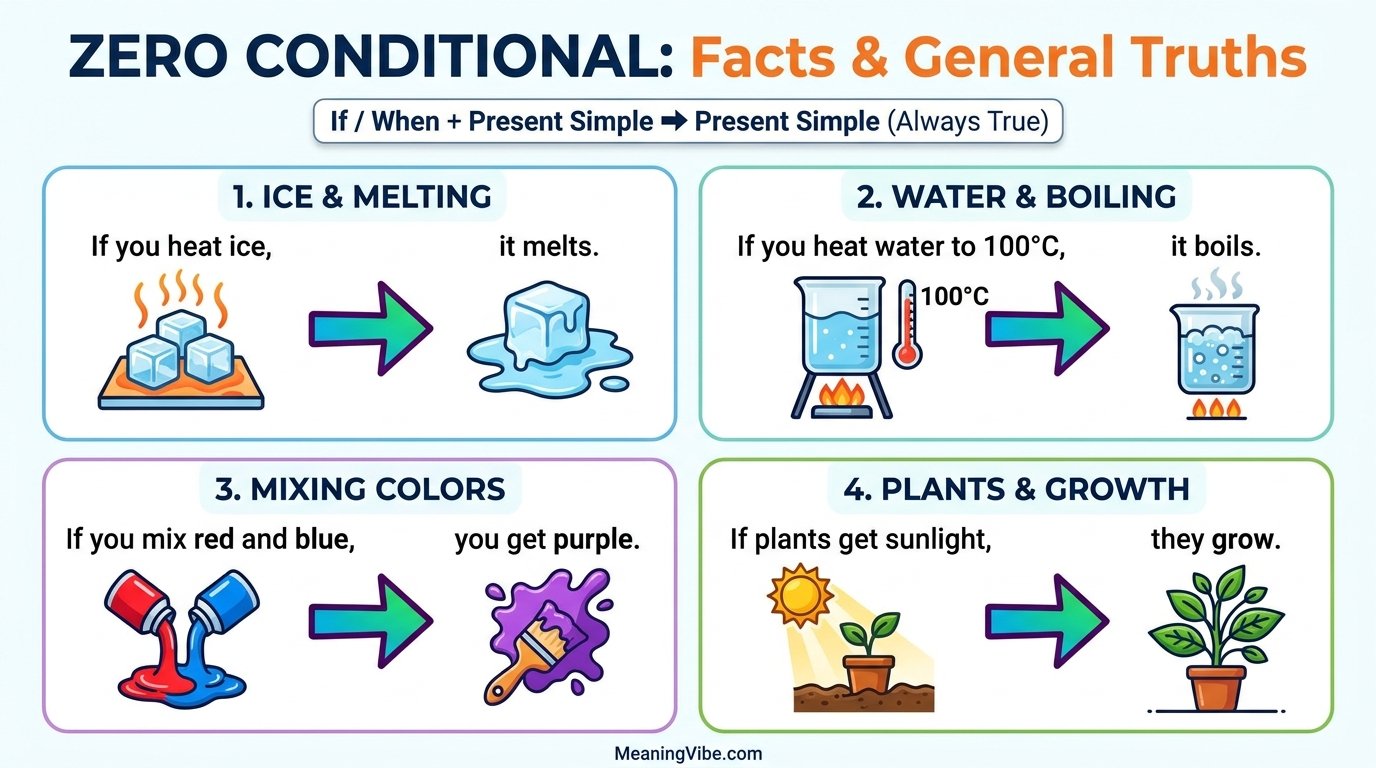
The Error Gallery: 6 Errors, 2 Competitor Defects, 3 False Alarms
|
# |
Item |
Verdict |
Correction or note |
|---|---|---|---|
|
1 |
If you heat ice, it will melt, offered as a general truth |
Learner error of scope |
Will converts the law into a forecast about an occasion; the fact takes melts |
|
2 |
If you will heat ice, it melts |
Learner error, always |
Will never belongs inside the if clause of any conditional |
|
3 |
If I see him, I tell him, said about tomorrow only |
Learner error of scope |
One future occasion needs the first conditional: I will tell him |
|
4 |
If she work late, she miss dinner |
Learner error |
The third person s is owed twice: works, misses |
|
5 |
The ground gets wet, if it rains (comma before a trailing if clause) |
Learner error |
The comma follows a leading if clause only |
|
6 |
If the alarm rings, you will leave the building, as a standing rule |
Learner error of scope |
A permanent instruction takes the imperative or the present: leave |
|
7 |
A famous fact sentence, If you heat ice, it will melt, printed as the zero conditional model on multiple teaching pages |
Competitor defect |
The content is a fact; the grammar is first conditional. Form decides the type, not content |
|
8 |
Broad course pages print past and continuous variants in the same table as the core rule, unlabelled |
Competitor defect |
The variants are real but they are strands; unlabelled breadth teaches learners to produce what exams mark wrong |
|
9 |
If it rained, the streets flooded |
False alarm, correct as past zero |
A finished era’s standing pattern, labelled and recognised, not produced by beginners |
|
10 |
If metal gets hot, it can burn you |
False alarm, correct |
A modal main clause states a general possibility; the type is unchanged |
|
11 |
Whenever I am tired, I go to bed early |
False alarm, correct |
Whenever is the emphatic member of the when family, not an error for if |
Frequently Asked Questions
What is a zero conditional sentence?
A sentence that states a general truth as a condition and its automatic result: if plus present simple in the if clause, present simple in the main clause. If you heat ice, it melts. The result is not a possibility or a prediction; it is what always happens when the condition is met.
What is the zero conditional formula?
If plus present simple, present simple. Both clauses use the same tense, and both verbs take the third person s where the subject needs it: If it rains, the ground gets wet. The clauses can swap order, and the main clause can also be an imperative when the sentence gives an instruction.
Why is it called the zero conditional?
Because it sits before the first conditional in the numbering system teachers use: zero, first, second, third. It is the baseline member of the family, the real and factual one. A popular memory aid says zero stands for zero uncertainty, and as a mnemonic it works, but the name itself comes from the numbering.
What is the zero conditional used for?
Five jobs dominate: scientific facts (If you heat water to 100 degrees, it boils), general truths, habits and routines (If I drink coffee late, I can’t sleep), personal truths about one person’s body or life, and standing instructions (If the alarm rings, leave the building).
What is the difference between the zero and first conditional?
Time scope. The zero conditional states what always happens: If you press the button, the machine starts, every time, as a fact about the machine. The first conditional predicts one specific future occasion: If you press the button, the machine will start, this once, when you do it. Will is the visible difference; generality is the real one.
Can I replace if with when in the zero conditional?
Yes, and this is the zero conditional’s signature test. Because the result is certain, if, when and whenever all fit: When you heat ice, it melts. The swap works only here. In the first conditional, when changes the meaning, because when promises the event will happen while if leaves it open.
What is the difference between when and whenever in these sentences?
When points at the occasion type; whenever stresses every single occasion, without exception. If I am tired, I go to bed early states the habit. Whenever I am tired, I go to bed early underlines that there are no exceptions. Both keep the sentence inside the zero conditional.
Can the main clause of a zero conditional be an imperative?
Yes, and manuals are built on it: If you feel sick, stay at home. If the printer jams, open the side panel. The imperative version is a standing instruction, true every time the condition occurs, which is why it belongs to the zero conditional and not to a one off order.
How do I make a zero conditional negative?
Put don’t or doesn’t into either clause, or both: If plants don’t get water, they die. If I drink coffee late, I don’t sleep well. The negatives describe what always fails to happen, or what always happens instead, and the general truth logic does not change.
How do I ask a question in the zero conditional?
Invert do or does in the main clause, or question the whole pattern: Do you sleep well if you exercise? What happens if you mix blue and yellow? The what happens if pattern is the natural question form of this conditional, and science teaching runs on it.
Is If you heat ice, it will melt a zero conditional?
By form, no: will makes the main clause a first conditional prediction about an occasion. The fact underneath belongs to zero conditional territory, which is why the sentence feels like a fact. For the general truth, English uses the present in both clauses: If you heat ice, it melts. Pages that file the will version as a zero conditional model blur the family’s most tested border.
Why is will not used in the zero conditional?
Because will moves the result into the future of one occasion, and the zero conditional has no occasions. Its results are timeless: they were true yesterday, they are true now, and the sentence makes no claim about a specific tomorrow. Adding will quietly converts a law into a forecast.
Can the zero conditional talk about the past?
In its school form, no; it is a present structure. Descriptively, English also runs a past version for finished eras: If it rained, the streets flooded, meaning whenever it rained in that place and period. GrammarTrack documents this past zero pattern openly. Learners should recognise it and produce the present form.
Can the if clause use the present continuous or present perfect?
Broader descriptions allow it: If you are working late, you miss dinner; If you have eaten breakfast, you feel energetic. The school rule, present simple only, is the safe production target and the form exams expect. The wider forms are a recognition strand, printed here as a strand and not merged into the core rule.
Can the main clause use can, may or must?
Yes. General truths often carry a modal: If you heat metal, it can expand unevenly is loose, but If metal gets hot, it can burn you states a general possibility, and rules use must: If visitors arrive, they must sign in. The modal changes the kind of truth, not the conditional type.
What is the difference between the zero and second conditional?
Reality. The zero conditional describes what really and always happens. The second describes what would happen in an imagined present or future that is not real: If it rained in the desert every week (it does not), the plants would grow. Present simple plus present simple against past simple plus would is the form signal.
Is a zero conditional always 100 percent true?
It is always presented as a rule by the speaker, which is not the same as a law of physics. If I miss breakfast, I am hungry by ten can have rare exceptions and still be a true zero conditional, because the speaker states it as their standing pattern. Scientific facts sit at the certain end; personal truths sit at the pattern end.
What is a personal truth in the zero conditional?
A general truth whose scope is one person: If I eat peanuts, I get sick. If my sister is stressed, she goes for a run. The every time logic is identical to a scientific fact; only the population shrinks from everyone to one. Pages that teach only laboratory examples leave learners unable to describe their own lives.
Why do learners drop the s in zero conditional sentences?
Because the form loads the third person s twice, once in each clause: If she works late, she misses dinner. Missing either s is the most common mechanical error in this structure, and it survives because meaning survives. Drilling both clauses as one chunk is the standard cure.
What is the comma rule in the zero conditional?
The same as in every conditional: a comma after a leading if clause (If it rains, the ground gets wet), and no comma when the main clause leads (The ground gets wet if it rains). The comma follows the order, never the type.
Can the clauses of a zero conditional change places?
Yes, freely, with no change in meaning: Metal expands if you heat it says the same as If you heat metal, it expands. Writers choose the order that puts the condition or the result in focus, and only the comma moves with the choice.
Can I use unless in a zero conditional?
Yes. Unless means if not, and rules use it constantly: Unless you water plants, they die is the compact form of If you don’t water plants, they die. The if not version is easier for learners to build; the unless version is essential for reading rules and notices.
Why do instructions and manuals use the zero conditional so much?
Because an instruction is a general truth about a system: whenever this happens, do that. If the light flashes red, press reset. The structure carries no date and no occasion, which is exactly what a manual needs, and it is why technical writing teaches this conditional before all others.
At what CEFR level is the zero conditional taught?
Usually A2, sometimes introduced at A1 with routines: it is the first conditional most courses teach, because its form is only the present simple used twice. Sources differ on the exact slot, so the honest statement is a range: met at A1 to A2, expected to be controlled by A2.
What are the most common zero conditional mistakes?
Five recur: adding will to a general truth; putting will inside the if clause; using the zero form for one specific future event (If I see him, I tell him, said about tomorrow only); dropping a third person s in either clause; and placing a comma before a trailing if clause. Each error is a border error, not a form error.
Is If I see him tomorrow, I will tell him a zero conditional?
No, it is a first conditional, and correctly so: one person, one meeting, one future occasion. The zero version would describe a standing pattern: If I see him, I tell him, meaning every time our paths cross. The same verbs change type purely on whether the claim is general or occasional.
Can when replace if in the first conditional too?
Grammatically the word fits, but the meaning moves: When I see him, I will tell him promises that the meeting will happen; If I see him leaves it open. That is why the substitution test identifies the zero conditional: only there do if and when cost nothing, because certainty is already total.
How is the zero conditional used in science writing?
As the cause and effect frame: If the temperature drops below zero, water freezes. If a plant receives no light, it stops growing. Science needs claims that hold every time, with no occasion attached, and the zero conditional is the sentence shape that carries exactly that claim.
Do proverbs use the zero conditional?
Several do, in compressed form: If you snooze, you lose. If it ain’t broke, don’t fix it, which also shows the imperative main clause. Proverbs are general truths about how life works, so the family resemblance is real, even when the wording is trimmed for rhythm.
What is the difference between a zero conditional and a plain present simple statement?
The statement asserts one fact: Water boils at 100 degrees. The conditional asserts a dependency between two facts: If you heat water to 100 degrees, it boils. The condition is the added machinery, and it is what lets the sentence explain, instruct and predict patterns rather than merely report.
Can a zero conditional have different subjects in each clause?
Yes, and most real ones do: If the alarm rings, everyone leaves the building. If babies are hungry, they cry keeps one subject family, but nothing in the form requires it. The condition and the result each bring their own subject, joined only by the always logic.
Why do exams test zero against first so heavily?
Because the two share an if clause and differ only in scope, so they discriminate learners who understand meaning from learners who memorised forms. The standard item gives a context, one general truth and one future occasion, and asks for the type or the correct main clause. The always test settles every item of this kind.
Is If it rains, the ground gets wet about the future?
No. It is a timeless claim about what rain does, true on every rainy day in the past and the future without being about any one of them. Learners who file it as future usually arrive from the first conditional, where a tomorrow version of the same scene genuinely is future.
How do I describe nature and animals with the zero conditional?
Exactly as science does, with species level truths: If bees disappear, plants lose their pollinators. When the sun goes down, it gets cold in the desert. If a cat is frightened, it runs. The population scope, a whole species or a whole place, is what makes these zero rather than first.
Can the zero conditional express a warning?
Yes, as a standing warning rather than a one off threat: If you touch that wire, you get a shock. If drivers speed on this road, they get fined. The general form is actually the stronger warning, because it promises the result every time, not just today.
What does whenever add that when does not?
Emphasis on repetition without exception. When the shop closes, we go home describes the routine. Whenever the shop closes early, someone complains underlines that early closings have never once passed without a complaint. Teachers use whenever to make the every time logic audible.
Is the verb be handled specially in the zero conditional?
Only in that it shows the present simple forms clearly: If I am tired, I drink coffee. If she is hungry, she eats. If they are late, the lesson starts without them. Am, is and are sit in the if clause exactly as they do in any present simple statement.
How many conditional types are there, and where does zero sit?
The school system counts four numbered types, zero to third, with mixed conditionals added as a fifth pattern in fuller treatments. Zero is the only fully real and fully general member: first is real but occasional, second and third are unreal, and mixed borrows a half from each of the unreal pair.
What is the fastest check for a zero conditional sentence?
Two questions. Can if be replaced by when without changing the meaning? And is the claim true every time, as a fact, habit or rule? Two yes answers settle it. If either answer is no, the sentence belongs to another type, most often the first.
How should a beginner practise the zero conditional?
With their own truths first: five sentences about their body, their home and their day, each checked by the when test. Personal truths are self verifying, because the learner knows whether the claim holds every time, and that verification habit is worth more than fifty copied science examples.
Why do some pages print If you heat ice, it will melt as the zero conditional example?
Because the fact is famous and the wording is careless. The sentence’s grammar is first conditional, whatever its content, and printing it as the type’s model teaches learners to add will to facts. It is the single most repeated defect in this topic’s pages, and this report quarantines it.
Can a zero conditional be used to give advice?
Yes, through the imperative and through general consequence statements: If you feel dizzy, sit down. If you save a little every week, the money grows. Advice works here when it states a standing rule of the body, the budget or the workplace, rather than a suggestion for one occasion.
Conclusion
Zero conditional sentences are one short formula wrapped around one large idea: some claims hold every time, and English keeps a sentence shape that says exactly that. Learn the when test and the always test, sort your truths by scope, and this foundation type will carry your facts, your habits, your rules and your instructions for the rest of your English. The rest of the family, real occasions, imagined presents and rewritten pasts, builds on the ground this page lays.