

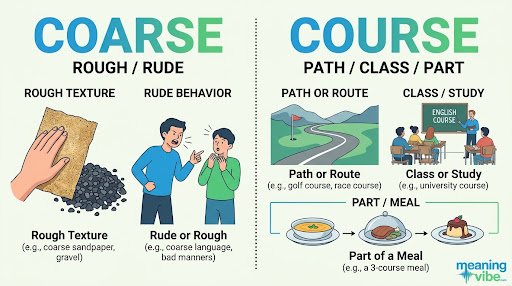
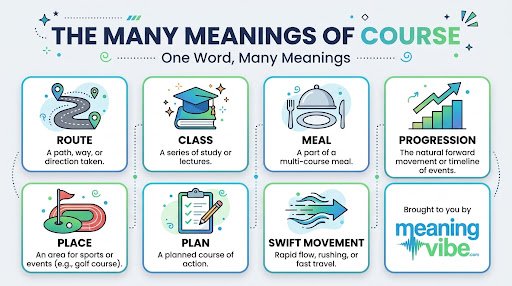
Coarse vs course confuses writers because both words sound exactly alike, yet they never mean the same thing in a sentence. Coarse is always an adjective that describes roughness, large grains, or crude behaviour. Course is a noun or verb that names a path, a class, a meal part, a progression, or swift movement.
Most mistakes come from the course, because it has many meanings and coarse has only one job. Course can be a route, a programme of study, a dinner part, a span of time, or a verb. Coarse only describes something, so it always stands before a noun or after a linking verb.
Coarse Describes, Course Is a Path, Class, Meal, or Progression
Coarse answers the question “what is it like?” and its answer is always rough, large-grained, or unrefined. Coarse sand feels gritty, coarse language sounds rude, and coarse fabric feels thick and uneven. The word never names a thing or an action, so it cannot stand alone as a subject.
Course answers the question “which way, which class, or which part?” and its answer changes with context. A golf course is a place, an English course is a programme, and the main course is a dinner part. The same spelling also works as a verb, as in blood coursed through veins.
Of course is a fixed idiom, and it always uses course, never coarse. The phrase means certainly or naturally, and it is one of the most common error sites in this pair. If you write of coarse, a reader will hear the right sound but see the wrong meaning.
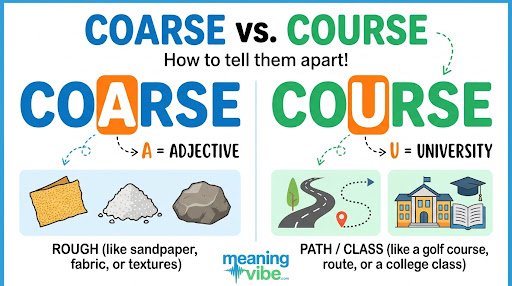
A useful rule is that coarse has an “a” like adjective, while course has a “u” like university. That trick helps for coarse, but it does not explain every course sense, so pair it with the substitution test. Replace the word with rough for coarse, and with path or class for course.
Why the Pair Is Confusing
Coarse and course are homophones, which means they share a pronunciation but not a spelling or a meaning. In American English the sound is /kɔːrs/, and in British English it is /kɔːs/. Spelling cannot be heard, so only meaning and grammar can guide the choice.
Spellcheckers rarely catch the error, because both spellings are valid English words in their own right. A sentence with coarse for course passes a spellcheck and still reads as wrong to a human. That is why a meaning test matters more than a spelling check for this pair.
The confusion is also uneven, because course is far more common than coarse in everyday writing. Most writers reach for course first, which makes course for coarse errors common in texture sentences. The reverse error, coarse for course, appears most often in fixed phrases like of course.
Coarse: Definition, Forms, and Examples
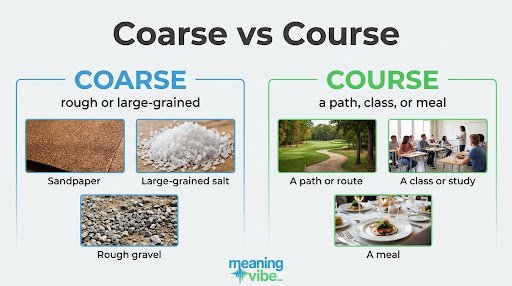
Coarse is an adjective, and its core meaning is rough, not smooth, or made of large parts. Coarse cloth feels scratchy, coarse sand has large grains, and coarse hair feels thick and wiry. The opposite of coarse in texture is fine, which means small-grained or smooth.
Coarse also describes behaviour and quality, and those senses share the idea of lacking refinement. Coarse manners are rude, coarse jokes are vulgar, and coarse work is rough or unfinished. A coarse perfume or coarse diet can also mean plain, common, or inferior in older usage.
The forms of coarse follow regular adjective patterns, and they help confirm its part of speech. Coarser is the comparative, coarsest is the superlative, coarsely is the adverb, and coarseness is the noun. If a sentence needs coarser or coarsest, the base word must be coarse, never course.
Coarse Texture: Rough Surfaces and Large Grains
Coarse texture is the most common sense, and it covers surfaces that feel uneven to the touch. Coarse fabric catches the skin, coarse wool feels heavy, and coarse hands feel calloused. These examples all describe a physical quality, not a route or a lesson.
Coarse grain is the second texture sense, and it means made of relatively large particles. Coarse sand drains quickly, coarse salt has large crystals, and coarse sugar has large grains. In each case, fine is the natural opposite, and that contrast is a quick check.
Coarse thread and coarse yarn are thick, not delicate, and they make a rough cloth. Coarse bread is plain and heavy, while coarse metal is unrefined or gross in older dictionary senses. All of these uses stay inside the adjective job, which is to describe a noun.
Coarse Behaviour: Rude, Vulgar, or Unrefined
Coarse language is rude or offensive, especially about sex or bodily matters, and it is the behaviour sense most writers need. Coarse jokes cross a line in formal settings, and coarse laughter sounds loud and unrefined. The test still works: replace the word with rude or vulgar and the sentence keeps its sense.
Coarse manners show a lack of polish, not a lack of direction, and that distinction prevents a common swap. A person with coarse manners is not following a course of behaviour in the route sense. The word describes how the person acts, so it must be the adjective form.
Coarse behaviour in a workplace, classroom, or family setting is a social judgement, not a grammar judgement. Writers should use it carefully, because it labels a person rather than a mistake. In neutral writing, rough or unrefined is often clearer than coarse for behaviour.
Coarse Quality and Special Senses
Coarse quality means ordinary, inferior, or common, and it appears in older and literary uses. Coarse metal in Shakespeare’s line “Of what coarse metal ye are molded” means base or common material. That sense is less common today, but it explains why coarse can sound like a judgement of value.
Coarse adjustment is a technical sense meaning not precise or detailed, as in a coarse adjustment on a tool. A coarse saw has large teeth and is designed for heavy, fast, less delicate work, according to Merriam-Webster. These senses keep the idea of large scale and low precision.
Coarse fishing is a chiefly British sense meaning fishing for non-game fish, such as carp and roach, in freshwater. Coarse fish are the fish themselves, and the term has nothing to do with roughness. American writers rarely need this sense, but they should not mistake it for a spelling error.
Course: Definition, Forms, and Examples
Course is usually a noun, and its most common meanings are a route, a programme of study, and a part of a meal. The course of a river is its path, a history course is a series of lessons, and the main course is a dinner part. Each sense answers a different question, so context must do the work.
Course is also a verb, though that use is less common in everyday writing and more common in literary writing. Blood coursed through veins, a ship coursed across waves, and tears coursed down a face all mean moved swiftly. The verb form changes with tense: course, courses, coursed, coursing.
Course is never an adjective, and that rule is the strongest defence against confusion. A phrase like course material uses course as a noun modifier, not as an adjective, and the head noun is still material. If a sentence needs a describing word for roughness, the word must be coarse.
Course as a Route, Direction, or Path
Course as a route is the oldest sense, from Latin cursus, meaning a running or journey. Set a course for a ship, follow the course of a river, and change course in a debate all use this sense. The course is the line taken, not the surface travelled on, which matters for the path distinction below.
Course of action is a fixed phrase meaning a plan or a way of proceeding in a situation. A course of action is chosen, changed, or followed, and it is not a texture or a class. The phrase appears in business, law, and everyday decisions, and it always uses course.
Race course and golf course are place senses, and they name a defined route or ground. A race course is the track followed, while a golf course is the whole playing ground. Both are nouns, and neither can be replaced by rough without losing the meaning.
Course as a Programme of Study
Course as a programme is the sense most students meet first, and it means a series of lessons on one subject. An English course teaches English, a biology course teaches biology, and a cooking course teaches cooking. The word course here names the programme, not the roughness of the teaching.
Course of study is a fuller phrase for a programme, and it often appears in university contexts. A course of study can include lectures, workshops, and assessments, and it can last a term or a year. The plural courses follows the same pattern, as in required courses for a degree.
Training course is a workplace version of the same sense, and it covers a short programme with a clear outcome. A first aid course and a photography course are both training courses, even though their subjects differ. The key test is simple: if the sentence is about learning, the word is course.
Course as a Meal Part
Course as a meal part means one part of a meal served at one time, and it is a sense that surprises many learners. The first course might be soup, the main course might be roast duck, and the dessert course might be fruit. A three-course meal has three such parts, served in order.
Main course is the most common meal sense, and it names the principal dish, not the whole meal. A five-course meal extends the same pattern, with more parts and more formality. The phrase course of a meal is also used, and it always uses course.
Writers sometimes confuse main course with main coarse, but the substitution test ends the confusion. Main rough makes no sense, while main part makes perfect sense, so the word must be course. That test works for every meal sense, from first course to dessert course.
Course as Progression, Time, and Duration
Course as progression means the way events unfold over time, and it appears in phrases like the course of history. Over the course of the year, weather changes, projects finish, and people learn new skills. The phrase does not name a single moment, but a whole span.
Over the course of the meeting, many issues were discussed, and that sentence uses course for duration. In due course means at the proper time, not immediately, and stay the course means continue despite difficulty. Each phrase uses course for time or persistence, never for texture.
Course of the river can mean both a physical route and a progression, because a river moves over time and space. That overlap is why course feels slippery: one word covers a path, a programme, a meal, and a duration. A sense map, rather than a single definition, is the only honest way to teach it.
Course as a Verb: To Run Swiftly or Flow
Course as a verb means to run, race, or move swiftly through or over something. Adrenaline coursed through veins, a ship coursed across waves, and blood coursed through a wound all use this sense. The verb is literary and physical, and it always involves movement.
Coursed is the past tense, and coursing is the present participle, as in tears coursing down a face. Course as a verb can also mean to hunt with dogs in older usage, but that sense is rare today. Modern writers should use the verb only for swift, flowing movement, not for ordinary walking.
The verb test is useful because coarse can never be a verb, so a verb slot must take course. If the sentence needs a word like ran or flowed, the spelling is course, even though the sound is the same. That rule alone corrects many coarse for course errors in literary sentences.
Coarse vs Course: The Master Comparison Table
| Feature | Coarse | Course |
| Part of speech | Adjective only | Noun, and verb in literary use |
| Core meaning | Rough, large-grained, crude | Path, class, meal part, progression, swift movement |
| Opposite | Fine, smooth, refined | No single opposite; opposite depends on sense |
| Pronunciation | /kɔːrs/ (US), /kɔːs/ (UK) | /kɔːrs/ (US), /kɔːs/ (UK) |
| Comparative / forms | Coarser, coarsest, coarsely, coarseness | Courses, coursed, coursing |
| Typical noun it modifies | Sand, salt, fabric, hair, language, manners | River, ship, history, meal, study, golf ground |
| Fixed phrase | No common fixed phrase with coarse alone | Of course, matter of course, par for the course, over the course of |
| Substitution test | Replace with rough or rude | Replace with path, class, or part |
| Common error | Course for texture (course sand) | Coarse for class or idiom (English coarse, of coarse) |
| Etymology | Late Middle English, origin uncertain, once spelled like course | Latin cursus, via Old French cours, meaning running or journey |
Coarse describes, course names or moves, and that split never changes across senses. A word that describes a noun must be coarse, while a word that is the noun or the action must be course. The table above is the shortest form of the whole article, and it can be used as a quick check.
The table also shows why course is harder: it has many senses, while coarse has one job with several applications. A writer who learns coarse first, and then learns course as “everything else in this pair,” will make fewer errors. That approach is counterintuitive, but it matches how the pair actually behaves in sentences.
Course Sense Map: 7 Meanings in One Table
| Course sense | Meaning | Example |
| Route or direction | A line taken by a person, ship, or river | The ship set a course for open sea. |
| Programme of study | A series of lessons on one subject | She took a course in welding. |
| Part of a meal | One dish served at one time | Soup was the first course. |
| Progression or duration | The way events unfold over time | Over the course of the year, prices changed. |
| Place or ground | A defined playing or racing ground | They walked the golf course at dawn. |
| Way of proceeding | A plan or method in a situation | He chose the wisest course of action. |
| Verb: swift movement | To run, race, or flow swiftly | Blood coursed through her veins. |
Course sense 1 is the route sense, and it is the sense that gives the word its history. Course sense 2 is the education sense, and it is the sense most students meet in school. Course sense 3 is the meal sense, and it is the sense most diners meet in restaurants.
Course sense 4 is the progression sense, and it covers time phrases like over the course of and the course of history. Course sense 5 is the place sense, and it covers golf course and race course as grounds. Course sense 6 is the plan sense, and it covers course of action as a method.
Course sense 7 is the verb sense, and it is the only sense where course is an action rather than a thing. A writer who can name the sense before choosing the spelling will rarely confuse the pair. The sense map is therefore a decision tool, not just a list of definitions.
Coarse Sense Map: 6 Meanings in One Table
| Coarse sense | Meaning | Example |
| Rough texture | Not smooth, uneven to the touch | The coarse fabric scratched her skin. |
| Large grains or parts | Made of relatively large particles | Coarse sand covered the beach. |
| Rude or vulgar behaviour | Crude in manners, language, or jokes | His coarse language shocked the guests. |
| Low or inferior quality | Ordinary, common, plain, or unrefined | The coarse bread was heavy and plain. |
| Not precise adjustment | Large-scale, not detailed or delicate | The report gave a coarse outline only. |
| Coarse fishing (chiefly British) | Fishing for non-game freshwater fish | Coarse fishing targets carp and roach. |
Coarse sense 1 is texture, and it is the sense that most examples in this article use. Coarse sense 2 is grain, and it is the sense that pairs with fine as its opposite. Coarse sense 3 is behaviour, and it is the sense that pairs with rude or vulgar as its substitute.
Coarse sense 4 is quality, and it is the oldest sense, with literary examples in Shakespeare. Coarse sense 5 is adjustment, and it appears in tool and report contexts where precision is low. Coarse sense 6 is fishing, and it is a British term that American writers should recognise but rarely use.
All six senses share one idea: large, rough, or unrefined, rather than small, smooth, or polished. That shared idea is why coarse feels like one word despite its different applications. A writer who holds that idea will choose coarse for texture, grain, behaviour, and quality without hesitation.
Fixed Phrases: Of Course, Matter of Course, Par for the Course
Of course means certainly, naturally, or as expected, and it always uses course, never coarse. Of course, I agree is correct, while of coarse, I agree is a spelling error that changes the phrase. The phrase is so common that it is the single best memory anchor for the pair.
Matter of course means something that happens naturally or as a routine part of a process. As a matter of course, reports are checked before publication, and the phrase uses course for routine progression. The phrase does not describe roughness, so coarse cannot fit it.
Par for the course means what is normal or expected in a situation, often something mildly disappointing. Delays are par for the course in that project, and the phrase uses course from golf, where par is the expected score. The phrase is idiomatic, so its spelling must be learned as a whole, not guessed from sound.
More Fixed Phrases With Course
Over the course of means during a period, and it always uses course for duration. Over the course of the day, it rained four times, and the phrase cannot take coarse without losing its time sense. The phrase is a progression phrase, so it belongs to course sense 4.
In due course means at the proper time, not immediately, and it uses course for a timeline. Stay the course means continue with a plan despite difficulty, and it uses course for a route or plan. Set a course and follow the course use course for direction, while change course uses it for a new direction.
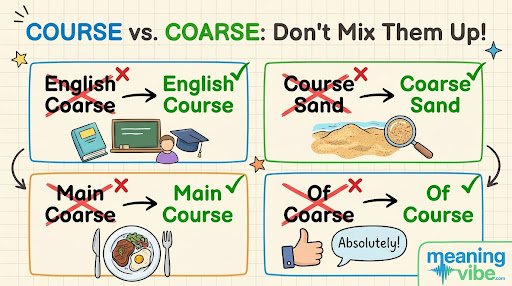
Course of action is a plan phrase, and it uses course for a way of proceeding, as shown above. Course of history uses course for the progression of events over time. Course of study uses course for a programme, and course of lectures uses it for a series of talks.
A table of fixed phrases is more useful than a list of rules, because phrases are learned as wholes. Writers should memorise the five phrases in this section as course phrases, and then use the substitution test for everything else. That combination covers most real-world errors in this pair.
| Fixed phrase | Meaning | Why it uses course |
| Of course | Certainly, naturally | Idiom, fixed spelling, never coarse |
| Matter of course | Routine, natural part of a process | Course as progression or routine |
| Par for the course | Normal or expected, often mildly disappointing | Course from golf, expected score |
| Over the course of | During a period of time | Course as duration or progression |
| In due course | At the proper time | Course as timeline |
| Stay the course | Continue despite difficulty | Course as route or plan |
| Course of action | Plan or way of proceeding | Course as method |
| Course of history | Progression of events | Course as unfolding time |
The 5-Second Test: Rough, Path, Class, and Part of Speech
Step 1: Find the job. Ask whether the word describes a noun, names a thing, or names an action. If it describes, the answer is coarse; if it names or moves, the answer is course. This step alone solves most sentences, because coarse can only describe.
Step 2: Try rough. Replace the word with rough or rude and read the sentence aloud. If the sentence keeps its sense, the word is coarse, as in coarse sand becoming rough sand. If the sentence breaks, the word is not coarse, so move to the next step.
Step 3: Try path or class. Replace the word with path, class, or part and read the sentence aloud. If one of those fits, the word is course, as in English course becoming English class. If none fits, the sentence may need a different word altogether, not either member of the pair.
Step 4: Check fixed phrases. If the sentence contains of course, matter of course, par for the course, or over the course of, the spelling is course by definition. Fixed phrases do not follow the substitution test, because their meaning is idiomatic, so they must be learned as wholes.
Worked Examples of the Test
Example 1: “The towel feels ___.” Rough fits, so the word is coarse: the towel feels coarse. Path and class do not fit, which confirms the choice from the other direction. The test gives the same answer from both sides, which is a good sign.
Example 2: “I enrolled in a writing ___.” Class fits, so the word is course: I enrolled in a writing course. Rough does not fit, which confirms the choice from the other direction. The test works because the sentence is about learning, not texture.
Example 3: “___ , I agree with you.” Certainly fits, so the phrase is of course, with course as the fixed spelling. Rough does not fit, and path does not fit as a phrase, which confirms that this is an idiom case. Fixed phrases are the exception that proves the need for Step 4.
Example 4: “Blood ___ through her veins.” Flowed fits, so the word is coursed, the past tense of the verb course. Rough does not fit, and class does not fit, which confirms that this is a verb case. The verb test is the strongest version of the part-of-speech test.
Rough-Surface Path vs Route: When “Coarse Path” Is Correct
A path with a rough surface can be coarse, because coarse describes the surface, not the route. A coarse gravel path has large, rough gravel, and the word coarse modifies gravel, not path. That sentence is correct, and it is the only case where coarse and path appear together without an error.
The route itself is a course, because a route is a line taken, not a surface. The course of the path through the woods is the direction it takes, and that phrase uses course for route. A writer who confuses these two cases will write coarse path for a route, which is wrong.
The distinction is subtle, but it can be taught with a simple question: are you describing the surface or the route? If the answer is surface, the word is coarse; if the answer is route, the word is course. A path can be both coarse in surface and a course in route, but the two words describe different things.
Examples That Show the Distinction
Correct surface use: “The coarse gravel path hurt bare feet.” The gravel is large and rough, so coarse is correct. Correct route use: “We followed the course of the path into the mountains.” The direction is the course, so course is correct.
Incorrect route use: “We followed the coarse of the path into the mountains.” The sentence needs a route word, so coarse is wrong and course is correct. Incorrect surface use: “The course gravel path hurt bare feet.” The sentence needs a texture word, so course is wrong and coarse is correct.
Writers should avoid coarse path without a surface noun, because it invites confusion even when it is technically correct. Coarse gravel path is clearer than coarse path, because the surface noun makes the description explicit. Clarity, not just correctness, is the goal in this edge case.
Wrong Examples, Corrected
Wrong: “I’m taking a coarse in computer science.” Correct: “I’m taking a course in computer science.” The sentence is about learning, so the word must be course, and the substitution test confirms it: class fits, rough does not.
Wrong: “The towel feels course.” Correct: “The towel feels coarse.” The sentence is about texture, so the word must be coarse, and the test confirms it: rough fits, class does not. This is the most common course for coarse error in everyday writing.
Wrong: “He made a course joke.” Correct: “He made a coarse joke.” The sentence is about vulgar behaviour, so the word must be coarse, and the test confirms it: rude fits, path does not. A joke cannot be a route, a class, or a meal part.
Wrong: “Of coarse, I agree with you.” Correct: “Of course, I agree with you.” The phrase is a fixed idiom, so the spelling is course by definition, and no substitution test is needed. This error is common because the idiom is spoken far more often than it is written.
More Wrong Examples, Corrected
Wrong: “She took an English coarse.” Correct: “She took an English course.” The sentence is about a programme of study, so the word must be course. English class fits, English rough does not, which is the fastest check for this error.
Wrong: “The dish called for course salt.” Correct: “The dish called for coarse salt.” The sentence is about grain size, so the word must be coarse. Large-grained salt fits, class salt does not, which is the fastest check for this error.
Wrong: “They followed the coarse of the river.” Correct: “They followed the course of the river.” The sentence is about a route, so the word must be course. Path of the river fits, rough of the river does not, which is the fastest check for this error.
Wrong: “The waiter served the main coarse.” Correct: “The waiter served the main course.” The sentence is about a meal part, so the word must be course. Main part fits, main rough does not, which is the fastest check for this error.
A Warning About Wrong Sources
One top-ranked grammar page defines this pair incorrectly, using accept and except meanings for coarse and course. That page’s definitions, examples, and quiz answers are wrong for this pair, and they must not be copied. The correct meanings are verified against Dictionary.com, Oxford, and Merriam-Webster, which all agree on the split in this article.
Another grammar page lists the same sentence as both incorrect and correct for a cloth example, which is a source typo, not a teaching point. That page’s mistake does not change the rule: the cloth was coarse is correct for texture, and the cloth was course would be wrong. Writers should trust dictionaries over blogs when a blog contradicts itself.
A third page suggests “a coarse path” for “a rough path” without explaining the surface-versus-route distinction above. That suggestion is only correct if the path’s surface is rough, and it is misleading without that explanation. This article’s surface-versus-route section exists to correct that gap.
Pronunciation: Both Words Sound the Same
Coarse and course are both pronounced /kɔːrs/ in American English, with a rhotic r sound that is heard clearly. In British English, both are pronounced /kɔːs/, with a non-rhotic vowel and no heard r in most accents. The spelling difference cannot be heard, so pronunciation alone can never decide the choice.
Homophones are words that sound alike but differ in meaning and spelling, and coarse and course are a textbook example. Other homophone pairs in this cluster include cite, site, and sight, and censor and censure, which are covered in related MeaningVibe guides. The teaching point is the same: sound does not decide spelling, meaning does.
Syllable stress is the same for both words, because each is a single syllable with a long vowel. Coarse has one syllable, course has one syllable, and neither has a stress pattern to distinguish it. That is why a written test, not a spoken test, is needed for this pair.
Pronunciation in Different Accents
American English pronounces the r in both words, so coarse and course sound like KORS with a clear r. British English in most accents does not pronounce the r, so both words sound like KAWS with a long vowel. The spelling is the same in both varieties, unlike colour and color, which differ by country.
Regional accents can make the vowel slightly different, but they do not create a distinction between the two words. A speaker from Texas, London, or Sydney will still pronounce coarse and course the same way within their own accent. That uniformity is why the pair is confused across all English varieties.
Pronunciation audio is useful for learners, but it cannot teach the spelling distinction, because the audio is identical for both words. A pronunciation guide for this pair should therefore pair audio with a written example for each word. Audio alone will confirm the sound and leave the spelling unresolved.
Why They Sound Alike: History and Etymology
Course comes from Latin cursus, meaning a running, movement, or journey, via Old French cours. That history explains its route, progression, and programme senses, because a journey can be a path, a series of lessons, or a span of time. The word entered English with a broad sense of movement, and it kept that breadth.
Coarse comes from late Middle English, in the sense of ordinary or inferior, and its origin is uncertain according to Oxford. Until the 17th century, coarse was identical in spelling with course, and it may be derived from course in the sense of ordinary manner. That shared spelling is the historical reason the two words are now confused.
The spelling divergence is dated to the 17th century by Oxford, while one grammar blog claims the 18th century. That conflict should not be resolved by copying either blog, because Oxford is the dictionary authority and the blog is not. This article follows Oxford’s 17th-century note and flags the 18th-century claim as unverified.
What the History Teaches Writers
Shared spelling history explains why the pair feels like one word with two spellings, rather than two unrelated words. Coarse may have started as course in the sense of common or ordinary manner, which then became rough or inferior. That path from ordinary to rough is the bridge between the two words’ histories.
Latin cursus also gives English words like curriculum, current, and cursor, all of which involve running or flowing. Coarse has no such family, because its origin is uncertain and its sense is descriptive, not motional. That family difference is a useful memory aid for advanced learners.
History does not decide modern spelling, but it does explain why the confusion is so persistent. A pair that once shared a spelling, and still shares a sound, will always be confused by writers who rely on sound. The only defence is a meaning test, which is why this article returns to that test in every section.
Memory Tricks That Actually Work
Trick 1: A = adjective. Coarse contains a, and adjective starts with a, so the a in coarse signals its part of speech. Course has no a, and it is never an adjective, so the absence of a is a warning sign. This trick works for coarse, but it does not explain course senses.
Trick 2: U = university. Course contains u, and university contains u, so the u in course signals a class or programme. Coarse has no u, and it is never a class, so the absence of u is a warning sign. This trick works for the education sense, but it does not explain route, meal, or progression senses.
Trick 3: Rough test. If rough or rude can replace the word, the word is coarse; if path or class can replace it, the word is course. This trick works for most sentences, because it tests meaning rather than spelling. It fails only for fixed phrases, where Step 4 of the 5-second test must take over.
Trick 4: Of course anchor. Memorise of course as a fixed phrase with course, and use it as an anchor for the whole pair. If a sentence contains of course, the spelling is course, and that anchor can be extended to other fixed phrases. This trick works because of course is the most common phrase in the pair.
Pros and Cons of Each Trick
| Trick | Pros | Cons |
| A = adjective | Links coarse to its only part of speech, easy to recall | Does not help with course senses, only with coarse |
| U = university | Links course to its most common sense, easy to recall | Course has many senses beyond class, so the trick is incomplete |
| Rough test | Tests meaning, works for texture and behaviour | Fails for fixed phrases, where meaning is idiomatic |
| Of course anchor | Most common phrase, fixed spelling, high frequency | Only helps phrases, not new sentences |
| Path or class test | Tests meaning, works for route and education | Fails for meal and progression senses without a part test |
The best approach is to combine tricks, rather than relying on one trick alone. Use A = adjective for coarse, rough test for texture, path or class test for route and education, and of course anchor for fixed phrases. A combined approach covers more sentences than any single trick, and it is more robust under time pressure.
Practice is more reliable than tricks, because tricks fade under pressure while habits persist. Writers should practise the 5-second test on ten sentences a day for a week, using the quiz below. After that week, the test becomes automatic, and the tricks become backup rather than the main tool.
Quiz: 10 Questions With Explanations
Question 1: The road changed ___ after the storm. Answer: course. The sentence is about a route, so the word must be course, and path fits while rough does not. The storm changed the direction, not the texture, of the road.
Question 2: She complained about his ___ manners. Answer: coarse. The sentence is about rude behaviour, so the word must be coarse, and rude fits while path does not. Manners are described, not named as a route or a class.
Question 3: We enjoyed a three-___ meal. Answer: course. The sentence is about meal parts, so the word must be course, and part fits while rough does not. A three-course meal has three parts, served in order, not three textures.
Question 4: The material is too ___ for a baby’s skin. Answer: coarse. The sentence is about texture, so the word must be coarse, and rough fits while class does not. A baby’s skin needs smooth material, not rough material.
Question 5: I signed up for an online photography ___. Answer: course. The sentence is about a programme of study, so the word must be course, and class fits while rough does not. Photography is learned, not felt as a texture.
Question 6: It’s not unusual to kiss on the cheek as a greeting; it’s simply a matter of ___. Answer: course. The phrase is matter of course, a fixed phrase meaning routine, so the spelling is course by definition. No substitution test is needed for a fixed phrase.
Question 7: These grains of sugar are too fine; I need something a little more ___. Answer: coarse. The sentence is about grain size, so the word must be coarse, and large-grained fits while class does not. Fine is the opposite of coarse in this sense, which confirms the choice.
Question 8: I need to speak to my father about his habit of using ___ language around my baby. Answer: coarse. The sentence is about rude language, so the word must be coarse, and rude fits while path does not. Language is described, not named as a route or a class.
Question 9: I’m so hungry I could eat a five-___ meal. Answer: course. The sentence is about meal parts, so the word must be course, and part fits while rough does not. A five-course meal has five parts, not five textures.
Question 10: My coworkers insult me every day; it’s just par for the ___. Answer: course. The phrase is par for the course, a fixed phrase meaning normal or expected, so the spelling is course by definition. The phrase comes from golf, where par is the expected score.
Common Mistakes to Avoid
Mistake 1: Using course for texture. “The course sand hurt my feet” is wrong, because sand’s texture needs coarse. The test is simple: rough sand fits, class sand does not, so the word must be coarse. This mistake is common because course is the more frequent word overall.
Mistake 2: Using coarse for a class. “I’m taking an English coarse” is wrong, because a programme needs course. The test is simple: English class fits, English rough does not, so the word must be course. This mistake is common in student writing, where the class sense is new.
Mistake 3: Using coarse in of course. “Of coarse, I agree” is wrong, because the idiom is fixed as of course. No substitution test is needed, because the phrase is learned as a whole, and its spelling is course by definition. This mistake is common in fast typing, where sound guides spelling.
Mistake 4: Using coarse for a meal part. “The main coarse was roast duck” is wrong, because a meal part needs course. The test is simple: main part fits, main rough does not, so the word must be course. This mistake is common in restaurant writing, where the meal sense is less familiar than the class sense.
More Mistakes to Avoid
Mistake 5: Using course for behaviour. “His course jokes offended the guests” is wrong, because vulgar behaviour needs coarse. The test is simple: rude jokes fits, class jokes does not, so the word must be coarse. This mistake is common because course is the default spelling for many writers.
Mistake 6: Using coarse for a route. “They followed the coarse of the river” is wrong, because a route needs course. The test is simple: path of the river fits, rough of the river does not, so the word must be course. This mistake is common in geography and travel writing.
Mistake 7: Using course for grain size. “The recipe needs course sugar” is wrong, because grain size needs coarse. The test is simple: large-grained sugar fits, class sugar does not, so the word must be coarse. This mistake is common in cooking writing, where course also appears as a meal sense.
Mistake 8: Trusting spellcheck alone. Spellcheck will not flag coarse for course, because both are valid words, so a manual meaning test is required. Writers should proofread homophone pairs by meaning, not by spelling, and they should use the 5-second test on every instance. That habit is more reliable than any automated check for this pair.
Writing Contexts: Academic, Business, and Everyday
Academic writing uses course most often for programmes of study, and coarse rarely for texture or behaviour. A course in economics is a programme, coursework is assessed work, and course of study is a degree programme. Academic writers should check every course instance for the education sense, and every coarse instance for the adjective job.
Business writing uses course for plans and idioms, and coarse for quality judgements that should be used carefully. Course of action is a plan, over the course of is a duration, and of course is a politeness phrase. Business writers should avoid coarse for people, because it labels behaviour as rude, and they should use rough or unrefined for objects instead.
Everyday writing uses course for idioms and meals, and coarse for texture and language. Of course appears in messages, main course appears in dinner plans, and coarse language appears in complaints. Everyday writers should memorise of course as an anchor, because it is the phrase they will write most often in this pair.
Context-Specific Guidance
Cooking writing needs both words, and it needs them in different sections, which is why it is a high-error context. Coarse salt and coarse sugar are ingredients, while main course and three-course meal are meal parts. A recipe that uses both should check each instance with the substitution test, because sound alone will not distinguish them.
Geography and travel writing needs course for routes and coarse for surfaces, and it needs the surface-versus-route distinction above. Course of the river is a route, coarse gravel is a surface, and coarse gravel path is a surface description. Travel writers should name the surface noun explicitly, as in coarse gravel path, to avoid ambiguity.
Education writing needs course for programmes and coarse almost never, which makes coarse for course errors more likely. English course, biology course, and training course are all programmes, and they should be checked against class as a substitute. Education writers should also check coursework and course of study as programme phrases, not texture phrases.
Golf and sports writing needs course for grounds and coarse rarely, which makes the pair feel one-sided. Golf course is a ground, race course is a track, and par for the course is an idiom from golf. Sports writers should check par for the course as a fixed phrase, because it is the only idiom in this pair that comes from a sport.
Expert Tips
- Learn coarse first, then course as everything else. Coarse has one job, course has many senses, so learning the smaller set first reduces errors. A writer who knows coarse cold will rarely swap it for course.
- Use the substitution test on every instance. Replace the word with rough for coarse, and with path or class for course, and read the sentence aloud. A test that takes five seconds prevents an error that takes a reader’s trust.
- Memorise of course as an anchor. Of course is the most common phrase in the pair, and its spelling is fixed as course. An anchor phrase gives a writer a known correct instance to compare new sentences against.
- Name the sense before choosing the spelling. Ask whether the sentence needs texture, grain, behaviour, route, class, meal, progression, or verb, and then choose the word for that sense. Sense-first writing is slower at first, but it becomes automatic with practice.
- Check fixed phrases as wholes. Matter of course, par for the course, and over the course of are idioms, and their spelling cannot be guessed from sound. Learn them as wholes, and check them as wholes in proofreading.
- Name the surface noun in path sentences. Write coarse gravel path rather than coarse path, because the surface noun makes the description explicit. Clarity prevents the surface-versus-route confusion that even grammar blogs get wrong.
- Proofread homophones by meaning, not by spelling. Spellcheck will not flag coarse for course, because both are valid words, so a manual meaning check is required. Read each instance, apply the substitution test, and correct by sense.
- Keep a personal error list. Note which error you make most often — of coarse, English coarse, or course sand — and check that error first in proofreading. A personal list is more useful than a generic list, because it targets your own habit.
- Use dictionaries for definitions, not blogs for rules. Dictionary.com, Oxford, and Merriam-Webster agree on this pair, while grammar blogs contradict each other and themselves. When a blog and a dictionary disagree, follow the dictionary.
- Practise with the quiz, not just the rules. Take the 10-question quiz above, explain each answer in your own words, and then write ten new sentences with the pair. Practice turns a rule into a habit, and a habit survives time pressure better than a trick.
FAQs
What is the difference between coarse and course?
Coarse is an adjective meaning rough, large-grained, or crude, while course is a noun or verb meaning a path, a class, a meal part, a progression, or swift movement. Coarse describes a noun, course names a thing or an action, and that part-of-speech split never changes.
What does coarse mean?
Coarse means rough, not smooth, or made of large parts, and it can also mean rude or unrefined in behaviour. Coarse sand has large grains, coarse fabric feels scratchy, and coarse language sounds rude. The opposite of coarse in texture is fine.
What does course mean?
Course means a route, a programme of study, a part of a meal, a progression, or swift movement, depending on context. A golf course is a ground, an English course is a programme, and the main course is a dinner part. The verb sense means to run or flow swiftly, as in blood coursed.
Is coarse an adjective?
Yes, coarse is always an adjective, and it never works as a noun or a verb in modern English. Its forms are coarser, coarsest, coarsely, and coarseness, all of which confirm its adjective job. If a sentence needs a noun or a verb, the word cannot be coarse.
Is course a noun or a verb?
Course is usually a noun, and sometimes a verb, but it is never an adjective in modern English. As a noun it names a route, a class, a meal part, or a progression, and as a verb it means to run or flow swiftly. Course material uses course as a noun modifier, not as an adjective.
Can course be used as an adjective?
No, course cannot be used as an adjective, even though it can appear before a noun as a noun modifier. Course material means material for a course, and the head noun is still material. If a sentence needs a describing word for roughness, the word must be coarse.
How do you pronounce coarse and course?
Both words are pronounced /kɔːrs/ in American English and /kɔːs/ in British English, with the same vowel and the same single syllable. The spelling difference cannot be heard, so pronunciation alone can never decide the choice. Only meaning and grammar can guide the spelling.
Are coarse and course homophones?
Yes, coarse and course are homophones, which means they sound alike but differ in meaning and spelling. Homophones are confused because sound guides spelling in speech, but spelling must follow meaning in writing. That is why a meaning test, not a sound test, is needed for this pair.
What is the opposite of coarse?
The opposite of coarse in texture is fine, which means small-grained or smooth, as in fine sand versus coarse sand. In behaviour, the opposite is polite or refined, as in polite manners versus coarse manners. The opposite depends on the sense, so it must be chosen by context.
What is the opposite of course?
Course has no single opposite, because it has many senses, and each sense has a different opposite. A route’s opposite might be a detour, a class’s opposite might be a break, and a meal part’s opposite might be a whole meal. Writers should answer by sense, not by a single word.
Is it of course or of coarse?
It is always of course, never of coarse, because of course is a fixed idiom meaning certainly or naturally. The phrase is so common that it is the best anchor for the whole pair, and its spelling is course by definition. No substitution test is needed for a fixed phrase.
Is it English course or English coarse?
It is always English course, never English coarse, because the sentence is about a programme of study. English class fits as a substitute, while English rough does not, which confirms the choice. This error is common in student writing, where the class sense is new.
Is it coarse salt or course salt?
It is coarse salt, never course salt, because the sentence is about grain size, not a programme or a route. Large-grained salt fits as a substitute, while class salt does not, which confirms the choice. Coarse salt has large crystals, while fine salt has small crystals.
Is it coarse sand or course sand?
It is coarse sand, never course sand, because the sentence is about texture and grain size. Rough sand fits as a substitute, while path sand does not, which confirms the choice. Coarse sand drains quickly and feels gritty, while fine sand feels smooth.
What does of course mean?
Of course means certainly, naturally, or as expected, and it is used to agree or to state something obvious. Of course, I agree means certainly I agree, and of course is always spelled with course. The phrase is an idiom, so its spelling must be learned as a whole.
What does matter of course mean?
Matter of course means something that happens naturally or as a routine part of a process, as in reports being checked as a matter of course. The phrase uses course for routine progression, and it never uses coarse. It is a fixed phrase, so its spelling is learned as a whole.
What does par for the course mean?
Par for the course means what is normal or expected in a situation, often something mildly disappointing, as in delays being par for the course. The phrase comes from golf, where par is the expected score, and it uses course from golf course. It is a fixed phrase, so its spelling is course.
What does over the course of mean?
Over the course of means during a period of time, as in over the course of the year or over the course of the meeting. The phrase uses course for duration or progression, and it never uses coarse. It is a time phrase, so it belongs to course sense 4.
What does course of action mean?
Course of action means a plan or a way of proceeding in a situation, as in choosing the wisest course of action. The phrase uses course for a method, and it never uses coarse. It appears in business, law, and everyday decisions, and it is always spelled with course.
What is a three-course meal?
A three-course meal is a meal with three parts served in order, typically a starter, a main course, and a dessert. First course might be soup, main course might be roast duck, and dessert course might be fruit. The phrase uses course for meal parts, never coarse.
What is coarse fishing?
Coarse fishing is a chiefly British term for fishing for non-game freshwater fish, such as carp and roach, as opposed to game fishing for trout or salmon. Coarse fish are the fish themselves, and the term has nothing to do with roughness. American writers rarely need this sense, but they should recognise it.
What is a coarse adjustment?
A coarse adjustment is a large-scale adjustment that is not precise or detailed, as in a coarse adjustment on a tool or a coarse outline in a report. The sense keeps the idea of large scale and low precision, which is the core of coarse. It is a technical sense, not a texture sense, but it follows the same adjective job.
What does blood coursed mean?
Blood coursed means blood flowed swiftly, as in blood coursed through veins during a race or a fright. Coursed is the past tense of the verb course, which means to run or flow swiftly, and it is a literary use. Coarse can never be a verb, so a verb slot must take course.
Did coarse and course once share a spelling?
Yes, coarse and course were identical in spelling until the 17th century, according to Oxford, and coarse may be derived from course in the sense of ordinary manner. That shared spelling is the historical reason the two words are now confused, even though their modern meanings are distinct. One grammar blog claims the 18th century, but Oxford is the dictionary authority for this note.
How do I remember coarse vs course?
Use the 5-second test: rough means coarse, path or class means course, and of course is always course. Pair that test with two letter tricks: coarse has an “a” like adjective, and course has a “u” like university. A combined approach covers more sentences than any single trick, and practice turns the test into a habit.
Conclusion on Coarse vs Course
Coarse vs course is a small pair with a large effect, because a single letter changes a description into a route, a class, or a meal. Coarse describes roughness, large grains, or crude behaviour, and it always works as an adjective. Course names a path, a class, a meal part, or a progression, and it works as a noun or a verb.
The habit that prevents errors is simple, and it fits in five seconds: try rough for coarse, try path or class for course, and memorise of course as a fixed phrase. Writers who apply that habit, and who check fixed phrases as wholes, will choose the right spelling without hesitation. The sense maps, tables, and quiz in this guide exist to make that habit automatic, not to replace it.
For MeaningVibe readers, the next step is practical rather than theoretical: take the 10-question quiz above, then apply the 5-second test to your next ten sentences. That practice, repeated for a week, will turn a rule into a habit, and a habit will survive the time pressure that causes most coarse vs course errors.