

Reported speech examples teach faster than rules, because a conversion is a small visible machine: the direct sentence goes in, and the reported sentence comes out with every change on show.
This bank prints 87 fully worked pairs. They are sorted three ways at once, by sentence type, by tense and modal lane, and by the reporting verb pattern each pair forces.
Where the authorities disagree, the bank prints both answers as labelled strands. Must, shall, the past simple and still-true statements keep their rival forms, because a single blended answer would be wrong somewhere.
Reported speech is also called indirect speech, and the two names cover one system. Cambridge Dictionary Grammar frames the changes as the ones we make because time has passed between speaking and reporting.
Read the bank by lane, not from the top, once you know your weak lane. A learner who only misses questions needs sections C and D; a learner who only misses modals needs section B and the must rows.
The companion reported speech rules guide on this site owns the full backshift system and the no-backshift decision. This page owns the pairs themselves, the lane tables they build, and the practice sets.
Every pair here was checked against the strand positions before publication. Writer-facing references such as Grammarly’s direct and reported speech guide frame the topic for working writers, and the bank follows that example-first habit.
The Bank at a Glance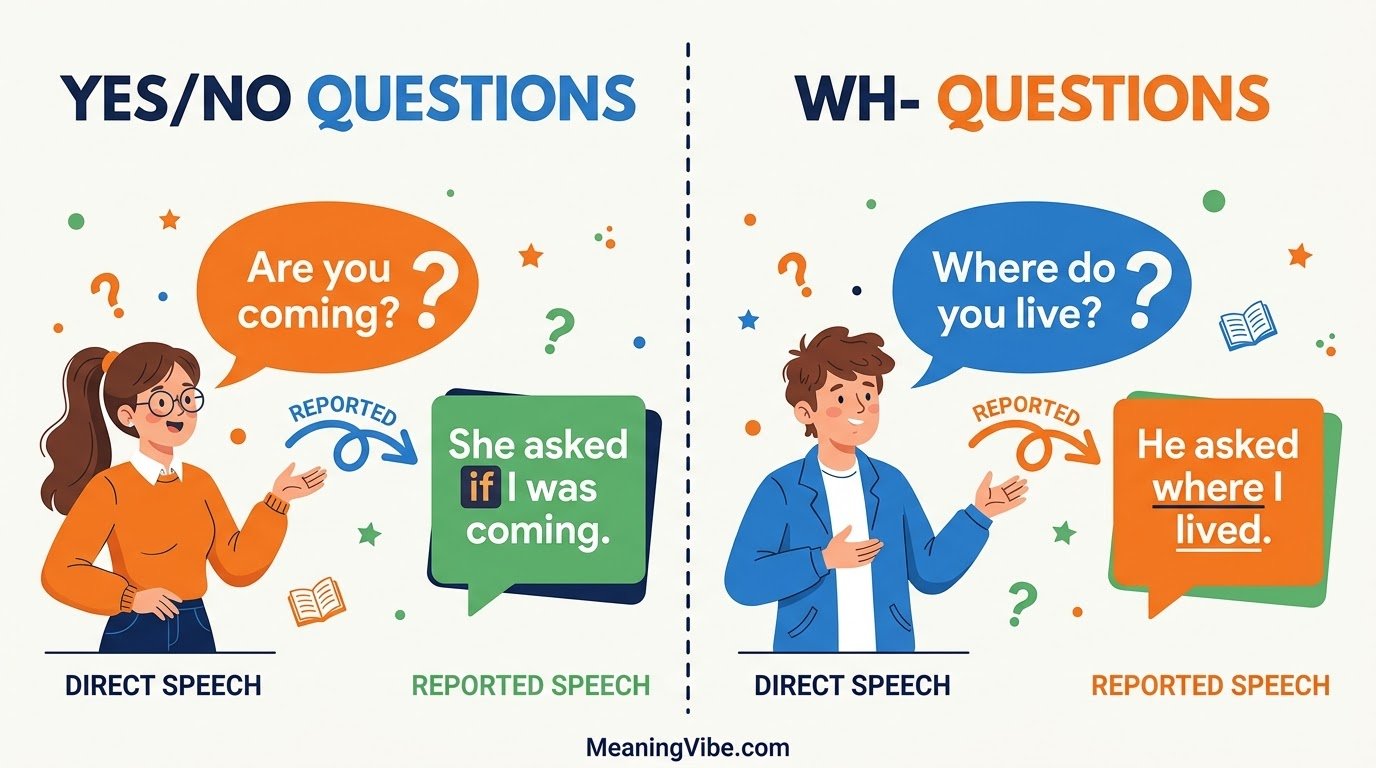
|
Section |
What it covers |
Pairs |
|---|---|---|
|
A. Statements, lane by lane |
Every tense lane, plus the no-backshift rows |
28 |
|
B. Modal lanes |
Can, may, shall, must and the modals that never change |
13 |
|
C. Yes and no questions |
If and whether, negative questions, permission |
8 |
|
D. Wh questions |
Statement order restored, question word kept |
8 |
|
E. Commands, requests and advice |
Object plus to-infinitive, function over form |
8 |
|
F. Reporting verb variety |
Promise, warn, admit, deny, suggest, offer, explain |
8 |
|
G. Pronoun, time and place shifts |
The shifts inside pairs, plus the same-day proof |
8 |
|
H. Mixed and tricky cases |
Exclamations, greetings, wishes, conditionals |
6 |
|
Total |
The full classified bank |
87 |
The count is the point, and it is countable on the page. The largest classified bank elsewhere, at Games4ESL, prints roughly a hundred pairs but converts some of them inconsistently.
Three-way sorting is the bank’s real claim, because each sort answers a different failure. Sentence type finds your homework item, the lane finds your tense gap, and the verb pattern finds the frame your sentence must fit.
Other big lists print a hundred reported sentences with no direct side at all, like the set at EnglishGrammar.org. A reported sentence alone cannot teach a conversion, because the change itself stays invisible.
Statements, Lane by Lane
A reported statement keeps the speaker’s content and rebuilds it from the reporter’s viewpoint. The reporting verb is usually said, that is optional, and the tense steps back one lane when the report is later.
That is optional in statements and impossible in questions, which is why it appears and disappears across the bank. Dropping it changes nothing in the reported clause; keeping it is the exam-safe habit.
Present Lanes
Present simple and present continuous step back to past simple and past continuous.
|
Direct speech |
Reported speech |
|---|---|
|
She said, “I work in a bank.” |
She said (that) she worked in a bank. |
|
He said, “I like ice cream.” |
He said (that) he liked ice cream. |
|
They said, “We live near the station.” |
They said (that) they lived near the station. |
|
Maria said, “I don’t speak French.” |
Maria said (that) she didn’t speak French. |
|
She said, “I am living in London.” |
She said (that) she was living in London. |
|
He said, “We are watching the news.” |
He said (that) they were watching the news. |
|
Anna said, “I am waiting for my sister.” |
Anna said (that) she was waiting for her sister. |
|
Tom said, “It is raining.” |
Tom said (that) it was raining. |
The two present lanes anchor the whole system, so they reward a slow look. The step from works to worked is the present simple move, and living to was living is the present continuous move.
Perfect Lanes
Present perfect steps back to past perfect, and present perfect continuous to past perfect continuous.
|
Direct speech |
Reported speech |
|---|---|
|
She said, “I haven’t seen Julie.” |
She said (that) she hadn’t seen Julie. |
|
He said, “We have finished the report.” |
He said (that) they had finished the report. |
|
Lucy said, “I have lost my keys.” |
Lucy said (that) she had lost her keys. |
|
She said, “I have been working all day.” |
She said (that) she had been working all day. |
|
They said, “We have been waiting for an hour.” |
They said (that) they had been waiting for an hour. |
The perfect lanes move as one family, from have finished to had finished. Our present perfect rules and present perfect examples pages work the source forms, and the present perfect continuous page covers the longest lane.
Past Lanes
Past forms step back once, and the past perfect cannot move at all.
|
Direct speech |
Reported speech |
|---|---|
|
He said, “I bought a car.” |
Strand A: He said (that) he had bought a car. Strand B: He said (that) he bought a car. |
|
Sarah said, “I came back yesterday.” |
Sarah said (that) she had come back the day before. |
|
She said, “I woke up early.” |
She said (that) she had woken up early. |
|
He said, “I was walking along the street.” |
He said (that) he had been walking along the street. |
|
They said, “It was raining.” |
They said (that) it had been raining. |
|
He said, “I had taken English lessons before.” |
He said (that) he had taken English lessons before. |
The first row is the bank’s most argued conversion, so it prints both strands. Perfect English Grammar owns Strand B: the retained past simple stays correct when the sequence is already clear.
One minor strand leaves the past continuous unchanged in the raining row. The majors move it to past perfect continuous, and the bank prints the major form.
The past perfect row shows the floor of the system, because had taken cannot step back again. The source lanes sit in our past simple, past continuous, past perfect and past perfect continuous guides.
Future and Going To Lanes
Will steps back to would, future continuous to conditional continuous, and going to backshifts with be.
|
Direct speech |
Reported speech |
|---|---|
|
He said, “I’ll see you later.” |
He said (that) he would see me later. |
|
They said, “I will phone you tomorrow.” |
They said (that) they would phone me the next day. |
|
He said, “I won’t be late.” |
He said (that) he wouldn’t be late. |
|
She said, “I will be flying to Tokyo on Tuesday.” |
She said (that) she would be flying to Tokyo on Tuesday. |
|
She said, “I am going to travel round the world.” |
She said (that) she was going to travel round the world. |
Will is the lane learners meet first, because promises, offers and predictions all live there. The future simple page covers the source form, and the future continuous page covers will be flying and its conditional twin.
Statements That Do Not Move
A present or future reporting verb blocks backshift, and a universal truth never moves.
|
Direct speech |
Reported speech |
|---|---|
|
She says, “I like ice cream.” |
She says (that) she likes ice cream. |
|
He says, “I will be late.” |
He says (that) he will be late. |
|
He said, “The earth moves round the sun.” |
He said (that) the earth moves round the sun. |
|
She said, “I have broken my arm.” |
She said she has broken her arm (British Council wide scoping), or she had broken her arm (narrow and exam strands). |
No-backshift rows are not exceptions to memorize; they follow from distance. A present reporting verb means no time has passed, a universal truth is still true now, and a still-true statement splits the authorities into the four scopings the last row names.
Modal Lanes: Can, May, Shall, Must and the Verbs That Never Change
Modal lanes move less than tense lanes, and three of them barely move at all. Could, might, should and would are already one step back, so the report leaves them exactly where they stand.
Ought to and used to join the no-change set, for the same reason as could and might. Both already sit at the back of their lane, so the report leaves them untouched, as the ought to advice pair in the wider bank shows.
Can steps back to could and may to might, while could, might, should and would never move.
|
Direct speech |
Reported speech |
|---|---|
|
He said, “I can speak perfect English.” |
He said (that) he could speak perfect English. |
|
She said, “I can’t come.” |
She said (that) she couldn’t come. |
|
He said, “I could swim when I was four.” |
He said (that) he could swim when he was four. |
|
He said, “I may be late.” |
He said (that) he might be late. |
|
He said, “I might be late.” |
He said (that) he might be late. |
|
She said, “I shall come later.” |
Strand A: She said (that) she would come later. Strand B: She said (that) she should come later. |
|
He said, “Shall I open the window?” |
He asked if he should open the window. He offered to open the window. |
|
She said, “I should call my mother.” |
She said (that) she should call her mother. |
|
He said, “I must leave at once.” |
Strand A: He said (that) he had to leave at once. Strand B: He said (that) he must leave at once. |
|
The sign said, “Visitors must not park here.” |
The sign said (that) visitors must not park there. |
|
She said, “I must remember to phone Ana.” |
She said (that) she had to remember to phone Ana. Strand: She said (that) she must remember to phone Ana. |
|
He said, “You must be tired.” |
He said (that) I must be tired. |
|
She said, “I would help, but I can’t.” |
She said (that) she would help, but she couldn’t. |
Must is the field’s most contested modal, and it prints here in four positions, never blended. The learner default is had to, and Perfect English Grammar prints must itself alongside it.
The United Nations Editorial Manual, named here in text, holds that must never changes. Prohibition and deduction split off by meaning instead, which is why the sign row and the tired row keep must.
Shall prints in two strands and the bank refuses to pick a winner. Strand A gives would, Strand B gives should or would, and Indian answer keys often print should.
Questions: Yes and No, Wh, Negative and Permission
A reported question is a statement about a question, so it takes statement order and drops the question mark. What changes between the two groups is only the hinge: if or whether for yes and no, the question word itself for wh.
Whether is the formal hinge and the required one before or, as the tea or coffee row shows. If stays the everyday default everywhere else, and the two are interchangeable in most yes and no rows.
Yes and No Questions
Yes and no questions take if or whether, statement word order, and no question mark.
|
Direct speech |
Reported speech |
|---|---|
|
She asked, “Do you like coffee?” |
She asked if I liked coffee. |
|
He asked, “Are you coming?” |
He asked whether I was coming. |
|
They asked, “Have you finished?” |
They asked if I had finished. |
|
She asked, “Did you see the film?” |
She asked if I had seen the film. Strand B keeps saw. |
|
He asked, “Can you help me?” |
He asked if I could help him. |
|
She asked, “Do you want tea or coffee?” |
She asked whether I wanted tea or coffee. |
|
He asked, “Don’t you like it?” |
He asked why I didn’t like it. He asked if I liked it. |
|
She asked, “May I leave early?” |
She asked if she might leave early. She asked for permission to leave early. |
Two rows deserve a second look, because they report function rather than form. The negative question is usually reported by its expected content, and May I is a permission request wearing a question’s clothes.
Wh Questions
Wh questions keep the question word, drop do-support, and restore statement order.
|
Direct speech |
Reported speech |
|---|---|
|
She asked, “Where do you live?” |
She asked where I lived. |
|
He asked, “What time is it?” |
He asked what time it was. |
|
They asked, “Why did you leave?” |
They asked why I had left. |
|
She asked, “Who is coming?” |
She asked who was coming. |
|
He asked, “What happened?” |
He asked what had happened. |
|
He asked, “How long will it take?” |
He asked how long it would take. |
|
They asked, “Whose book is this?” |
They asked whose book that was. |
|
He asked, “What are you doing tomorrow?” |
He asked what I was doing the next day. |
Subject questions are the quiet rows: who was coming and what had happened need no order change. The tense still steps back, which is why happened becomes had happened even when the words stay in place.
Commands, Requests and Advice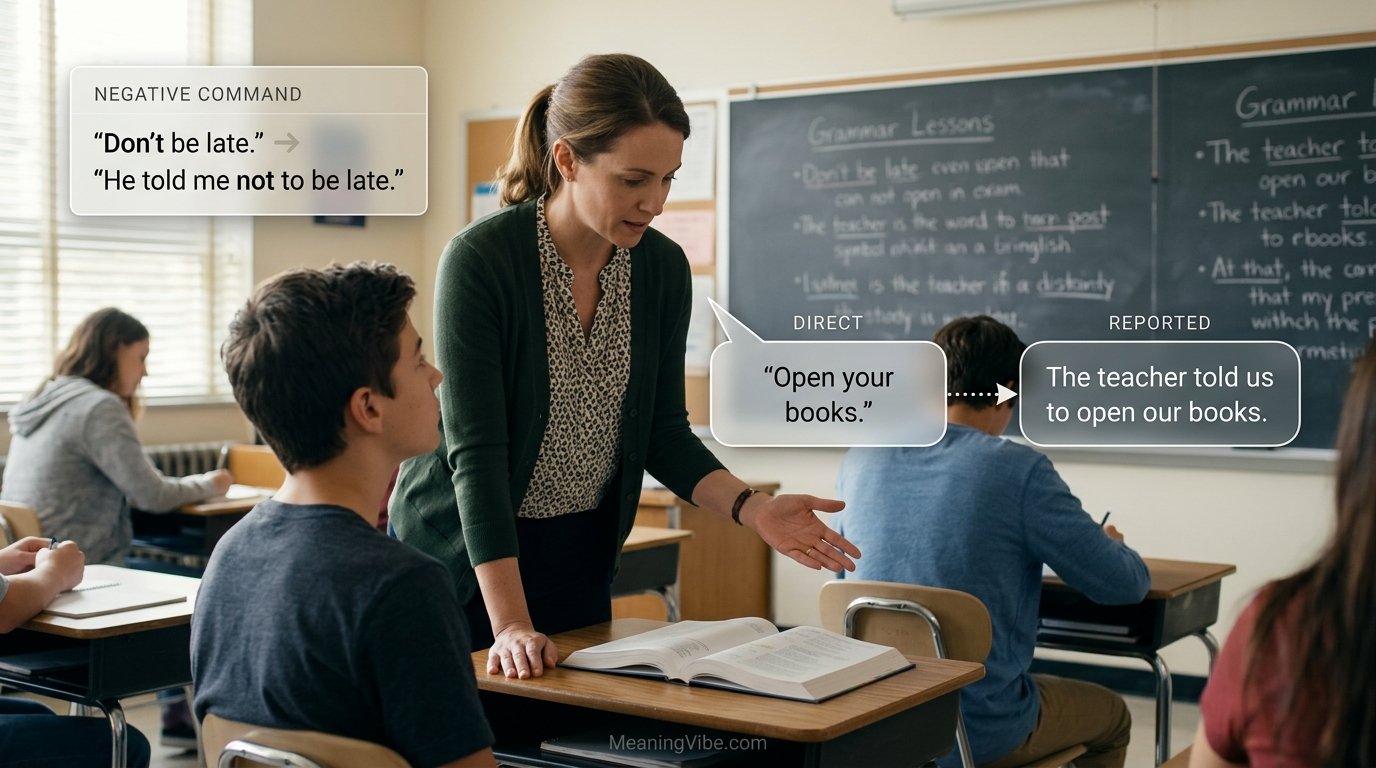
Commands, requests and advice convert to a reporting verb plus object plus to-infinitive, and please is deleted.
|
Direct speech |
Reported speech |
|---|---|
|
The teacher said, “Open your books.” |
The teacher told us to open our books. |
|
He said, “Don’t be late.” |
He told me not to be late. |
|
She said, “Don’t touch that.” |
She warned me not to touch that. |
|
He said, “Please sit down.” |
He asked me to sit down. |
|
She said, “Could you close the window?” |
She asked me to close the window. |
|
She said, “You should see a dentist.” |
She advised me to see a dentist. |
|
He said, “Why don’t you take a break?” |
He suggested taking a break. He suggested that I should take a break. |
|
They said, “Let’s go home.” |
They suggested going home. |
Say and tell split here in the open: said takes no personal object, told demands one. The gallery below shows both errors, because this single contrast produces more wrong conversions than any other in the field.
Politeness changes the verb, not the pattern: please turns told into asked, and a question-shaped request reports as a request. Suggest stands apart, taking -ing or a that-clause, and never an object plus to-infinitive.
Reporting Verbs in Action: Promise, Suggest, Warn, Admit, Deny, Offer
Each reporting verb forces its own pattern, and the pattern is visible inside the pair.
|
Direct speech |
Reported speech |
|---|---|
|
She said, “I’ll help you.” |
She promised to help me. She promised that she would help me. |
|
She said, “You mustn’t tell anyone.” |
She warned me not to tell anyone. |
|
She said, “I’m sorry I broke it.” |
She apologised for breaking it. |
|
He said, “Yes, I took the money.” |
He admitted taking the money. He admitted that he had taken the money. |
|
She said, “I didn’t take the money.” |
She denied taking the money. |
|
He said, “Shall I carry your bag?” |
He offered to carry my bag. |
|
She said, “No, I won’t lend him any money.” |
She refused to lend him any money. |
|
He said, “The train leaves at nine.” |
He explained that the train left at nine. |
The -ing family is small and strict: deny and admit take -ing, and apologise takes for plus -ing. Offer, promise and refuse take the to-infinitive, while explain, like say, refuses a personal object.
The Shifts Inside the Examples: Pronouns, Time Words, Place Words
Time and place words shift only when the day or the place actually changed.
|
Direct speech |
Reported speech |
|---|---|
|
He said, “I saw her today.” |
He said (that) he had seen her that day. |
|
She said, “I’ll do it tomorrow.” |
She said (that) she would do it the next day. |
|
He said, “I finished it two days ago.” |
He said (that) he had finished it two days before. |
|
She said, “I’ll wait here.” |
She said (that) she would wait there. |
|
He said, “This is my seat.” |
He said (that) that was his seat. |
|
She said, “I’m busy now.” |
She said (that) she was busy then. |
|
She said, “I’ll call you tonight.” |
She said (that) she would call me that night. |
|
He said, five minutes later and in the same room, “I’ll wait here.” |
He said he would wait here. |
This section is the bank’s answer to the fixed time-word table, which is quarantined as a method. British Council, named in text, sets the condition: a time word shifts only when the time it points at is no longer accurate.
The last row is the proof pair: reported five minutes later in the same room, here correctly stays here. Any table that shifts it anyway is teaching a mechanical rule the authorities do not hold.
Mixed and Tricky Cases: Exclamations, Greetings, Conditionals
Exclamations, greetings, wishes and conditionals are reported by function, not word by word.
|
Direct speech |
Reported speech |
|---|---|
|
She said, “What a lovely dress.” |
She exclaimed that it was a lovely dress. |
|
She said, “Hello, Tom.” |
She greeted Tom. |
|
He said, “Good luck with the exam.” |
He wished me luck with the exam. |
|
She said, “If I were rich, I would travel.” |
She said that if she were rich, she would travel. |
|
He said, “If it rains, I’ll stay home.” |
He said that if it rained, he would stay home. |
|
She said, reporting her own words at once, “I am tired.” |
She said she is tired. |
Conditionals draw the sharpest line in this section: the first conditional backshifts, the second does not move. Exclamations lose their What a frame, and greetings and wishes collapse into a single function verb.
The Error Gallery: Ten Wrong Conversions, Corrected
Each row below is a documented error, printed in competitor content or harvested from the field’s standard trap lists. The correction follows the strand positions used across the bank, so the gallery and the pairs never contradict each other.
Two defective pairs on the Grammarist reported speech page are named here as a class and deliberately not reproduced. Its examples are quarantined in the research, and the gallery prints only errors that can be corrected cleanly.
|
Wrong conversion |
Correction |
Why it is wrong |
|---|---|---|
|
She said me that she was tired. |
She told me that she was tired. She said that she was tired. |
Say takes no personal object; tell requires one. |
|
He told that he was leaving. |
He said that he was leaving. He told me that he was leaving. |
Tell without its object, the mirror image of the first error. |
|
She asked me where do I live. |
She asked me where I lived. |
Inversion and do-support survive into the reported question; reported questions use statement order. |
|
He asked me that I was coming. |
He asked me if I was coming. |
That cannot report a yes and no question; questions take if or whether. |
|
She suggested me to take a break. |
She suggested taking a break. She suggested that I should take a break. |
Suggest never takes object plus to-infinitive. |
|
He said that he will come tomorrow (reported a week later). |
He said that he would come the next day. |
Half conversion: the tense stayed present while the context moved on. |
|
He said he had had finished his work. |
He said he had finished his work. |
Double backshift: the past perfect pushed one step too far. |
|
She asked if I can help her (reported the next day). |
She asked if I could help her. |
A modal left unshifted inside a question while everything around it moved. |
|
He explained me that the train had left. |
He explained that the train had left. |
Explain patterns like say, not like tell; it takes no personal object. |
|
Mother told me to listen to him (as the report of a mother saying “Listen to me.”). |
Mother told me to listen to her. |
The pronoun left pointing at the wrong person; this error is printed in a widely copied 100-example list and its copies. |
Read the gallery as a checklist before any exam or submission: object after say, missing object after tell, inversion, that for a question. Most wrong conversions a marker sees are sitting in these ten rows.
Practise: Cover the Answer, Then Check
The bank doubles as a practice set when you hide the right-hand column. Academic writing courses, such as the writing resources at St. Louis Community College, teach the same pair-checking habit for quoted material.
- Cover the reported column and convert the direct sentence aloud. Say the whole reported sentence, not just the verb.
- Run the three-move check: pronoun, tense, time word. Each move is either needed or correctly skipped, and the strand rows tell you which.
- Uncover and compare, then mark any difference against the gallery. A difference that matches a gallery row is a pattern to fix, not a slip.
The same conversion habit powers the site’s other transformation pages. The active voice vs passive voice rules guide rebuilds sentences from the other direction, with the same check-before-you-trust discipline.
Frequently Asked Questions
What is reported speech, in one example?
Reported speech retells what someone said without quoting their exact words. Direct: She said, “I am tired.” Reported: She said she was tired.
What are the best examples of reported speech for beginners?
Start with present simple statements, will statements and can statements: I work in a bank becomes she said she worked in a bank; I’ll help you becomes she promised she would help me; I can swim becomes he said he could swim.
How many examples do I need to learn reported speech?
Enough to cover every lane once: twelve tense and modal lanes, two question types, commands, and the reporting verb patterns.
What is an example of reported speech in the present simple?
Direct: He said, “I like ice cream.” Reported: He said (that) he liked ice cream.
What is an example of reported speech in the past simple?
Direct: He said, “I bought a car.” The default school answer is he said he had bought a car, but Perfect English Grammar and Murphy both print the retained form, he said he bought a car, as correct when the sequence is clear.
Does the past simple always change to the past perfect in reported speech?
No. Strand A (British Council, Grammarist, school tables) presents the change as the default. Strand B (Perfect English Grammar and Murphy) prints the retained past simple as correct when the sequence of events is already clear.
What is an example of a reported yes and no question?
Direct: She asked, “Do you like coffee?” Reported: She asked if I liked coffee. Yes and no questions take if or whether, statement word order, and no question mark.
What is an example of a reported wh question?
Direct: She asked, “Where do you live?” Reported: She asked where I lived. The wh word is kept, do-support disappears, and the verb steps back.
Why is there no question mark in a reported question?
Because a reported question is grammatically a statement about a question, not a question itself.
What is an example of a reported command?
Direct: The teacher said, “Open your books.” Reported: The teacher told us to open our books. Commands convert to reporting verb plus object plus to-infinitive, and please is deleted.
How do you report a negative command?
With not before the to-infinitive: He said, “Don’t be late” becomes he told me not to be late. The not never moves after the verb in careful style.
How do you report a polite request that looks like a question?
By its function, not its form. Could you close the window is reported as she asked me to close the window, because the speech act is a request, not a question about ability.
What is the difference between say and tell in examples?
Say takes no personal object: she said that she was tired. Tell requires one: she told me that she was tired.
Can you drop that in reported speech?
Yes, in statements that is optional and usually dropped in speech: she said she was tired.
What does today become in reported speech?
That day, but only when the day actually changed. Reported on the same day, today correctly stays today.
What does ago become in reported speech?
Before: I finished it two days ago becomes he said he had finished it two days before. It is the shift learners forget most in the time-word set, because ago has no obvious partner.
What happens to here and this in reported speech?
They become there and that when the report is made from a different place: I’ll wait here becomes she said she would wait there.
Do pronouns always change in reported speech?
They change to match the reporter’s viewpoint, not by a fixed table. I becomes he or she when someone else reports it, but stays I when you report your own words.
What is an example of reported speech with must?
There are four positions in the field, so the honest answer is a strand set: he said he had to leave (learner default), he said he must leave (Perfect English Grammar prints both), must never changes (United Nations Editorial Manual), and prohibition must usually stays must.
What does shall become in reported speech?
Strand A: would (Perfect English Grammar: I shall come later becomes she would come later). Strand B: should or would (Grammarist; United Nations Editorial Manual). Indian answer keys often print should.
Which modal verbs do not change in reported speech?
Would, could, might, should, ought to, used to, had better and needn’t.
What is an example of a reported offer?
Direct: Shall I carry your bag? Reported: He offered to carry my bag. Offers are reported by function with offer plus to-infinitive, not word by word with if.
How do you report a suggestion with let’s?
With suggest plus -ing or suggest plus that: Let’s go home becomes they suggested going home. Suggest never takes an object plus to-infinitive, so she suggested me to go is wrong.
How do you report an exclamation?
As a statement with exclaim: What a lovely dress becomes she exclaimed that it was a lovely dress. The What a or How frame disappears and statement order takes over.
How do you report hello and good luck?
By function verbs only: Hello, Tom becomes she greeted Tom, and Good luck becomes he wished me luck. Greetings and wishes have no that-clause form.
What is an example of reported speech with no backshift?
She says, “I like ice cream” becomes she says she likes ice cream: a present reporting verb blocks backshift in every source.
When a statement is still true, do you backshift?
It depends on the authority, in four scopings: British Council wide (any still-true statement may stay), Perfect English Grammar narrow (general facts only, and even then usually changed), a middle position (both forms correct, the choice signals currency), and exam practice (backshift anyway).
What is an example of a reported conditional?
Second and third conditionals do not change: If I were rich, I would travel becomes she said that if she were rich, she would travel.
Can you backshift the past perfect?
No. He said, “I had already left” becomes he said he had already left. The past perfect is the floor of the system; pushing it further produces the double backshift error in the gallery.
What is an example of reported speech in the future continuous?
Direct: I will be flying to Tokyo on Tuesday. Reported: She said she would be flying to Tokyo on Tuesday. Will be plus -ing becomes would be plus -ing, the conditional continuous.
How do you report May I leave?
As a permission request: She asked if she might leave early. The form is a question, the function is permission, and the report follows the function.
How do you report a negative question like Don’t you like it?
Usually by its expected content: he asked why I didn’t like it, or he asked if I liked it.
What is the reported speech of I am happy?
She said, “I am happy” becomes she said she was happy.
What is the reported speech of I will call you tomorrow?
He said he would call me the next day: will to would, you re-aimed at the listener, tomorrow to the next day because the day changed. Three systems move in one short example.
Which reporting verbs take the -ing form?
Deny, admit, suggest and apologise for are the core set in the bank: she denied taking it, he admitted taking it, they suggested going, she apologised for breaking it.
Why do some examples keep the past simple instead of the past perfect?
Because the sequence is already clear from context or a time phrase, so the past perfect adds nothing; Perfect English Grammar and Murphy both print the retained form as correct in that case.
What is an example of reported speech for an exam answer?
The exam-safe pattern backshifts fully, shifts the time words and uses the standard verbs: She said, “I will finish it tomorrow” becomes she said that she would finish it the next day.
How do you report what someone thought or felt?
With think, believe, hope and feel in the same frames: I think I have lost it becomes he said he thought he had lost it. Reported thoughts follow the statement track exactly.
What is the difference between reported speech and indirect speech?
Nothing in modern teaching usage: the two names cover the same system. Indirect speech is the older and Indian school term (there called narration); reported speech is the Cambridge and British Council term.
Are there examples of reported speech with answers for practice?
Yes: the bank on this page is built as a practice set, with the direct sentence, the reported answer and a one-line note on what moved.
What are common mistakes in reported speech examples?
The gallery on this page documents ten: say with an object, tell without one, inversion in reported questions, that used for a question, suggest plus object plus to, half conversion, double backshift, unshifted modals, explain with an object, and pronouns pointing at the wrong person.
Where can I get reported speech examples in PDF?
Exercise sites such as e-grammar.org publish free PDF exercises with answer keys, verified for this report.
Conclusion
Reported speech examples work because the change stays visible: pronoun, tense and time word move inside a pair you can inspect. Learn the lanes from the pairs, and the rules become a summary of things you have already seen.
Keep the strand rows beside you when the authorities disagree, and run the three-move check before you trust any conversion, including your own. More worked grammar banks and guides live across MeaningVibe, sorted by the same example-first habit.