

If you’ve ever paused mid-sentence wondering whether to write “today’s meeting” or “todays meeting,” you’re not alone. This tiny apostrophe trips up native speakers, students, and even professional writers every single day.
The good news? Once you understand the simple rule behind it, you’ll never second-guess yourself again.
In this guide, you’ll learn the exact meaning of “today’s,” why “todays” is almost always wrong, how the word evolved historically, and how to apply the rule confidently in emails, reports, and everyday writing.
Todays or Today’s – Quick Answer
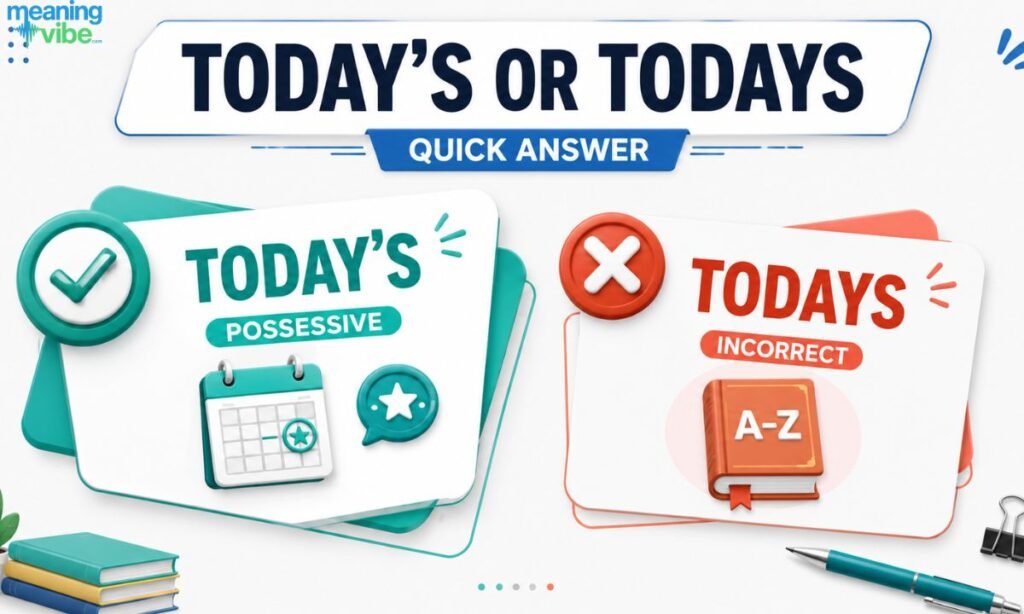
“Today’s” (with an apostrophe) is correct. “Todays” (without an apostrophe) is not a standard English word.
“Today’s” is the possessive form of the noun “today,” used to show that something belongs to or is associated with the present day — for example, today’s weather, today’s news, or today’s date. Because “today” is always singular, it never takes a plural form, which means “todays” has no legitimate grammatical function in modern English.
| Term | Correct? | Function |
| Today’s | ✅ Yes | Possessive form of “today” |
| Todays | ❌ No | Not a recognized word; incorrect plural attempt |
Today’s vs Todays: Examples
Seeing the correct form in context makes the rule easier to remember. Here are some everyday examples:
- Correct: Today’s forecast calls for rain in the afternoon.
- Incorrect: Todays forecast calls for rain in the afternoon.
- Correct: I haven’t read today’s newspaper yet.
- Incorrect: I haven’t read todays newspaper yet.
- Correct: Today’s lesson covers punctuation rules.
- Incorrect: Todays lesson covers punctuation rules.
Notice that in every case, “today’s” is followed by a noun (forecast, newspaper, lesson) that belongs to or relates to the present day.
Today’s vs Todays: Grammar Explained
To understand why the apostrophe matters, it helps to know a basic rule of English possessives.
- Most singular nouns form the possessive by adding an apostrophe + “s” (e.g., dog’s leash, Sarah’s book).
- “Today” follows this same rule, becoming today’s when showing ownership or association.
- Because “today” refers to a single, specific day, it cannot logically take a plural form like “days” or “cats” do. That’s why “todays” doesn’t work grammatically — there’s no concept of multiple “todays” in ordinary usage.
The only rare exception is a stylistic or literary one, such as a book or song title using “todays” as a deliberate plural noun (referring to multiple present moments across different realities or timelines). Outside of creative writing, this usage doesn’t apply to standard grammar.
Today or Today’s: Class

- Correct: Today’s class starts at 9 a.m.
- Incorrect: Todays class starts at 9 a.m.
Here, “today’s” modifies “class,” showing that the class belongs to the current day’s schedule.
Today or Today’s: Activity
- Correct: Today’s activity focuses on team building.
- Incorrect: Todays activity focuses on team building.
The same possessive logic applies — the activity is tied to the present day.
Also Read This: Receive vs. Recieve: What’s the Difference and Which Is Right? (2026)
Today’s or Todays: Meeting
- Correct: Don’t forget about today’s meeting at 3 p.m.
- Incorrect: Don’t forget about todays meeting at 3 p.m.
This is one of the most searched examples online, likely because “meeting” appears so often in workplace communication. Always use the apostrophe here.
Today’s Means Today Is
There’s a second, less common use of “today’s” — as a contraction of “today is.”
- Today’s a beautiful day. (= Today is a beautiful day.)
- Today’s the deadline for submissions. (= Today is the deadline for submissions.)
In this case, the apostrophe doesn’t show possession — it replaces the missing letters in “is.” Context tells you which meaning applies: if a noun follows immediately (today’s meeting), it’s possessive; if an adjective or verb phrase follows (today’s great), it’s a contraction.
The Origin of Todays / Today’s
The word “today” traces back to Old English tō dæġe, meaning “on [this] day.” Over centuries, the two words merged into the single term we use now.
Because English possessives developed the apostrophe + “s” convention for singular nouns, “today’s” naturally follows that same historical pattern once “today” became a standalone noun.
“Todays” never developed as a legitimate plural because the concept of “today” resists pluralization — there’s only ever one “today” at a time.
British English vs. American English Spelling
Good news for global writers: this isn’t a spelling variation issue like “colour” vs. “color.” Both British and American English treat “today’s” identically.
| Region | Preferred Form | Notes |
| American English | Today’s | Standard possessive usage |
| British English | Today’s | Identical rule; no regional variation |
Unlike many words that differ across dialects, the apostrophe rule for “today’s” is universal in standard English.
Which Spelling Should You Use?
Always use today’s when:
- Showing possession or association (“today’s schedule”)
- Forming a contraction of “today is” (“today’s Monday”)
Avoid todays in virtually all formal, academic, and professional writing. It will read as a typo or grammar mistake to most readers and can hurt the credibility of your content.
Common Mistakes with Todays / Today’s
- Dropping the apostrophe entirely — “todays date” instead of “today’s date.”
- Confusing it with “today’s” as a contraction vs. possessive — misplacing punctuation when combining with other words.
- Autocorrect errors — some devices fail to auto-insert apostrophes, leading to accidental “todays” in texts or quick emails.
- Overcorrecting — adding an apostrophe where none is needed, such as in “today’s” used incorrectly as a plural noun.
Today’s / Todays in Everyday Examples
- Business: Today’s sales figures exceeded expectations.
- Education: Today’s homework is due tomorrow.
- News: Today’s headlines focus on the economy.
- Casual conversation: Today’s been a long day.
- Social media: Today’s outfit inspiration.
Todays or Today’s – Usage Trends
Search interest in this exact grammar question has remained steady for years, reflecting how often the mistake appears in emails, school assignments, and blog posts.
Style guides, grammar checkers like Grammarly and ProWritingAid, and English-language dictionaries consistently confirm the same rule: “today’s” is correct, and “todays” is not standard usage.
This consensus across major grammar authorities reinforces that the rule isn’t up for debate — it’s a settled point of English grammar.
Keyword Comparison Table
| Aspect | Today’s | Todays |
| Grammatical status | Correct possessive/contraction | Not a standard word |
| Common usage | Very common in writing and speech | Rare; usually a typo |
| Dictionary recognition | Yes | No |
| Example | Today’s weather is sunny. | ❌ Todays weather is sunny. |
| Apostrophe required? | Yes | N/A |
Conclusion
The difference between “today’s” and “todays” comes down to one small but essential mark: the apostrophe. “Today’s” correctly shows possession or forms a contraction of “today is,” while “todays” has no place in standard English grammar.
Whether you’re writing a business email, a school assignment, or a quick text message, remembering this simple rule will keep your writing polished and professional.
The next time you’re unsure, just ask yourself: does something belong to today? If yes, add the apostrophe today’s the day you get it right for good.