

Second conditional sentences talk about situations that are not real: If I had more time, I would learn the piano. The speaker has no more time, and the sentence says so through its form, not through any word meaning unreal.
The key is distance, not time. English steps one tense back to step one step away from reality: the past form in the if clause describes the present as it is not, or a future the speaker does not expect.
This page prints a classified bank of 100 examples, sorted by use and by form, then teaches the decisions around it, checked against Perfect English Grammar, the authority standard for the pattern.
Where the authorities disagree, both positions print as labeled strands. Was or were, would after if, and even the name of the form stay open here, because flattening them would teach something false.
The Short Answer: One Step Back in Form, One Step Away From Reality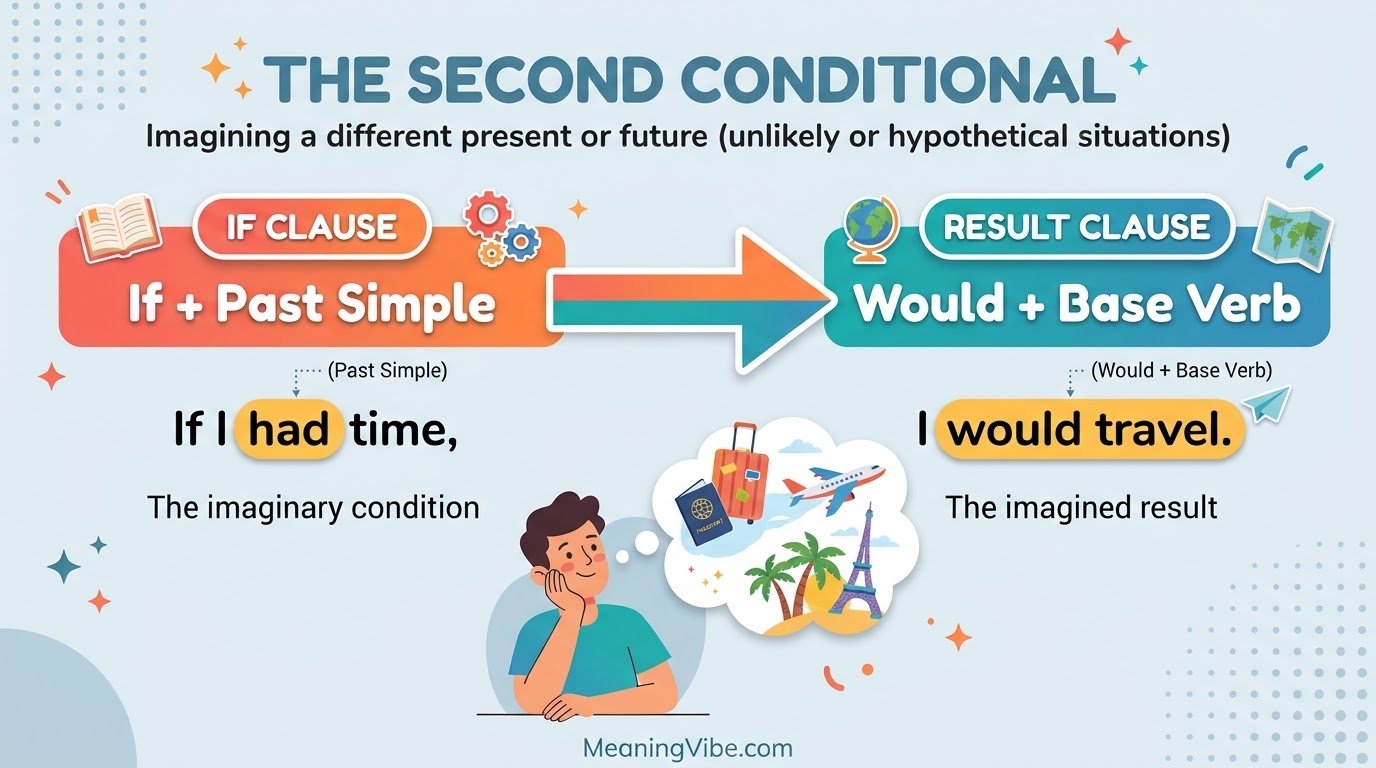
The second conditional joins two clauses. The if clause states the imagined condition in the past simple; the result clause states what would follow, usually would plus the base verb.
|
Clause |
Form |
Example |
|---|---|---|
|
If clause |
if + past simple |
If I had time |
|
Result clause |
would + base verb |
I would travel |
The if clause borrows its shape from the past simple tense rules pattern. The form is past; the meaning is present or future. That mismatch is the whole pattern.
One step back in form means one step away from reality. If I have time is a real plan; If I had time is a wish about today.
An unreal condition in progress takes the past continuous: If I were not working this weekend, I would join your trip. The past continuous tense rules page teaches that form.
The Example Bank: How It Is Sorted
The bank sorts each sentence twice: by use, then by form. Uses answer what the sentence does (imagines, advises, requests, criticizes); forms answer how it is built (negative, question, modal, pair).
|
Section |
Group |
Sentences |
|---|---|---|
|
A. Imaginary present situations |
By use |
12 |
|
B. Identity swaps and impossible worlds |
By use |
10 |
|
C. Unlikely future events |
By use |
10 |
|
D. Advice: If I were you |
By use |
10 |
|
E. Polite requests and offers |
By use |
8 |
|
F. Criticism and gentle regret |
By use |
8 |
|
G. Negative forms |
By form |
10 |
|
H. Questions |
By form |
10 |
|
I. Could and might: the meaning scale |
By form |
10 |
|
J. Same event pairs: first beside second |
By form |
6 |
|
K. Were forms and the spoken shape |
By form |
6 |
|
Total |
100 |
Read the bank by section, not from the top. A learner who only misses questions needs section H; a speaker who wants to sound polite needs section E.
Examples by Use
A. Imaginary Present Situations
The home ground of the pattern. The condition is false now, and every sentence implies its own opposite: the opposite is the reality the speaker actually lives in.
- If I lived in Lisbon, I would walk to work along the river.
- If we had a garden, we would grow tomatoes and peppers.
- If she spoke Mandarin, she would work in Shanghai.
- If he knew the answer, he would tell us.
- If I had more free time, I would learn the piano.
- If they lived closer, we would see them every week.
- If the office were quieter, I could concentrate.
- If I were taller, I would reach the top shelf without a chair.
- If it were not so cold, we would eat outside.
- If you understood the problem, you would not ask that question.
- If my phone worked, I would call her now.
- If we did not need the money, we would both work less.
B. Identity Swaps and Impossible Worlds
The dream section the school pages live on, kept in its place. These sentences swap a fact of identity, species or physics, where the distance idea is easiest to feel.
- If I were a bird, I would fly south every winter.
- If she were the manager, she would change the schedule.
- If I could read minds, I would know what to say.
- If animals could talk, the dog would ask for more walks.
- If there were no gravity, we would float around the room.
- If I were invisible, I would listen at doors all day.
- If time travel were possible, I would visit ancient Rome.
- If he had superpowers, he would catch every falling thing.
- If the moon were made of cheese, astronauts would bring crackers.
- If I were you for one day, I would finally understand.
C. Unlikely Future Events
The second future use: the event could happen, and the speaker rates it unlikely. The lottery appears once, as it should; the rest are ordinary unlikely futures.
- If I won the lottery, I would buy a small house by the sea.
- If it snowed in July, the whole city would stop.
- If they offered me the job in Tokyo, I would take it.
- If the tickets were cheaper, we would fly home for Christmas.
- If she practiced every day, she might win the competition.
- If an alien ship landed in the park, I would film it.
- If the train drivers went on strike, nobody would get to work.
- If he asked her to marry him, she would say yes.
- If prices fell by half, everyone would buy two.
- If you met a famous actor in the street, what would you say?
D. Advice: If I Were You and Its Family
The single most useful spoken pattern in the topic. If I were you is fixed with were in every register, and its family (in your place, in your shoes) works the same way, because advice steps inside the listener’s situation.
- If I were you, I would apologize before lunch.
- If I were you, I would not tell her yet.
- If I were in your place, I would ask for more time.
- If I were in your shoes, I would take the earlier train.
- I would not worry about it if I were you.
- If I were you, I would save the receipt.
- If I were you, I would study a little every day instead of all night once.
- If I were you, I would check the contract before signing.
- If I were you, I would wear something warmer.
- If I were you, I would not lend him money again.
E. Polite Requests, Offers and Softened Questions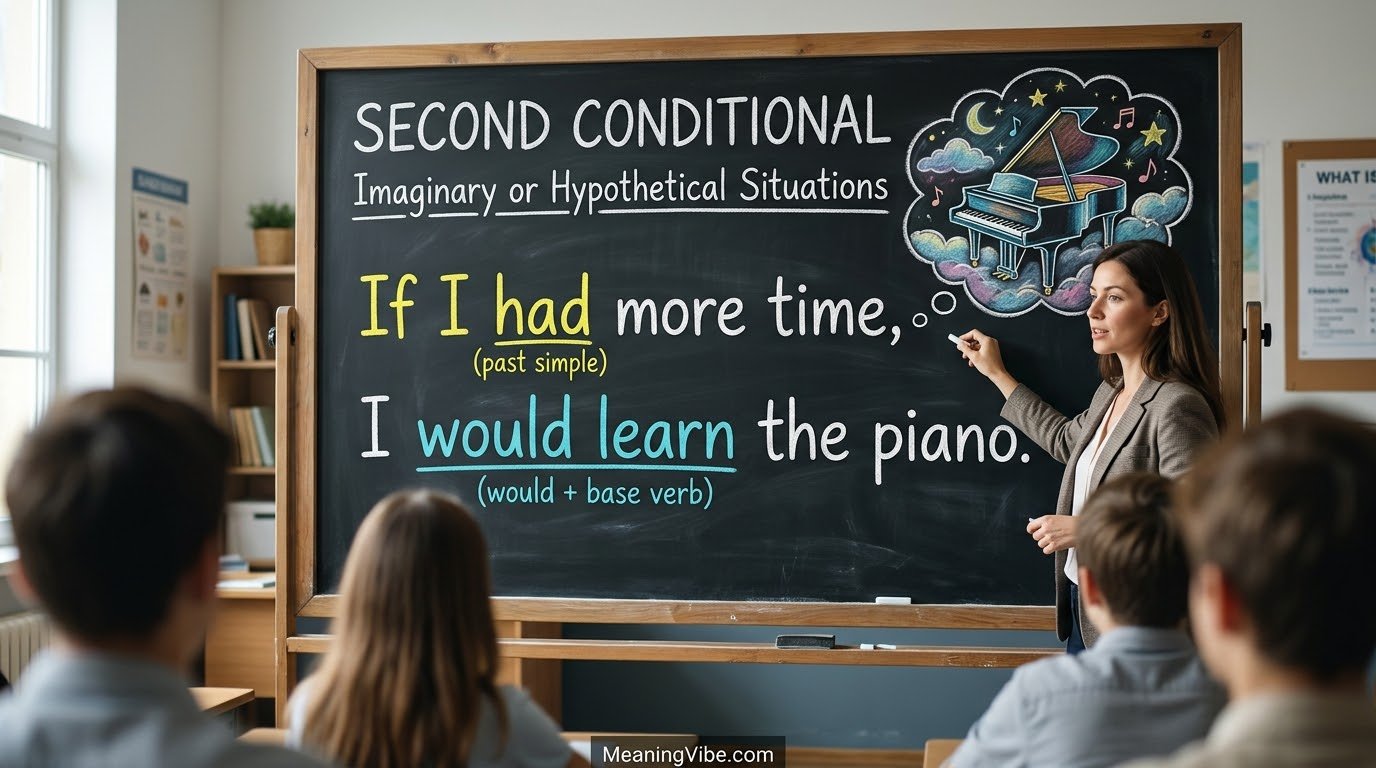
The use the dream pages never mention: the pattern as a politeness tool. One step back in form steps the request one step back in pressure, which is why office English runs on it. Would you mind if is its flagship.
- Would you mind if I opened the window?
- If you had a moment, would you check this email for me?
- If you could pass the salt, that would be lovely.
- Would it be all right if I left ten minutes early?
- If I could borrow your charger for an hour, I would be grateful.
- I would appreciate it if you replied by Friday.
- If you would like to sit down, there is a chair by the door.
- Would you help me if I asked politely?
F. Criticism and Gentle Regret: The Could Family
Criticism without a quarrel. The condition names what is not happening, and could names the result it blocks. These are present regrets; regret about the past belongs to the third conditional, at the boundary below.
- If you listened more carefully, you would understand the instructions.
- If he tried harder, he could pass easily.
- You could finish on time if you started earlier.
- If she were more patient, the children would listen to her.
- If they saved a little each month, they would not panic in December.
- If I knew how to cook, I would not order food every night.
- If the team communicated better, we could avoid these mistakes.
- If you were not so stubborn, we would not argue about this.
Examples by Form
G. Negative Forms
Negation can sit in the if clause, in the result clause, or in both. Each seat changes the meaning. Were not and was not contract to weren’t and wasn’t in speech.
- If I did not have to work tomorrow, I would sleep until ten.
- If she did not live so far away, we would visit her more often.
- If it were not raining, we could walk to the station.
- If you did not ask, you would never know.
- If he were not so shy, he would speak in meetings.
- If I did not know you better, I would be offended.
- If they did not charge so much, more people would join.
- If we were not saving for a house, we would travel this year.
- If you did not leave the lights on, the bill would be lower.
- If I were not afraid of heights, I would climb with you.
H. Questions
Questions invert the result clause only. The if clause keeps statement order, and short answers use would or wouldn’t: Yes, I would. No, I wouldn’t.
- What would you do if you won a million dollars?
- Where would you live if you could live anywhere?
- Would you move abroad if you found a job there?
- If you could have dinner with anyone, who would it be?
- What would happen if the internet disappeared tomorrow?
- Would you tell me if you knew the secret?
- If you were the president for one day, what would you change?
- How would you get home if the last bus left without you?
- Would she come if we invited her?
- If your house burned down, what would you save first?
I. Could and Might in the Result Clause: The Meaning Scale
Would is the default result, not the only one. Could marks imaginary ability or permission, might marks a weaker result, and the choice is a meaning decision the school formula hides. Each sentence is labeled with its value.
- If I had a car, I could drive you to the airport. (could: imaginary ability)
- If she practiced more, she might win the competition. (might: uncertain result)
- If we lived by the sea, we could swim every morning. (could: imaginary ability)
- If you asked nicely, she might help you. (might: possible, not promised)
- If he saved his money, he could buy a bike by summer. (could: ability)
- If I fired my assistant, I could hire someone faster. (could: ability)
- If it were warmer, we might eat on the balcony. (might: weak possibility)
- If they offered him the job, he might accept it. (might: uncertain)
- If you spoke three languages, you could work anywhere. (could: ability)
- If she knew about the surprise, she might ruin it. (might: unwanted possibility)
J. Same Event Pairs: First Conditional Beside Second
The boundary taught the only honest way: the same event in both patterns. Only the speaker’s likelihood judgement changes between the two lines. No competitor prints pairs.
- If I get the job, I will move to London. / If I got the job, I would move to London.
- If it rains tomorrow, we will stay at home. / If it rained tomorrow, we would stay at home.
- If she studies, she will pass. / If she studied, she would pass.
- If we have time, we will call you. / If we had time, we would call you.
- If you ask him, he will help. / If you asked him, he would help.
- If I see her, I will tell her. / If I saw her, I would tell her.
K. Were Forms and the Spoken Shape
A form clinic to close the bank. Were appears with every person it surprises learners in, and the contracted shape (I’d, you’d, wouldn’t) is the shape speech actually uses.
- If I were rich, I would buy a library, not a car.
- If he were here, he would know what to do.
- If the weather were better, we’d go out.
- You’d be surprised if you saw the bill.
- She wouldn’t say that if she knew the truth.
- If it weren’t for your help, I would be lost.
The Distance Decisions
After the formula, five decisions remain. Each is a meaning or register choice disguised as a grammar choice, taught below as a test with its authorities named.
Was or Were? The Register Strands
Three positions print here as strands, because the authorities genuinely split. The school and exam strand says were for all persons: If I were rich, If he were here. Exam boards expect it, and careful writing follows it.
The usage strand runs the other way. The Cambridge Dictionary blog notes that was is actually the most common form with I, he, she and it in real usage, with were the more formal subjunctive, preferable in very formal or literary writing.
Perfect English Grammar holds the middle: were can replace was with I and he, she, it. The Cambridge Dictionary Grammar hub files the pattern under imagined conditions, beside the wish entries.
One fixed point anchors every strand: If I were you is always were. Default to were in writing and exams; hear was in speech without treating it as broken English.
Would, Could or Might? The Meaning Scale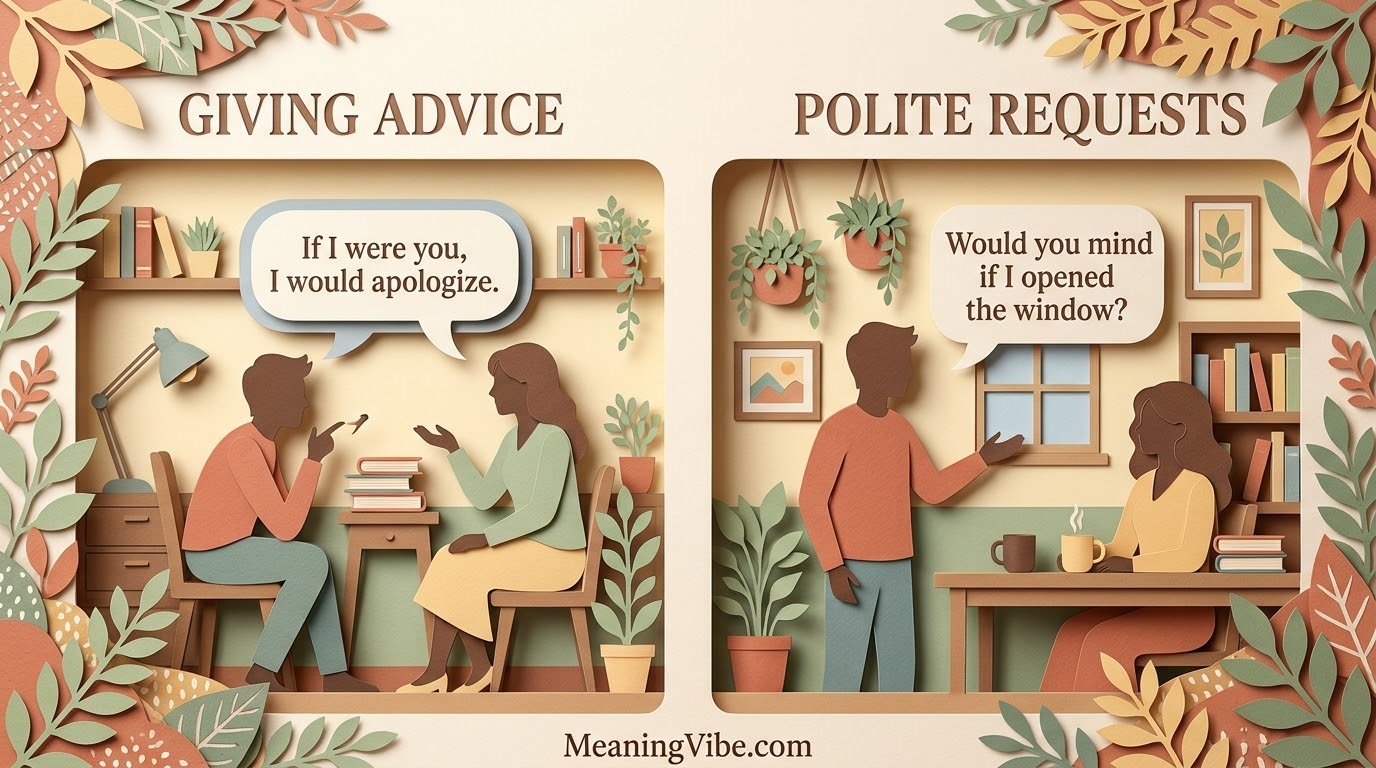
Would states the imagined result as the speaker’s settled picture. Step sideways and the result changes job: could hands the subject an ability, and might loosens the result into a possibility the speaker will not guarantee.
|
Result form |
What the speaker signals |
Example |
|---|---|---|
|
would |
the imagined result, stated plainly |
If I had time, I would travel. |
|
could |
imaginary ability or permission inside the result |
If I had a car, I could drive you. |
|
might |
a weaker result the speaker will not guarantee |
If she practiced more, she might win. |
Choose the modal by what you mean, not by habit. Advice built on might sounds hesitant; a result built on could promises ability, not outcome. Bank section I prints the scale in labeled sentences.
First or Second? The Likelihood Judgement
The same event can wear either pattern, and the speaker’s judgement decides. If I get the job treats the job as a live possibility; If I got the job treats it as a daydream. Only the rating changes.
The first conditional keeps the present form and the future simple tense rules result with will. Its if clause is the present simple tense rules shape.
This page’s pair is the first conditional sentences page in the same cluster. It owns the real future pattern; this page owns the unreal one, and bank section J prints the six same event pairs where the two meet.
Advice, Request or Criticism? The Social Jobs
The pattern earns its keep in social work the dream examples never show. Advice steps into the listener’s place (If I were you), requests step back to lower the pressure (Would you mind if), and criticism names the missing condition instead of blaming (If you listened more carefully).
Perfect English Grammar frames the pattern with two uses: a future probably not true, and a present impossible. The social jobs sit inside those two uses, and the bank is sorted by them.
Polite requests carry the one licensed would after if. If you would wait a moment, I will check expresses willingness, exactly as in the first conditional. The gallery protects it as a false alarm.
What the Form Is Called: A Naming Note
The name is itself a strand, printed once and labeled. School pages call the if clause form the past simple, which names its shape honestly. Swan calls it the unreal past, which names its job: a past form doing present, unreal work.
Reference grammars add a third name for the be form: the past subjunctive, or irrealis were. All three names describe the same bank sentences. Pick the name your exam uses; the pattern does not change with its label.
The Boundaries: Wish, Third and Mixed
Three neighbours share this pattern’s machinery, and each owns its own ground. The wish family states the desire; the third moves the unreality into the past; the mixed crosses the two time frames.
|
Pattern |
What it imagines |
Form |
Example |
|---|---|---|---|
|
Second conditional |
A different present or unlikely future |
if + past simple, would + base verb |
If I had his number, I would call him now. |
|
Third conditional |
A different past |
if + past perfect, would have + participle |
If I had taken his number, I would have called him. |
|
Wish clauses |
A present fact regretted, no result stated |
I wish + past simple |
I wish I had his number. |
|
Mixed conditional |
A past condition with a present result |
if + past perfect, would + base verb |
If I had saved his number, I would know it now. |
The third conditional’s condition is the past perfect tense rules form. Would have plus the past participle is its result marker; when that shape appears inside a present counterfactual, it has leaked across the boundary, and the gallery corrects it.
Wishes are this pattern with the result left unsaid. I wish I had more time and If I had more time, I would learn Spanish are twins on the same unreal past. The third and mixed patterns get their own pages in this cluster.
Common Mistakes: The Error Gallery
The gallery prints each error beside its correction and the rule it teaches. Most items are learner errors the field documents itself; Cambridge Dictionary Grammar states the headline rules, and Oxford English Global lists the will and would error family among its common mistakes.
Three items are classification defects, described as classes and never reproduced as models. A list filing other conditionals as second conditional, a famous line under the wrong type, and an example stopping mid phrase teach one lesson: a counted list is not an edited bank.
- Wrong: If I would be rich, I would buy a mansion. Right: If I were rich, I would buy a mansion. Would inside the if clause is the headline error: the condition takes the past form; would belongs in the result clause.
- Wrong, for a present meaning: If I had money now, I would have bought a car. Right: If I had money, I would buy a car. Would have plus the participle imagines a different past; here it leaks in from the third conditional.
- Wrong: If I had a car, I will drive you to work. Right: If I had a car, I would drive you to work. The half converted sentence distances the condition and forgets the result.
- Misfiled, as the plain pattern: a past perfect condition presented under this formula. If I had studied medicine with a present result is a mixed conditional, correct English but a separate pattern. The second conditional’s condition is past simple.
- Misfiled: third conditional and mixed sentences printed inside a list of second conditional examples. Right: if plus past perfect with would have is the third conditional, whatever the list around it claims. Check the form, not the heading.
- Misfiled: a famous film line in first conditional form, present simple plus will, presented among second conditional examples. Right: the form decides the type. A line can be famous and still belong to the sibling pattern.
- Broken print: an example in a published list that stops mid phrase, its result clause unfinished. Right: every sentence in a bank a learner copies from must be complete. An unfinished model teaches hesitation, not grammar.
- False alarm: If I was taller, corrected on sight in every register. Verdict: the exam and formal rule is were, and this bank prints were. But the Cambridge Dictionary blog strand records was as the most common spoken form, so the sentence is informal, not invented. Was has no defence only inside If I were you.
- False alarm: If you would wait a moment, I will check. Verdict: correct as written; do not correct it. Would after if is legitimate for willingness and polite requests. The item 1 error is would as a future marker inside an ordinary condition, a different structure.
- False alarm: If I was you, produced by a learner applying the was strand inside the advice formula. Verdict: wrong in careful use. If I were you is fixed with were in every authority and every register; it is the exception that anchors the were strand.
- False alarm: I’d, you’d and wouldn’t treated as careless versions of the pattern. Verdict: they are its normal spoken shape; a bank that prints only full forms teaches a dialect nobody speaks.
Practice: Work the Bank by Section
Practice works best one decision at a time. Each pass isolates one choice, and five short moves turn reading into production.
- Read one section aloud. Hearing the pattern fixes the rhythm of condition, pause, result, and the contracted shape (I’d, wouldn’t) settles in as its normal sound.
- Cover the result clause. Complete each sentence from its condition alone, then uncover and compare your modal with the bank’s: would for the result, could for ability, might for the weaker outcome.
- Convert the pairs. Run the section J pairs in both directions: second to first by restoring the present form and will, first to second by stepping both clauses back.
- Run the were clinic. Rewrite the section K sentences with was where the verb is be, then judge each by register: exam, email, or speech. Keep If I were you untouched.
- Finish with the error gallery. Correct each wrong sentence before reading its correction; the gallery is the test the bank has been preparing you for.
When somebody reports these sentences, the shape usually survives. The unreal past is already one step back, so the form often survives reporting. The reported speech rules page owns that system, and its reported speech examples bank shows reported advice and offers.
Frequently Asked Questions
What is the second conditional?
A sentence pattern for an unreal or unlikely situation in the present or future and its imagined result. It joins a past simple condition (If I had time) to a result with would plus the base verb.
What is the formula for the second conditional?
If + past simple, would + base verb. In the swapped order there is no comma: I would travel if I had time. Could and might can replace would, each with its own meaning.
Why does the second conditional use the past tense for present meaning?
Because the past form marks distance from reality, not past time. English steps one tense back to show a situation is imagined: If I have time (real) against If I had time (imagined). Swan calls it the unreal past.
Is the second conditional about the past?
No. It talks about the present and future through a past shaped form. If I lived in Rome is about where I live now, not the past. Past counterfactuals are the third conditional.
What is the difference between the first and second conditional?
The speaker’s judgement of likelihood. The first treats the event as real and possible (If I get the job, I will move); the second treats it as unlikely or imagined (If I got the job, I would move). Bank section J prints the pairs.
Is it If I was or If I were?
Both occur, and the choice is register. Formal and exam English uses were for all persons (If I were rich). The Cambridge Dictionary blog notes was is actually the most common form in real usage, were the formal subjunctive. One exception has no debate: If I were you is always were.
Why is it If I were you and not If I was you?
Because If I were you is a fixed formula, and every authority prints were in it. Cambridge states we always use were in the phrase. In an exam, was here is marked wrong.
What does If I were you mean?
It means: imagine you were in my situation; here is what I would do. The speaker steps into the listener’s place to give advice: If I were you, I would apologize. The listener is not the speaker, which is why the unreal form appears.
Can I use could in the second conditional?
Yes, in the result clause, where it marks imaginary ability or permission: If I had a car, I could drive you. Could replaces would when the result is about being able.
Can I use might in the second conditional?
Yes, in the result clause, where it marks a weaker, less certain result: If she practiced more, she might win. Might is the choice when the speaker will not commit.
Can I use would in the if clause?
Not in an ordinary condition: If I would be rich is the field’s headline error, and Cambridge lists would in the conditional clause among its typical errors. One exception: would after if can express willingness or a polite request (If you would wait a moment).
Why do learners put would in the if clause?
Because the result clause has would, and many first languages mark both clauses the same way. English distances the condition with a past form instead.
How do I make a negative second conditional sentence?
Negate either clause or both. Negative condition: If I did not have to work, I would sleep late. Negative result: If it rained, we would not go out.
How do I ask a question in the second conditional?
Invert the result clause only: What would you do if you won a million? The if clause keeps statement order, and short answers are Yes, I would or No, I wouldn’t.
What are 10 examples of the second conditional?
If I were you, I would apologize. If I had more time, I would learn the piano. If she spoke Mandarin, she would work in Shanghai. If it rained tomorrow, we would stay in. If I won the lottery, I would buy a house by the sea. If you listened, you would understand. If they lived closer, we would visit. If I could fly, I would visit the moon. If he knew, he would tell us. If we had a garden, we would grow tomatoes.
What are 20 examples of the second conditional?
The bank on this page prints 100 classified examples; its first twenty cover imaginary presents and identity swaps. A flat list of twenty is what list sites offer; classification is the difference.
What are examples of second conditional questions?
What would you do if you won a million dollars? Where would you live if you could live anywhere? Would you move abroad if you found a job there? What would happen if the internet disappeared?
What are examples of second conditional negative sentences?
If I did not have to work tomorrow, I would sleep until ten. If she did not live so far away, we would visit more. If it were not raining, we could walk. If you did not ask, you would never know.
How is the second conditional used for advice?
Through the formula If I were you plus would: If I were you, I would take the earlier train. The speaker imagines being the listener, which softens the advice. The bank gives advice its own section of ten.
How is the second conditional used to make polite requests?
By stepping the request one step back: Would you mind if I opened the window? The past form makes the request tentative, and tentative reads as polite in English.
What is the most common mistake with the second conditional?
Putting would in the if clause: If I would have more money, I would buy a car. It is the first item in this page’s error gallery.
What is the difference between the second and third conditional?
Time and reality together. The second imagines a different present or future (If I had his number, I would call him now). The third imagines a different past (If I had taken his number, I would have called him). Would have plus the participle is the third’s result.
Can the second conditional talk about the future?
Yes, when the future event is unlikely: If it rained tomorrow, we would stay in. A real possibility takes the first conditional instead. Likelihood, not the calendar, chooses the pattern.
Can the second conditional talk about the present?
That is its home ground: an unreal present. If I lived in Lisbon describes where I do not live now.
Does the second conditional use was or were in exams?
Were. Exam boards, including Cambridge B2 First, expect were for all persons, and always in If I were you. ESL-Tests states it directly. Spoken was is a usage strand, not an exam answer.
What level is the second conditional, B1 or B2?
Most coursebooks introduce it at B1, after the first conditional, because it combines a known past form with would. It is then tested in B2 First transformations.
Can I use the past continuous in the if clause?
Yes, when the unreal situation is in progress: If I were not working this weekend, I would join your trip. The condition keeps the distance and adds an ongoing scene.
What is the difference between would and could in the result?
Would states the imagined result; could states imaginary ability or permission inside it. If I had a car, I would drive to work. If I had a car, I could drive you.
Is If I would like correct?
No. I would like is a polite way to say I want, not a conditional. The if belongs in sentences like Would you mind if I sat here?
What does Would you mind if mean?
It is a polite request formula: Would you mind if I opened the window? asks permission politely. Note the past form after if, and that No, not at all means go ahead.
Can I use unless in the second conditional?
Yes: unless means if not, and the verb after it takes the same past form. Unless works best for one clear exception, the scope limit the sibling page prints.
What is a mixed conditional and is it a second conditional?
A mixed conditional combines clauses from two types: a past condition with a present result (If I had studied medicine, I would be a doctor now), or the reverse. It is correct English but a separate pattern, treated here at the boundary only.
How does the second conditional connect to I wish?
They share the same machinery: I wish I had more time uses the same unreal past form. Wish states the desire; its conditional twin adds the imagined result.
Do I need a comma in a second conditional sentence?
Yes when the if clause comes first: If I were rich, I would travel. No when the result comes first: I would travel if I were rich.
Can the if clause come second?
Yes: I would tell her the truth if I were you says the same as If I were you, I would tell her the truth, without the comma, as speech often does.
Why do songs and films use the second conditional so much?
Because it is the grammar of imagining, and songs and films trade in imagined lives: Beyonce’s If I Were a Boy is the famous case. One caution from the gallery: not every famous if line is second conditional; a well known film line built on present simple plus will is a first conditional.
Are contractions like I’d and wouldn’t correct?
Yes; they are the normal spoken shape of the pattern. EngQuiz notes would almost always contracts to ‘d in speech. Full forms are safer in formal writing and exams.
How do I teach the second conditional?
Teach the distance idea before the formula: one step back in form, one step away from reality. Then sort examples by use, drill the were strand honestly, and finish with the error gallery.
What is the second conditional in reported speech?
Reported, the pattern usually stays in its own shape, because the unreal past is already one step back: He said if he had time, he would help. The cluster’s reported speech pages own the full system.
Can the second conditional express regret?
Gentle present regret, yes: If I knew how to cook, I would not order food every night regrets a present fact. Regret about the past takes the third conditional: If I had known, I would have helped.
Is second conditional formal or informal?
Both. The pattern is neutral; register sits in the choices around it: were over was in formal writing, contractions in speech, polite request forms at work.
How do I practice the second conditional?
Work the bank by section: read aloud, cover the result clause and complete it, then convert sentences into their first conditional pairs. Finish with the error gallery, correcting each sentence before reading its correction.
Conclusion
Second conditional sentences rest on one idea and a set of decisions: the past form marks distance, the modal grades the imagined result, was or were sets the register, and the likelihood judgement chooses this pattern over its real future pair.
Work the bank by section and the pattern becomes a daily tool. Imagining, advising, requesting and criticizing are the four jobs English gives this pattern, and the 100 examples show each one done.
The neighbouring systems complete the picture. More patterns like this one live across MeaningVibe, and the conditional family grows from this page and its first conditional pair outward.