

First conditional sentences talk about one real future possibility and its result: If it rains tomorrow, we will stay at home. The condition can genuinely happen, and the result is what follows if it does.
The formula takes one line, but the decisions around it fill a page. Which present form enters the if clause, where the comma goes, and whether will, can or might carries the result are choices, and each one moves the meaning.
This page prints a classified bank of 108 examples, sorted by use and by form, then teaches each decision with minimal pairs, checked against Perfect English Grammar, the authority standard for the pattern.
Where the authorities disagree, both positions print as labelled strands. The will after if rule, shall, and even the number of conditional types stay open here, because flattening them would teach something false.
The Short Answer: One Formula, One Real Future
The first conditional joins two clauses. The if clause states the condition in a present form; the result clause states what follows, usually will plus the base verb.
|
Clause |
Form |
Example |
|---|---|---|
|
If clause |
if + present simple |
If it rains |
|
Result clause |
will + base verb |
we will stay at home |
Use the pattern for a real, possible future event and its likely result. Not a general truth and not a fantasy: one occasion that could happen, from tomorrow’s weather to a job offer.
The result clause is the future simple tense rules pattern at work. Will marks the result as the speaker’s expected outcome; the condition hangs the statement on one checkable event.
Swap the clauses and the meaning survives. We will stay at home if it rains says the same thing without a comma; front the if clause and the comma appears. Section K prints the pairs.
The Example Bank: How It Is Sorted
The bank sorts each sentence twice: by use, then by form. Uses answer what the sentence does (predicts, promises, warns, plans); forms answer how it is built (negative, question, imperative, modal).
|
Section |
Group |
Sentences |
|---|---|---|
|
A. Predictions |
By use |
12 |
|
B. Promises and offers |
By use |
10 |
|
C. Warnings and threats |
By use |
10 |
|
D. Plans and decisions |
By use |
10 |
|
E. Negative forms |
By form |
10 |
|
F. Questions |
By form |
10 |
|
G. Imperative result clause |
By form |
8 |
|
H. Modal and other future forms |
By form |
12 |
|
I. Time and condition conjunctions |
By form |
14 |
|
J. Present continuous and perfect conditions |
By form |
6 |
|
K. Clause order pairs |
By form |
6 |
|
Total |
108 |
Read the bank by section, not from the top. A learner who only misses questions needs section F; each section opens with the one rule it drills.
Examples by Use
A. Predictions
Predictions are the default use. The condition is a real possibility, and the result is the speaker’s best forecast of what follows if it happens.
- If it rains this afternoon, the match will be postponed.
- If the train is late, we will arrive after nine.
- If prices rise again, fewer families will buy new cars.
- If she practices the piano every day, she will play much better by June.
- If the wind picks up, the ferry will not sail tonight.
- If you charge your phone now, it will last all day.
- If the shop closes early, we will buy bread at the market instead.
- If he saves a little each week, he will have enough for the deposit by spring.
- If the road freezes tonight, the buses will run slowly tomorrow.
- If they win tonight, the fans will celebrate in the square.
- If the soup needs more salt, it will taste flat.
- If the baby wakes early, we will be tired all day.
B. Promises and Offers
Promises and offers put the speaker inside the result. The condition names what the other person does; the result names what the speaker guarantees in return.
- If you help me move on Saturday, I will cook dinner for everyone.
- If you lend me the book, I will return it on Monday.
- If she calls, I will tell her the news at once.
- If you need a lift to the station, I will drive you.
- If I see your brother, I will give him the message.
- If you finish the report today, I will check it tonight.
- If anyone phones while I am out, I will call them back.
- If you wait here, I will bring the car round.
- If the children behave at the dentist, I will buy them ice cream.
- If you are hungry, I will make you a sandwich.
C. Warnings and Threats
Warnings flip the promise. The condition sits in the listener’s control, and the result is the bad outcome the speaker wants them to avoid.
- If you touch the hot pan, you will burn your hand.
- If you do not hurry, you will miss the last bus.
- If you drive too fast on this road, you will have an accident.
- If you leave the door open, the cat will run away.
- If you ride without a helmet, you will get hurt in a fall.
- If you forget your passport, you will not be allowed on the plane.
- If you cheat in the exam, the teacher will find out.
- If you stay out in the sun all day, you will get sunburn.
- If you do not water the plants, they will die.
- If you lose this key, we will not be able to get in.
D. Plans and Decisions
Plans are decisions waiting on a condition. The result is not a forecast but the speaker’s own settled intention, ready to run when the condition lands.
- If I get the job, I will move to Chicago.
- If we save enough money, we will take a holiday in July.
- If the weather is fine on Sunday, we will have a picnic in the park.
- If I finish my homework early, I will watch a film.
- If the price is right, we will book the flights tonight.
- If she passes her driving test, she will buy a small car.
- If the meeting ends early, I will visit my aunt.
- If we have time after lunch, we will visit the museum.
- If he accepts the offer, he will start work in May.
- If the team trains well this week, the coach will pick the same eleven.
Examples by Form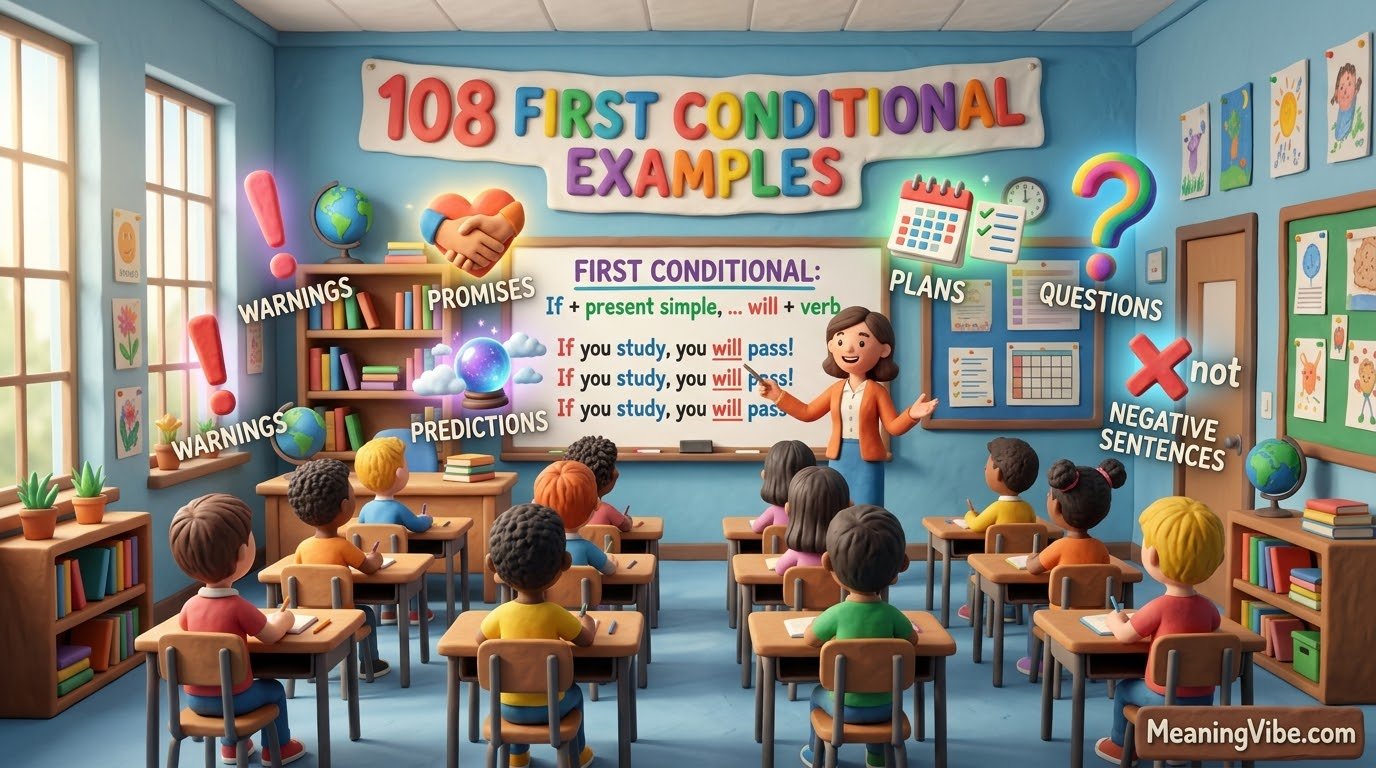
E. Negative Forms
Negation can sit in either clause, or in both. Each position changes the meaning, so the negative forms earn a classified set of their own.
- If you do not call me, I will not wait for you.
- If it does not rain tomorrow, we will play outside.
- If he does not come, we will not start the meeting.
- If they do not practice, they will not win the match.
- If you do not ask, you will not get an answer.
- If she does not study, she will fail the test.
- If we do not leave now, we will be late.
- If the shop is not open, I will come back later.
- If you do not charge the laptop, the battery will die in class.
- If I finish late, I will not cook tonight.
F. Questions
Questions invert the result clause only. The if clause keeps statement order, and short answers use will or won’t: Yes, I will. No, I won’t.
- What will you do if you miss the train?
- Will you call me if you need help?
- Where will you go if it rains on Saturday?
- What will happen if I press this button?
- Will she come if we invite her?
- How will you get home if the bus does not come?
- If the shop is closed, where will we buy milk?
- Will they be angry if we are late?
- What will the teacher say if I forget my homework?
- If it snows tomorrow, will the school close?
G. Imperative Result Clause
The result clause can be an instruction instead of will. Imperative results run daily life, from recipes to fire drills, and almost no teaching page collects them.
- If you see Tom, tell him to call me.
- If you go shopping, get some milk, please.
- If the baby is asleep, please be quiet.
- If anyone calls, take a message.
- If you feel ill, sit down and rest.
- If the alarm rings, leave the building at once.
- If you are not sure, ask the teacher.
- If it rains, take an umbrella.
H. Modal and Other Future Forms in the Result Clause
Will is the default result, not the only one. Can, may, might, could, should and must grade the same result from permission to weak possibility to obligation.
One result form looks further ahead. The future continuous tense rules pattern appears when the result is pictured in progress, as item 8 shows.
- If you finish early, you can leave. (can: permission)
- If it is cold tomorrow, I might wear my heavy coat. (might: weak possibility)
- If we leave at six, we may catch the early train. (may: possibility)
- If you feel ill, you should see a doctor. (should: advice)
- If you have a fever, you must stay in bed. (must: obligation)
- If the sun comes out, we could have lunch outside. (could: possibility, slightly more distant)
- If you are staying for dinner, I am going to open a bottle of wine. (be going to: prior intention)
- If our team wins, we will be celebrating until morning. (future continuous: result in progress)
- If you save fifty dollars a month, you will be able to travel next year. (will be able to: future ability)
- If he does not stop smoking, he may damage his health seriously. (may: possible bad result)
- If you are hungry later, there will be sandwiches in the kitchen. (there will be: availability)
- If the children finish their homework, they can watch TV. (can: permission earned)
I. Time and Condition Conjunctions
If is not the only door into the pattern. When, as soon as, until, before, after, unless, as long as, provided that and in case all take the same present form after them.
- When I get home, I will call you. (when: the event is expected)
- I will text you when I arrive. (when: clause second, no comma)
- As soon as he arrives, we will start dinner. (as soon as: immediately after)
- I will help you as soon as I finish this email. (as soon as: clause second)
- We will not begin until everyone is ready. (until: the result waits)
- I will check the address before I send the parcel. (before: precaution order)
- After the meeting ends, we will go for coffee. (after: sequence)
- Unless you hurry, you will be late. (unless: if you do not hurry)
- We will go for a walk unless it rains. (unless: the one exception)
- As long as you tell the truth, I will support you. (as long as: only if)
- You can borrow my car provided that you fill the tank. (provided that: formal condition)
- Take an umbrella in case it rains. (in case: precaution, not a condition)
- I will take a jacket in case the evening turns cold. (in case: precaution)
- If it does not rain, we will eat outside. (the plain if paraphrase of the unless sentence above)
J. Present Continuous and Present Perfect in the If Clause
The if clause takes a present form, not the present simple only. A condition in progress takes the present continuous; a condition completed by a deadline takes the present perfect.
Both borrowed forms have their own pages in this cluster. The present continuous tense rules and the present perfect tense rules teach the forms this section puts to work.
- If you are staying for dinner, I will open a bottle of wine. (present continuous: arrangement in progress)
- If they have not arrived by eight, we will eat without them. (present perfect: completion deadline)
- If he is working late tonight, I will cook for one. (present continuous: tonight’s arrangement)
- If you have finished the exercise, you can check the answers. (present perfect with a modal result)
- If it is raining when we land, we will take a taxi. (present continuous: weather in progress)
- If she has read the report, she will have questions. (present perfect: completed reading, future result)
K. Clause Order Pairs and the Comma Rule
Every pair below prints one sentence in both orders. The meaning does not change; the comma does. No competitor prints pairs, so the comma rule is asserted and never shown.
- If it rains, we will stay at home. / We will stay at home if it rains.
- If you study hard, you will pass the exam. / You will pass the exam if you study hard.
- If she calls, I will answer. / I will answer if she calls.
- If we leave early, we will avoid the traffic. / We will avoid the traffic if we leave early.
- If you do not hurry, you will miss the bus. / You will miss the bus if you do not hurry.
- If the shop is open, I will buy bread. / I will buy bread if the shop is open.
The Form Decisions
After the formula, five decisions remain. Each is a meaning choice disguised as a grammar choice, taught below as a test with a minimal pair.
Will, or a Modal? The Certainty Scale
Will presents the result as expected. Step down the scale and the speaker’s commitment weakens or changes job: permission, possibility, advice and obligation each have their own modal, printed in bank section H.
|
Result form |
What the speaker signals |
Example |
|---|---|---|
|
will |
the expected result |
If it rains, we will stay home. |
|
be going to |
a prior intention |
If he calls, I am going to tell him. |
|
can |
permission or ability |
If you finish early, you can leave. |
|
may |
a real possibility |
If we leave at six, we may catch the train. |
|
might |
a weaker possibility |
If it is cold, I might wear my heavy coat. |
|
should |
advice |
If you feel ill, you should see a doctor. |
|
must |
obligation |
If you have a fever, you must stay in bed. |
|
imperative |
an instruction |
If you see Tom, tell him to call me. |
Choose the modal by what you mean, not by habit. A warning built on might sounds weak; a promise built on might sounds unwilling. The modal is the speaker’s signature.
If or When? Possibility versus Expectation
If keeps the event open; when treats it as settled. If I go to Paris, I will visit the tower leaves the trip undecided. When I go to Paris, I will visit the tower assumes the trip will happen.
The choice records the speaker’s judgement, not a fact about the world. Careful references add the strand: when shows the speaker’s view, not a logical guarantee.
If or In Case? Condition versus Precaution
If states a condition; in case states a precaution. Take an umbrella if it rains would mean waiting to see the rain first. Take an umbrella in case it rains means take it now, because rain is possible later.
Almost no teaching page separates the two, so learners merge them. The test is mechanical: in case acts before the event as insurance; if reacts to the event when it lands.
Which Present Form Goes in the If Clause?
The school rule says present simple after if, and it covers most sentences. Its home ground is this site’s present simple tense rules page, and as a first approximation for learners it does honest work.
The accurate rule is wider: a present form, not the present simple only. A condition in progress takes the present continuous; a condition complete by a deadline takes the present perfect. Bank section J prints both.
The One Exception: Will After If for Willingness and Politeness
One exception stands beside the headline rule, printed as a strand. Cambridge Dictionary Grammar accepts will after if where it expresses willingness or a polite request: If you will wait a moment, I will check for you is correct.
The school rule still governs ordinary conditions. If it will rain stays wrong, because rain has no willingness to express. The exception belongs to polite requests, and the gallery closes with it as a false alarm.
Shall in the Result Clause: A Formal British Strand
Shall survives in the result clause as a formal, British strand. Perfect English Grammar lists shall beside will, can and may as a result option, and older British usage keeps it for I and we: If it rains, we shall stay in.
Mainstream US teaching uses will for every person. Default to will for US readers, and read shall as a register marker from formal British English, not as the rule.
First, Zero or Second? The Boundary Decision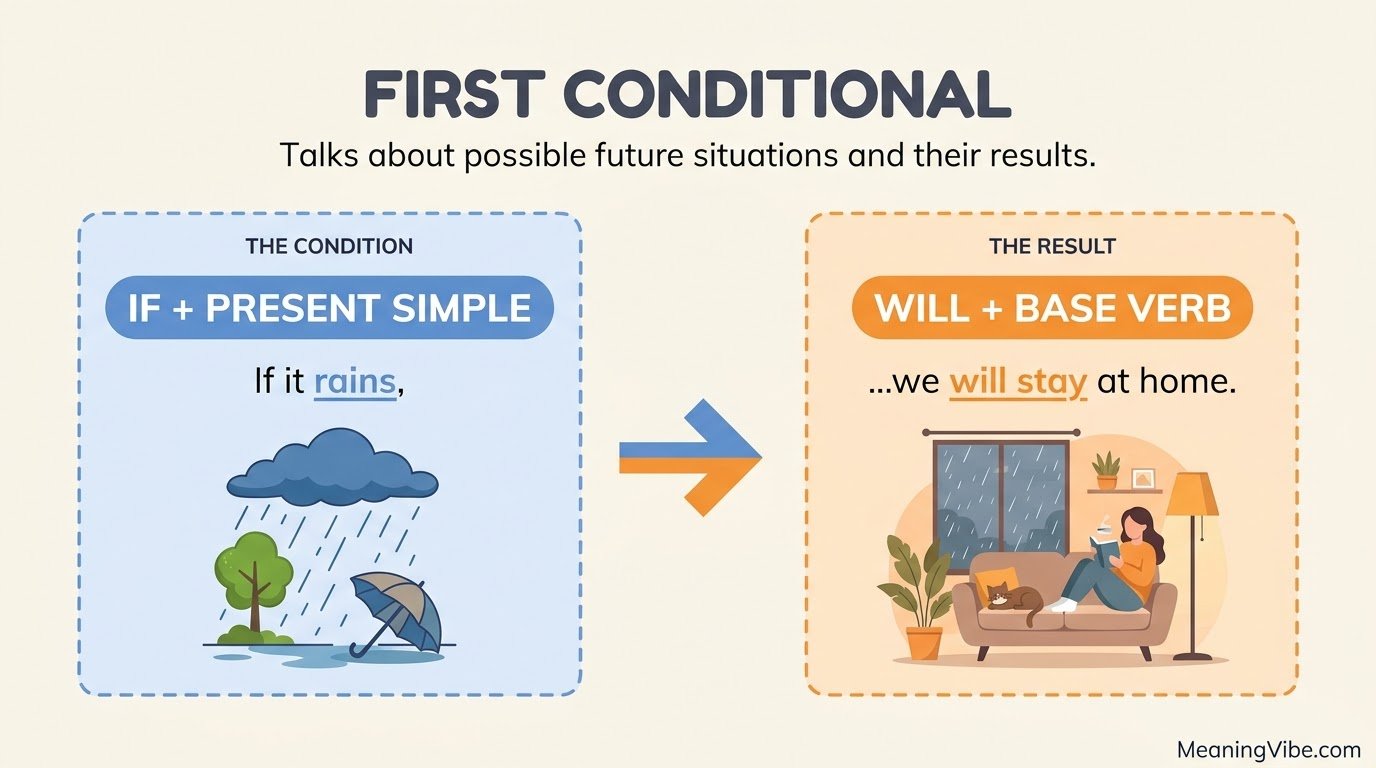
Three test questions sort the whole family. Is the result always true? True on one real future occasion? Or true only in the speaker’s imagination? The answer picks the pattern before any formula is needed.
|
Pattern |
Test question |
Form |
Example |
|---|---|---|---|
|
Zero conditional |
Always true? |
if + present simple, present simple |
If you heat ice, it melts. |
|
First conditional |
One real future occasion? |
if + present form, will + base verb |
If it rains tomorrow, we will cancel the match. |
|
Second conditional |
Imagined or unlikely? |
if + past simple, would + base verb |
If I won the lottery, I would travel. |
The same event can take any of the three patterns. If I get the job treats the job as possible; If I got the job treats it as a dream. The speaker’s judgement, not the calendar, makes the choice.
The zero and second conditionals get their own pages in this cluster. This page owns the first conditional and the test that separates it from its siblings.
Common Mistakes: The Error Gallery
The gallery prints each error beside its correction and the rule it teaches. Most items are learner errors the field documents itself; Oxford English Global lists the headline error, will after if, among its common English grammar mistakes.
One item is a classification error, not a learner error. A ranking teaching page files an always true result inside a first conditional table; it is described here as a class, because the correction matters more than the sentence.
- Wrong: If it will rain, we will stay home. Right: If it rains, we will stay home. Will inside the if clause is the headline error: the condition takes a present form even when the meaning is future.
- Wrong: If I will see him, I will tell him. Right: If I see him, I will tell him. The same error in its most copied shape: the future sits in the result clause only.
- Wrong: Unless you do not hurry, you will be late. Right: Unless you hurry, you will be late. Unless already means if not, so a second negative reverses the meaning.
- Wrong: If you study, you passed. Right: If you study, you will pass. A past tense result turns a real future condition into a report about yesterday.
- Wrong: If it rains we will stay home. Right: If it rains, we will stay home. The missing comma after a fronted if clause is the one pure punctuation error here.
- Wrong: When I will arrive, I will call you. Right: When I arrive, I will call you. The no-will rule covers the whole time clause family, not if alone.
- Wrong: If he don’t hurry, he will miss the bus. Right: If he doesn’t hurry, he will miss the bus. Third person agreement still applies inside the if clause: does, and the main verb drops its s.
- Wrong: I will call you if I will have time. Right: I will call you if I have time. The rule holds when the if clause comes second, the order where learners break it most.
- Misfiled: an always true result printed as a first conditional. Right: general truths take the zero conditional, present simple in both clauses. If a result never fails, no future occasion exists, and will does not belong.
- Wrong: If you are not hurry, you will be late. Right: If you are not in a hurry, you will be late. Hurry is a verb here; the error copies the be plus adjective pattern of if you are late.
- False alarm: If you will wait a moment, I will check for you. Verdict: correct as written; do not correct it. Will after if is legitimate for willingness and polite requests, the Cambridge strand from the decisions section.
Practice: Work the Bank by Section
Practice works best one section at a time. Each pass isolates one decision, and five short moves turn reading into production.
- Read one section aloud. Hearing the pattern fixes the rhythm of condition, pause, result faster than silent reading does.
- Cover the result clause. Complete each sentence from its condition alone, then uncover and compare your modal with the bank’s.
- Swap the clause order. Rewrite each sentence with the clauses reversed and check the comma: present when the if clause leads, absent when it follows.
- Change the modal, change the meaning. Take one prediction and run it down the certainty scale: will, may, might. Feel the commitment weaken.
- Finish with the error gallery. Correct each wrong sentence before reading its correction; the gallery is the test the bank has been preparing you for.
When somebody reports these sentences, the pattern changes shape again. The reported speech rules page owns that system, and its reported speech examples bank shows conditional offers and warnings reported.
Frequently Asked Questions
What is the first conditional?
A sentence pattern for a real, possible future situation and its likely result. It joins a condition clause (if plus a present form) to a result clause (will plus the base verb): If it rains, we will stay at home.
What is the formula for the first conditional?
If + present simple, will + base verb. The same pattern holds in the swapped order with no comma: We will stay at home if it rains.
Why does the if clause use the present simple for a future meaning?
English marks the future once, in the result clause; the condition is stated as a present fact to be checked. Cambridge and the British Council both teach the pattern this way.
Can I use will in the if clause?
Not for an ordinary future condition: If it will rain is the field’s headline error. One strand exception exists: will is legitimate after if for willingness or a polite request, as in If you will wait a moment, I will check.
What is the difference between the first conditional and the zero conditional?
The zero conditional states what is always true (If you heat ice, it melts). The first conditional states what will happen on one real future occasion (If it rains tomorrow, we will cancel the match). The test is always versus once.
What is the difference between the first conditional and the second conditional?
The first conditional treats the condition as real and possible (If I get the job, I will move). The second treats it as imagined or unlikely (If I got the job, I would move). Same event, different speaker judgement: the choice is likelihood, not time.
Do I need a comma in a first conditional sentence?
Yes, when the if clause comes first: If it rains, we will stay home. No, when the result clause comes first: We will stay home if it rains. The British Council states that clause order does not change the meaning; the comma follows the order.
Can the if clause come second?
Yes, and the meaning stays the same: I will answer if she calls is If she calls, I will answer without the comma. The bank prints six pairs in both orders.
How do I make a negative first conditional sentence?
Negate either clause or both. Negative condition: If you do not hurry, you will miss the bus. Negative result: If it rains, we will not go out. Both: If he does not come, we will not start.
How do I ask a question in the first conditional?
Invert the result clause only: Will you call me if you need help? Wh questions work the same: What will you do if you miss the train? The if clause keeps statement order; short answers are Yes, I will or No, I won’t.
What does unless mean in the first conditional?
Unless means if not. Unless you hurry, you will be late is the same as If you do not hurry, you will be late. Because unless already carries the negative, the verb after it stays positive.
Can I say unless you do not hurry?
No. That double negative reverses the meaning: it would mean you will be late only if you hurry. Say Unless you hurry, you will be late.
What is the difference between if and when in the first conditional?
If presents the event as possible; when presents it as expected. If I go to Paris leaves the trip open; When I go to Paris treats it as settled. Careful references add that when shows the speaker’s view, not a logical guarantee.
When do I use as soon as instead of if?
As soon as marks sequence, not possibility: the result follows the condition immediately. As soon as he arrives, we will start. Its clause takes the same present form and never will.
What is the difference between if and in case?
If states a condition. In case states a precaution taken before a possible problem: Take an umbrella in case it rains means take it now, because rain is possible later. Most competitor pages never separate them.
Can I use can, may or might instead of will?
Yes. The result clause takes other modals to grade the result: can for permission or ability (If you finish, you can leave), may and might for possibility, should for advice and must for obligation.
Can I use an imperative in the first conditional?
Yes. The result clause can be an instruction: If you see Tom, tell him to call me. Instructions are one of the commonest daily uses of the pattern, and the bank gives them their own section.
Can I use the present continuous in the if clause?
Yes, when the condition is an arrangement already in progress: If you are staying for dinner, I will open a bottle of wine. The rule is a present form, not the present simple only.
Can I use the present perfect in the if clause?
Yes, when the condition is completion by a deadline: If they have not arrived by eight, we will eat without them. Reference pages accept present forms beyond the simple in this clause.
Can I use be going to in the first conditional?
Yes, in the result clause, when the result is a prior intention: If you are staying for dinner, I am going to open a bottle of wine. It does not go in the if clause.
What is a first conditional sentence with should in the result?
A first conditional giving advice: If you feel ill, you should see a doctor. Should replaces will when the result is a recommendation rather than a forecast.
Is shall used in the first conditional?
As a strand: older and formal British usage allows shall for I and we in the result clause (If it rains, we shall stay in). Mainstream US teaching uses will for all persons; read shall as a strand, not the rule.
How many types of conditional sentences are there?
School grammar usually teaches four: zero, first, second and third. Reference grammars add mixed conditionals and treat the four as common patterns, not a closed list. The count is a strand.
What are 10 examples of the first conditional?
If it rains, we will stay at home. If you study hard, you will pass the exam. If she calls, I will answer. If we leave early, we will avoid the traffic. If you do not hurry, you will miss the bus. If I get the job, I will move to Chicago. If you touch the hot pan, you will burn your hand. If you finish early, you can leave. Unless it rains, we will eat outside. As soon as he arrives, we will start.
What are 20 examples of the first conditional?
The bank on this page prints 108 classified examples; its first twenty cover predictions, promises, warnings and plans. A flat list of twenty is what list sites offer; classification is the difference.
What are examples of first conditional questions?
What will you do if you miss the train? Will you call me if you need help? Where will you go if it rains? What will happen if I press this button? If it snows tomorrow, will the school close?
What are examples of first conditional negative sentences?
If you do not call me, I will not wait. If he does not come, we will not start. If they do not practice, they will not win. If the shop is not open, I will come back later. If I finish late, I will not cook tonight.
How is the first conditional used for warnings?
The condition is in the listener’s control and the result is bad: If you touch that wire, you will get a shock. Warnings are the second most common use after predictions, and the bank gives them a section of ten.
How is the first conditional used for promises?
The speaker commits to the result: If you help me move, I will cook dinner for everyone. The condition is the other person’s action; the result is the speaker’s guarantee. Offers work the same way: If you are hungry, I will make you a sandwich.
What is the most common mistake with the first conditional?
Putting will in the if clause: If it will rain. It is the first item in this page’s error gallery and the lead correction on the major teaching and reference pages.
Why do learners put will in the if clause?
Because the meaning is future, and many first languages mark future time in both clauses. English marks it once. Naming the transfer reason corrects the error faster than repeating the rule.
Is if I will see him correct?
No, for an ordinary condition: If I see him, I will tell him. The only will after if authorities accept is the willingness strand (If you will follow me, please), a different structure with a different meaning.
What level is the first conditional, A2 or B1?
Most coursebooks introduce it at B1, after the zero conditional, because it combines a known present form with will. The British Council places conditionals in its B1 to B2 reference.
Does the first conditional appear in IELTS and Cambridge exams?
Yes. EngQuiz’s types of conditionals page documents Cambridge B2 First and C1 Advanced transformations between conditional types, and the pattern suits B1 Preliminary writing and IELTS speaking answers about plans.
Can the first conditional talk about the present?
The condition can describe a present state with a future result: If you are hungry now, I will make you a sandwich. The pattern is named for the future result, not the condition’s timing.
What is the difference between provided that and if?
Provided that (and providing that) is a formal, stronger if that sets the condition as a requirement: You can borrow my car provided that you fill the tank. Cambridge lists it among expressions that impose specific conditions.
What does as long as mean in the first conditional?
As long as means only if, with the condition treated as a continuing requirement: As long as you tell the truth, I will support you. The British Council lists it among the standard alternatives to if.
Can I use until and before in the first conditional?
Yes, as future time clauses with the same present form rule: We will not begin until everyone is ready. Will never follows until, before, after, when or as soon as in this pattern.
How do I teach the first conditional?
Teach one formula, then sort examples by use before drilling form: predictions, promises, warnings, plans. Add the comma rule through order pairs, the conjunction family as meaning choices, and the error gallery last.
What is the difference between the first conditional and future simple with will?
Will alone makes a simple future statement: I will call you. The first conditional adds the condition it depends on: I will call you if I finish early. The conditional is the future simple plus a condition clause, which is why the two are taught as neighbours.
Are first conditional sentences formal or informal?
Both. The pattern is neutral: contracts use provided that, instructions use imperative results, and speech uses contractions (I’ll, won’t). Register sits in the conjunction and modal choices, not the pattern.
How do I practice the first conditional?
Work the bank by section: read a section aloud, cover the result clause and complete it, then swap the clause order and check the comma. Finish with the error gallery, correcting each wrong sentence before reading its correction.
Conclusion
First conditional sentences rest on a small formula and a set of decisions: the present form in the condition, the modal grading the result, the comma following the clause order, and the conjunction framing the event.
Work the bank by section and the pattern becomes a daily tool. Predictions, promises, warnings and plans are the four jobs English gives this pattern, and the 108 examples show each job being done.
The neighbouring systems complete the picture. More patterns like this one live across MeaningVibe, and the conditional family grows from this page outward.