

Present simple tense rules start with the plainest fact in English grammar. Most subjects change nothing at all. I work, you work, we work, they work: the verb stays in its base form.
Then one subject group changes everything. He works, she works, it works. Third person singular adds an s ending, and that single change is where almost every beginner error in the tense is born.
Most grammar pages teach the use list and stop. Habits, facts, routines, schedules: memorize the list, copy the examples, and the judgment is left to you.
The judgment is where learners actually struggle. They drop the s. They mark it twice after does. They reach for the continuous form for permanent situations that this tense owns.
This page teaches the judgment as three runnable checks. The one change comes first: only he, she, and it alter the verb, and its spelling is a small closed system.
Mark it once comes second. The third person marker lives in exactly one place per sentence, on the verb or on does, and never on both.
The permanent test comes third. Generally true, regular, permanent, or stable takes this tense; happening now, temporary, or changing takes its continuous neighbor.
The Short Answer: The Base Form, One Change, and Four Jobs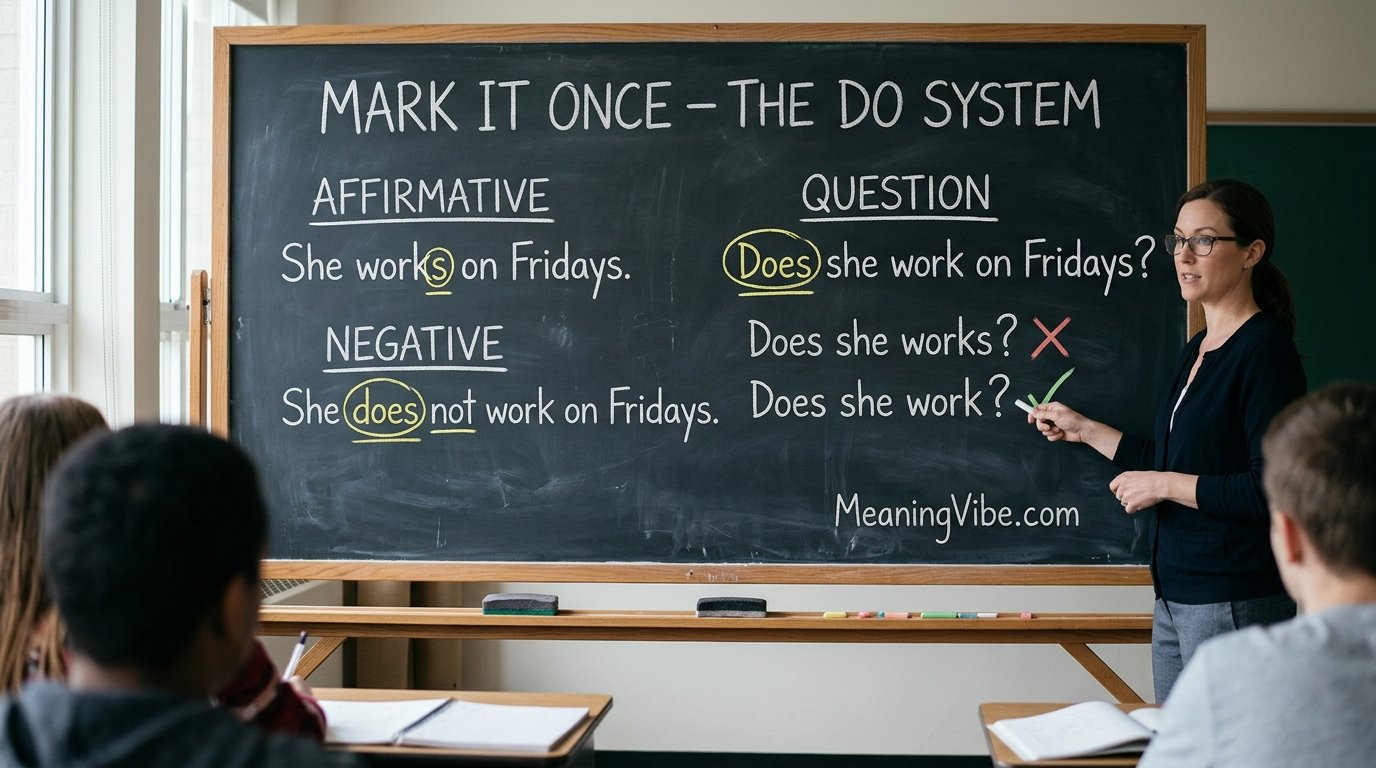
The present simple is the base form of the verb, with s or es added for he, she, and it. It covers habits and routines, facts and general truths, continuing states, and schedules.
I get up at six every day. She drinks tea in the morning. One subject changes nothing, the other adds the s, and both sentences describe what regularly happens rather than what is happening now.
Think of the tense as the language’s default present. It reports how things generally are and generally happen, which is why it is the first tense English teaching builds, at A1 to A2.
Its closest relatives sit in the same cluster. The anchor tense at our present perfect tense rules guide looks back from now at finished and unfinished past, while this page covers the ground those forms stand on.
A quick self check frames everything below. Who is the subject? If the answer is he, she, it, or one person or thing, the verb changes. Every other decision in the tense follows from that one.
The Form: One Change in the Whole Tense
Subject plus the base form of the verb. That is the complete formula for I, you, we, and they, and nothing about it ever changes.
The subject table in the EnglishDart present simple guide shows the shape plainly. Four subjects share the base form. One row, he she it, carries the s. The whole agreement system of the tense fits in that contrast.
Singular nouns join the changing group. The dog has four legs. My father works in an office. A singular noun is a he, she, or it in disguise, and the verb treats it that way.
The full form set fits in one small table. Affirmative, negative, question, and short answer are the four shapes every learner needs.
|
Form |
Structure |
Example |
|---|---|---|
|
Affirmative |
Subject + base verb (+ s or es for he, she, it) |
She works in a bank. |
|
Negative |
Subject + do or does not + base verb |
She doesn’t work on Fridays. |
|
Question |
Do or does + subject + base verb? |
Does he speak French? |
|
Short answer |
Yes, subject + do or does / No, subject + don’t or doesn’t |
Yes, he does. / No, she doesn’t. |
The Spelling of the Change: S, Es, Ies, and Has
Most verbs simply add s. Work becomes works, play becomes plays, read becomes reads. The default covers the large majority of the vocabulary a beginner meets.
Verbs ending in s, ss, sh, ch, x, z, or o add es. Watch becomes watches, wash becomes washes, fix becomes fixes, go becomes goes, do becomes does. The extra syllable makes the ending pronounceable.
Verbs ending in consonant plus y change the y to ies. Study becomes studies, carry becomes carries, try becomes tries. The spelling pattern table in the Pronunciation App simple present lesson prints the system in exactly this shape.
Verbs ending in vowel plus y just add s. Play becomes plays, enjoy becomes enjoys, say becomes says. The y survives because a vowel stands in front of it.
One verb breaks the pattern entirely. Have becomes has, never haves. She has a car. It has four legs. Has is the only irregular main verb form in the whole tense.
|
Verb ending |
Rule |
Examples |
|---|---|---|
|
Most endings |
Add s |
work, works; play, plays |
|
s, ss, sh, ch, x, z, o |
Add es |
watch, watches; go, goes |
|
Consonant + y |
Change y to ies |
study, studies; carry, carries |
|
Vowel + y |
Add s, keep the y |
enjoy, enjoys; say, says |
|
have |
Irregular: has |
have, has |
The Sounds of the Change: /s/, /z/, and /iz/
The written s has three sounds, and the verb’s final sound chooses between them. After voiceless sounds like p, t, k, and f, the ending is /s/: works, hopes, sits, laughs.
After voiced sounds and vowels, the ending is /z/. Plays, runs, loves, and goes all end in that buzzing sound. It is the same /z/ that starts zoo, shortened to a whisper.
After hissing sounds, the ending becomes /iz/ and adds a whole syllable. Watches, washes, fixes, and changes each gain a beat. The syllable exists because two hiss sounds cannot sit side by side.
The lesson in the Pronunciation App simple present lesson builds its whole page on this system, and it matters beyond pronunciation. The ending learners drop in writing is the ending they fail to hear, because /s/ and /z/ are short and quiet in fast speech.
One pronunciation note rides along. Does is pronounced /duz/, rhyming with buzz, not like the word do with an s attached. Questions sound natural only when the auxiliary shrinks this way.
Mark It Once: The Do System
Questions and negatives in this tense run on a helper verb: do. I do not work on Sundays. Do you speak English? The helper carries the grammar so the main verb can stay in its base form.
With he, she, and it, the helper is does. She does not work on Fridays. Does he speak French? Notice the main verb in both: work and speak, bare, with no s anywhere.
That is the discipline this page is named for. The third person marker lives in exactly one place: on the main verb in affirmatives, or on does in questions and negatives, and never on both.
The rule is stated in so many words in the VocabularyAn present simple guide. Mark third person singular on the main verb or on does, never both. Does she works is therefore wrong twice over, and the fix removes one marker, not the other.
Think of the marker as a token the sentence must spend once. She works spends it on the verb. Does she work spends it on does. A sentence that spends it twice, or not at all, is the error.
The Verb Be: The Exception That Takes No Do
Be conjugates itself: am, is, are. I am ready. She is a doctor. They are here. No do appears anywhere in its forms, in statements, questions, or negatives.
Its questions move be itself to the front. Is she ready? Are they here? Does she be ready is never correct, because be never borrows the helper the other verbs need.
Its negatives simply add not. He is not late. We are not ready. The contractions isn’t and aren’t cover speech, and the system needs no doesn’t anywhere near it.
Have splits by dialect in its possession sense, and the strands stay labeled. Does she have a car is the American default. Has she a car survives as a formal British strand, correct in its own system and dated in American ears.
Question Words and Short Answers
Question words stand in front of the whole do pattern. Where do you live? What does he do? When does the museum open? The helper still carries the grammar, and the verb still stays bare.
The what does he do question deserves its fame. It asks about a job, not a moment’s activity, because the present simple reports what someone generally does. Beginners who answer it with a hobby have misread the tense, not the words.
Short answers echo the helper and nothing else. Yes, I do. No, she doesn’t. Does he speak French? Yes, he does. The main verb is understood, and repeating it sounds like a machine.
What the Present Simple Does: Four Jobs
The tense does four jobs in real English. Habits and routines come first. Facts and general truths, continuing states, and schedules follow, and together they cover the large majority of its life.
Job One: Habits and Routines
Repeated actions are the tense’s home ground. I get up early every day. Carol brushes her teeth twice a day. John sleeps eight hours every night during the week.
The signal phrases gather here. Every day, on Mondays, twice a week, and the frequency adverbs always, usually, and often all point at repetition, and repetition points at this tense.
Job Two: Facts and General Truths
Things that are always or generally true take the simple form. Water boils at 100 degrees Celsius. The sun rises in the east. The Earth orbits the Sun.
Facts need no time phrase at all. The truth carries its own timing, which is why science writing, reference works, and definitions live in this tense from the first line.
Choose fact examples that cannot date. Water, sun, and earth stay true; examples built on office holders and addresses silently expire, and careful teachers avoid them.
Job Three: Continuing States
States are conditions, not actions, and they take this tense. Omar owns a bicycle. They live next door to us. She knows the answer. The situation holds steady rather than happening.
The verb bank is the stative set. Know, believe, like, want, own, belong, and seem describe thoughts, feelings, and possession. They are the same verbs that refuse continuous forms everywhere in the system.
The category bank in the Cambridge Dictionary present simple or continuous page sorts them by family: mental processes, feelings, senses, permanent qualities, and speech acts. The families help learners recognize a state verb they have never been told about.
Job Four: Schedules and Timetables, Including Future Ones
Fixed schedules take the present simple, even when the event is in the future. The train leaves at 6. The film starts at 8. The museum opens at nine.
The logic is permanence again. A timetable is not changed by one speaker’s wishes, so English treats its entries as facts, and facts take this tense whatever the calendar says.
Class timetables, opening hours, and exam dates all follow. The exam starts on Monday is the standard form, in school English and in the exam systems themselves.
The Advanced Horizon: Instructions, Headlines, Plots, and Anecdotes
Four more uses wait at the advanced level, and the British Council’s advanced page teaches them together. Instructions run in this tense and its imperative neighbor: open the link, add the flour, mix well.
Headlines simplify past events into the present simple. Billionaire buys multinational reports a finished purchase. The compression saves space and makes the news feel immediate.
Stories of books, films, and plays are told in the present. She travels to India, meets someone, and quits her job. The plot present is the standard of reviews and summaries everywhere.
Spoken anecdotes borrow the same trick. So I’m on the bus and this guy comes up to me. The present makes a past story happen in front of the listener, and native speakers do it constantly.
The Permanent Test: Simple or Continuous
One question separates this tense from the present continuous. Is the situation generally true, regular, permanent, or stable? Or is it happening now, temporary, or changing?
The canonical pair comes from Cambridge. She lives with her parents describes a permanent fact; we do not expect the situation to change. She’s living with her parents describes a temporary arrangement; we do expect it to change.
Same verb, same subject, opposite expectations. The form carries the expectation, which is why choosing between them is a meaning decision and not a style preference.
The building blocks framing in the OnlineEduHelp present simple guide orders the machine the same way. Base form, third person s, and the auxiliary do are its three named parts, and the permanent test is the judgment that runs on top of them.
Temporary situations flip to the continuous even when they last months. I’m working in Berlin this year is continuous because the speaker frames it as a phase. Framing, not calendar length, is what the test measures.
Change and development also take the continuous. Rents are rising. More people are working from home. A trend is a situation in motion, and motion is the continuous form’s territory in every tense.
One charming exception runs the other way. Always with the continuous complains about a habit: he’s always coming in late. The simple form with always merely reports the routine, without the irritation.
Frequency Adverbs: Before the Verb, After Be
Always, usually, often, sometimes, rarely, and never form a scale. Always is every time, never is no times, and the others fill the space between in that order.
With ordinary verbs, the adverb sits before the main verb. She always walks to work. They usually finish at five. We never eat out on weekdays. The position is fixed and worth memorizing.
With be, the adverb sits after the verb. He is always late. She is usually right. I am never bored. The be exception mirrors its question behavior: be plays by its own rules in this tense throughout.
Frequency phrases behave more freely. Every day and twice a week can open or close the sentence. She checks her email at 9 a.m. The train leaves at 6 on weekdays. Position changes emphasis, not grammar.
Working With the Tense: A Five Step Drafting Routine
New writers can run the whole system as a five step check. The routine takes under a minute per paragraph once it is habit, and it catches the traps before a reader does.
Step 1: name the subject of every sentence. One person or thing means the third person rules apply. A plural or I, you, we, they subject means the base form stands.
Step 2: spend the marker exactly once. Affirmative sentences mark the verb. Questions and negatives mark do or does instead, and the verb goes bare.
Step 3: sort every third person verb by its ending. S, es, or ies, decided by the final letters, with have checked separately as has.
Step 4: run the permanent test on any doubtful sentence. Generally true or stable stays simple. Happening now, temporary, or changing moves to the continuous form.
Step 5: place the frequency words. Adverbs go before ordinary verbs and after be. Phrases like every day can sit at either end of the sentence.
The Error Clinic: Five Traps, Five Fixes
Every common error in this tense is mechanical. None of them requires talent to fix. Run the clinic below against your own writing once and the traps stop repeating.
1. The Missing S
She work in a bank is the most common beginner error in English. The correction adds the one change: she works in a bank. The subject is third person singular, so the verb must say so.
The trap persists because four subjects out of five change nothing. Writers generalize the base form, and the s is dropped precisely where concentration lapses: at the end of long sentences.
2. Double Marking After Does
Does she works and she doesn’t works spend the marker twice. The corrections strip the verb back to its base: does she work, she doesn’t work. Does already carries the third person signal.
This trap outranks the others for learners who know the s rule. They add the s everywhere the rule mentions, verb and helper together, because nobody taught them the marker moves.
3. The Studys Spelling
He studys English misspells the change. Consonant plus y becomes ies: he studies English. The vowel plus y verbs keep the y, which is why plays beside studies confuses writers until the pattern is sorted by sound.
Dictation sorts it fastest. Three columns, s, es, ies, with the verbs read aloud. The spelling system and the sound system reinforce each other when they are practiced together.
4. Do With Be
Does she be ready imports the helper where it is banned. Be makes its own questions: is she ready. The correction removes do entirely rather than repairing it.
The same ban covers negatives. She isn’t ready, never she doesn’t be ready. One verb in the language refuses the whole do system, and it is the most common verb of all.
5. The Continuous Form for a Fact
Water is boiling at 100 degrees as a general truth misuses the neighbor. Facts take the simple form: water boils at 100 degrees. The continuous version describes one pot, now, on one stove.
The reverse trap exists too. I work today for a one day arrangement flattens a temporary situation. I am working today frames it as the phase it is. The permanent test catches both directions.
Where This Tense Actually Lives
Everywhere, starting on day one. This is the first tense in the standard teaching sequence, the foundation of A1 and A2, and the default present of the language itself.
Its habitats are routines, facts, instructions, schedules, and introductions. What does he do? Where do you live? Do you speak English? The survival questions of a first month in English run on this tense alone.
It also works behind the scenes of the whole system. The time clause rule borrows it for future sentences: by the time you arrive takes the present simple, exactly as the future perfect pages in this cluster teach.
Sports commentary and demonstrations run on it live. He passes, he shoots. Watch, I add the flour and stir. The historic present makes unfolding action feel immediate, on air and in kitchens.
One strand deserves a flag. Has she a car is British and formal; American English defaults to does she have. Both are correct inside their own systems, and mixing the labels helps nobody.
The Present Family Map
The four present forms are one standpoint with four aspects. Present simple states how things generally are. The continuous forms show them in progress, and the perfect forms look back at them from now.
The duration sibling runs through our present perfect continuous guide. Its process test is the continuous mirror of the permanent test above, run on actions instead of situations.
The perfect sibling and its worked bank sit at our present perfect tense rules guide and our present perfect examples collection. Learners meet this tense first for a reason: every later form is described by contrasting it with the simple base learned here.
Start the family tour at the MeaningVibe home page if the map is new. Each form has its own page in this cluster, and they cross reference at exactly the decision points where learners confuse them.
A Worked Paragraph: The Tense Doing Its Job
Read one short routine paragraph and watch the rules do the work. Every verb below obeys the one change, and the markers appear exactly once each.
Marta gets up at six and checks the ferry timetable. The first ferry leaves at seven, and it does not run on Sundays. She works at the harbor office, where she answers the phone and sells tickets.
Her brother drives the harbor bus. He does not work on Mondays, so he visits their mother, who lives two streets away and makes soup for whoever comes.
Nothing in that paragraph is decorative. Change one subject and the s moves with it, exactly once, which is the entire agreement system of the tense visible in the wild.
Write your own routine the same way. One subject per sentence, one marker per sentence, and the paragraph checks itself as you go.
Frequently Asked Questions
1. What is the present simple tense?
It is the tense for how things generally are and generally happen. Habits, facts, continuing states, and schedules take the base form of the verb: I work, they play, the sun rises in the east.
2. What is the formula of the present simple tense?
Subject plus the base form, with s or es added for he, she, and it. I, you, we, and they change nothing.
Third person singular is the one change in the whole tense: she works, it watches.
3. What are the rules of the present simple tense?
Four rules carry the tense. Base form for four subjects, s or es for third person singular, do support for questions and negatives with the verb back in base form, and the marker spent exactly once per sentence.
4. When do we use the present simple tense?
Use it for what is generally true, regular, permanent, or stable. Habits and routines, facts, continuing states, and schedules are its four jobs.
The train leaves at 6 is a schedule fact, even about tomorrow.
5. Why does only he, she, and it change in the present simple?
Because English kept agreement in only this one place. The other persons lost their endings centuries ago; third person singular kept its s.
Singular nouns count as third person too: the dog has four legs.
6. How do I know whether to add s, es, or ies?
Sort by the verb’s final letters. Most verbs add s.
Endings s, ss, sh, ch, x, z, and o add es.
Consonant plus y changes to ies.
Vowel plus y just adds s.
Have is irregular: has.
7. Why is it studies but plays?
Because the letter before the y decides. Study ends in consonant plus y, so the y changes: studies.
Play ends in vowel plus y, so the y stays: plays.
The spelling follows the sound pattern every time.
8. Why is has used instead of haves?
Because have is the tense’s one irregular verb. Its third person form is has, never haves.
She has a car.
It has four legs.
Every other verb in the tense follows the regular s system.
9. How is the third person s pronounced?
It has three sounds, chosen by the verb’s final sound. Works is /s/ after voiceless sounds, plays is /z/ after voiced sounds and vowels, and watches is /iz/ with an extra syllable after hissing sounds.
10. Why is Does she works wrong?
Because the marker is already spent on does. Mark it once: third person sits on the verb or on does, never on both.
Does she work spends it on does, so the verb returns to its base form.
11. Why does the s disappear in negative sentences?
Because the marker moves onto doesn’t. She doesn’t work carries the third person signal in does, so the main verb goes back to base form.
The s does not vanish; it changes address.
12. How do I make a negative sentence in the present simple?
Use do not or does not plus the base verb. I don’t work on Sundays.
She doesn’t work on Fridays.
Does goes with he, she, and it; do covers everyone else.
The main verb never changes.
13. How do I ask a question in the present simple?
Put do or does before the subject and keep the verb bare. Do you speak English?
Does he speak French?
Wh questions put the question word first: Where do you live?
The marker sits on does alone.
14. What are the short answers in the present simple?
Yes with do or does, no with don’t or doesn’t. Yes, I do.
No, she doesn’t.
The short answer echoes the auxiliary from the question, and the main verb is understood, never repeated.
15. Do we use do with the verb be in the present simple?
No, be never uses do. Be conjugates itself: am, is, are.
Its questions move be forward (Is she ready?) and its negatives add not (He is not late).
Does she be is never correct.
16. Does she have a car or has she a car, which is correct?
Both exist, in different systems. Does she have a car is the American default and the safe modern choice.
Has she a car survives as a formal British strand.
Pick one system and stay inside it.
17. Can the present simple talk about the future?
Yes, for anything a timetable controls. The train leaves at 6, the film starts at 8, the exam begins on Monday.
Schedules are treated as facts, and facts take the present simple whatever the date.
18. Why is The train leaves at 6 in the present simple?
Because the timetable, not the speaker, controls the event. English treats schedule entries as permanent facts.
A fact takes the present simple even when its date is tomorrow, which is why leaves, not will leave, is standard.
19. Where do frequency adverbs go in the present simple?
Before the main verb, but after be. She always walks to work.
They usually finish at five.
With be the order flips: He is always late.
She is usually right.
Frequency phrases like every day move freely.
20. What is the difference between the present simple and the present continuous?
Permanence decides. The present simple covers what is generally true, regular, or stable: she works in a bank.
The continuous covers what is happening now or temporary: she is working late today.
21. Why is She living with her parents different from She lives with her parents?
The expectation of change flips. She lives with her parents states a permanent fact we do not expect to change.
She’s living with her parents describes a temporary arrangement we do expect to end.
Cambridge prints this pair.
22. Can the present simple describe something happening now?
Mostly no, and that surprises learners. The present simple reports general truth, not this moment’s action.
Exceptions are live commentary, demonstrations, and plot narration, where the present is used deliberately for immediacy.
23. What are stative verbs in the present simple?
They are verbs that name states instead of actions. Know, believe, like, want, own, belong, and seem describe thoughts, feelings, and possession.
They take the present simple and refuse continuous forms across the system.
24. Why do headlines use the present simple for past events?
For compression and immediacy. Headlines simplify past events into the present simple: Billionaire buys multinational reports a finished deal.
The form saves space and makes the event feel as if it is happening now.
25. Why are book and film stories told in the present simple?
Because the plot present is the reviewing standard. Summaries retell a story as it unfolds: she travels to India, meets someone, and quits her job.
The present keeps the reader inside the story’s own timeline.
26. What is the zero conditional and why does it use the present simple?
It is the if pattern for general truths. When you heat ice, it melts.
Both clauses take the present simple because the result always follows the condition.
The British Council uses this exact example.
27. Does the present simple need a time expression?
No, facts carry their own timing. Water boils at 100 degrees needs no time phrase.
Routines usually add one for clarity, every day or on Mondays, but the tense itself never requires it.
28. What is the difference between do and does?
They are the same helper at two addresses. Do serves I, you, we, and they.
Does is do wearing the third person marker, serving he, she, and it.
Choosing between them is the one change applied to the helper.
29. Is don’t or doesn’t used with he and she?
Doesn’t, always. He doesn’t work here.
She doesn’t like coffee.
Don’t with a third person subject drops the marker entirely, which is why don’t she is wrong in standard English.
30. Can I use the present simple for instructions?
Yes, instructions are one of its habitats. Recipes, manuals, and directions run in the simple present and its imperative neighbor: add the flour, mix well, open the link.
The British Council lists instructions among its uses.
31. What level is the present simple, A1 or A2?
A1 to A2, the first tense taught. It opens the standard curriculum because its form is the base every other tense is described against.
Mastery here is the foundation the whole tense system stands on.
32. What are the most common present simple mistakes?
Five traps cover most of them. The missing s, double marking after does, the studys spelling, do used with be, and the continuous form used for facts.
Each one is mechanical and fixable.
33. Why is She work wrong but They work right?
Because they is not third person singular. They work keeps the base form because they patterns with I, you, and we.
She is third person singular, so her verb carries the change: she works.
34. How do I form the present simple with singular nouns like the dog?
A singular noun behaves as he, she, or it. The dog has four legs.
My father works in an office.
The museum opens at nine.
Count the subject: one person or thing means the s applies.
35. Is there a passive in the present simple?
Yes, a beginner level passive exists. Facts are often stated without an actor: tea is grown in India, cars are made here.
The form is be plus the past participle, built on this tense’s be.
36. What does the present simple in time clauses mean for future sentences?
It means future sentences borrow this form after time words. By the time you arrive uses the present simple inside the clause while the main clause carries the future.
The rule runs across the whole future system.
37. How do I talk about my daily routine in the present simple?
Chain short sentences with time phrases. I get up at six.
I take the bus at seven.
I start work at nine.
One subject, one marker per sentence, and frequency phrases to glue the routine together.
38. Why does English mark third person at all in this tense?
As a fossil of a fuller system. Older English marked every person; the endings eroded until only third person singular kept one.
The surviving s is a remnant, which is why it sits in exactly one place.
39. What is an example of the present simple for a fact?
Water boils at 100 degrees Celsius. The sun rises in the east.
The Earth orbits the Sun.
Structural facts like these never date, which is why teachers build the fact use on them.
40. What is an example of the present simple for a schedule?
The train leaves at 6. The film starts at 8.
The museum opens at nine.
Each states a timetable entry as a fact, which is why the present simple is used even for future times.
41. Can always go with the present continuous?
Yes, and it adds irritation. He’s always coming in late complains about a habit rather than reporting it.
With the simple form, always merely states the routine: he always comes in late, no complaint attached.
42. How is the present simple used in sports commentary?
As live narration. He passes, he shoots, the crowd goes wild.
Commentators use the present simple to make unfolding action immediate, the same historic present that powers anecdotes and demonstrations.
Conclusion
Present simple tense rules reduce to one change and one discipline. Only he, she, and it change the verb, and the marker is spent exactly once, on the verb or on does, never on both.
Run the checks in order and the foundation holds. The one change builds the form, mark it once keeps questions and negatives clean, and the permanent test chooses this tense over its continuous neighbor.
The rest of the present family builds on this base, and the full cluster is gathered at the MeaningVibe home page.