

Present perfect continuous tense is the form English uses when an action’s duration is the point: it started in the past, it is still running, or it has just stopped and left evidence behind. It has been raining since morning is its signature sentence.
The form is a chain of three links: have or has, plus been, plus the verb-ing form. Drop the middle link and you have built a different tense, which is why this page teaches the chain first and defends it throughout.
The meaning needs two checks, not a list of uses to memorize. The process test asks whether you are pointing at an activity or at its result. The stative gate asks whether your verb names an action or a state.
Together they decide nearly every real sentence.
One warning before the details: this tense never pairs with finished time. Yesterday, last week, and in 2019 are banned, because its whole job is connecting a past start to now.
Below: the chain built link by link, the four real uses in frequency order, for and since settled, the fork with the present perfect simple decided by paired examples, the stative gate with its escape hatch, and an error clinic built from the mistakes learners actually make.
The Short Answer: Have or Has, Been, Verb-ing
The present perfect continuous describes an action that began in the past and continues up to now, or stopped so recently that its effects are visible. It is also called the present perfect progressive; the two names denote one tense.
Form it like this: subject + have or has + been + verb-ing. She has been working here since 2020. They have been waiting for twenty minutes. The auxiliary matches the subject, been never changes, and the main verb always carries ing.
If you know the simple form already, MeaningVibe’s guide to present perfect tense rules covers its rules in full. This page assumes that foundation and builds the continuous twin on top of it: same perfect frame, progressive engine inside.
The Chain: Forming the Tense Without Dropping a Link
Think of the form as three links, each doing one job. Have or has anchors the tense in the present perfect frame. Been, the past participle of be, carries the progressive machinery. Verb-ing names the activity itself.
Drop been and the tense changes. I have been working here since 2020 is continuous. I have worked here since 2020 is the simple form, grammatical but different in emphasis. Drop have instead and the sentence collapses entirely: “I been working” is not standard English at any level.
The master form table
|
Sentence type |
Formula |
Example |
|---|---|---|
|
Affirmative |
Subject + have/has + been + verb-ing |
She has been reading for two hours |
|
Negative |
Subject + have/has + not + been + verb-ing |
We have not been studying enough |
|
Yes or no question |
Have/Has + subject + been + verb-ing? |
Have you been waiting long? |
|
Wh question |
Wh word + have/has + subject + been + verb-ing? |
How long has he been running? |
|
Short answer |
Yes, subject + have/has / No, subject + haven’t/hasn’t |
Yes, I have. / No, she hasn’t |
Contractions are the spoken norm. I’ve been, you’ve been, she’s been, we’ve been, they’ve been. In negatives, haven’t been and hasn’t been. Formal writing spells them out; conversation almost never does, and learners should recognize both on sight.
Spelling the ing form
Three spelling adjustments recur. Drop a silent final e: make becomes making, write becomes writing. Double a final consonant after one short vowel: run becomes running, sit becomes sitting. Change ie to y: lie becomes lying, die becomes dying.
Everything else simply adds ing, including verbs ending in y (studying, playing) and two syllable verbs stressed on the first syllable (listening, opening).
The banks in MeaningVibe’s bank of present perfect tense examples show these patterns across the perfect family if you want more raw material.
What It Means: Duration Up to Now
The core use is duration. The action began at a past point and reaches the present moment, unfinished. I have been studying for two hours means the studying started two hours ago and has not stopped. The clock is part of the message.
Completion is irrelevant to this use. The tense does not say whether the action will finish, or even whether finishing makes sense. Rain does not complete. Waiting completes only when the waited for thing arrives, which the tense leaves entirely open.
The time frame must stay unfinished. Today, this week, and since morning all reach now, so they fit. Yesterday and last week are closed boxes in the past, so the past simple owns them. That single rule, the finished time ban, explains half the errors in learner writing.
The Visible Results Use: The Tense Explains the Present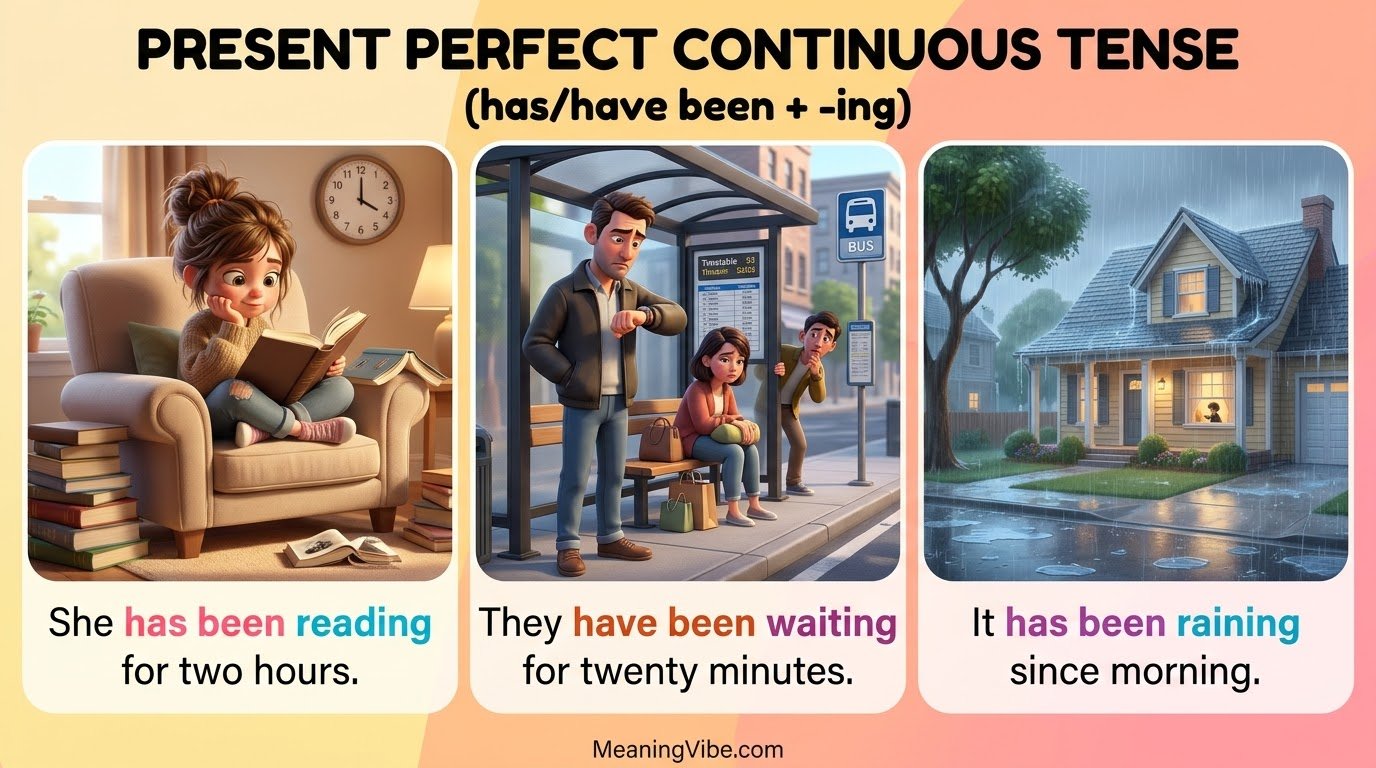
The second use is the most spoken one. The action has stopped, or paused, but its evidence is in front of the listener.
Your eyes are red, so you have been crying; the ground is wet, so it has been raining; his voice is hoarse, so he has been shouting.
Notice what the tense is doing here. It explains a present state by pointing at the recent activity that caused it. No duration needs stating. The listener can see the duration’s deposit. Textbooks bury this use third or fourth; conversation puts it near first.
It also explains unfinished work. I have been reading the report means the report is not finished, and the reading is why I can discuss page four but not page nine. The simple form, I have read the report, claims the whole thing. Same verb, opposite news.
Recent Activity and Repeated Actions
Without any time expression, the tense reports recent activity: I have been feeling tired lately. She has been working hard recently. Lately and recently are its natural partners here, stretching a loose recent period up to now.
Repeated recent actions take the same form: someone has been cutting pictures out of this book, said of page after page of damage. The repetition, not one event, is the point, and the simple form would wrongly suggest a single cut.
Register comes free with this use. The form carries a mild energy of explanation, complaint, or accusation that neutral lists flatten: I have been waiting for forty minutes is never just information. Knowing that tone is part of knowing the tense.
For and Since: The Measurement and the Starting Point
For measures a period; since marks a point. That one sentence settles the pair. For two hours, for three years, for a long time: lengths. Since Monday, since 2020, since I woke up: starting points on the clock or calendar.
|
Word |
What follows it |
Correct pairings |
Classic trap |
|---|---|---|---|
|
For |
A period of time |
for 20 minutes, for six months, for ages |
Since three years (wrong: three years is a period) |
|
Since |
A point in time |
since 9 o’clock, since last June, since childhood |
For Monday (wrong: Monday is a point) |
The traps are mechanical, which makes them fixable.
“I have been working here since three years” fails because three years measures, and measuring words take for: for three years, or since 2023 if a point is wanted. Run the measure or point check before the word leaves your mouth.
Since can also take a whole clause: since I arrived, since we met, since the course started. The clause names the point by describing the event that started the clock. For never takes a clause.
Neither word is required. All day, all morning, and all week carry duration without them, and the lately pattern carries recency without any time phrase at all. For and since are the commonest signals, not conditions of use.
The Process Test: Continuous Versus Simple
Here is the fork, the contrast MyEnglishPages’ comparison of present perfect and present perfect continuous also tabulates.
The simple form points at a result, its completion, or its quantity; the continuous points at the activity, its duration, or its evidence. Before choosing, ask one question: am I reporting what got done, or what has been going on?
|
Pair |
What the simple claims |
What the continuous claims |
|---|---|---|
|
I have written three emails / I have been writing emails |
Three finished emails exist |
Email writing has occupied me; count unstated, maybe unfinished |
|
I have read the report / I have been reading the report |
The report is finished |
The report is in progress |
|
She has painted the room / She has been painting the room |
The room is done |
The room is under way; paint on her clothes explains itself |
|
He has run five kilometers / He has been running |
A completed distance |
An activity, possibly still running, certainly recent |
Quantity is the tell. Numbers and counts (three emails, five kilometers, twice) belong to the simple, because counting finished units is result thinking.
Durations (for hours, all day, since dawn) belong to the continuous, because measuring activity is process thinking. When a sentence offers both a count and a duration, the writer’s emphasis decides, and native speakers feel the difference instantly.
The both forms possible zone is where honest teaching matters most. With live, work, study, wait, stay, teach, and similar long duration verbs, both forms are correct.
I have lived here for years; I have been living here for years. The difference is shading: the continuous leans temporary or recent, the simple leans settled or permanent.
Exam questions that mark one of these wrong without context are testing a rule the language does not actually have.
Stative verbs break the tie absolutely, which is the next chapter’s subject. Where the verb names a state, only the simple survives, whatever the emphasis.
The Stative Gate: Verbs That Refuse the Continuous
Some verbs name states, not actions: knowing, owning, believing, wanting, liking, seeming. States do not unfold in stages, so continuous forms reject them. The gate is absolute in standard English: I have known her for years, never “I have been knowing her.”
|
Category |
Verbs |
Correct form |
|---|---|---|
|
Mind and knowledge |
know, believe, understand, remember, mean |
I have known him since school |
|
Emotion and desire |
like, love, hate, want, prefer, need |
She has wanted a change for months |
|
Possession and relation |
own, belong, contain, consist of |
They have owned the shop since 2015 |
|
Senses and appearance |
seem, appear, sound, smell (state senses) |
It has seemed quiet lately (state reading) |
Mixed verbs slip through the gate by changing meaning.
Have as possession is stative: I have had this car for years, never have been having. Have as activity is dynamic: we have been having trouble with the car, perfectly continuous.
Think splits the same way: I have thought so for years (opinion, simple) against I have been thinking about it all week (activity, continuous).
Feel splits too. I have been feeling unwell is standard despite feel’s stative family membership, because bodily sensation reads as an ongoing process.
The gate judges the meaning in the sentence, not the dictionary entry. LearnGrammarFast’s B2 lesson on the present perfect continuous, with its mistakes list teaches the same gate at B2 level with its own inventory.
Why learners fall here: many first languages mark ongoing states with progressive forms, so the transfer feels natural. The fix is exposure to the gate list plus the meaning check: if the verb could take a photograph of itself happening, it is dynamic; if not, it is stative.
Questions: How Long Is This Tense’s Home Ground
How long have you been waiting? is the question this tense was born to answer. The question asks for duration up to now, and only the perfect continuous, or its simple sibling with stative verbs, can answer in kind: for twenty minutes, or since nine o’clock.
General questions invert have or has to the front: Have you been waiting long? Has she been practicing? Short answers use the auxiliary alone: Yes, I have. No, she hasn’t. Never answer with been; the chain’s first link carries the reply.
Wh questions put the question word first and keep the chain intact: What have you been doing? Why have they been arguing? Where has he been working? The word order after the question word is exactly the yes or no order, a mercy learners should exploit.
Notice the diagnostic power. If a conversation opens with how long, the answer’s tense is chosen before the content is: duration questions demand duration forms. Drilling question and answer as one unit, rather than the tense in isolation, is how the form becomes automatic.
The Error Clinic: Six Mistakes and Their Fixes
The mistakes below are the documented ones, the same inventory strong lessons like LearnGrammarFast’s B2 lesson on the present perfect continuous, with its mistakes list build from. Each fix is a check you can run mid sentence.
1. The stative in the chain
“I have been knowing her since school.” Know is a state. Fix: pass the verb through the stative gate first. I have known her since school.
2. The dropped link
“I have working here since 2020.” Been is missing, and without it the chain is broken. Fix: count the links aloud: have, been, working. Three, or it is not this tense.
3. For and since swapped
“Since three years” / “for Monday.” Fix: run measure or point. Three years measures, so for. Monday points, so since.
4. Finished time smuggled in
“I have been studying yesterday.” Yesterday closes the time frame. Fix: closed frames take the past simple: I studied yesterday. Or drop the adverb and let the tense breathe: I have been studying all day.
5. The present simple with since
“I am here since January.” A widespread transfer error. English demands the perfect frame for past to now spans: I have been here since January. The present simple cannot reach backwards.
6. Result questions answered with the process form
“How many pages have you been writing?” asked of a finished count, misfires; counts live in the simple: How many pages have you written? Fix: run the process test on questions too, not only statements.
Level, Frequency, and Honest Expectations
Teaching level: the tense sits in the B1 to B2 band of the CEFR inventories, after the present perfect simple and the present continuous are secure.
IELTS speaking rewards it inside grammar range: it is a natural answer form for duration questions in Part 1, never a score guarantee in itself.
Frequency honesty: among the perfect forms, this is one of the least frequent in everyday English. That is not a reason to skip it. Its two home territories, duration answers and visible results explanations, are high value conversations, and exams test it precisely because learners avoid it.
The passive exists and is best avoided. “The road has been being repaired” is grammatical in theory and vanishingly rare in life.
Writers recast: workers have been repairing the road. Knowing a form is rare is part of knowing the tense; MeaningVibe’s grammar and meaning library collects companion explanations across the verb system.
Practice Method: Build the Habit in Four Passes
1. Chain drills
Say twenty sentences aloud on one verb until have, been, verb-ing runs as one gesture. Waiting is the traditional training verb: I have been waiting, she has been waiting, have they been waiting.
2. Timeline narration
Narrate your morning with start points: I have been awake since six. I have been working since nine. The timeline forces since into its correct shape without a rule sheet.
3. Evidence spotting
Explain five present sights with the visible results use: the kitchen is a mess because we have been cooking. This pass teaches the tense’s most spoken job directly.
4. Fork rewriting
Take ten simple sentences from MeaningVibe’s bank of present perfect tense examples and rewrite each in the continuous where the language allows, noting what changed: counts vanish, durations appear, finished becomes under way. The pairs teach the process test better than any definition.
Signal Words, Sorted by the Form They Favor
Signals are evidence, not orders, but their leanings are strong enough to teach. When a learner is stuck mid sentence, the time words already chosen usually point at the right form.
|
Signal |
Leans continuous |
Leans simple |
Why |
|---|---|---|---|
|
For, since (with action verbs) |
Yes |
Possible with statives |
Duration is process language; states take the simple by the gate |
|
All day, all morning, all week |
Yes |
Rarely |
Whole span activity framing |
|
Lately, recently |
Yes |
Sometimes |
Recent activity versus recent single events |
|
Just |
Both |
Both |
Very recent either way; emphasis decides |
|
Already, yet, ever, never |
Rarely |
Yes |
Result and experience vocabulary |
|
How many, how much (counts) |
No |
Yes |
Counting finished units is result thinking |
|
How long |
Yes |
Stative cases |
Duration questions demand duration forms |
Read the table as a weather report, not a law code. It tells you which way the wind blows in native usage; the process test and the stative gate remain the courts of final appeal when signals conflict.
A Day in This Tense: Worked Narration
Watch the form do its jobs in sequence. At 7 a.m.: It has been raining since five, and the garden has had enough. The first clause measures duration; the rain explains the flooded path without another word.
At work: I have been answering emails since nine, and I have answered forty. One verb, both forms, in a single breath: the continuous reports the occupied morning, the simple delivers the count. That sentence pair is the process test with its sleeves rolled up.
At lunch: She has been coughing all morning, so she is seeing a doctor at two. Evidence in the present, explanation in the tense, plan in another form entirely. Three clauses, three jobs, no confusion for any listener.
In the evening: We have been renovating the kitchen since June, and your hands show it. The span reaches now, the work is unfinished, and the evidence is literally on display. A learner who can narrate one honest day this way owns the tense.
Frequently Asked Questions
1. What is the present perfect continuous tense?
A tense for duration up to now. It describes an action that began in the past and is still running, or has just stopped leaving visible evidence.
Form: have or has plus been plus verb-ing, as in It has been raining since morning.
2. What is the formula of the present perfect continuous?
Subject plus have or has plus been plus verb-ing. She has been working here since 2020.
Three links: the auxiliary anchors the perfect frame, been carries the progressive machinery, and the ing form names the activity.
Drop a link and you have built something else.
3. What is the difference between present perfect continuous and present perfect progressive?
None. They are two names for one tense.
Continuous is the commoner label in British materials, progressive in many American and linguistics texts.
Same form, same uses, same restrictions.
Learners lose real time treating them as separate topics; they are not.
4. When do we use the present perfect continuous tense?
For duration, evidence, and recency. An action still running since a past start, a recently stopped action explaining a visible present state, and recent activity reported with lately or recently.
If none of those is your meaning, another tense probably owns the sentence.
5. How do you form the negative of the present perfect continuous?
Insert not after the auxiliary. Subject plus have or has plus not plus been plus verb-ing: We have not been studying enough.
Contracted in speech as haven’t been and hasn’t been.
The rest of the chain does not move.
6. How do you ask questions in the present perfect continuous?
Move the auxiliary to the front. Have you been waiting long?
Wh questions add the question word first and keep the chain intact: How long has he been running?
Short answers use the auxiliary alone: Yes, I have.
No, she hasn’t.
7. Why is I have been knowing wrong?
Because know is stative. Stative verbs name states, not unfolding actions, and continuous forms reject them.
The correct sentence is I have known her since school, in the present perfect simple.
The gate applies to believe, own, want, and their family as well.
8. Which verbs cannot be used in the present perfect continuous?
The stative families. Verbs of knowledge (know, believe, understand), desire (want, prefer), possession (own, belong), and state senses and appearance (seem, appear).
Mixed verbs like have and think pass the gate only in their activity meanings, not their state meanings.
9. What is the difference between present perfect and present perfect continuous?
Process versus result. The continuous points at the activity and its duration: I have been writing emails, count unstated, possibly unfinished.
The simple points at the result and its quantity: I have written three emails.
Run the process test: activity or outcome?
10. Should I say I have lived here for years or I have been living here for years?
Both are correct. Live sits in the both forms possible zone with work, study, and wait.
The difference is shading: I have been living here leans temporary or recent, I have lived here leans settled.
Context decides; neither is an error.
11. Does the present perfect continuous always need for or since?
No. All day, all morning, and all week carry duration without either word, and the lately pattern needs no time phrase at all.
For and since are the commonest signals for duration, not conditions the tense requires.
12. Can I use the present perfect continuous with yesterday?
No. Yesterday is finished time, and this tense demands a time frame reaching now.
Closed past periods take the past simple: I studied yesterday.
Either drop the adverb or change the tense; the two cannot share a sentence.
13. Can the present perfect continuous describe a finished action?
Yes, recently finished. The visible results use exists precisely for stopped actions: your eyes are red because you have been crying.
The action ended; its evidence has not.
What the tense cannot describe is a distantly finished action with no present trace.
14. How do I answer How long have you been waiting?
With for or since. For twenty minutes (a period) or since nine o’clock (a point).
The question asks for duration up to now, and the answer mirrors it.
A bare time like twenty minutes works in conversation but the full forms teach the distinction.
15. What does It has been raining since morning mean exactly?
Rain began in the morning and reaches now. Since marks the starting point, morning, and the tense carries the action from that point to the present moment.
It does not promise the rain continues one second beyond the sentence, only that its span touches now.
16. When do you use has been and when have been?
By the subject. I, you, we, and they take have; he, she, and it take has.
She has been working; they have been working.
The choice is ordinary subject agreement applied to the chain’s first link; been and the ing form never change.
17. What are the signal words for the present perfect continuous?
For, since, all day, lately, recently, how long. For and since carry duration, all day type phrases carry it without prepositions, lately and recently signal the no time expression use, and how long introduces its home ground questions.
Signal words guide the choice; they do not force it.
18. How do you spell verb-ing in this tense?
Three adjustments recur. Drop silent e (make, making; write, writing), double a final consonant after one short vowel (run, running; sit, sitting), and change ie to y (lie, lying; die, dying).
Everything else simply adds ing, including verbs ending in y.
19. Can the present perfect continuous be passive?
Grammatically yes, practically almost never. Forms like has been being repaired are so rare that writers recast them actively: workers have been repairing it.
Treat the passive of this tense as a curiosity to recognize, not a tool to use.
20. What is the difference between present perfect continuous and present continuous?
The starting point differs. The present continuous describes an action around now that may have begun moments ago: I am reading.
The perfect continuous anchors the start in the past and measures the span: I have been reading for two hours.
Duration is the dividing line.
21. What is the difference between present perfect continuous and past perfect continuous?
The anchor differs. Past perfect continuous measures duration up to a past moment: I had been waiting for an hour when she arrived.
Present perfect continuous measures up to now.
Same chain logic, different anchor: had been versus have or has been.
22. Is She’s been working a correct contraction?
Yes. She’s been working is the standard contraction of she has been working, and I’ve been, we’ve been, they’ve been follow it.
Contractions are the spoken norm for this tense; formal writing spells the auxiliaries out.
23. Can I use just and already with the present perfect continuous?
Just works; already is less typical. I have just been reading is natural for very recent activity.
Already belongs more comfortably to the simple form’s result world, though context can rescue it.
Adverb placement sits after the auxiliary or after been in most patterns.
24. Why do we say I have been reading the book, not I have read, when it is unfinished?
Because read is unfinished there. The continuous reports the activity without claiming completion: part of the book, an unknown amount, still in progress.
I have read the book claims the final page.
Choosing between them is reporting honestly about where the bookmark sits.
25. Does the present perfect continuous imply something is temporary?
Often, yes. In the both forms zone, the continuous quietly suggests a temporary or recent arrangement while the simple can suggest a settled one.
Compare I have been staying with friends (a stopgap) with the more permanent feel of long residence in the simple.
It is shading, not a rule.
26. What does lately mean in I have been feeling tired lately?
Over a recent stretch, up to now. I have been feeling tired lately reports a pattern across recent days reaching the present, with no single start point named.
Lately licenses the tense without for or since, which is why the pair appears so often in speech.
27. Can I say I have been working here since three years?
No. Three years is a period, and periods take for: I have been working here for three years.
Or name the point instead: since 2023.
Since plus a period is among the commonest learner errors in this tense, and the measure or point check kills it.
28. What is wrong with I am working here since 2020?
It uses the wrong frame. The present simple cannot stretch from a past start to now.
English requires the perfect: I have been working here since 2020.
This transfer error is widespread among learners whose first languages mark the span differently.
29. How many auxiliaries does the present perfect continuous have?
Two. Have or has is the primary auxiliary of the perfect frame, and been is the past participle of the second auxiliary, be.
Together with the main verb’s ing form they make the three link chain learners should count when checking their sentences.
30. Why is been always been in this tense?
Because been is a participle, not a tense form. It is the past participle of be, and participles do not agree with subjects.
Have and has absorb the agreement and the present anchoring, leaving been identical for every subject: I have been, she has been.
31. Can have meaning possession be used in the present perfect continuous?
Not in its possession meaning. I have had this car for years is the correct simple form; have been having a car is not standard.
In activity meanings it passes freely: we have been having trouble with the car.
Judge the meaning, not the verb.
32. What are mixed verbs in this tense?
Verbs that split by meaning. A mixed verb is stative in one sense and dynamic in another: think (opinion versus deliberation), have (possession versus activity), feel (sensation reads as process), see (perception versus meeting).
The sentence’s meaning decides which forms it may take.
33. Does the present perfect continuous work for repeated actions?
Yes, for repeated recent actions. Someone has been cutting pictures out of this book, said of damage across many pages, uses the tense for a repeated pattern reaching now.
The simple form would suggest one completed event; the continuous spreads it across the period.
34. How is the present perfect continuous used for complaints?
Because it reports a span endured. I have been waiting for forty minutes carries complaint energy the simple cannot: it measures the imposition.
Explanation, mild accusation, and evidence pointing all ride this form in daily speech, which is why flat textbook lists undersell it.
35. What CEFR level is the present perfect continuous?
B1 to B2. The CEFR inventories place the present perfect continuous in the intermediate band, after the present perfect simple and present continuous are secure.
Learners meet it once they can already handle been in the simple perfect’s passive and participle uses.
36. Do I need the present perfect continuous for IELTS speaking?
It helps range, honestly framed. IELTS speaking rewards varied accurate forms, and duration answers are natural Part 1 territory: I have been studying English for six years.
No tense guarantees a band; accurate, natural use inside a wider range is the whole claim.
37. How do short answers work with this tense?
With the auxiliary alone. Yes, I have.
No, she hasn’t.
Been never appears in short answers, and the main verb disappears entirely.
The pattern matches every perfect tense, which is why the first link of the chain is worth drilling.
38. Can the action in the present perfect continuous still be happening now?
Yes, that is its core use. The default reading of the tense is an action running at the moment of speaking: they have been playing since morning, and they still are.
The just stopped reading needs the visible evidence context to be understood.
39. What is the difference between for two hours and since two o’clock here?
A period versus a point. For two hours measures the span’s length; since two o’clock names where the span began.
Both complete the same sentence frame: I have been working for two hours, I have been working since two o’clock.
Measure takes for; point takes since.
40. Why is someone has been cutting pictures different from someone has cut a picture?
Repetition versus one event. Someone has cut a picture reports a single completed act.
Someone has been cutting pictures reports a repeated pattern across the book, discovered through its accumulating evidence.
The classic tutorial pair shows how aspect alone changes the police report.
41. How do I choose between simple and continuous with live, work, and study?
By emphasis, honestly. These verbs sit in the both forms zone.
Choose the continuous to stress activity, duration, or temporariness; choose the simple to stress settled fact or results so far.
If an exercise demands one answer, it is testing emphasis conventions, not correctness.
42. Is the present perfect continuous common in spoken English?
Less common than its siblings. Among perfect forms it is relatively infrequent in everyday English, concentrated in duration answers, explanations of visible evidence, and exam English.
Infrequency is not unimportance: its home conversations are ones learners actually have every week.
Conclusion
The present perfect continuous tense is a three link chain with two checks on the gate: have or has, been, verb-ing for the form; the process test for the fork with its simple sibling; and the stative gate for the verbs that refuse it.
Keep the checks in order. Build the chain and count its links. Ask whether the sentence reports an activity or a result. Ask whether the verb names an action or a state.
Those three habits answer nearly every question this tense raises, in class and in conversation.
Then practice where the tense lives: in how long answers, in explanations of what the eyes can already see, and in the mild complaints of everyday waiting. A form learned at its home ground stays learned.