

Draft vs draught confuses writers because the two spellings look like different words, yet they name the same word in most senses.
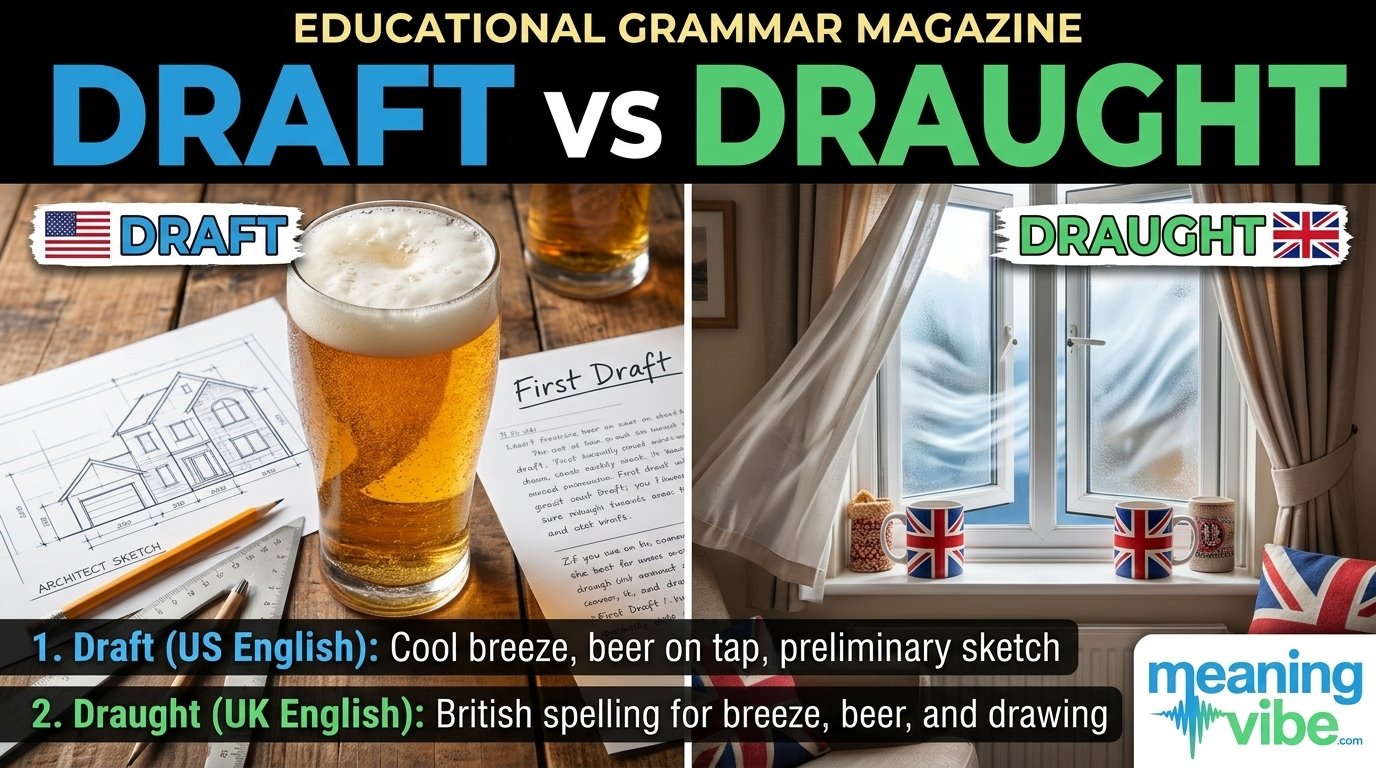
Draft is the US spelling for almost every sense, from a preliminary document to beer from a keg. Draught is mainly a UK spelling, used for certain senses, plus a beer branding spelling in the US.
The fastest rule for a US audience is simple: use draft unless you are quoting a UK source, writing for a UK audience, or copying a beer brand name. For a UK audience, check the sense list, because the UK split is not simple.
Table of Contents
ToggleDraft vs Draught in One Line
Draft and draught are spelling variants, not two words with different meanings. They share a root, a pronunciation within each dialect, and most of their senses.
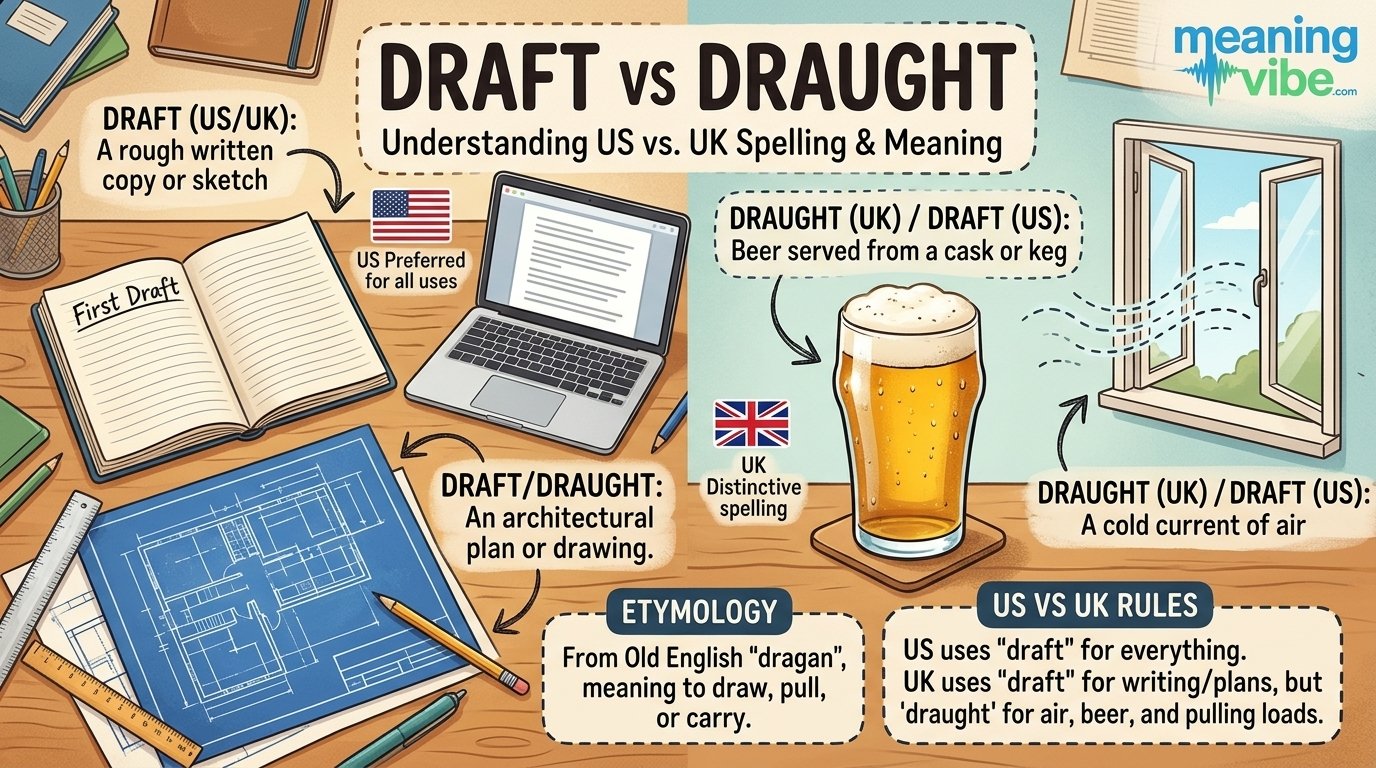
That shared root explains why a draft of air and a draught of beer feel related: both involve drawing, pulling, or pouring. Spelling, not meaning, is what changes across regions.
| Spelling | US use | UK use | Pronunciation |
|---|---|---|---|
| Draft | Almost everything | Verb, preliminary document, bank draft, military draft | US /dræft/, UK /drɑːft/ |
| Draught | Mainly beer branding, imported beer | Air, drink, beer, horse, ship depth, draughts game | Same as draft within the dialect |
What Does Draft Mean
Draft covers a wide set of senses, all linked to drawing, pulling, or a first version. Merriam-Webster and WordReference list those senses across noun, verb, and adjective forms.
A draft can be a document, a current of air, a drink, a pulling animal, a ship depth, a selection, or a payment order. Context decides which sense applies, while spelling decides which region the text belongs to.
That breadth is why learners should learn senses first, then spelling rules. A sense map prevents the common error of treating beer spelling as a different product.
Draft as a Preliminary Version
A draft as a preliminary version is an early, unfinished form of a document, plan, or work. Students write a draft essay, architects draw a draft plan, and authors revise a draft novel.
WordReference uses a student essay draft and a novel draft version as examples, which show the sense in school and creative writing. That sense is spelled draft in both US and UK English.
A rough draft is the earliest version, while a final draft is the last version before publication or submission. That rough to final ladder helps writers talk about revision without confusion.
A draft document is not a mistake; it is a planned stage in writing. Editors expect a draft to change, and they judge it by structure and ideas, not by polish.
Draft as a Current of Air
A draft as a current of air is a flow of cool air through a room, window, or chimney. WordReference uses a window letting in a draft as a clear example.
That sense is spelled draft in US English, and draught in UK English. A US homeowner should write “cold draft,” while a UK homeowner should write “cold draught.”
A draft can feel pleasant on a hot day, or unwelcome on a cold night, depending on context. That feeling does not change the spelling, but region does.
Home sealing products follow the same split: a US product is a draft excluder or draft stopper, while a UK product is a draught excluder. JCP Hardware notes both spellings mean the same product.
Draft as a Drink, Beer, and Gulp
A draft as a drink can mean a portion of liquid to be drunk, a gulp, or beer served from a keg or cask. WordReference uses a long draft of fresh air and a draft of medicine as examples.
Beer served from a keg or cask is called draft beer in the US, and draught beer in the UK. Kegworks states plainly that there is no difference between draft beer and draught beer as products.
A draft of beer in a pub means beer drawn from a large container, not from a bottle or can. That serving method, not the spelling, is what makes it fresh and tap-poured.
A single draft can also mean one swallow, as in “He took a deep draft of water.” That gulp sense is formal or literary in modern US writing, but it survives in older texts.
Draft as a Pulling Animal and Load
A draft animal is an animal used to pull heavy loads, such as a horse, ox, or mule. WordReference uses draft horses pulling carts before motorised vehicles as an example.
That sense is spelled draft in US English, and draught in UK English. A US farm text should write draft horse, while a UK farm text should write draught horse.
A draft load is the load drawn by that animal or vehicle, and draft can also mean the act of pulling itself. Collins lists pulling a load and the load drawn as separate but related senses.
Breeds such as Clydesdale and Percheron are often called draft horses in US writing, because they are large, strong, and bred for pulling. That breed label follows region, not breed, so UK texts use draught horse for the same breeds.
Draft as a Ship Depth
A ship draft is the depth of water a ship needs to float, measured from the waterline to the lowest point of the hull. Collins gives that definition for draught, with US draft as the equivalent.
That sense is spelled draft in US English, and draught in UK English, according to the Wikipedia spelling table. A US harbour document should write ship draft, while a UK harbour document should write ship draught.
A shallow draft lets a ship enter shallow water, while a deep draft needs deeper water and a deeper harbour. That depth matters for safety, cargo loading, and harbour entry.
Maritime writers should verify units locally, because feet and metres both appear in ship documents. Spelling does not change the measurement, but audience region does change the spelling.
Draft as a Selection, Conscription, and Payment Order
Draft as a selection means choosing people for a team, army, or job, often by a formal system. A sports draft picks players, while a military draft conscripts people for service.
That sense is spelled draft in both US and UK English, according to Proofed and the Wikipedia spelling table. A UK text about military conscription uses draft, not draught, even though conscription is less common in modern UK writing.
Draft as a payment order means a written order for money, such as a bank draft, which works like a check guaranteed by a bank. Proofed lists banker draft as a draft spelling in both regions.
A draft pick in sports is a player selected in a draft, while a draft notice in military writing is a call to service. Both uses keep the selection idea, which comes from drawing names or people from a group.
What Does Draught Mean
Draught is the older spelling, and it survives in UK English for certain senses, plus in US beer branding. Dictionary.com calls draught a variation of draft, with chiefly British senses listed separately.
That older spelling reflects an older pronunciation, before draft emerged in the 16th century to match a changed sound. Wikipedia notes that draft appeared to reflect pronunciation change, while draught kept the older letters.
Learners should not treat draught as a fancy or formal version of draft in US writing. In US writing, draught outside beer branding usually looks like a UK spelling error, not a style upgrade.
Draught as the Older Spelling
Draught comes from Middle English, in the sense of drawing or pulling, and from Old Norse drattr, related to draw. Oxford Advanced Learner notes that origin, with draught linked to draw and draft.
The letters aught in draught once matched a sound that later changed, which is why draft looks more phonetic today. That history explains why draught feels old-fashioned to many US readers.
Old texts may use draught for senses that modern US texts spell draft, including plans, drawings, and air currents. Readers of older texts should translate spelling, not meaning, when they meet draught there.
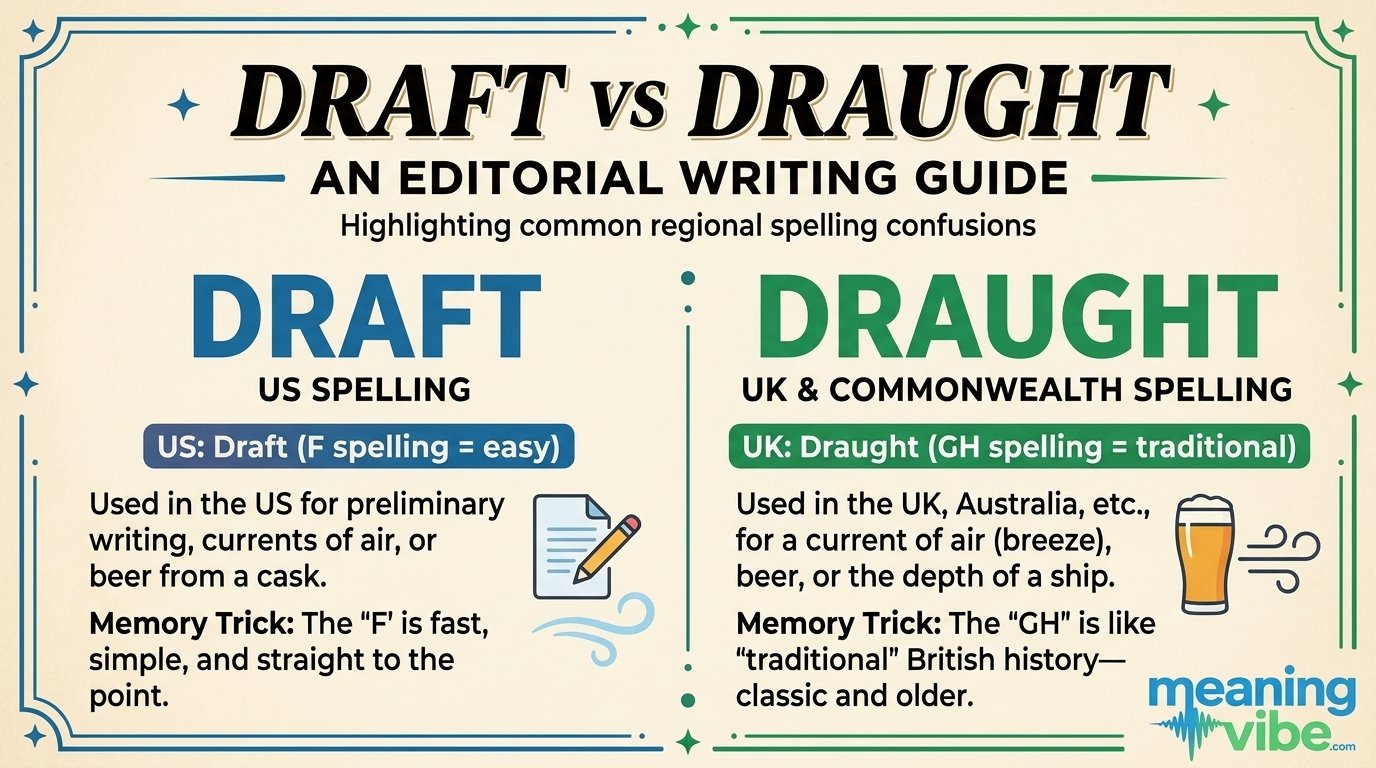
A modern writer who copies an old draught spelling into a US document risks confusing a reader who expects draft. Quoting an old source exactly is different from adopting its spelling for new writing.
Draught in UK Senses Only
In UK English, draught covers a current of air, an act of drinking, a portion of liquid, beer from a cask or keg, a pulling animal, a ship depth, and the game draughts. Proofed lists those noun senses clearly for UK use.
In UK English, draught also works as an adjective for drink served from a barrel and for an animal used for pulling. Proofed gives draught beer and draught horse as adjective examples.
That UK list is the key to Step 2, because it is narrower than “UK uses draught for everything.” UK writers use draft for the verb, for a preliminary document, for a bank draft, and for military draft.
A UK writer who writes “draught document” for a preliminary essay would be using the wrong UK spelling for that sense. That error shows why a sense list matters more than a simple region label.
Draught as Beer Branding in the US
In US English, draught survives mainly for beer, especially imported beer and beer at notably British or fancy establishments, per Merriam-Webster. That survival is branding and atmosphere, not a general US rule.
Kegworks notes that some American bars use draught to create an authentic feel, especially Irish pubs and German beer halls. That branding choice signals tradition, even when the beer itself is served from a standard keg system.
A US menu that writes “draught beer” is not wrong in a branding sense, but a US style guide would still prefer draft beer for general writing. Writers should follow the menu or brand name exactly when quoting it, and follow US spelling otherwise.
Imported beer labels may keep draught from their home country, even when sold in the US. That label spelling should be copied exactly for the product name, while general text about beer should use draft for a US audience.
Draft vs Draught Comparison Table, Sense by Sense
| Sense | US spelling | UK spelling | Example |
|---|---|---|---|
| Preliminary document version | Draft | Draft | Rough draft of an essay |
| Verb: to write or sketch | Draft | Draft | Draft the plans |
| Bank payment order | Draft | Draft | Bank draft |
| Military conscription | Draft | Draft | Military draft |
| Sports selection | Draft | Draft | Draft pick |
| Current of air | Draft | Draught | Cold draft or draught |
| Drink, gulp, dose | Draft | Draught | Deep draft or draught |
| Beer from keg or cask | Draft, draught as branding | Draught | Beer on draft or draught |
| Pulling animal | Draft | Draught | Draft or draught horse |
| Ship depth below waterline | Draft | Draught | Ship draft or draught |
| Board game | Checkers | Draughts | Game of draughts in the UK |
| Technical drawing person | Draftsman | Draughtsman for plans, draftsman for legal | Draughtsman drew the plans |
That table is the most useful part of the article, because it replaces a vague region rule with a sense rule. Writers should keep it open while editing, especially for UK texts.
Pronunciation: Same Sound, Different Letters
Pronunciation explains why the pair confuses readers, because the letters differ while the sound stays the same within each dialect. Learners should practise sound and spelling separately.
US /dræft/, UK /drɑːft/
In US English, both spellings are pronounced /dræft/, with a short a sound like cat. In UK English, both spellings are pronounced /drɑːft/, with a long a sound like father.
Wikipedia notes that pronunciation is always the same for all meanings within a dialect, which means sound cannot decide spelling. A listener hears draft whether the writer spelled it draft or draught.
That same-sound rule helps learners in listening tests: if a speaker says /dræft/ in the US, the spelling could be either, but the expected written form is usually draft. Context and region, not sound, decide the written form.
A UK speaker saying /drɑːft/ also gives no spelling clue, because both spellings sound identical in UK speech. Writers must know the sense list, not just the sound, to choose correctly.
The Caught-Like Mispronunciation Trap
Dictionary.com warns that a caught-like pronunciation is sometimes heard for draught, because aught often sounds like caught or taught in other words. That pronunciation is a spelling trap, not a standard pronunciation for draught.
A learner who reads draught as “drawt” with an aw sound may be understood, but that reading marks the learner as unfamiliar with the word. Teachers should correct that reading early, with the standard /dræft/ or /drɑːft/ form.
That trap also explains why some learners think draught must be a different word: the letters suggest a different sound, even though dictionaries give the same sound as draft. Spelling history, not sound, created the trap.
A useful practice is to read draft and draught aloud as the same word, then write them side by side. That exercise separates sound from spelling in a memorable way.
The US Rule: Use Draft for Almost Everything
The US rule, stated by Proofed and Merriam-Webster, is simple: use draft for all noun, verb, and adjective uses in American English. That rule covers documents, air, beer, horses, ships, military, banking, and sports.
A US writer who follows that rule will be correct in almost every case, except for quoted brand names and imported beer labels. That exception is narrow, and it should not be treated as a second US rule.
A US menu, product label, or technical document that uses draught for air, horse, or ship senses will look like a UK import or an error. US readers expect draft in those senses, and US style guides enforce that expectation.
A US writer who writes for a UK audience should switch to the UK sense list, not keep US draft for every sense. Audience region, not writer region, should decide spelling in professional writing.
The UK Rule: Draft for Some Senses, Draught for Others
The UK rule, stated by Wikipedia and Proofed, splits by sense, not by word class alone. That split is the reason UK writers need a table, while US writers need only a rule.
UK Draft Senses: Verb, Document, Bank Draft, Military Draft
In UK English, draft is used for the verb meaning to write or sketch, for a preliminary version of a document, for a bank draft, and for military conscription. Proofed lists banker draft and military draft as draft spellings in UK English as well.
A UK student should write “first draft of an essay,” not “first draught,” because the document sense takes draft. A UK architect should write “draft the plans,” not “draught the plans,” because the verb takes draft.
A UK bank should write “bank draft,” not “bank draught,” because the payment order sense takes draft. That sense follows the document and money tradition, not the air and beer tradition.
A UK sports writer should write “draft pick” for a US sports selection, because sports draft is a US term borrowed with its spelling. That borrowing shows how US terms can keep US spelling even in UK texts.
UK Draught Senses: Air, Drink, Beer, Horse, Ship, Draughts
In UK English, draught is used for a current of air, an act of drinking, a portion of liquid, beer from a cask or keg, a pulling animal, a ship depth, and the game draughts. Proofed lists those senses as draught noun uses in UK English.
A UK homeowner should write “cold draught through the window,” not “cold draft,” for a UK audience. A UK pub should write “draught beer,” not “draft beer,” for a UK menu.
A UK farmer should write “draught horse,” not “draft horse,” for a UK audience. A UK harbour document should write “ship draught,” not “ship draft,” for a UK audience.
A UK board game player should write “game of draughts,” not “game of drafts,” because draughts is the UK name for checkers. That game name is plural, which creates a separate trap discussed below.
UK Either Senses: Plan or Sketch, With Draughtsman Note
In UK English, either draught or draft can be used for a plan or sketch, according to the Wikipedia spelling table. That either sense is the most flexible part of the UK rule, and it needs a house style choice.
Wikipedia notes that UK writing almost always uses draughtsman for a plan drawer, while a draftsman drafts legal documents. That distinction is subtle, and writers should verify it against a current dictionary before using it in a legal or technical text.
A UK technical drawing office may prefer draughtsman for tradition, while a UK legal office may prefer draftsman for documents. That office preference is a house style, not a universal rule, so writers should follow the office style.
For learners, the safe UK choice for a plan is draft, because it matches the document sense and the verb sense. That choice avoids the draughtsman trap, while still being acceptable in most UK contexts.
Canada, Australia, and New Zealand Notes
Canada uses both US and UK systems, according to Wikipedia, which means Canadian writers should follow a house style or audience region. A Canadian beer menu may use draft or draught, depending on branding and province.
Australia uses draft for technical drawings, accepts draft for the air meaning, and prefers draft by professionals in the nautical sense, according to Wikipedia. That Australian pattern is closer to US draft than to UK draught for technical senses.
New Zealand generally follows UK draught for beer and air, but also uses draft for documents and technical senses, similar to Australia. Writers for those audiences should check a local style guide, not assume a single Commonwealth rule.
That regional variation shows why a single “Commonwealth uses draught” claim is too vague. Writers should name the country, not just the region, when they give a spelling rule.
Etymology: Old English Dragan, to Pull, Draw, or Drag
Draft and draught go back to Middle English and to Old English dragan, meaning to pull, draw, or drag, per Merriam-Webster. That root explains the pulling, drawing, and pouring senses in one family.
A draft horse pulls, a draft of air is drawn through a room, a draft of beer is drawn from a keg, and a draft document is drawn up as a first version. All of those senses share the drawing idea, even when the modern uses feel distant.
Draught reflects the older spelling, while draft emerged in the 16th century to reflect a changed pronunciation, per Wikipedia. That emergence explains why draft looks more modern and phonetic to US readers today.
Old Norse drattr, related to draw, also appears in Collins etymology for draught, which shows a Germanic root family, not a Latin borrowing. That Germanic root helps learners link draft, draught, draw, and drag as cousins.
Draft and Draught in Context
Context turns abstract spelling rules into usable decisions. Seven settings cover almost every real example a learner will meet, from essays to ships.
Writing and Documents
In writing, draft is the only spelling for a preliminary version in both US and UK English. A student, author, lawyer, or architect should write draft for a document, plan, or sketch in a document sense.
A rough draft is an early version with gaps, a second draft is a revised version, and a final draft is the version ready for submission. That ladder works in school, publishing, and legal writing alike.
A writer who writes “draught essay” for a UK audience would be using the wrong spelling for that sense, even though draught is a UK word. That error shows why sense, not region alone, decides spelling.
Editors should search for draught in a document and check each instance against the sense list, rather than replacing all instances blindly. A beer mention in the same document may correctly keep draught in UK writing.
Beer: Spelling Versus Serving Method
Beer spelling and beer serving method are separate questions, and confusing them is the most common beer error. Spelling asks whether the text uses draft or draught, while serving asks whether beer comes from a cask or a pressurised keg.
Cask beer is served by hand pump or gravity, with natural carbonation from secondary fermentation, while keg beer is served by pressurised CO2 or nitrogen, with a crisp, stable carbonation. Food and Beverage Knowledge describes that serving contrast, but its flavour claims should be treated as serving claims, not spelling facts.
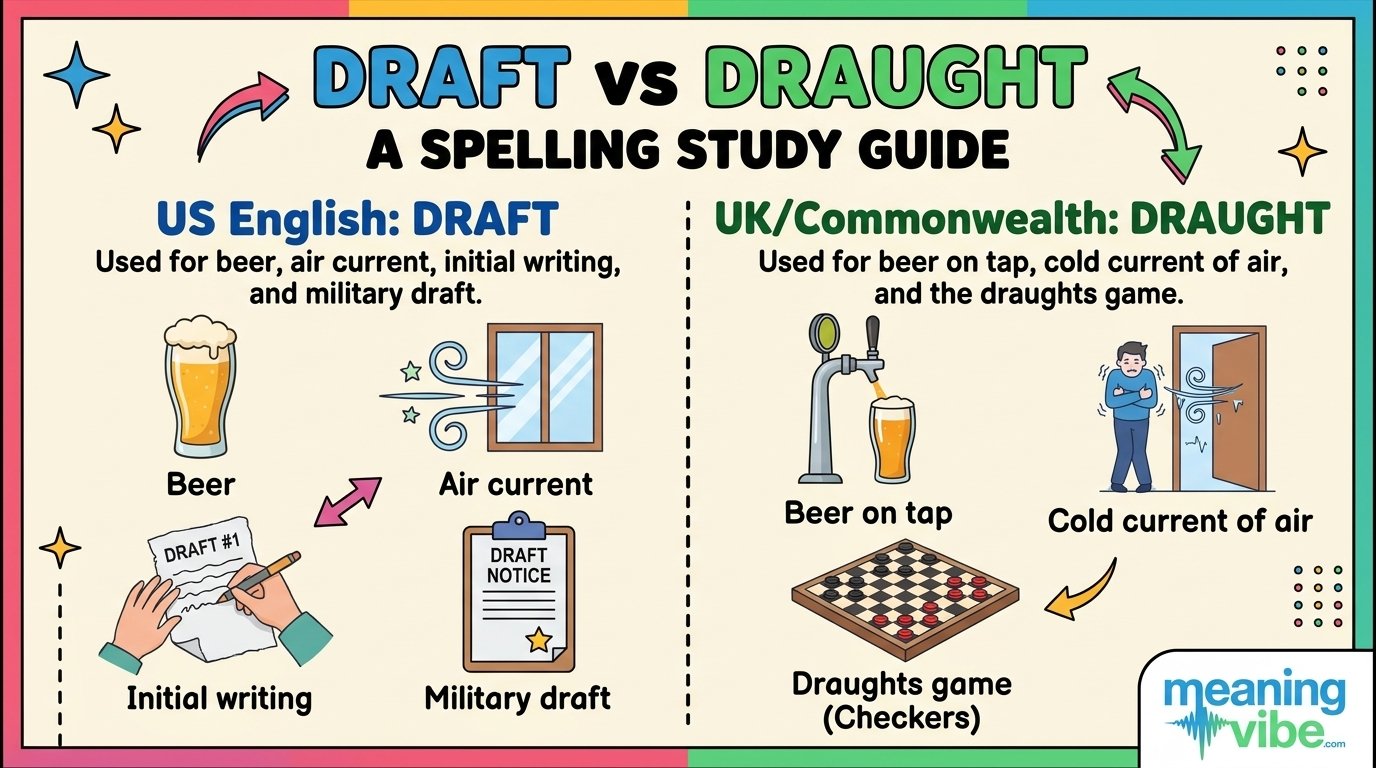
Draft beer in the US and draught beer in the UK can both be cask or keg beer, depending on the pub and the product. A UK pub may serve keg draught beer, while a US pub may serve cask draft beer, which breaks any simple cask equals draught rule.
Kegworks states the core fact plainly: there is no difference between draft beer and draught beer as products, only spelling and region differ. That fact should be the lead sentence for any beer spelling section.
A beer writer who claims draught beer tastes softer or more traditional because of spelling alone is making a branding claim, not a spelling fact. Taste comes from serving method, recipe, temperature, and glass, not from letters.
Air and Home Sealing
In home sealing, a draft in US writing and a draught in UK writing both mean unwanted cold air through gaps. JCP Hardware gives a UK fitting guide for draught excluders, with the same product meaning as US draft excluders.
A US homeowner should search for draft excluder, draft stopper, or door seal, while a UK homeowner should search for draught excluder. That search term difference matters for product finding, even though the product is the same.
A draft excluder can be a foam strip, a brush strip, or a rubber gasket, fitted around a door or window frame. That product stops cold air, reduces heating loss, and improves comfort, regardless of spelling.
A fireplace draft in US writing, and draught in UK writing, can mean air flow up a chimney, which helps a fire burn. That chimney sense also follows region, not product, so writers should follow audience region.
Horses and Farm Work
In farm work, a draft horse in US writing and a draught horse in UK writing both mean a large horse bred to pull heavy loads. That horse may pull a cart, plough, wagon, or logging sled, depending on farm and era.
Breeds such as Clydesdale, Percheron, Shire, and Belgian are often listed as draft horses in US sources, and draught horses in UK sources. That breed list is an example set, not a complete breed guide, and writers should verify breed details before publishing a breed list.
A draft horse team in a parade, a farm show, or a historical reenactment uses the same spelling rule as a working farm horse. Region, not occasion, decides spelling, so a US parade programme should use draft horse.
A writer who writes “draught horse” for a US audience may be understood, but that spelling will look like a UK import or an error. US style guides prefer draft horse for US readers, even for UK breeds.
Ships and Harbours
In shipping, a ship draft in US writing and draught in UK writing both mean the depth from waterline to lowest hull point. That depth determines whether a ship can enter a harbour, pass under a bridge, or load full cargo.
A ship with a deep draft needs deeper water, while a ship with a shallow draft can enter shallow ports and rivers. That depth changes with cargo load, fuel, and water density, so harbour documents must state the current draft, not just the design draft.
A draft mark on a hull shows depth in feet or metres, read at the waterline by a harbour pilot or surveyor. That mark is a safety tool, not a decoration, and errors in reading it can ground a ship.
Maritime writers for a US audience should use ship draft, while writers for a UK audience should use ship draught, with units verified locally. That region rule is the only spelling difference; the measurement itself does not change.
Military, Sports, and Banking
In military writing, draft means conscription, or selection for service, in both US and UK English. A US Selective Service notice uses draft, and a UK historical text about conscription also uses draft.
In sports writing, draft means selection of players, as in NFL draft or NBA draft, in both US and UK English. That sports draft is a US term, borrowed with its spelling, even when UK writers discuss US sports.
In banking, a bank draft means a payment order guaranteed by a bank, in both US and UK English. That bank draft works like a check, but with bank backing, and it should not be spelled draught in either region.
Those three senses show why a simple “UK uses draught” rule fails: military, sports, and banking all keep draft in the UK. Writers must learn the sense list, not just the region label.
Board Games: Draughts Versus Checkers
In board games, draughts is the UK name for checkers, while checkers is the US name for the same game. That game uses an 8 by 8 board and 12 pieces per player, with diagonal moves and jumps.
A draughts piece is called a draughtsman in UK writing, while a checkers piece is called a checker in US writing. That piece name follows the game name, not the general draft versus draught rule.
Draughts is plural for the game, even though it looks like a plural of draught for beer or air. Writers should not write “a game of draught” for checkers, because the game name is draughts with an s.
A US writer who writes about UK draughts should keep the UK game name when discussing UK rules or history, but use checkers for a US audience in general text. That audience choice mirrors the beer branding choice, with name fidelity versus audience spelling.
Fixed Phrases Table
| Phrase | US spelling | UK spelling | Meaning |
|---|---|---|---|
| Rough draft | Rough draft | Rough draft | Early version |
| Final draft | Final draft | Final draft | Last version before submission |
| First draft | First draft | First draft | First version |
| Beer on draft | On draft | On draught | Beer from keg or cask |
| Draft beer | Draft beer | Draught beer | Beer from keg or cask |
| Draft horse | Draft horse | Draught horse | Pulling horse |
| Cold draft | Cold draft | Cold draught | Cold air current |
| Draft excluder | Draft excluder, draft stopper | Draught excluder | Door or window seal |
| Ship draft | Ship draft | Ship draught | Depth below waterline |
| Bank draft | Bank draft | Bank draft | Bank payment order |
| Military draft | Military draft | Military draft | Conscription |
| Game of draughts | Game of checkers | Game of draughts | Board game, 8 by 8, 12 pieces |
That fixed phrase table helps writers check common phrases quickly, without re-reading the whole sense list. Keep it open during editing, especially for UK texts where the split is widest.
Traps to Avoid: Beer Flavour Claims, Draughts Plural, Draftsman
Three traps catch even careful writers, because they share letters, products, or job titles with the pair. Each trap needs a one-line rule to prevent confusion.
Beer Flavour Trap: Spelling Does Not Taste
Beer flavour comes from recipe, serving method, temperature, carbonation, and glass, not from spelling letters. A draft beer and a draught beer with the same recipe and serving method should taste the same, because they are the same product with different spelling.
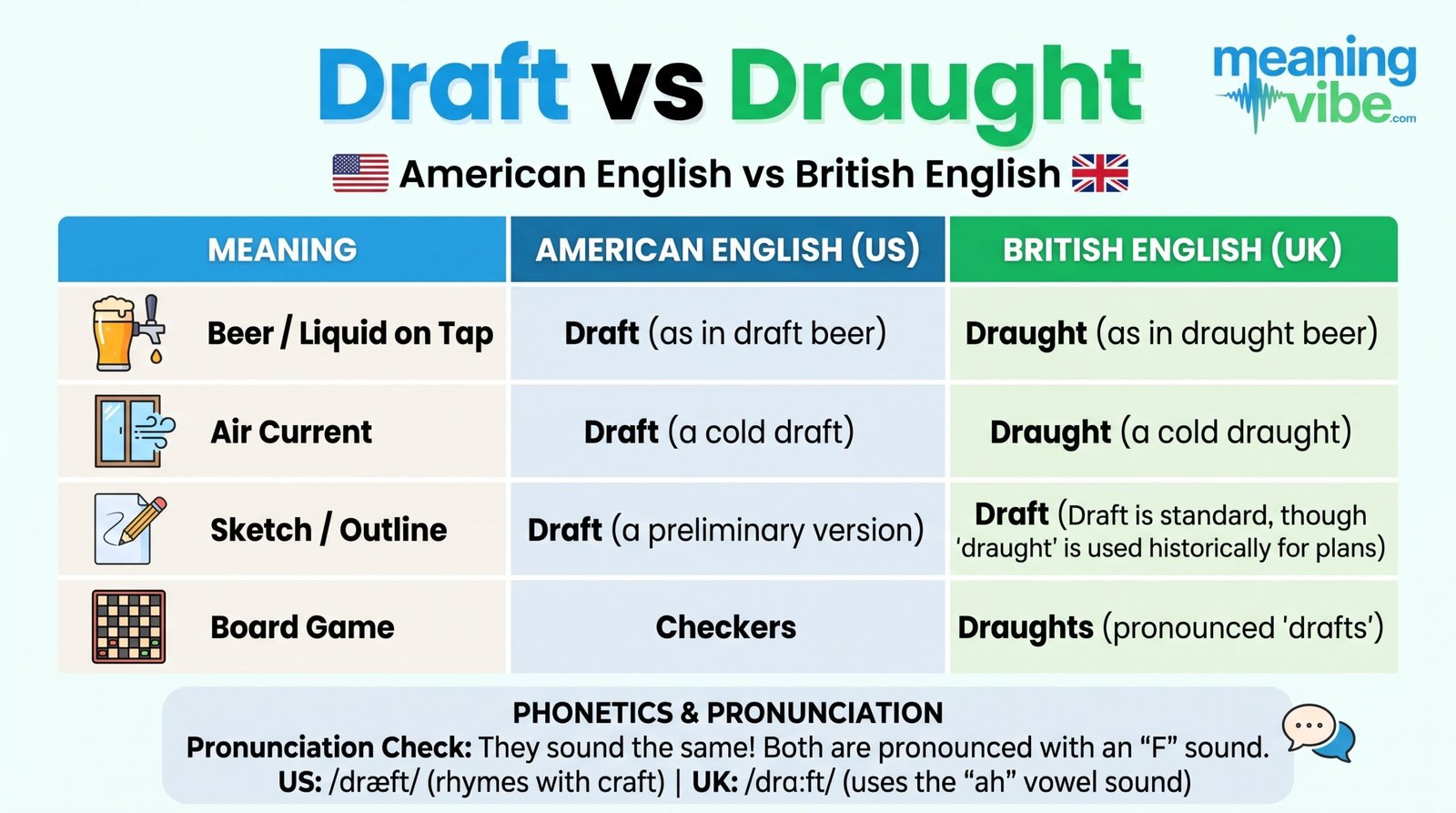
Food and Beverage Knowledge claims draft beer is crisp and draught beer is softer and more traditional, but those claims describe serving methods, not spelling. A cask beer served by hand pump may taste softer, while a keg beer served by CO2 may taste crisper, regardless of spelling.
Writers should separate those claims: describe cask versus keg when taste matters, and describe draft versus draught when spelling matters. Mixing those two questions creates a false taste rule from a spelling difference.
A beer menu that writes draught for branding may still serve keg beer, which breaks any cask equals draught taste rule. Menu spelling is branding, while serving method is physics and recipe.
Draughts Plural Trap: Game Versus Drink
Draughts with an s is the UK game name for checkers, not a plural of draught beer or draught air. A sentence such as “We played draughts after dinner” uses the game name correctly, while “We drank three draughts” uses a different plural for drinks.
That plural trap confuses learners who assume every s ending means plural of the same sense. Here, draughts as a game is a fixed plural name, while draughts as drinks is a regular plural, and context must decide which is meant.
Writers should use checkers for a US audience in general text, and draughts for a UK audience or for UK game history. That audience choice prevents a US reader from thinking draughts means multiple beers.
A draughtsman as a game piece adds another layer, because it shares letters with draughtsman as a plan drawer. Context, not spelling alone, decides whether the piece or the person is meant.
Draftsman Versus Draughtsman Trap
Draftsman and draughtsman both name a person who draws plans or documents, but UK usage splits them by work type, per Wikipedia. A draughtsman draws plans, while a draftsman drafts legal documents, in that UK note.
That split is subtle and needs verification against a current dictionary before use in a legal or technical text. Writers should not assume the split applies in US English, where draftsman is the general form.
Modern inclusive language often prefers drafter, draftsperson, or technical drawer, depending on house style. That modern preference does not change the spelling rule, but it may change the job title choice.
For learners, the safe choice is drafter for a general US text, and the house style choice for a UK technical or legal text. That safe choice avoids the draftsman versus draughtsman trap entirely.
Wrong Examples Corrected
Wrong examples teach faster than rules alone, because learners see the error and the fix side by side. Each row below keeps the same sentence structure, with only the target spelling changed, plus audience noted.
| Wrong sentence, for the stated audience | Correct sentence | Why it changes |
|---|---|---|
| US: There is a cold draught through the window. | US: There is a cold draft through the window. | US air sense uses draft. |
| UK: There is a cold draft through the window. | UK: There is a cold draught through the window. | UK air sense uses draught. |
| US: The pub serves draught beer, general text. | US: The pub serves draft beer, general text. | US general beer spelling uses draft. |
| UK: The pub serves draft beer, general text. | UK: The pub serves draught beer, general text. | UK general beer spelling uses draught. |
| US: A draught horse pulled the cart. | US: A draft horse pulled the cart. | US horse sense uses draft. |
| UK: A draft horse pulled the cart. | UK: A draught horse pulled the cart. | UK horse sense uses draught. |
| US: Ship draught is 12 feet. | US: Ship draft is 12 feet. | US ship sense uses draft. |
| UK: Ship draft is 12 metres. | UK: Ship draught is 12 metres. | UK ship sense uses draught. |
| Both: First draught of the essay. | Both: First draft of the essay. | Document sense uses draft in both regions. |
| Both: Bank draught payment. | Both: Bank draft payment. | Bank sense uses draft in both regions. |
| US: We played draughts after dinner, general text. | US: We played checkers after dinner, general text. | US game name is checkers. |
| UK: We played checkers after dinner, UK rules text. | UK: We played draughts after dinner, UK rules text. | UK game name is draughts. |
Proofed, Merriam-Webster, and Daily English Here all use wrong and corrected pairs, and that format works well for learners. The key is to keep audience and sense in the row, so the correction is not overgeneralised.
Memory Tricks That Actually Work
Memory tricks help only when they connect to region, sense, or audience. The best tricks use a short phrase that survives under exam pressure.
US Audience, Use Draft
For a US audience, the trick is one word: draft. That single word covers documents, air, beer, horses, ships, military, banking, and sports, with only brand names as exceptions.
Think “US equals draft,” and most US sentences become easy. That trick works because US spelling simplified draught to draft across senses, while UK spelling kept the split.
Use that trick as a first check, then check brand names second. A quoted brand name may keep draught, even in a US text, because names should be copied exactly.
UK Audience, Check the Sense List
For a UK audience, the trick is a sense list, not a single word. Check whether the sense is document, verb, bank, or military, which take draft, or air, drink, beer, horse, ship, or game, which take draught.
Think “UK document equals draft, UK air equals draught,” and the two most common senses become easy. That pair covers essays and windows, which are the most common learner examples.
Use that pair as a first check, then check the full table for horse, ship, and game senses. Those senses are less common, but they appear in exams and technical texts.
Beer Branding Is the Exception, Not the Rule
For beer, the trick is branding: draught on a US menu signals British or fancy branding, not a US spelling rule. Kegworks notes that branding use for Irish pubs and German beer halls, which helps learners recognise it.
Think “US draught beer equals branding, UK draught beer equals standard,” and the beer exception becomes easy. That trick prevents learners from generalising beer branding to air, horse, or ship senses.
Use that trick as a branding check, then return to the US rule for general text. A US article about beer in general should use draft beer, even if one quoted menu uses draught.
Quiz: Draft or Draught, With Explanations
Choose draft or draught for each blank, with audience noted, then check the answer and reason. Each explanation restates the region and sense rule in one line.
- US: There is a cold ______ through the window. Answer: draft. US air sense uses draft.
- UK: There is a cold ______ through the window. Answer: draught. UK air sense uses draught.
- Both: First ______ of the essay. Answer: draft. Document sense uses draft in both regions.
- US, general text: The pub serves ______ beer. Answer: draft. US general beer spelling uses draft.
- UK, general text: The pub serves ______ beer. Answer: draught. UK general beer spelling uses draught.
- US: A ______ horse pulled the cart. Answer: draft. US horse sense uses draft.
- UK: A ______ horse pulled the cart. Answer: draught. UK horse sense uses draught.
- US: Ship ______ is 12 feet. Answer: draft. US ship sense uses draft.
- Both: Bank ______ payment. Answer: draft. Bank sense uses draft in both regions.
- UK: We played ______ after dinner. Answer: draughts. UK game name is draughts, plural.
A score of eight or more shows a solid grasp of the pair. A lower score usually means UK sense split needs extra practice, not US rule practice.
Common Mistakes to Avoid
- Using draught for a US document. A US or UK document sense uses draft, not draught, for a preliminary version.
- Using draught for US air, horse, or ship senses. US writing uses draft for air, horse, and ship senses, with beer branding as the main exception.
- Using draft for UK air, beer, horse, or ship senses. UK writing uses draught for those senses, in general text for a UK audience.
- Treating draft beer and draught beer as different products. They are the same serving idea, with spelling and branding differing, not product identity.
- Treating cask as draught and keg as draft. Cask versus keg is a serving difference, not a spelling difference, and both spellings can cover both methods.
- Using draughts for checkers in US general text. US general text uses checkers, while draughts is the UK game name.
- Using draught for bank or military senses in the UK. UK bank draft and military draft keep draft spelling, even in UK writing.
- Pronouncing draught like caught. Standard pronunciation matches draft within each dialect, not caught or taught.
- Copying a beer brand spelling into general text. A quoted brand name may keep draught, but general US text should use draft.
- Relying on spellcheck alone. Spellcheck accepts both spellings as real words, so it will not flag a region or sense error.
Tips for Writers, Teachers, and Learners
- Decide audience first. US audience means draft for almost everything, while UK audience means check the sense list.
- Decide sense second. Document, verb, bank, and military senses take draft in both regions, while UK air, beer, horse, and ship senses take draught.
- Separate spelling from serving for beer. Describe cask versus keg for taste and serving, and describe draft versus draught for spelling.
- Teach document examples first. Rough draft and final draft are the clearest examples, because they use draft in both regions.
- Teach air examples second. Cold draft in the US and cold draught in the UK show the region split in one sentence pair.
- Teach beer examples third. Draft beer in the US and draught beer in the UK show branding and region in one menu pair.
- Teach ship and horse examples fourth. Ship draft and draft horse show technical and farm senses that learners often miss.
- Teach draughts versus checkers fifth. That game pair shows why plural draughts is a name, not just a plural form.
- Proofread with region in mind. Search for draught in a US text and for draft in UK air, beer, horse, and ship senses, then check each instance.
- Keep a personal error list. Note each real mistake once, with audience and sense, and review that list before exams or important drafts.
FAQs
What is the difference between draft and draught?
Draft and draught are spelling variants of one word, not different meanings. US English uses draft for almost everything, while UK English splits by sense.
Is draught American or British?
Draught is mainly British, with a narrow US use for beer branding and imported beer. In general US writing, draft is the standard spelling.
Is draft American or British?
Draft is standard in American English for all senses, and standard in British English for verb, document, bank, and military senses. It is not only American.
Do Americans use draught?
Americans rarely use draught, except for beer branding, imported beer, and notably British or fancy establishments, per Merriam-Webster. General US text uses draft.
Do British people use draft?
Yes, British people use draft for the verb, for a preliminary document, for a bank draft, and for military draft. They use draught for air, beer, horse, ship, and game senses.
Is draught beer different from draft beer?
No, draught beer and draft beer are the same serving idea: beer from a keg or cask, not from a bottle or can. Spelling and branding differ, while product identity does not.
Is it draft beer or draught beer in America?
In general US text, use draft beer, because draft is much more common in American English. Draught beer appears mainly as branding or for imported beer.
Is it draft beer or draught beer in the UK?
In UK text, use draught beer, because draught is the usual UK spelling for beer from a cask or keg. That spelling applies to general UK menus, not just branding.
What does draught mean?
Draught means the same as draft in the senses where UK English uses it: air current, drink, beer, pulling animal, ship depth, and game. It is a spelling variant, not a separate meaning.
What does draft mean?
Draft means a preliminary version, a current of air, a drink, a pulling animal, a ship depth, a selection, or a payment order, depending on context. All senses share a drawing or pulling root.
How do you pronounce draught?
Draught is pronounced the same as draft within each dialect: US /dræft/, UK /drɑːft/. A caught-like pronunciation is a spelling trap, not standard.
How do you pronounce draft?
Draft is pronounced US /dræft/ and UK /drɑːft/, with the vowel differing by dialect. The consonants stay the same in both dialects.
Are draft and draught pronounced the same?
Yes, within a dialect, draft and draught are pronounced the same. Across dialects, the vowel differs, US short a versus UK long a.
Is it draft horse or draught horse in America?
In America, use draft horse, because US English uses draft for pulling animals. Draught horse in a US text looks like a UK import.
Is it draft horse or draught horse in the UK?
In the UK, use draught horse, because UK English uses draught for pulling animals. That spelling applies to general UK farm and equestrian text.
Is it draft or draught of air?
In the US, use draft of air, and in the UK, use draught of air. That air sense is one of the clearest region splits in the pair.
Is it draft excluder or draught excluder?
In the US, use draft excluder or draft stopper, and in the UK, use draught excluder. Both names mean the same door or window seal product.
What is a ship draft?
A ship draft is the depth from waterline to lowest hull point, or the depth of water needed to float. US texts use ship draft, while UK texts use ship draught.
Is it ship draft or ship draught?
For a US audience, use ship draft, and for a UK audience, use ship draught. The measurement itself does not change with spelling.
What is a bank draft?
A bank draft is a payment order guaranteed by a bank, similar to a check with bank backing. It is spelled draft in both US and UK English.
Is it bank draft or bank draught?
Use bank draft in both US and UK English, because the payment order sense takes draft in both regions. Draught for a bank payment is incorrect in standard use.
What is a military draft?
A military draft is conscription, or selection of people for military service by a formal system. It is spelled draft in both US and UK English.
Is it rough draft or rough draught?
Use rough draft in both US and UK English, because the document sense takes draft in both regions. Rough draught is incorrect for a document in standard use.
Is it on draft or on draught?
In the US, use on draft for beer from a keg or cask, and in the UK, use on draught. That phrase follows the beer spelling rule for each region.
What is draughts?
Draughts is the UK name for the board game checkers, played on an 8 by 8 board with 12 pieces per player. It is a fixed plural game name, not a beer plural.
Is draughts the same as checkers?
Yes, draughts and checkers are the same game, with the same board, pieces, and basic moves. The names differ by region, UK draughts versus US checkers.
Conclusion
Draft vs draught becomes easy once spelling and meaning are kept apart. Draft and draught name the same word, with draft covering almost everything in US English, and draught covering certain senses in UK English plus beer branding in the US.
Keep two checks close: audience first, then sense. For a US audience, use draft; for a UK audience, check whether the sense is document, verb, bank, or military, which take draft, or air, beer, horse, ship, or game, which take draught.
Try those checks on your next doubtful sentence, and let region and sense, not habit or flavour claims, settle the spelling before you move on.