

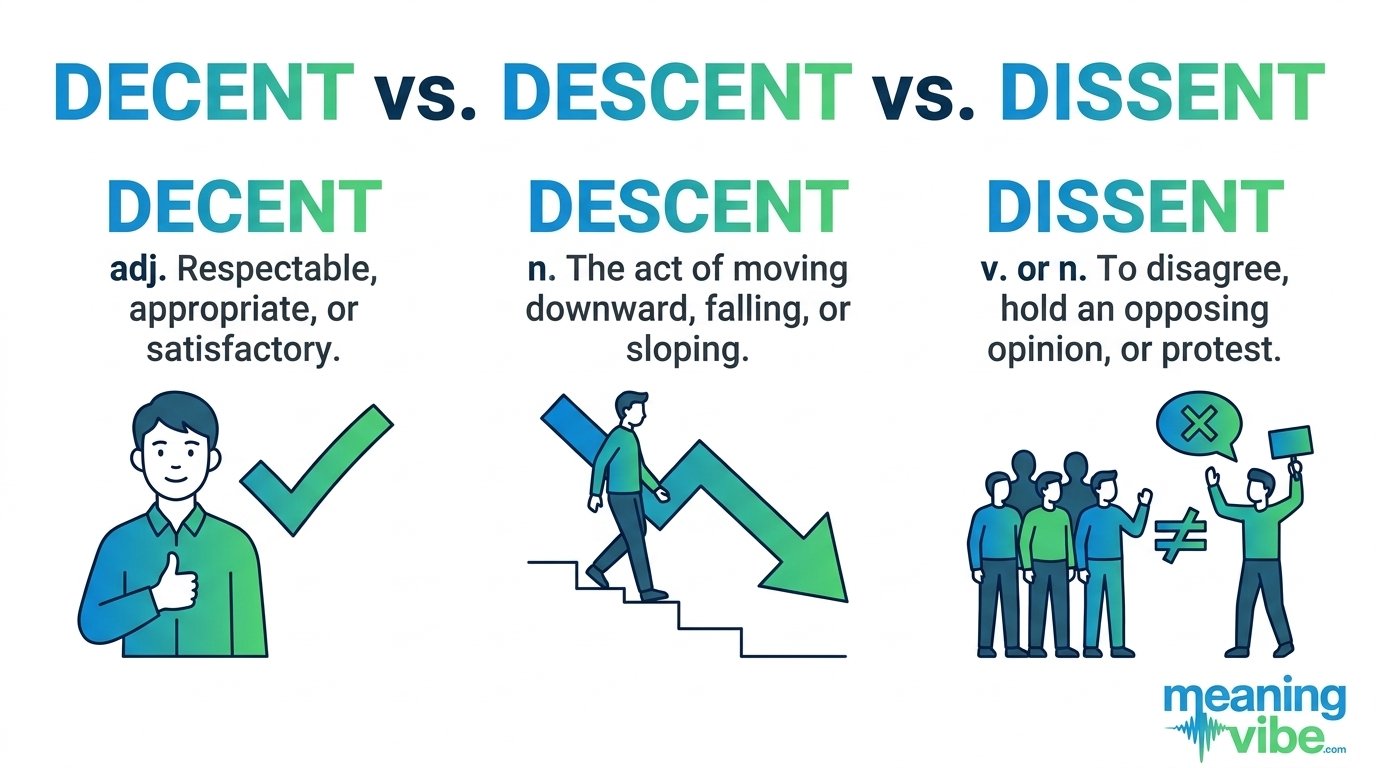
Decent vs descent vs dissent confuses writers because the three words look almost identical, yet they describe quality, downward movement, and disagreement.
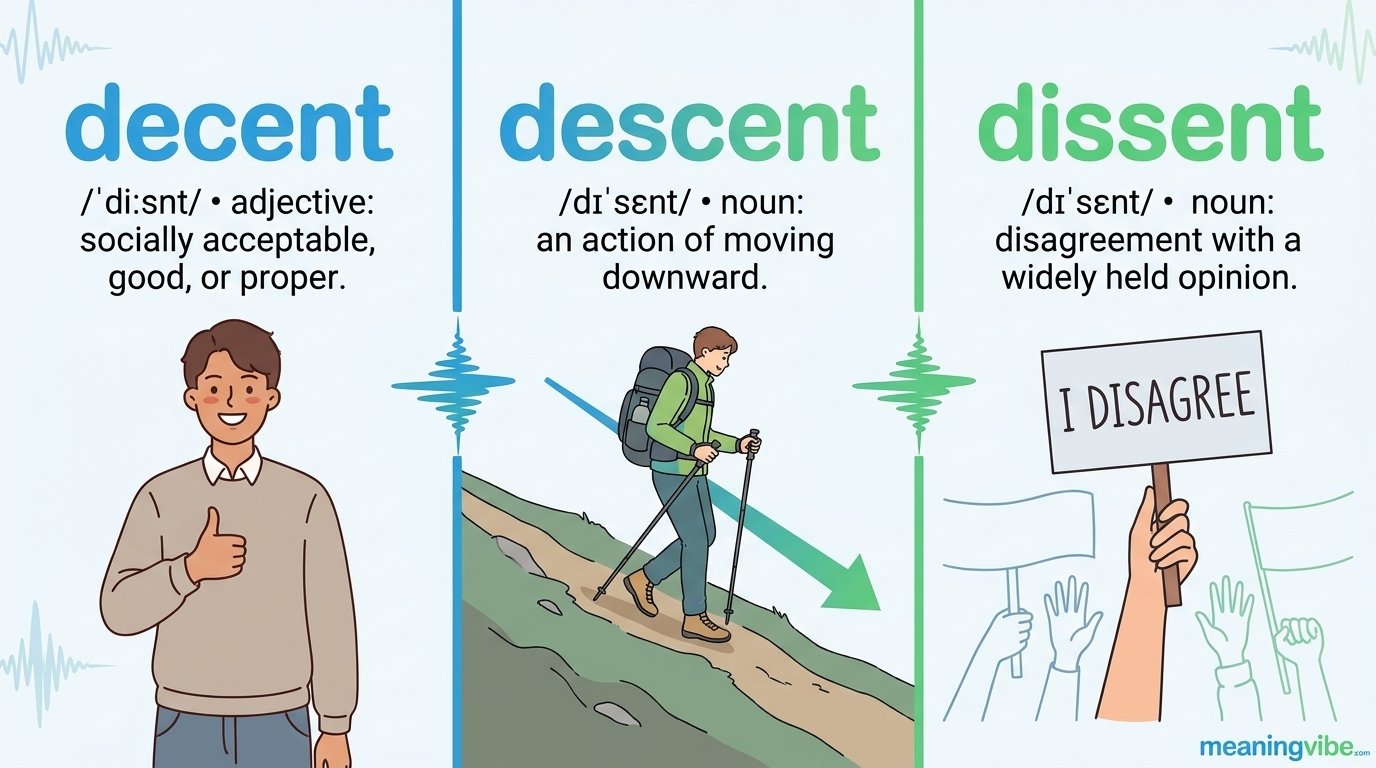
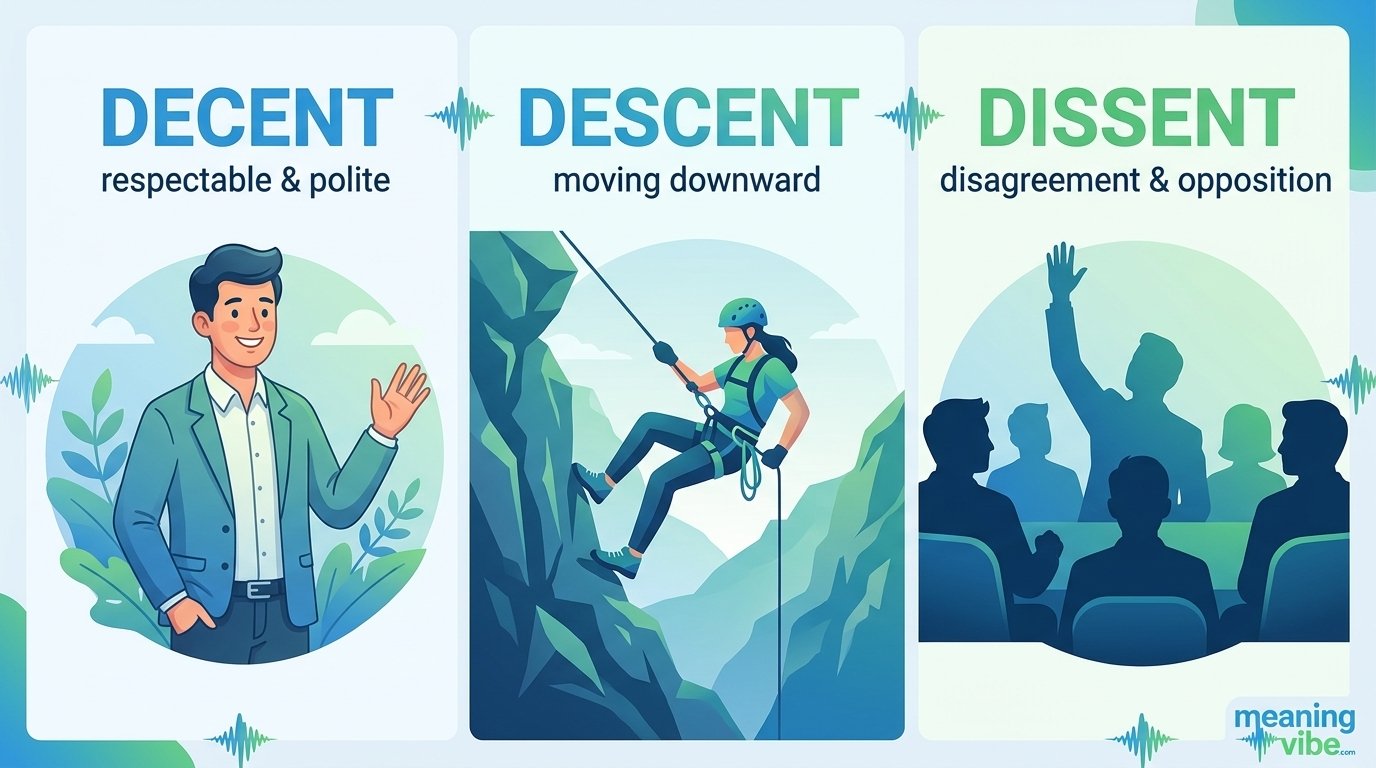
Decent means good, proper, or adequate. Descent means going down, a slope, or ancestry. Dissent means disagreement, especially with a majority or official view.
The fastest check uses three substitute words: respectable for decent, down or ancestry for descent, and disagreement for dissent. If the substitute fits, the spelling follows.
Decent vs Descent vs Dissent in One Line
Decent answers the question, “Is it good enough or proper?” Descent answers the question, “Is it moving down, or where does it come from?”
Dissent answers the question, “Does someone disagree?” Those three questions cover almost every real sentence, from school essays to court reports.
| Word | Part of speech | Pronunciation | Core meaning |
| Decent | Adjective only | /ˈdiːsənt/, DEE-sent | Good, proper, adequate |
| Descent | Noun only | /dɪˈsɛnt/, dih-SENT | Downward movement, slope, ancestry |
| Dissent | Noun and verb | /dɪˈsɛnt/, dih-SENT | Disagreement, to disagree |
What Does Decent Mean
Decent is always an adjective, and it describes something that meets an acceptable standard. It never names a movement, and it never names a disagreement.
Dictionary.com defines decent as adequate or suitable, and also as good or respectable. Vocabulary.com adds a social sense: socially acceptable, polite, and properly behaved.
That range matters, because decent can praise quality without claiming excellence. A decent meal satisfies hunger, but it does not promise a fine dining experience.
Decent as Adequate and Satisfactory
In its most common use, decent means good enough for the purpose. A decent salary covers needs, a decent grade passes comfortably, and a decent hotel room feels clean and comfortable.
Writers often use decent when they want honest praise without exaggeration. “The film was decent” means enjoyable, but not outstanding, and readers understand that restraint.
Comparative and superlative forms follow normal adjective rules: more decent and most decent. A second hotel can offer a more decent breakfast, while a third can offer the most decent rooms in town.
Decent as Respectable and Proper
Decent also means respectable, proper, and morally acceptable. A decent person treats others fairly, keeps promises, and behaves well in public.
The phrase “do the decent thing” means choose the honest or kind action, even when a selfish action would be easier. That use stresses character, not quality or price.
Older writing uses “decent society” for people who follow social rules, dress properly, and avoid rude language. Modern writing keeps the same idea, but usually applies it to individuals.
Decent as Sufficiently Clothed
In informal speech, decent can mean sufficiently clothed to be seen by other people. The question “Are you decent?” usually means, “Are you dressed enough for me to enter?”
Dictionary.com lists this informal sense alongside the main senses, and learners should recognise it in dialogue and comedy. It is polite, practical, and completely different from movement or disagreement.
A hotel guest might shout, “Wait, I am not decent yet,” before opening a door. That sentence has nothing to do with ancestry, slopes, or opinions.
Decent Collocations: Living, Chance, Meal, Job, Person
Collocations are word pairs that sound natural together, and decent has several strong ones. “A decent living” means enough income to live reasonably well, not wealth.
“A decent chance” means a fair or reasonable chance of success. “A decent meal” means satisfying food, while “a decent job” means acceptable work with fair pay.
“A decent person” praises character, while “a decent offer” means a fair price or proposal. Learning these pairs helps learners use decent naturally, without forcing it into movement or disagreement sentences.
What Does Descent Mean
Descent is always a noun, and it never describes quality or disagreement. It describes a downward path, a downward movement, or a family origin traced downward through generations.
Dictionary.com defines descent as the act of moving downward, a downward movement, or downward movement in general. That core idea expands into slope, ancestry, and metaphorical decline.
Vocabulary.com stresses the same split: physical descent goes down a mountain or into a subway, while family descent goes down a family tree. Both uses share the downward image.
Descent as Downward Movement
A plane begins its descent when it leaves cruising height and moves toward landing. A lift makes a rapid descent when it drops several floors in seconds.
Climbers plan a descent as carefully as an ascent, because going down can be steeper, looser, and more tiring than going up. A careful descent protects knees, balance, and safety.
The verb for this action is descend, not descent. Writers should say, “The plane will descend,” but, “The plane began its descent.” That noun and verb split prevents a common error.
Descent as a Slope or Path
Descent can also name a downward slope or the path taken while going down. A ski resort may advertise a long, steep descent for advanced skiers, meaning a downhill run.
A walking route can include short climbs and several long descents, as in Vocabulary.com’s Guardian example. In that use, descent describes terrain, not a single act of moving.
Engineers and geographers use descent for gradients and drops in roads, rivers, and trails. A gentle descent feels easy, while a sharp descent demands brakes, care, and control.
Descent as Ancestry and Lineage
Descent also means ancestry, lineage, or family origin. The phrase “of Irish descent” means having Irish ancestors, not disagreeing with Ireland or going down a hill.
Official forms, history books, and census writing use this phrase constantly. “People of African descent” describes heritage, while “people of Latin American descent” describes regional ancestry.
The related noun descendant names a person who comes from an ancestor. A grandchild is a descendant of a grandparent, and that word also comes from the downward family tree image.
Descent as Metaphorical Decline
Descent can describe a metaphorical fall into a worse state, such as a descent into madness, chaos, or war. The movement is not physical, but the downward direction still fits.
A company can experience a descent in profits, meaning a steady fall, not a disagreement among managers. A character in fiction can face a descent into crime, meaning a gradual moral fall.
Writers should keep this metaphor separate from dissent. A descent into chaos describes decline, while dissent during chaos describes people disagreeing about what to do.
What Does Dissent Mean
Dissent names disagreement, especially when one person or a minority disagrees with a majority, a leader, or an official decision. It can be a noun or a verb, unlike decent and descent.
Dictionary.com defines dissent as a noun meaning disagreement, and as a verb meaning to disagree. The Content Authority and BroadLearners both stress formal, political, and legal contexts for this word.
Dissent is not casual dislike. It usually involves a stated opinion, a vote, a protest, or a formal record of disagreement, not a private feeling alone.
Dissent as a Noun: Disagreement
As a noun, dissent means a difference of opinion or an act of disagreeing. “There was strong dissent among committee members” means members openly disagreed with a proposal.
The phrase “without dissent” means everyone agreed, or at least no one formally objected. A decision passed “without dissent” sounds unanimous in a meeting record.
Public dissent can mean protests, petitions, or critical speeches against a government or organisation. That use is political, but it still keeps the core meaning: disagreement with power.
Dissent as a Verb: To Disagree, Dissent From
As a verb, dissent means to disagree or withhold assent. The standard pattern is dissent from a decision, opinion, or majority view, not dissent against in formal writing.
Several judges dissented from the majority opinion in a famous case. One board member dissented during a vote, while others approved the plan without comment.
Verb forms are regular: dissents, dissenting, and dissented. “She is dissenting from the proposal” describes ongoing disagreement, while “He dissented yesterday” describes a completed act.
Dissenting Opinion in Law
In law, a dissenting opinion is a separate opinion written by a judge who disagrees with the majority decision. The judge explains why the majority reasoning is wrong, even though the majority ruling stands.
Dictionary.com lists this legal sense explicitly, including the voicing of a minority opinion when a court announces a decision. That sense is essential for law students and journalists.
A dissenting judge does not block the ruling, but creates a record for future cases. Later courts may quote a dissent when they reconsider an old rule.
Dissent in Politics, Religion, and Sport
In politics, dissent can mean opposition to a government, party, or official policy. Democratic writing often treats dissent as legitimate, while authoritarian writing may treat it as a threat.
In religion, historical dissent meant separation from an established church and adherence to different beliefs. That sense survives in history books, and in the word Dissenter with a capital letter in some contexts.
In sport, dissent is a technical term for disputing an official in an inappropriate way. Grammar-Monster gives the example of a referee showing a red card for dissent, meaning rude or persistent disagreement.
Decent vs Descent vs Dissent Comparison Table
| Feature | Decent | Descent | Dissent |
| Part of speech | Adjective only | Noun only | Noun and verb |
| Pronunciation | /ˈdiːsənt/, DEE-sent | /dɪˈsɛnt/, dih-SENT | /dɪˈsɛnt/, dih-SENT |
| Stress | First syllable | Second syllable | Second syllable |
| Core idea | Good, proper, adequate | Down, slope, ancestry | Disagreement |
| Related verb | None, use be decent | Descend | Dissent itself |
| Related noun | Decency | Descendant | Dissenter |
| Example | A decent meal. | A steep descent. | Strong dissent. |
| Wrong swap | A descent meal. | A dissent from a mountain. | A descent in court. |
The table shows why part of speech helps more than spelling alone. If the sentence needs an adjective, only decent fits, while a noun slot needs descent or dissent.
Pronunciation and Stress
Pronunciation separates decent from the other two words, while descent and dissent remain true homophones. Stress, not just letters, must be taught alongside spelling.
Decent, DEE-sent, First Syllable
Decent is pronounced /ˈdiːsənt/, with a long ee sound and stress on the first syllable. It rhymes with recent, which shares the same final five letters, cent.
Grammar-Monster uses that rhyme as its main trick, and Deep English lists the same IPA pattern. Learners who say DEE-sent will rarely confuse decent with the other two words in speech.
The first syllable sounds like dee, while the second syllable is weak and short. That stress pattern matches recent, decent, and other cent adjectives with first-syllable stress.
Descent and Dissent, dih-SENT, Second Syllable
Descent and dissent are both pronounced /dɪˈsɛnt/, with a short dih sound and stress on the second syllable. Dictionary.com stresses that the two words are pronounced exactly the same.
That shared pronunciation explains why proofreading matters more than listening. A speaker can say the word perfectly, while a writer still chooses the wrong spelling for the meaning.
The second syllable sounds like sent, with a clear s and t ending. Both words end in sent sounds, even though descent spells that sound with sc plus ent.
Why Descent and Dissent Are Homophones, and Decent Is Not
Descent and dissent are homophones because they share sound, differ in spelling, and differ in meaning. Decent is a near neighbour, not a homophone, because its stress and first vowel differ.
Vocabulary.com makes this split clear by giving decent as DEE-sent and the other two as dih-SENT. That three-way pronunciation table belongs in every complete explanation.
Learners should not rely on sound alone for descent versus dissent. Meaning, spelling family, and synonym tests must decide, because ears give no help there.
Part of Speech Test
Part of speech gives a fast filter before meaning tests begin. If the grammar slot is wrong, the word is wrong, even if the letters look plausible.
Decent Is an Adjective Only
Decent modifies a noun, as in decent job, decent meal, decent person, and decent chance. It cannot act as a subject, object, or verb in a standard sentence.
Linguix answers this directly in its FAQ: decent is not a noun, while the related noun is decency. Writers who need a noun should use decency, not decent.
A sentence like “His decent impressed everyone” fails immediately, because an adjective cannot stand alone as a subject. The correct noun form would be “His decency impressed everyone.”
Descent Is a Noun Only
Descent names a thing, action, or origin, as in “the descent was steep” or “her descent was Irish.” It cannot modify a noun as an adjective, and it cannot act as a verb.
Yorkville College labels a “descent staircase” example as adjective usage, but that labelling misleads learners. Descent can appear before another noun as a modifier, but its part of speech remains noun.
The verb for downward movement is descend, while the noun for the movement is descent. Writers should keep that pair apart, just as they keep decide and decision apart.
Dissent Is a Noun and a Verb
Dissent works in both slots, which makes it the most flexible word in the trio. As a noun, it names disagreement; as a verb, it performs disagreement.
“The committee recorded strong dissent” uses the noun form, while “One member dissented” uses the verb form. Both sentences are correct, but they use different grammar.
That flexibility also creates errors, because writers may use dissent where a noun like descent is needed. Grammar alone cannot save a sentence when both words can fill a noun slot.
The Synonym Test: Respectable, Down or Ancestry, Disagreement
The synonym test works in three steps, and it handles almost every sentence in the trio. Replace the target word with a simple synonym, then read the sentence again.
Step 1, Try Respectable for Decent
Replace the word with respectable, good, or adequate. If the sentence still makes sense, decent is correct, because quality and propriety are its core ideas.
“A respectable meal” works for a restaurant review, just as “a decent meal” works. “A respectable from the mountain” fails, so decent cannot fit a mountain sentence.
Step 2, Try Down or Ancestry for Descent
Replace the word with downward movement, slope, or ancestry. If one of those fits, descent is correct, because movement and origin are its core ideas.
“The downward movement was steep” works for a ski run, just as “the descent was steep” works. “Her ancestry was Irish” works for family history, just as “her descent was Irish” works.
Step 3, Try Disagreement for Dissent
Replace the word with disagreement or to disagree. If that version fits, dissent is correct, because disagreement is its only core idea.
“There was strong disagreement in the courtroom” works perfectly, just as “there was strong dissent” works. “The plane began its disagreement” fails, so dissent cannot fit a flight sentence.
Daily English Here uses a similar heritage versus disagreement test, and Linguix uses a respectable versus drop test. Combining those tests gives learners one method for all three words.
Spelling Families: SC, SENT, and DECENCY
Spelling families help writers who forget a single word but remember a related word. Dictionary.com presents this as the best memory method for descent versus dissent.
Descent Family: Descend, Descendant, Ascent, Transcend
Descent belongs to a movement family spelled with sc: descend, descent, descendant, ascent, ascend, and transcend. All of these words involve going, climbing, or moving across a height or boundary.
If a related movement word fits the context, descent is likely correct. A climber descends, a family has a descendant, and a hiker fears a steep descent.
That sc spelling is the visual clue. When the sentence involves down, up, or crossing, look for sc in the target word family.
Dissent Family: Assent, Consent, Dissenter, Dissenting
Dissent belongs to an agreement family ending in sent: assent, consent, dissent, dissenter, and dissenting. All of these words involve feeling, agreeing, or disagreeing with a view.
Dictionary.com lists assent and consent as the key relatives, because they share the sent ending and the agreement idea. If agreement language fits, dissent is likely correct.
A committee member can assent to a plan, consent to a rule, or dissent from a decision. Those three verbs form a clean agreement set for learners.
Decent Family: Decency, Decently
Decent belongs to a propriety family: decency as a noun, decently as an adverb, and decent as an adjective. Dictionary.com lists decently and decentness as related forms, with decency as the standard noun.
A person can behave decently, show decency in a dispute, or offer a decent apology. Those forms all keep the quality and propriety idea intact.
That family has no sc movement spelling and no sent agreement spelling. Its core root is dec, from Latin decens, meaning fitting, which leads directly to etymology.
Etymology: Three Different Latin Roots
Etymology proves that the trio shares spelling patterns, not meanings. Each word comes from a different Latin root, and those roots explain the modern senses.
Decent From Latin Decens, Fitting
Decent comes from Latin decens, the present participle of decere, meaning to be fitting or acceptable. Dictionary.com dates the English form to 1485 to 1495, with the same fitting sense.
WordInfo traces decere to a root meaning to be suitable, with relatives including decorate and dignity in broader etymology summaries. Those relatives should be checked against Oxford at writing time, but the fitting core is stable.
That root explains why decent means proper and adequate: something decent fits its purpose, fits social standards, or fits decent behaviour. Fitting, not falling, is the image.
Descent From Latin Descendere, to Go Down
Descent comes from Latin descendere, meaning to go down, from de plus scandere, to climb. WordPandit and Vocabulary.com summaries both give that downward root, and it matches every modern sense.
Physical descent goes down a mountain, family descent goes down a family tree, and metaphorical descent goes down into a worse state. All three keep the downward direction.
That root also explains descendant: a person who comes down a family line from an ancestor. The downward image never leaves the family, even when the context changes.
Dissent From Latin Dissentire, to Feel Differently
Dissent comes from Latin dissentire, meaning to feel differently, from dis plus sentire, to feel or perceive. Wiktionary traces Middle English dissenten to that Latin root, with the same disagreement sense.
That root explains why dissent belongs with assent and consent: all three involve feeling or sensing agreement. Dis adds separation, so dissent means feeling apart from the majority.
Grammar-Monster links dissent to street slang diss, but that link is only a mnemonic, not etymology. The real root is Latin sentire, not modern slang, and Step 2 must label that distinction plainly.
Verb Forms and Related Forms Table
| Base word | Related noun | Related verb | Related adjective | Related adverb |
| Decent | Decency | None, use be decent | Decent, more decent, most decent | Decently |
| Descent | Descent, descendant | Descend, descends, descended, descending | Descending, as in a descending path | None standard |
| Dissent | Dissent, dissenter, dissidence | Dissent, dissents, dissenting, dissented | Dissenting, as in a dissenting opinion | Dissentingly |
“The climbers descended slowly” uses the verb, while “their descent was slow” uses the noun. “Judges dissented” uses the verb, while “their dissent was noted” uses the noun.
Decent has no verb form in standard use, so writers must not invent one. A sentence like “They decented the room” is incorrect, while “They made the room decent” is correct.
Decent vs Descent vs Dissent in Context
Context turns abstract definitions into usable decisions. Four settings cover almost every real example a learner will meet, from meals to courtrooms.
Everyday Life and Work
In everyday life, decent describes jobs, meals, hotels, clothes, and behaviour. A decent salary feels fair, a decent hotel feels clean, and a decent colleague behaves kindly.
Workplace writing uses dissent for formal disagreement in meetings, votes, and reviews. A manager might note dissent from a budget plan, while still recording the majority decision.
Everyday writing rarely needs descent, except for stairs, lifts, hills, and family background. A sentence about a decent lunch should never become a sentence about a descent lunch.
Aviation, Mountains, and Sport
In aviation, descent is a flight phase, not a disagreement or a quality judgement. Pilots announce a descent to landing, controllers clear a descent to a lower altitude, and passengers feel a descent in their ears.
In mountaineering and skiing, descent means the downhill journey, route, or slope. Climbers check weather, snow, and daylight before a descent, because downhill travel carries its own risks.
In sport, dissent means disputing an official in an inappropriate way, as in a football referee showing a card for dissent. That technical sense should not be confused with a physical descent down a stadium stairway.
Genealogy, History, and Identity
In genealogy, descent describes family origin with the phrase “of descent” plus a place or group. “Of Irish descent” means Irish ancestry, while “of African descent” means African ancestry.
History books use descent for royal lines, migration lines, and cultural heritage. A person can trace their descent through records, DNA tests, and family stories, but never through disagreement.
Identity writing must keep descent separate from dissent, because swapping them changes heritage into protest. “She is of Irish dissent” would wrongly suggest she disagrees with Ireland, not that her ancestors came from Ireland.
Law, Politics, and Committees
In law, dissent appears most often as a dissenting opinion, where a judge disagrees with the majority. That opinion is published, cited, and studied, even though it does not change the ruling.
In politics, dissent can mean public opposition, protest, or critical speech against a government. Democratic theory often protects dissent as free expression, while authoritarian systems may punish it.
In committees, dissent appears in minutes as a formal objection or a recorded vote against a motion. A chair might ask, “Is there any dissent?” before declaring a decision unanimous.
Fixed Phrases and Collocations Table
| Phrase | Correct word | Meaning |
| A decent living | Decent | Enough income to live reasonably well |
| A decent chance | Decent | A fair chance of success |
| Do the decent thing | Decent | Choose the honest or kind action |
| Are you decent? | Decent | Are you dressed enough to be seen? |
| Of Irish descent | Descent | Having Irish ancestors |
| Begin a descent | Descent | Start moving downward |
| A steep descent | Descent | A sharp downward slope |
| Descent into madness | Descent | Gradual fall into madness |
| Dissent from the majority | Dissent | Disagree with the majority |
| Voice dissent | Dissent | Express disagreement openly |
| A dissenting opinion | Dissent | A judge’s minority opinion |
| Without dissent | Dissent | With no formal disagreement |
Fixed phrases reward memorisation, because their meanings cannot always be guessed from single words. Learn “of descent” for ancestry and “dissent from” for disagreement as complete units.
Traps to Avoid: Decadent, Descend, Descendant, Dissidence
Four nearby words trap even careful writers, because they share letters or ideas with the trio. Each trap needs a one-line rule to prevent confusion.
Decadent Is Not Decent
Decadent means characterised by moral or cultural decline, luxury, or self-indulgence. Testbook lists decadent as a distractor for dissent, and learners often confuse it with decent because of the shared dec opening.
A decent meal is satisfying and proper, while a decadent dessert is rich, excessive, and indulgent. One word praises adequacy, while the other describes excess or decline.
Do not use decadent as a stronger form of decent. They point in opposite directions: decent means fitting, while decadent means falling away from fitting standards.
Descend Is the Verb, Descent Is the Noun
Descend is the verb for moving downward, while descent is the noun for that movement. Daily English Here stresses this pair, because learners often swap them in essays.
“The plane will descend” is correct verb use, while “the plane began its descent” is correct noun use. “The plane began its descend” fails, because a possessive needs a noun.
That split mirrors other English pairs, such as decide and decision. Learning the pair together prevents half of all descent errors in student writing.
Descendant Is a Person, Descent Is a Movement or Origin
A descendant is a person who comes from an ancestor, while descent is the movement, slope, or ancestry itself. A grandchild is a descendant, but the family line is their descent.
Writers should not say, “Her descendant was Irish,” when they mean ancestry. The correct sentence is, “She is of Irish descent,” or, “She is a descendant of Irish immigrants.”
That distinction matters in genealogy, history, and immigration writing, where precision about people versus lines prevents serious misreading.
Dissidence Is Stronger Than Dissent
Dissidence means strong, determined opposition, often to a government or established system. Dictionary.com notes that dissidence formerly meant much the same as dissent, but now suggests stronger dissatisfaction.
Ordinary dissent can be a single vote against a motion, while dissidence suggests a sustained stance against authority. A committee member shows dissent, while a political movement may show dissidence.
Writers should reserve dissidence for strong, persistent opposition, and use dissent for general disagreement. Swapping them exaggerates a normal vote into a movement.
Wrong Examples Corrected
Wrong examples teach faster than rules alone, because learners see the error and the fix side by side. Each row below keeps the same sentence structure, with only the target word changed.
| Wrong sentence | Correct sentence | Why it changes |
| She is of Irish decent. | She is of Irish descent. | Ancestry needs descent. |
| The plane began its dissent. | The plane began its descent. | Going down needs descent. |
| There was strong descent in court. | There was strong dissent in court. | Disagreement needs dissent. |
| That was a descent meal. | That was a decent meal. | Quality needs decent. |
| He showed descent with the plan. | He showed dissent with the plan. | Opposition needs dissent, with from in formal use. |
| The climbers began their dissent. | The climbers began their descent. | Downhill movement needs descent. |
| She earned a descent salary. | She earned a decent salary. | Adequate pay needs decent. |
| The judge wrote a descenting opinion. | The judge wrote a dissenting opinion. | A minority opinion needs dissenting. |
| Profits are in dissent. | Profits are in descent. | A fall in profits needs descent. |
| Are you descent yet? | Are you decent yet? | Dressed enough needs decent. |
BroadLearners, Daily English Here, and The Content Authority all use wrong and corrected pairs, and that format works well for learners. The key is to keep the rest of the sentence identical, so only the target word carries the lesson.
Memory Tricks That Actually Work
Memory tricks help only when they connect to meaning, spelling, or stress. The best tricks use a short phrase that survives under exam pressure.
Decent Rhymes With Recent
Decent rhymes with recent, and both words share the final five letters, cent. Grammar-Monster uses this rhyme as its main trick, and it works because stress matches too.
If a word rhymes with recent and means good or proper, decent is correct. If it rhymes with sent and means down or disagreement, decent is wrong.
Use the rhyme as a first check, then run the synonym test as well. Rhyme helps spelling, while synonym helps meaning, and both checks together catch most errors.
Descent Has SC, Like Descend
Descent contains sc, just like descend, descendant, ascent, and transcend. Dictionary.com presents this sc family as the best way to separate descent from dissent.
When the sentence involves moving, climbing, or going down, look for sc. When the sentence involves agreeing or disagreeing, look for sent instead.
That visual rule works even when pronunciation gives no help, because descent and dissent sound identical. Spelling family, not sound, must decide that pair.
Dissent Has Double S, Like Disagree With a Sentence
Dissent starts with diss, which learners can link to disagree or to disagreeing with a sentence or decision. BroadLearners uses that sent link, and Grammar-Monster uses the diss link.
Use those links as mnemonics only, not as etymology. The real root is Latin sentire, to feel, but the mnemonic still helps under time pressure.
A simple chant helps younger learners: “Decent is good, descent goes down, dissent disagrees.” Short, rhythmic rules stick better than long definitions during tests.
Quiz: Decent, Descent, or Dissent, With Explanations
Choose decent, descent, or dissent for each blank, then check the answer and reason. Each explanation restates the synonym or spelling rule in one line.
- She is of Irish ______ . Answer: descent. Ancestry needs descent, not quality or disagreement.
- That hotel served a ______ breakfast. Answer: decent. Satisfying quality needs decent.
- There was strong ______ in the courtroom. Answer: dissent. Courtroom disagreement needs dissent.
- The plane began its ______ to landing. Answer: descent. Going down needs descent.
- One judge ______ from the majority opinion. Answer: dissented. Verb disagreement needs dissented.
- He earns a ______ salary for his work. Answer: decent. Adequate pay needs decent.
- The climbers planned a careful ______ . Answer: descent. Downhill movement needs descent.
- Are you ______ yet, or still changing? Answer: decent. Dressed enough needs decent.
- The committee passed the plan without ______ . Answer: dissent. No formal disagreement means without dissent.
- Her ______ into sleep was slow and peaceful. Answer: descent. A gradual downward movement needs descent.
A score of eight or more shows a solid grasp of the trio. A lower score usually means descent versus dissent needs extra practice, not decent.
Common Mistakes to Avoid
- Using decent for ancestry. “Of Irish decent” is wrong, because ancestry needs descent, not quality.
- Using descent for disagreement. “Strong descent in court” is wrong, because courtroom disagreement needs dissent.
- Using dissent for going down. “The plane began its dissent” is wrong, because flight movement needs descent.
- Using descent for quality. “A descent meal” is wrong, because satisfying food needs decent.
- Using descent as a verb. “The plane will descent” is wrong, because the verb is descend.
- Using decent as a noun. “His decent impressed everyone” is wrong, because the noun is decency.
- Using dissent with the wrong preposition. Formal writing prefers dissent from a decision, not a vague dissent with in every case.
- Confusing decent with decadent. Decent means fitting and proper, while decadent means excessive or in decline.
- Confusing descent with descendant. Descent is a movement or origin, while a descendant is a person from an ancestor.
- Relying on sound alone. Descent and dissent sound identical, so meaning and spelling family must decide, not pronunciation.
Tips for Writers, Teachers, and Learners
- Run the synonym test first. Try respectable, down or ancestry, and disagreement, and keep the version that still makes sense.
- Check part of speech second. Adjective slots need decent, noun slots need descent or dissent, and verb slots need descend or dissent.
- Teach stress aloud. Say DEE-sent for decent and dih-SENT for descent and dissent, so learners hear the first split.
- Teach spelling families together. Drill sc words for movement and sent words for agreement in the same lesson.
- Use real contexts. Show a flight descent, a family descent form, a court dissent, and a hotel decent review together.
- Practise with paired sentences. Write one quality sentence, one movement sentence, and one disagreement sentence together, so contrast stays visible.
- Keep a personal error list. Note each real mistake once, with its correction, and review that list before exams or important drafts.
- Proofread with meaning in mind. Reading aloud helps rhythm, but only a meaning check catches a swapped descent and dissent.
- Label fixed phrases as units. Learn “of descent”, “dissent from”, and “do the decent thing” as whole phrases.
- Check dictionary entries for new senses. Verify legal, sports, and historical senses against Merriam-Webster or Oxford before publishing them.
FAQs
What is the difference between decent, descent, and dissent?
Decent means good or proper, descent means going down or ancestry, and dissent means disagreement. Part of speech and synonym tests separate them quickly.
Are descent and dissent pronounced the same?
Yes, both are pronounced /dɪˈsɛnt/, with stress on the second syllable. They are true homophones, so spelling must be decided by meaning.
Is decent pronounced like descent?
No, decent is pronounced /ˈdiːsənt/, with stress on the first syllable. It rhymes with recent, while descent stresses the second syllable.
Is decent a noun or an adjective?
Decent is an adjective only. The related noun is decency, and the related adverb is decently.
Is descent a noun or a verb?
Descent is a noun only. The related verb is descend, as in “The plane will descend,” versus “The plane began its descent.”
Is dissent a noun or a verb?
Dissent is both a noun and a verb. As a noun, it means disagreement; as a verb, it means to disagree, usually dissent from a decision.
What does “of Irish descent” mean?
“Of Irish descent” means having Irish ancestors or Irish family origin. It does not mean disagreeing with Ireland or going down a hill.
What is a dissenting opinion?
A dissenting opinion is a separate opinion by a judge who disagrees with the majority decision. It explains the minority reasoning, even though the majority ruling stands.
What does “descent into madness” mean?
“Descent into madness” means a gradual fall into madness or a worse mental state. The movement is metaphorical, not physical, but the downward image remains.
What does “are you decent” mean?
“Are you decent?” usually means, “Are you dressed enough for me to enter?” That informal sense is about clothing, not quality, movement, or disagreement.
What does “a decent living” mean?
“A decent living” means enough income to live reasonably well. It suggests adequacy and comfort, not wealth or luxury.
What is the difference between dissent and dissidence?
Dissent means general disagreement, while dissidence means stronger, determined opposition, often to a government or system. Dictionary.com notes that stronger sense for dissidence.
What is the difference between descent and descend?
Descent is the noun for downward movement or ancestry, while descend is the verb for moving downward. Use descend for action and descent for the movement itself.
What is the difference between decent and decadent?
Decent means fitting, proper, and adequate, while decadent means excessive, luxurious, or in moral or cultural decline. They share letters, but not meanings.
How can I remember decent, descent, and dissent?
Use three links: decent rhymes with recent, descent has sc like descend, and dissent has sent like assent and consent. Then run the synonym test.
Is it descent or dissent for a plane going down?
Use descent for a plane going down, because flight movement needs descent. Dissent would wrongly suggest the plane disagrees with landing.
Is it decent or descent for a good meal?
Use decent for a good meal, because satisfying quality needs decent. Descent would wrongly suggest the meal moves downward or has ancestry.
Can descent be used as an adjective?
No, descent is a noun only, even when it appears before another noun as a modifier. Use descending for adjective-like description, as in a descending path.
What preposition goes with dissent?
Formal writing usually uses dissent from a decision, opinion, or majority view. That pattern marks the thing being disagreed with, not the person disagreeing.
What is the most common decent, descent, dissent mistake?
The most common mistake is swapping descent and dissent, because they sound identical. A meaning check, not a sound check, prevents that error.
Conclusion
Decent vs descent vs dissent becomes easy once quality, movement, and disagreement are kept apart. Decent praises what is good or proper, descent traces what goes down or where it comes from, and dissent records what disagrees.
Keep the three tests close: respectable for decent, down or ancestry for descent, and disagreement for dissent. Add the spelling families, sc for movement and sent for agreement, and most errors disappear.
Try the test on your next doubtful sentence, and let meaning, not sound, settle the spelling before you move on.