

Censor vs censure confuses even careful writers, because the two words look alike, sound alike, and both imply authority.
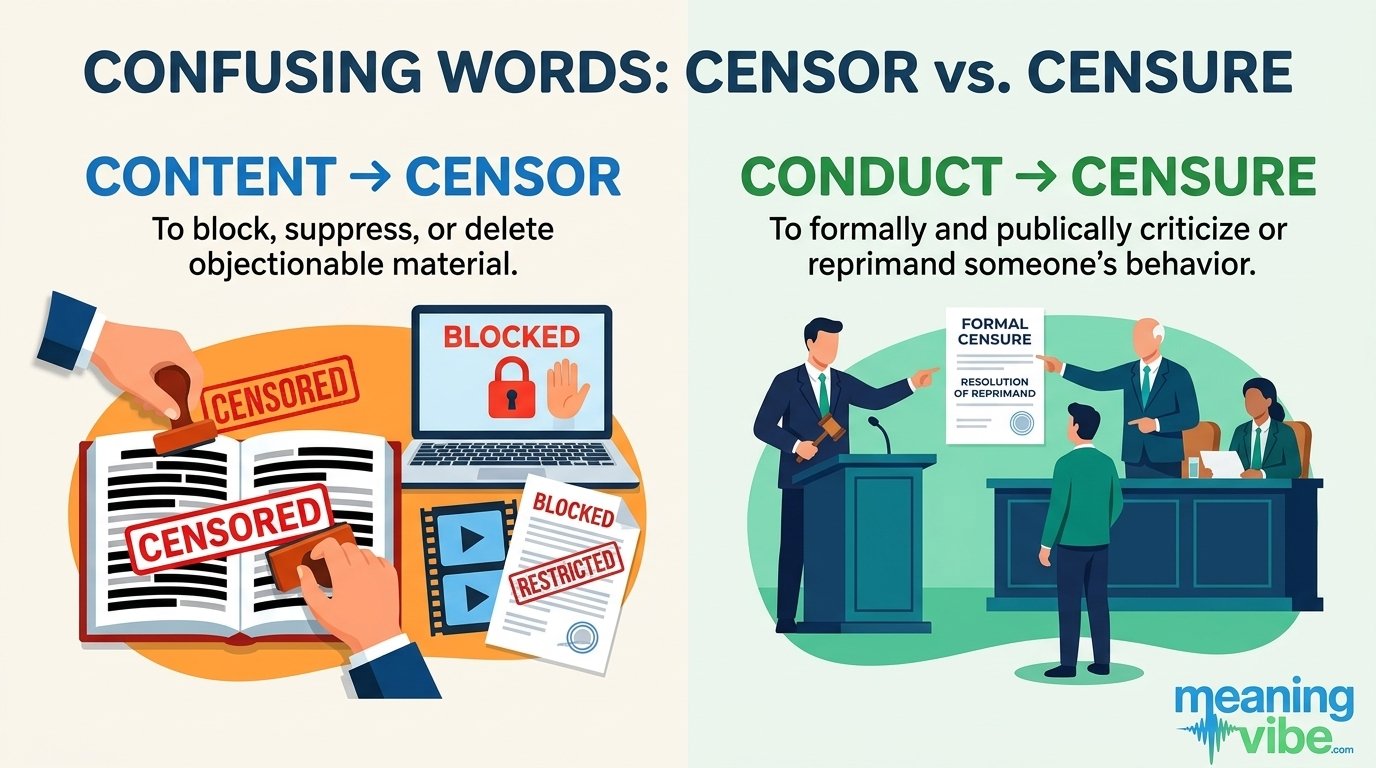
The difference is simple once you see it: censor removes content, while censure criticizes conduct. If you are deleting, blocking, or bleeping something, you need censor; if you are formally criticizing a person, an action, or a decision, you need censure.
Short Answer: Censor Removes Content, Censure Criticizes Conduct
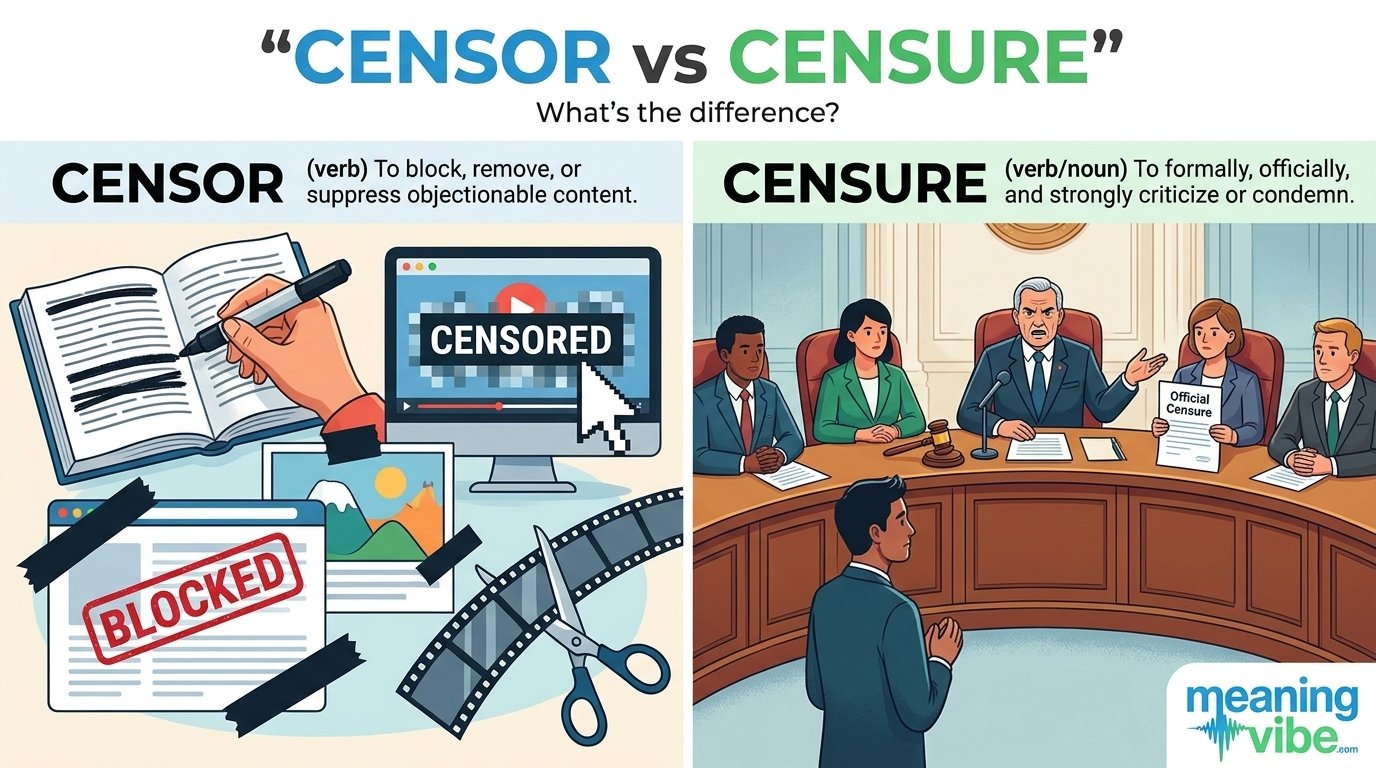
To censor something is to examine it and suppress or delete anything considered objectionable, in whole or in part. A censor is also the person who does that examining and suppressing, whether for a government, a broadcaster, a publisher, or a platform. The object of censor is almost always content: a book, a film, a broadcast, a website, a speech, or a set of words.
To censure someone is to formally criticize or reprimand them for an act or failure, especially from a position of authority. Censure is also the noun for that formal criticism: a judgment involving condemnation, an official reprimand, or a stern act of blaming. The object of censure is almost always a person, an action, or a decision being judged, not a piece of content being removed.
That object difference is the whole distinction, and it works in almost every sentence you will write. Ask what is being acted on: if the answer is content that is being removed, blocked, or hidden, use censor; if the answer is a person or conduct being judged, use censure. Keep that test in mind, and the rest of this article is detail, examples, and edge cases.
Censor: Definition, Pronunciation, and Examples
What Does Censor Mean?
Censor, as a verb, means to subject material to political, religious, or moral censorship, or to forbid its public distribution. A magazine censored by a government, a film censored before release, and a broadcast censored for language all share the same action: something was examined, and something objectionable was removed, altered, or blocked. That removal is the defining feature of censor, and without removal, the word does not fit.
Censor, as a noun, means a person authorized to examine publications, correspondence, or performances and suppress anything considered obscene or politically unacceptable. The noun is less common in everyday writing than the verb, but it appears in history, media, and government contexts. A film censor, a wartime censor, and a Roman censor are all people who examine and judge, though their powers differ greatly.
Censorship is the noun for the system, practice, or institution of censoring, not for censure. Government censorship, media censorship, and self-censorship all describe suppression of content, while censure has no “censorship” form. Confusing censorship with censure is a second-order error: if you mean the practice of removing content, use censorship; if you mean a formal reprimand, use censure.
Censor as a Noun and a Verb
Use censor as a verb when an action is being done to content, and as a noun when a person or office is being named. “The network censored the scene” uses the verb, because a scene was cut; “the network censor reviewed the script” uses the noun, because a person did the reviewing. That noun-verb flexibility is shared by censure, which is why part of speech alone cannot distinguish the pair — you must check meaning and object.
Censor’s verb forms are regular: censor, censors, censored, censoring. “The publisher censored the chapter” is past tense, “the platform is censoring posts” is present participle, and “the censored version” is the adjective form. Those forms never change meaning: censored always means content was removed or altered, never that a person was formally criticized.
Censor also appears in related adjectives that describe attitudes, not actions. Censorial means relating to a censor or censorship, while censorious means severely critical — and censorious is closer in feeling to censure than to censor. That overlap is a trap: a censorious remark is a harshly critical remark, not a remark that removed content, so do not use censorious as a synonym for censoring.
Censor in a Sentence: Books, Films, Websites, Broadcasts
The television channel censored several violent scenes before broadcasting the movie. That sentence works because scenes — content — were removed before broadcast, which is the core censor action. The same structure works for books, newspapers, and websites, wherever content is cut, blocked, or altered before an audience sees it.
Some governments censor websites to control information, and publishers sometimes refuse to censor an author’s original work. Both sentences use censor correctly, because the object in each case is content being controlled or left alone. A government that blocks a website is censoring it, while a publisher that leaves a manuscript intact is refusing to censor it.
Parents sometimes censor the music or online content their children listen to or see. That everyday use is correct, because the parent is filtering content, not formally criticizing a child. The same logic applies to a teacher who censors bad language from a school publication: the language is content, so censor is the word, even though the setting is a school, not a government.
Censure: Definition, Pronunciation, and Examples
What Does Censure Mean?
Censure, as a verb, means to find fault with and criticize as blameworthy, or to formally reprimand someone and express official censure of them. A committee that censures a minister, a board that censures a chief executive, and a Senate that censures a senator are all doing the same thing: issuing a formal, public judgment that conduct was wrong. That judgment is the defining feature of censure, and without judgment, the word does not fit.
Censure, as a noun, means a judgment involving condemnation, the act of blaming or condemning sternly, or an official reprimand. “The minister faced public censure” uses the noun for the criticism itself, while “the committee voted to censure the minister” uses the verb for the act of criticizing. Both forms describe judgment, not removal, which is why censure never means deleting content.
Censure is formal by nature, and it is relatively rare outside politics, law, and formal organisations. You would not normally say a friend “censured” you for being late; you would say they criticized or scolded you. Reserve censure for formal contexts — a legislature, a board, a professional body, a court, or a public body — where the criticism is official, recorded, and consequential.
Censure as a Noun and a Verb
Use censure as a verb when a body is criticizing someone, and as a noun when the criticism itself is being named. “The board voted to censure the chief executive” uses the verb, because the board acted; “the chief executive faced censure” uses the noun, because the criticism is the subject. Like censor, censure is both noun and verb, so part of speech cannot distinguish the pair — meaning and object must.
Censure’s verb forms are also regular: censure, censures, censured, censuring. “The senator was censured by Congress” is past tense, “the committee is censuring the official” is present participle, and “a censured member” is the adjective form. Those forms never change meaning: censured always means formally criticized, never that content was removed.
Censure’s noun forms include censurer (a person who censures) and censurable (able to be censured), though both are rare in everyday writing. You will almost never need censurer, and you should not use it to sound formal — it will sound obscure instead. Stick to censure and censured, which are the forms readers recognize and dictionaries list first.
Censure in a Sentence: Politicians, Officials, Organisations
The board voted unanimously to censure the chief executive for misleading investors. That sentence works because a person was formally criticized for conduct, which is the core censure action. The same structure works for ministers, senators, lawyers, students, and employees, wherever a body issues a formal judgment about behaviour.
The committee censured the minister for misconduct, and the principal censured the students for cheating. Both sentences use censure correctly, because the object in each case is a person being judged for actions, not content being removed. A committee that criticizes a minister is censuring, while a committee that hides a report about that minister is censoring — and that pair of sentences is the best test of the distinction.
His irresponsible behaviour attracted widespread censure, and she received public censure for breaking company rules. Those noun uses show censure as a public judgment, not a private opinion: widespread censure means many people or bodies judged the conduct, while public censure means the judgment was made openly. Private disapproval, without a formal or public element, is usually better described as criticism, not censure.
Censor vs Censure: The Master Comparison Table
| Feature | Censor | Censure |
| Meaning | To remove, block, or restrict content | To criticize or officially disapprove |
| Part of speech | Noun and verb | Noun and verb |
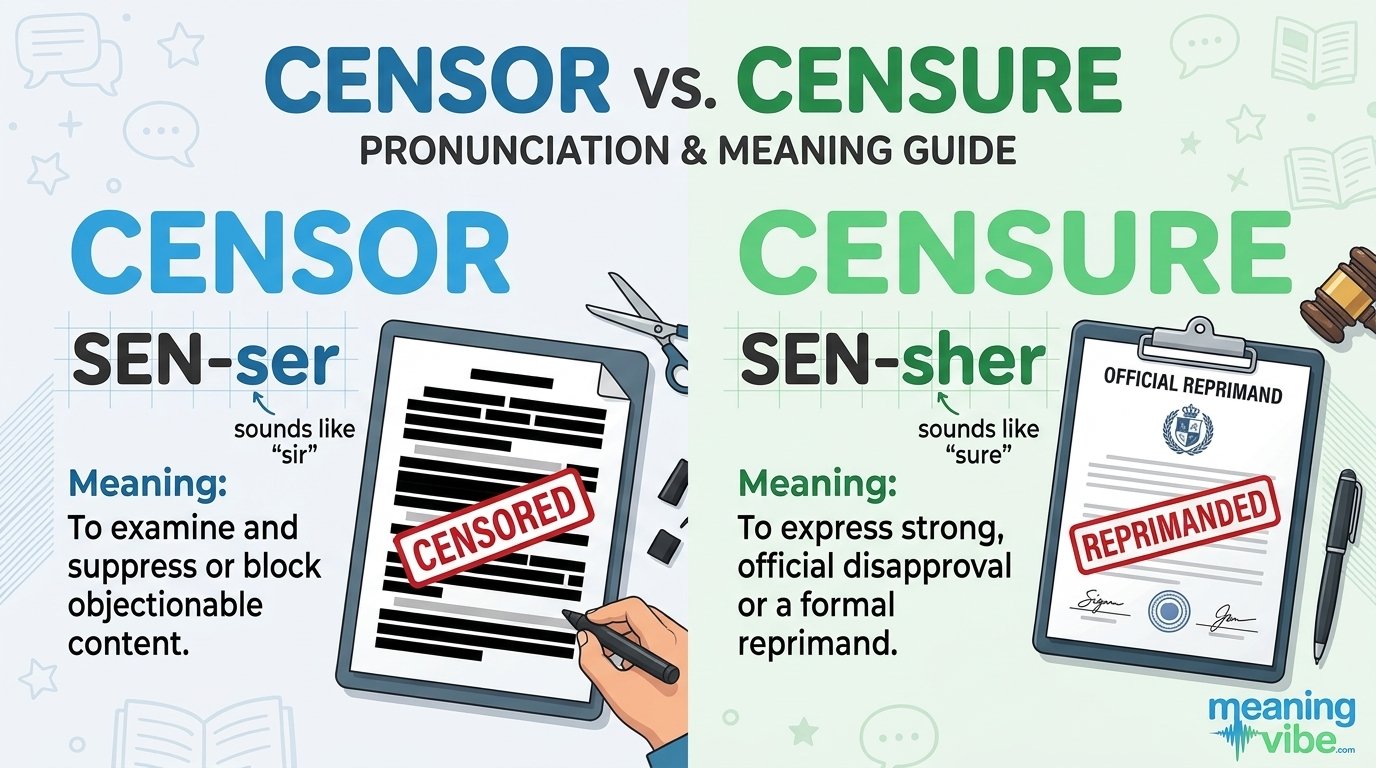
| Pronunciation | SEN-ser | SEN-sher |
| Object | Content: books, films, websites, words, scenes | Person, action, or decision being judged |
| Purpose | Control information | Express judgment |
| Related noun | Censorship, self-censorship | Censure (same word), letter of censure |
| Typical actor | Government, broadcaster, publisher, platform, parent | Committee, board, legislature, court, professional body |
| Typical example | The movie was censored. | The minister was censured. |
| Removes anything? | Yes — content is removed, blocked, or altered | No — nothing is removed; judgment is expressed |
| Formal? | Can be formal or everyday | Formal by nature |
Read that table as a decision tool, not as decoration. If your sentence’s object is in the censor column (content), use censor; if it is in the censure column (person or conduct), use censure. When a sentence seems to fit both columns — for example, a committee that both criticizes a person and hides a report — split it into two clauses, one per word, because one word cannot do both jobs.
The table also settles the most common follow-up question: can you censor a person? In ordinary usage, no: you censor what a person says, writes, or publishes, not the person themselves. A government that silences a journalist is censoring the journalist’s work, while a body that formally criticizes that journalist is censuring the journalist. That distinction matters in journalism, because “censored the journalist” and “censured the journalist” describe very different actions.
The Five-Second Decision Rule: What Is Being Acted On?
The Object Test
Step 1: Find the object — what is being censored or censured in your sentence? Underline the noun after the verb, or the noun that the verb acts on, and ask whether it is content or conduct. Content includes books, films, broadcasts, websites, speeches, essays, scenes, words, and posts; conduct includes behaviour, decisions, actions, remarks, and the person who did them.
Step 2: If the object is content being removed, blocked, or altered, use censor. “The government censored the article” passes, because an article is content and it was removed. “The school censored the essay” passes for the same reason, even though the setting is a school, not a government.
Step 3: If the object is a person, action, or decision being judged, use censure. “The committee censured the mayor” passes, because a mayor is a person being judged. “The board censured the decision” passes, because a decision is being judged, even though no person is named.
Step 4: If the sentence still makes sense when you substitute the definition, you have the right word. Replace censor with “remove or suppress content” and censure with “formally criticize,” then read the sentence aloud. If “the government formally criticized the article” sounds wrong for what you mean, you need censor; if “the committee removed the mayor” sounds wrong, you need censure.
When the Object Test Feels Unclear
Some sentences have two objects, and those sentences need two clauses, not one word. “The committee censured the senator and censored the report” is correct, because the senator was judged and the report was hidden. “The committee censored the senator” is wrong if you mean they criticized him, and “the committee censured the report” is wrong if you mean they hid it.
Some sentences use censor or censure figuratively, and the object test still works if you ask what is literally happening. “The public censured the company” means the public criticized the company, not that it removed the company’s content, so censure is correct. “The platform censored the post” means the platform removed the post, not that it criticized the poster, so censor is correct — even if the platform also disapproved of the poster.
If you are still unsure after the object test, check a dictionary, not a memory trick. Merriam-Webster and Dictionary.com both list censor as “suppress or delete as objectionable” and censure as “fault or reprimand, often officially,” and those definitions are the authority. A memory trick helps you recall the rule; a dictionary settles a disputed sentence.
Wrong Examples, Corrected
The Accept and Except Confusion
Some top-ranked pages for this query define censor as “to receive or agree” and censure as “to exclude or leave out.” Those are the meanings of accept and except, not censor and censure, and any page that gives those definitions for this pair has confused two different word pairs. If you saw censor defined as “agree” or censure defined as “except,” that page was wrong for this query, even if it ranked first.
Correct those examples like this: “I’m happy to accept your invitation” is accept, not censor, while “Everyone except the manager attended” is except, not censure. The confusion is understandable — accept/except and censor/censure are both similar-sounding pairs — but it is still a confusion, and copying it will teach readers the wrong words. Step 2’s job is to name the confusion plainly, so a reader who arrived from a wrong page can correct their understanding.
Do not cite a page that defines censor as “agree” for any claim about censor or censure. Cite Merriam-Webster or Dictionary.com for definitions, and cite the Congressional Research Service for Congress procedure, because those sources are authoritative for their domains. A ranking position does not make a definition correct, and a wrong definition at the top of a search result is still wrong.
The Two Most Common Swaps
Incorrect: “The government censured the violent scenes from the movie.” That sentence is wrong if you mean the government removed the scenes, because scenes are content, not a person being judged. Correct: “The government censored the violent scenes from the movie,” because the scenes were cut before broadcast.
Incorrect: “The senator was censored by Congress for unethical behaviour.” That sentence is wrong if you mean Congress formally criticized the senator, because a senator is a person being judged, not content being removed. Correct: “The senator was censured by Congress for unethical behaviour,” because Congress issued a formal reprimand.
Incorrect: “The committee censored the mayor for corruption.” That sentence is wrong for the same reason: a mayor is a person, so the committee censured, not censored, him. Correct: “The committee censured the mayor for corruption,” and if the committee also hid a report, add a second clause: “and censored the report about that corruption.”
Incorrect: “The publisher censured the author’s manuscript.” That sentence is wrong if you mean the publisher cut or altered the manuscript, because a manuscript is content. Correct: “The publisher censored the author’s manuscript,” and if the publisher also criticized the author publicly, that criticism would be censure of the author, not of the manuscript.
Pronunciation: SEN-ser vs SEN-sher
Censor, Censure, Censer, and Sensor Sounds
Censor is pronounced SEN-ser in American English, with the stress on the first syllable and a soft “ser” ending. Its International Phonetic Alphabet form is /ˈsɛnsər/ in American English and /ˈsɛnsə/ in British English, though the American form is the one most US readers need. Censer, the incense container, shares that pronunciation exactly, which is why censer and censor are homophones.
Censure is pronounced SEN-sher in American English, with the stress on the first syllable and a “sher” ending that rhymes with “sure.” Its IPA form is /ˈsɛn.ʃər/ in American English and /ˈsɛnʃə/ in British English, and the second syllable is the only sound difference from censor. That one-syllable difference — ser vs sher — is the pronunciation distinction, and it is smaller than the meaning distinction, which is why the words are confused in speech as well as in writing.
Sensor is pronounced SEN-ser as well, sharing censor’s sound, which makes sensor, censor, and censer a homophone set. A smoke detector’s sensor, a film censor, and a church censer all sound the same in American English, even though their meanings are unrelated. Censure stands apart in sound, with its sher ending, which is a useful pronunciation clue: if you hear sher, you are hearing censure, not censor.
| Word | Pronunciation (US) | IPA | Sounds like |
| Censor | SEN-ser | /ˈsɛnsər/ | Sensor, censer |
| Censure | SEN-sher | /ˈsɛn.ʃər/ | Sure (second syllable) |
| Censer | SEN-ser | /ˈsɛnsər/ | Censor, sensor |
| Sensor | SEN-ser | /ˈsɛnsər/ | Censor, censer |
Practice the pair aloud with a sentence that uses both words, so the sound difference becomes muscle memory. Say: “The committee censured the official, but it did not censor the report.” Hearing SEN-sher for the judgment and SEN-ser for the removal, in the same sentence, trains the ear faster than reading the IPA alone.
Why They Sound Alike: Latin Censere, Roman Censors, and the Census
Shared Root, Divergent Meanings
Both words share a common ancestor: the Latin verb censere, meaning “to give as an opinion,” “to assess,” or “to perform the duties of a censor.” That shared root explains why the words look and sound alike, and why both typically imply acts of authority. A Roman censor gave opinions and assessments, and both modern words descend from that judging function — but they diverged into different kinds of judging.
In early Rome, censors were magistrates who took the census, assessed property values, and supervised the moral conduct of citizens. That Roman office is the direct ancestor of censor, and it is also the ancestor of census, the official count of a population. A censor judged what was acceptable, and a census counted what existed — both from the same Latin root, censere, meaning to assess.
Censure derives from Latin censura, meaning “office of censor, assessment, or moral oversight,” via Anglo-French censure and Middle French censurer. Merriam-Webster dates the noun censure to 1539 and the verb to 1571, while censorship dates to 1556 in its Roman-office sense. Those dates show that both words have been in English for nearly five centuries, which is why their confusion is old, not new.
The divergence is this: censor kept the “examine and suppress” sense, while censure kept the “judge and condemn” sense. A Roman censor both assessed morals and could note disapproval, so the two modern meanings are branches of one original judging function. Knowing that history does not choose the word for you, but it explains why the confusion feels natural — the words were once closer than they are now.
The Four-Word Confusion Set: Censor, Censure, Sensor, Censer
One Table, Four Words
| Word | Meaning | Object / thing | Example |
| Censor | Suppress or delete as objectionable | Content: books, films, broadcasts, websites | The network censored the comedian’s monologue. |
| Censure | Formally criticize or reprimand | Person, action, or decision being judged | The committee censured the minister. |
| Sensor | Device that detects and responds to a signal | Physical device: smoke, motion, light, speed | A smoke alarm is an essential sensor in case of fire. |
| Censer | Container in which incense is burned | Religious object: brass, chains, incense | He lighted the censer on the altar. |
Sensor is the easiest word in the set to separate, because it is a device, not a judgment or a suppression. A sensor detects motion, light, smoke, or speed and responds — a smoke detector senses smoke, a motion sensor senses movement, a light sensor senses changing light. If your sentence is about a device that detects, use sensor, and neither censor nor censure will fit.
Censer is the rarest word in the set, and the easiest to remember once you see it. A censer is a holder for incense used in a religious ritual, often a small metal pot held by chains and swung by a priest or altar server. If your sentence is about incense, a church, or a ritual, use censer, and the other three words will not fit.
The full scenario that ties all four together is memorable because it is visual. Imagine a religious leader holding a censer during a ceremony, while a government official decides to censor a film, and that same official is later censured by the public for overstepping. That one image contains all four words in their correct roles, and it is the scenario WordPandit uses for the same reason.
Censure in Congress: Reprimand, Censure, Expulsion, Impeachment
What Happens When a Member Is Censured?
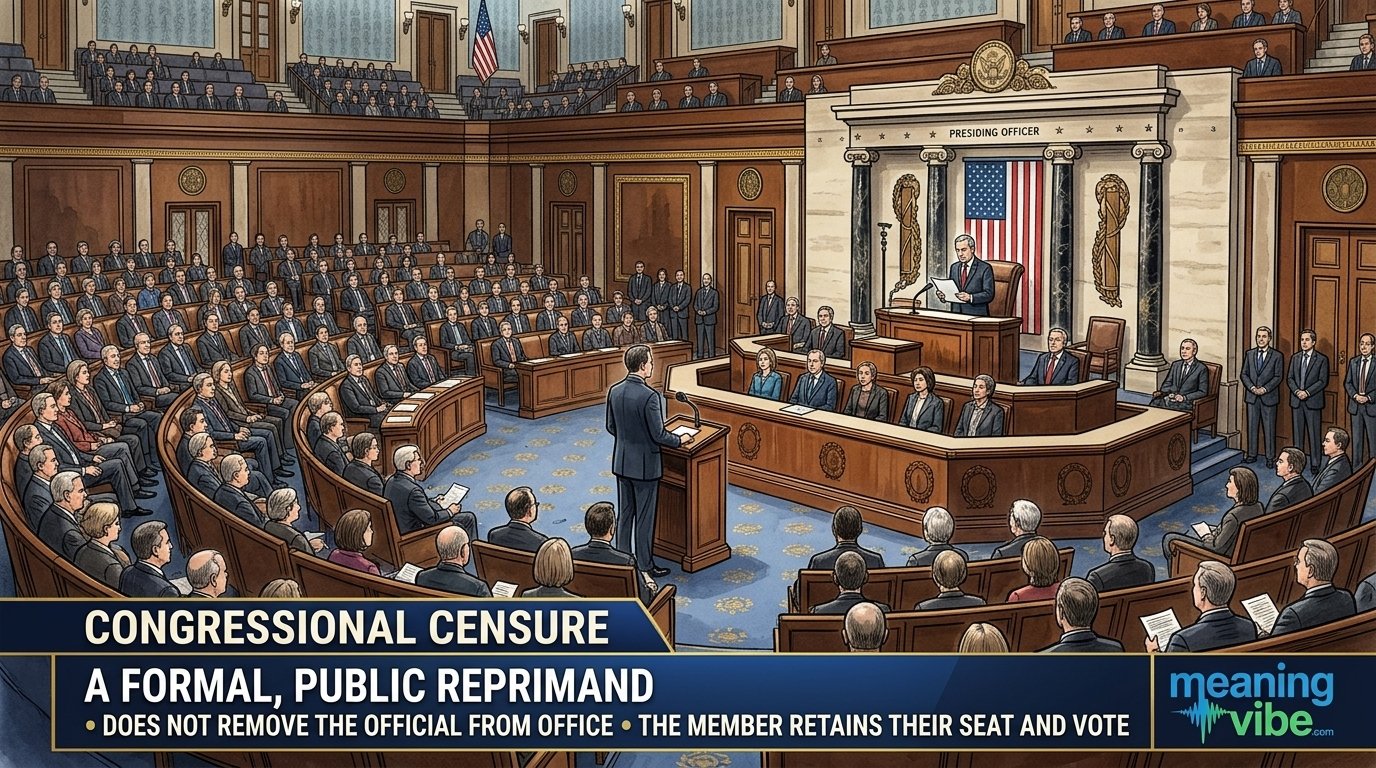
Censure is a reprimand adopted by one or both chambers of Congress against a member, a president, a federal judge, or another government official. For members, censure is a disciplinary measure sanctioned by the Constitution’s Article I, Section 5, which gives each house authority to punish its members for disorderly behaviour. For non-members, censure is not a constitutional disciplinary measure, but a formal expression or “sense of” one or both houses.
In the House, a censured member is typically required to stand in the well of the chamber while the Speaker reads the resolution aloud. That public, in-person reading is the ceremony that makes censure more serious than a reprimand, because it is a visible, institutional black mark, not just a vote on paper. The exact ritual varies by case and era, but the point is consistent: the member hears the judgment in front of peers.
Censure does not remove a member from office, and it does not automatically remove committee chairs. A censured member walks back to their desk and keeps working, unless a separate action — by the party, by the chamber, or by the member’s own resignation — removes a chair or a seat. That separation matters, because many summaries imply that censure automatically strips chairs, which is a political consequence, not a procedural one.
Does Censure Remove Someone From Office?
No, censure does not remove someone from office, and it carries no legal penalties beyond the public stigma of the rebuke. That is why censure is described as less severe than expulsion, which permanently terminates a seat, and more severe than a reprimand, which is a lesser formal rebuke. A censured member keeps their seat, keeps voting, and can run for re-election, though the reputational damage often makes re-election harder.
The clearest instance of a successful presidential censure is Andrew Jackson, censured by the Senate in 1834, according to the Congressional Research Service. Since 1800, members have introduced censure resolutions against at least 13 sitting presidents, with two additional presidents receiving criticism via alternative means. Those numbers are from CRS, and they should be cited to CRS, not to a blog summary, because CRS is the authoritative source for Congress procedure.
Recent partisan examples show censure’s use as a political tool, not just a disciplinary one. Republicans censured Adam Schiff in June 2023, Rashida Tlaib in November 2023, and Jamaal Bowman in December 2023, while Democrats attempted but failed to censure Marjorie Taylor Greene in 2021 and 2023. Those examples are dated and partisan, so cite them with date and source, and do not present them as timeless definitions of censure.
Censure vs Reprimand vs Expulsion: The Table
| Action | Vote required | Removes from office? | Ceremony | Severity |
| Letter of reproval | Ethics Committee only, no full-chamber vote | No | None, letter issued | Mildest formal sanction |
| Reprimand | Simple majority | No | Member stands in place, no Speaker reading | Less severe than censure |
| Censure | Simple majority | No | Member stands in the well, Speaker reads resolution | More serious than reprimand |
| Expulsion | Two-thirds majority | Yes, seat terminated | Removal, vacancy filled by election or appointment | Most severe, rarest |
| Impeachment | House majority to impeach, Senate two-thirds to convict | Yes, if convicted (for president, judges, executive officials) | Trial in Senate | Not a member-discipline tool |
Impeachment is not a form of censure, and it is not used against members of Congress for their own discipline. Impeachment removes federal officials — president, vice president, judges — through House charges and a Senate trial, while Congress uses expulsion for its own members. Confusing impeachment with censure is a common error in news summaries, and the table above prevents it by separating the two processes.
House Ethics rules treat reprimand as appropriate for serious violations, censure for more serious violations, and expulsion for the most serious violations. That ladder is the official framing, and it is more useful than any blog’s “slap on the wrist” label, because it ties severity to the chamber’s own rules. Use that ladder when you explain why a body chose censure instead of a lesser or greater sanction.
Censorship and the First Amendment: Government vs Private vs Self-Censorship
Government Censorship
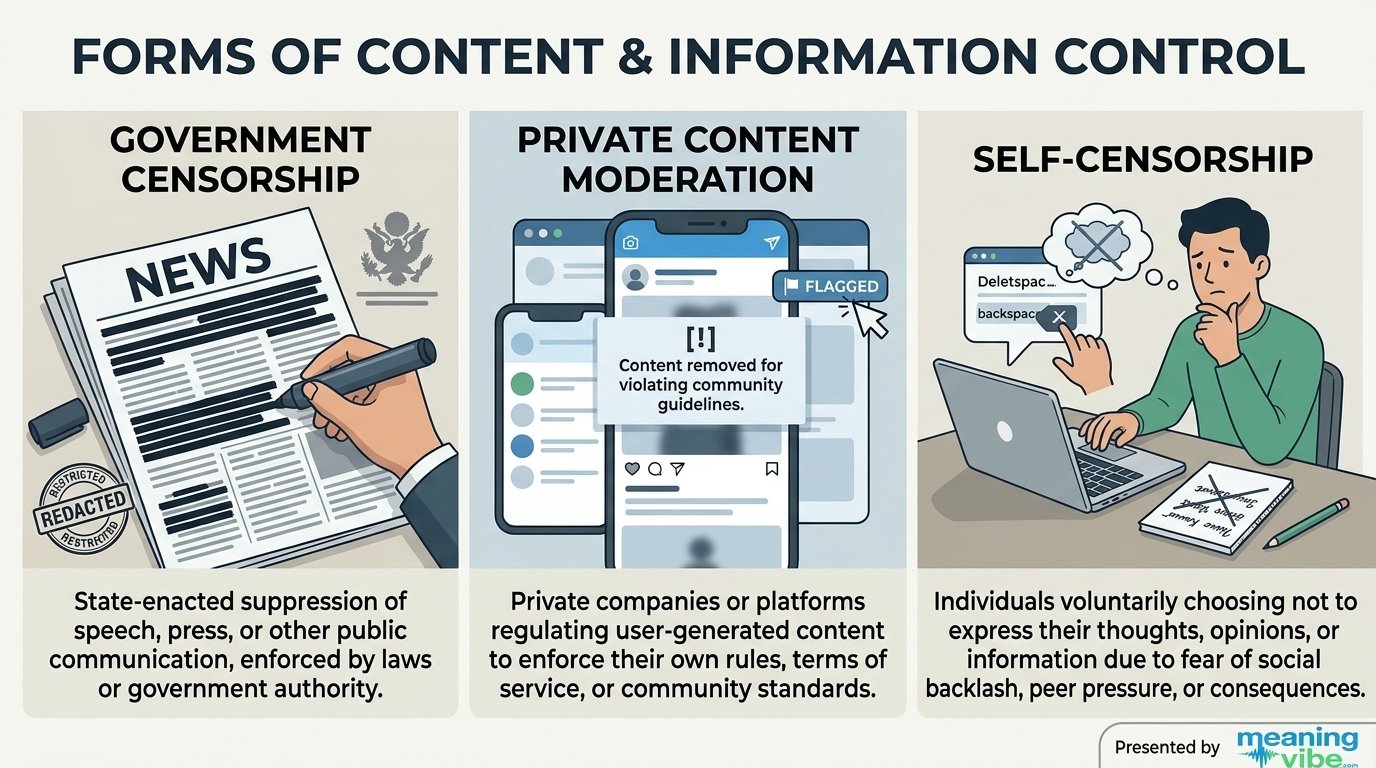
The First Amendment protects people in the United States from government censorship, but its protections are not absolute. Government censorship — when the government prevents speech, printing, or depiction — implicates First Amendment freedoms, and the Supreme Court has been reluctant to allow prior restraint, even of previously classified material. In New York Times v. United States (1971), the Court overturned an order stopping the newspaper from printing Pentagon Papers excerpts, calling that prior restraint unconstitutional.
Not all government censorship is unlawful, and not all government action that limits speech is censorship in the legal sense. Obscenity laws allow the government to punish production or dissemination of material about sex if a judge or jury finds it sufficiently offensive and lacking serious value, while national-security and copyright restrictions have their own legal frameworks. Those boundaries are legal, not linguistic, and a grammar article should state them as general information, not as legal advice.
Censorship occurs when individuals or groups try to prevent others from saying, printing, or depicting words and images, according to the First Amendment Encyclopedia. Censors seek to limit freedom of thought and expression by restricting spoken words, printed matter, symbolic messages, freedom of association, books, art, music, movies, television, and internet sites. That broad definition covers government and private action in ordinary language, even though only government action triggers First Amendment scrutiny.
Private Moderation and Self-Censorship
Private actors — for example, corporations that own radio stations, publishers, or social media platforms — can engage in forms of censorship in the ordinary-language sense, but that presents no First Amendment implications without state action. A private platform that removes a post is censoring that post in ordinary language, because content was removed, but it is not violating the First Amendment, because the First Amendment restrains government, not private companies. That distinction is the most important legal nuance in this section, and it is the one most summaries get wrong.
Self-censorship is when a person censors their own work or speech, before anyone else does, usually from fear of backlash, punishment, or social cost. A journalist who deletes a tweet before sending it, a writer who softens a passage for a middle-grade audience, and an employee who withholds a criticism in a meeting are all self-censoring, because they are suppressing their own content. Self-censorship is not the same as external censorship, because the suppressor and the speaker are the same person.
When private individuals agitate to eliminate television programmes they dislike, or threaten to boycott advertisers, they are trying to censor artistic expression in ordinary language, but their protests are themselves protected speech. That paradox — protesting speech is speech — is why censorship debates are rarely simple, and why a grammar article should not take a political position on whether a given removal was justified. The article’s job is to name the action correctly, not to judge whether it was right.
When to Use Each Word: Academic, Journalistic, Political, and Everyday Writing
Academic and Formal Writing
In academic writing, use censor for content suppression and censure for formal judgment, and define both on first use if your reader may not know them. An essay that says “the regime censored textbooks” is correct, while an essay that says “the regime censured textbooks” is wrong, because textbooks are content, not a body being judged. Academic readers notice that error, because precision is the point of academic prose.
In formal writing, censure should be reserved for official, recorded judgments, not for everyday criticism. A formal letter that says “we censure your conduct” is appropriate if the letter is from a body with authority to issue a reprimand, while a letter from a peer that says the same thing will sound over-formal. If you are not issuing a formal reprimand, use criticize, condemn, or rebuke, which are less formal and more accurate for peer criticism.
In exam writing, the object test is faster than a dictionary, and it is the test examiners expect you to apply. Underline the object, ask whether it is content or conduct, and choose accordingly, because exam questions for this pair almost always hinge on that one distinction. A student who writes “the committee censored the minister” in an exam will lose marks for the same reason a journalist who writes it in a news article will lose credibility.
Journalistic and Political Writing
In journalism, the censor/censure distinction is a credibility test, because news readers trust a publication that uses legal and political terms correctly. A news article that says a senator was “censored” when Congress actually “censured” him misleads readers about what happened: censored implies content was hidden, while censured implies a formal reprimand was issued. That error is not a typo; it changes the story.
In political writing, censure is a term of art with a specific procedure, so use it only when a formal vote or resolution actually occurred. A politician who was criticized on social media was not “censured” unless a body voted to censure them, just as a book that was criticized in a review was not “censored” unless it was actually removed or altered. Loose use of censure in political commentary dilutes the term and confuses readers who follow Congress procedure.
In everyday writing, censor is the more common word, because content filtering is an everyday experience, while formal reprimands are rare. You censor a post, a photo, or a word in a message, but you rarely censure anyone outside a formal body. If you find yourself using censure in a text message or a casual email, check whether criticize would be more natural — it usually will be.
Memory Tricks That Actually Work
Sensor, Sure, Scissors, and the Object Test
Trick 1: Censor sounds like sensor, and a sensor checks and controls things. A sensor detects and blocks, a censor checks and removes content, and both words share the SEN-ser sound. That trick helps you recall censor, but it does not help you recall censure, so pair it with a second trick for the other word.
Trick 2: Censure contains “sure,” and when you censure someone, you are sure they did something wrong and you criticize them. That trick is memorable because “sure” is the second syllable of SEN-sher, and it links the sound to the judgment. Its weakness is that “sure” appears in many words, so it works best as a recall aid, not as a definition.
Trick 3: Censor sounds like scissors, and a censor cuts out information like scissors cut paper. Both words contain an “s” sound and a cutting action, which makes the image vivid for visual learners. Its weakness is that it is a sound association, not a meaning, so it should not replace the object test for a disputed sentence.
Trick 4: The object test, which is not a trick but a rule, and the only trick that works every time. Content → censor, conduct → censure, and if you substitute the definition and the sentence still makes sense, you have the right word. That rule takes five seconds, it works for every sentence in this article, and it is the rule to teach if you teach only one.
| Trick | Helps recall | Weakness | Best for |
| Sensor | Censor = checks and removes | Only helps censor, not censure | Auditory learners |
| Sure | Censure = sure they did wrong | “Sure” is in many words | Auditory learners |
| Scissors | Censor = cuts out | Sound association, not meaning | Visual learners |
| Object test | Both words, every sentence | Needs 5 seconds of thought | Every writer, every sentence |
Use tricks for recall, and use the object test for decisions. A trick that helps you remember a word is useful, but a trick that helps you choose the wrong word confidently is worse than no trick at all. That is why this article puts the object test first and the tricks second, even though competitors put tricks first.
Quiz: 10 Questions With Explanations
Question 1: The television station decided to ______ the violent scenes before airing the movie. Answer: censor, because scenes are content being removed before broadcast. Censure would mean the station formally criticized the scenes, which is not what happened.
Question 2: The committee voted to ______ the minister for misconduct. Answer: censure, because a minister is a person being formally criticized for conduct. Censor would mean the committee removed the minister’s content, which is not what happened.
Question 3: Many countries ______ harmful websites. Answer: censor, because websites are content being blocked or restricted. Censure would mean countries formally criticized websites, which is not the action described.
Question 4: The school decided to ______ the student for repeated misconduct. Answer: censure, because a student is a person being officially criticized for behaviour. Censor would mean the school removed the student’s content, which is not the action described.
Question 5: The newspaper refused to ______ the journalist’s report. Answer: censor, because a report is content being edited or removed. Censure would mean the newspaper formally criticized the report’s author, which is a different action.
Question 6: The board ______ the chief executive, but it did not ______ the report. Answer: censured, censored, because the chief executive was judged and the report was hidden. That pair in one sentence is the best single test of the distinction.
Question 7: A smoke detector’s ______ senses smoke and sounds an alarm. Answer: sensor, because a sensor is a device that detects. Censor and censure are judgments or suppressions, not devices, so neither fits a smoke detector.
Question 8: The priest swung the ______ during the service, filling the church with incense. Answer: censer, because a censer is the incense container. Censor and censure are actions, not objects, so neither fits a swung container.
Question 9: The Senate ______ Andrew Jackson in 1834. Answer: censured, because Jackson was formally reprimanded by a legislative body. Censor would mean the Senate removed Jackson’s content, which is not what happened in 1834.
Question 10: The platform ______ the post, but the user was not ______ by any body. Answer: censored, censured, because the post was removed and the user was not formally criticized by a body. That distinction matters for platform moderation debates, where the two actions are often confused.
Mistakes to Avoid
- Using censor for a person being criticized. Fix: if the object is a person, action, or decision being judged, use censure, not censor, because censor’s object is content.
- Using censure for content being removed. Fix: if the object is a book, film, website, or scene being cut or blocked, use censor, not censure, because censure’s object is conduct.
- Using censorship as the noun for censure. Fix: censorship is the noun for censor’s practice, while censure is its own noun for a formal reprimand, so do not swap them.
- Using censure for everyday criticism. Fix: reserve censure for formal, official, or public judgments, and use criticize, condemn, or rebuke for peer or private criticism.
- Using censor for a device. Fix: a device that detects is a sensor, not a censor, even though the words sound the same in American English.
- Using censor for an incense container. Fix: a container for incense is a censer, not a censor, even though the words sound the same and look similar.
- Assuming censure removes someone from office. Fix: censure does not remove a member, and it does not automatically remove committee chairs — those are separate actions.
- Assuming censure and impeachment are the same. Fix: impeachment removes federal officials through a trial, while censure is an internal reprimand that leaves the member in place.
Expert Tips
- Underline the object before you choose the word. Content → censor, conduct → censure, and that one underline prevents most errors in this pair.
- Substitute the definition and read the sentence aloud. If “remove content” fits, use censor; if “formally criticize” fits, use censure; if neither fits, rewrite the sentence.
- Check a dictionary for a disputed sentence, not a memory trick. Merriam-Webster and Dictionary.com are the authority for definitions, and CRS is the authority for Congress procedure.
- Reserve censure for formal judgments. If no body voted, no resolution was adopted, and no official reprimand was issued, use criticize, not censure.
- Do not use censorship as a synonym for censure. Censorship is the practice of censoring, while censure is a formal reprimand, and swapping them changes the meaning.
- Say the pair aloud: SEN-ser for censor, SEN-sher for censure. Hearing the difference trains the ear, and the ear will catch errors the eye misses.
- Split a sentence that needs both words into two clauses. “Censured the senator and censored the report” is correct, while either word alone for both actions is wrong.
- Cite the source for Congress claims. House and Senate censure counts, vote thresholds, and ceremony details should be verified on congress.gov on a stated date, not copied from a blog.
- Do not copy a top-ranked page’s definitions without checking them. A ranking position does not make a definition correct, as the accept/except confusion in this SERP shows.
- Keep the cheat sheet beside you while editing. A one-page table with definitions, pronunciation, the object test, and ten examples will prevent more errors than any grammar checker.
FAQs
What is the difference between censor and censure?
Censor means to remove, block, or restrict content, while censure means to formally criticize or reprimand someone. You censor books, films, websites, and broadcasts, and you censure people, actions, and decisions. Censoring removes information, while censuring expresses judgment, and that object difference is the whole distinction.
What does censor mean?
Censor means to examine material and suppress or delete anything considered objectionable, in whole or in part, or to forbid its public distribution. A censor is also the person who does that examining and suppressing, whether for a government, a broadcaster, a publisher, or a platform. The object of censor is almost always content, not a person being judged.
What does censure mean?
Censure means to find fault with and criticize as blameworthy, or to formally reprimand someone and express official censure of them. As a noun, censure means a judgment involving condemnation, the act of blaming sternly, or an official reprimand. The object of censure is almost always a person, action, or decision being judged, not content being removed.
Is censor a noun or a verb?
Censor is both a noun and a verb. As a verb, it means to suppress or delete objectionable material; as a noun, it means a person authorized to examine and suppress such material. Its forms are regular: censor, censors, censored, censoring, and the noun for its practice is censorship.
Is censure a noun or a verb?
Censure is both a noun and a verb. As a verb, it means to formally criticize or reprimand; as a noun, it means the formal criticism or official reprimand itself. Its forms are regular: censure, censures, censured, censuring, and part of speech alone cannot distinguish it from censor.
How do you pronounce censor?
Censor is pronounced SEN-ser in American English, with stress on the first syllable. Its IPA form is /ˈsɛnsər/ in American English and /ˈsɛnsə/ in British English. It sounds the same as sensor and censer, which is why those three words form a homophone set.
How do you pronounce censure?
Censure is pronounced SEN-sher in American English, with stress on the first syllable and a “sher” ending that rhymes with “sure.” Its IPA form is /ˈsɛn.ʃər/ in American English and /ˈsɛnʃə/ in British English. That sher ending is the only sound difference from censor, and it is smaller than the meaning difference.
What is the difference between censor and sensor?
Censor suppresses content, while sensor is a device that detects and responds to a signal. A sensor detects motion, light, smoke, or speed — a smoke detector senses smoke, a motion sensor senses movement — while a censor examines and removes objectionable material. If your sentence is about a device, use a sensor, and neither censor nor censure will fit.
What is a censer?
A censer is a container in which incense is burned during a religious ceremony, often a small metal pot held by chains and swung by a priest or altar server. It is the rarest word in the censor/censure/sensor/censer set, and it is the easiest to remember once you see it, because its meaning is a physical object, not an action.
Can you censor a person?
In ordinary usage, no: you censor what a person says, writes, or publishes, not the person themselves. A government that silences a journalist is censoring the journalist’s work, while a body that formally criticizes that journalist is censuring the journalist. That distinction matters in journalism, because the two sentences describe very different actions.
Can you censure a book?
No, you do not normally censure a book, because censure’s object is a person, action, or decision being judged, not content being removed. You can criticize a book, condemn a book, or review a book harshly, but if you mean the book was removed, altered, or blocked, use censor. A book that was formally condemned by a body would be described as condemned, not censured, in most usage.
What is censorship?
Censorship is the system, practice, or institution of censoring — examining material and suppressing or deleting anything considered objectionable. Government censorship, media censorship, and self-censorship all describe suppression of content, while censure has no “censorship” form. If you mean the practice of removing content, use censorship; if you mean a formal reprimand, use censure.
What is self-censorship?
Self-censorship is when a person censors their own work or speech, before anyone else does, usually from fear of backlash, punishment, or social cost. A journalist who deletes a tweet before sending it and a writer who softens a passage for a younger audience are both self-censoring, because they are suppressing their own content. Self-censorship is not the same as external censorship, because the suppressor and the speaker are the same person.
What is the difference between censure and reprimand?
A reprimand is a formal rebuke generally considered less severe than censure, while censure is a stronger, more public formal condemnation. In the House, both require a simple majority vote, but a reprimand involves the member standing in place, while a censure typically requires the member to stand in the well while the Speaker reads the resolution. House Ethics rules treat reprimand as appropriate for serious violations and censure for more serious violations.
What is the difference between censure and expulsion?
Expulsion permanently removes a member from Congress and requires a two-thirds vote, while censure is a formal public condemnation that requires only a simple majority and does not remove the member. A censured member walks back to their desk and keeps working, while an expelled member’s seat is terminated and filled by election or appointment. Expulsion is the most severe and rarest congressional sanction, reserved for the most serious violations.
What is the difference between censure and impeachment?
Impeachment is a process for removing federal officials — president, vice president, judges — through House charges and a Senate trial, while censure is an internal reprimand a body issues against its own members. Congress does not impeach its own members; it uses expulsion for removal and censure or reprimand for lesser discipline. Confusing impeachment with censure misstates both the process and the consequence.
Does censure remove someone from office?
No, censure does not remove someone from office, and it carries no legal penalties beyond the public stigma of the rebuke. A censured member keeps their seat, keeps voting, and can run for re-election, though the reputational damage often makes re-election harder. Removal requires expulsion (for members) or impeachment and conviction (for executive officials and judges), not censure.
Does a censured member lose committee chairs automatically?
No, a censured member does not automatically lose committee chairs, because chair removal is a separate action by the party, the chamber, or the member’s own resignation. The political pressure from a censure often leads a party to strip roles, but that is a political consequence, not a procedural effect of the censure resolution itself. Some summaries imply automatic chair loss, which is incorrect as a matter of procedure.
What happens when a member of Congress is censured?
In the House, a censured member is typically required to stand in the well of the chamber while the Speaker reads the resolution aloud, as a visible, institutional rebuke. The member then returns to their desk and keeps working, with no removal from office and no automatic loss of chairs. The reputational and political consequences — media coverage, party pressure, electoral risk — are the real effects, not a legal penalty.
Why do censor and censure sound alike?
Censor and censure share a common ancestor, the Latin verb censere, meaning “to give as an opinion” or “to assess,” and both typically imply acts of authority. In early Rome, censors assessed property and supervised morals, and that judging function split into two modern meanings: censor kept “examine and suppress,” while censure kept “judge and condemn.” Their shared root explains the similarity, but their modern meanings are wholly distinct.
What is the Latin origin of censor and censure?
Censor derives from Latin censere via the Roman censor’s office, while censure derives from Latin censura, meaning “office of censor, assessment, or moral oversight,” via Anglo-French censure and Middle French censurer. Merriam-Webster dates the noun censure to 1539 and the verb to 1571, while censorship dates to 1556 in its Roman-office sense. Census also derives from censere, which is why censor and census are related words.
How do I remember censor vs censure?
Use the object test: content → censor, conduct → censure, and substitute the definition to check. For recall, use sensor for censor (a sensor checks and controls, a censor checks and removes) and “sure” for censure (you are sure they did wrong and you criticize them). Tricks help recall, but the object test is the only rule that works for every sentence.
Can a private company censor content?
Yes, in ordinary language, a private company can censor content by removing, blocking, or altering it, but that does not violate the First Amendment without state action. The First Amendment restrains government, not private companies, so a platform that removes a post is censoring that post in ordinary language without triggering First Amendment scrutiny. That distinction is the most important legal nuance in censorship debates, and it is the one most summaries get wrong.
Is censorship legal in the United States?
Government censorship is generally restricted by the First Amendment, but its protections are not absolute, and some government restrictions — such as obscenity laws, national-security restrictions, and copyright restrictions — have their own legal frameworks. Private censorship in ordinary language is generally legal, because private actors are not bound by the First Amendment in the same way. Those boundaries are legal, not linguistic, and this article states them as general information, not as legal advice.
What does the First Amendment say about censorship?
The First Amendment protects people in the United States from government censorship, and the Supreme Court has been reluctant to allow prior restraint, even of previously classified material. In New York Times v. United States (1971), the Court overturned an order stopping the newspaper from printing Pentagon Papers excerpts, calling that prior restraint unconstitutional. Private action, without state involvement, does not trigger the same First Amendment analysis.
Conclusion
Censor vs censure is a distinction you can master in five seconds, once you stop memorizing tricks and start checking the object. Censor removes content, while censure criticizes conduct: censor a book, a film, a website, or a scene, and censure a minister, a senator, a decision, or an action. That object test — content → censor, conduct → censure — works for every example in this article, from a television broadcast to a Congress resolution, and it will work for your next sentence too.
Keep the rest of the system beside the test, not instead of it. Remember SEN-ser for censor and SEN-sher for censure, remember that sensor is a device and censer is an incense container, and remember that censure does not remove anyone from office — expulsion does, with a two-thirds vote, while censure needs only a simple majority and a public reading. Those details will not change your choice in most sentences, but they will prevent the errors that make a writer look careless: censoring a person, censuring a book, or calling a formal reprimand a removal.
Use the quiz and the Related Topics links above to lock the distinction in, and check a dictionary for any sentence that still feels unclear. Start with the object test, substitute the definition, and read the sentence aloud — if “remove content” fits, use censor, and if “formally criticize” fits, use censure. That habit, practiced on ten sentences, will make censor vs censure a pair you never confuse again, in academic writing, journalism, politics, and everyday English.