

Have you ever paused mid sentence, unsure whether to type signor or signer? You are not alone. These two words look almost identical on paper, yet they belong to completely different worlds. One lives in legal paperwork and business contracts. The other lives in Italian culture and polite conversation.
This guide breaks down exactly what each word means, where each one came from, and how to use both correctly in real life. By the end, you will never second guess this word pair again.
Signor or Signer: Quick Answer
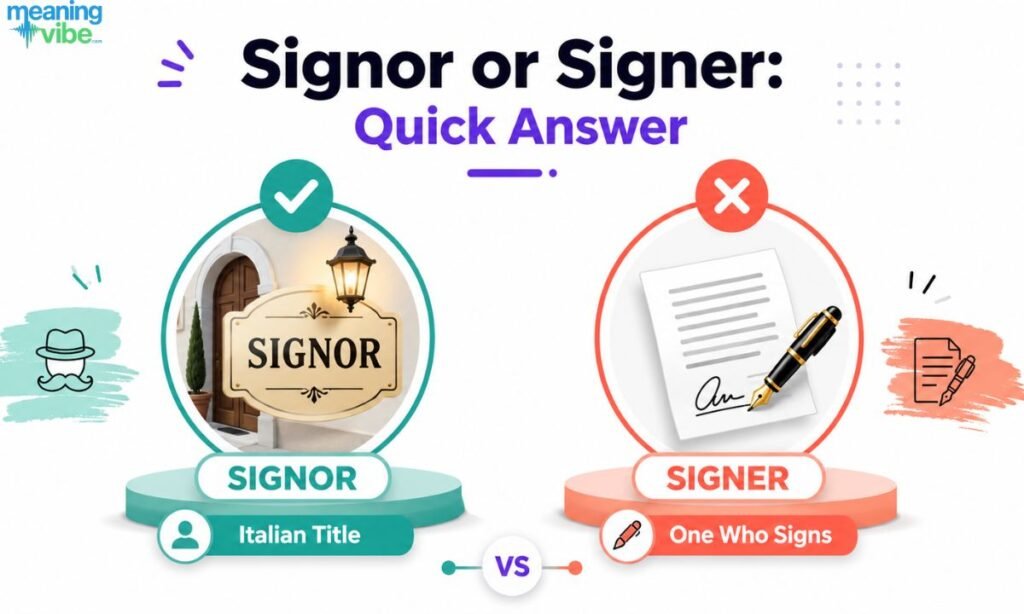
Here is the short version before we go deeper.
- Signer is the correct English word for a person who signs a document, contract, form, or agreement.
- Signor is an Italian title of respect for a man, similar to Mr. or Sir in English.
If you are writing about paperwork, contracts, or signatures, use signer. If you are writing about an Italian man, an Italian name, or a cultural reference, use signor. That single rule solves almost every mix up between these two words.
Signor or Signer Meaning
What Does Signer Mean?
A signer is someone who physically or digitally applies their signature to a document. This person confirms their identity, agrees to the terms written in the document, and takes responsibility for what they have signed.
Signer shows up constantly in everyday and professional English, including:
- Loan agreements and mortgage paperwork
- Employment contracts
- Notarized documents
- Bank account authorizations
- Digital signature platforms and electronic signature tools
There is also a second, less common meaning. A signer can refer to a person who communicates using sign language. This usage appears mostly in conversations about accessibility and deaf communities, not in legal writing.
What Does Signor Mean?
Signor is a title of courtesy used before an Italian man’s name. It functions exactly like Mr. does in English. You might see it written as Signor Rossi or Signor Bianchi in a letter, a novel, or a travel article.
Signor has no connection to signatures, contracts, or paperwork of any kind. Using it in a legal document instead of signer is a mistake that can confuse readers and weaken the credibility of formal writing.
The Origin of Signor or Signer
Understanding where each word comes from makes the difference much easier to remember.
Signer traces back to the Latin word signare, meaning to mark or to sign. That root passed through Old French before settling into English as sign and later signer, simply describing the act of marking a document with one’s name.
Signor has a completely different history. It comes from the Italian word signore, which itself developed from the Medieval Latin word senior, meaning elder or superior.
Over centuries, senior evolved in Romance languages into titles of respect: señor in Spanish, senhor in Portuguese, monsieur in French, and signor or signore in Italian. All of these words originally honored someone seen as older, wiser, or of higher social standing.
So while the two English words share several letters, their family trees never cross. Signer grew from the idea of marking something. Signor grew from the idea of respecting someone.
British English vs American English Spelling

A common question people ask is whether British and American English treat these words differently. The answer is straightforward.
| Word | British English | American English |
| Signer | Signer | Signer |
| Signor | Signor | Signor |
There is no regional spelling variation for either word. Unlike color and colour, or organize and organise, signer stays exactly the same across every English speaking country, including the UK, the US, Canada, and Australia.
Signor is a borrowed Italian word, so it also does not change based on dialect. The only spelling variation you may encounter is signore, which is the full Italian form sometimes used instead of the shortened signor.
Which Spelling Should You Use?
Choosing the right word comes down to context. Ask yourself one simple question: does this sentence involve signing something, or does it involve addressing an Italian man politely?
Use these quick guidelines:
- Writing a contract, agreement, email, or legal document in English? Use signer.
- Referring to a bank account holder or a co signer on a loan? Use signer.
- Addressing or describing an Italian man in a formal or cultural context? Use signor.
- Writing fiction, travel content, or dialogue set in Italy? Use signor.
- Unsure which one fits? Default to signer, since it applies to the vast majority of English writing situations.
In professional and academic English, signer will be correct almost every time. Signor only belongs in writing that specifically touches on Italian names, culture, or settings.
Also Read This: Wierd or Weird: Meaning, Correct Usage & Examples (2026)
Common Mistakes with Signor or Signer
Even experienced writers slip up occasionally. Here are the errors that show up most often, along with corrections.
- Mistake: Writing “the signor must approve this contract.” Correction: “The signer must approve this contract.” Signor has no legal meaning.
- Mistake: Assuming signor is simply a more formal spelling of signer. Correction: The two words are unrelated in meaning and origin, despite the similar spelling.
- Mistake: Confusing signor with senor, the Spanish equivalent. Correction: They mean the same thing but belong to different languages. Senor is Spanish, signor is Italian.
- Mistake: Using signer and signee as if they were the same role. Correction: A signer actively signs a document. A signee is the person designated to receive and sign it. The roles overlap but are not identical.
- Mistake: Using signer and signatory interchangeably in every context. Correction: A signatory usually represents an organization or formal party in an agreement, while a signer can refer to any individual applying a signature.
Signor or Signer in Everyday Examples
Seeing both words in context makes the distinction stick.
Examples using signer:
- Every signer on the mortgage must provide valid identification.
- She was the third signer of the petition demanding better road safety.
- The bank requires a co signer for applicants with limited credit history.
- His parents are signers because his mother is deaf and communicates through sign language.
Examples using signor:
- Good evening, Signor Moretti, your table is ready.
- The article described Signor Bianchi as one of the city’s most respected architects.
- I am sorry to inform you that Signor Rossi has retired from the company.
- Signor Conti owns several vineyards across the Tuscany region.
Notice how signer always connects to an action, signing, while signor always connects to a person’s identity or title.
Signor or Signer: Google Trends and Usage Data
Search interest data consistently shows a clear pattern. Signer receives significantly higher search volume across English speaking countries, including the United States, the United Kingdom, Canada, and Australia, largely driven by legal, financial, and business related searches. Interest in signor tends to spike around travel planning, Italian language learning, and literature or film references connected to Italy.
This trend lines up with real world usage. English language content, contracts, and news articles use signer far more frequently, while signor appears almost exclusively in content tied to Italian culture, names, or settings.
Comparison Table: Signor vs Signer
| Feature | Signer | Signor |
| Language origin | English, from Latin signare | Italian, from Latin senior |
| Meaning | A person who signs a document | A polite title for an Italian man |
| Common use | Legal, financial, and business writing | Cultural, travel, and literary writing |
| Equivalent term | Signatory, endorser | Mr., Sir |
| Female equivalent | No distinct form | Signora |
| Regional spelling differences | None | None |
| Used in contracts | Yes | No |
Final Thoughts
The confusion between signor and signer usually comes down to their similar spelling rather than any real overlap in meaning. Once you remember the simple rule, paperwork calls for signer, and Italian names or titles call for signor, you will never mix them up again.
Whether you are drafting a business contract, writing a travel blog, or crafting a scene set in Italy, choosing the correct word adds precision and professionalism to your writing.