

If you have ever paused mid sentence wondering whether to type “wierd” or “weird,” you are not alone. This is one of the most commonly Googled spelling questions in English, and for good reason.
The word breaks a spelling rule almost every native speaker learns in school, which makes the mistake feel oddly natural. This guide settles the confusion once and for all, explains why the mix up happens, and shows you exactly how to use the word correctly in real sentences.
Wierd or Weird: Quick Answer
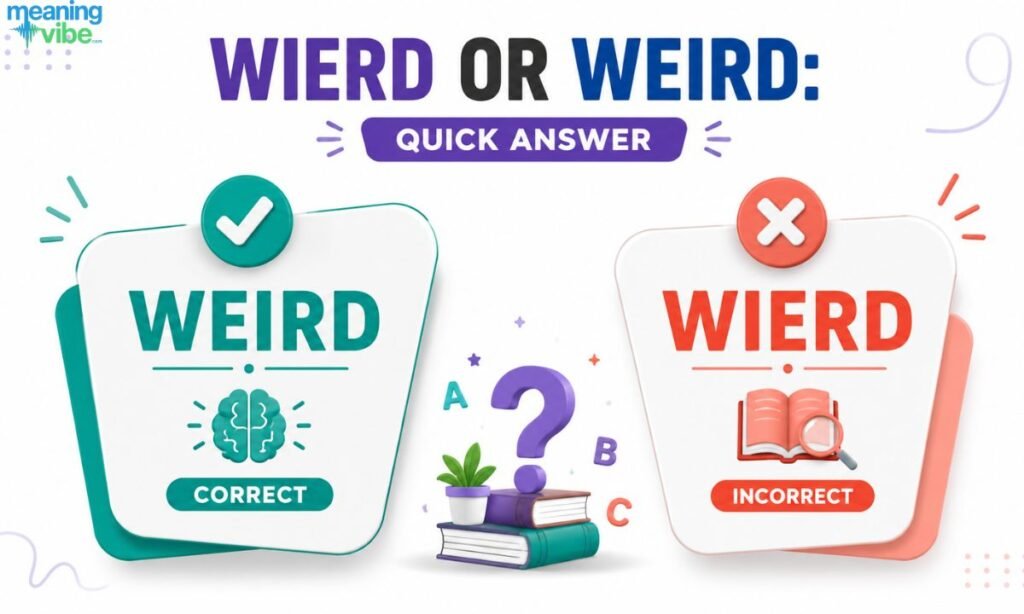
The correct spelling is weird, with the “e” placed before the “i.” The version “wierd” is a spelling error and is not recognized as a real word in any English dictionary, whether British, American, or Australian.
Here is the short version for anyone in a hurry:
- Correct spelling: weird
- Incorrect spelling: wierd
- Word type: adjective (and sometimes a verb, as in “weirded out”)
- Meaning: strange, unusual, or hard to explain
- Regional difference: none, the spelling is identical worldwide
Wierd or Weird Synonym
Once you have the spelling locked in, it helps to know words you can swap in for variety, especially in writing where “weird” gets repeated too often. Common synonyms include:
- Strange
- Odd
- Unusual
- Peculiar
- Bizarre
- Eerie
- Uncanny
- Quirky
- Curious
- Off beat
Each of these carries a slightly different shade of meaning. “Eerie” and “uncanny” lean toward something spooky or unsettling, while “quirky” and “off beat” suggest something charmingly different rather than alarming.
Wierd or Weird Examples
Seeing the word in context makes the correct spelling easier to remember. Below are natural sentence examples using “weird” correctly:
- That noise coming from the attic sounds weird.
- It felt weird walking into the office after two weeks away.
- She gave me a weird look when I mentioned the plan.
- The weather has been weird all week, sunny one hour and pouring the next.
- His explanation was weird, but it actually made sense in the end.
Notice that “weird” almost always sits right before the noun it describes, functioning as a standard adjective.
Wierd or Weird Spelled
People often ask specifically how the word is spelled because the pronunciation does not offer many clues. Phonetically, “weird” sounds like “weerd,” which does nothing to hint at the correct letter order.
The spelling is fixed as w e i r d, five letters, with no accepted variant. There is no British versus American difference here, unlike words such as “colour” and “color.” Every major dictionary, including Merriam Webster, Cambridge, and Oxford, lists only one spelling.
Also Read This: Modeling or Modelling: Correct Spelling, Meaning & Examples (2026)
Wierd or Weird in English
In everyday English, “weird” is an extremely common descriptive word used in casual conversation, writing, journalism, and even academic contexts when describing unusual phenomena. It appears constantly in spoken English, social media captions, product reviews, and storytelling.
Because it is used so often, small spelling slips like “wierd” tend to show up frequently in text messages, emails, and quick online posts, particularly from people typing fast or relying on muscle memory from the “i before e” rule.
Wierd or Weird Meaning
“Weird” is an adjective that describes something strange, unusual, surprising, or difficult to explain using normal logic. It can also describe something with a supernatural or eerie quality. A few core meanings include:
- Strange or unusual: “That was a weird coincidence.”
- Suggesting something supernatural or uncanny: “The house had a weird atmosphere at night.”
- As a verb (informal), meaning to make someone feel uneasy: “The silence weirded me out.”
There is also an older, mostly archaic noun form referring to fate or destiny, which connects directly to the word’s origin below.
The Origin of Weird
The history of “weird” explains why its spelling refuses to follow normal rules. The word traces back to the Old English term wyrd, meaning fate, chance, or destiny. In early English literature, wyrd was tied to the idea of a controlling, almost supernatural force that shaped human events.
The word gained lasting cultural attention through William Shakespeare’s Macbeth, where the “Weird Sisters” (the three witches) were named using this very concept of fate and prophecy.
Over the following centuries, spelling shifted through Middle English variations until it settled into the modern form “weird” by around the 15th century. As the spelling changed, the meaning gradually expanded from “connected to fate” to the broader modern sense of “strange or unusual” that we use today.
This unusual linguistic path is exactly why “weird” does not follow the typical “i before e” pattern that governs so many other English words.
British English vs American English Spelling
Many spelling debates in English come down to regional differences, but “weird” is not one of them. Whether you are writing for a British, American, Canadian, or Australian audience, the spelling remains exactly the same.
| Spelling Feature | British English | American English |
| Correct spelling | weird | weird |
| Regional variation | None | None |
| Pronunciation | /wɪəd/ | /wɪrd/ |
| Common misspelling | wierd | wierd |
This consistency makes “weird” easier to remember once you know it, since you do not need to adjust the spelling depending on your audience or publication style guide.
Which Spelling Should You Use?
Always use weird. There is no context, formal or informal, academic or casual, in which “wierd” is considered acceptable. If you are writing:
- An email or text message: use weird
- A school essay or academic paper: use weird
- A blog post or article: use weird
- A resume or professional document: use weird
- Social media content: use weird
Since “wierd” carries no separate meaning and is not listed in dictionaries, there is genuinely no situation where choosing it over “weird” is correct.
Common Mistakes with Wierd or Weird
Understanding why this mistake happens can help you avoid it permanently. Common causes include:
- The “i before e” rule. Many people learned the rhyme “i before e, except after c,” which works for words like believe, chief, and piece. “Weird” is a well known exception, yet the rule still influences muscle memory.
- Fast typing. Autocorrect sometimes catches the error, but not always, especially on mobile keyboards where predictive text can occasionally reinforce the wrong spelling if used carelessly.
- Pronunciation mismatch. The way “weird” sounds does not clearly signal which vowel comes first, unlike more phonetic English words.
- Learned habit. If someone has spelled it incorrectly for years without correction, the wrong version can start to feel more familiar than the correct one.
A simple memory trick that many writers use: remember the phrase “weird is a weird word,” which visually reinforces the correct e-then-i pattern every time you recall it.
Wierd or Weird in Everyday Examples
Here are more real world style examples showing correct usage across different tones and settings:
- Casual text: “lol that dream was so weird”
- Professional email: “The client gave some weird feedback that we should discuss before the next meeting.”
- Creative writing: “A weird silence settled over the town just before the storm hit.”
- Review: “The pricing structure felt weird compared to competitors, but the product itself worked well.”
- Conversation: “Isn’t it weird how time feels slower on Mondays?”
Across every one of these contexts, the spelling never changes, only the tone of the sentence does.
Wierd or Weird: Google Trends & Usage Data
Search interest in “wierd or weird” and related misspelling queries stays consistently high year round, which reflects just how widespread this particular error is among English learners and native speakers alike.
Spelling checkers and grammar tools consistently flag “wierd” as one of the top misspelled English words, largely because it breaks such a well known rule. This steady search demand shows that confusion around this word is not fading, making a clear, reliable reference genuinely useful for students, professionals, content writers, and English learners worldwide.
Spelling Comparison Table
| Feature | Weird (Correct) | Wierd (Incorrect) |
| Recognized in dictionaries | Yes | No |
| Follows “i before e” rule | No, it is an exception | Would follow the rule, but is still wrong |
| Word origin | Old English “wyrd” | Not applicable |
| Acceptable in formal writing | Yes | No |
| Acceptable in casual writing | Yes | No |
| Used by Shakespeare (Weird Sisters) | Yes | No |
Conclusion
The debate between “wierd or weird” really has a simple resolution: weird is always correct, and wierd is always a mistake. The confusion makes sense given how strongly the “i before e” rule is taught, but “weird” remains one of English’s most famous exceptions.
Now that you understand its meaning, origin, and correct usage across every context, from casual texts to formal writing, you can spell it confidently every single time. The next time your fingers want to type “wierd,” just remember that the spelling of weird is, fittingly, a little weird itself.