

You’re typing a review, a caption, or a work email, and you pause on one tiny word. Is it pricy or pricey? Both look plausible. Both sound identical out loud. And that split-second hesitation is exactly why so many people search for this word every single day.
The short version: pricey is the correct, standard spelling. Pricy isn’t a made-up word, but it’s a rare variant that most dictionaries, editors, and style guides don’t recommend.
This guide breaks down the meaning, the origin, the British vs. American usage question, and the small mistakes that trip up even confident writers — so you never have to second-guess this word again.
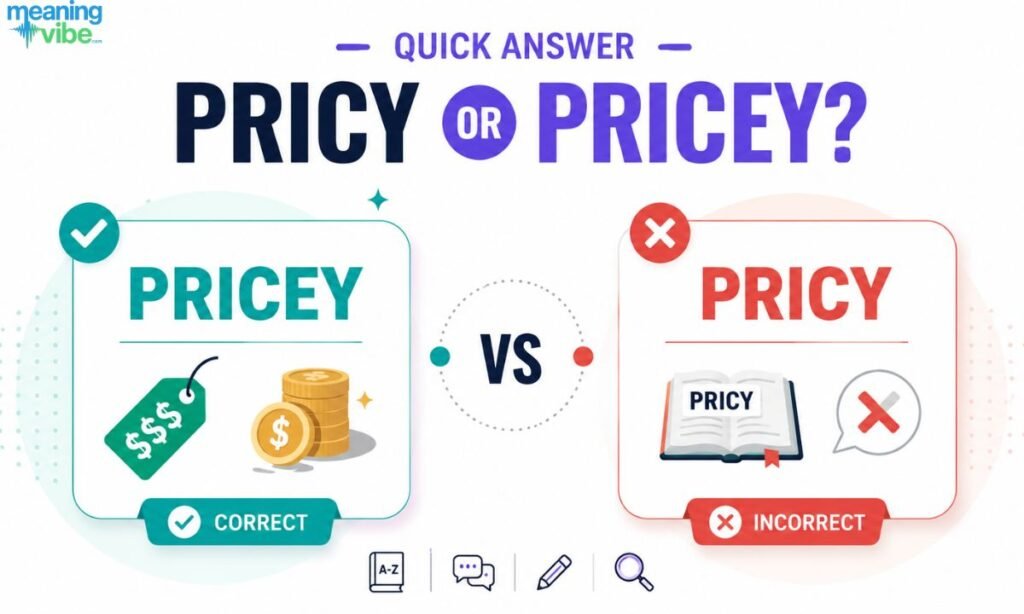
Quick Answer: Pricy or Pricey?
| Question | Answer |
| Which spelling is correct? | Pricey |
| Is “pricy” a real word? | Yes, but it’s a rare, less accepted variant |
| Does meaning change between the two? | No — both mean “expensive” |
| Is this a British vs. American spelling issue? | No, both regions prefer pricey |
| Safe choice for formal writing? | Use pricey, or “expensive” for very formal contexts |
If you remember nothing else from this article, remember this: when in doubt, write pricey.
Pricy or Pricey Meaning
Both words describe something that costs a lot of money — often more than you’d expect to pay. As an adjective, pricey means expensive, costly, or overpriced relative to what you were hoping to spend.
It’s a subjective word. What feels pricey to one person might feel perfectly reasonable to someone else, since it depends on personal budget, expectations, and context rather than a fixed price point.
Examples:
- That handbag is gorgeous, but it’s a bit pricey for my budget.
- Renting downtown has gotten pricier every year.
- The tasting menu was pricey, though every course was worth it.
Notice that pricey often carries a slightly softer, more conversational tone than “expensive.” Saying something is pricey feels like a personal reaction, while “expensive” sounds more neutral and factual.
Pricy or Pricey: UK Usage
Here’s something that surprises a lot of people: this isn’t a regional spelling split like color vs. colour or organize vs. organise. In UK English, pricey is also the preferred and standard form. British dictionaries, newspapers, and style guides consistently favor it over pricy.
So whether you’re writing for a British, American, Canadian, or Australian audience, the safe, universally accepted choice stays the same: pricey.
Pricy or Pricey: iPhone and Product Reviews
This word shows up constantly in tech and shopping content — “Is the new iPhone too pricey?” or “This laptop is pricier than last year’s model.” In product reviews, tech blogs, and comparison articles, pricey is the spelling used almost universally, since it’s what readers expect and what search engines associate with correct, trustworthy content.
If you’re writing reviews, listicles, or comparison content around gadgets, subscriptions, or big-ticket purchases, stick with pricey — it reads as more professional and polished.
Quick Quiz: Spot the Correct Spelling
Test yourself before reading on. Which word fits each sentence?
- That new phone looks amazing, but it’s way too ______ for my budget.
- City-center apartments are getting ______ every single year.
- The tasting menu was ______, but every bite justified the bill.
- Designer sneakers can be surprisingly ______.
Answer: All four should use pricey.
The Origin of Pricy/Pricey
Both spellings trace back to the noun price, with the adjective-forming suffix -y attached to mean “having the quality of.” That part is simple. The confusing part is the spelling rule that follows.
In English, when you add -y to a word that ends in a silent e, that e is usually dropped — think ice → icy, or spice → spicy. Following that same logic, price would logically become pricy.
But language doesn’t always follow logic perfectly. Over time, pricey became the dominant, widely accepted spelling instead — likely because keeping the e helps preserve the correct pronunciation and avoids visual confusion with words like “tricky.” A similar pattern shows up with dicey, which is preferred over the technically-logical dicy.
Both forms appeared in written English decades ago, but usage data, dictionaries, and edited publications have overwhelmingly settled on pricey as the modern standard.
British English vs. American English
Given how many word pairs differ between British and American spelling, it’s natural to assume this is one of them. It isn’t.
| Word Pair | Differs by Region? | Notes |
| Color / Colour | Yes | US vs. UK spelling rule |
| Organize / Organise | Yes | US vs. UK spelling rule |
| Pricy / Pricey | No | Both regions prefer pricey |
Both American and British dictionaries list pricey as the primary form and pricy as a secondary or “less common” variant. So you don’t need to adjust your spelling based on your audience’s location — pricey works everywhere.
Which Spelling Should You Use?
In almost every writing situation, pricey is the smarter choice. Here’s a simple breakdown of when each form fits:
- Everyday and casual writing (texts, social captions, blog posts): Use pricey — it reads naturally and is instantly recognizable.
- Business and marketing content (emails, product descriptions, reviews): Use pricey — it’s professional enough while staying conversational.
- Formal or academic writing (essays, reports, research papers): Skip both and use expensive, costly, or high-priced instead, since pricey can feel slightly informal in strict academic contexts.
- Branding or stylistic choice: Only use pricy if a specific style guide or brand voice intentionally calls for it.
As a rule of thumb: if you can see the full word “price” sitting inside the spelling, you’ve got it right — pricey.
Common Mistakes with Pricy or Pricey
Even careful writers slip up here. Some of the most frequent errors include:
- Dropping the “e” out of habit — because words like spicy and icy drop it, writers assume price should too.
- Typing too fast and not noticing the missing letter until after publishing.
- Assuming both spellings are equally correct in formal writing, when only pricey is broadly accepted.
- Using “pricy” in professional emails or reports, which can subtly reduce credibility with careful readers.
- Confusing tone, using pricey in a strict legal or academic document where expensive would sound more appropriate.
A simple fix: before submitting any important document, search for “pricy” and replace it with “pricey” if it appears.
Pricy or Pricey in Everyday Examples
Seeing the word in context makes the correct usage stick. Here are natural, everyday sentences using pricey:
- The new smartphone is quite pricey this year, but the camera upgrade is impressive.
- We skipped that restaurant because the menu looked too pricey for a casual dinner.
- Good running shoes can be pricey, but they tend to last much longer.
- That neighborhood is lovely, though housing there is notoriously pricey.
- Flights during the holidays are always pricier than usual.
- The software felt pricey at first, but it saved the team hours every week.
Pricy or Pricey in Trends and Popular Usage
Search data and everyday usage both tell the same story: pricey dominates. It appears far more often in news articles, product reviews, marketing copy, and social media captions than pricy ever does. Major dictionaries — including Merriam-Webster and Cambridge — list pricey as the headword, with pricy noted only as a lesser-used variant.
This matters beyond grammar. Content that consistently uses the correct, expected spelling tends to read as more polished and trustworthy — a small detail that quietly reinforces credibility with readers.
Comparison Table: Pricy vs. Pricey
| Feature | Pricey | Pricy |
| Spelling status | Standard, widely accepted | Variant, rarely used |
| Meaning | Expensive, costly | Same meaning |
| Regional preference | Preferred in US and UK English | No regional advantage |
| Formal writing | Acceptable in semi-formal use | Best avoided |
| Dictionary listing | Primary entry | Listed as “another spelling of pricey” |
| Reader perception | Polished, professional | Can look like a typo |
| Recommended use | Everyday and business writing | Only for intentional style choices |
Reference: Cambridge Dictionary Definition
According to the Cambridge Dictionary, <cite index=”10-1″>”pricey” is defined simply as expensive</cite>, and Cambridge lists <cite index=”12-1″>”pricy” as “another spelling of pricey”</cite> rather than a separate word. This confirms what usage data already shows: the two words share an identical meaning, but only one is treated as the primary, dictionary-preferred spelling.
Merriam-Webster follows the same pattern, listing pricey as the main entry <cite index=”19-1″>with “pricy” noted as a less common variant</cite>.
Conclusion
The debate between pricy and pricey isn’t really a debate at all — it’s a spelling preference that English has already settled. Both words mean the same thing: expensive, or costing more than expected. But pricey is the version dictionaries recommend, publications use, and readers expect to see.
If you want your writing — whether it’s a product review, a business email, or a casual caption — to look polished and error-free, make pricey your default. Save pricy for the rare occasion a specific style guide asks for it, and reach for expensive or costly when you need something more formal.
Next time your fingers hesitate over the keyboard, you won’t need to guess. Just type “price,” add the “y,” and keep writing with confidence.