

Moral vs morale is a one letter difference with a stress shift hiding inside it: the word about right and wrong is not the word about team spirit, and English marks the border with an extra e and a moved accent.
Here is the whole distinction in one breath. Moral judges and teaches: it concerns right and wrong, and as a noun it is the lesson of a story. Morale measures: it is the confidence, enthusiasm, and spirit of a person or group.
Say them and the spelling explains itself. Moral stresses the first syllable, MOR-al, rhyming with coral. Morale stresses the second, mor-AL, rhyming with corral. The e is not silent decoration; it pulls the stress to the end of the word.
This guide gives you the three step stress shift test, the four way family sorted in one table (moral, morals, morality, morale), the bridge phrase where the two words nearly touch, and the five errors that give writers away.
Moral vs Morale at a Glance
|
Word |
Spelling Cue |
Stress |
Grammar Role |
Core Meaning |
|---|---|---|---|---|
|
Moral |
No final e |
MOR-al, rhymes with coral |
Adjective; noun |
Right and wrong; a lesson; principles |
|
Morale |
Extra final e |
Mor-AL, rhymes with corral |
Noun only |
Confidence and spirit of a group |
Read the table as one fact stated four ways. The e, the stress, the grammar, and the meaning always move together, so any single check settles the word.
It is the same species of trap as the near identical pair in our guide to discrete vs discreet and the one letter swap in our guide to complement vs compliment: two real words, a small visible difference, and a test as the only referee worth trusting.
The Stress Shift Test
Step One: Say It
Speak the sentence and find the stress. Stress on the first syllable, MOR-al, and the word is moral. Stress on the second, mor-AL, and the word is morale.
The rhyme anchors are a gift, because they are themselves a confusable pair: moral rhymes with coral, the reef; morale rhymes with corral, the pen that rounds up horses. Learn the rhymes and the stress never needs memorizing.
Step Two: Substitute It
Replace the word with ethical or lesson. If the sentence survives, the word is moral: a moral duty becomes an ethical duty; the moral of the story becomes the lesson of the story.
Replace it with team spirit or confidence. If that survives, the word is morale: the win lifted morale becomes the win lifted team spirit, intact. Grammarly’s guide to morale vs moral builds its whole ruling on this substitution, and it is the right instinct.
Step Three: Check the E
When spelling is the only question left, use the letter itself. Morale is the word with the extra e, and Merriam-Webster’s usage guide to moral and morale gives the reason to remember: morale expresses enthusiasm, which begins with e.
The ethics word needs no such hook, because it travels with its own family: moral, morals, morality, none of them ending in e. If the sentence is about energy, the e is present. If it is about ethics, it is not.
Why the E Exists: The French Respelling
Morale was borrowed from French in the early nineteenth century, in the French word’s military sense: the shared pride and confidence of a body of troops, what French calls esprit de corps.
English speakers respelled the word, adding the final e to preserve the French stress on the last syllable.
The e is a pronunciation instruction disguised as a letter, which is why the stress test and the spelling test in this guide are really the same test read twice.
The sound deciding the sense is a pattern this cluster meets often: the pair in our guide to elicit vs illicit turns on one letter and one sound in exactly the same way.
Moral: The Word That Judges and Teaches
The Adjective: Right and Wrong
As an adjective, moral describes anything concerned with right and wrong, or conforming to accepted standards of conduct. Its home nouns are the furniture of ethical life.
- Moral duty, moral obligation: what conscience requires, whether or not law does.
- Moral dilemma: a choice between two courses, each with a cost in principle.
- Moral values, moral standards, moral code: the rules a person or society actually lives by.
- Moral compass: the inner sense that steers judgment, pictured as an instrument.
- Moral high ground: the ethically superior position in a dispute.
Notice that every phrase judges something. That is the adjective’s whole job, and it is why none of these phrases can take morale: a morale dilemma would be a crisis of confidence, which English expresses in entirely different words.
The Lesson Noun: The Moral of the Story
As a singular noun, a moral is the lesson a story, fable, or experience teaches about conduct: the moral of the tortoise and the hare is that slow and steady wins.
This is one of the oldest jobs in the family, and the phrase is fixed. Stories carry morals; they do not carry morale, because a story has no confidence to measure. The error form, morale of the story, simply swaps in the wrong sibling.
Morals: The Principles, Plural
In the plural, the noun changes jobs. Morals are a person’s or society’s principles of right conduct: her morals would not let her cheat; the scandal raised questions about his morals.
Keep the two noun uses apart by number: one moral is a lesson extracted from a tale; morals are the standing rules a life is run by. Writers who feel the difference stop confusing both with morale at the same time.
Morality: The System Around Them
Morality is the whole framework: the system of right and wrong within which morals sit and moral judgments operate. Public morality, the morality of the decision, questions of morality.
A useful sorting sentence: morality is the system, morals are its rules as one person holds them, a moral is one lesson drawn from a single tale, and the adjective moral describes anything the system touches.
Four forms, four altitudes, one territory, and morale is in none of them.
Moralize: The Verb Relative With a Reputation
Moral itself is never a verb. Its verb relative is moralize: to deliver moral opinions or lessons, almost always with a disapproving flavor, as usage writers note when they define it.
He moralized at the children about waste is a criticism, not a compliment. Knowing the verb exists matters for one reason: it proves moral’s family handles action through a derivative, while morale, a pure noun, has no verb at all.
Morale: The Word That Measures Spirit
What Morale Measures
Morale is the confidence, enthusiasm, and discipline of a person or group at a particular time, especially in the face of a task or hardship.
Merriam-Webster’s entry for morale and Cambridge Dictionary’s entry for morale define it in near identical terms, and the agreement is the definition’s strength.
Three ingredients recur in every serious definition: confidence (we can do this), enthusiasm (we want to do this), and cohesion (we are doing it together).
A group can be strong in one and weak in another, which is why morale is reported as a level, high or low, rather than a possession.
The Verb Company Morale Keeps
Morale is known by the verbs that govern it, and collecting them is the practical heart of this section.
- Raise it: boost morale, raise morale, lift morale, improve morale, build morale, restore morale.
- Report it: morale is high, morale is low, morale soared, morale sank.
- Damage it: hurt morale, damage morale, crush morale, destroy morale, morale plummeted.
If your sentence contains one of these verbs, the noun it wants is morale with the e, every time. The collocations are so fixed that they function as a spelling test in their own right.
Morale’s Territories
The word was born among troops, and troop morale remains its most quoted setting. From the military it spread to sports teams, whose morale rises and falls with results in every match report.
Its largest modern territory is the workplace: employee morale, staff morale, morale surveys, morale boosters. Classrooms and hospitals follow: teacher morale, nursing morale. Any group with a shared task and a measurable spirit qualifies; the settings rotate, the word does not.
The Uncountable Rule
Morale is uncountable. Morale is high and morale is low, but there is no plural: morales does not exist in this sense.
Run the rule in reverse and it becomes a decision tool. If your sentence needs a plural noun, the word you want is morals, the principles. Plural means principles; singular and uncountable means spirit. The grammar settles what the spelling leaves open.
The Four Way Family in One Table
|
Form |
Role |
What It Names |
Example |
|---|---|---|---|
|
Moral |
Adjective |
Ethical, concerning right and wrong |
A moral duty |
|
Moral |
Noun, singular |
The lesson of a story |
The moral is honesty pays |
|
Morals |
Noun, plural |
A person’s principles |
Her morals forbade it |
|
Morality |
Noun |
The system of right and wrong |
Questions of morality |
|
Morale |
Noun, uncountable |
A group’s confidence and spirit |
Team morale soared |
Read down the example column and the family’s map draws itself: four forms share the ethics territory at different altitudes, and one form, the one with the e and the end stress, lives in a different country altogether.
Role sorting of this kind is the house pattern of this cluster: the direction pair in our guide to imply vs infer splits two verbs by who performs them, speaker or listener.
This family splits by what is being named: a judgment, a lesson, a rule set, a system, or a spirit.
Moral Support: The Bridge Phrase
One phrase crosses the border, and it is the most instructive phrase in the whole topic. Moral support means encouragement: emotional backing that helps someone persist, with no material help attached.
Cheering a friend through a marathon, sitting with a colleague before a hard meeting, writing the letter that says keep going: all moral support. The phrase is fixed with moral, never morale support, even though its meaning lives in morale’s neighborhood.
The Fossil of an Older Moral
The bridge has a historical explanation. Moral once carried emotional and mental senses it has since surrendered, and moral support survives from that era: the moral in it means something close to psychological.
Hold that fact and the phrase stops looking like an exception. It is a fossil, a preserved piece of the word’s older range, and fossils are not required to obey the modern border.
Both Words in One Sentence
The phrase also produces the pair’s perfect teaching sentence: you give moral support to raise someone’s morale.
Support given is moral; spirit raised is morale. One sentence, both words, each in its only correct home. A writer who can produce that sentence on demand has finished learning this pair.
Neighbors Worth One Paragraph Each
Immoral Against Amoral
Immoral means against the rules: knowingly violating accepted standards. Amoral means outside the system: lacking a moral sense or indifferent to right and wrong.
A fraudster is immoral; a tornado is amoral. Both words grow from moral, both belong to the ethics territory, and neither touches morale.
Morale Against Motivation
Workplace writing needs this line drawn. Morale is the collective emotional state: confidence and spirit toward the group and its task. Motivation is the drive to act, often individual and tied to a goal or reward.
A team can be motivated by a bonus while its morale is low from distrust. The distinction is an expert beat precisely because the words are used as synonyms by writers who should know better.
Moral Against Ethical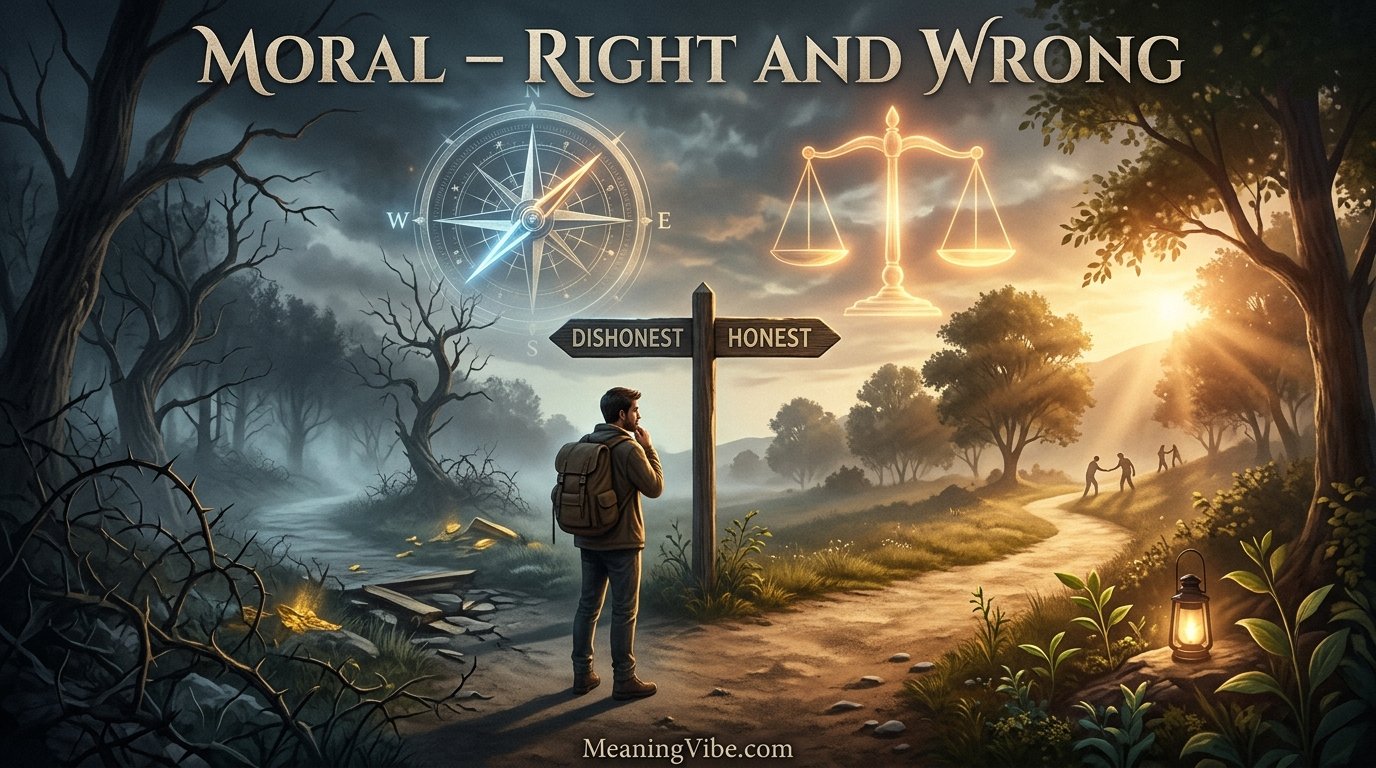
Inside moral’s own territory, careful usage separates the twins: morals are personal principles (my morals forbid it), ethics are external codes (medical ethics, professional ethics). Everyday writing treats them as near synonyms, and dictionaries define one with the other.
The boundary matters here for one reason only: neither word, in any of its forms, ever does morale’s spirit work. The feeling vocabulary sorted in our guide to empathy vs sympathy observes the same discipline: close words, separate jobs, no borrowing across the line.
When the Words Traded Jobs: The Historical Swap
Here is the strangest fact in the pair’s history, and the most forgiving. The two words have not always held their current posts.
ThoughtCo, citing the Oxford English Dictionary, reports that morale once meant the morals or morality of a person or group, while moral was sometimes used for a mental or emotional state. Neither usage survives as standard today.
The words effectively traded territories and then settled, leaving moral support behind as evidence of the older arrangement. A confusion with this pedigree is not carelessness; it is an old border dispute, and the modern map in this guide is the settled treaty.
Worked Examples: Five Sentences Decided
1. The announcement steadied the nurses’ ___ before the winter surge. Morale. A group’s steadiness under pressure is spirit, measured by the e word. The stress agrees: mor-AL.
2. The committee faced a ___ question, not a legal one. Moral. The sentence sorts questions by the standard they answer to, and the standard here is right and wrong, not statute.
3. Every fable in the book ends with the ___ stated in one line. Moral. The lesson slot at the end of a tale is the singular noun’s oldest address in the language.
4. Two defeats did nothing for the squad’s ___, and the coach knew it. Morale. Sports pages write this sentence weekly, and the word in the wild is always the spirit noun with its verb company doing the damage.
5. She offered ___ support, not money, and it was enough. Moral. The bridge phrase keeps its fossil spelling; the sentence is about encouragement given, not a state measured.
Read the five verdicts together and the pattern is plain: wherever a standard judges, moral; wherever a spirit is measured, morale. The sentences decide themselves once the question is asked in the right order.
Common Mistakes and Corrections
1. Moral booster. “The away win was a real moral booster for the squad.” The error Merriam-Webster itself flags: the writer did not know morale has its own spelling. Correction: morale booster. Spirit takes the e word.
2. Morale of the story. “The morale of the story is to share.” Stories teach lessons, and lessons are morals. Correction: the moral of the story. Teams have morale; tales have morals.
3. Team moral is low. “After the layoffs, team moral is low.” A group’s sagging confidence is its morale. Correction: team morale is low. The same fix covers employee moral, staff moral, and classroom moral.
4. Morale support. “Thanks for the morale support during the move.” The fixed phrase kept the ethics word centuries ago and never changed. Correction: moral support. You give moral support to raise morale.
5. Morale high ground. “The senator claimed the morale high ground.” The high ground in this idiom is ethical territory, judged before an audience. Correction: the moral high ground. If the phrase judges conduct, moral holds it.
The discipline behind all five corrections is the same one that runs through our guide to fewer vs less and our guide to farther vs further: a small test, applied once, instead of a list of phrases memorized one by one.
Its companion cases live in our guide to precede vs proceed and our guide to stationary vs stationery, where a single letter likewise decides whether the sentence means what its writer intended.
Practice: Ten Sentences
Choose moral, morals, or morale for each sentence. The key follows, with the reasoning compressed to the test.
1. The victory lifted the team’s ___ before the final.
2. The ___ of the fable is that honesty pays.
3. She faced a ___ dilemma about reporting the error.
4. After the announcement, staff ___ sank across the office.
5. His ___ would not allow him to take the bribe.
6. Friends offered ___ support through the whole trial.
7. The coach’s speech was a genuine ___ booster.
8. They claimed the ___ high ground in the debate.
9. Questions of ___ belong in a philosophy seminar.
10. You give ___ support to raise a friend’s ___.
Key: 1 morale (team spirit). 2 moral (the lesson). 3 moral (the adjective of ethics). 4 morale (a group’s state). 5 morals (his principles, plural).
Key, continued: 6 moral (the fixed phrase). 7 morale (booster takes the spirit word). 8 moral (ethical territory). 9 morality (the system). 10 moral, morale (the bridge sentence).
Score it honestly: the misses cluster on sentences 5, 6, and 10, the plural and the bridge. Those are the two places the family table and the bridge section exist to serve.
The 30 Second Decision Card
Say it. Stress first, rhymes with coral: moral. Stress last, rhymes with corral: morale.
Substitute it. Ethical or lesson fits: moral. Team spirit or confidence fits: morale.
Check the e. Enthusiasm begins with e, and so does the spirit word’s extra letter.
Plural check. Needs a plural? Morals, the principles. Morale never pluralizes.
Four checks, thirty seconds, and the pair is settled for good. What deserves one more minute is the bridge phrase, because moral support is the exception that proves the history.
Keep the card beside the family table and the two cover nearly every sentence the pair will ever appear in. The remaining cases are names and fossils, and this guide has flagged each one where it lives.
Frequently Asked Questions
What is the difference between moral and morale?
Meaning, grammar, and sound. Moral concerns right and wrong: an adjective meaning ethical, and a noun meaning a story’s lesson or, as morals, a person’s principles.
Morale is a noun only: the confidence and spirit of a group. Moral stresses its first syllable; morale stresses its second.
How do you remember moral vs morale?
Two hooks work. Sound: moral stresses the first syllable and rhymes with coral; morale stresses the second and rhymes with corral.
Spelling: morale carries the extra e, and it expresses enthusiasm, which begins with e. Grammar Girl’s version: say mo-RALLY and picture a rally lifting the group.
Is it team morale or team moral?
Team morale. A team’s confidence, spirit, and enthusiasm are morale, the group state noun.
Team moral would claim the team is ethical, a different sentence and usually not the intended one. The same ruling covers employee morale, staff morale, troop morale, and classroom morale.
Is it moral of the story or morale of the story?
The moral of the story. The lesson a story teaches is the noun moral, one of its oldest jobs: the fable’s moral is that honesty pays.
Morale of the story swaps in the spirit word where no group’s confidence exists. Stories carry morals; teams carry morale.
What does moral mean?
Two jobs. As an adjective, moral means concerned with right and wrong or conforming to ethical standards: a moral obligation, moral values.
As a noun, a moral is a story’s lesson, and morals, plural, are a person’s principles. The stress falls on the first syllable: MOR-al.
What does morale mean?
Morale is a noun: the confidence, enthusiasm, and discipline of a person or group at a particular time, especially under pressure.
It came from French and keeps its final syllable stress, mor-AL. It has no plural and no adjective form; English uses moral where those jobs are needed.
How do you pronounce moral and morale?
With the stress in different places, the fastest ear test in the pair. Moral is MOR-al, stress first, rhyming with coral.
Morale is mor-AL, stress second, rhyming with corral. The extra e is not decoration; it carries the French ending and pulls the stress with it.
Is morale a noun or an adjective?
Only a noun. Morale names a state, the spirit of a group, and never describes things directly: morale is high, never a morale victory.
That phrase is a moral victory, a different idiom. Where a sentence needs an adjective, English reaches for moral or a phrase like morale boosting.
Is it boost morale or boost moral?
Boost morale. Raising a group’s confidence is morale work: boost, raise, improve, or lift morale.
Boost moral is the exact error Merriam-Webster flags in its usage guide, made by writers who do not know morale has its own spelling. Morale booster is the fixed phrase.
What is a morale booster?
Anything that lifts a group’s confidence or spirit: a win, a respected leader’s visit, good news, rest, recognition.
Merriam-Webster defines it as something that enhances the morale among a group of people. A moral booster would improve ethics, a phrase English does not use.
What does moral support mean?
Encouragement: emotional or psychological backing that helps someone persist, without material help. Cheering a friend through a marathon is moral support.
It is the pair’s bridge phrase, where moral does spirit work from its older senses. The phrase is always moral support, never morale support.
What is the moral of a story?
The lesson the story teaches about conduct: slow and steady wins, honesty pays, pride goes before a fall. Fables exist to deliver morals, so the phrase is fixed.
One story carries one moral. A person’s morals, plural, are their standing principles, a related but different noun use.
What is the difference between moral and morals?
Number changes the noun’s job. A moral, singular, is a lesson drawn from a story or event.
Morals, plural, are a person’s or society’s principles of right conduct: her morals would not let her cheat. The adjective moral covers both territories, which is why the nouns need separating.
Moral vs morality: what is the difference?
Morality is the system; moral is the unit and the adjective. Morality names the whole framework of right and wrong.
Moral picks out one lesson, one principle, or describes one thing as ethical. A sound mnemonic: morality has no final e, and neither does moral; morale stands apart with its e.
What does low morale mean?
A group whose confidence, enthusiasm, and willingness have sagged: missed targets, complaints, disengagement.
Low morale is the standard workplace and military diagnosis, paired with high morale. Management writing names causes like poor communication and unrecognized work; the word itself simply reports the state.
How do you use morale in a sentence?
Put it where a group’s spirit is measured: the victory lifted the team’s morale; after the layoffs, morale fell sharply.
Notice its verb company: boost, raise, lift, improve, hurt, damage. If the sentence reports how a group feels about its task, morale is the noun waiting.
How do you use moral in a sentence?
As an adjective before ethics nouns: a moral duty to report the error; she faced a moral dilemma; he took the moral high ground.
As a noun in story talk: the moral of the fable is plain. As the plural in character talk: questions about his morals. Right and wrong in play means moral.
Are moral and morale homophones?
Not quite. They are near homophones: close enough to confuse in fast speech, distinct in careful speech by stress.
Moral stresses the first syllable, morale the second. Usage writers group them with the look alike, sound alike confusables rather than true homophones like their and there.
Where does the word morale come from?
From French. English borrowed French moral in its esprit de corps sense, a body of troops’ shared pride and confidence, in the early nineteenth century.
It was then respelled morale to preserve the French stress on the final syllable. Merriam-Webster notes the French root had also been spelled moral.
Did moral and morale ever swap meanings?
Remarkably, yes. ThoughtCo, citing the Oxford English Dictionary, reports that morale once meant the morals or morality of a group.
Meanwhile moral was sometimes used for a person’s mental or emotional state. Neither usage is standard today; moral support survives as a fossil of the older arrangement.
What is a moral victory?
A defeat that feels like a win in principle: the team lost but proved its quality, so it claims a moral victory.
Moral here is figurative, a victory in judgment rather than on the scoreboard. A morale victory is not the phrase; English says the win boosted morale instead.
What does moral compass mean?
An inner sense guiding a person’s judgments of right and wrong, pictured as a navigational instrument: his moral compass never wavered.
It is among the most common moral collocations in news writing. Nobody has a morale compass, because morale is a state to measure, not a guide to steer by.
What is the difference between immoral and amoral?
A neighbor pair worth one answer. Immoral means violating accepted moral standards: knowingly wrong.
Amoral means lacking a moral sense or indifferent to right and wrong: outside the system rather than against it. A fraudster is immoral; a tornado is amoral. Neither touches morale.
Is it moral booster or morale booster?
Morale booster. The thing that lifts group spirit takes the spirit noun.
Merriam-Webster treats moral booster as the textbook example of this pair’s confusion, the error made when a writer does not know morale exists as its own spelling. Confidence and enthusiasm mean the e word carries it.
Can morale describe one person?
Yes, though groups are its home. Dictionaries define morale as the state of a person or group: her morale collapsed after the third rejection.
The individual use usually borrows the group frame of a soldier, athlete, or employee. Purely private moods more often take spirit, confidence, or mood.
Is there a plural of morale?
No. Morale is an uncountable noun: morale is high, morale is low, never morales are high.
Run it as a test in reverse: if your sentence needs a plural, you almost certainly want morals, the principles, or another noun entirely.
What are examples of high morale?
A team that trains eagerly after a loss, a unit that trusts its officers, a staff that volunteers ideas in meetings.
In sentences: morale soared after the announcement; the crew’s morale stayed high through the storm season. Confidence and enthusiasm are morale’s exact contents, e included.
What does it mean to take the moral high ground?
To claim the ethically superior position in a dispute: by refusing the bribe, she took the moral high ground.
The phrase uses moral because it judges conduct, not feelings. The morale high ground is not a phrase; ground in this idiom is ethical territory, and moral holds it.
Morale vs motivation: are they the same?
Close neighbors, different measures. Morale is the collective emotional state: confidence and spirit toward the group and its task.
Motivation is the drive to act, often individual and goal specific. A team can be motivated by a bonus while morale is low from distrust, which is why HR writing separates them.
What does esprit de corps mean?
The shared pride, loyalty, and confidence members feel for their group: literally, the spirit of the body.
It is the French phrase morale was borrowed to express, and dictionaries still use it to define morale’s core. It explains both the word’s military home and its group focus.
Is morale only a military word?
No, though the military is its English birthplace and most quoted setting, in troop morale.
It spread to sports teams, then to workplaces, where employee morale is now its most searched companion, then to classrooms and hospitals. Any group with a shared task and a measurable spirit can have morale.
What is moral development?
The growth of a person’s understanding of right and wrong, a standard term in psychology and education, tied to stage theories in textbooks.
It belongs to the moral family because it concerns ethical judgment forming over time. Development of morale would be a nonsense phrase, which confirms the adjective’s domain.
Why do people confuse moral and morale?
One letter, a shared root, and a pronunciation difference carried only by stress. Both descend from Latin moralis, and morale is moral’s French twin, respelled.
Writers who know one spelling use it for both jobs, producing moral booster and morale of the story. The words even traded meanings historically, making the confusion forgivable and fixable.
What is the fastest test to choose between moral and morale?
Two substitutions. Replace the word with ethical or lesson: if the sentence survives, it is moral.
Replace it with team spirit or confidence: if that survives, it is morale. When in doubt, listen for the stress: first syllable moral, second syllable morale.
Is moral support the same as morale?
Neighbors, not twins. Moral support is one person’s encouragement to another, a fixed phrase with moral.
Morale is a measurable state of a person or group. You give moral support to raise someone’s morale: both words in one sentence, each in its own job, the pair’s best teaching example.
What does loose morals mean?
A dated phrase meaning standards of conduct, especially sexual conduct, that the speaker judges lax.
It uses morals, the plural principles noun, and carries a judgmental tone modern writers usually avoid or quote deliberately. It proves morals, not morale, is the conduct word.
Employee morale or employee moral: which is correct in HR writing?
Employee morale, always. HR writing measures confidence, engagement, and spirit, which is morale’s exact definition, and the collocation is established across management English.
Employee moral appears only as an error. Sentences about how staff feel take morale; sentences about what staff believe is right take moral or morals.
What is the difference between moral and ethical?
A close synonym pair inside moral’s territory. In careful usage, morals are personal principles and ethics are external codes: professional ethics, medical ethics.
Everyday writing treats them as near synonyms, and dictionaries define moral with ethical freely. Neither word ever does morale’s spirit work.
Can moral be a verb?
No. Moral is an adjective and a noun. Its verb relative is moralize: to give moral opinions or lessons, usually with a disapproving flavor.
He moralized at the children about waste is a criticism. Morale, a pure noun, cannot be a verb either; if the sentence needs an action, neither word supplies it.
What does the moral high ground mean in politics?
The position of claimed ethical superiority in a public argument: the party seized the moral high ground on the scandal.
Political writing uses it because moral judges conduct before an audience. The phrase is a frequency anchor for learners: where high ground appears, the word is moral in every edited source.
What is a morale survey?
A workplace questionnaire measuring staff confidence, satisfaction, and spirit, used by HR teams to track the state morale names.
It shows morale in its professional habitat: a thing organizations measure and try to raise. A survey of ethics would be an ethics audit, a different instrument entirely.
Moral vs morale in one line: how do I decide?
Ask what the sentence measures. If it judges right from wrong, teaches a lesson, or names a principle, the word is moral: stress first, no final e.
If it measures confidence, spirit, or enthusiasm, the word is morale: stress last, extra e for enthusiasm. Ethics takes moral; energy takes morale.
Conclusion
The moral vs morale choice is a question about which world a sentence lives in: moral judges right from wrong and draws lessons from stories, while morale measures the confidence and spirit of the people doing the work.
Run the stress shift test, keep the family table in reach, and give moral support its fossil rights. The words traded jobs once in their history; in your writing, they never have to trade again.
The neighboring calls live throughout the MeaningVibe word pair library, where every pair gets the same treatment: a test first, the exceptions named, and no claim the evidence cannot carry.