

Elicit vs illicit confuses even careful writers because both words sound exactly alike in speech. One spelling means to draw something out, while the other describes something forbidden. Sound alone cannot tell you which spelling fits a sentence.
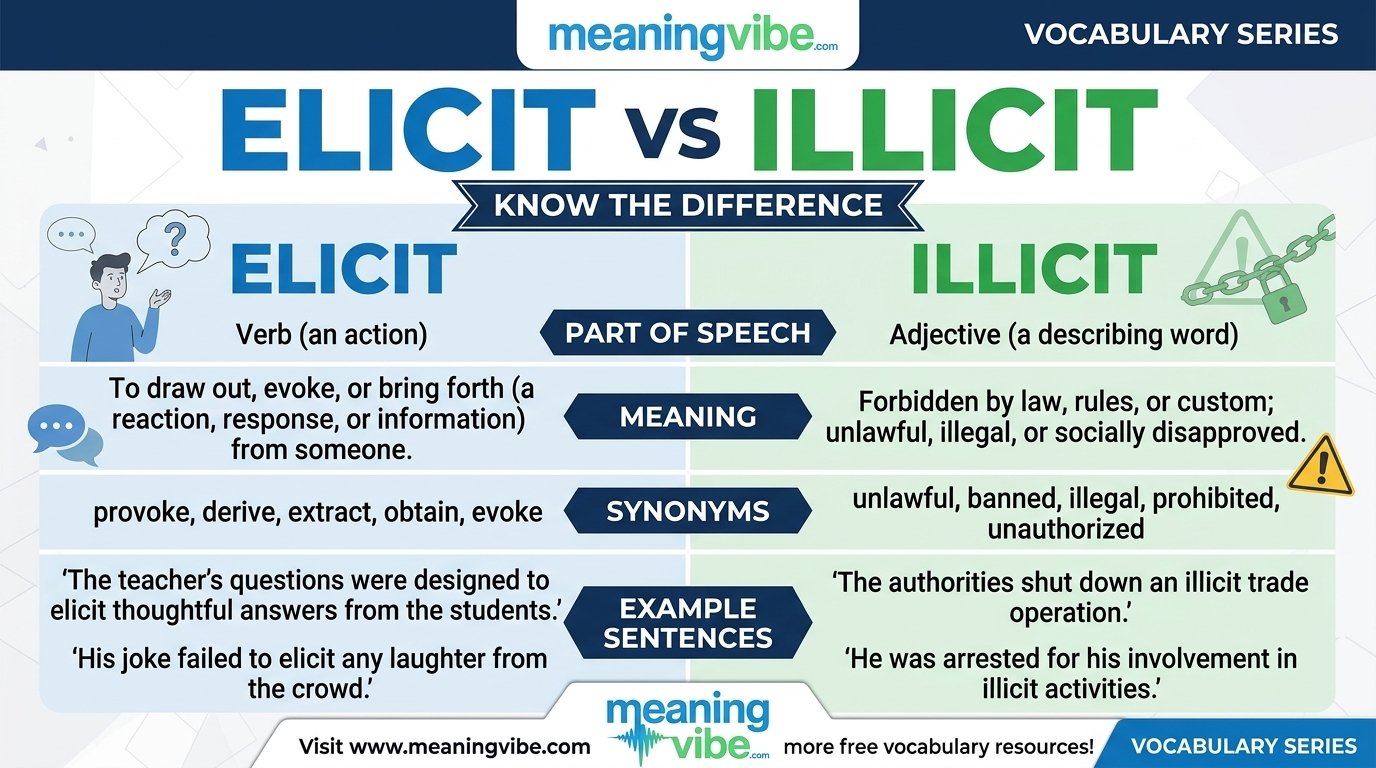
Part of speech decides the choice in almost every case you will meet. Elicit works as a verb, an action word that does something. Illicit works as an adjective, a describing word that modifies a noun.
Meaning follows grammar in this pair, and that link makes the test reliable. If the word performs an action, choose elicit. If the word describes a forbidden noun, choose illicit.
Spellcheck rarely saves a writer here because both spellings are real words. A sentence can look fluent while carrying the wrong meaning entirely. Reading for logic, not only for spelling, catches the error.
Formal writing raises the stakes for this small difference in spelling. Academic essays, business reports, legal notes, and news copy all suffer when a response becomes unlawful by accident. Precision protects credibility in each setting.
Table of Contents
ToggleThe Difference in One Line
Elicit draws out a response, answer, reaction, fact, or feeling from someone. Illicit describes a thing, activity, or relationship that is not permitted, especially because it is illegal.

One test covers most sentences without a dictionary check in the middle of drafting. Ask whether the word is doing something or describing something. Doing points to elicit, describing points to illicit.
Substitution sharpens the test when grammar feels unclear at first glance. Try replacing the word with draw out for elicit, or with illegal for illicit. Only one substitution will keep the sentence sensible.
Collocation adds a second check after the grammar test has done its work. Elicit naturally pairs with response, reaction, laughter, and feedback. Illicit naturally pairs with drugs, trade, goods, and affair.
Combined sentences prove that both words can appear together without confusion when roles stay clear. An interviewer can elicit information about illicit activities in one sentence. Each word keeps its own job there.
Why Sound Misleads Writers
Both words share the pronunciation /ɪˈlɪsɪt/ in careful American speech. Stress falls on the second syllable, and the vowel pattern stays identical. Hearing cannot separate them in isolation.
Rhyme partners confirm how close the sound really is for most speakers. Merriam-Webster notes that both words rhyme with explicit and complicit. Those rhymes help with sound, not with meaning.
Writing differs from speech because spelling carries meaning that sound cannot carry here. A listener hears one sound, while a reader sees two different words with different jobs. Writers must choose by role, not by ear.
Autocorrect adds risk when a writer types quickly and trusts the first suggestion. Autocorrect fixes misspellings, but it cannot know whether a response or a crime was intended. Human judgment must finish the job.
The Describing or Doing Test
Step one finds the target word and the words around it in the sentence. Underline the target word and read the whole clause, not only the word itself. Context reveals the job faster than memory alone.
Step two asks whether the word describes a noun directly before or after it. Phrases such as illicit trade and illicit funds describe nouns as forbidden. That describing job belongs to illicit every time.
Step three asks whether the word performs an action on an object. Phrases such as elicit laughter and elicit feedback show an action drawing something out. That action job belongs to elicit every time.
Step four tests a plain substitution in the same sentence structure. Replace the target with draw out and then with illegal. The substitution that preserves meaning reveals the correct spelling quickly.
Step five reads the finished sentence for logic, not only for grammar. A questionnaire cannot illicit feedback, because feedback is not unlawful. It can elicit feedback, because feedback is drawn out.
What Elicit Means
Elicit is a transitive verb meaning to get information, a response, or a reaction from someone. Merriam-Webster gives that sense first, with examples such as a questionnaire used to elicit feedback. Transitive means it takes an object, something drawn out.
A second sense broadens the verb beyond people and direct questions. Merriam-Webster also defines elicit as bringing out something latent or potential, such as positive change. A vaccine elicits an immune response in that broader sense.
Effort or skill often appears in careful dictionary notes about elicit. Careful questioning elicited the truth in one Merriam-Webster example, showing skill in drawing forth a response. Difficulty is common, but it is not required by the definition.
Formal register suits elicit better than casual speech in many contexts. Teachers, researchers, interviewers, lawyers, and journalists use elicit when describing responses drawn out through questions, tests, or stimuli. Everyday speech often prefers simpler verbs such as get or prompt.
Objects of elicit tell a reader what kind of response is involved. Common objects include response, reaction, laughter, applause, sympathy, support, confession, and information. Each object names something brought out, not something forbidden.
Elicit in Plain Language
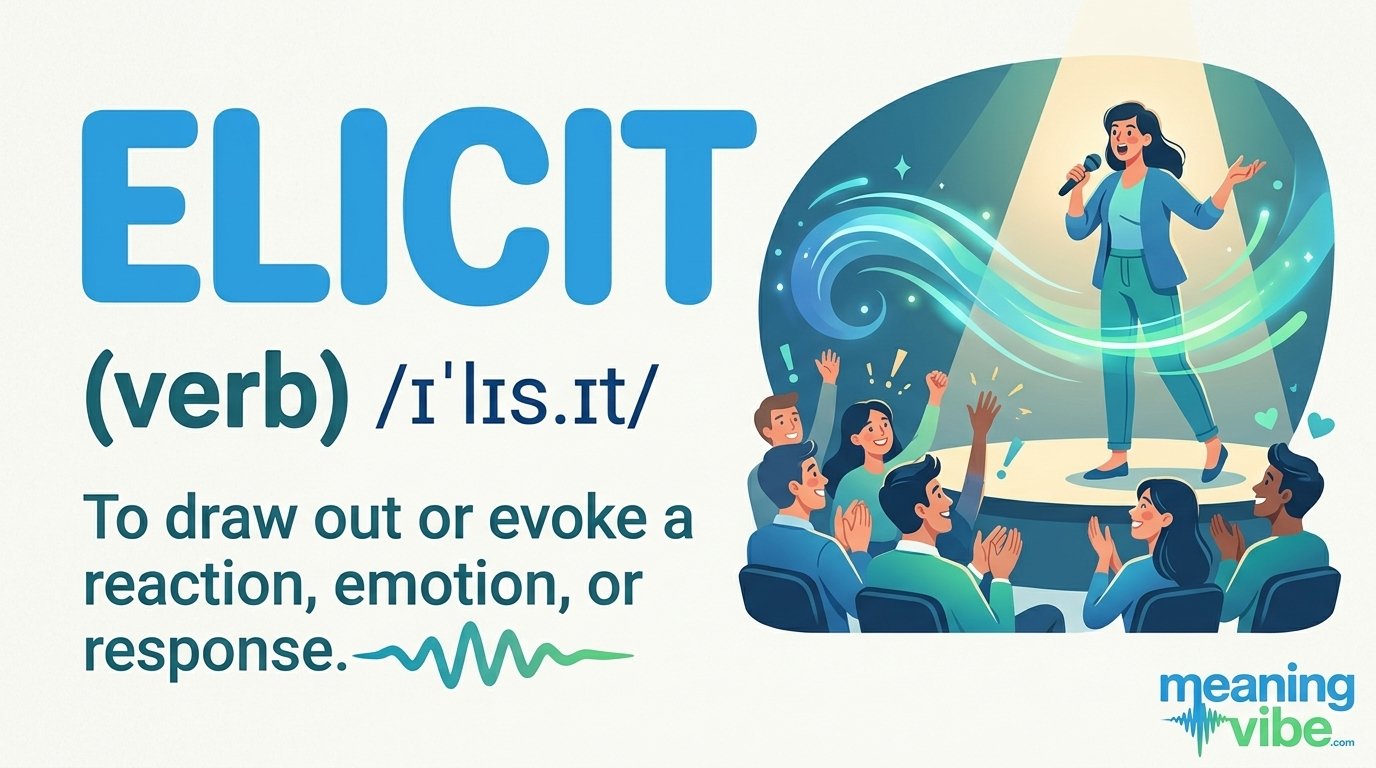
Think of elicit as pulling a response into the open through a question, stimulus, or event. A joke elicits laughter because laughter already sits ready to emerge in the audience. A question elicits an answer by inviting it out.
Think of eliciting as different from forcing in most neutral uses. A teacher elicits answers by asking well-chosen questions, not by threatening students into speech. Force belongs to stronger verbs such as extract or extort.
Think of a stimulus whenever elicit appears in research or psychology writing. An experiment elicits a behavior when a controlled condition produces that behavior in participants. The stimulus comes first, and the response follows.
Think of latent potential whenever elicit appears outside human conversation. Music elicits memories, a photograph elicits nostalgia, and a policy elicits public debate. Nothing unlawful hides in those uses, only something brought forward.
Verb Forms of Elicit
Verb forms follow a regular pattern, which removes one common source of doubt. Present forms are elicit and elicits, past forms are elicited, and the present participle is eliciting. No irregular spelling change interrupts the pattern.
Third person singular adds a simple s in present tense writing. She elicits strong reactions, he elicits sympathy, and the survey elicits honest feedback. Subject and verb agreement still applies in every sentence.
Past tense and past participle share the same form, elicited, in standard use. The interview elicited detailed answers yesterday, and the answers have been elicited through careful questioning. Context shows tense, not a different spelling.
Present participle works as a verb form and as a gerund in different sentence roles. The film is eliciting strong emotions right now, while eliciting feedback remains a goal of the survey. Neither use turns eliciting into an adjective for illicit.
Passive voice keeps elicit as a verb even when the subject changes. Feedback was elicited by the questionnaire, and laughter was elicited by the comedian. Passive structure never converts elicit into a describing word.
| Form | Example |
|---|---|
| elicit | The teacher hopes to elicit answers from the class. |
| elicits | Her speech elicits applause from every audience. |
| eliciting | The interviewer is eliciting details from the witness. |
| elicited | The question elicited no response from the witness. |
| have elicited | Surveys have elicited honest feedback for years. |
Elicitation, Elicitor, and Elicitable
Elicitation names the act or process of drawing something out. Merriam-Webster lists elicitation as a noun related to elicit, often used in research and interview contexts. The elicitation of information requires method, not luck.
Elicitor names a person or thing that draws out a response. A question can act as an elicitor when it reliably produces an answer from respondents. This noun stays rare in everyday writing, but it remains correct.
Elicitable works as an adjective meaning capable of being drawn out. A response is elicitable when a suitable question or stimulus can bring it forward. Writers rarely need this form, yet it proves elicit belongs to a full word family.
Word family clarity prevents a common confusion between eliciting and illicit. Eliciting always connects back to the verb elicit, even when it functions as a noun in a sentence. Illicit never enters that family at all.
Dictionary checks help when a derived form feels unfamiliar in drafting. Merriam-Webster, Oxford, and Collins all list elicitation and elicitor as derived forms. Checking once beats guessing repeatedly across a document.
Elicit Examples by Context
In teaching, a question elicits discussion when students answer from knowledge rather than repeat a prompt. A teacher might ask, “What evidence supports that claim?” and elicit reasoning from the whole class. Discussion follows the question naturally.
In research, a survey elicits feedback when respondents answer honestly about experience. Researchers design items to elicit specific information without leading respondents toward one answer. Wording shapes the response that follows.
In interviews, a lawyer elicits testimony by asking precise questions in a careful order. Each question builds on the last answer and elicits detail that a single broad question would miss. Sequence matters as much as wording.
In performance, a comedian elicits laughter through timing, surprise, and shared recognition. The audience response arrives as a direct reaction to the performance, not as a description of it. Laughter proves the verb worked.
In medicine and science, a stimulus elicits a response when it triggers a measurable reaction. A vaccine elicits an immune response, and a test elicits a reflex in a clinical exam. These uses show the latent potential sense clearly.
What Illicit Means
Illicit is an adjective meaning not permitted, especially because it is illegal. Merriam-Webster applies the word to no-nos, things people are not supposed to do. It describes, and it never performs an action itself.
Forbidden covers more than criminal law in careful dictionary use. Illicit can describe something barred by law, rules, or accepted custom, depending on the noun it modifies. Context decides which shade applies in each sentence.
Formality marks illicit as a serious word for serious disapproval. A small classroom breach, such as talking during a test, usually deserves broke a rule, not illicit. Reserve illicit for conduct carrying real penalty or strong disapproval.
Position in a sentence usually places illicit directly before the noun it describes. Writers say illicit drugs, illicit trade, and illicit affair, not illicit standing alone as a verb. That position gives readers an immediate clue.
Moral shade often accompanies the legal shade, but the two shades differ. An illicit affair may violate social or marital expectations without breaking a criminal law. An illicit drug market, by contrast, breaks the law directly.
Three Senses of Illicit
Against the law forms the strongest and most common sense of illicit. Officers seized illicit goods at the border, and auditors flagged illicit payments hidden through shell companies. Law provides the prohibition in those cases.
Against the rules forms a second sense for institutions, codes, and competitions. A club denied any illicit approach to a rival player, meaning an approach barred by league rules. No criminal statute needs to apply for the word to fit.
Against custom forms a third sense for social expectations and moral norms. Their illicit relationship cost them both their jobs in one common example, even when no law was broken. Social disapproval supplies the prohibition there.
Sense checking prevents overstatement when illicit appears in weak contexts. Ask whether a law, rule, or custom actually forbids the thing described. If none forbids it, choose a milder word such as unauthorized or improper.
Noun choice controls which sense a reader hears first in a sentence. Illicit drugs point toward law, illicit trade points toward law and regulation, and illicit affair points toward custom. The noun guides interpretation before any extra explanation.
| Sense | Plain meaning | Example |
|---|---|---|
| Against the law | Banned by statute | Officers seized illicit timber at the border. |
| Against the rules | Forbidden by a code | The club denied an illicit approach to a player. |
| Against custom | Disapproved by society | Their illicit relationship damaged both careers. |
Illicitly and Illicitness
Illicitly works as the adverb form, describing how an action was done. Money obtained illicitly came through forbidden means, while goods sold illicitly bypassed legal channels. Adverb use never turns illicit into a verb.
Illicitness names the quality of being illicit, but it stays rare in modern writing. Dictionaries list illicitness as a noun, yet most writers prefer unlawful nature or illegality for clarity. Rare forms should stay out of plain writing.
Comparative and superlative forms exist in dictionary entries, though writers rarely need them. More illicit and most illicit compare degrees of prohibition in formal analysis. Everyday sentences almost never require that comparison.
Position still matters when illicitly appears in a sentence with a verb nearby. The adverb modifies the verb, while illicit itself still modifies a noun elsewhere. Keeping those roles separate prevents a new confusion.
Plain alternatives help when illicitness feels stiff or academic in a draft. Unlawfulness, illegality, or forbidden nature often read more clearly for general readers. Clarity beats rare vocabulary in most professional writing.
Illicit Examples by Context
In law enforcement, police found illicit drugs in the van during a routine inspection. The phrase names substances barred by law, not substances drawn out by questioning. Law supplies the meaning instantly.
In finance and compliance, auditors flagged illicit payments routed through shell companies to hide their source. Compliance writing uses illicit for flows that bypass regulation, even when the full criminal case remains unproven.
In trade and policy, illicit trade covers smuggled tobacco, counterfeit medicines, and black-market fuel. Policy writers use the phrase for cross-border flows that evade law and regulation. Scale and secrecy strengthen the word choice.
In social commentary, an illicit affair describes a secret relationship violating marital or social expectations. The word carries moral disapproval even when no criminal charge follows. Readers understand the social judgment from context.
In education and sport, illicit behaviour can describe actions barred by school codes or league rules. A student expelled for illicit behaviour broke institutional rules, not necessarily criminal law. Institution supplies the prohibition there.
Master Comparison Table
One table answers the pair faster than separate definitions scattered across a page. Keep this table near the top of any reference section for quick checking. Readers return to it during editing.
| Feature | Elicit | Illicit |
|---|---|---|
| Part of speech | Transitive verb | Adjective |
| Core meaning | Draw out a response | Not permitted, especially illegal |
| Pronunciation | /ɪˈlɪsɪt/ | /ɪˈlɪsɪt/ |
| Typical job | Performs an action | Describes a noun |
| Typical objects or nouns | Response, laughter, feedback, information | Drugs, trade, goods, affair, funds |
| Opposite or contrast | Suppress a response | Licit, meaning permitted |
| Word family | Elicitation, elicitor, elicitable | Illicitly, illicitness |
| Latin root | Elicere, to allure | Illicitus, not permitted |
| Common error | Using illicit as a verb | Using elicit as an adjective |
Table use during editing follows a simple habit for busy writers. Find the target word, check its job in the table, and compare that job with the sentence. Mismatch means the spelling must change.
Table limits matter for unusual sentences that mix both words in one clause. A combined sentence can contain elicit as a verb and illicit as an adjective at once. Each word still passes its own table test separately.
Pronunciation and Etymology
Pronunciation stays identical for both words in careful American speech. Both forms sound like /ɪˈlɪsɪt/, with stress on the second syllable. No vowel change separates them for a listener.
Rhyme partners help speakers recognize the sound pattern without solving the spelling problem. Explicit and complicit rhyme with both words, yet neither rhyme partner shares illicit meaning or elicit function. Sound groups words loosely, not by meaning.
Spelling carries meaning in writing precisely because sound cannot carry it here. A reader sees the initial e in elicit and the initial ill in illicit. Those letters, not sound, signal verb versus adjective.
Dictionary audio helps learners who need to hear stress and syllable shape. Merriam-Webster and Oxford both provide audio pronunciation for elicit, and dictionary audio for illicit follows the same pattern. Listening confirms sound, while grammar confirms spelling.
Accent variation deserves a brief note for international readers and exam writers. Some speakers may vary vowel length slightly, but standard references treat the pair as homophones in American English. Exam answers should follow dictionary pronunciation, not regional guesswork.
Latin Roots, and Why Shared Letters Trap Writers
Elicit traces back to Latin elicitus, the past participle of elicere. Elicere combines e-, meaning out, with lacere, meaning to allure or entice. Drawing out through allure explains the modern verb sense clearly.
Illicit traces back to Latin illicitus, combining in-, meaning not, with licitus, meaning permitted. Licitus comes from licere, meaning to be permitted, which also connects to license in English. Not permitted explains the modern adjective sense clearly.
Shared lic letters create a trap for writers who rely on visual similarity. Elicit and illicit both contain lic, yet their roots diverge after that shared element. One root means allure, the other means permitted.
First known use adds historical weight without changing modern meaning. Merriam-Webster dates elicit in its latent potential sense to 1605, showing long standard use. Age alone does not decide correctness, but it confirms stability.
Root memory tricks work better when they separate the roots cleanly. Link elicit to allure and extraction, and link illicit to license denied. Two different root stories prevent one blurred memory.
The Sentence Choice Test in Full
Test step one asks the writer to underline the target word in the sentence. Reading the full clause around it matters more than staring at the word alone. Context reveals whether action or description fits.
Test step two labels the job with a single letter, V for verb or ADJ for adjective. Writers who label first choose correctly more often, because labeling forces a grammar decision before spelling. Guessing by sound skips that decision entirely.
Test step three tries the substitution draw out in place of the target word. “The survey was designed to draw out responses” reads naturally, so elicit fits there. Substitution failure signals a wrong spelling immediately.
Test step four tries the substitution illegal in place of the target word. “They were caught in an illegal trade network” reads naturally, so illicit fits there. Illegal substitution failing for a response sentence rules illicit out.
Test step five checks collocation, meaning the words that naturally partner with the target. Elicit partners with response and reaction, while illicit partners with trade and drugs. Unnatural partnerships warn of an error even when grammar looks plausible.
Test step six reads the corrected sentence for logic from a fresh reader perspective. Ask whether the sentence claims a response is unlawful or a forbidden thing is drawn out. Logic failure after correction means another revision remains.
Worked Examples for the Test
Example one starts with a survey sentence that many writers get wrong under pressure. “The survey was designed to elicit responses from participants” passes every test step. Responses are drawn out, not declared unlawful.
Example two starts with a trade sentence that tempts the wrong verb form. “Police cracked down on illicit trade in the region” passes every test step. Trade is described as forbidden, not performed as an action.
Example three combines both words in one sentence without confusion. “The interviewer could not elicit information about illicit transactions from the executive” passes both tests separately. Information is drawn out, transactions are forbidden.
Example four exposes a logic error hidden inside fluent grammar. “The questionnaire illicit feedback from users” fails because feedback is not unlawful. Correction to elicits feedback restores both grammar and logic.
Example five exposes a different logic error in the opposite direction. “Investigators tried to elicit funds” may read grammatically, yet funds are usually illicit funds when obtained illegally. Intended meaning, not grammar alone, decides there.
Collocations: What Each Word Naturally Pairs With
Collocation means the words that commonly appear together in natural English. Learning collocations speeds choice because familiar partnerships feel right instantly. Unfamiliar partnerships deserve a second look during editing.
Elicit collocations cluster around responses, reactions, and information drawn from people. A speaker elicits applause, laughter, sympathy, and support from an audience through words or actions. Each object names something brought forward.
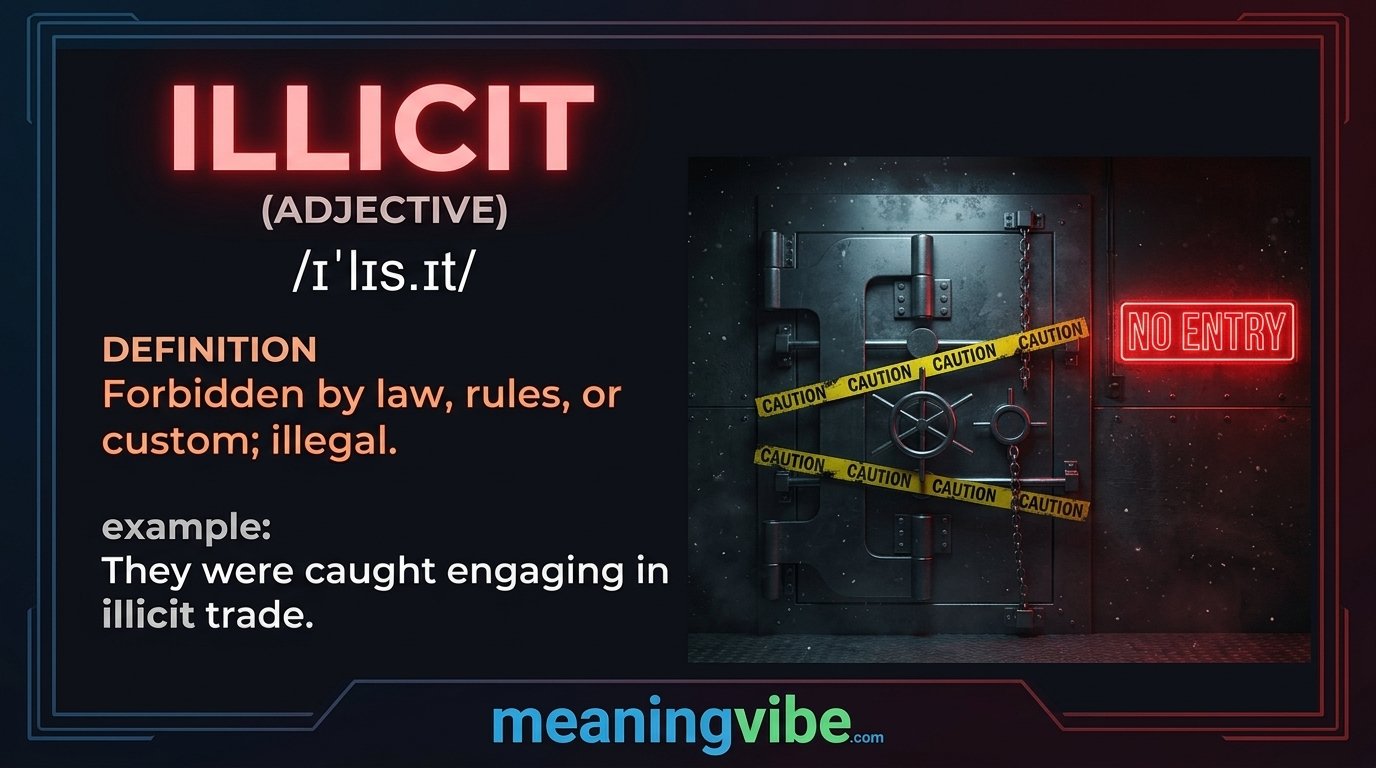
Illicit collocations cluster around forbidden things, activities, and flows. Authorities seize illicit drugs, regulators track illicit funds, and journalists report illicit trade across borders. Each noun names something barred by law, rule, or custom.
Collocation tables help learners more than definition lists alone in many classrooms. Students remember elicit a confession and illicit affair as fixed partnerships faster than abstract rules. Fixed examples anchor abstract grammar.
Collocation limits matter when a new combination appears in creative or technical writing. A novel pairing can still be correct if grammar and meaning pass the sentence choice test. Familiarity guides, but it never replaces grammar and logic.
Elicit Collocations Table
| Collocation | Meaning in context | Example |
|---|---|---|
| elicit a response | Draw out an answer | The question elicited a response at once. |
| elicit a reaction | Provoke a reaction | The film elicited a strong reaction. |
| elicit laughter | Bring out laughter | The comedian elicited laughter all evening. |
| elicit applause | Draw out applause | Her speech elicited warm applause. |
| elicit sympathy | Bring out sympathy | His story elicited sympathy from listeners. |
| elicit support | Draw out support | The proposal elicited support from members. |
| elicit a confession | Draw out a confession | Questions elicited a confession from the witness. |
| elicit feedback | Draw out feedback | The survey elicited honest feedback. |
| elicit information | Draw out information | Interviews elicited key information. |
| elicit testimony | Draw out testimony | Counsel elicited testimony in court. |
| elicit change | Bring out change | Reform elicited positive change. |
| elicit an immune response | Trigger a response | The vaccine elicited an immune response. |
Illicit Collocations Table
| Collocation | Meaning in context | Example |
|---|---|---|
| illicit drugs | Drugs barred by law | Police found illicit drugs in the van. |
| illicit trade | Trade barred by law | Officials targeted illicit trade routes. |
| illicit goods | Goods barred by law | Customs seized illicit goods at the border. |
| illicit affair | Affair barred by custom | The illicit affair damaged both careers. |
| illicit activity | Activity barred by law or rules | The firm faced illicit activity charges. |
| illicit funds | Funds obtained unlawfully | Auditors flagged illicit funds. |
| illicit payments | Payments bypassing regulation | Banks reported illicit payments. |
| illicit market | Market operating unlawfully | The illicit market evaded regulation. |
| illicit behaviour | Behaviour barred by rules | The school punished illicit behaviour. |
| illicit dealings | Dealings done secretly | Reports exposed illicit dealings. |
| illicit access | Access without permission | The system blocked illicit access. |
| illicit transfer | Transfer done unlawfully | Investigators traced an illicit transfer. |
Licit, Explicit, and Complicit: Three Words Not to Confuse
Licit means permitted or lawful, forming the direct opposite of illicit. Writers rarely use licit in everyday English, yet it clarifies illicit structure instantly. Illicit adds a negative prefix to licit, just as illegal adds one to legal.
Licit usage stays formal, legal, or academic in most modern writing. A licit transaction follows law, while an illicit transaction breaks law, rule, or custom. Readers benefit from seeing the pair side by side once.
Explicit means clear or graphic, with no connection to legality at all. An explicit lyric can be perfectly legal, while an illicit transaction can be described in discreet language. Sound similarity between explicit and illicit misleads writers who rely on rhyme.
Complicit means involved in wrongdoing, usually with another person or group. A complicit manager helped conceal misconduct, while illicit funds describe the money itself as forbidden. One word describes involvement, the other describes the thing.
Three-word separation prevents a chain of errors in editing and exam writing. Licit opposes illicit, explicit clarifies meaning, and complicit assigns involvement in wrongdoing. Each word keeps a distinct job in a sentence.
How to Keep the Three Separate
Ask about permission first when licit or illicit appears as a candidate. Permission denied points to illicit, permission granted points to licit. Permission questions never point to explicit or complicit.
Ask about clarity next when explicit appears as a candidate. Clear, direct, or graphic language points to explicit, even when the content feels sensitive. Sensitivity alone never makes language illicit.
Ask about involvement last when complicit appears as a candidate. A person who helped wrongdoing counts as complicit, while the forbidden act itself counts as illicit. Person versus thing separates those words cleanly.
Combined example clarifies all three distinctions in one short passage. An explicit report described illicit payments, and a complicit manager helped hide them from auditors. Each word performs a different job there.
Editing habit for these three words mirrors the main pair test. Label the job, test a substitute, and check collocation before finalizing spelling. Habits beat memory tricks under deadline pressure.
Wrong Examples Corrected
Wrong examples teach faster than correct examples alone for many learners. Seeing an error marked wrong, with a reason attached, prevents silent repetition in future drafts. Correction tables make that learning visible.
Academic errors often involve surveys, interviews, and experiments using illicit as a verb. “The study aimed to illicit responses” fails because responses are not unlawful. Correction to elicit responses restores meaning instantly.
Business errors often involve reports describing forbidden activity with elicit as an adjective. “The company faced elicit activities” fails because elicit cannot describe a noun. Correction to illicit activities restores grammar instantly.
Legal errors carry higher risk because meaning shifts can change a document’s force. “Counsel tried to illicit testimony” fails because testimony is drawn out, not declared forbidden. Correction to elicit testimony protects legal clarity.
News errors often mix both words in one sentence about investigations. “The reporter could not illicit information about elicit transactions” fails twice in opposite directions. Correction reverses both words into their correct roles.
| Wrong sentence | Correct sentence | Why it was wrong |
|---|---|---|
| The teacher tried to illicit answers. | The teacher tried to elicit answers. | Illicit cannot act as a verb. |
| The firm faced elicit activities. | The firm faced illicit activities. | Elicit cannot describe a noun. |
| The survey aimed to illicit responses. | The survey aimed to elicit responses. | Responses are drawn out, not unlawful. |
| Police seized elicit drugs. | Police seized illicit drugs. | Drugs are described as forbidden. |
| The speech illicit strong reactions. | The speech elicited strong reactions. | Reactions are drawn out by speech. |
| They joined an elicit trade network. | They joined an illicit trade network. | Trade is described as forbidden. |
| The movie had an illicit effect. | The movie had an eliciting effect. | Effect came from drawing out reaction. |
| The investigation was illicit new facts. | The investigation was eliciting new facts. | Facts are drawn out by investigation. |
| She hoped to illicit sympathy. | She hoped to elicit sympathy. | Sympathy is drawn out, not forbidden. |
| The club faced illicit support. | The club faced elicited support is wrong too, use support was elicited. | Support needs a verb, not an adjective. |
| Auditors found elicit funds. | Auditors found illicit funds. | Funds are described as unlawful. |
| The question illicit no response. | The question elicited no response. | No response was drawn out. |
Last row warning matters because support needs a verb phrase, not a simple swap. “Support was elicited” works, while “elicit support” works only with a subject performing the action. Grammar role still decides the form.
Correction habit for every wrong example follows the same three moves. Mark the error, name the job mismatch, and rewrite the sentence fully. Partial correction leaves doubt for the next reader.
Contexts: Academic, Business, Legal, News, and Everyday
Academic writing uses elicit most often for research methods and results. A study elicits responses, an experiment elicits behavior, and an interview elicits detailed accounts from participants. Method language demands precision there.
Academic illicit uses appear in policy, criminology, and ethics discussions about forbidden conduct. Researchers study illicit markets, illicit behavior, and illicit flows without describing those things as actions. Noun description keeps the analysis clear.
Business writing uses elicit for surveys, feedback, and stakeholder responses. A manager elicits input before a decision, a team elicits customer feedback after a launch, and a proposal elicits support from investors. Drawing out input drives better decisions.
Business illicit uses appear in compliance, audit, and risk reporting about forbidden flows. Auditors flag illicit payments, compliance teams track illicit activity, and risk reports describe illicit access to systems. Forbidden description protects legal clarity there.
Legal writing uses elicit for testimony, statements, and evidence drawn through questioning. Counsel elicits testimony, cross-examination elicits inconsistencies, and investigators elicit facts from witnesses. Each use keeps the verb role clear.
Legal illicit uses appear in charges, findings, and regulatory language about forbidden acts. Courts address illicit trade, illicit substances, and illicit enrichment as described conduct. Adjective role keeps charges precise and defensible.
News writing uses both words in the same investigation story more often than other contexts. Reporters elicit comments from officials about illicit transactions, and editors must keep both roles straight under deadline pressure. Combined sentences test the pair hardest there.
Everyday writing uses elicit less often, preferring get, prompt, or bring out in casual speech. Illicit appears in everyday news talk about illicit drugs or illicit affairs, even when speakers rarely use licit. Register awareness helps writers match audience expectations.
Exam writing rewards the sentence choice test because examiners check meaning, not only spelling. IELTS candidates who label V or ADJ before choosing avoid a common homophone trap under time pressure. Practice with timed sentences builds that habit fastest.
Academic and Research Examples
A questionnaire elicited honest feedback because items avoided leading language and protected anonymity. Researchers reported response patterns without claiming that feedback itself was unlawful or forbidden. Method clarity supports result credibility.
An experiment elicited predictable behavior when the stimulus matched the hypothesis under test. Behavior emerged from the experimental condition, not from a description of that condition as illicit. Cause and response stay distinct there.
An interview elicited detailed accounts when follow-up questions built on each prior answer. Interviewers who listen well elicit depth that a single broad question cannot reach. Depth comes from sequence and patience.
A study of illicit markets described trade flows barred by law without confusing description with action. Researchers did not elicit markets, they described markets as illicit through evidence. Description and action remain separate jobs.
Business and Survey Examples
A launch survey elicited customer feedback within days because questions stayed short and specific. Product teams used that feedback to fix onboarding friction before wider release. Feedback drawn out early prevents larger problems later.
A proposal elicited support from investors after it showed clear costs, risks, and returns. Support arrived as a response to evidence, not as a forbidden activity described by an adjective. Evidence drives support in business writing.
A compliance review flagged illicit payments routed through vendors with no clear business purpose. Auditors described payments as illicit based on regulation, not based on drawing payments out. Description protects the audit trail.
A risk report described illicit access attempts against customer accounts during a single week. Security teams counted attempts, blocked access, and reported forbidden access to management. Counting and describing stay distinct from drawing out.
Legal and News Examples
Counsel elicited testimony by asking the witness to describe events in chronological order. Testimony emerged step by step, and each answer shaped the next question in the sequence. Order creates clarity in courtroom language.
Cross-examination elicited inconsistencies when prior statements conflicted with current testimony. Inconsistencies surfaced through questioning, not through labeling testimony itself as illicit. Surfacing and describing remain different jobs.
Reporters elicited comments from officials about illicit transactions uncovered in the investigation. Comments were drawn out, while transactions were described as forbidden by law. Combined sentences demand both tests at once.
Editors corrected a draft that called survey results illicit responses before publication. Correction to elicited responses saved the story from implying that respondents broke the law. Editing protects both accuracy and reputation.
Memory Tricks That Actually Work
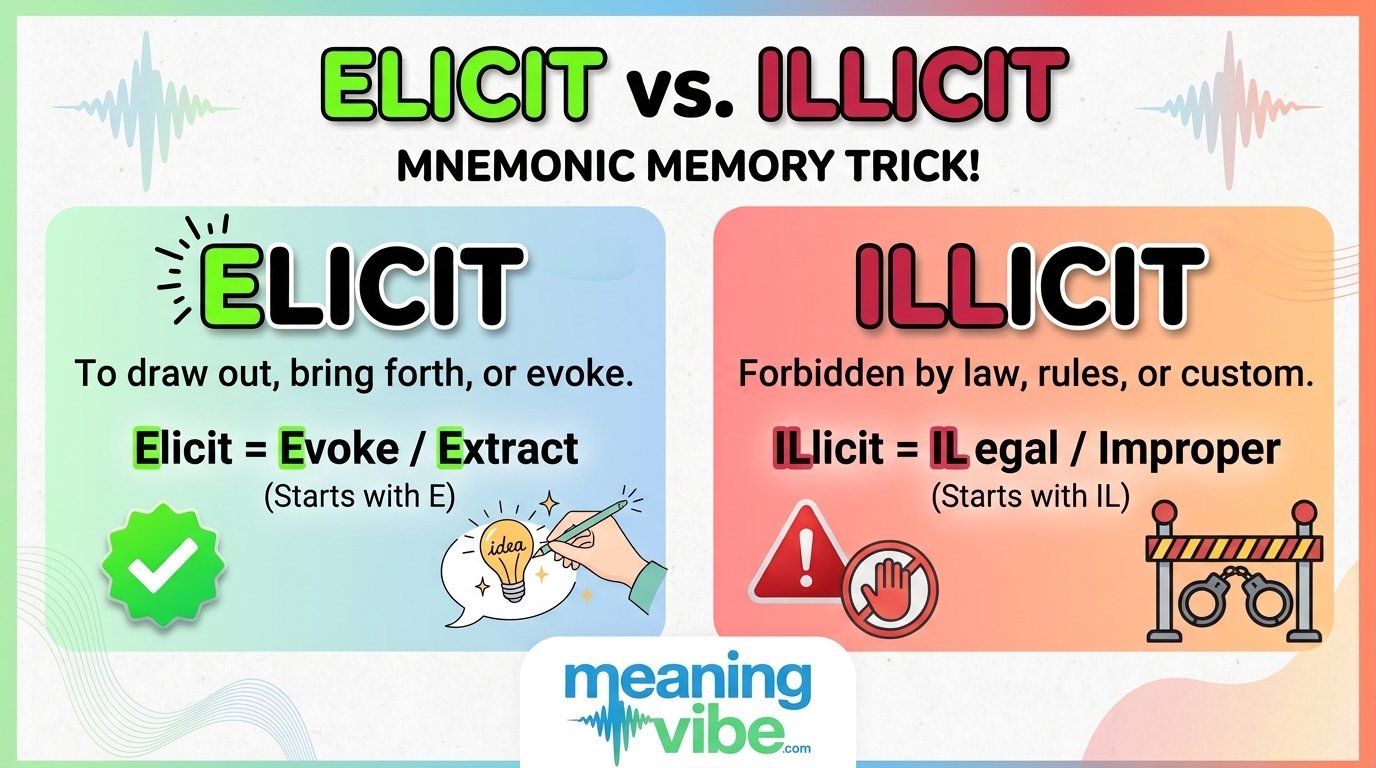
Illicit equals illegal works because both words begin with ill. Writers who see ill at the start should think forbidden first. That visual cue survives even under deadline pressure.
Elicit equals extract works because both words begin with e and involve drawing out. Writers who see e at the start should think drawing out first. Extract adds force, while elicit stays neutral, yet the cue still helps.
Verb vowel trick links elicit to verb through the shared initial e sound. Elicit starts with e, and verb contains e as its vowel focus in many learner guides. The trick is rough, but it reinforces the verb link.
Describing versus doing beats any single mnemonic when a sentence feels ambiguous. Ask the job question first, then use ill or e as a backup check. Two checks beat one guess every time.
Collocation memory helps writers who learn through phrases rather than rules. Remember elicit a response and illicit drugs as anchor phrases for each word. Anchors recall the correct job instantly in new sentences.
Combined sentence memory helps writers who face both words together in investigations. Remember elicit information about illicit activities as a model sentence for combined use. Model sentences reduce combined-sentence errors sharply.
Practice memory grows stronger when writers write ten sentences of their own. Ten self-written sentences beat ten memorized definitions because production forces a choice each time. Choice practice builds durable accuracy.
Editing memory grows stronger when writers reread only for homophones in a final pass. A dedicated homophone pass catches elicit and illicit errors that a general proofread misses. Separate passes catch separate error types.
Quiz With Answers
Quiz instructions stay simple for learners at beginner, intermediate, and advanced levels. Choose elicit or illicit for each blank, then check the answer and explanation below each item. Explanations matter more than scores alone.
Question 1: The documentary was meant to ______ strong emotions from viewers.
Answer: elicit. Emotions are drawn out by the documentary, not described as forbidden.
Question 2: The organization was accused of ______ activities.
Answer: illicit. Activities are described as forbidden, not performed as drawing out.
Question 3: The interviewer asked questions to ______ detailed responses.
Answer: elicit. Responses are drawn out through questions, not declared unlawful.
Question 4: Police are cracking down on ______ trade.
Answer: illicit. Trade is described as forbidden by law in that sentence.
Question 5: Her joke ______ laughter from the whole room.
Answer: elicited. Laughter was drawn out by the joke in past tense form.
Question 6: Auditors flagged ______ funds in the accounts.
Answer: illicit. Funds are described as obtained unlawfully, not drawn out.
Question 7: The survey was designed to ______ honest feedback.
Answer: elicit. Feedback is drawn out by survey design, not declared unlawful.
Question 8: They were involved in an ______ affair.
Answer: illicit. Affair is described as forbidden by custom in that sentence.
Question 9: The teacher hoped to ______ answers from students.
Answer: elicit. Answers are drawn out through teaching questions, not forbidden.
Question 10: The reporter could not ______ information about ______ transactions.
Answer: elicit information about illicit transactions. Information is drawn out, transactions are forbidden.
Quiz scoring guidance keeps focus on learning rather than ranking for most readers. Eight or more correct answers show strong control of the pair in timed writing. Fewer correct answers point to the sentence choice test for review.
Quiz extension for advanced writers adds combined sentences and context shifts. Advanced items should mix academic, legal, and news contexts in one set. Context shifts test whether the rule transfers beyond familiar examples.
Mistakes to Avoid
1. Using illicit as a verb tops the mistake list for this pair in learner writing. Sentences such as “The teacher tried to illicit answers” fail grammar immediately. Illicit never performs an action in standard English.
2. Using elicit as an adjective tops the opposite mistake list for this pair. Sentences such as “The firm faced elicit activities” fail grammar immediately. Elicit never describes a noun directly in standard English.
3. Trusting spellcheck alone leaves both errors invisible in many drafts. Spellcheck approves both spellings because both words exist in standard dictionaries. Human logic checks must follow spellcheck passes.
4. Trusting sound alone leaves the pair indistinguishable in speech-based drafting. Dictation and fast typing both produce sound-based errors when writers choose by ear rather than grammar. Reading aloud does not fix spelling here.
5. Copying synonym lists without checking force and context creates new errors. Extort implies force, wrest implies struggle, and bootleg implies specific goods, so none works as a neutral synonym always. Synonyms need context checks.
6. Overusing elicit in casual writing sounds stiff when simpler verbs fit better. Get, prompt, spark, or bring out often read more naturally for general readers. Formal verbs suit formal contexts, not every sentence.
7. Overusing illicit for minor rule breaches sounds exaggerated and legally risky. A late homework submission breaks a rule, but it rarely deserves illicit description. Reserve illicit for serious prohibition or strong disapproval.
8. Mixing both words in one sentence without testing each word separately causes double errors. Combined sentences need two tests, one for elicit and one for illicit. Single-test editing misses the second error.
9. Ignoring collocation slows learning and increases guesswork in new sentences. Writers who know elicit a response and illicit drugs choose faster than writers who recall definitions alone. Collocation practice builds speed.
10. Skipping the logic read lets fluent but false sentences survive into publication. A sentence can sound smooth while claiming that feedback is unlawful or that trade is drawn out. Logic reads catch meaning errors grammar checks miss.
Tips for Editors and Exam Writers
1. Label the job first before choosing spelling in any uncertain sentence. Write V above a verb slot and ADJ above an adjective slot in a draft margin. Labeling forces grammar before spelling.
2. Test a substitute with draw out for elicit and illegal for illicit. Substitution reveals meaning faster than dictionary browsing during timed writing. Keep both substitutes ready as a mental tool.
3. Check collocation second after grammar and substitution have pointed one way. Elicit partners with response, illicit partners with trade, and unnatural partnerships warn of error. Collocation confirms, but never replaces, grammar.
4. Read for logic third after grammar and collocation checks pass. Ask whether the sentence claims something unlawful or drawn out in a way that matches intent. Logic failures demand revision even when grammar looks clean.
5. Run a homophone pass as a separate final proofread for any document with confused words. Search for elicit and illicit separately, then test each occurrence with the sentence choice test. Separate passes catch errors general reading misses.
6. Keep a personal error list with your own repeated homophone mistakes across documents. Personal lists beat generic lists because they target actual habits, not possible habits. Review the list before submitting important work.
7. Use dictionary entries for first known use, senses, and synonym distinctions when doubt persists. Merriam-Webster distinguishes elicit from extract and extort by force and skill, a distinction learner lists often miss. Dictionary nuance improves advanced writing.
8. Teach with combined sentences when helping students or colleagues learn the pair. Combined sentences such as elicit information about illicit activities test both words at once. Combined practice transfers better than isolated examples.
9. Match register to audience when choosing between elicit and simpler verbs. Academic and legal readers expect elicit, while general readers may prefer prompt or draw out. Register matching improves readability without losing accuracy.
10. Save illicit for serious prohibition in professional and legal writing. Overuse weakens the word and risks legal overstatement when a milder term fits better. Precision protects both writer and reader in sensitive contexts.
FAQs About Elicit vs Illicit
What is the difference between elicit and illicit?
Elicit is a verb meaning to draw out a response, answer, fact, or reaction. Illicit is an adjective meaning not permitted, especially because it is illegal. Part of speech plus meaning decides every standard sentence.
Are elicit and illicit homophones?
Yes, in careful American speech, both words sound like /ɪˈlɪsɪt/. Merriam-Webster notes that they are auditorily indistinguishable in isolation. Spelling, not sound, carries meaning in writing.
How do you pronounce elicit and illicit?
Both sound like /ɪˈlɪsɪt/, with stress on the second syllable. Dictionary audio for elicit confirms that stress pattern for American English. Illicit follows the same pattern in standard references.
Is elicit a verb or an adjective?
Elicit is a transitive verb only in standard use. It takes an object, such as a response, reaction, or information drawn out. It never describes a noun directly as an adjective.
Is illicit a verb or an adjective?
Illicit is an adjective only in standard use. It describes a noun, such as drugs, trade, goods, or affair, as forbidden. It never performs an action as a verb.
Can illicit be used as a verb?
No, not in standard English, even though many learners try that form under pressure. Sentences such as “The teacher tried to illicit answers” fail grammar. Use elicit for any verb slot.
Can elicit be used as an adjective?
No, not in standard English, even though the spelling looks similar to illicit. Sentences such as “The firm faced elicit activities” fail grammar. Use illicit for any adjective slot describing forbidden conduct.
What does elicit mean in a sentence?
Elicit means to draw out something already present or latent, such as laughter, feedback, or testimony. A comedian elicits laughter, a survey elicits feedback, and a question elicits an answer. Each object names something brought forward.
What does illicit mean in a sentence?
Illicit means not permitted, especially because it is illegal, barred by rules, or barred by custom. Police seize illicit drugs, auditors flag illicit funds, and journalists report illicit trade. Each noun names something forbidden.
How do you remember elicit vs illicit?
Remember illicit equals illegal, because both begin with ill. Remember elicit equals extract, because both begin with e and involve drawing out. Use the describing-or-doing test as the main check, with mnemonics as backup.
What is the opposite of illicit?
Licit is the direct opposite, meaning permitted or lawful. Licit stays rare in everyday writing, yet it clarifies illicit structure instantly. Most writers prefer lawful or permitted for general readers.
Is licit a real word?
Yes, licit is a real word, though far rarer than illicit in modern use. Dictionaries define licit as permitted or lawful, forming a clean opposite pair. Rarity does not make it incorrect.
Is explicit the same as illicit?
No, explicit means clear or graphic, with no connection to legality. An explicit lyric can be legal, while an illicit transaction can use discreet language. Rhyme similarity misleads writers who rely on sound.
Is complicit the same as illicit?
No, complicit means involved in wrongdoing, usually with another person or group. A complicit manager helped hide misconduct, while illicit funds describe money itself as forbidden. Person involvement differs from thing description.
What is the difference between illicit and illegal?
Illegal means forbidden by law in plain legal language, while illicit adds formal tone and often moral shade. Illicit can also cover rule-breaking and custom-defying conduct beyond criminal law. Illegal stays narrower and plainer in most legal writing.
What is the difference between elicit and extract?
Elicit implies effort or skill in drawing forth a response, while extract implies force or pressure. Merriam-Webster distinguishes those verbs by force and resistance in its synonym note. Extract fits forced confessions, elicit fits skilled questioning.
What is the difference between elicit and evoke?
Evoke implies a strong stimulus that arouses emotion, interest, or memory, often without deliberate questioning. Elicit implies drawing forth through effort, question, or stimulus in a broader sense. Music evokes memories, questions elicit answers.
What is elicitation?
Elicitation is the noun naming the act or process of drawing something out. Researchers use elicitation for interview methods, and Merriam-Webster lists it as a derived form of elicit. It never connects to illicit meaning.
What is an elicitor?
An elicitor is a person or thing that draws out a response, such as a well-designed question. This noun stays rare in everyday writing, yet it remains correct and useful in research contexts. It belongs only to the elicit family.
What are the verb forms of elicit?
Forms follow a regular pattern: elicit, elicits, eliciting, elicited, have elicited. Third person singular adds s, past forms use elicited, and present participle uses eliciting. No irregular change interrupts that pattern.
Why does spellcheck not catch elicit vs illicit mistakes?
Spellcheck approves both spellings because both words exist as correct dictionary entries. A wrong choice still forms a grammatically plausible sentence in many cases. Human logic checks must follow spellcheck passes for homophones.
Can you elicit illicit activities from someone?
Yes, in a combined sentence, bribery can elicit illicit activities from another person. Elicit performs the drawing out, while illicit describes activities as forbidden. Each word passes its own test separately there.
Does illicit always mean criminal?
No, illicit can mean barred by rules or disapproved by custom without a criminal charge. An illicit affair may violate social expectations only, while illicit drugs break criminal law. Noun and context decide which shade applies.
Does elicit always mean with difficulty?
No, difficulty is common but not required by the definition. Merriam-Webster also defines elicit as bringing out latent or potential qualities, such as change or an immune response. Ease does not disqualify elicit.
Is elicit formal or informal?
Elicit leans formal, fitting academic, legal, journalistic, and research writing best. General readers may prefer get, prompt, or draw out in casual writing. Register matching improves readability without losing accuracy.
Conclusion of Elicit vs Illicit
Elicit vs illicit rewards a simple habit more than memorized definitions alone. Label the job, test a substitute, check collocation, and read the finished sentence for logic. That habit turns a sound-alike trap into a quick, confident choice.
Elicit will serve writers whenever a response, reaction, answer, or fact must be drawn out. Illicit will serve writers whenever a noun must be described as forbidden by law, rule, or custom. Keeping those jobs separate protects meaning in every context from essays to news reports.
Try the habit on your next draft by searching for both spellings and testing each occurrence separately. Use the quiz above as a warm-up, then apply the sentence choice test to real sentences under deadline pressure. Accuracy built through practice lasts longer than accuracy borrowed from a single definition.