

Device vs devise confuses writers because the two words differ by one letter, sound almost identical, and both connect to plans, tools, and clever ideas.
Device is a noun for a tool, instrument, or plan made for a purpose. Devise is a verb meaning to plan, invent, or contrive something by careful thought.
The fastest check uses two substitute words: thing for device, and action for devise. If the slot needs a thing, use device; if it needs an action, use devise.
Table of Contents
ToggleDevice vs Devise in One Line
Device answers the question, “What thing is this?” Devise answers the question, “What planning action happened?”
That split works for technology, business, literature, and law. It also explains the bridge sentence that surprises learners: you devise a plan, and that plan itself can be called a device.
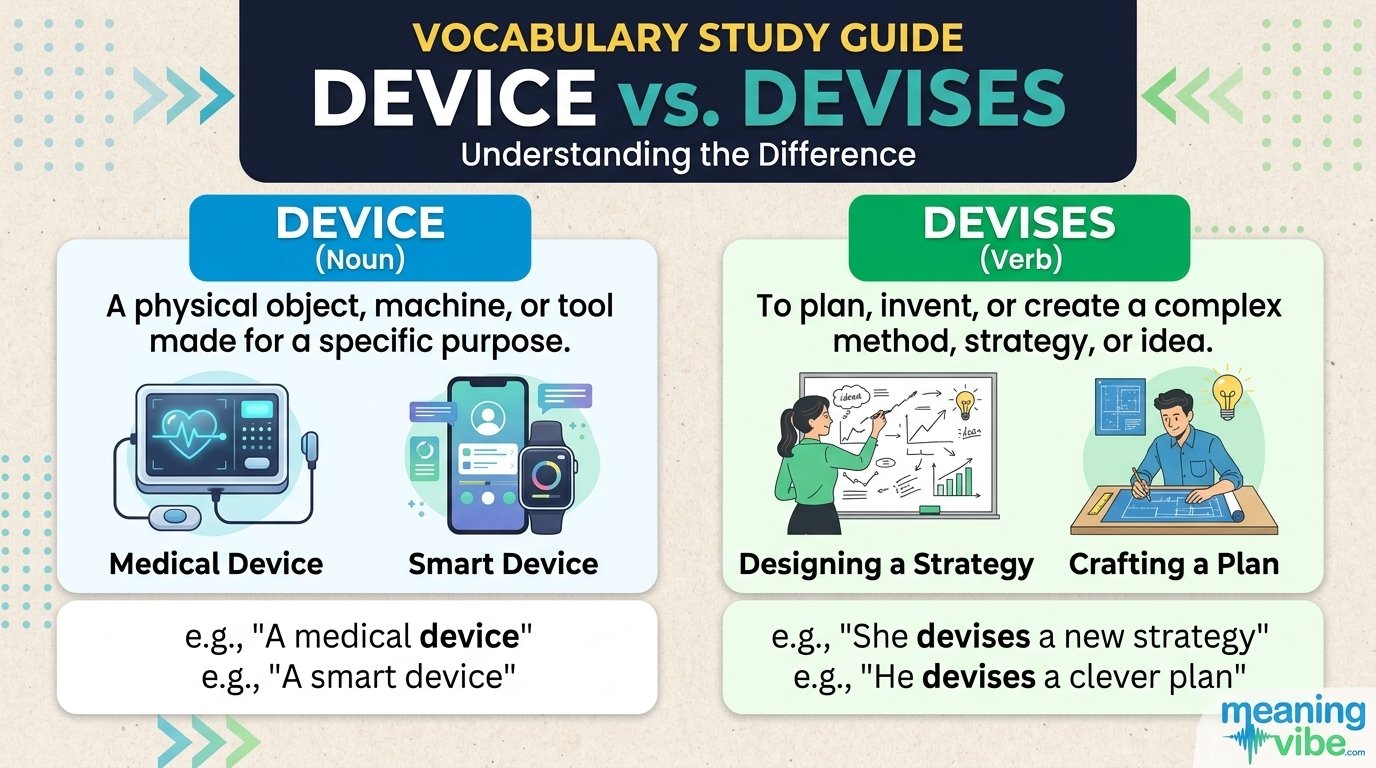
| Word | Part of speech | Pronunciation | Core meaning |
|---|---|---|---|
| Device | Noun | /dɪˈvaɪs/, final S | Tool, instrument, gadget, plan, literary technique |
| Devise | Verb, plus a legal noun sense | /dɪˈvaɪz/, final Z | Plan, invent, contrive; in law, give property by will |
What Does Device Mean
Device is a noun in general use, which means it names a person, place, thing, or idea, and here it names a thing. Merriam-Webster and Cambridge define it as something made for a particular purpose.
That purpose can be physical, such as opening a can, or abstract, such as shaping a story. Most competitors cover only the physical sense, but the abstract senses matter just as much.
A device can be held, used, read, or followed, depending on the sense. A smartphone is held, a literary device is read, and a tax device is followed as a scheme.
Device as a Tool or Instrument
A device as a tool is an object designed to do a particular job, often mechanical, electrical, or electronic. Grammarly gives a listening device and a seismic device as clear examples.
Everyday examples include a smartphone, a tablet, a laptop, a GPS device, and a kitchen gadget. Each one exists to perform a task, and each one can be named, counted, and replaced.
Medical examples include a heart monitor, a hearing device, and a safety device that stops a machine automatically. Those examples show why device appears so often in technical and healthcare writing.
An engineer might build a device that simplifies water purification, while a doctor might recommend a new medical device for a clinic. In both cases, the device is a tangible result, not the planning action.
Device as a Plan or Scheme
Device can also mean a plan, scheme, or procedure for achieving a purpose, sometimes with a crafty edge. The Free Dictionary lists that sense directly, with a device for avoiding income tax as its example.
That sense explains phrases such as “a clever device for saving time” and “an ingenious device for solving a puzzle.” The device here is not a gadget; it is a method dressed as a noun.
Writers should not hide the scheme sense, because it links device and devise without merging them. A person devises a scheme, and the finished scheme can be called a device.
A business team might adopt a new pricing device to attract early buyers, while a teacher might use a classroom device to keep students engaged. Both uses are correct, and both are noun uses.
Device as a Literary and Rhetorical Technique
A literary device is a word pattern, figure of speech, or dramatic convention used to create an effect. The Free Dictionary lists metaphor and theatrical convention under that sense.
Common literary devices include metaphor, simile, irony, foreshadowing, and repetition. Each one shapes how a reader feels, understands, or remembers a scene.
A plot device is a specific story element that moves the plot forward, such as a lost letter, a secret map, or a sudden storm. Writers use plot devices to create problems, reveal information, or force choices.
A rhetorical device works in speeches and essays, such as a rhetorical question, a repeated phrase, or a contrast between two ideas. Those devices persuade, emphasise, or clarify, and they are never gadgets.
Device as a Heraldic Emblem and Motto
In heraldry, a device is a design or emblem used as a charge on a shield, or a motto linked to a family, group, or institution. The Free Dictionary lists both emblem and motto senses.
That historical sense survives in phrases such as “a family device” and in logos that borrow heraldic shapes. A modern badge can echo a heraldic device without being a machine.
Writers rarely need the heraldic sense in everyday prose, but students of history and literature may meet it in older texts. Knowing it prevents a reader from forcing a gadget meaning onto an emblem.
An elaborate or fanciful design can also be called a device, especially in older writing. That sense links back to the idea of something deliberately designed, not something accidental.
What Does Devise Mean
Devise is a verb in general use, which means it describes an action, and here the action is planning or inventing. Merriam-Webster defines it as inventing from existing ideas, or contriving a plan by careful thought.
Grammarly stresses that devise conveys the process of designing or thinking up something, rather than the object created. That process focus is the key contrast with device.
A committee can devise a plan, a scientist can devise a method, and an author can devise a plot. In each case, the subject does mental work before any object exists.
Devise as Plan, Invent, and Contrive
To devise a plan means to work out a detailed way of achieving a goal, step by step. A team might devise a marketing plan, a study strategy, or an escape route for a story character.
To devise an invention means to create something new in the mind, then work out how it could work. An engineer might devise a better filter, while a cook might devise a new dish.
To contrive means to devise with cleverness, sometimes with a hint of scheming. A character might devise a scheme to win a game, while a student might devise a shortcut for revision.
Synonyms for devise include invent, formulate, craft, concoct, hatch, construct, arrange, and think up. Each synonym keeps the action focus, and none of them names a physical object.
Devise in Law: Give Property by Will
In law, devise as a verb means to give property through a will, especially real property such as land or a house. WritingTips lists that legal sense from Merriam-Webster.
That sense is not a metaphor; it is a technical legal use with real consequences. A testator, the person making the will, may devise a house to a child, while giving money by a different term.
Modern US statutes sometimes use devise more broadly, so writers should check the relevant state wording before using it in a legal document. General information only applies here, not legal advice for any reader.
A will clause might read, “I devise my house to my daughter,” and that sentence uses the verb correctly. Changing it to device would turn a legal action into a nonsense noun.
Devise as a Legal Noun: Property Given by Will
Devise can also be a noun in law, meaning the property given by will, or the clause that gives it. WritingTips lists that noun sense, including property obtained through a will.
That legal noun is the exception that proves the general rule: in everyday English, devise is a verb, but in wills, a devise can be a thing given. Learners should learn the exception separately, not as the main rule.
A sentence such as “The house was a devise under the will” uses the legal noun correctly. A sentence such as “I bought a new devise” does not, because a gadget is a device.
Go For English says devise is never a noun, but that absolute claim is too strong. It holds for general use, yet fails for legal use, so Step 2 must teach the split plainly.
Device vs Devise Comparison Table
| Feature | Device | Devise |
|---|---|---|
| Part of speech, general use | Noun | Verb |
| Legal exception | None needed | Noun for property given by will |
| Pronunciation | /dɪˈvaɪs/, final S | /dɪˈvaɪz/, final Z |
| Plural or third person | Devices | Devises |
| Past form | Not a verb | Devised |
| Core question | What thing is this? | What planning action happened? |
| Example, thing | A smartphone is a device. | Not applicable |
| Example, action | Not applicable | They devised a plan. |
| Wrong swap | She device a plan. | He bought a new devise. |
The table shows why part of speech decides most sentences before meaning does. If the slot needs a noun, device fits; if it needs a verb, devise fits.
Pronunciation: Final S Versus Final Z
Pronunciation explains part of the confusion, because careful speech separates the words, while casual speech blurs them. Learners should practise both levels, not just one.
Device: /dɪˈvaɪs/, Final S
Device in careful speech is pronounced /dɪˈvaɪs/, with a final s sound, like ice. Grammarly gives that IPA form, and IDP IELTS notes the rhyme with ice for device.
That final s matches the noun spelling ce, which often signals a noun in this pattern. Saying dih-VISE slowly helps learners hear the s ending.
A useful rhyme set for device includes ice, price, and advice, all nouns with a final s sound. That set helps learners group nouns by sound as well as spelling.
Devise: /dɪˈvaɪz/, Final Z
Devise in careful speech is pronounced /dɪˈvaɪz/, with a final z sound, like realise. Grammarly gives that IPA form, and IDP IELTS notes the rhyme with realise for devise.
That final z matches the verb spelling se, which often signals a verb in this pattern. Saying dih-VIZE slowly helps learners hear the z ending.
A useful rhyme set for devise includes realise, advise, and surprise, all verbs or verb-like words with a final z sound. That set helps learners group verbs by sound as well as spelling.
Why They Are Near Homophones, Not Exact Homophones
Device and devise are near homophones in careful speech, not exact homophones, because the final consonant differs. IDP IELTS calls them homophones, but that label hides the s versus z difference.
WordPandit gives both words as dih-VIZE, which also hides the difference. Learners who copy that simplification lose the one sound clue that separates noun and verb.
In casual speech, both words often reduce to a weak vowel plus vise, so sound alone cannot decide spelling. Meaning and part of speech must decide when pronunciation blurs.
Part of Speech Test
Part of speech gives a fast filter before meaning tests begin. If the grammar slot is wrong, the word is wrong, even if the letters look plausible.
Device Is a Noun, Countable, Plural Devices
Device is a countable noun, which means it can be singular or plural, and it can follow a, an, the, or a number. The Free Dictionary notes that device, unlike advice, can be used in the plural.
Examples include “a device,” “two devices,” “the device,” and “many ingenious devices.” Each form keeps the noun slot, and each form can be the subject or object of a sentence.
A sentence such as “The device tracks steps” uses device as a subject noun, while “She bought a new device” uses it as an object noun. Both slots are noun slots, and both are correct.
Devise Is a Verb, Forms Devises, Devised, Devising
Devise as a verb follows normal verb patterns: third person devises, past devised, present participle devising. A sentence such as “She devises a new method each year” uses the third person form.
A sentence such as “They devised a scheme to help him” uses the past form, while “They are devising a plan” uses the present participle. Grammarflex uses similar examples for planning and strategy.
A sentence such as “Can you devise a way out?” uses the base form after a modal verb, which is another verb slot. EnglishPractice uses that exact question as a teaching example.
The Legal Noun Exception for Devise
The legal noun devise breaks the general rule, but only in wills and estates writing. A clause can be called a devise, and property given by will can be called a devise.
Writers should mark that exception clearly in their own notes, so it does not leak into everyday writing. A gadget is never a legal devise, and a will clause is never an electronic device.
Teachers should teach the general rule first, then add the legal exception as a separate lesson. That order prevents learners from treating the exception as the main meaning.
The CE Versus SE Pattern
English has a useful spelling pattern for noun and verb pairs that share a root. The noun often ends in ce, while the verb often ends in se, with a matching s versus z sound change.
Noun CE, Verb SE: Device, Advice, Practice, Licence
Device is a noun ending in ce, while devise is a verb ending in se. Advice is a noun ending in ce, while advise is a verb ending in se.
Practice is a noun in US English, while practise is a verb in UK English, with the same ce versus se logic. Licence is a noun in UK English, while license is a verb, and US English uses license for both, with context deciding.
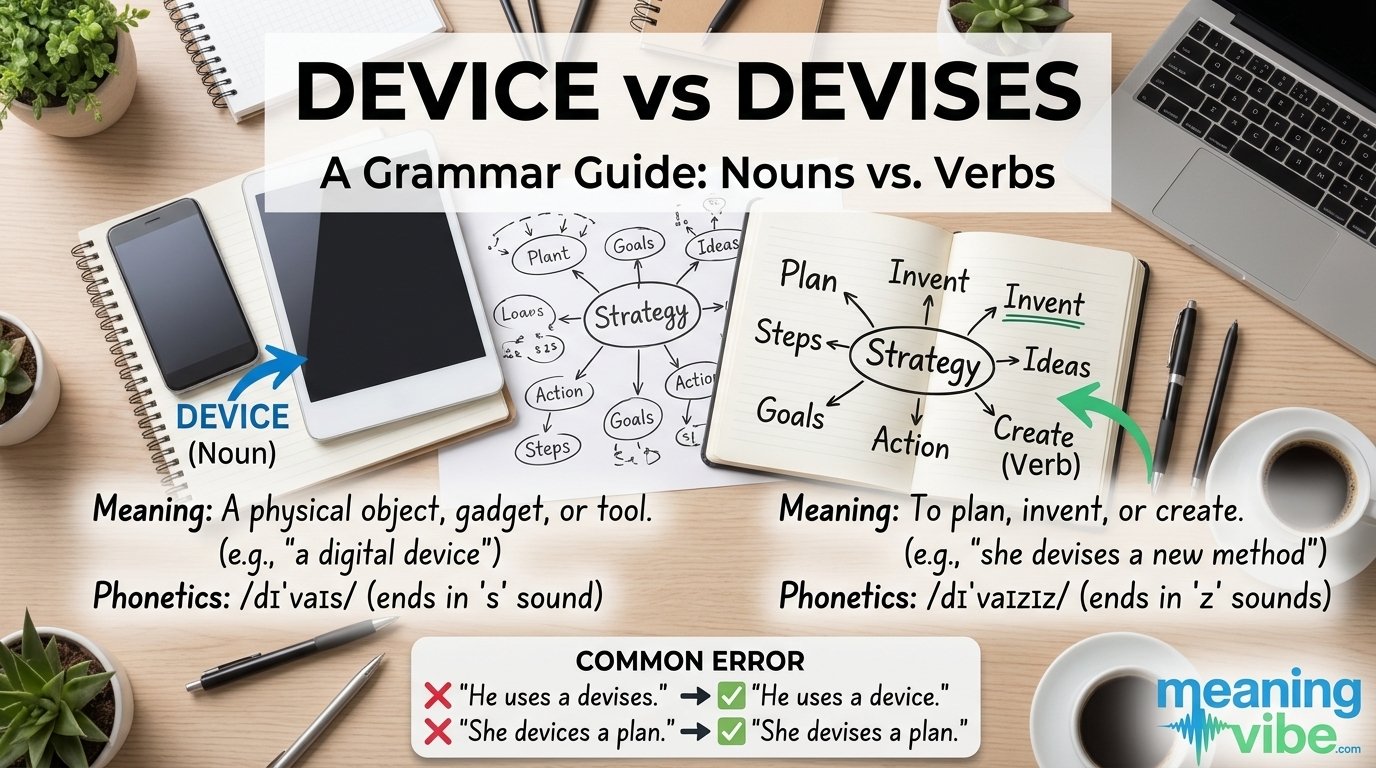
EnglishPractice lists advice and advise, device and devise, envelope and envelop, and practice and practise together. That set makes the pattern visible across several pairs at once.
A learner who knows advice versus advise already knows half of device versus devise. The same noun and verb logic applies, with the same final sound change.
The Envelope and Envelop Exception
Envelope is a noun for a paper wrapper, while envelop is a verb meaning to wrap or cover. That pair reverses the usual ce versus se order, because the noun ends in pe, not ce.
EnglishPractice notes that envelope is a noun and envelop is a verb, with the fire enveloped the house as an example. That exception shows why the pattern is a guide, not an absolute rule.
Writers should use the pattern as a first check, then run the part of speech test as well. Pattern plus grammar together catch most errors, while pattern alone can mislead on exceptions.
Why the Pattern Helps, and Where It Breaks
The pattern helps because it links spelling, sound, and grammar in one rule: ce for thing, se for action, s sound for noun, z sound for verb. That triple link sticks in memory better than spelling alone.
The pattern breaks where US and UK spelling differ, where a word has a legal exception, or where a pair reverses order. Licence versus license differs by country, and devise as a legal noun breaks the verb-only rule.
A safe habit is to learn the pattern, then check a dictionary for any new pair before using it in important writing. Dictionaries confirm part of speech, pronunciation, and regional spelling in one entry.
The Bridge: You Devise a Plan, the Plan Can Be a Device
The bridge sentence links the two words without merging them, and it explains why learners sometimes swap them. A person devises a plan, and the finished plan can be called a device.
Grammarflex states the bridge plainly: a device may aid in devising, and the two words work together in a sentence. That sentence uses device as a noun and devise as a verb, in correct slots.
An example helps: “The team devised a clever device for saving time.” That sentence uses both words correctly, with devised as the action and device as the resulting plan.
Another example: “She devised a new device for opening cans.” That sentence uses device as a physical tool, while devised names the inventing action that created it.
The bridge also works for literature: “The author devised a plot device that surprised readers.” That sentence uses device in the literary sense, while devised names the authorial action.
Writers should not use the bridge as proof that the words mean the same thing. The bridge shows a relationship between action and result, not a shared definition.
Etymology: Old French Devis and Deviser
Etymology proves that the pair shares a family, not a single meaning. Device and devise come from related Old French words, but they took different paths into English.
Device From Old French Devis
Device comes from Old French devis, meaning division, discourse, plan, and heraldic device. The Free Dictionary traces device through Anglo-French and Old French to Latin divisa, the feminine past participle of dividere, to divide.
That history explains the scheme sense: a device began as a division or plan, then became a thing designed for a purpose. The heraldic sense kept the design idea, while the tool sense kept the purpose idea.
Grammarflex does not give a full device etymology in its excerpts, but it gives the devise side clearly. Step 2 should keep both sides separate, not collapse them into one root word.
Devise From Old French Deviser
Devise comes from Old French deviser, meaning to dispose in portions, arrange, plan, or contrive. Grammarflex dates early 13th century devisen as form or fashion, and around 1300 as plan or contrive.
That history explains the planning sense: devise began as arranging parts in order, then became inventing a plan in the mind. The legal sense grew from arranging property by will, which is also a kind of disposal.
The Free Dictionary links devise to the same Latin divide family, but through a verb path, not a noun path. That verb path matters, because it explains why devise stayed an action word.
Latin Divide Family, With the Split Explained
WordPandit says both words come from Latin dividere, meaning to divide, and that claim is true at a very broad level. It is not the full story, because it hides the Old French split between devis and deviser.
A better explanation names both steps: Latin dividere gave Old French devis for a plan or design, and Old French deviser for arranging or planning. English then kept device as a noun and devise as a verb.
That two-step history also explains the spelling split: device kept c for the noun, while devise kept s for the verb. Spelling, sound, and grammar all follow the same Old French split.
Verb Forms and Related Forms Table
| Base word | Third person | Past tense | Present participle | Related noun |
|---|---|---|---|---|
| Device, noun | Not a verb | Not a verb | Not a verb | Devices, plural |
| Devise, verb | Devises | Devised | Devising | Devise, legal noun only |
| Devise, legal noun | Not a verb | Not a verb | Not a verb | Devises, legal plural |
“She devises a new method each term” uses the third person verb form, while “They devised a scheme” uses the past form. Grammarflex and EnglishPractice both use similar verb examples.
“The team is devising a plan” uses the present participle with a helping verb, while “The devising took a week” uses a gerund, which is a verb form acting as a noun. That gerund use does not turn devise into a general noun.
A related word, deviser, names a person who devises, but it is rare in everyday writing. Writers can usually replace it with inventor, planner, or strategist, depending on context.
Device vs Devise in Context
Context turns abstract definitions into usable decisions. Four settings cover almost every real example a learner will meet, from gadgets to wills.
Technology and Everyday Gadgets
In technology, device dominates, because phones, tablets, laptops, and peripherals are all devices. A user might say, “Put all electronic devices in your bag,” as WritingTips does in its example.
A GPS device helps a traveller in an unfamiliar city, while a hearing device helps a listener in a noisy room. Both examples use device as a noun for a tool with a clear job.
Windows Device Manager is a separate technical term for a tool that manages hardware devices, drivers, and troubleshooting. CopyProgramming covers that tool, but its page mixes a tutorial with a word explanation, which confuses intent.
Step 2 should mention Device Manager in one short note, then link to a separate tutorial page if one exists. A word pair page should not become a Windows tutorial.
Business, Strategy, and Study Plans
In business, devise dominates, because strategies, plans, and methods are devised before they are used. A committee might devise a thorough plan for an event, as Grammarly does in its example.
A marketing team might devise a new strategy to reach buyers, while a teacher might help students devise a study method. Each sentence uses devise as an action, with a plan object after it.
A scientist might devise a method for recycling plastics, while an engineer might devise a solution for energy efficiency. TwoMinEnglish uses the energy solution example, and Grammarly uses the recycling example.
Business writers should check their verbs carefully, because “We need to device a plan” is a common error. The correct form is “We need to devise a plan,” with the verb in the base form.
Literature, Theatre, and Film
In literature, device dominates in the technique sense, because authors use devices to shape meaning. A metaphor is a literary device, a twist is a plot device, and a chorus is a dramatic device.
An author might devise an intricate plot, as Grammarly does in its example, and that plot might contain a plot device that surprises readers. That sentence uses both words correctly, in different slots.
A theatre director might use a staging device to show two time periods at once, while a film director might use a flashback device to reveal a character past. Both uses are noun uses for techniques.
Students should not write “a literary devise” when they mean a technique, because that error changes a technique into an action. The correct form is “a literary device,” with the noun spelling.
Law, Wills, and Estates
In law, both words appear, but in different roles, which makes legal writing a high risk area. A testator may devise property by will, and that property may be called a devise in the will.
A sentence such as “She devised her house to her son” uses the verb correctly, while “The house was a devise” uses the legal noun correctly. Both sentences need checking against the relevant state wording.
Legal writers should not use device for a will gift, because a device is a tool or technique, not a bequest. That error would confuse a reader and could change the meaning of a clause.
General information only applies to legal examples here, not legal advice. Readers with a real will question should consult a qualified lawyer in their own state.
Fixed Phrases and Idioms Table
| Phrase | Word used | Meaning | Example |
|---|---|---|---|
| Electronic device | Device | Phone, tablet, or gadget | Put all electronic devices away. |
| Medical device | Device | Tool for diagnosis or treatment | The clinic bought a new medical device. |
| Safety device | Device | Tool that prevents harm | The safety device stopped the machine. |
| Literary device | Device | Technique in writing | Metaphor is a literary device. |
| Plot device | Device | Story element that moves plot | The lost letter is a plot device. |
| Devise a plan | Devise | Work out a plan | They will devise a plan. |
| Devise a strategy | Devise | Work out a strategy | The team devised a strategy. |
| Devise a method | Devise | Work out a method | Scientists devised a method. |
| Devise a way out | Devise | Work out an escape | Can you devise a way out? |
| Leave to your own devices | Devices | Leave to act as you wish | Left to her own devices, she read all day. |
Leave to Your Own Devices
“Leave to your own devices” means to allow a person to act according to their own desire or inclination, without supervision. The Free Dictionary lists that idiom under device, with the plural devices.
That idiom does not mean abandonment in a cruel sense, although it can feel lonely in context. It usually means freedom to choose, as in “Left to his own devices, he built a model plane.”
Writers should use devices, not devises, in that idiom, because the idiom uses the noun plural. A sentence such as “left to her own devises” would be a spelling error, not a variant.
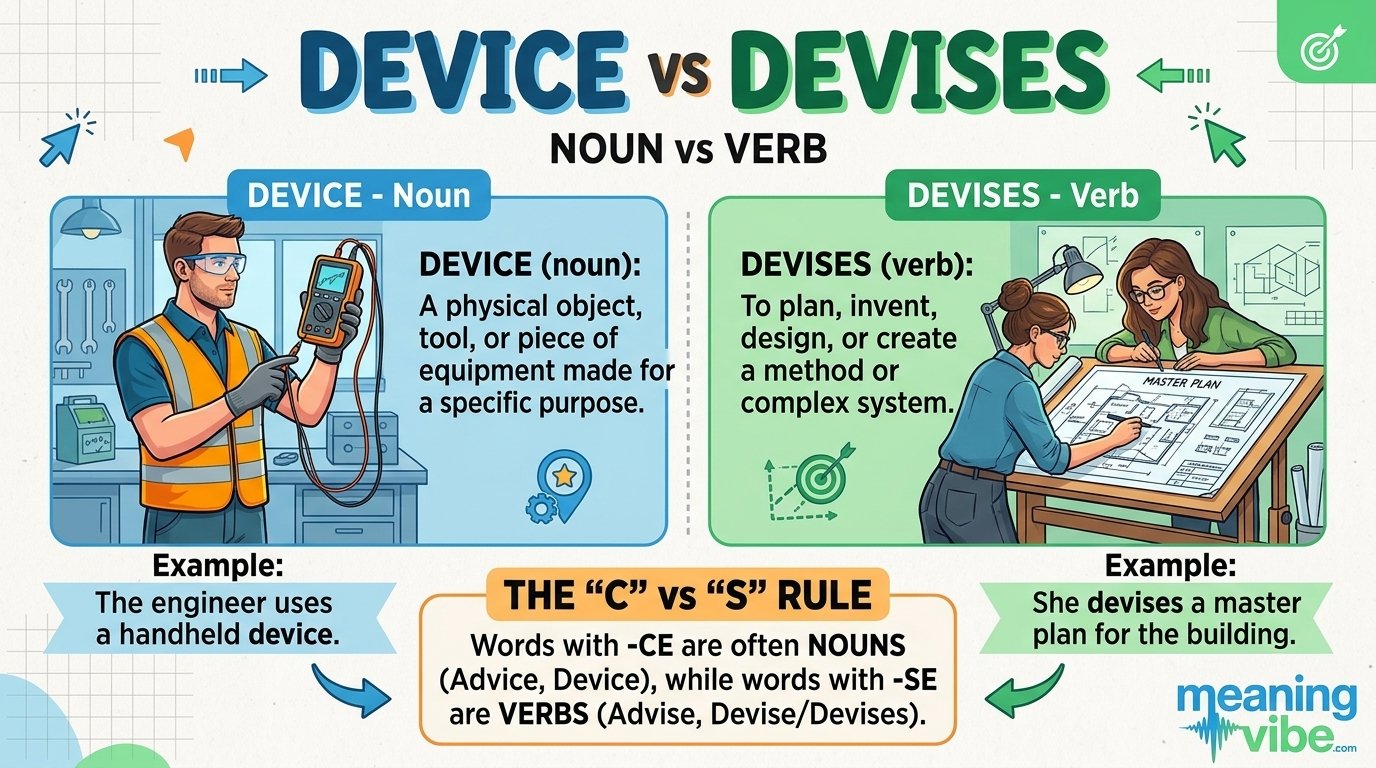
The idiom also shows the scheme sense in action: a person left alone may devise their own plan, using their own devices as tools and schemes. That link helps learners remember both senses at once.
Devise a Way Out, Devise a Plan, Devise a Method
Fixed verb phrases with devise almost always take a plan object: plan, strategy, method, solution, scheme, system, or way out. Grammarflex uses method, system, and scheme examples, while Grammarly uses plan and method examples.
A learner who memorises those objects can test a new sentence quickly: if the object is a plan-like noun, devise probably fits. If the object is a physical tool, device probably fits instead.
A sentence such as “They devised a new dish” works because a dish is a created plan, not a gadget. TwoMinEnglish uses that cooking example, and it shows how far the verb can stretch.
Electronic Device, Medical Device, Safety Device
Fixed noun phrases with device almost always take a tool object: electronic, medical, safety, assistive, hearing, GPS, or listening. WritingTips uses electronic devices in a tour example, while Leverage Edu uses medical device in a clinic example.
A learner who memorises those modifiers can test a new sentence quickly: if the modifier describes a tool type, device probably fits. If the modifier describes a planning action, devise probably fits instead.
Medical device is a regulated term in US law, with FDA oversight for many products, but that regulation does not change the spelling. Writers should not use devise for a regulated tool, even in a casual product description.
Traps to Avoid: Advise, Device Manager, Medical Device Sales
Three nearby traps catch even careful writers, because they share letters, sounds, or commercial weight with the pair. Each trap needs a one-line rule to prevent confusion.
Advise Versus Advice, and Devise Versus Advise
Advise is a verb meaning to recommend or give guidance, while advice is a noun meaning a recommendation. Devise is a verb meaning to plan or invent, which is a different action from advising.
Go For English notes that devise and advise can be confused because they sound similar, but their meanings differ. A teacher might advise students to study, then help them devise a study plan.
A sentence such as “She advised a new method” means she recommended it, while “She devised a new method” means she invented it. That contrast helps learners keep three words apart, not just two.
The CE versus SE pattern helps here as well: advice is a noun with ce, advise is a verb with se, just like device and devise. That pattern group should be taught together.
Device Manager Versus Devise, a Separate Intent
Windows Device Manager is a tool for managing hardware devices, updating drivers, and troubleshooting. It is not a word pair lesson, and it should not dominate a device versus devise page.
CopyProgramming mixes the two intents, with a video on opening Device Manager and a tutorial on drivers. That structure serves navigational users, but it weakens the word pair lesson for learners.
A word pair page should add one short cross-link note: for Device Manager steps, see a separate tutorial page. That note respects navigational intent without copying a tutorial into a grammar page.
Medical Device Sales Versus Word Meaning
Medical device is a large commercial term, with product pages, reviews, and regulatory pages. Those pages should not be copied into a word pair page, because they answer a buying question, not a spelling question.
A word pair page can use one medical device example, such as a heart monitor, without becoming a product review. That example teaches the noun sense, while a product page would teach features and prices.
Writers should also avoid inventing medical claims for a device example. A general example, such as “a device that monitors heart rate,” is safe, while a treatment claim needs a medical source and a disclaimer.
Wrong Examples Corrected
Wrong examples teach faster than rules alone, because learners see the error and the fix side by side. Each row below keeps the same sentence structure, with only the target word changed.
| Wrong sentence | Correct sentence | Why it changes |
|---|---|---|
| She device a new plan. | She devised a new plan. | Verb past form needed, not a noun. |
| He bought a new devise. | He bought a new device. | Noun object needed, not a verb. |
| They need to device a strategy. | They need to devise a strategy. | Base verb after modal needed. |
| The devise tracks your steps. | The device tracks your steps. | Subject noun needed, not a verb. |
| Metaphor is a literary devise. | Metaphor is a literary device. | Technique noun needed, not a verb. |
| Left to her own devises, she read. | Left to her own devices, she read. | Idiom uses noun plural. |
| She devised her house by will to her son. | She devised her house by will to her son. | Correct, legal verb sense. |
| The house was a device under the will. | The house was a devise under the will. | Legal noun needed, not a tool noun. |
| Can you device a way out? | Can you devise a way out? | Base verb after modal needed. |
| Every modern devise has internet. | Every modern device has internet. | Noun subject needed, not a verb. |
Grammarflex, Grammarly, and EnglishPractice all use wrong and corrected pairs, and that format works well for learners. The key is to keep the rest of the sentence identical, so only the target word carries the lesson.
Memory Tricks That Actually Work
Memory tricks help only when they connect to meaning, spelling, or sound. The best tricks use a short phrase that survives under exam pressure.
Noun CE, Verb SE
Device ends in ce, like advice and licence, which are nouns in UK spelling. Devise ends in se, like advise and practise, which are verbs in UK spelling.
That pattern gives learners a visual rule: c for thing, s for action, in the final letters. Grammarflex hints at that rule with s like plans and c like contraption, but the CE versus SE pattern is cleaner.
Use the pattern as a first check, then run the part of speech test as well. Pattern helps spelling, while grammar helps meaning, and both checks together catch most errors.
Thing Versus Action
Device is a thing you can hold, use, read, or follow, depending on the sense. Devise is an action you can do, plan, or invent, with your mind before any object exists.
Think “device equals thing, devise equals think,” and the first letters help: thing and think both start with th, while device and devise share dev. That wordplay is a mnemonic only, not etymology.
A simple chant helps younger learners: “Device is a thing, devise is a think.” Short, rhythmic rules stick better than long definitions during tests.
Final Sound Test: S for Thing, Z for Action, in Careful Speech
In careful speech, device ends in s, while devise ends in z. That sound test works for advice versus advise as well, which makes it a portable rule across pairs.
Say the sentence aloud slowly, then listen for the final sound: s points to a noun, z points to a verb. WritingTips gives that s versus z guide plainly, with di-vīs and di-vīz forms.
In casual speech, that test weakens, because both words may sound like vise. When sound blurs, return to part of speech and meaning, not to a guessed spelling.
Quiz: Device or Devise, With Explanations
Choose device or devise for each blank, then check the answer and reason. Each explanation restates the thing versus action rule in one line.
- She bought a new electronic ______ for note-taking. Answer: device. A gadget is a thing.
- The team tried to ______ a new strategy. Answer: devise. Planning is an action.
- Metaphor is a literary ______. Answer: device. A technique is a thing.
- Scientists ______ a method for recycling oil. Answer: devised. Past planning is an action.
- Left to his own ______, he built a model. Answer: devices. Idiom uses noun plural.
- Can you ______ a way out of this puzzle? Answer: devise. Base verb after modal.
- The safety ______ stopped the machine. Answer: device. A tool is a thing.
- She ______ her house to her son by will. Answer: devised. Legal giving is an action.
- The house was a ______ under the will. Answer: devise. Legal noun for property given.
- Every modern ______ has internet connectivity. Answer: device. A gadget is a thing.
A score of eight or more shows a solid grasp of the pair. A lower score usually means literary and legal senses need extra practice, not gadget and plan senses.
Common Mistakes to Avoid
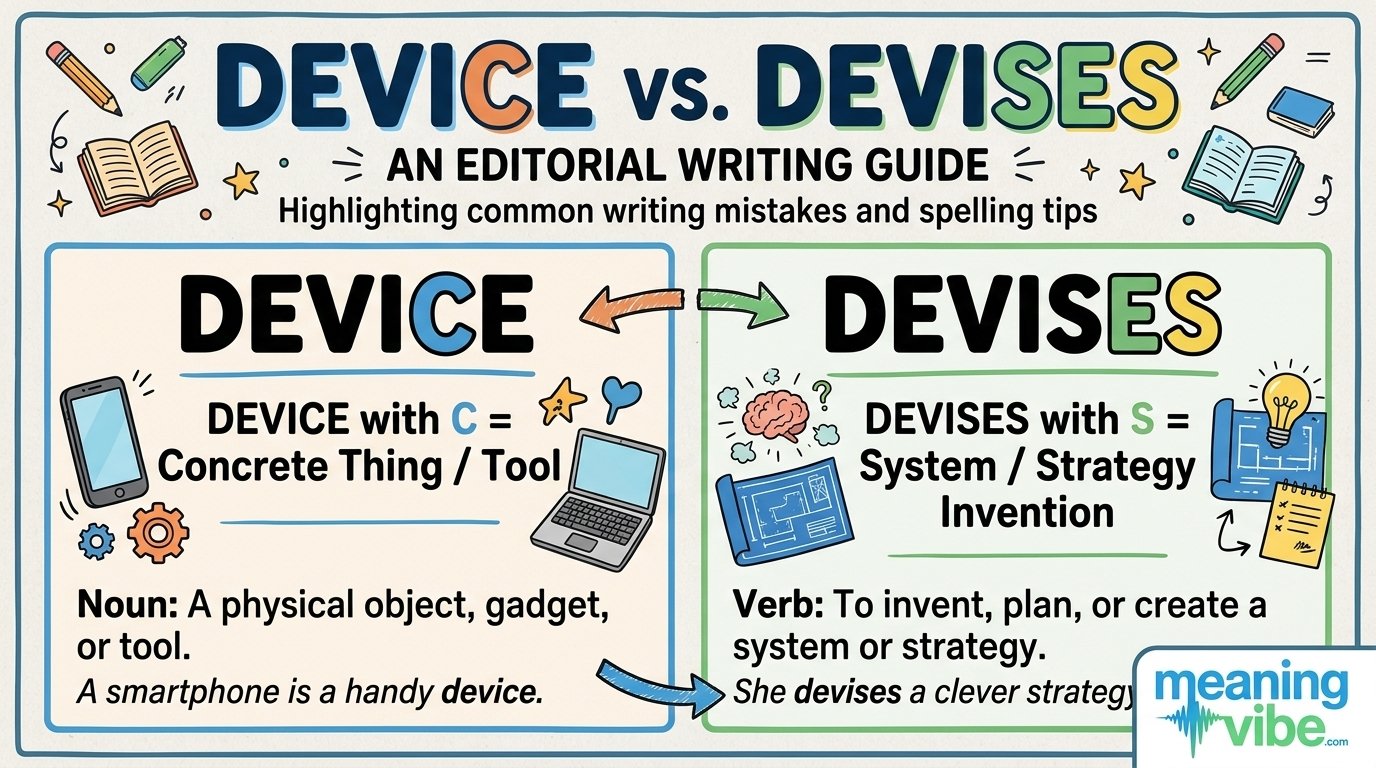
- Using device as a verb. A sentence such as “She device a plan” fails, because device is a noun in general use.
- Using devise as a gadget noun. A sentence such as “He bought a new devise” fails, because a gadget is a device.
- Ignoring the final sound. Careful speech gives s for device and z for devise, so listening helps spelling.
- Calling them exact homophones. They are near homophones in careful speech, with a final consonant difference.
- Forgetting the literary sense. A literary device is a technique, not a gadget, and students need that sense for essays.
- Forgetting the legal sense. A devise in a will is property given, not a tool, and lawyers need that sense.
- Copying the never a noun claim. Devise is a noun in law, even though it is a verb in general use.
- Merging Device Manager into the lesson. Device Manager is a separate tutorial intent, not a word pair lesson.
- Using devise for a physical tool. A tool is a device, while the planning action that created it is devise.
- Relying on spellcheck alone. Spellcheck accepts both words as real, so it will not flag a swapped device and devise.
Tips for Writers, Teachers, and Learners
- Run the part of speech test first. Ask whether the slot needs a thing or an action, then choose device or devise.
- Run the CE versus SE test second. Noun ce points to device, verb se points to devise, with the envelope exception noted.
- Run the final sound test third. In careful speech, s points to device, z points to devise.
- Teach literary devices separately. Spend one lesson on metaphor, irony, and plot devices, so learners do not force a gadget meaning.
- Teach legal devise separately. Spend one lesson on wills, testators, and beneficiaries, with a general information note.
- Use paired sentences. Write one gadget sentence and one planning sentence together, so contrast stays visible.
- Use the bridge sentence. “They devised a clever device” shows both words correctly in one sentence.
- Practise with a quiz. Mix gadget, plan, literary, and legal examples in the same set, so learners cannot rely on one sense.
- Proofread with meaning in mind. Reading aloud helps rhythm, but only a meaning check catches a swapped pair.
- Keep a personal error list. Note each real mistake once, with its correction, and review that list before exams or important drafts.
FAQs
What is the difference between device and devise?
Device is a noun for a tool, plan, or technique, while devise is a verb meaning plan or invent. The thing versus action test decides most sentences.
Is device a noun or a verb?
Device is a noun in general use, with plural devices. It is not a verb, so “She device a plan” is incorrect.
Is devise a noun or a verb?
Devise is a verb in general use, with forms devises, devised, and devising. It is a noun only in the legal sense for property given by will.
Is devise ever a noun?
Yes, in law only, a devise can mean property given by will, or the clause that gives it. In everyday writing, use device for a thing.
What does device mean?
Device means a tool or instrument made for a purpose, a plan or scheme, a literary technique, or a heraldic emblem. Context decides which sense applies.
What does devise mean?
Devise means to plan, invent, or contrive something by careful thought. In law, it also means to give property by will.
How do you pronounce device?
Device is pronounced /dɪˈvaɪs/, with a final s sound, like ice. That final s matches the noun spelling ce.
How do you pronounce devise?
Devise is pronounced /dɪˈvaɪz/, with a final z sound, like realise. That final z matches the verb spelling se.
Are device and devise homophones?
They are near homophones in careful speech, not exact homophones, because the final consonant differs. In casual speech, they often sound identical.
What is the plural of device?
The plural of device is devices, as in “many ingenious devices.” Device is countable, unlike advice, which has no plural in that sense.
What is the third person form of devise?
The third person form is devises, as in “She devises a new method each year.” That form follows normal verb patterns.
What is the past tense of devise?
The past tense is devised, as in “They devised a scheme to help him.” That form also works as a past participle.
What does devise a plan mean?
Devise a plan means to work out a detailed way of achieving a goal. A committee, team, or student can devise a plan.
What does devise a strategy mean?
Devise a strategy means to work out a long term plan for winning, selling, or solving a problem. The strategy is the result of the devise action.
What is an electronic device?
An electronic device is a gadget with electronic parts, such as a phone, tablet, or laptop. It is a noun phrase for a tool, not a planning action.
What is a medical device?
A medical device is a tool for diagnosis, treatment, or monitoring, such as a heart monitor. Regulatory details depend on the product and country, so check official sources for any specific product.
What is a literary device?
A literary device is a technique in writing, such as metaphor, irony, or foreshadowing. It shapes meaning and feeling, and it is not a gadget.
What is a plot device?
A plot device is a story element that moves the plot forward, such as a lost letter or a secret map. It creates problems, reveals information, or forces choices.
What is a rhetorical device?
A rhetorical device is a technique in speeches and essays, such as a rhetorical question or repeated phrase. It persuades, emphasises, or clarifies.
What does leave to your own devices mean?
It means to allow a person to act as they wish, without supervision. The idiom uses the noun plural devices, not devises.
What is a devise in a will?
A devise in a will is property given by will, or the clause that gives it. That legal noun sense is separate from everyday verb use.
What does devise property by will mean?
It means to give property through a will, especially real property in traditional usage. Modern US statutes may use the term more broadly, so check state wording.
What is the difference between devise and bequest?
Traditionally, devise covered real property given by will, while bequest covered personal property, and legacy covered money. Modern statutes vary, so verify wording for any real will.
What is the difference between device and gadget?
Gadget usually means a small, clever tool, while device covers tools, plans, techniques, and emblems. A gadget is a kind of device, not a synonym for every sense.
What is the most common device versus devise mistake?
The most common mistake is using device as a verb, or devise as a gadget noun. A part of speech check prevents both errors.
Conclusion
Device vs devise becomes easy once thing and action are kept apart. Device names a tool, a plan, a literary technique, or a heraldic emblem, while devise names the planning action that creates a plan, method, or invention.
Keep three tests close: part of speech first, CE versus SE second, and final s versus final z third in careful speech. Add the literary and legal senses, and most errors disappear.
Try the test on your next doubtful sentence, and let grammar and meaning, not sound alone, settle the spelling before you move on.